
Continuum models for the endcap shell moduli in
- Slides: 13
Continuum models for the endcap shell moduli in SUPER-B T the team at the “Università Politecnica delle Marche”: Fabrizio Davì, Daniele Rinaldi (* and INFN) Giovanni Lancioni, Michele Serpilli, Dario Genovese, Moreno Paciaroni Departments DICEA, SIMAU*
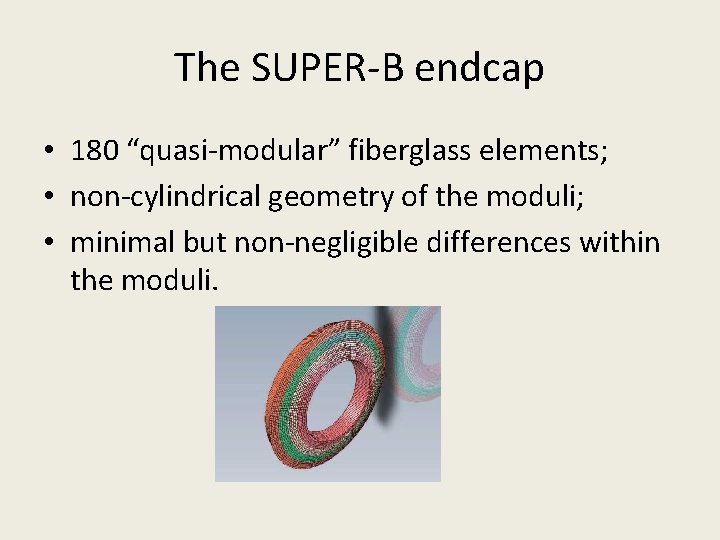
The SUPER-B endcap • 180 “quasi-modular” fiberglass elements; • non-cylindrical geometry of the moduli; • minimal but non-negligible differences within the moduli.
Expected performances Light-weight elements, non-metallic elements; Very small deformation expected (very high stiffness); 0, 35 g Dynamical load multiplicators (big earthquake) Safety factors: g=2 (Exercise loads) g=1, 15 (Collapse loads-static) g=1, 5 (Collapse loads-dynamics) No eiegen frequencies smaller than 100 Hz. • •
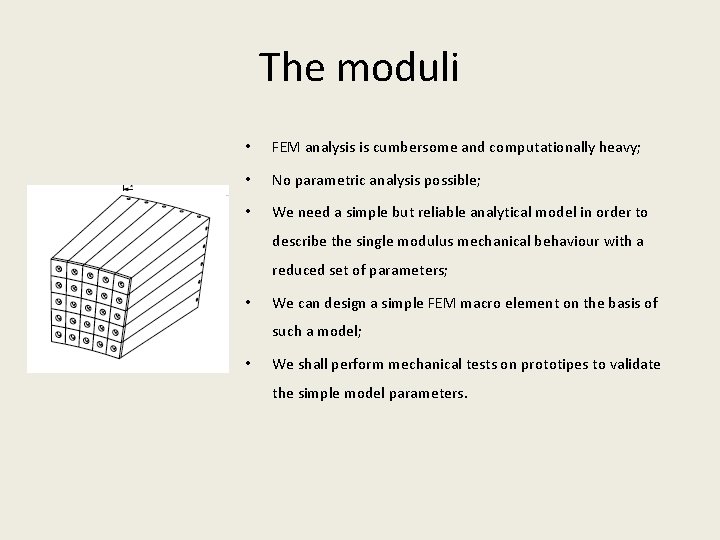
The moduli • FEM analysis is cumbersome and computationally heavy; • No parametric analysis possible; • We need a simple but reliable analytical model in order to describe the single modulus mechanical behaviour with a reduced set of parameters; • We can design a simple FEM macro element on the basis of such a model; • We shall perform mechanical tests on prototipes to validate the simple model parameters.
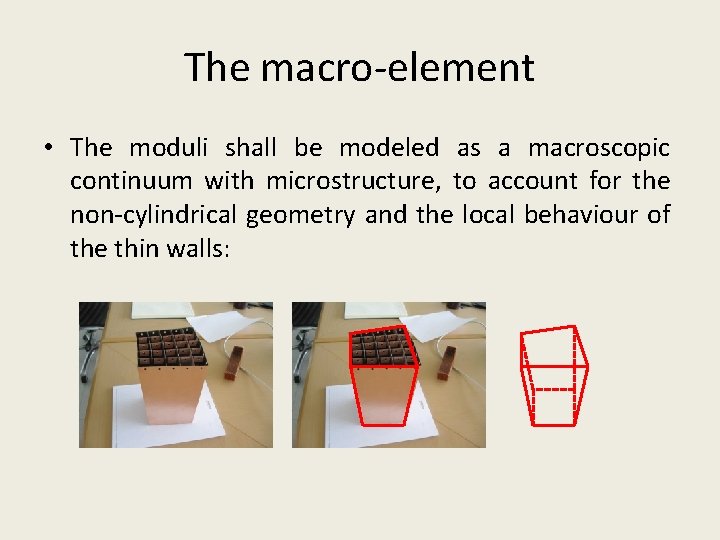
The macro-element • The moduli shall be modeled as a macroscopic continuum with microstructure, to account for the non-cylindrical geometry and the local behaviour of the thin walls:
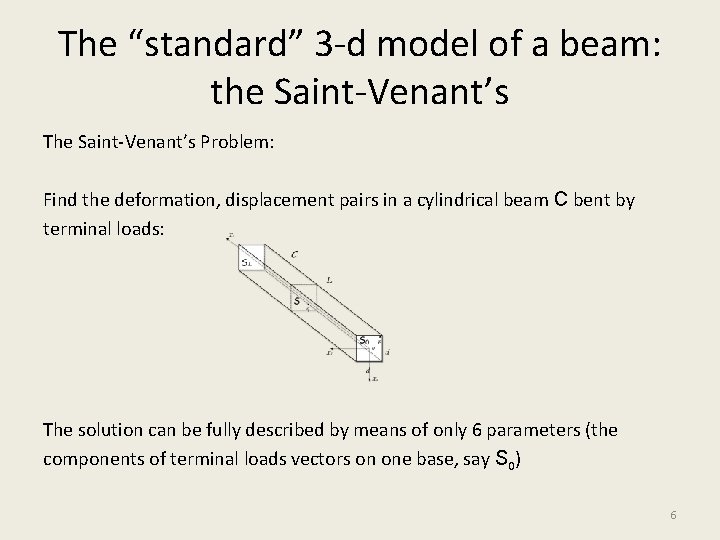
The “standard” 3 -d model of a beam: the Saint-Venant’s The Saint-Venant’s Problem: Find the deformation, displacement pairs in a cylindrical beam C bent by terminal loads: The solution can be fully described by means of only 6 parameters (the components of terminal loads vectors on one base, say S 0) 6
The “standard” 3 -d model of a beam: the Saint-Venant’s Pro: • exact solution within the general framework of 3 -d linear elasticity; • well-studied mathematical problem; • many well-posed approximated solutions; • a flood of experimental data to validate the constitutive parameters. Contra: • Cilindrical geometry: the cross-section must have the same geometry along the axis; • the cross-section must be “compact” or with some “big-holes”: the solution fails to describe the local kinematics for “thin” objects. 7
The “standard” 3 -d model of a beam: the Saint-Venant’s Our “beam”: • Is not “slender” enough to consider the Saint-Venant solutions a good description of the kinematics; • It is not cylindrical: the shell is chamfered indeed; • the cross-section notion is nearly meaningless: too much “big-holes” compared to the small amount of material; • 6 parameters aren’t enough to describe the rather complex kinematics and hence the stress within the object. To account for these peculiarities we choose to model the element as a 3 -d continuum with local microstructure. 8
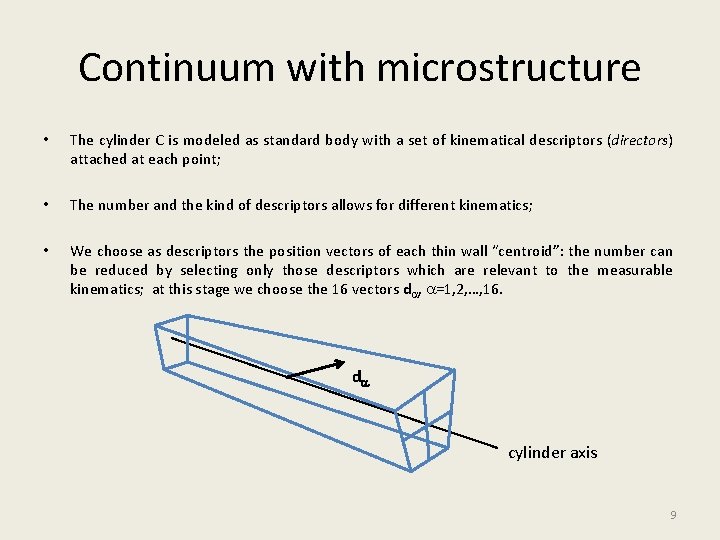
Continuum with microstructure • The cylinder C is modeled as standard body with a set of kinematical descriptors (directors) attached at each point; • The number and the kind of descriptors allows for different kinematics; • We choose as descriptors the position vectors of each thin wall “centroid”: the number can be reduced by selecting only those descriptors which are relevant to the measurable kinematics; at this stage we choose the 16 vectors da, a=1, 2, …, 16. da cylinder axis 9
Continuum with microstructure • In such a theory, besides the standard stress and deformation tensorial measures T (stress) and E (strain) we have two local stress measures which depends on the microstructure described by da: • The interactive microforce k, a vectorial quantity which accounts for the interactions between the body and the microstructure (in our case: the stress at the joints between the walls); • The microstress T, which accounts for the space changes of the microstructure (in our case the effect of chamfering). 10
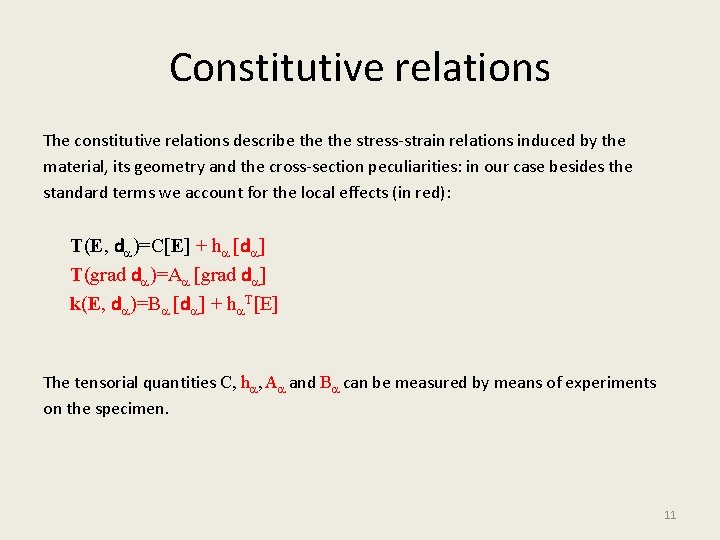
Constitutive relations The constitutive relations describe the stress-strain relations induced by the material, its geometry and the cross-section peculiarities: in our case besides the standard terms we account for the local effects (in red): T(E, da)=C[E] + ha [da] T(grad da)=Aa [grad da] k(E, da)=Ba [da] + ha. T[E] The tensorial quantities C, ha, Aa and Ba can be measured by means of experiments on the specimen. 11
Terminal loads The two vectorial quantities r 0 and m 0 which express the terminal loads and that can be controlled in an experiment, accounts in the present model for the local effects of the thin walls and allows for a constitutive model which links these 6 parameters to the “real” kinematic of the shell: Further, the vector k(E, da), which accounts for the stress at the joint and can be measured in an experiment, adds 3 more parameters. 12
Conclusions • The mathematical model allows for a reduced set of variables which describe the stress and strain in a macro-element; • The parameters which describes the stiffness of the material and the local and global geometry of the shell can be measured by means of “ad-hoc” mechanical tests.