
Continuous Wave Radar Doppler Objectives Distinguish between Pulsed
Continuous Wave Radar / Doppler
Objectives • Distinguish between Pulsed radar and CW radar. • Explain what is required for CW radar to “see” a contact. • Explain and calculate Doppler Shift • Calculate the combined speed between two contacts. • List and identify the components of the basic CW radar system • Solve for range for a CW radar system (FMCW).
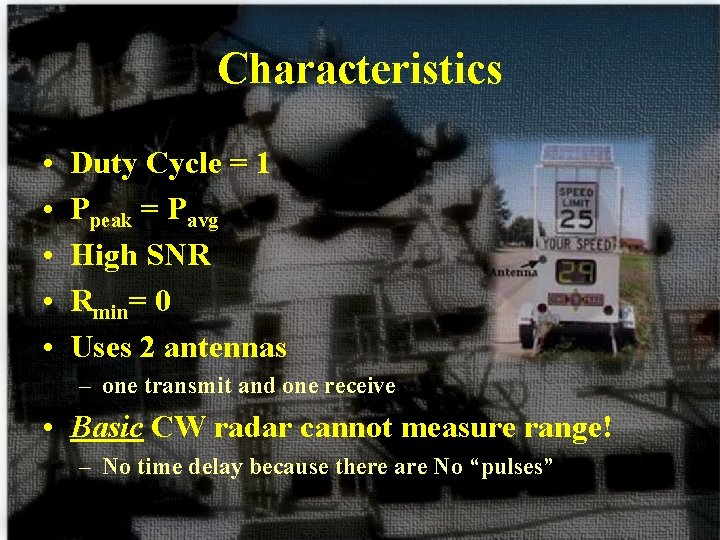
Characteristics • • • Duty Cycle = 1 Ppeak = Pavg High SNR Rmin= 0 Uses 2 antennas – one transmit and one receive • Basic CW radar cannot measure range! – No time delay because there are No “pulses”
Applications of CW Radar • CW Illuminator – SPG-62 CWI for SM-2 (Aegis) – MK-92 FCS (FFG-7) TT/CWI • • Navigation (Doppler Navigation) Speed Guns Radar Proximity Fuze Altimeter (FMCW)
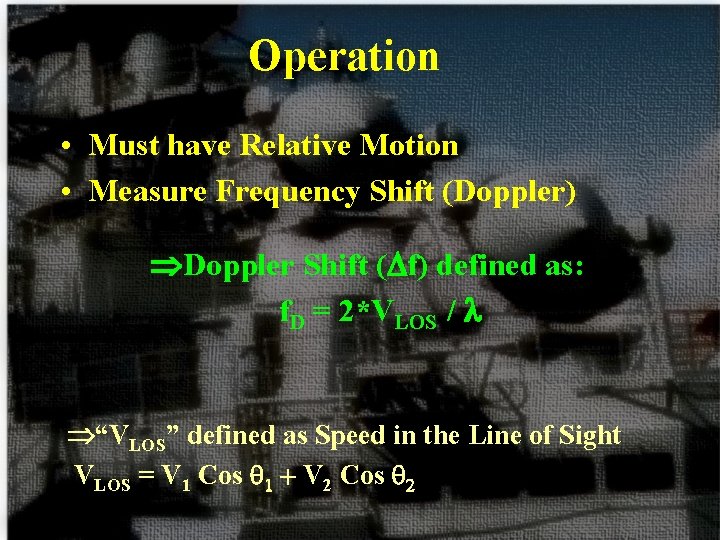
Operation • Must have Relative Motion • Measure Frequency Shift (Doppler) Doppler Shift (Df) defined as: f. D = 2*VLOS / “VLOS” defined as Speed in the Line of Sight VLOS = V 1 Cos 1 + V 2 Cos 2
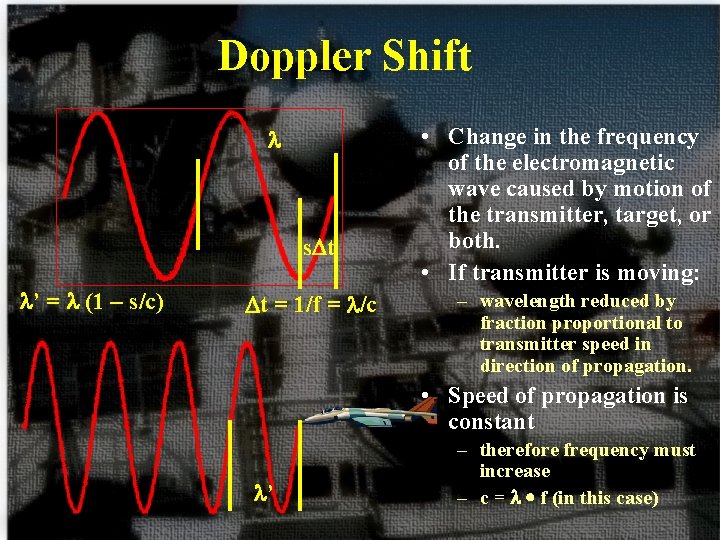
Doppler Shift s. Dt ’ = (1 – s/c) Dt = 1/f = /c • Change in the frequency of the electromagnetic wave caused by motion of the transmitter, target, or both. • If transmitter is moving: – wavelength reduced by fraction proportional to transmitter speed in direction of propagation. • Speed of propagation is constant ’ – therefore frequency must increase – c = f (in this case)
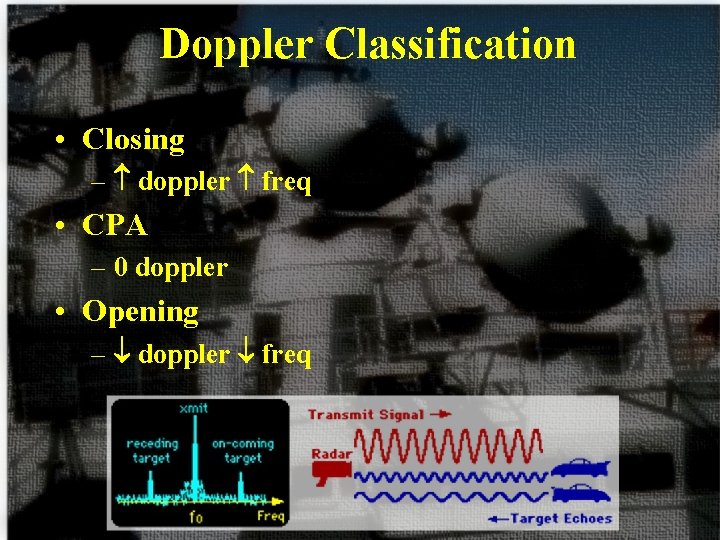
Doppler Classification • Closing – doppler freq • CPA – 0 doppler • Opening – doppler freq
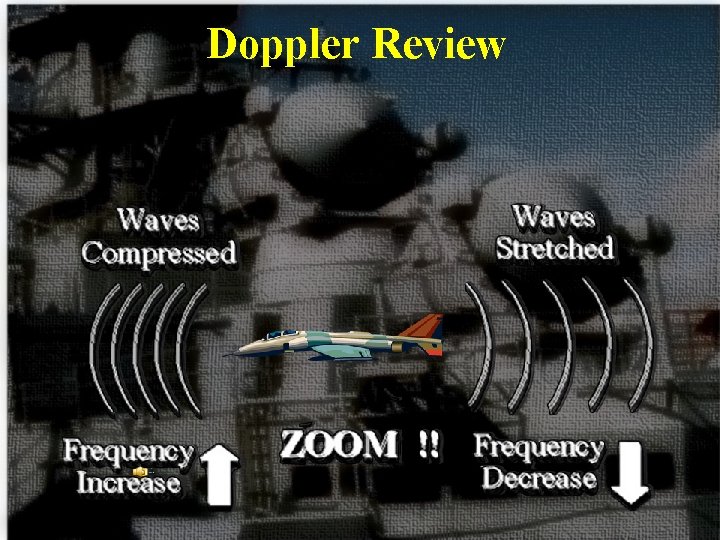
Doppler Review
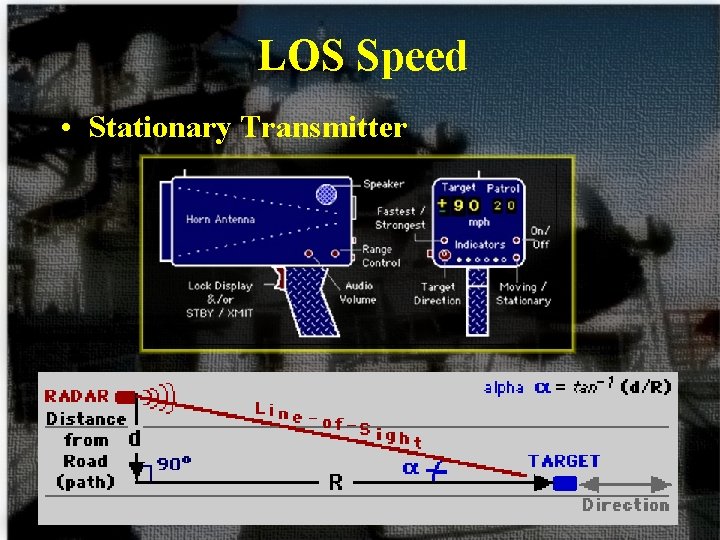
LOS Speed • Stationary Transmitter
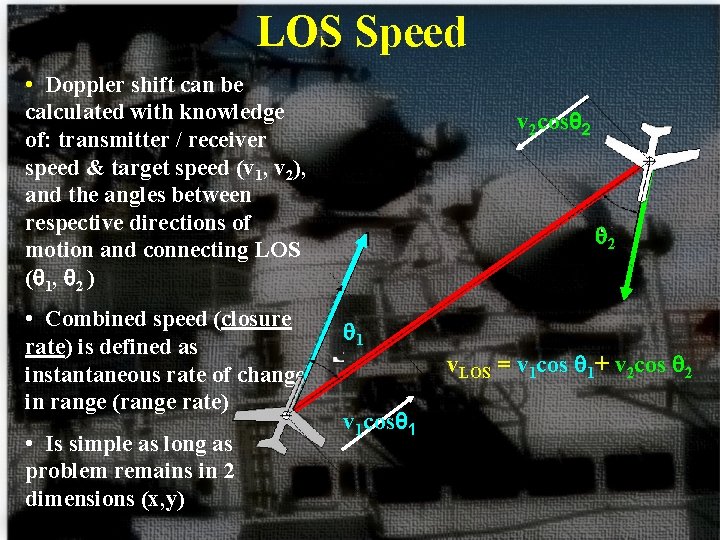
LOS Speed • Doppler shift can be calculated with knowledge of: transmitter / receiver speed & target speed (v 1, v 2), and the angles between respective directions of motion and connecting LOS ( 1, 2 ) • Combined speed (closure rate) is defined as instantaneous rate of change in range (range rate) • Is simple as long as problem remains in 2 dimensions (x, y) v 2 cosθ 2 2 1 v 1 cosθ 1 v. LOS = v 1 cos 1+ v 2 cos 2
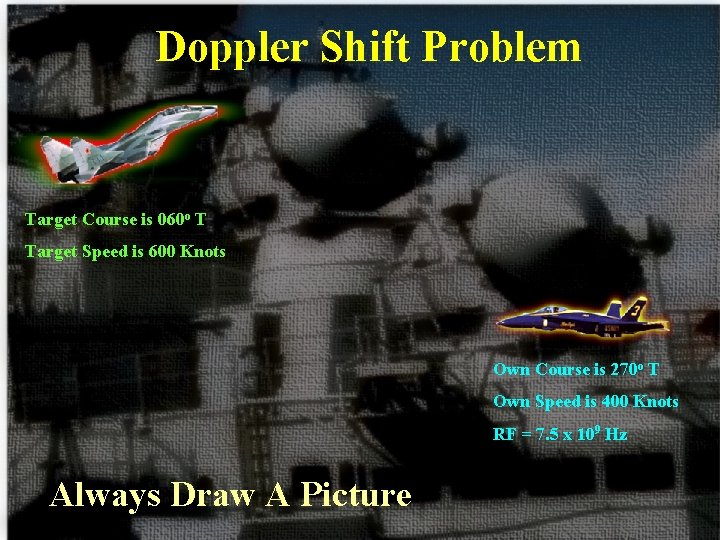
Doppler Shift Problem Target Course is 060 o T Target Speed is 600 Knots Own Course is 270 o T Own Speed is 400 Knots RF = 7. 5 x 10⁹ Hz Always Draw A Picture
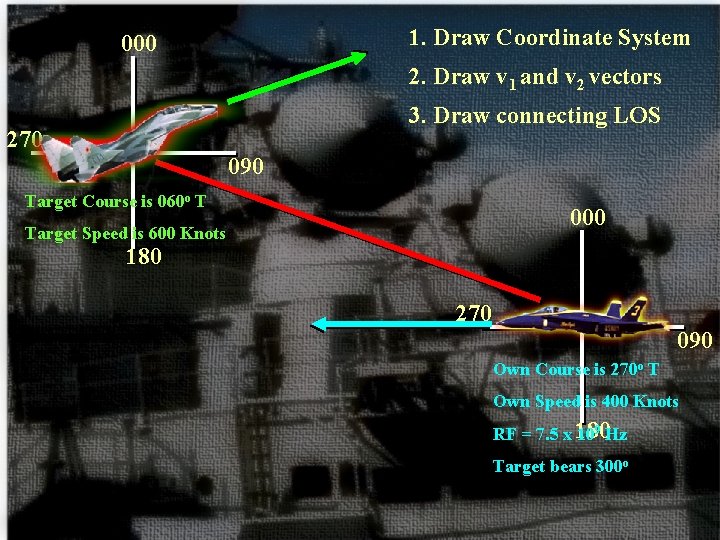
1. Draw Coordinate System 000 2. Draw v 1 and v 2 vectors 3. Draw connecting LOS 270 090 Target Course is 060 o T 000 Target Speed is 600 Knots 180 270 090 Own Course is 270 o T Own Speed is 400 Knots RF = 7. 5 x 180 109 Hz Target bears 300 o
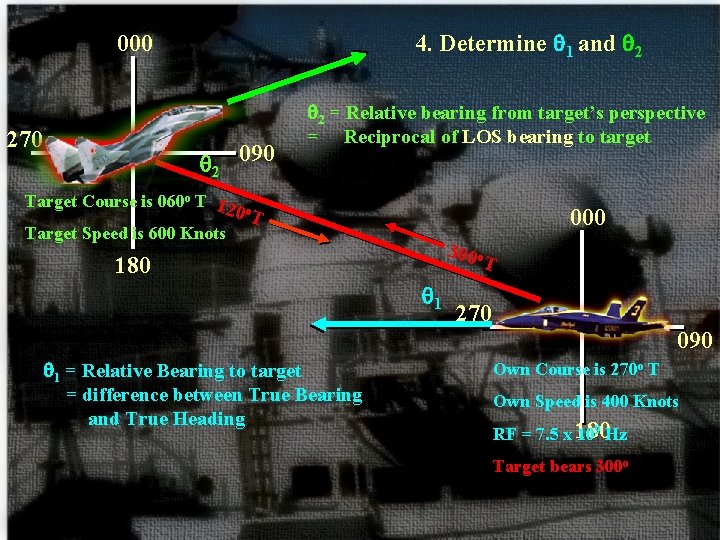
4. Determine 1 and 2 000 270 2 090 2 = Relative bearing from target’s perspective = Reciprocal of LOS bearing to target Target Course is 060 o T 12 o 0 T Target Speed is 600 Knots 000 300 o T 180 1 270 090 1 = Relative Bearing to target = difference between True Bearing and True Heading Own Course is 270 o T Own Speed is 400 Knots RF = 7. 5 x 180 109 Hz Target bears 300 o
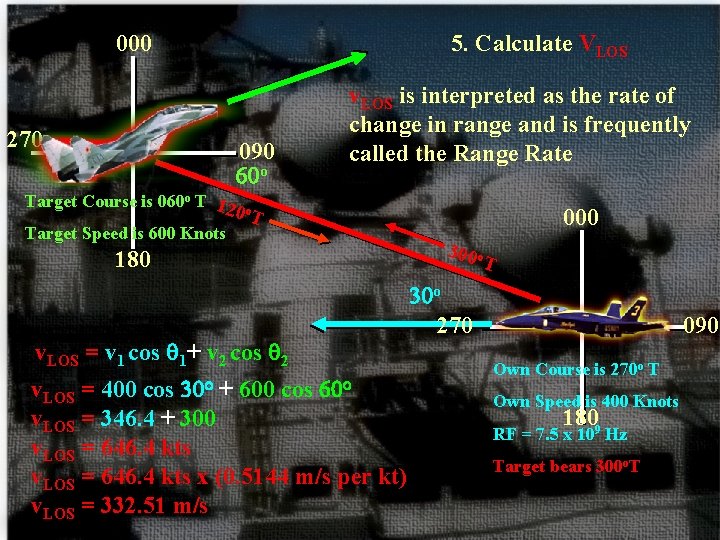
000 270 5. Calculate VLOS 090 60 o v. LOS is interpreted as the rate of change in range and is frequently called the Range Rate Target Course is 060 o T 12 o 0 T Target Speed is 600 Knots 180 v. LOS = v 1 cos 1+ v 2 cos 2 v. LOS = 400 cos 30 o + 600 cos 60 o v. LOS = 346. 4 + 300 v. LOS = 646. 4 kts x (0. 5144 m/s per kt) v. LOS = 332. 51 m/s 000 300 o T 30 o 270 090 Own Course is 270 o T Own Speed is 400 Knots 180 RF = 7. 5 x 10⁹ Hz Target bears 300 o. T
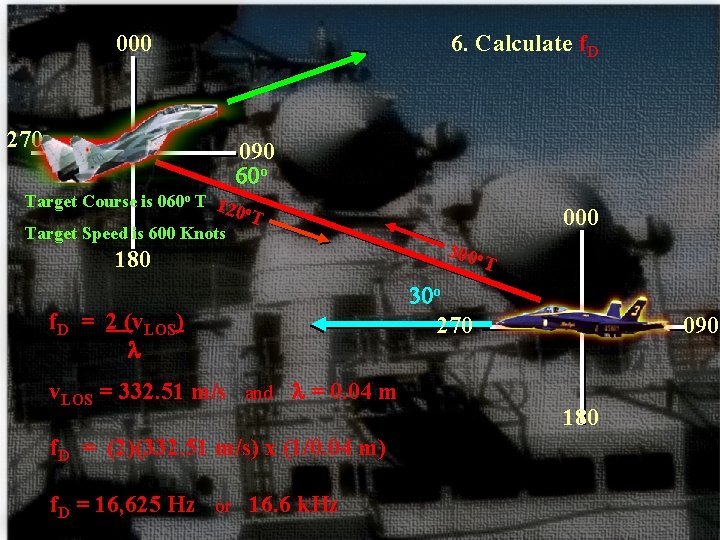
000 270 6. Calculate f. D 090 60 o Target Course is 060 o T 12 o 0 T Target Speed is 600 Knots 180 f. D = 2 (v. LOS) v. LOS = 332. 51 m/s and = 0. 04 m f. D = (2)(332. 51 m/s) x (1/0. 04 m) f. D = 16, 625 Hz or 16. 6 k. Hz 000 300 o T 30 o 270 090 180
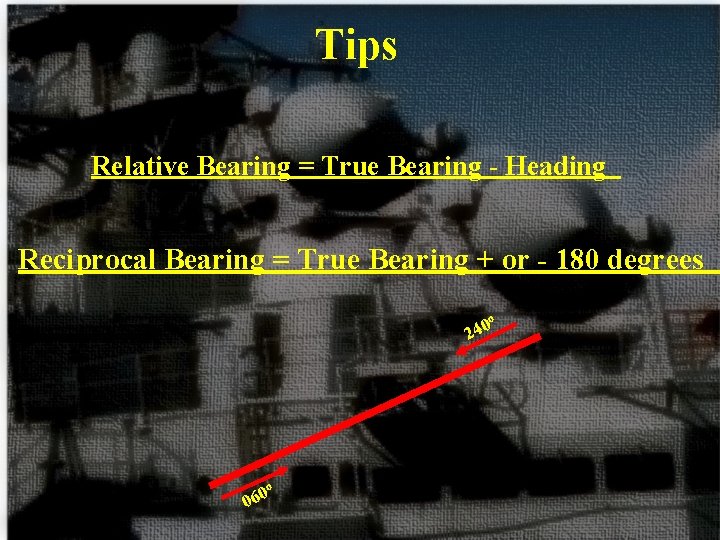
Tips Relative Bearing = True Bearing - Heading Reciprocal Bearing = True Bearing + or - 180 degrees o 240 o 060
Example Problem #1 While operating in the Arabian Gulf, you are flying your F-18 Hornet on a course of 325 o T at 450 knots, heading towards the nearest Tanker Track. An audio warning from your APG-73 all weather search and track radar, operating at 3. 5 GHz, notifies you that you have a target that bears 300 o R, with a Doppler shift of 4500 Hz. You estimate the contact to be departing Al Amarah airfield on a course of 110 o T Step #1: Draw the PICTURE:
Example Problem #2 You acquire an EA-6 B bearing 070 degrees True on course 120 degrees True cruising along at 360 Kts. Your course is 350 degrees True and speed is 400 Kts. Your radar Frequency is 500 MHz. What is the Doppler Shift?
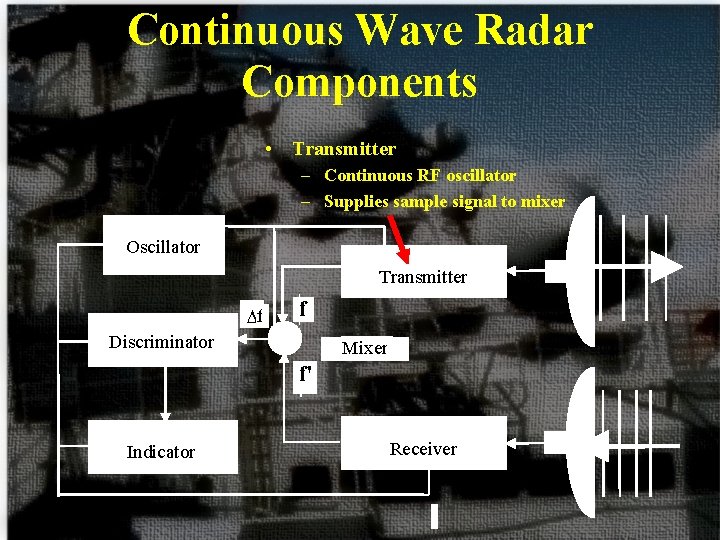
Continuous Wave Radar Components • Transmitter – Continuous RF oscillator – Supplies sample signal to mixer Oscillator Transmitter Df f Discriminator Mixer f' Indicator Receiver
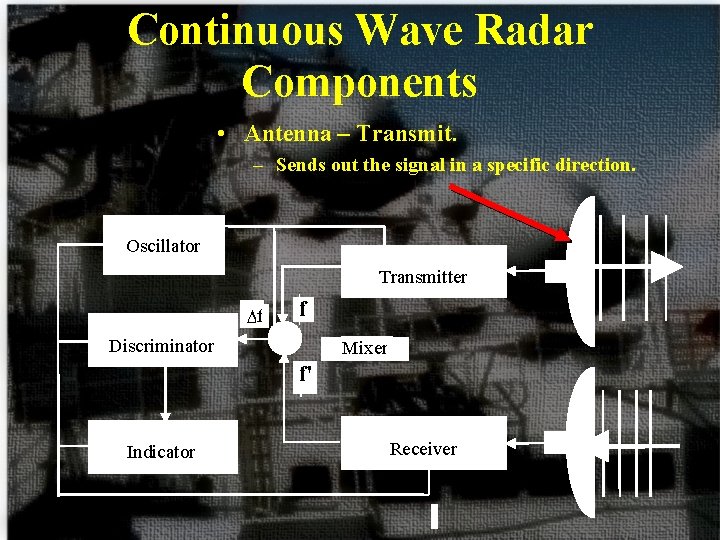
Continuous Wave Radar Components • Antenna – Transmit. – Sends out the signal in a specific direction. Oscillator Transmitter Df f Discriminator Mixer f' Indicator Receiver
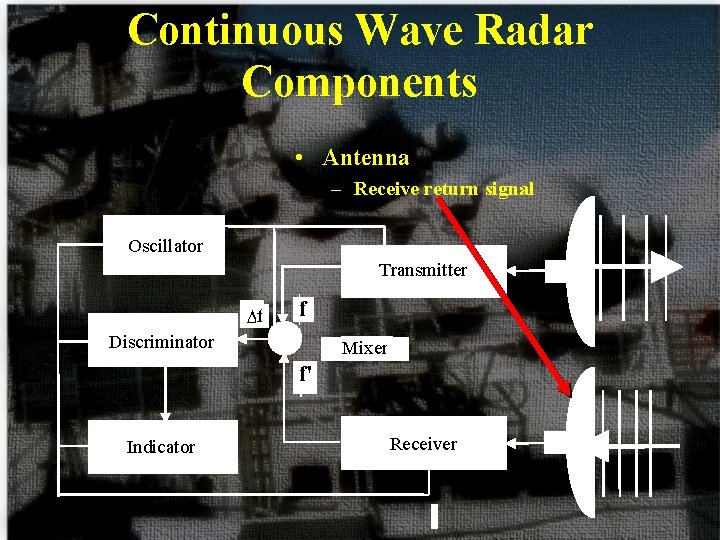
Continuous Wave Radar Components • Antenna – Receive return signal Oscillator Transmitter Df f Discriminator Mixer f' Indicator Receiver
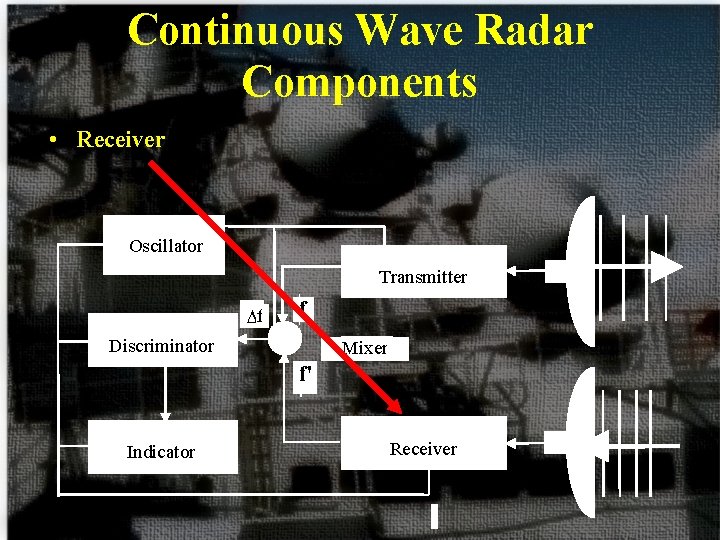
Continuous Wave Radar Components • Receiver Oscillator Transmitter Df f Discriminator Mixer f' Indicator Receiver
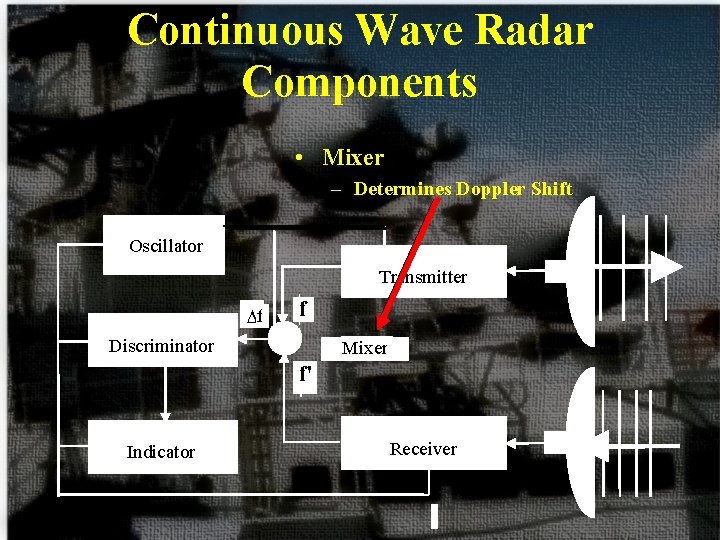
Continuous Wave Radar Components • Mixer – Determines Doppler Shift Oscillator Transmitter Df f Discriminator Mixer f' Indicator Receiver
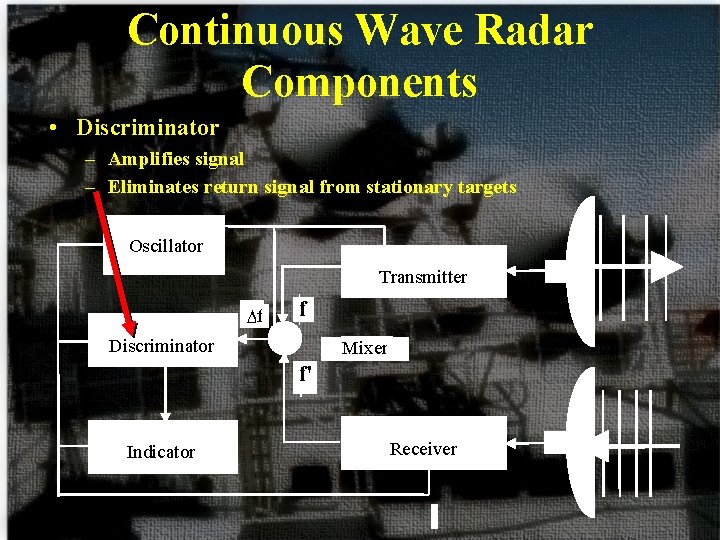
Continuous Wave Radar Components • Discriminator – Amplifies signal – Eliminates return signal from stationary targets Oscillator Transmitter Df f Discriminator Mixer f' Indicator Receiver
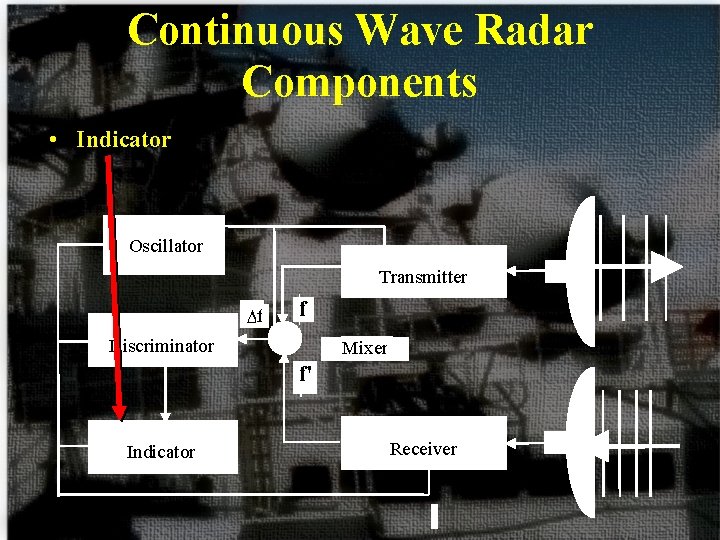
Continuous Wave Radar Components • Indicator Oscillator Transmitter Df f Discriminator Mixer f' Indicator Receiver
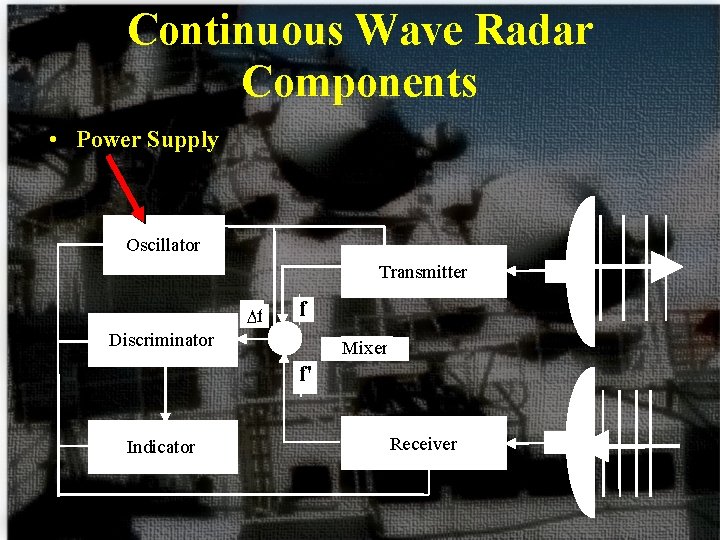
Continuous Wave Radar Components • Power Supply Oscillator Transmitter Df f Discriminator Mixer f' Indicator Receiver
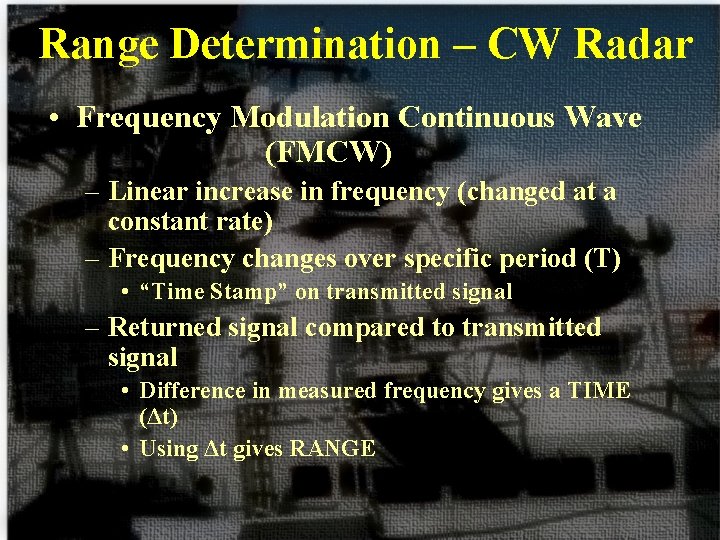
Range Determination – CW Radar • Frequency Modulation Continuous Wave (FMCW) – Linear increase in frequency (changed at a constant rate) – Frequency changes over specific period (T) • “Time Stamp” on transmitted signal – Returned signal compared to transmitted signal • Difference in measured frequency gives a TIME (Δt) • Using Δt gives RANGE
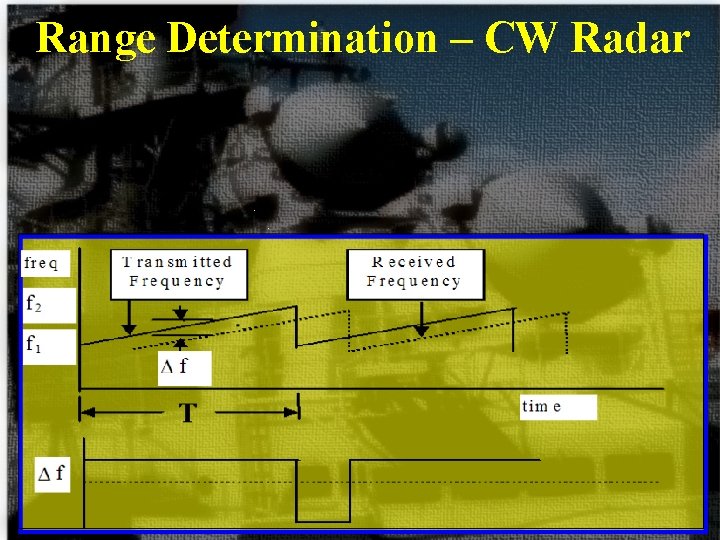
Range Determination – CW Radar
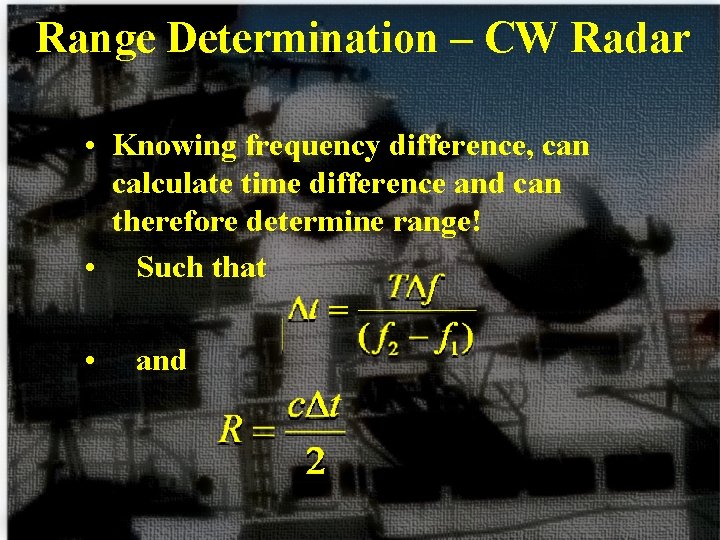
Range Determination – CW Radar • Knowing frequency difference, can calculate time difference and can therefore determine range! • Such that • and
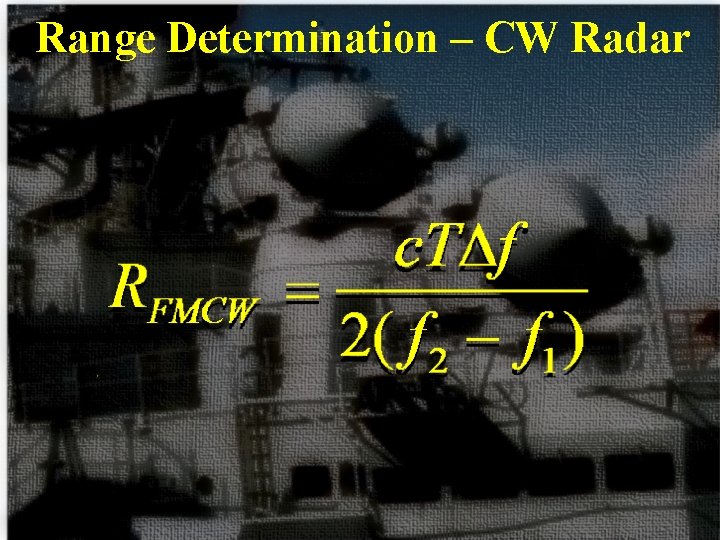
Range Determination – CW Radar
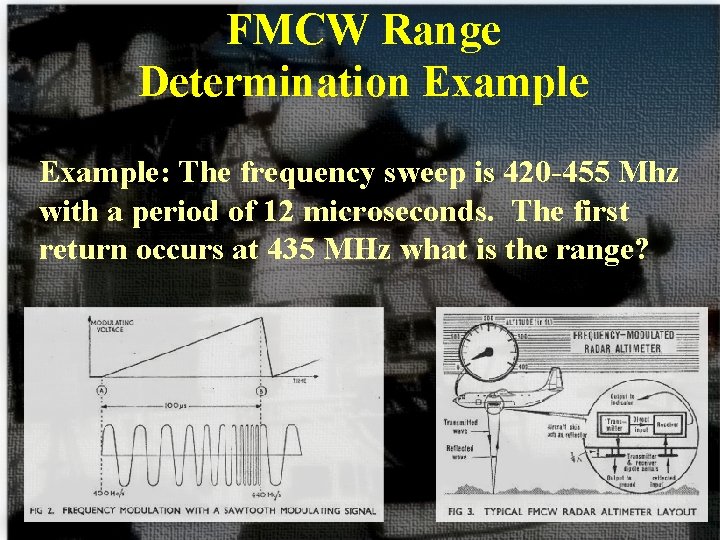
FMCW Range Determination Example: The frequency sweep is 420 -455 Mhz with a period of 12 microseconds. The first return occurs at 435 MHz what is the range?
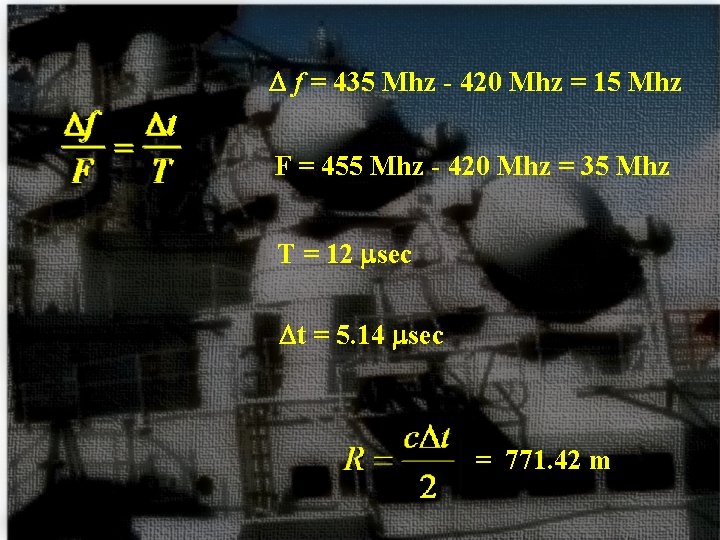
D f = 435 Mhz - 420 Mhz = 15 Mhz F = 455 Mhz - 420 Mhz = 35 Mhz T = 12 msec Dt = 5. 14 msec = 771. 42 m
- Slides: 32