
Continuous vs Pulsed Oscillatory Ultrasound in cataract phacoemulsification



- Slides: 10
Continuous vs Pulsed Oscillatory Ultrasound in cataract phacoemulsification The authors have not financial interest in the subject matter of this poster.
García - Ramírez Laura MD, Cervantes - Coste Guadalupe MD, Velasco - Barona Cecilio MD, Asociación para Evitar la Ceguera en México *adrygarcia 09@hotmail. com
Objective • To compare the effectiveness between continuous versus pulsed oscillatory ultrasound, in cataract removal with phacoemulsification.
Methods • Prospective study of 20 eyes with nuclear cataract N 2 or N 3 (LOCS III). • Cataract surgery was performed by one surgeon (CFB) with oscillatory ultrasound (INFINITI Vision System®) and “stop and chop” technique.
Methods • The nucleous was divided in 2 halves. The first fragment was emulsified with continuous oscillatory or pulsed ultrasound in a randomized mode. • All parameters were the same for both ultrasound modalities. • Amplitude 80%, vaccum 380 mm. Hg, aspiration 40 cc/min , dynamic rise 1, bottle height 110 cm. • At the end of the surgery, metrics for each half was recorded.
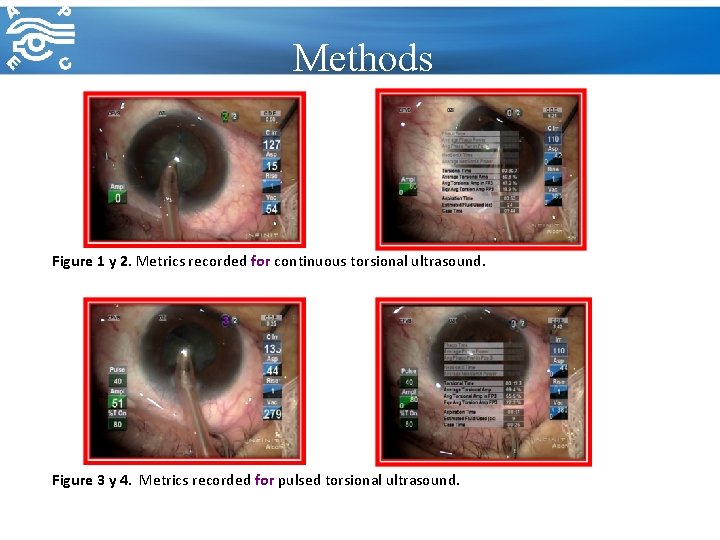
Methods Figure 1 y 2. Metrics recorded for continuous torsional ultrasound. Figure 3 y 4. Metrics recorded for pulsed torsional ultrasound.
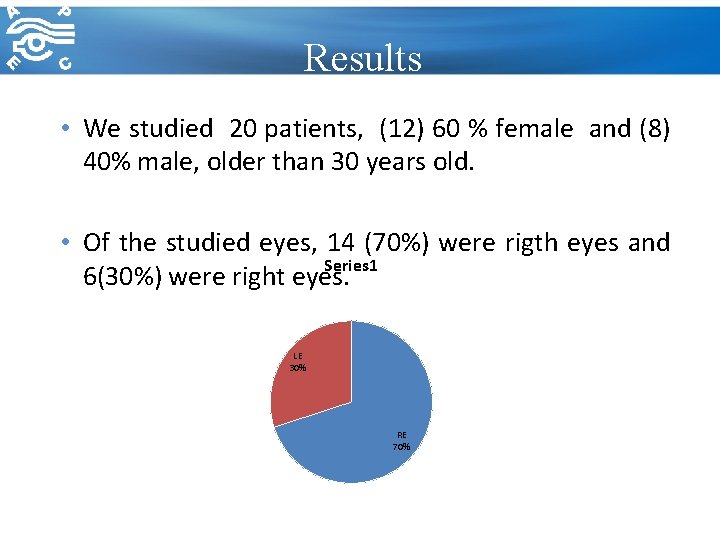
Results • We studied 20 patients, (12) 60 % female and (8) 40% male, older than 30 years old. • Of the studied eyes, 14 (70%) were rigth eyes and Series 1 6(30%) were right eyes. LE 30% RE 70%
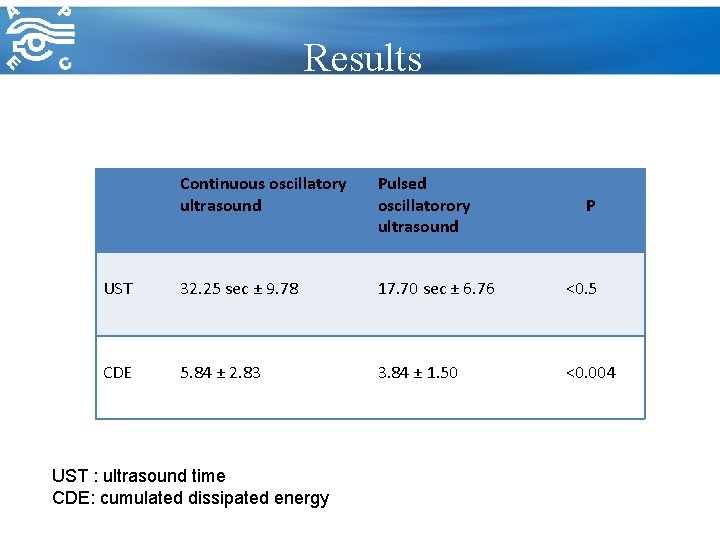
Results Continuous oscillatory ultrasound Pulsed oscillatorory ultrasound UST 32. 25 sec ± 9. 78 17. 70 sec ± 6. 76 <0. 5 CDE 5. 84 ± 2. 83 3. 84 ± 1. 50 <0. 004 UST : ultrasound time CDE: cumulated dissipated energy P
Results ULTRASOUND TIME 60 50 Graphic No. 1 Relation between the ultrasound time reported with the two modalities. (P<0. 5) 40 30 20 10 0 1 2 3 4 5 6 7 8 9 10 11 12 13 14 15 16 17 18 19 20 Continuous Pulsed CDE RELATION Graphic No. 2 Relation of cumulated dissipated energy reported with the two modalities. (P< 0. 004) 16 14 12 10 8 6 4 2 0 1 2 3 4 5 6 7 8 9 10 11 12 13 14 15 16 17 18 19 20 Continuous Pulsed
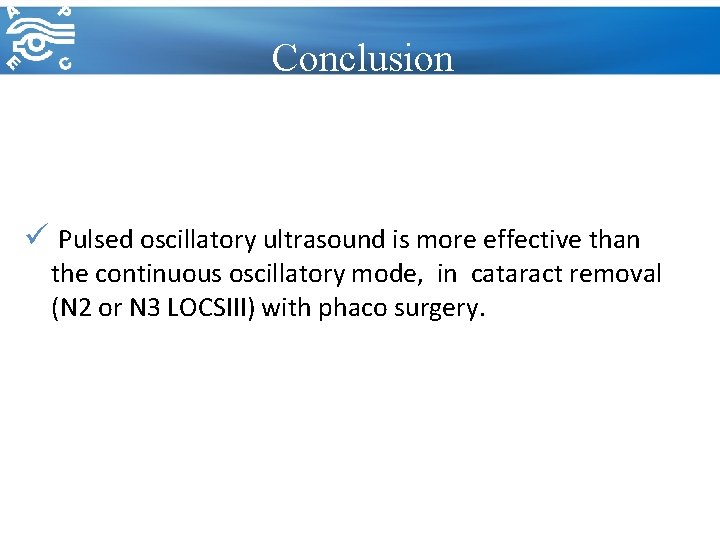
Conclusion ü Pulsed oscillatory ultrasound is more effective than the continuous oscillatory mode, in cataract removal (N 2 or N 3 LOCSIII) with phaco surgery.