
Continuous Time Signals All signals in nature are
- Slides: 24
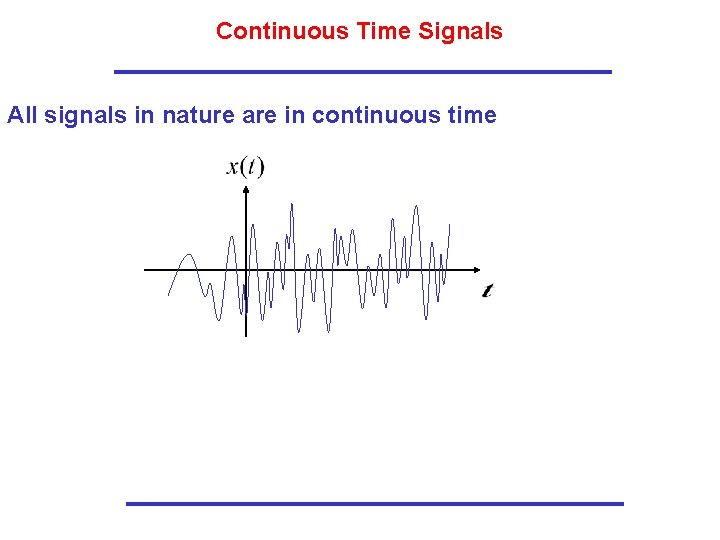
Continuous Time Signals All signals in nature are in continuous time
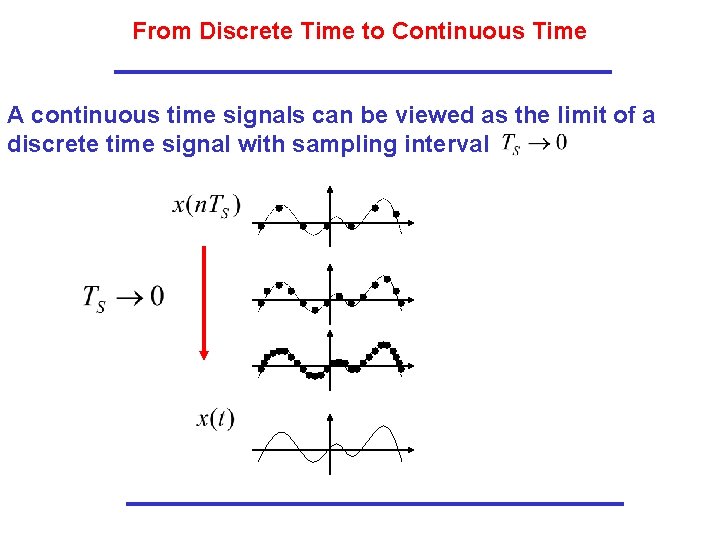
From Discrete Time to Continuous Time A continuous time signals can be viewed as the limit of a discrete time signal with sampling interval
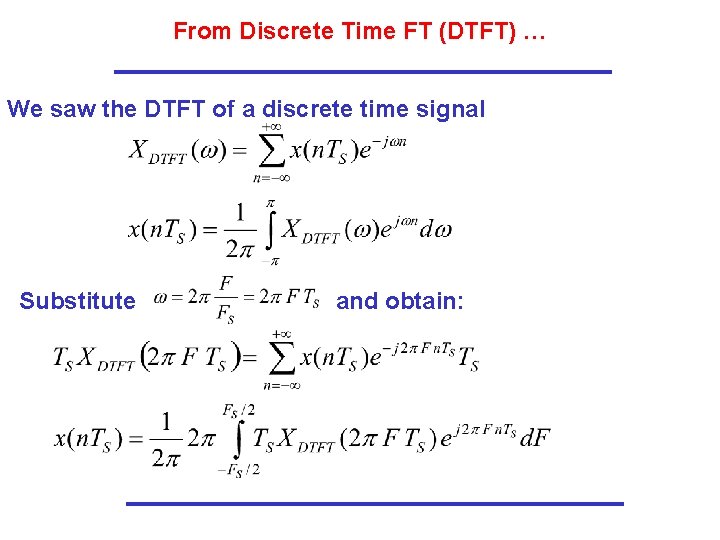
From Discrete Time FT (DTFT) … We saw the DTFT of a discrete time signal Substitute and obtain:
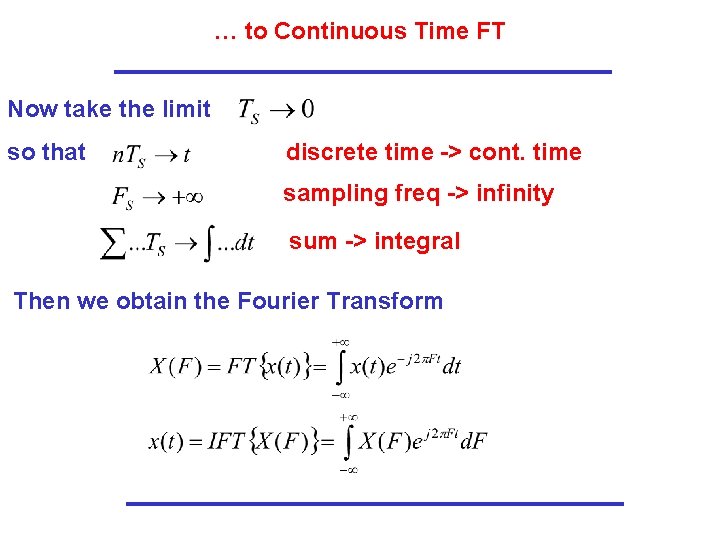
… to Continuous Time FT Now take the limit so that discrete time -> cont. time sampling freq -> infinity sum -> integral Then we obtain the Fourier Transform
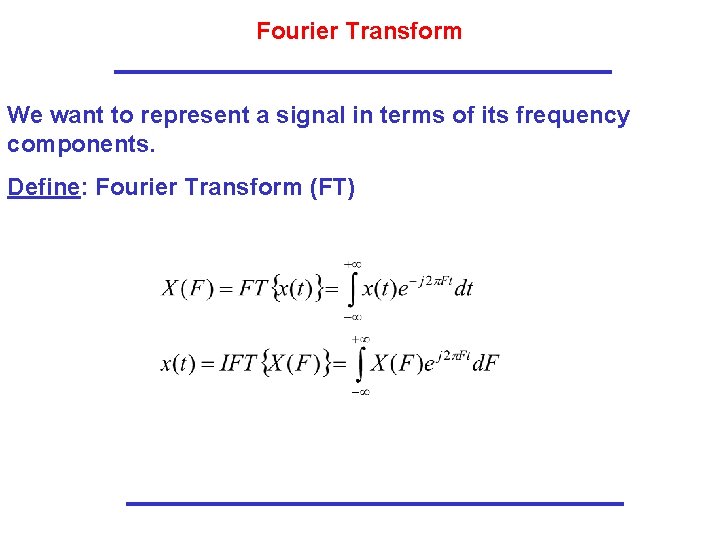
Fourier Transform We want to represent a signal in terms of its frequency components. Define: Fourier Transform (FT)
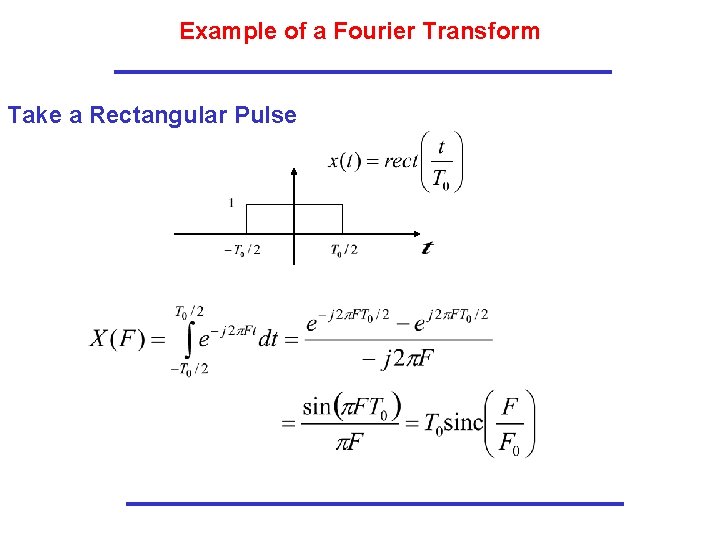
Example of a Fourier Transform Take a Rectangular Pulse
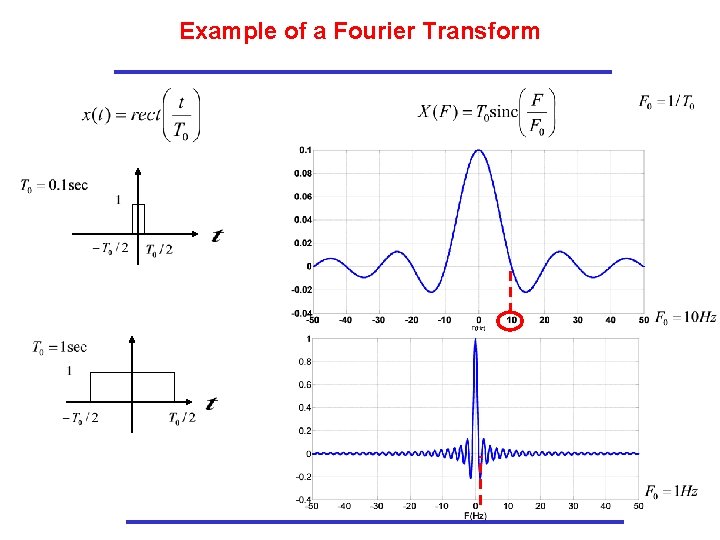
Example of a Fourier Transform
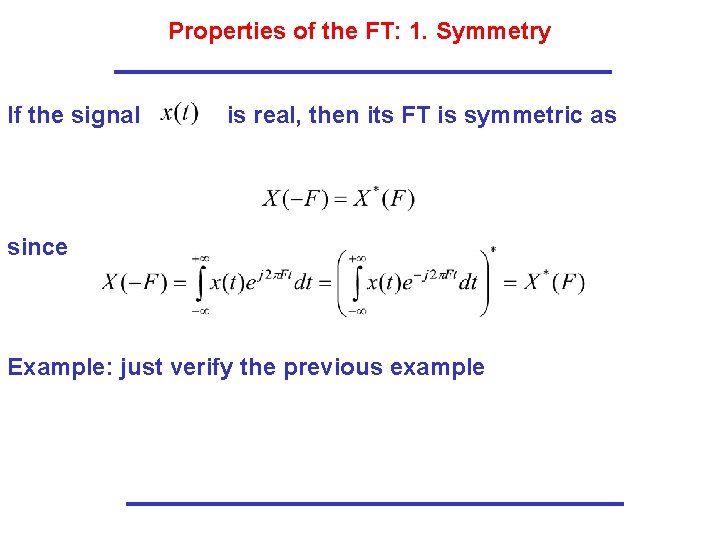
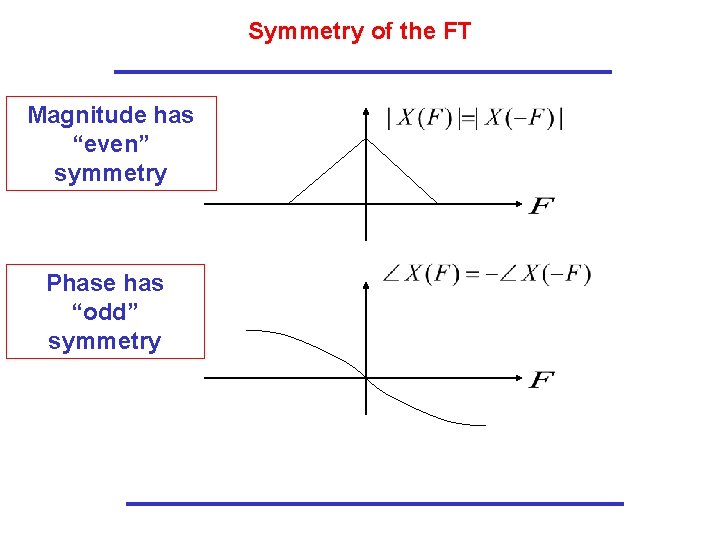
Properties of the FT: 1. Symmetry If the signal is real, then its FT is symmetric as since Example: just verify the previous example
Symmetry of the FT Magnitude has “even” symmetry Phase has “odd” symmetry
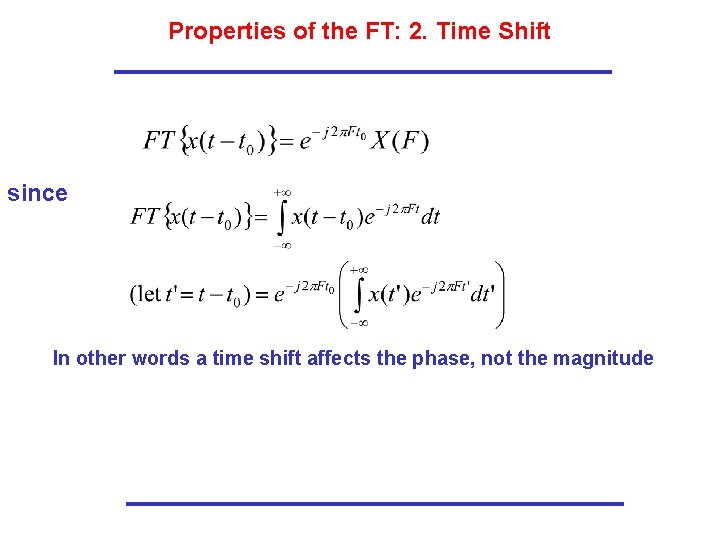
Properties of the FT: 2. Time Shift since In other words a time shift affects the phase, not the magnitude
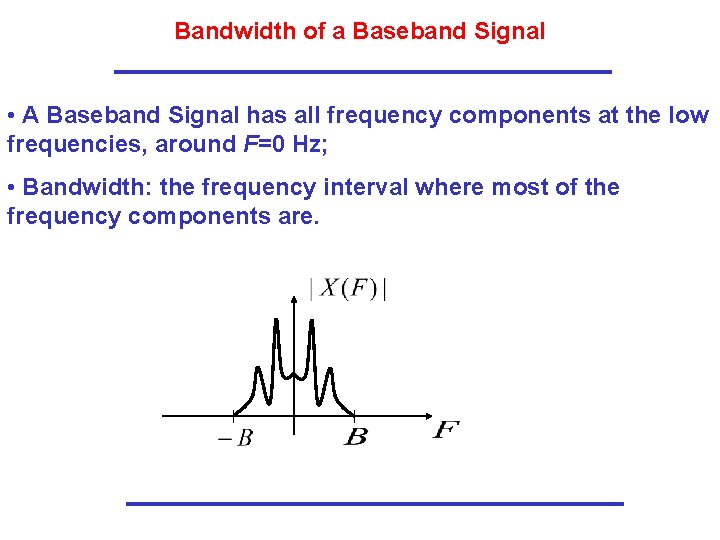
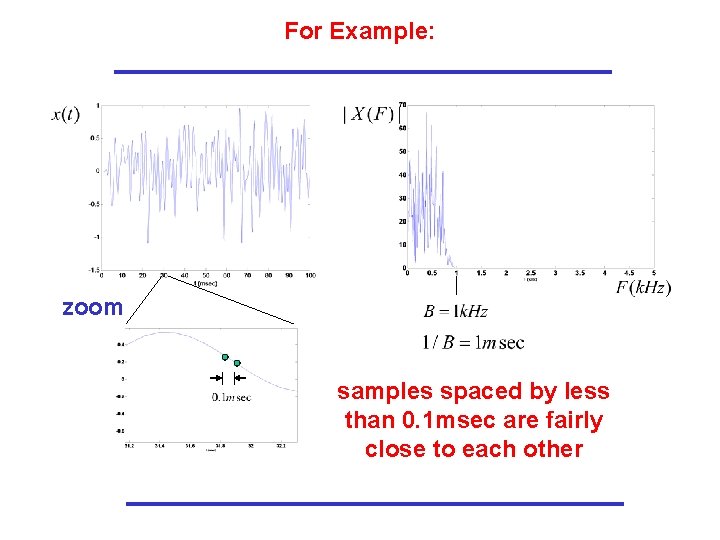
Bandwidth of a Baseband Signal • A Baseband Signal has all frequency components at the low frequencies, around F=0 Hz; • Bandwidth: the frequency interval where most of the frequency components are.
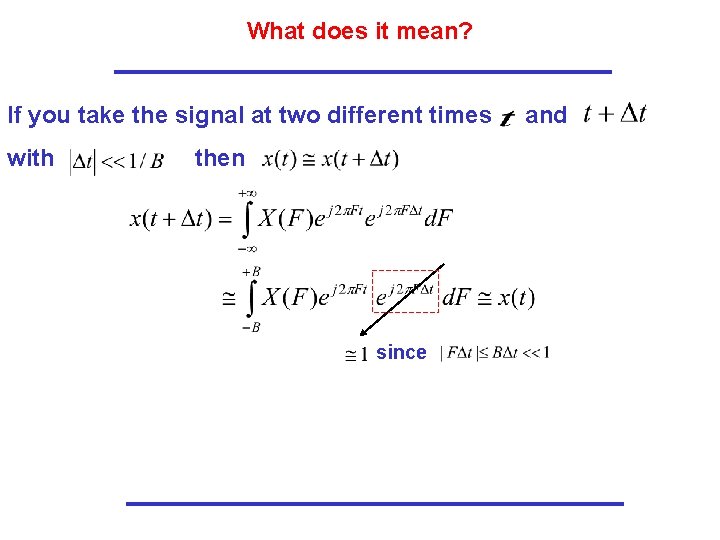
What does it mean? If you take the signal at two different times with then since and
For Example: zoom samples spaced by less than 0. 1 msec are fairly close to each other
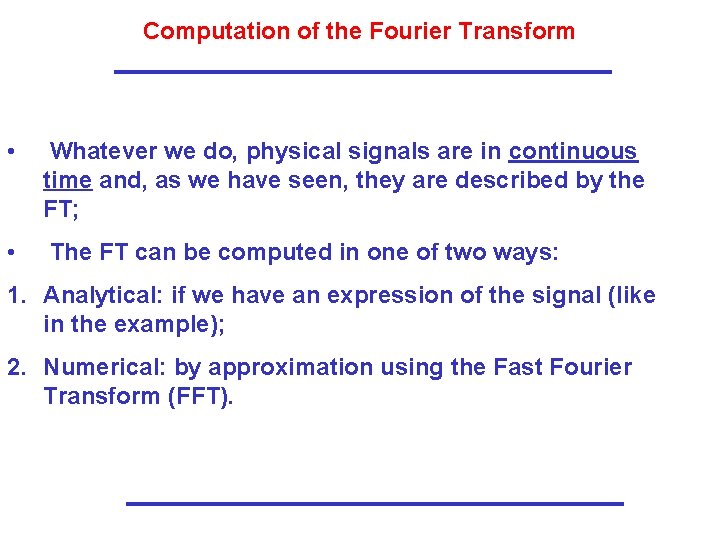
Computation of the Fourier Transform • Whatever we do, physical signals are in continuous time and, as we have seen, they are described by the FT; • The FT can be computed in one of two ways: 1. Analytical: if we have an expression of the signal (like in the example); 2. Numerical: by approximation using the Fast Fourier Transform (FFT).
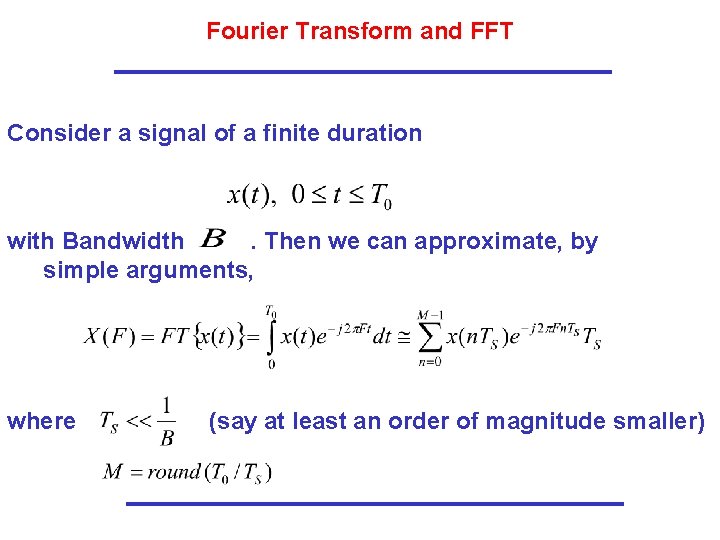
Fourier Transform and FFT Consider a signal of a finite duration with Bandwidth. Then we can approximate, by simple arguments, where (say at least an order of magnitude smaller)
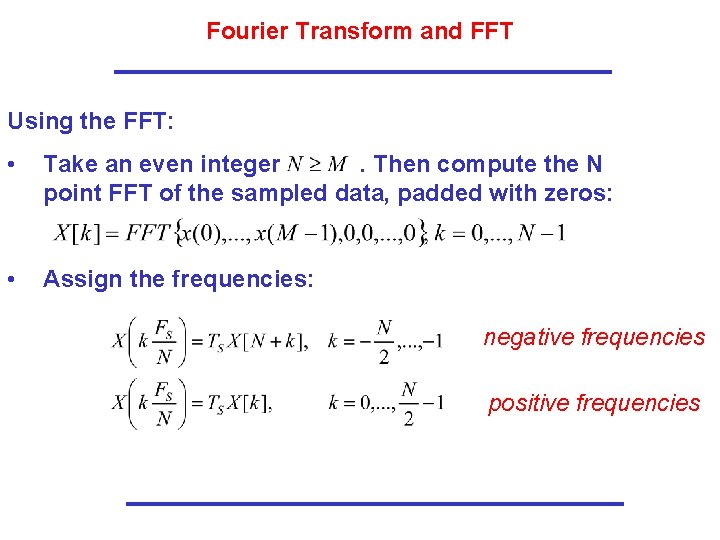
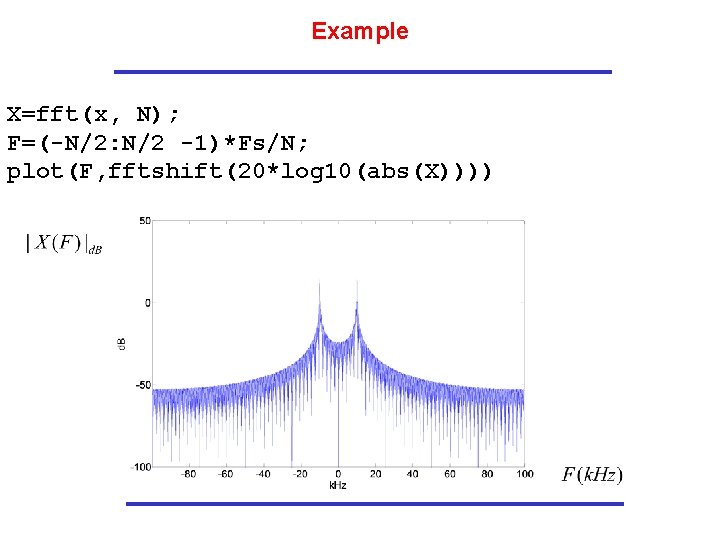
Fourier Transform and FFT Using the FFT: • Take an even integer. Then compute the N point FFT of the sampled data, padded with zeros: • Assign the frequencies: negative frequencies positive frequencies
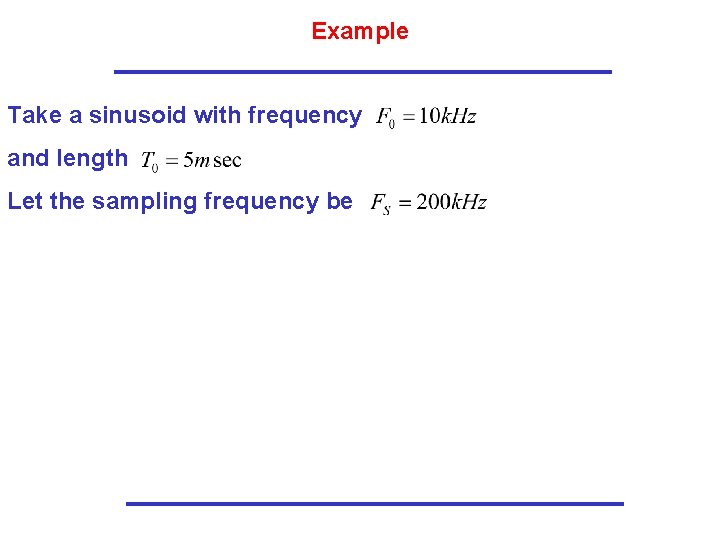
Example Take a sinusoid with frequency and length Let the sampling frequency be
Example X=fft(x, N); F=(-N/2: N/2 -1)*Fs/N; plot(F, fftshift(20*log 10(abs(X))))
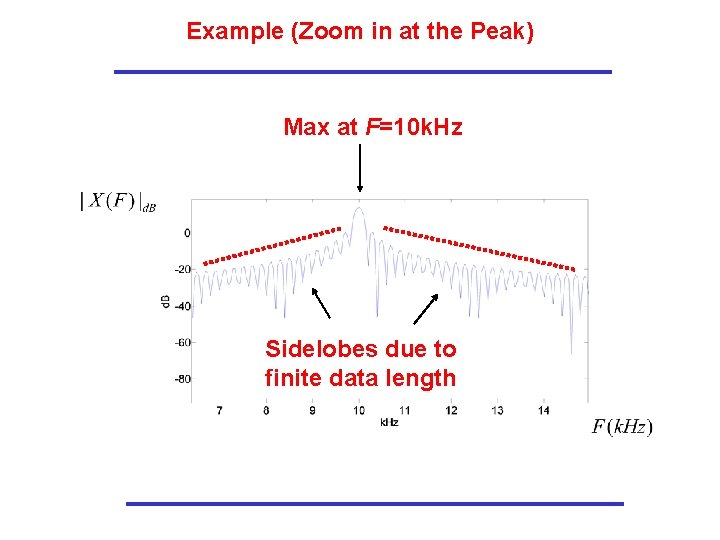
Example (Zoom in at the Peak) Max at F=10 k. Hz Sidelobes due to finite data length
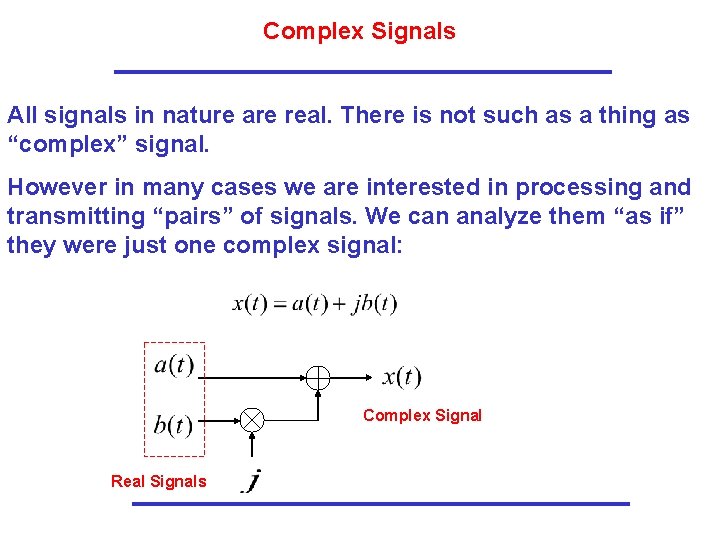
Complex Signals All signals in nature are real. There is not such as a thing as “complex” signal. However in many cases we are interested in processing and transmitting “pairs” of signals. We can analyze them “as if” they were just one complex signal: Complex Signal Real Signals
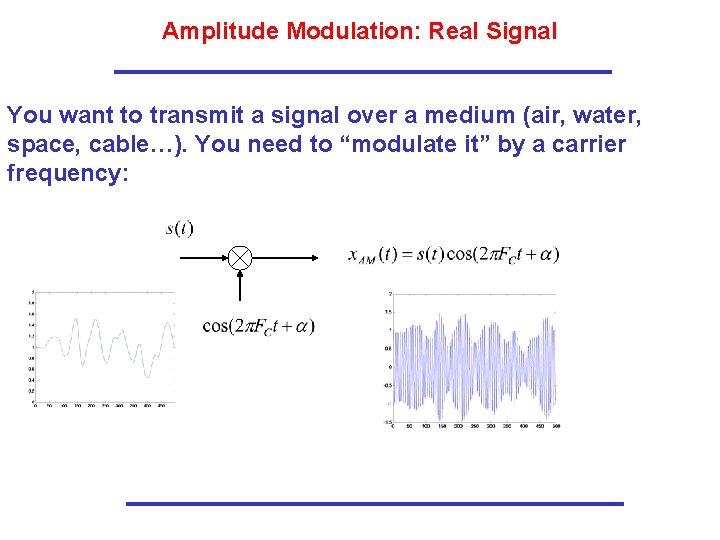
Amplitude Modulation: Real Signal You want to transmit a signal over a medium (air, water, space, cable…). You need to “modulate it” by a carrier frequency:
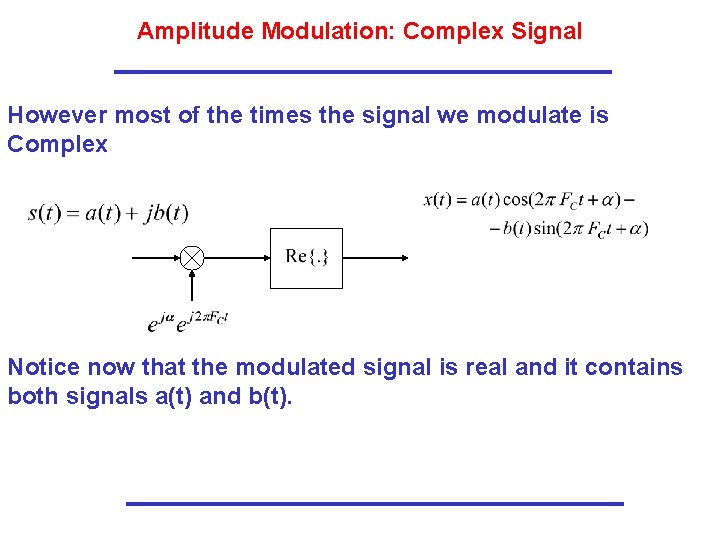
Amplitude Modulation: Complex Signal However most of the times the signal we modulate is Complex Notice now that the modulated signal is real and it contains both signals a(t) and b(t).
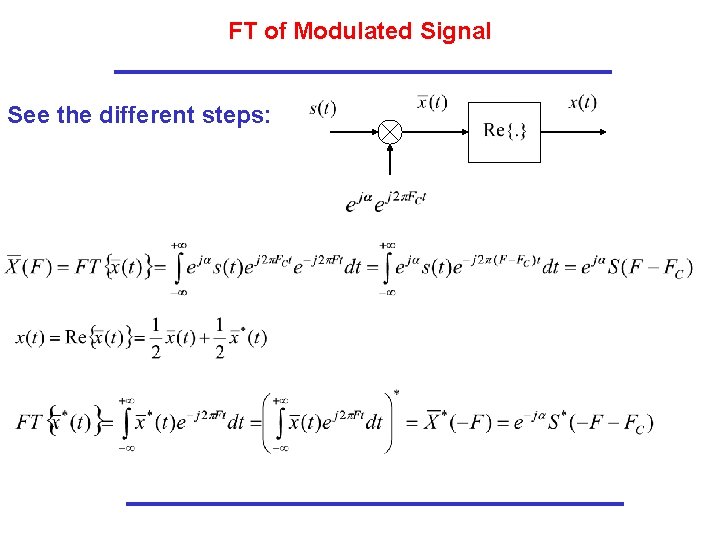
FT of Modulated Signal See the different steps:
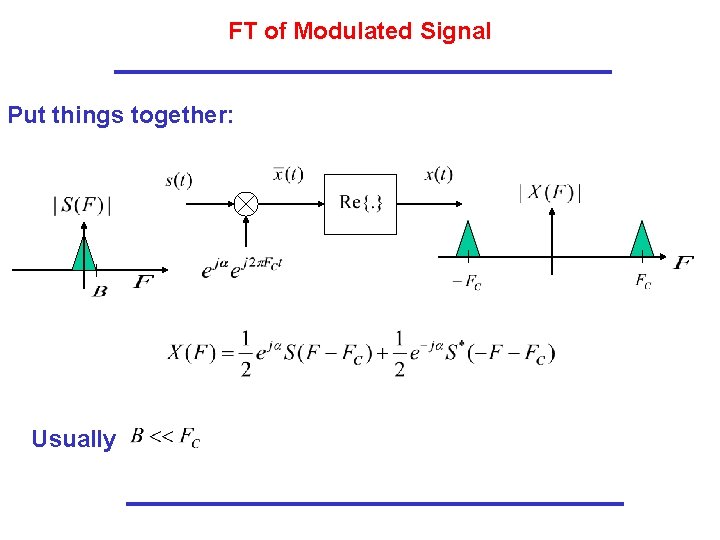
FT of Modulated Signal Put things together: Usually