
Continuous Time Monte Carlo methods for fermions Alexander

- Slides: 83
Continuous Time Monte Carlo methods for fermions Alexander Lichtenstein University of Hamburg In collaboration with A. Rubtsov (Moscow University) P. Werner (ETH Zurich)
Outline • Calculation of Path Integral • Problems with Hirsch-Fay QMC scheme • New fermionic solver - CT-QMC - weak coupling: CT-INT - strong coupling: CT-HYB • Magnetic nanosystems • Progress in DMFT • Conclusions
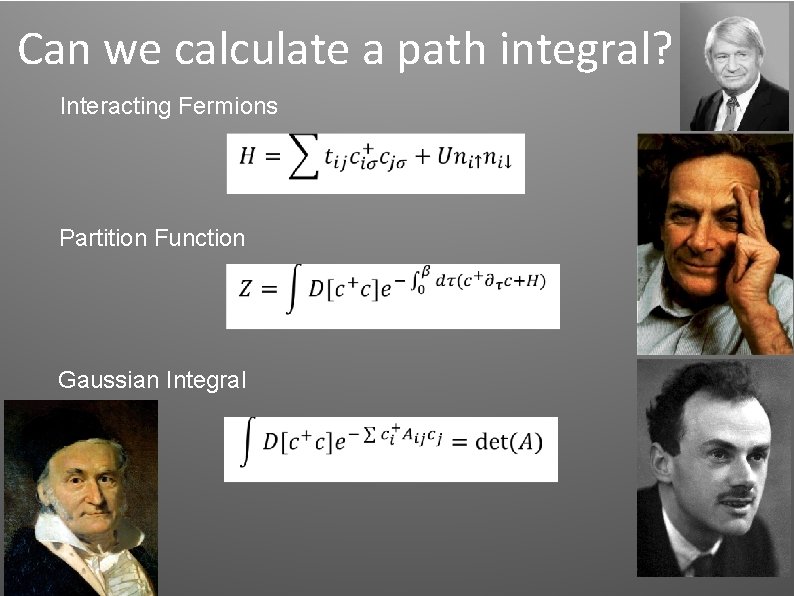
Can we calculate a path integral? Interacting Fermions Partition Function Gaussian Integral
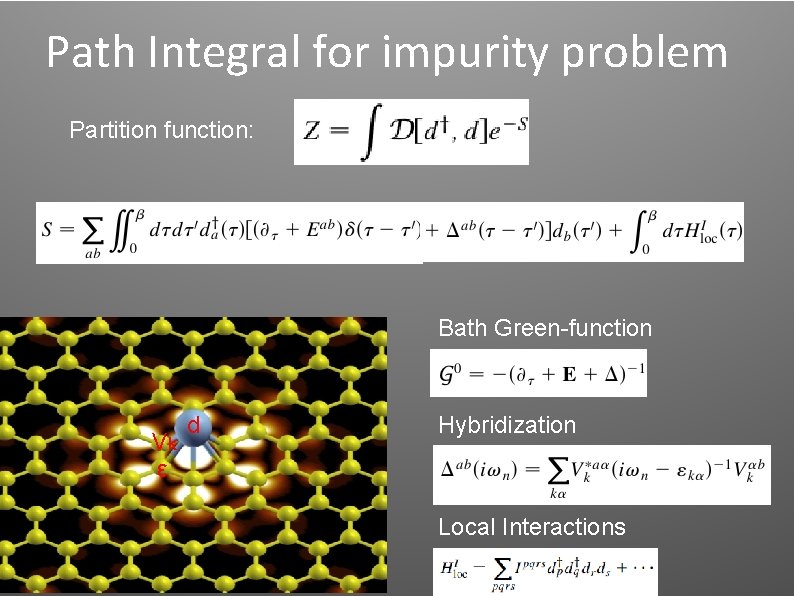
Path Integral for impurity problem Partition function: Bath Green-function Vk ε d Hybridization Local Interactions
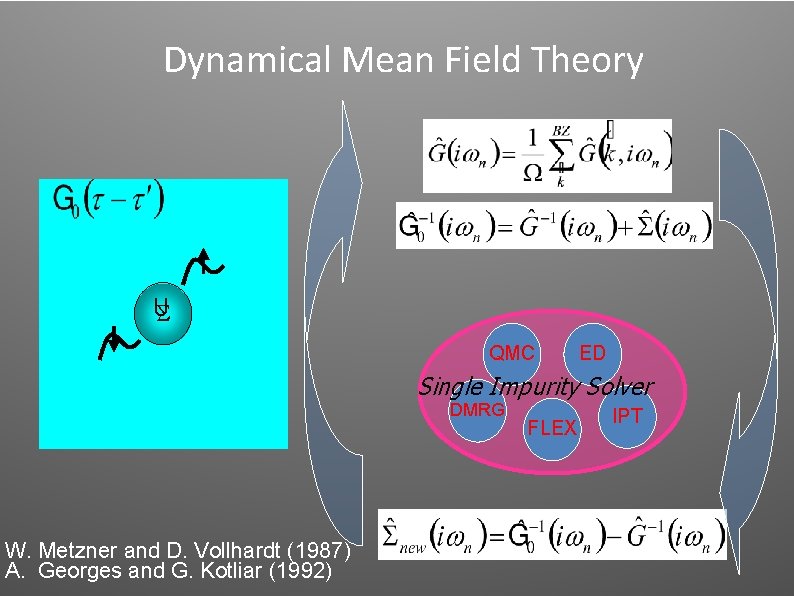
Dynamical Mean Field Theory S S U S S QMC S S S W. Metzner and D. Vollhardt (1987) A. Georges and G. Kotliar (1992) ED Single Impurity Solver DMRG FLEX IPT
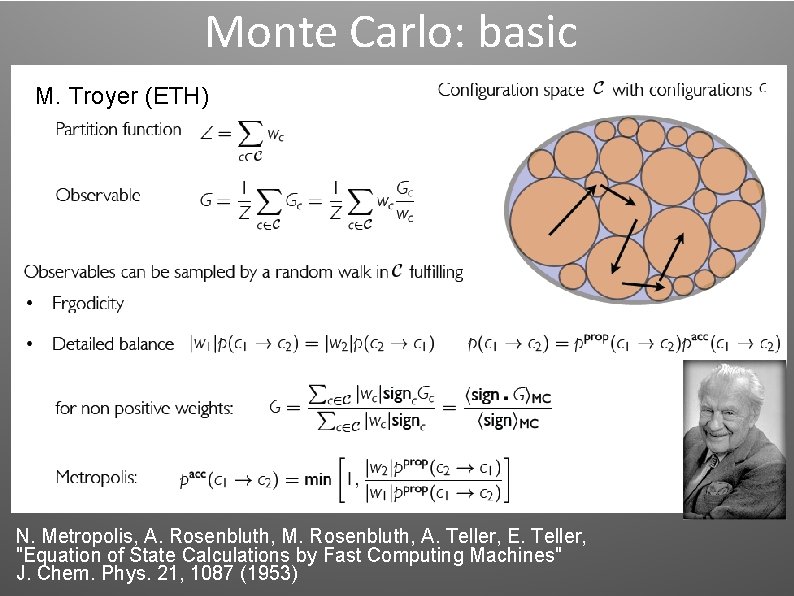
Monte Carlo: basic M. Troyer (ETH) N. Metropolis, A. Rosenbluth, M. Rosenbluth, A. Teller, E. Teller, "Equation of State Calculations by Fast Computing Machines" J. Chem. Phys. 21, 1087 (1953)
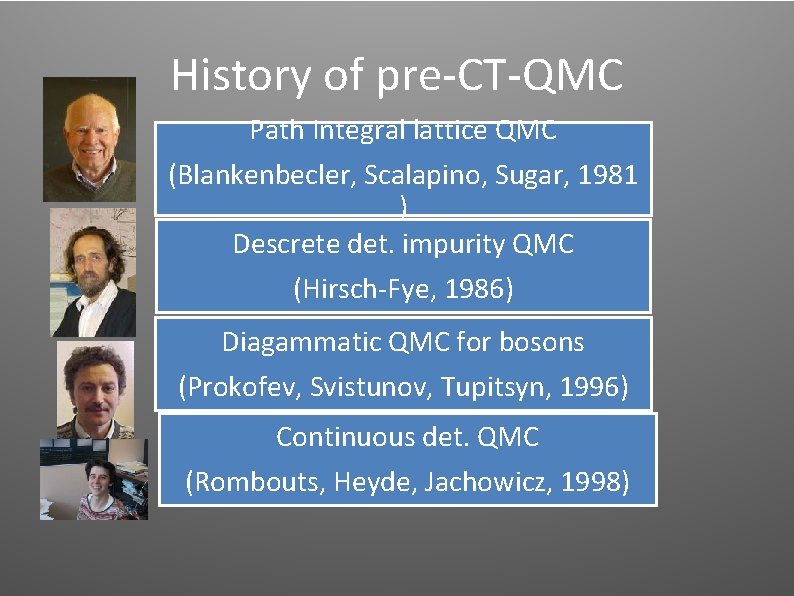
History of pre-CT-QMC Path Integral lattice QMC (Blankenbecler, Scalapino, Sugar, 1981 ) Descrete det. impurity QMC (Hirsch-Fye, 1986) Diagammatic QMC for bosons (Prokofev, Svistunov, Tupitsyn, 1996) Continuous det. QMC (Rombouts, Heyde, Jachowicz, 1998)
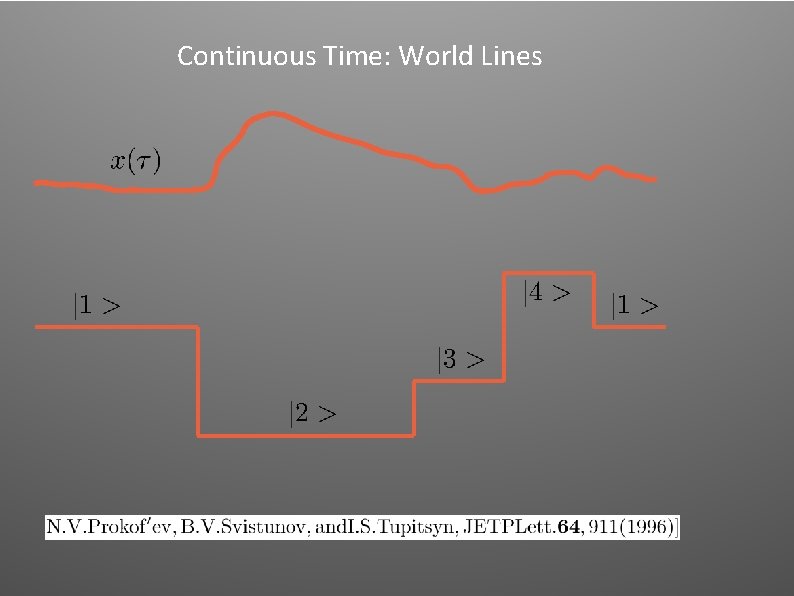
Continuous Time: World Lines
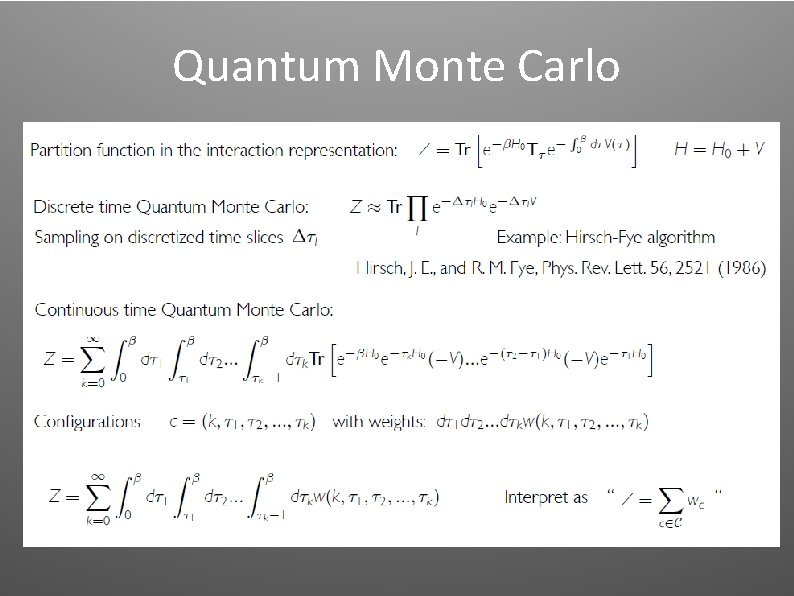
Quantum Monte Carlo
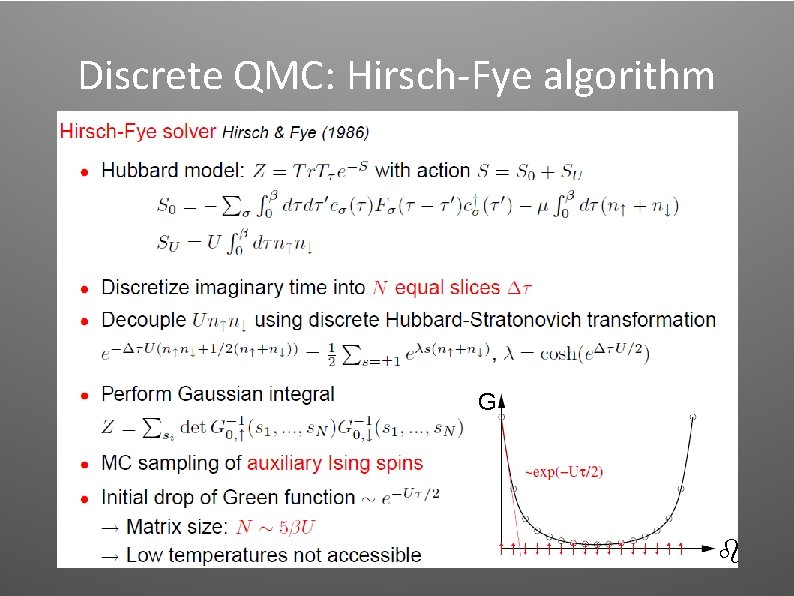
Discrete QMC: Hirsch-Fye algorithm G b
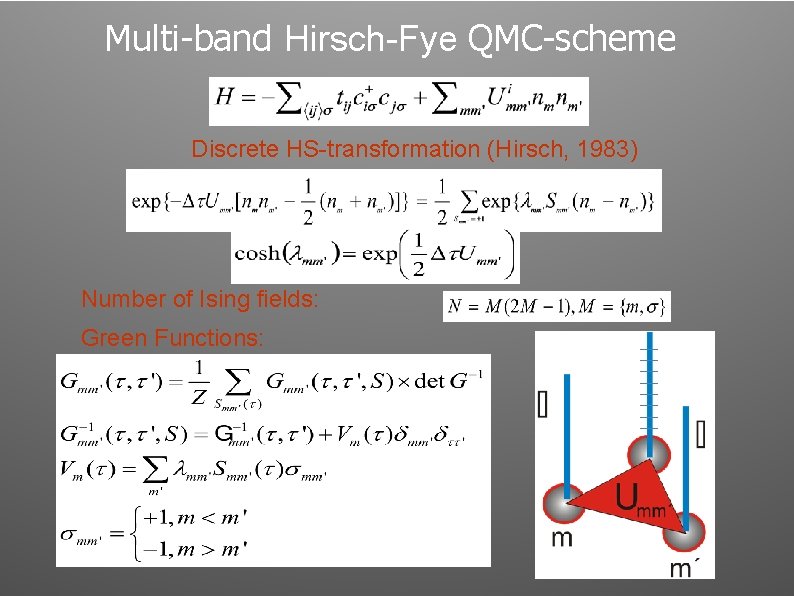
Multi-band Hirsch-Fye QMC-scheme Discrete HS-transformation (Hirsch, 1983) Number of Ising fields: Green Functions:
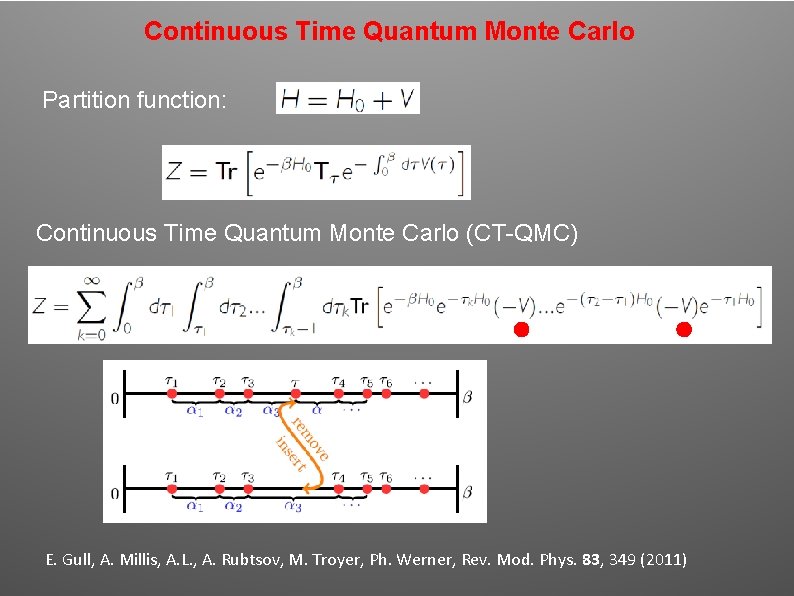
Continuous Time Quantum Monte Carlo Partition function: Continuous Time Quantum Monte Carlo (CT-QMC) E. Gull, A. Millis, A. L. , A. Rubtsov, M. Troyer, Ph. Werner, Rev. Mod. Phys. 83, 349 (2011)
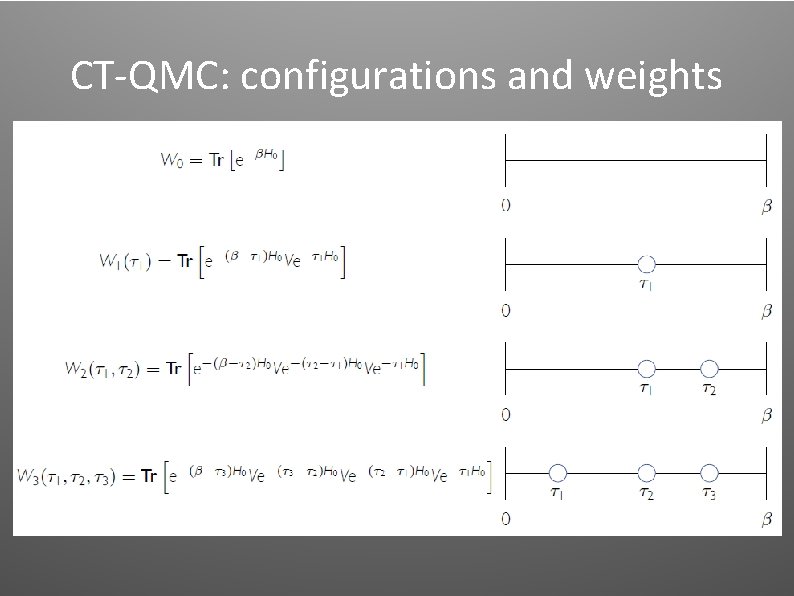
CT-QMC: configurations and weights
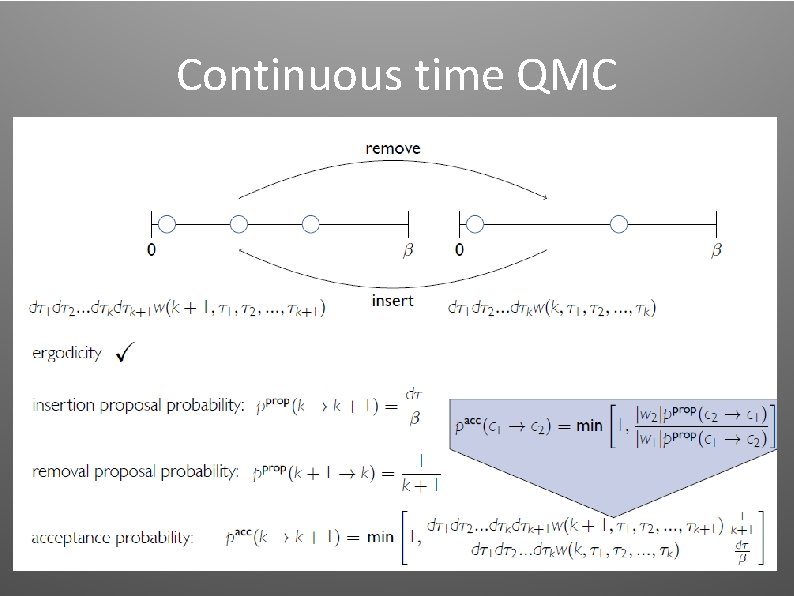
Continuous time QMC
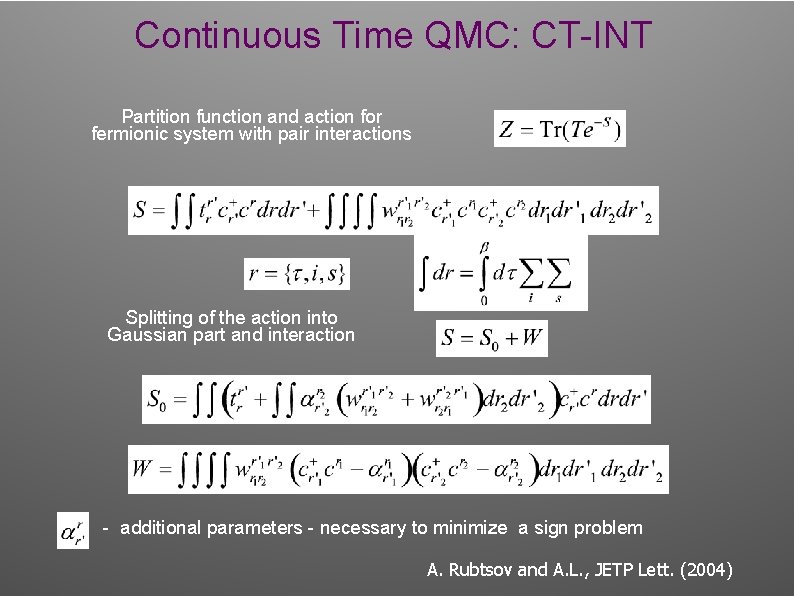
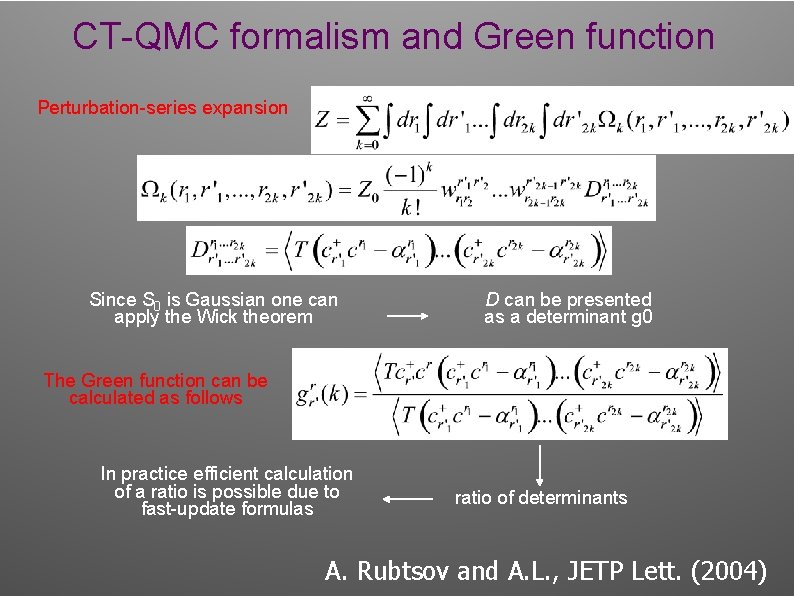
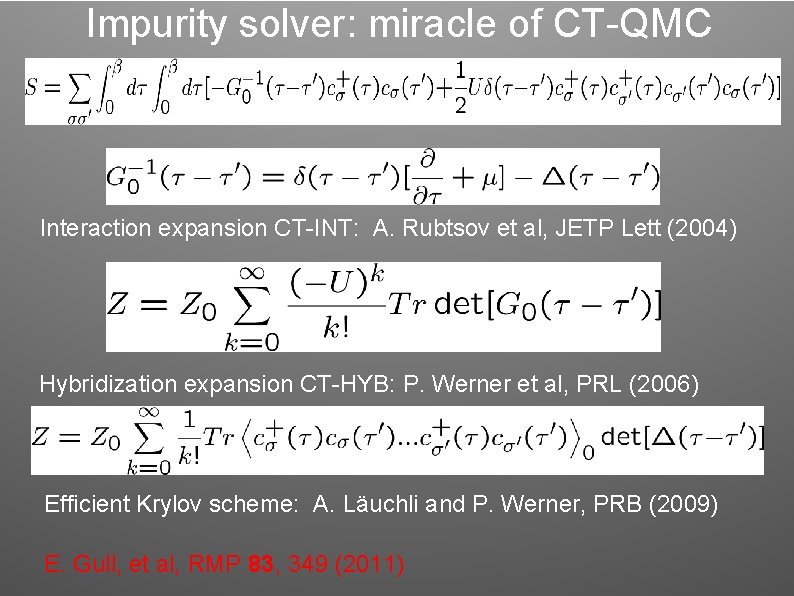
Continuous Time QMC: CT-INT Partition function and action for fermionic system with pair interactions Splitting of the action into Gaussian part and interaction - additional parameters - necessary to minimize a sign problem A. Rubtsov and A. L. , JETP Lett. (2004)
CT-QMC formalism and Green function Perturbation-series expansion Since S 0 is Gaussian one can apply the Wick theorem D can be presented as a determinant g 0 The Green function can be calculated as follows In practice efficient calculation of a ratio is possible due to fast-update formulas ratio of determinants A. Rubtsov and A. L. , JETP Lett. (2004)
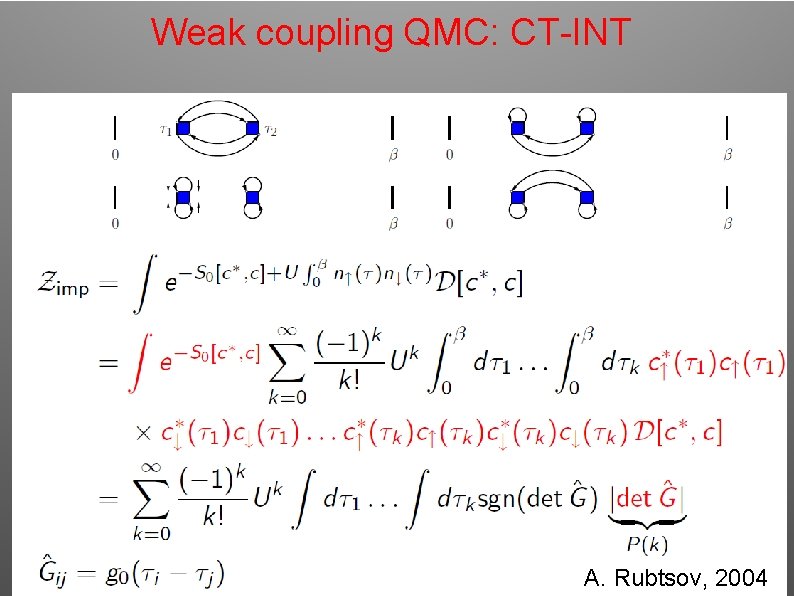
Weak coupling QMC: CT-INT A. Rubtsov, 2004
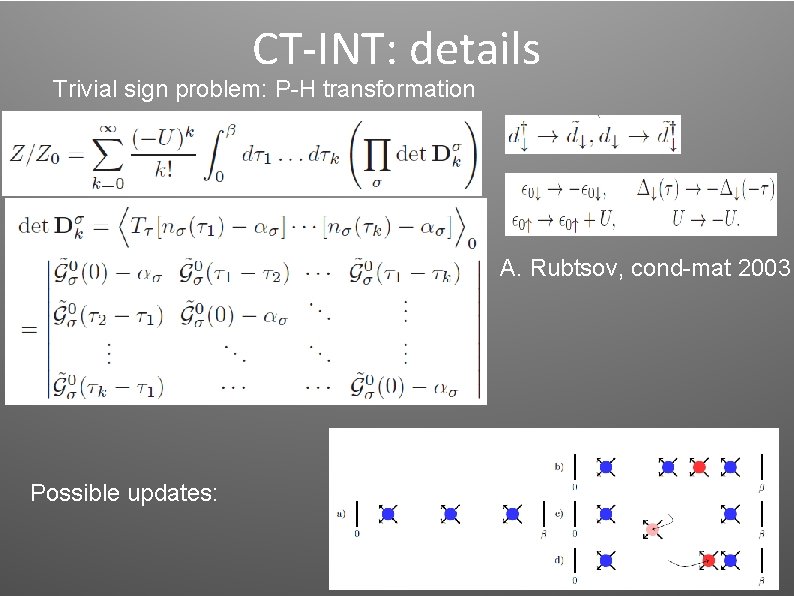
CT-INT: details Trivial sign problem: P-H transformation A. Rubtsov, cond-mat 2003 Possible updates:
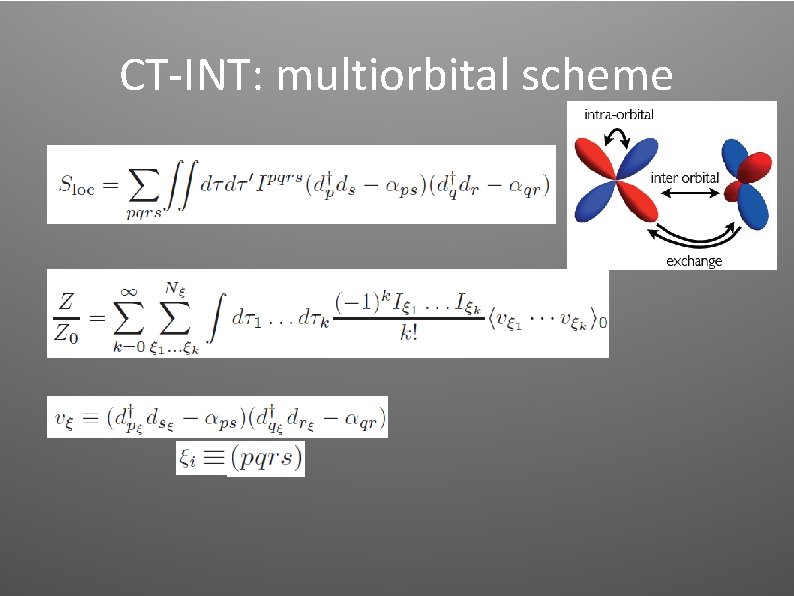
CT-INT: multiorbital scheme
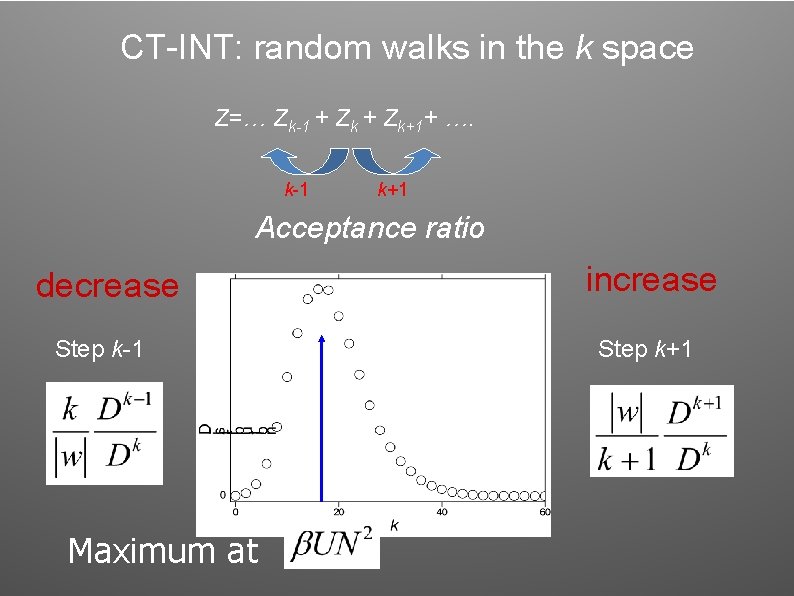
CT-INT: random walks in the k space Z=… Zk-1 + Zk+1+ …. k-1 k+1 Acceptance ratio decrease Step k-1 Maximum at increase Step k+1
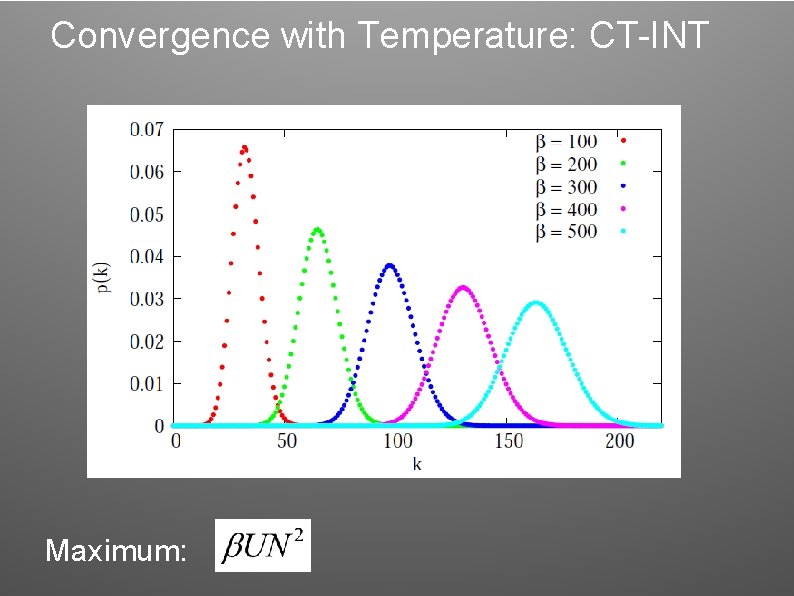
Convergence with Temperature: CT-INT Maximum:
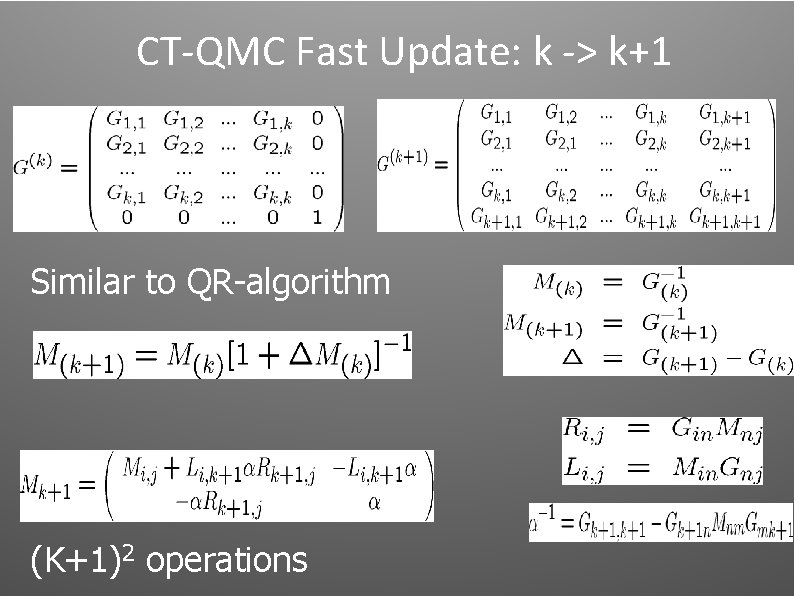
CT-QMC Fast Update: k -> k+1 Similar to QR-algorithm (K+1)2 operations
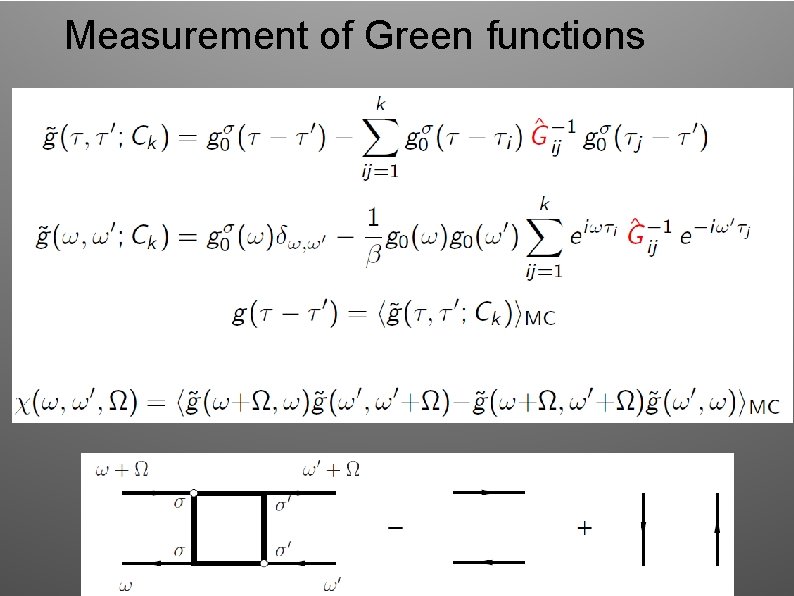
Measurement of Green functions
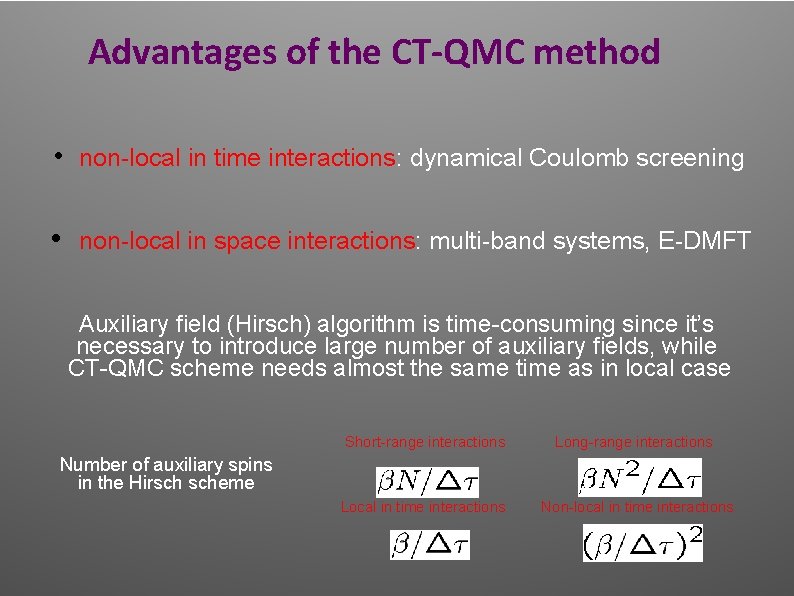
Advantages of the CT-QMC method • non-local in time interactions: dynamical Coulomb screening • non-local in space interactions: multi-band systems, E-DMFT Auxiliary field (Hirsch) algorithm is time-consuming since it’s necessary to introduce large number of auxiliary fields, while CT-QMC scheme needs almost the same time as in local case Short-range interactions Long-range interactions Local in time interactions Non-local in time interactions Number of auxiliary spins in the Hirsch scheme
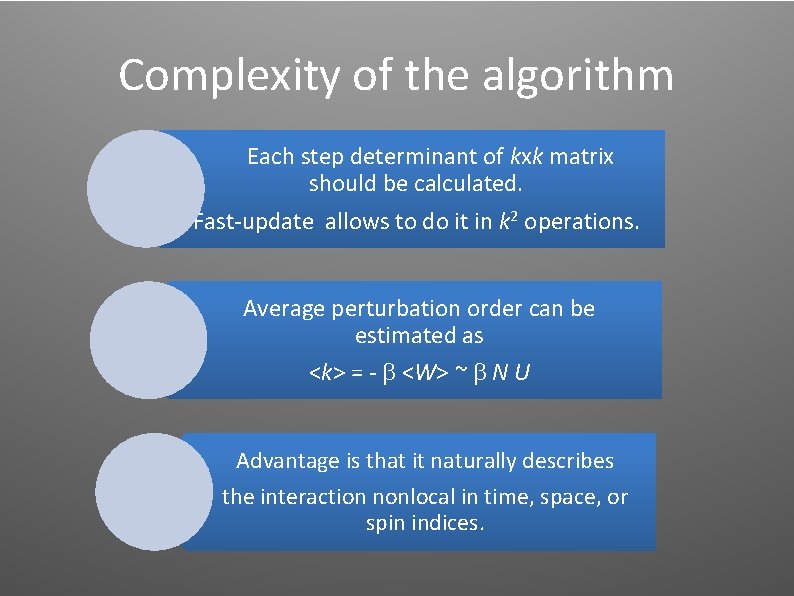
Complexity of the algorithm Each step determinant of kxk matrix should be calculated. Fast-update allows to do it in k 2 operations. Average perturbation order can be estimated as <k> = - b <W> ~ b N U Advantage is that it naturally describes the interaction nonlocal in time, space, or spin indices.
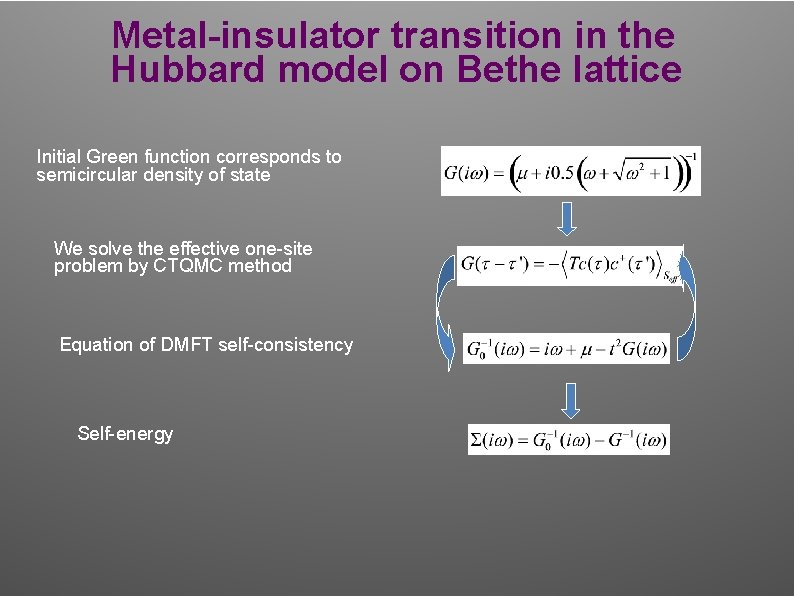
Metal-insulator transition in the Hubbard model on Bethe lattice Initial Green function corresponds to semicircular density of state We solve the effective one-site problem by CTQMC method Equation of DMFT self-consistency Self-energy
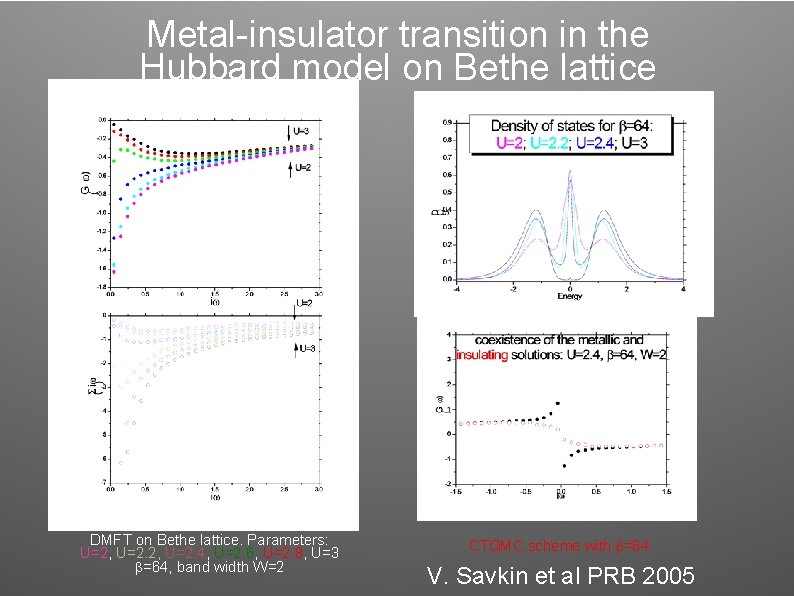
Metal-insulator transition in the Hubbard model on Bethe lattice DMFT on Bethe lattice. Parameters: U=2, U=2. 4, U=2. 6, U=2. 8, U=3 b=64, band width W=2 V. Savkin et al PRB 2005 CTQMC scheme with b=64
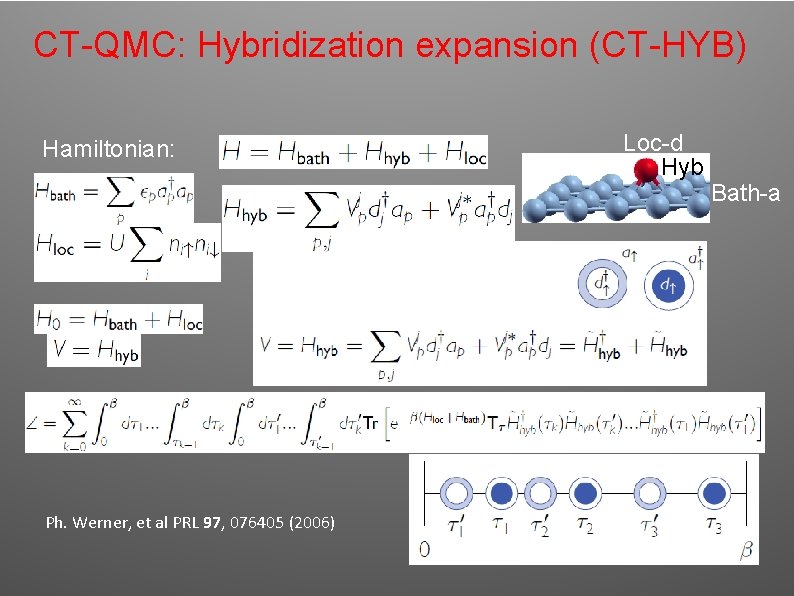
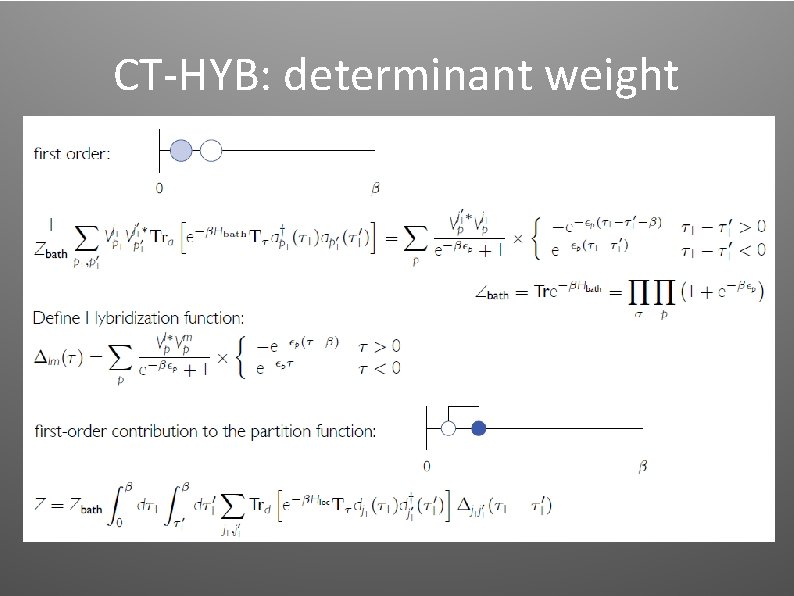
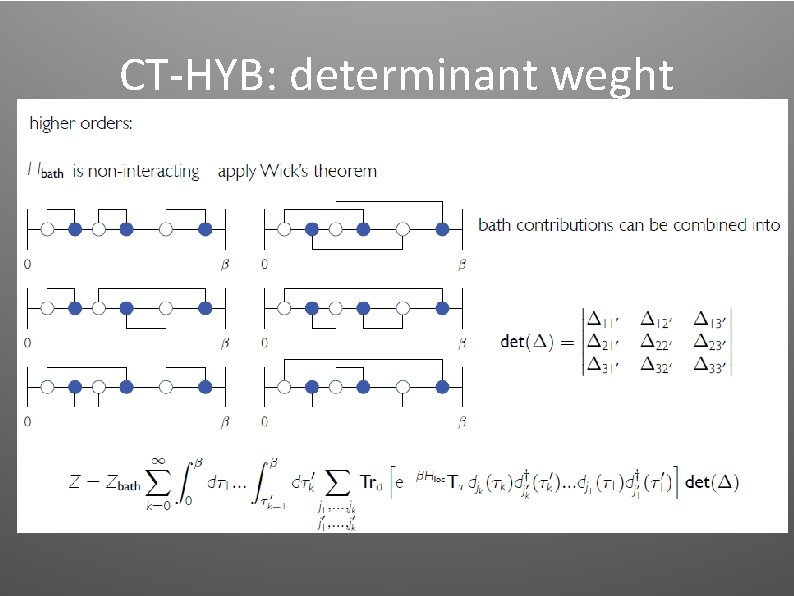
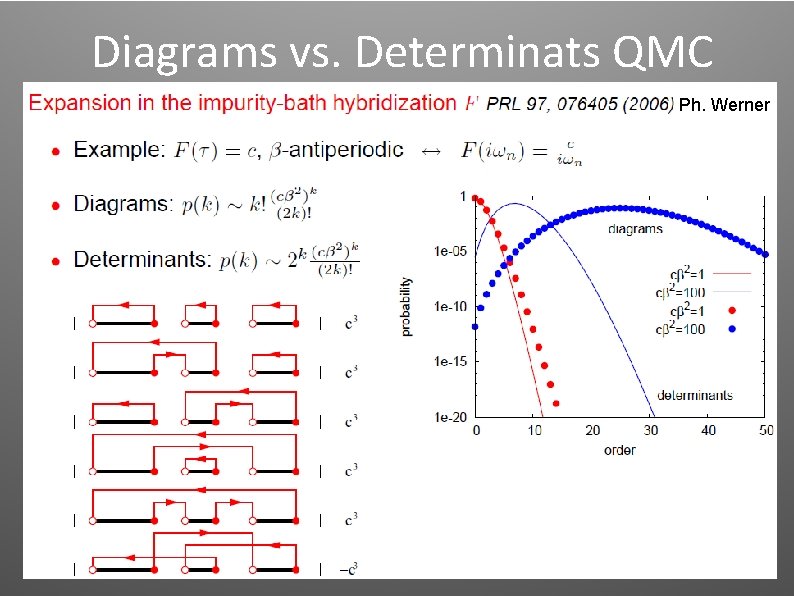
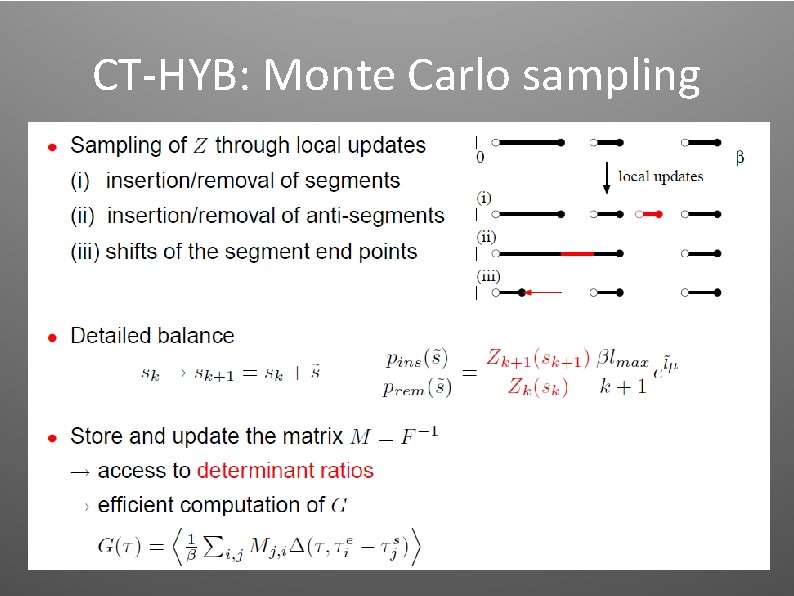
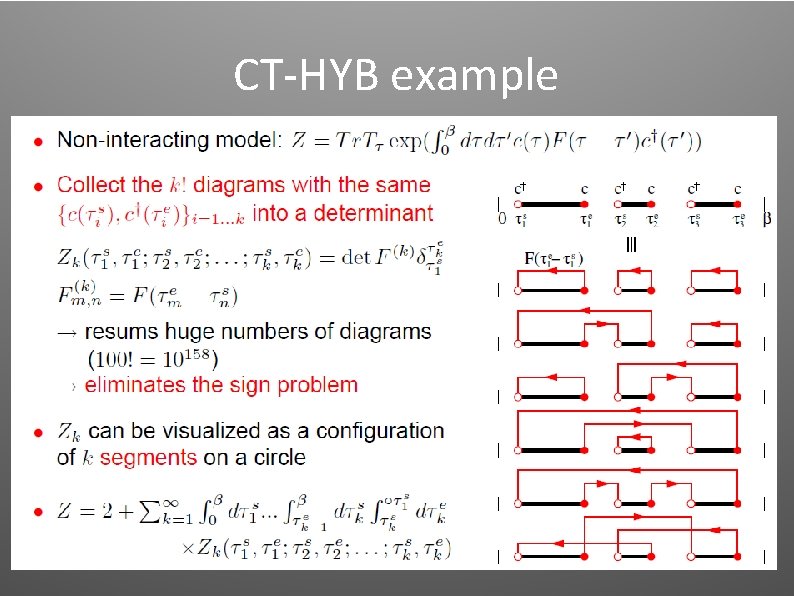
CT-QMC: Hybridization expansion (CT-HYB) Hamiltonian: Ph. Werner, et al PRL 97, 076405 (2006) Loc-d Hyb Bath-a
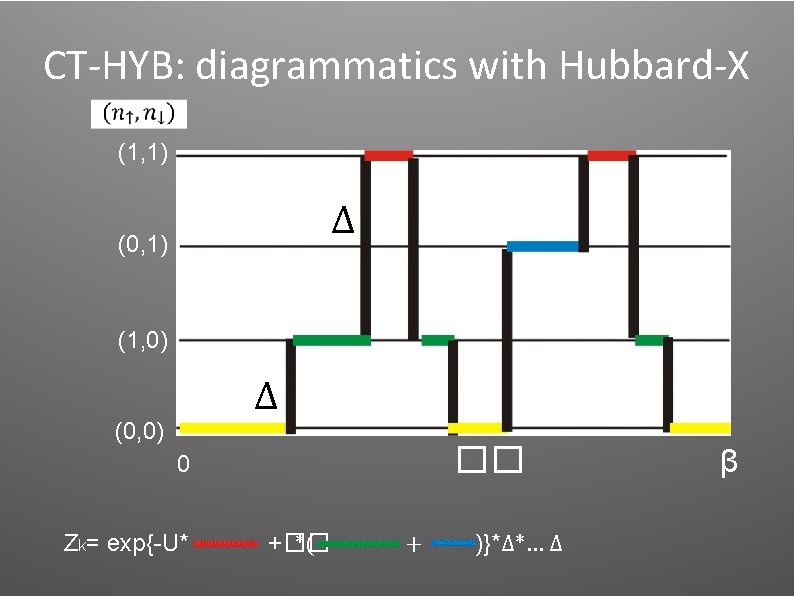
CT-HYB: diagrammatics with Hubbard-X (1, 1) Δ (0, 1) (1, 0) Δ (0, 0) �� 0 Zk= exp{-U* +�� *( + )}*Δ*… Δ β
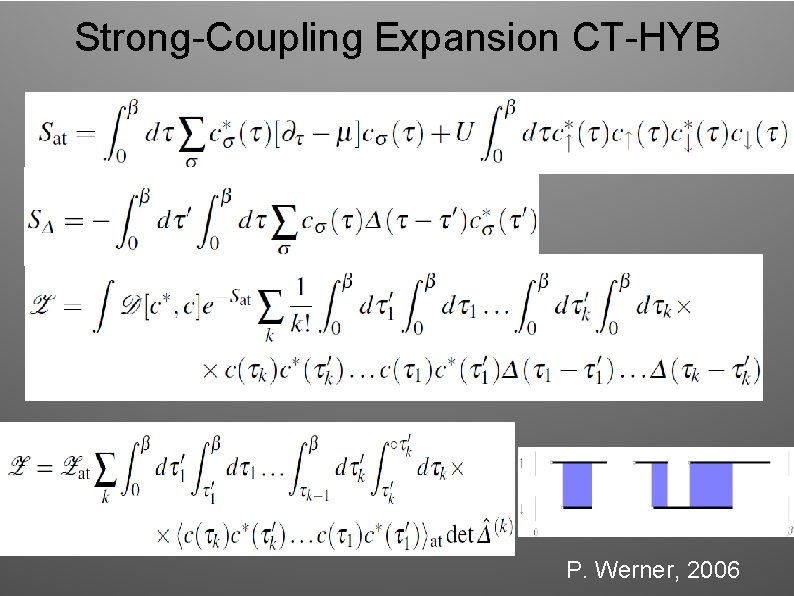
Strong-Coupling Expansion CT-HYB P. Werner, 2006
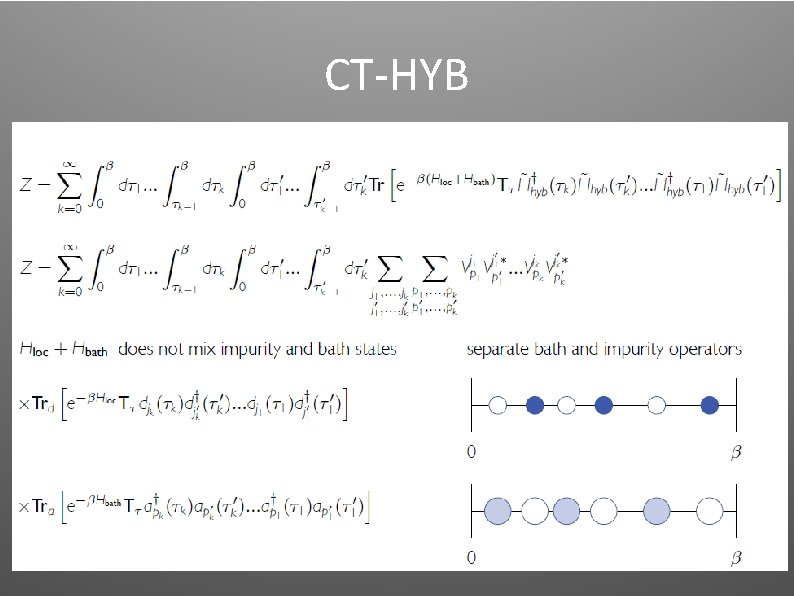
CT-HYB
CT-HYB: determinant weight
CT-HYB: determinant weght
Diagrams vs. Determinats QMC Ph. Werner
CT-HYB: Monte Carlo sampling
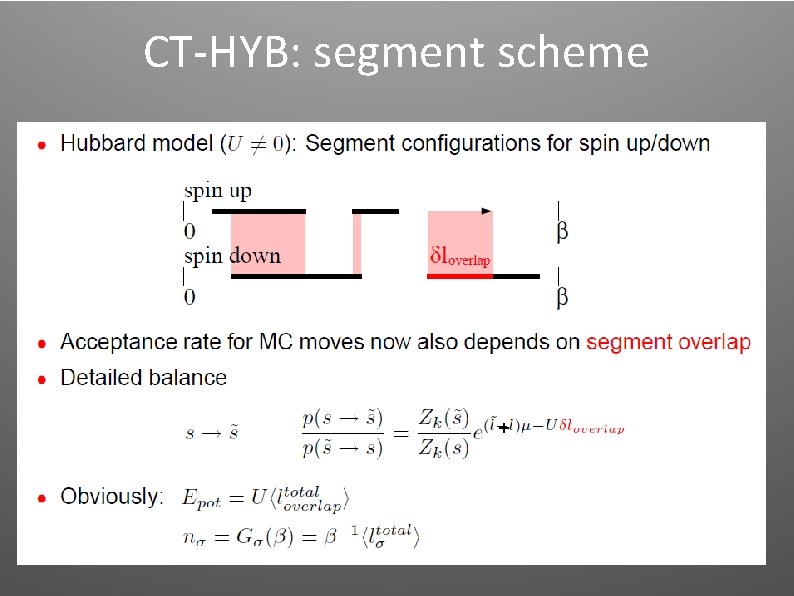
CT-HYB: segment scheme +
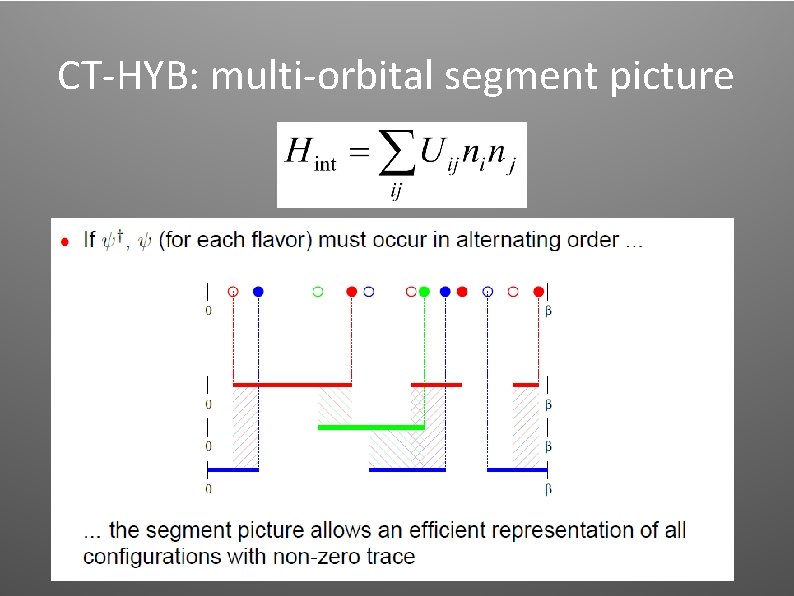
CT-HYB: multi-orbital segment picture
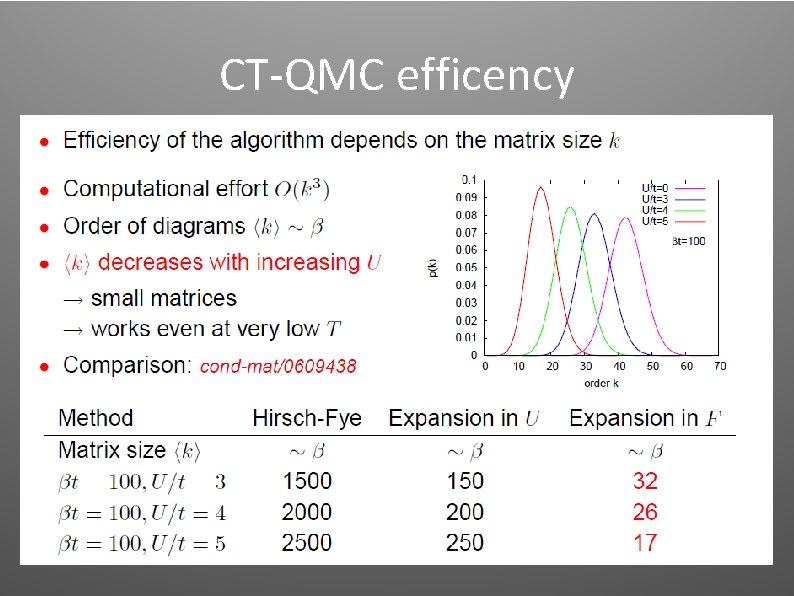
CT-QMC efficency
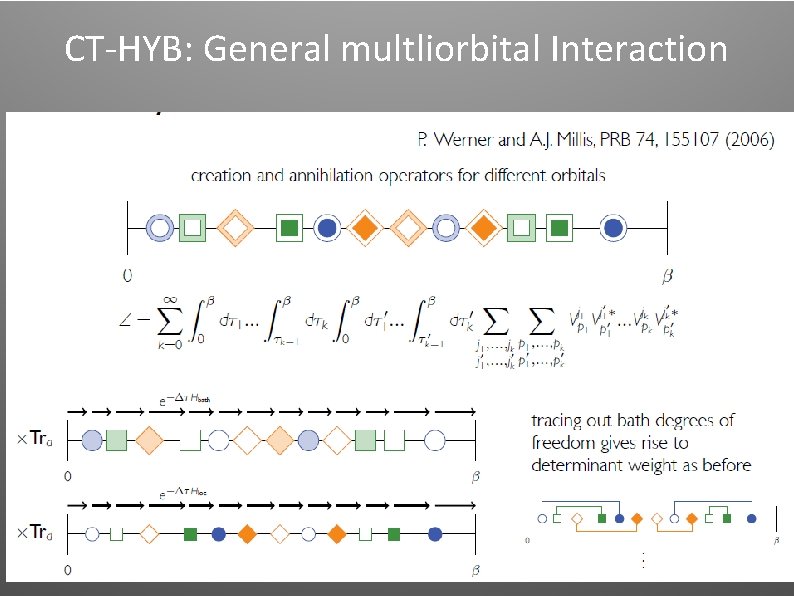
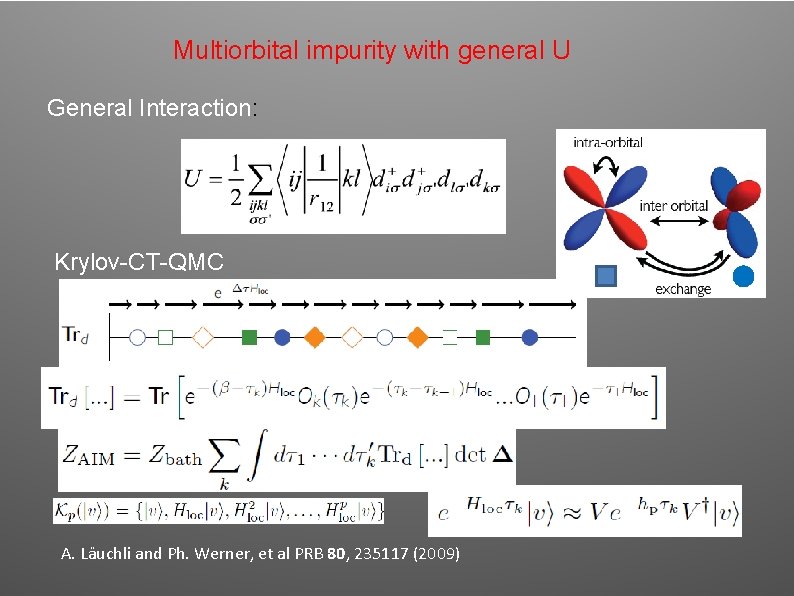
CT-HYB: General multliorbital Interaction
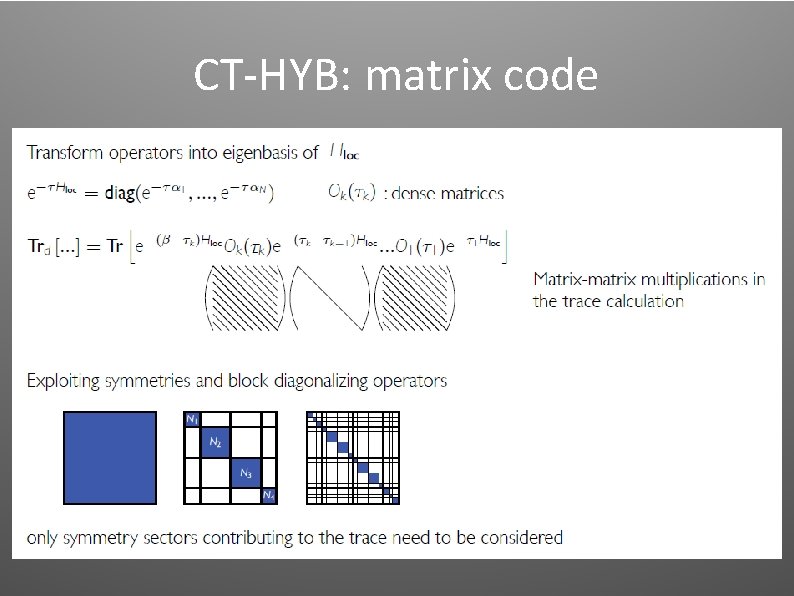
CT-HYB: matrix code
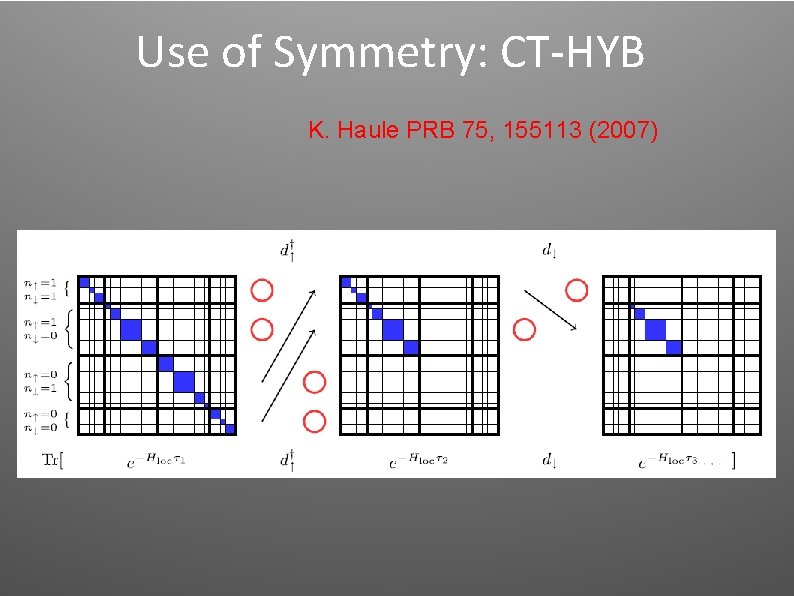
Use of Symmetry: CT-HYB K. Haule PRB 75, 155113 (2007)
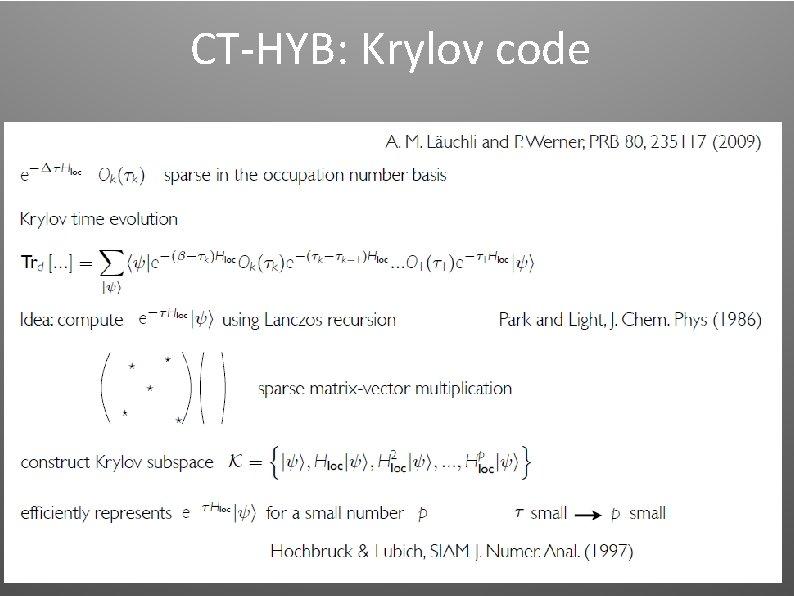
CT-HYB: Krylov code
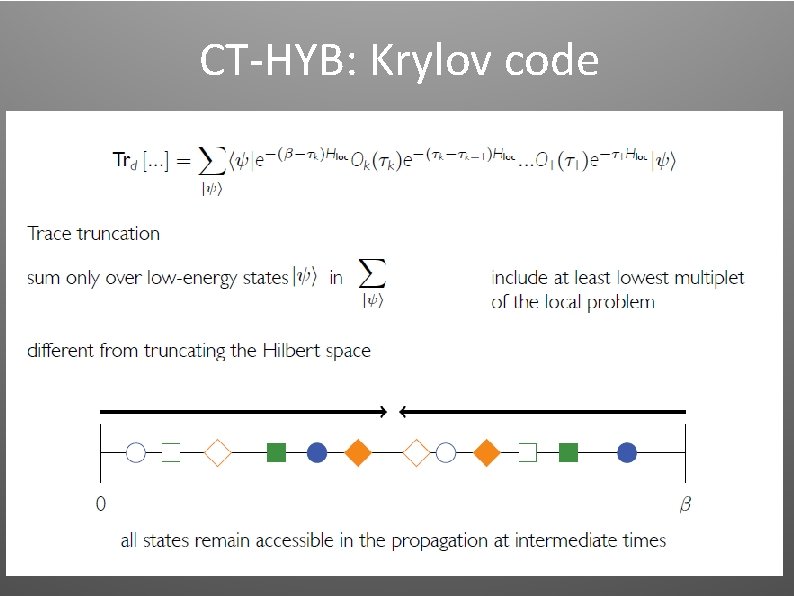
CT-HYB: Krylov code
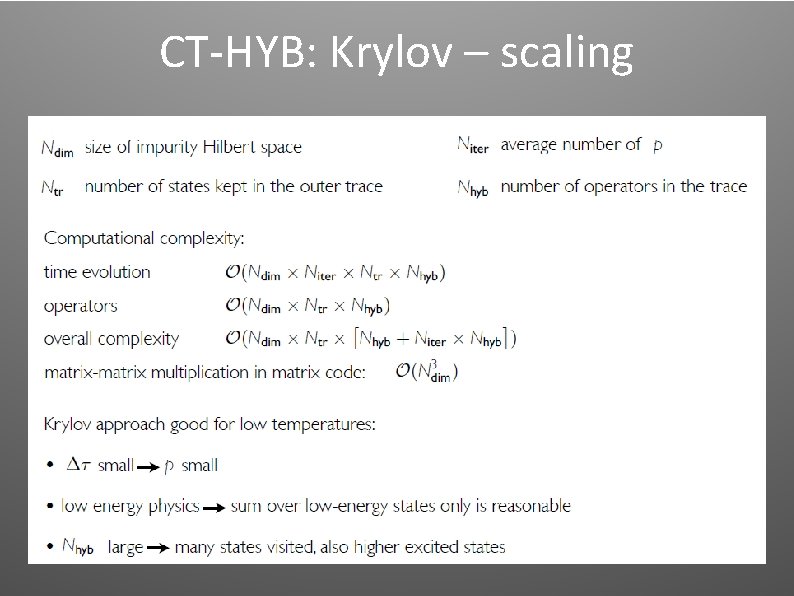
CT-HYB: Krylov – scaling
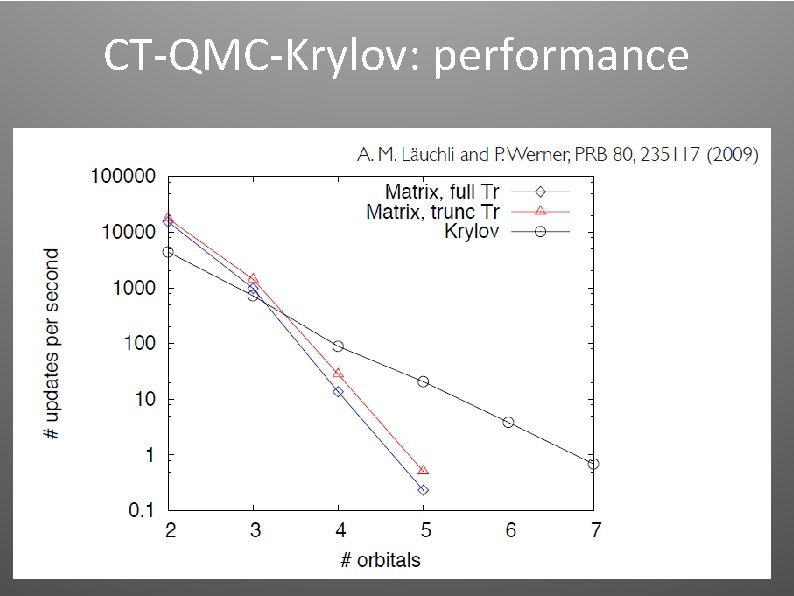
CT-QMC-Krylov: performance
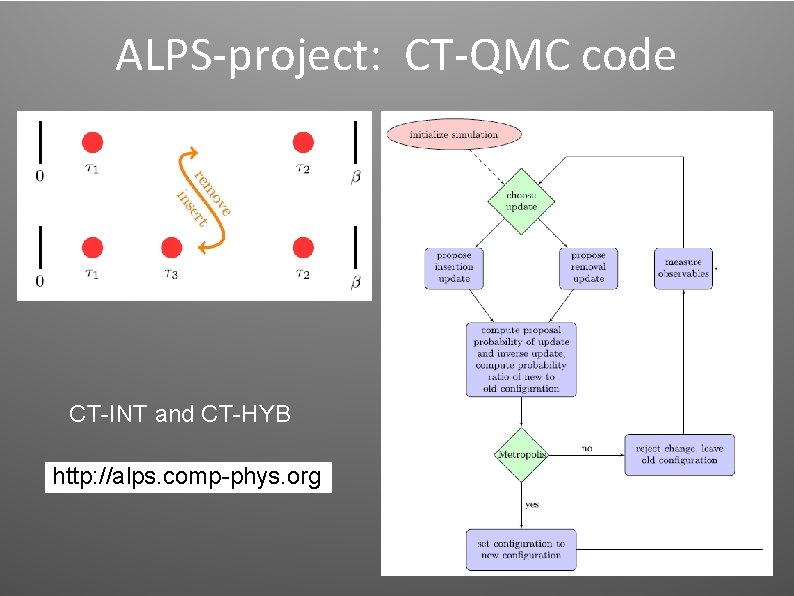
ALPS-project: CT-QMC code CT-INT and CT-HYB http: //alps. comp-phys. org
Continuous Time Monte Carlo methods for fermions Alexander Lichtenstein University of Hamburg In collaboration with A. Rubtsov (Moscow University) P. Werner, B. Surer (ETH Zurich) H. Hafermann (EPL Paris) T. Wehling (University of Bremen) A. Poteryaev (IMF Ekaterinburg)
Impurity solver: miracle of CT-QMC Interaction expansion CT-INT: A. Rubtsov et al, JETP Lett (2004) Hybridization expansion CT-HYB: P. Werner et al, PRL (2006) Efficient Krylov scheme: A. Läuchli and P. Werner, PRB (2009) E. Gull, et al, RMP 83, 349 (2011)
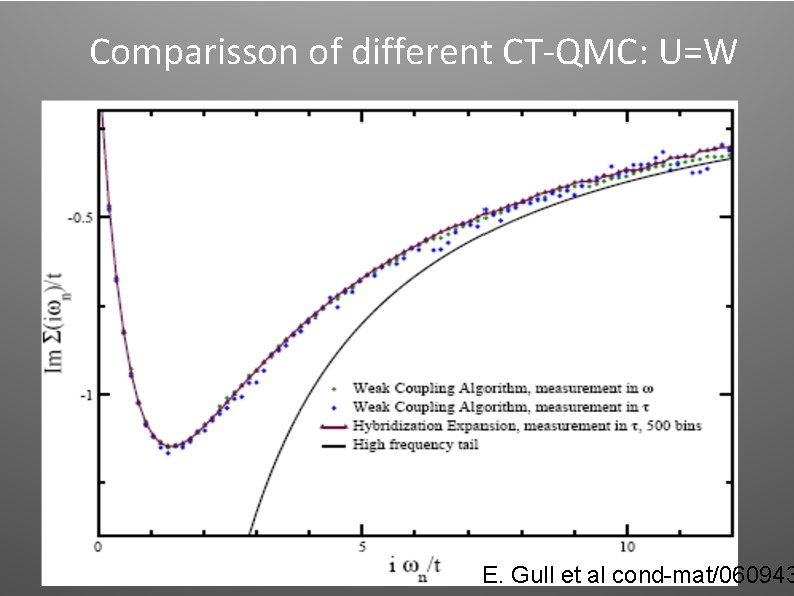
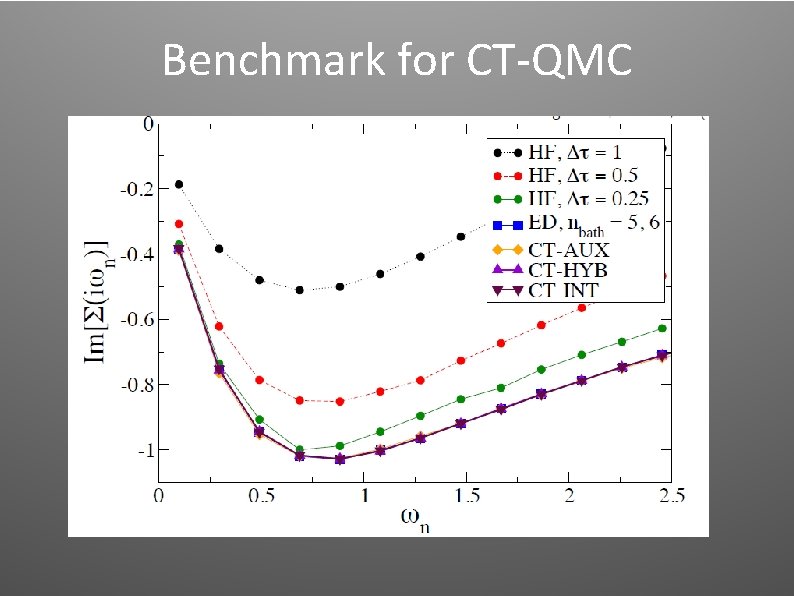
Comparisson of different CT-QMC: U=W E. Gull et al cond-mat/060943
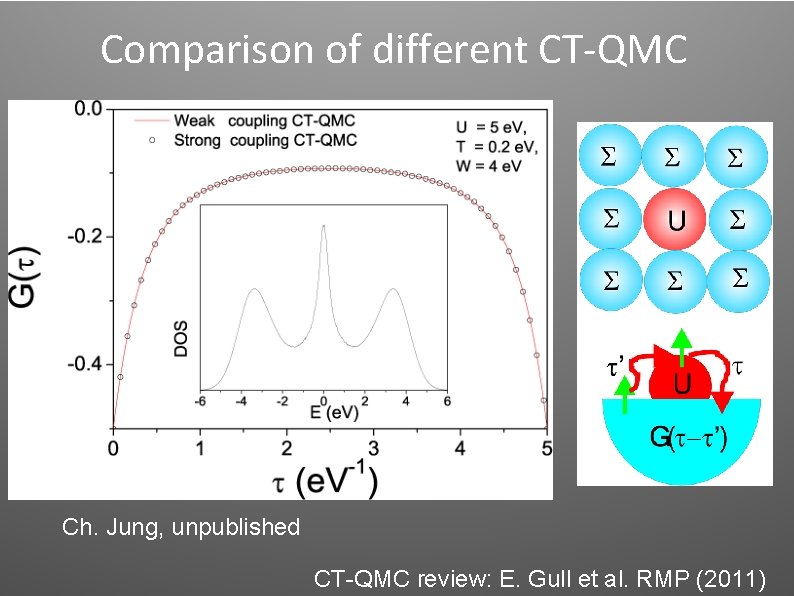
Comparison of different CT-QMC Ch. Jung, unpublished CT-QMC review: E. Gull et al. RMP (2011)
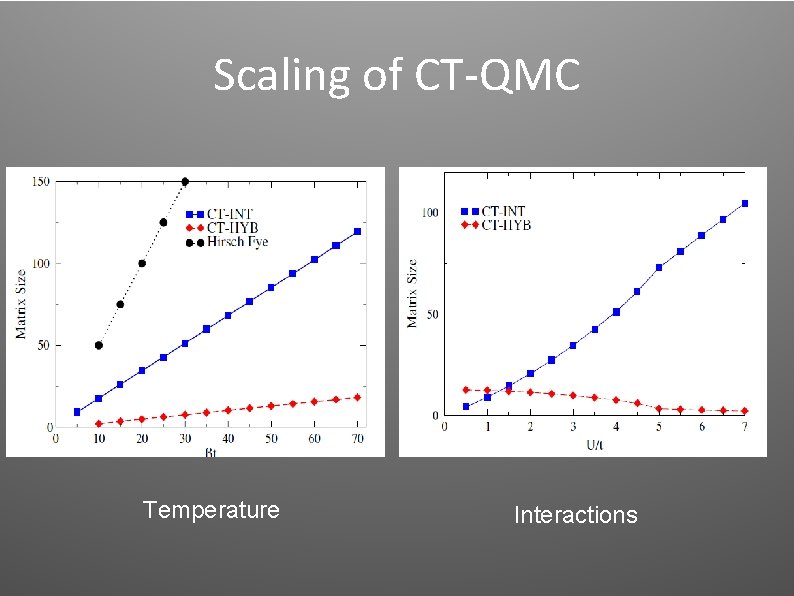
Scaling of CT-QMC Temperature Interactions
Benchmark for CT-QMC
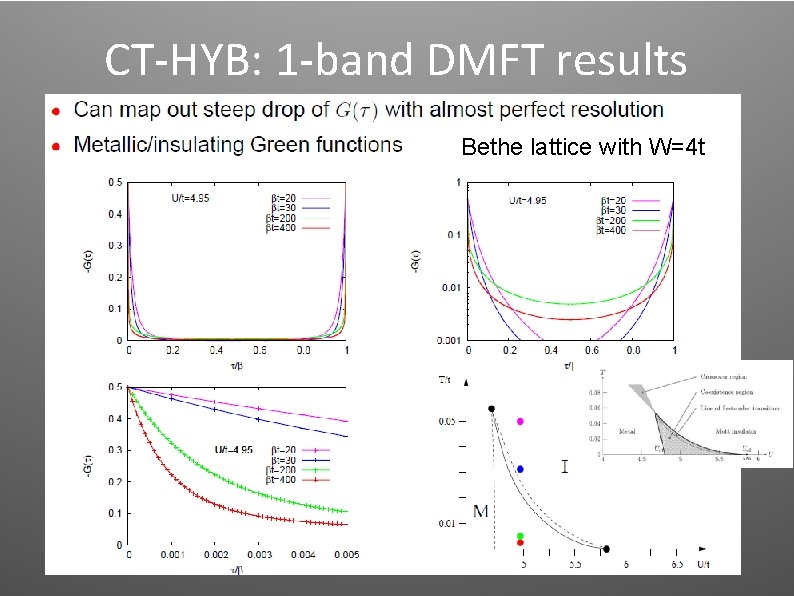
CT-HYB: 1 -band DMFT results Bethe lattice with W=4 t
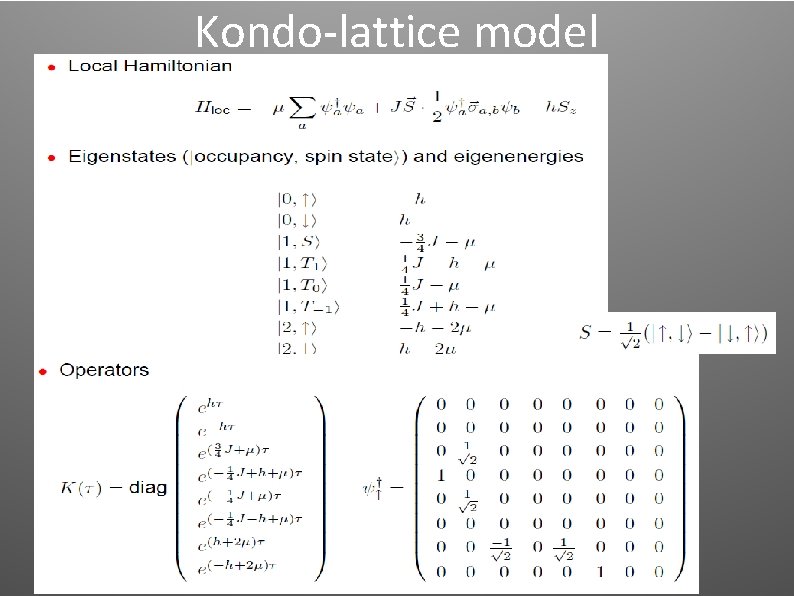
Kondo-lattice model
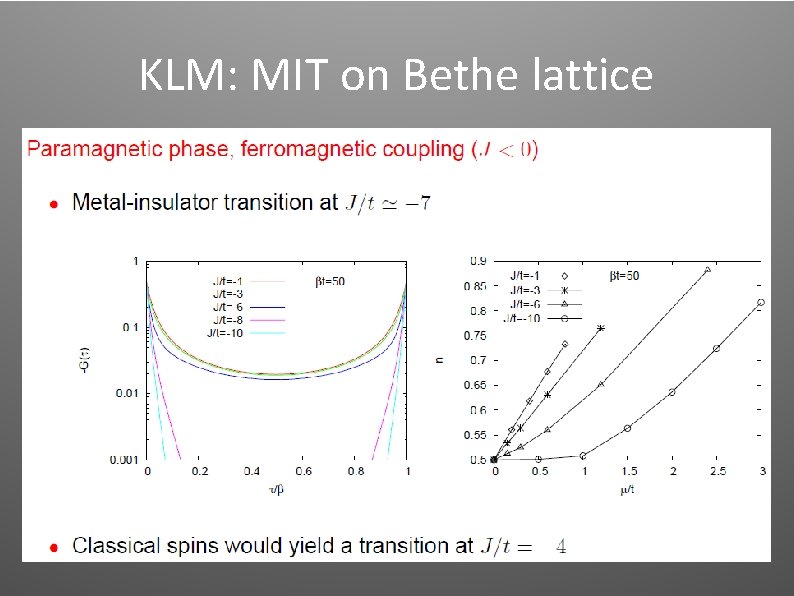
KLM: MIT on Bethe lattice
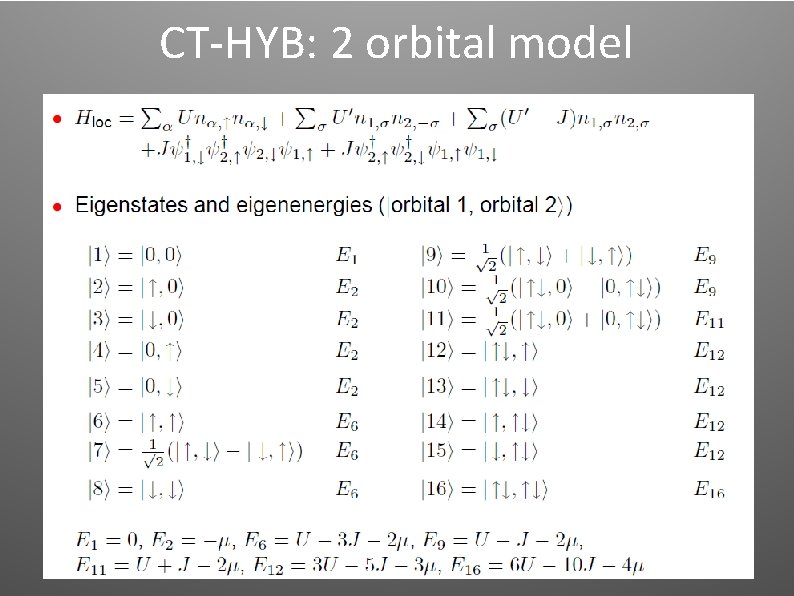
CT-HYB: 2 orbital model
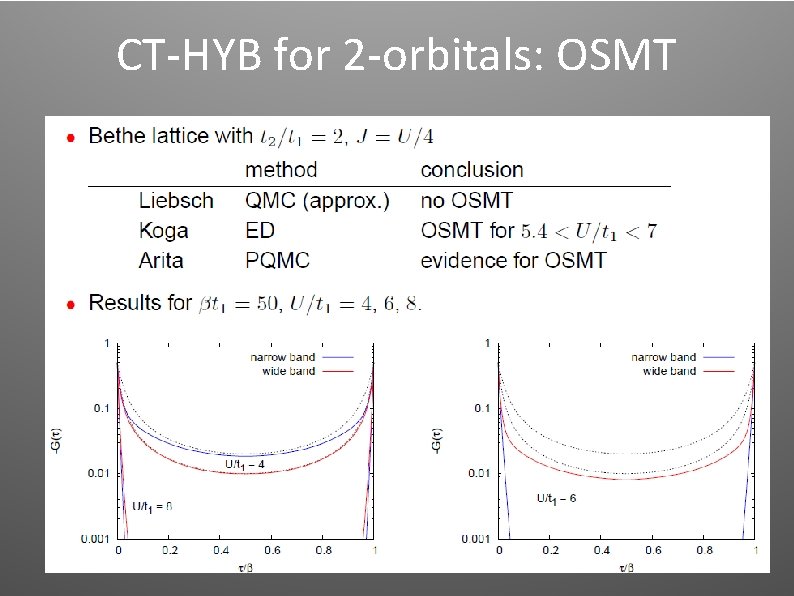
CT-HYB for 2 -orbitals: OSMT
Multiorbital impurity with general U General Interaction: Krylov-CT-QMC A. Läuchli and Ph. Werner, et al PRB 80, 235117 (2009)
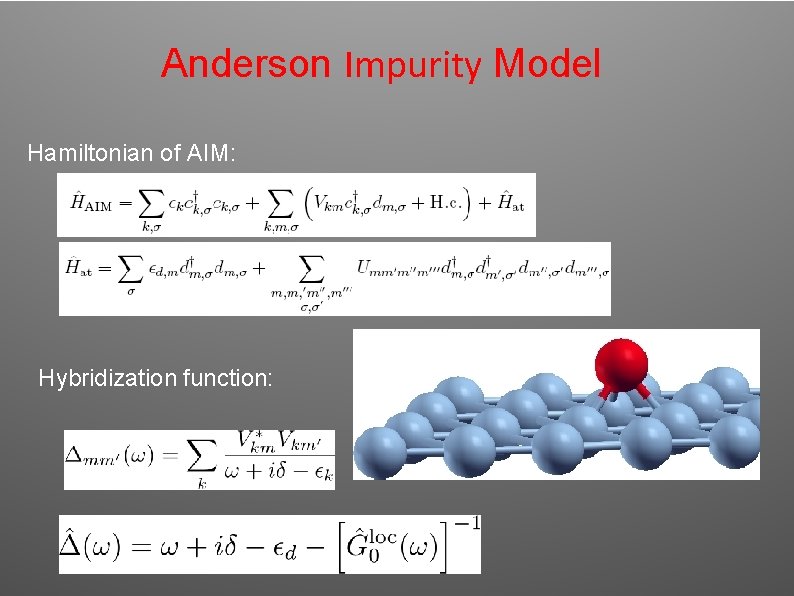
Anderson Impurity Model Hamiltonian of AIM: Hybridization function:
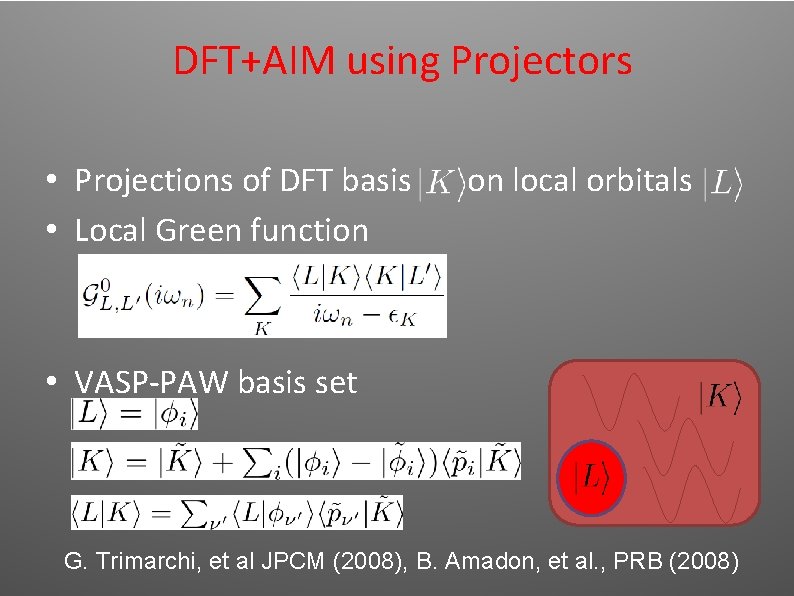
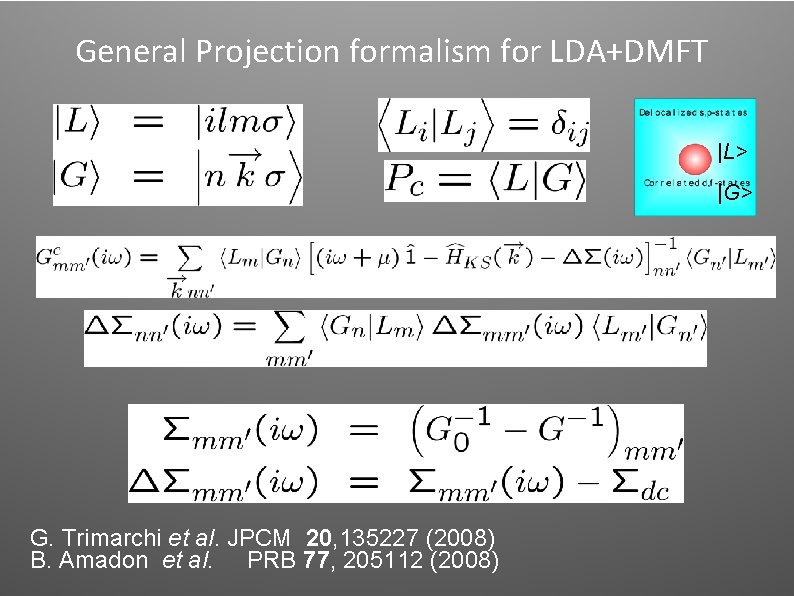
DFT+AIM using Projectors • Projections of DFT basis • Local Green function on local orbitals • VASP-PAW basis set G. Trimarchi, et al JPCM (2008), B. Amadon, et al. , PRB (2008)
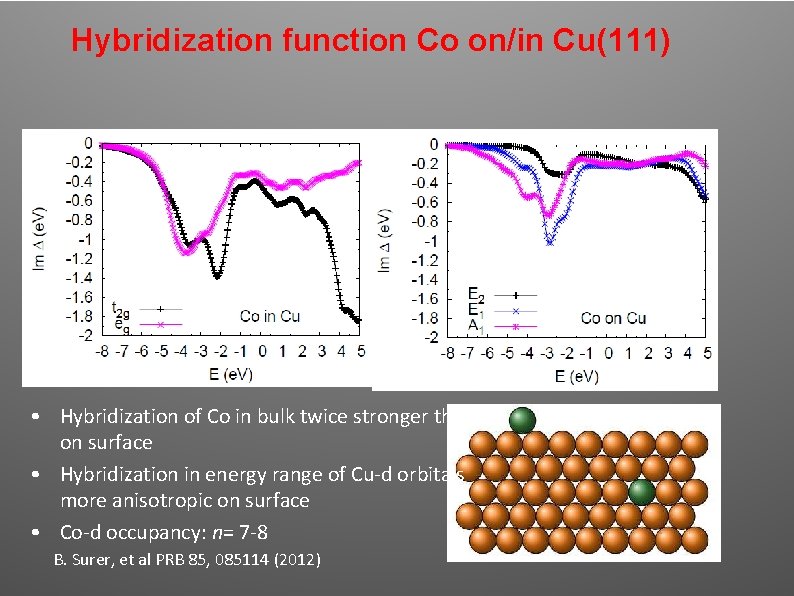
Hybridization function Co on/in Cu(111) • Hybridization of Co in bulk twice stronger than on surface • Hybridization in energy range of Cu-d orbitals more anisotropic on surface • Co-d occupancy: n= 7 -8 B. Surer, et al PRB 85, 085114 (2012)
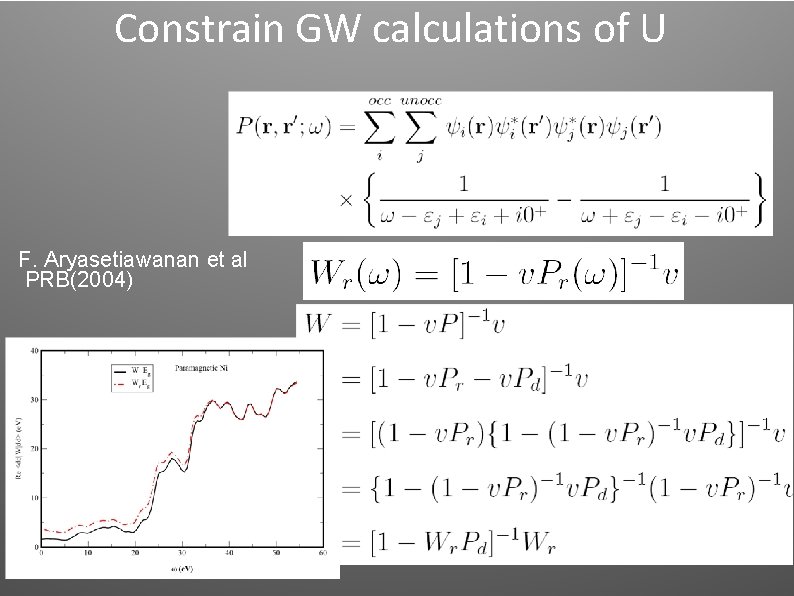
Constrain GW calculations of U F. Aryasetiawanan et al PRB(2004)
Wannier - GW and effective U( ) T. Miyake and F. Aryasetiawan Phys. Rev. B 77, 085122 (2008) C-GW GW
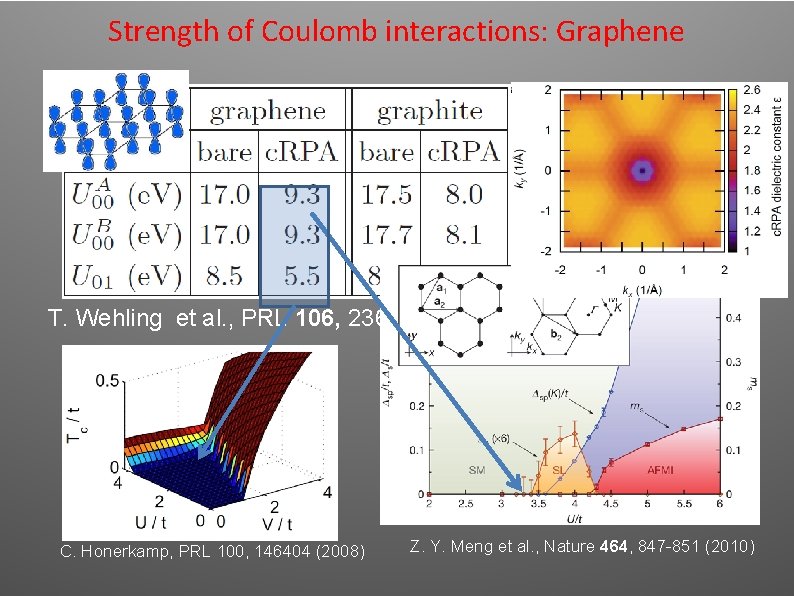
Strength of Coulomb interactions: Graphene T. Wehling et al. , PRL 106, 236805 (2011) C. Honerkamp, PRL 100, 146404 (2008) Z. Y. Meng et al. , Nature 464, 847 -851 (2010)
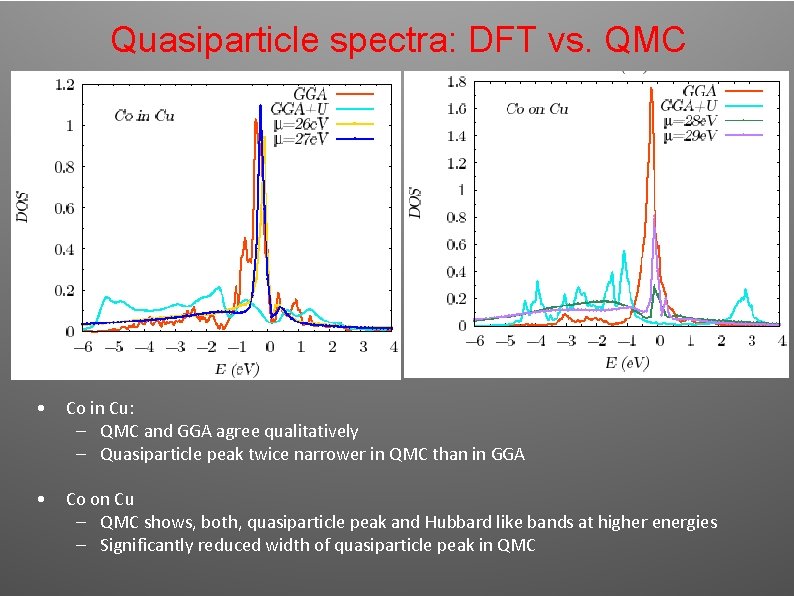
Quasiparticle spectra: DFT vs. QMC • Co in Cu: – QMC and GGA agree qualitatively – Quasiparticle peak twice narrower in QMC than in GGA • Co on Cu – QMC shows, both, quasiparticle peak and Hubbard like bands at higher energies – Significantly reduced width of quasiparticle peak in QMC
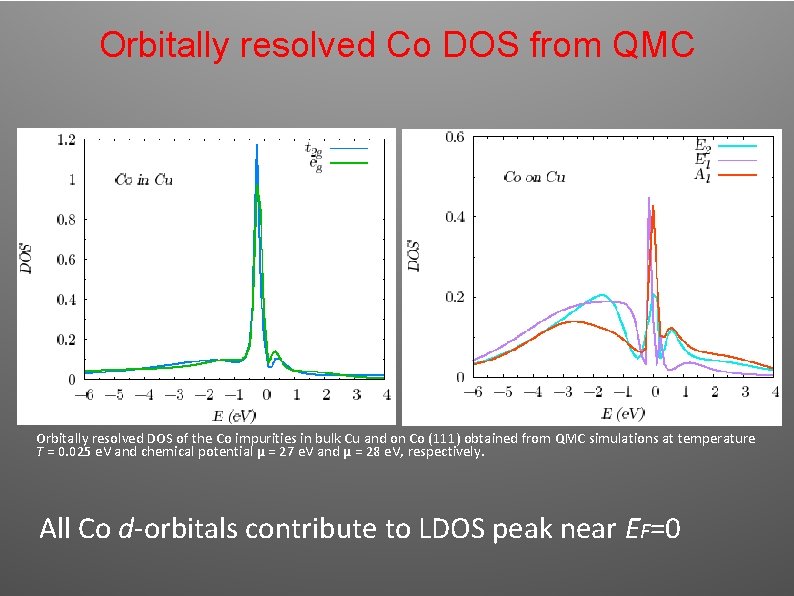
Orbitally resolved Co DOS from QMC Orbitally resolved DOS of the Co impurities in bulk Cu and on Co (111) obtained from QMC simulations at temperature T = 0. 025 e. V and chemical potential μ = 27 e. V and μ = 28 e. V, respectively. All Co d-orbitals contribute to LDOS peak near EF=0
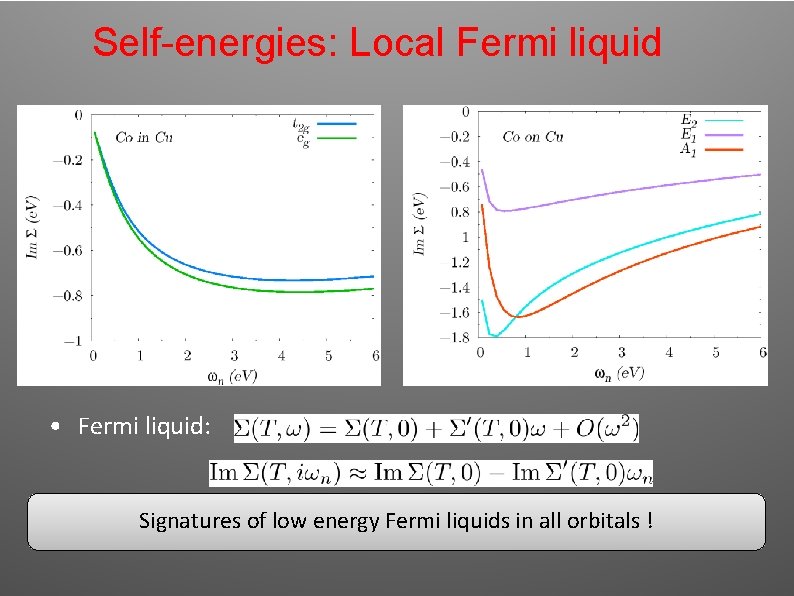
Self-energies: Local Fermi liquid • Fermi liquid: • Atomic limit: of low energy Fermi liquids in all orbitals ! Signatures
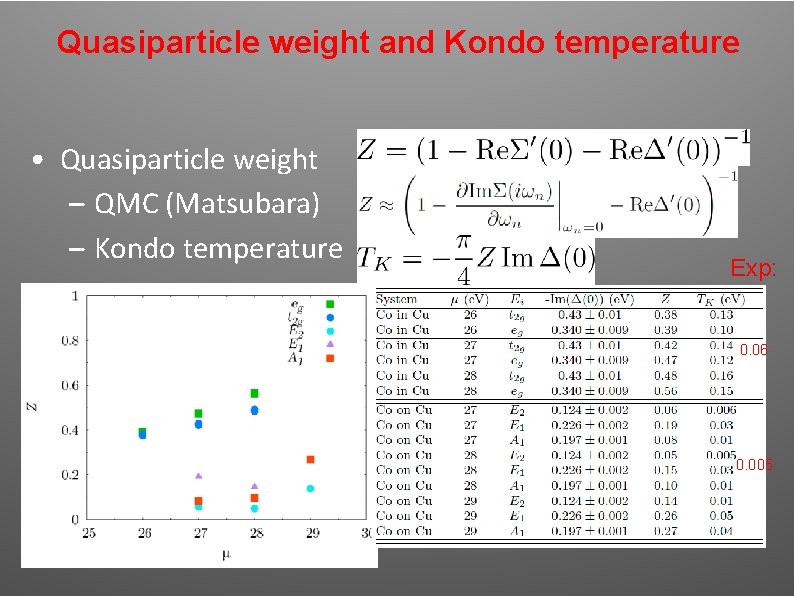
Quasiparticle weight and Kondo temperature • Quasiparticle weight – QMC (Matsubara) – Kondo temperature Exp: 0. 06 0. 005
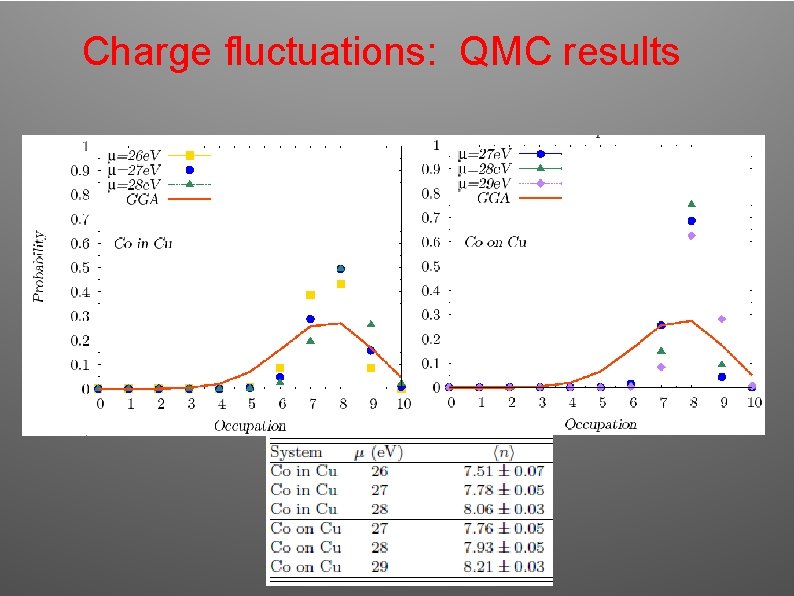
Charge fluctuations: QMC results
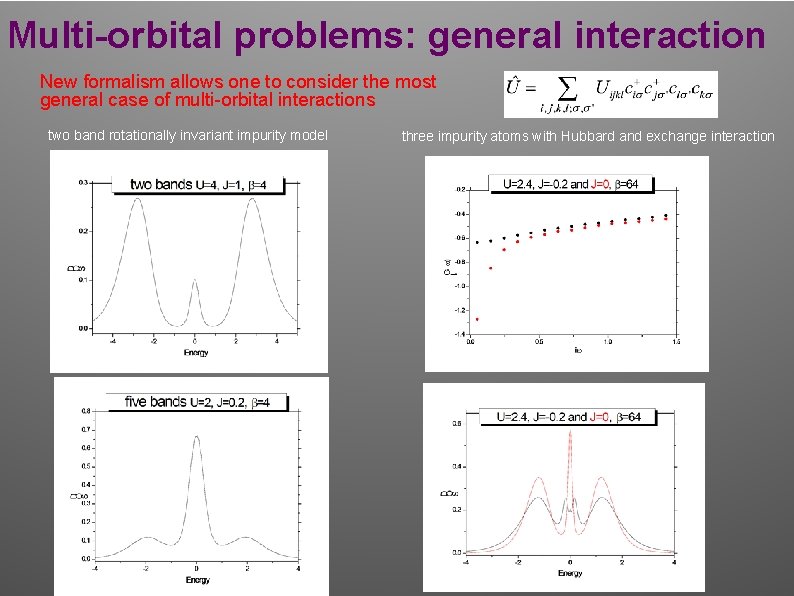
Multi-orbital problems: general interaction New formalism allows one to consider the most general case of multi-orbital interactions two band rotationally invariant impurity model three impurity atoms with Hubbard and exchange interaction
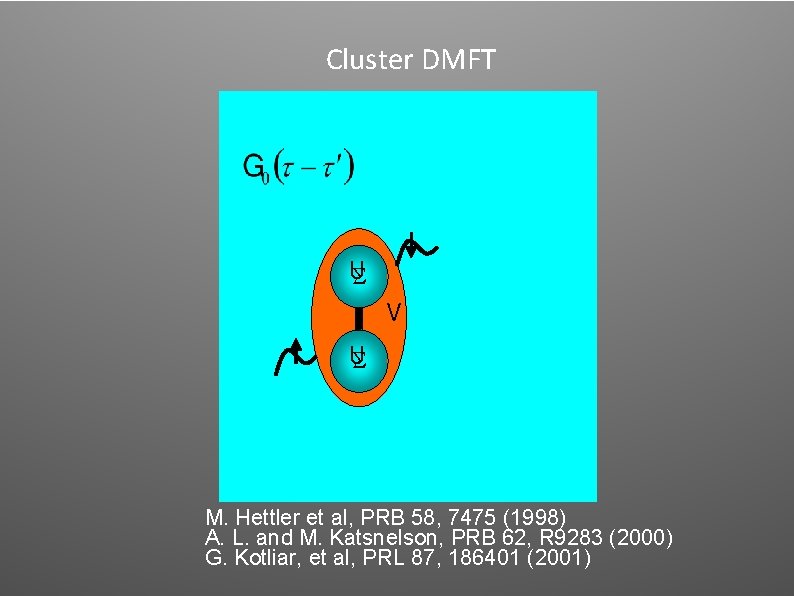
Cluster DMFT S S S U S S S V S U S S S S M. Hettler et al, PRB 58, 7475 (1998) A. L. and M. Katsnelson, PRB 62, R 9283 (2000) G. Kotliar, et al, PRL 87, 186401 (2001)
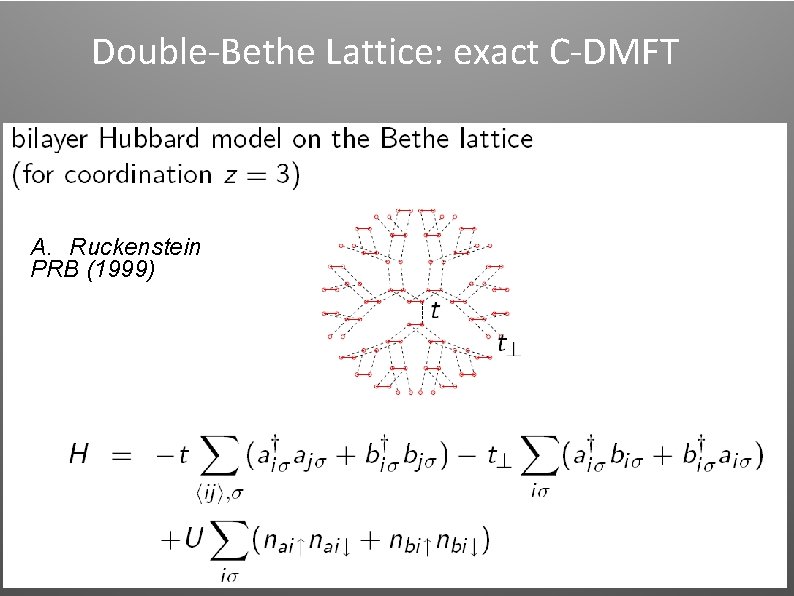
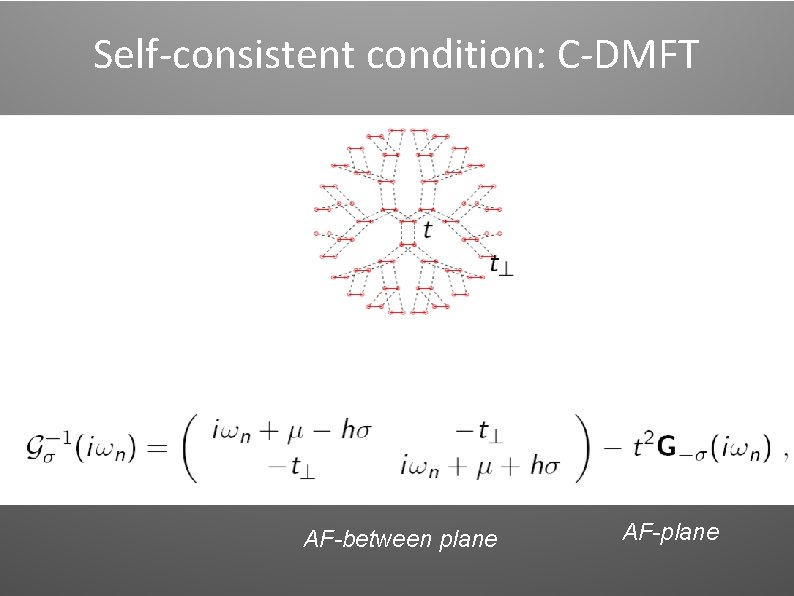
Double-Bethe Lattice: exact C-DMFT A. Ruckenstein PRB (1999)
Self-consistent condition: C-DMFT AF-between plane AF-plane
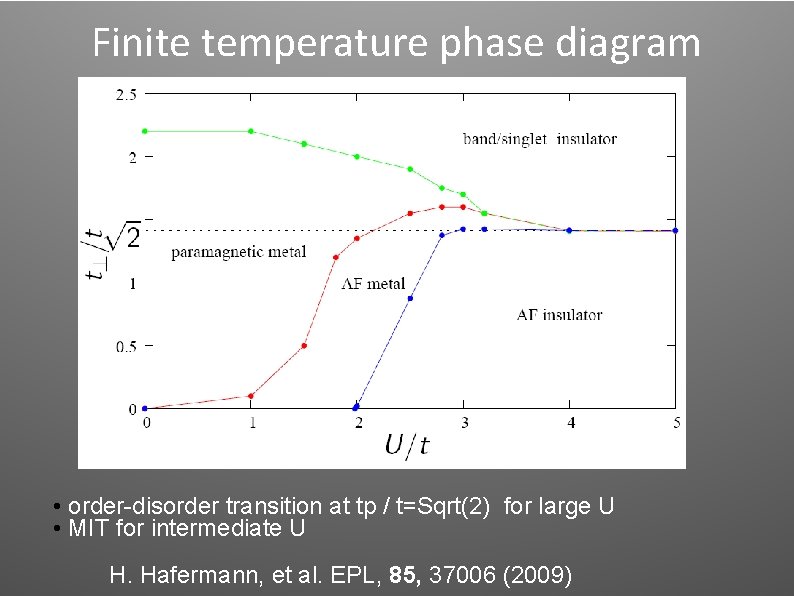
Finite temperature phase diagram • order-disorder transition at tp / t=Sqrt(2) for large U • MIT for intermediate U H. Hafermann, et al. EPL, 85, 37006 (2009)
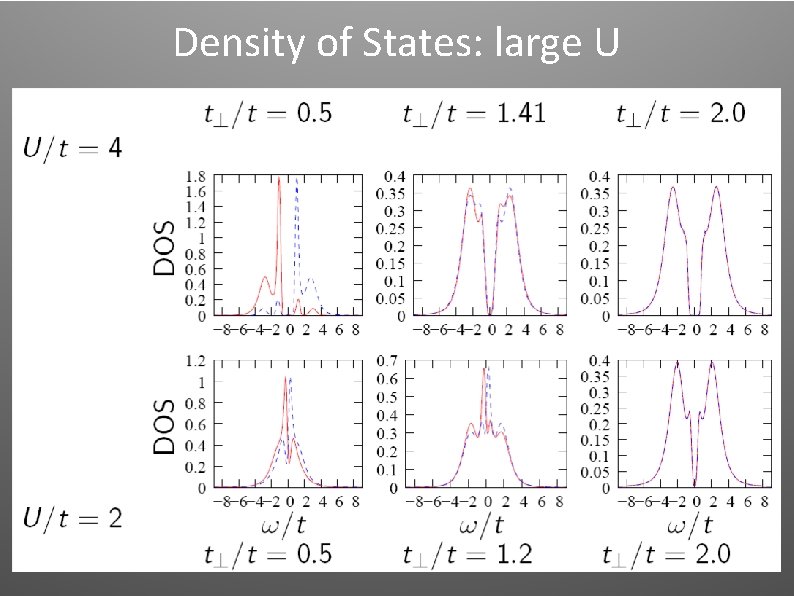
Density of States: large U
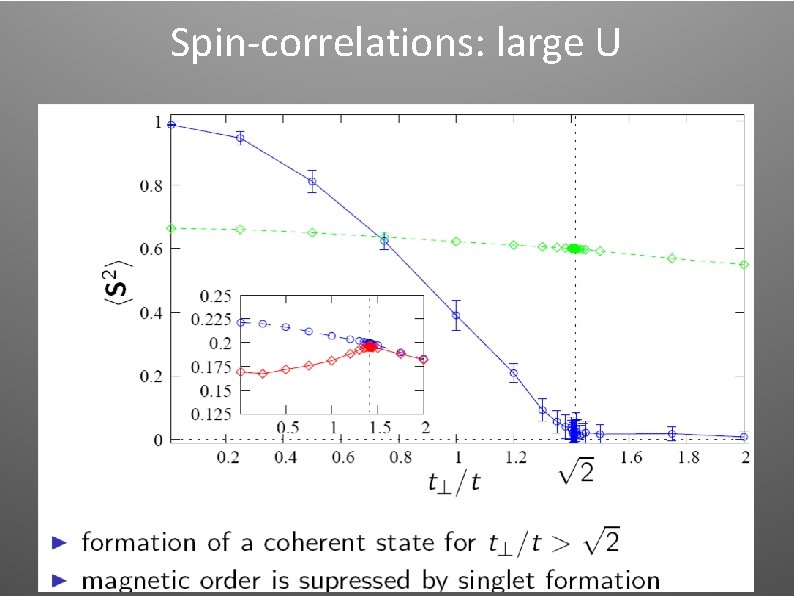
Spin-correlations: large U
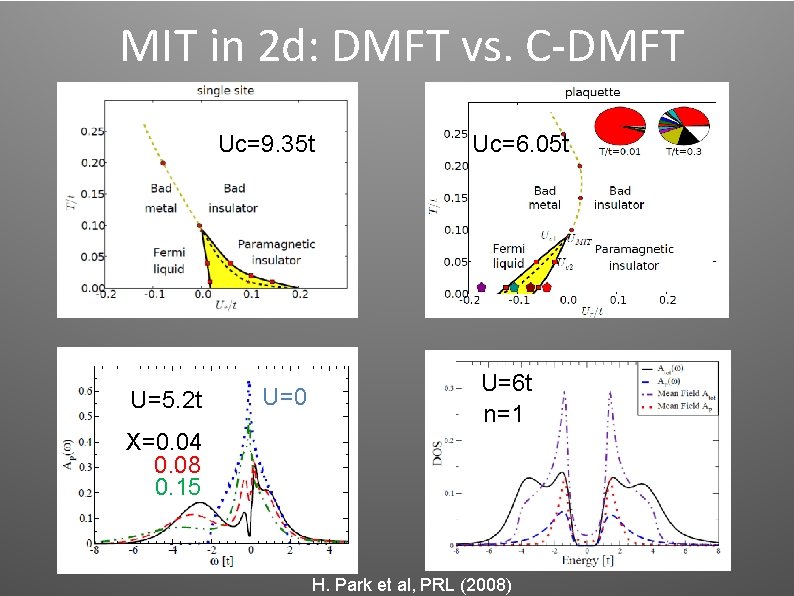
MIT in 2 d: DMFT vs. C-DMFT Uc=9. 35 t U=5. 2 t U=0 Uc=6. 05 t U=6 t n=1 X=0. 04 0. 08 0. 15 H. Park et al, PRL (2008)
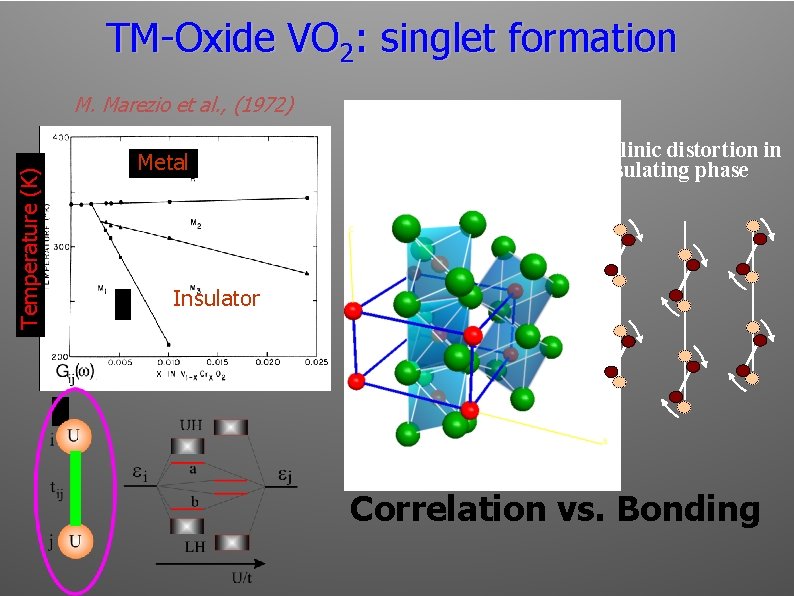
TM-Oxide VO 2: singlet formation Temperature (K) M. Marezio et al. , (1972) Metal Rutile structure Monoclinic distortion in the insulating phase Insulator Correlation vs. Bonding
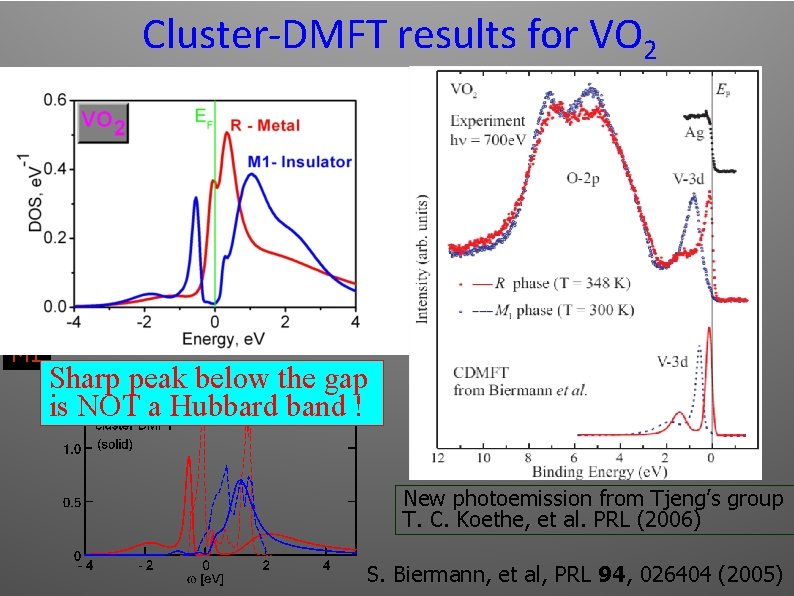
Cluster-DMFT results for VO 2 Rutile M 1 U = 4 e. V, J=0. 68 e. V b = 20 e. V-1 Sharp peak below the gap is NOT a Hubbard band ! New photoemission from Tjeng’s group T. C. Koethe, et al. PRL (2006) S. Biermann, et al, PRL 94, 026404 (2005)
Conclusions • Electronic Structure of correlated nano-systems can be described in CT-QMC scheme • CT-QMC is perfect for supercomputer applications
General Projection formalism for LDA+DMFT |L> |G> G. Trimarchi et al. JPCM 20, 135227 (2008) B. Amadon et al. PRB 77, 205112 (2008)
CT-HYB example