
Continuous StateSpace Models for Optimal Sepsis Treatment a
- Slides: 14
Continuous State-Space Models for Optimal Sepsis Treatment - a Deep Reinforcement Learning Approach A Raghu, M Komorowski, LA Celi, P Szolovits, M Ghassemi Computer Science and Artificial Intelligence Lab, MIT Speaker : seunghwa back July 16, 2020 Operations Research Laboratory
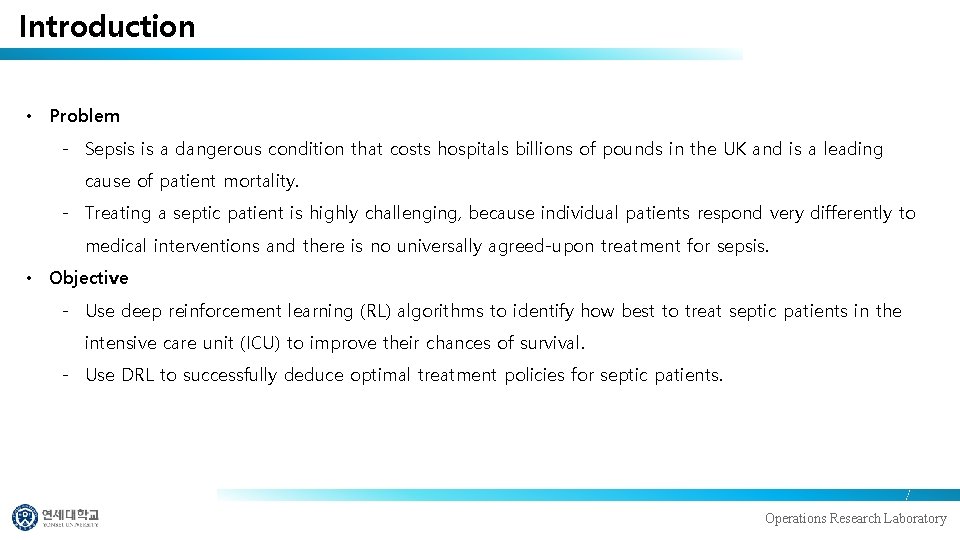
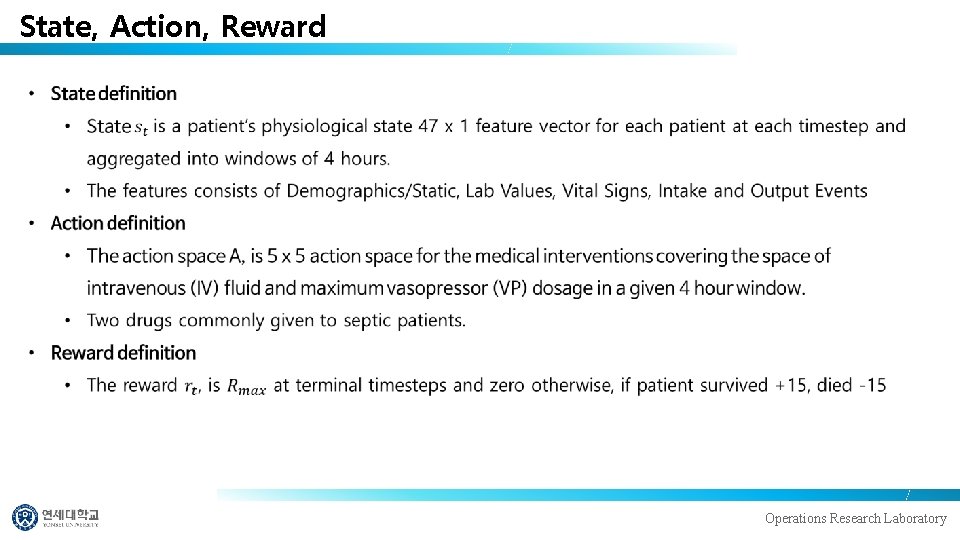
Introduction • Problem - Sepsis is a dangerous condition that costs hospitals billions of pounds in the UK and is a leading cause of patient mortality. - Treating a septic patient is highly challenging, because individual patients respond very differently to medical interventions and there is no universally agreed-upon treatment for sepsis. • Objective - Use deep reinforcement learning (RL) algorithms to identify how best to treat septic patients in the intensive care unit (ICU) to improve their chances of survival. - Use DRL to successfully deduce optimal treatment policies for septic patients. Operations Research Laboratory
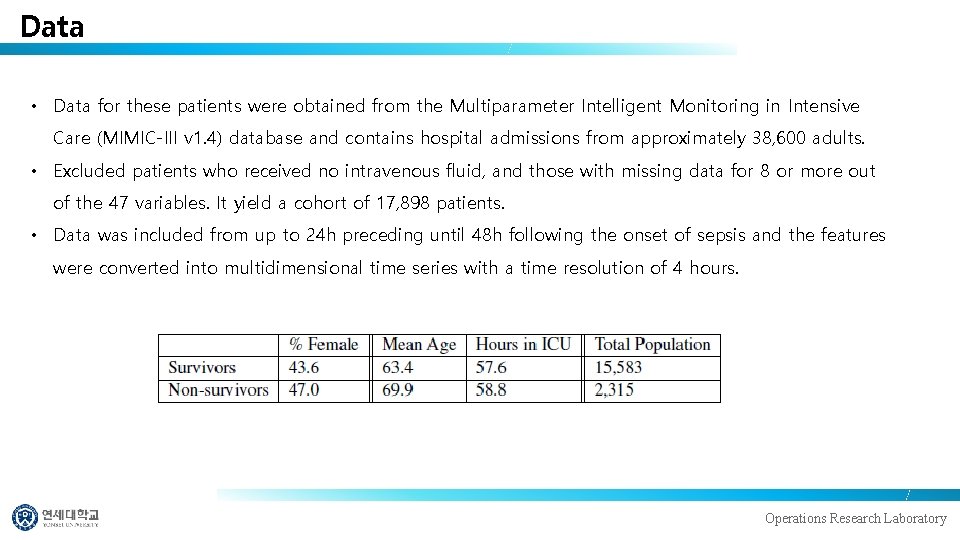
Data • Data for these patients were obtained from the Multiparameter Intelligent Monitoring in Intensive Care (MIMIC-III v 1. 4) database and contains hospital admissions from approximately 38, 600 adults. • Excluded patients who received no intravenous fluid, and those with missing data for 8 or more out of the 47 variables. It yield a cohort of 17, 898 patients. • Data was included from up to 24 h preceding until 48 h following the onset of sepsis and the features were converted into multidimensional time series with a time resolution of 4 hours. Operations Research Laboratory
State, Action, Reward Operations Research Laboratory
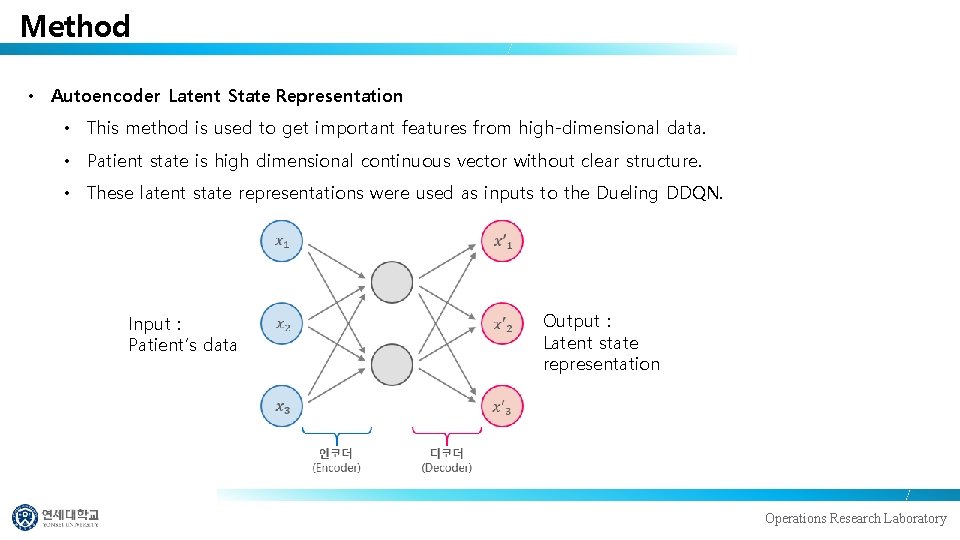
Method • Autoencoder Latent State Representation • This method is used to get important features from high-dimensional data. • Patient state is high dimensional continuous vector without clear structure. • These latent state representations were used as inputs to the Dueling DDQN. Input : Patient’s data Output : Latent state representation Operations Research Laboratory
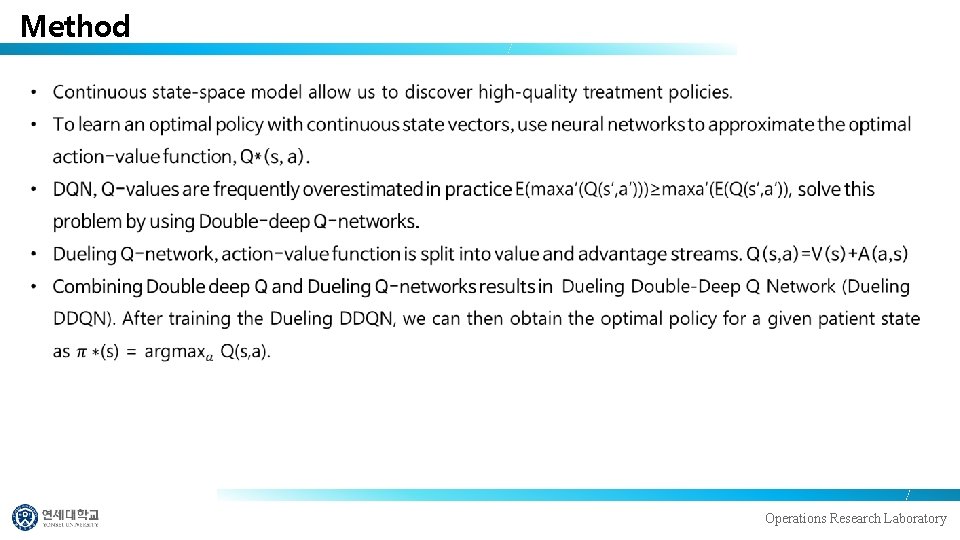
Method Operations Research Laboratory
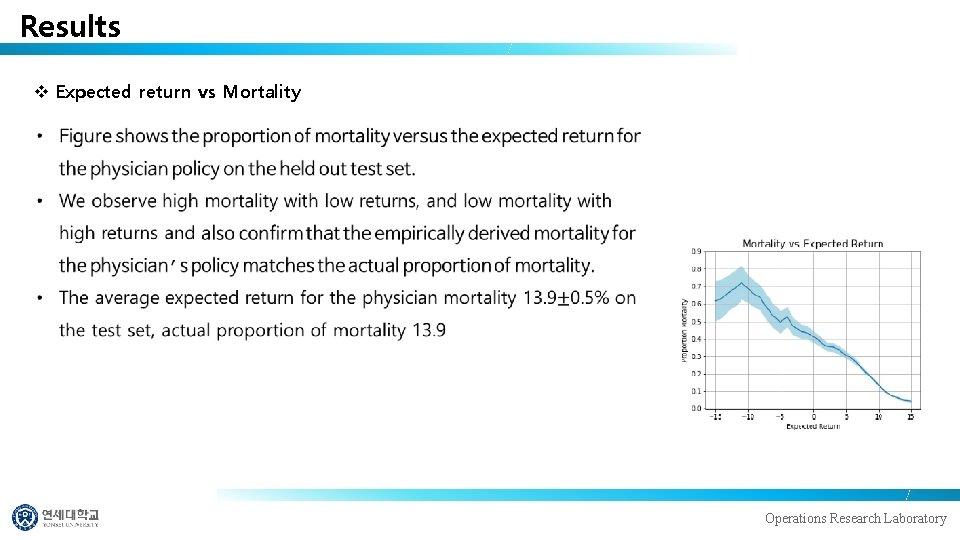
Results v Expected return vs Mortality Operations Research Laboratory
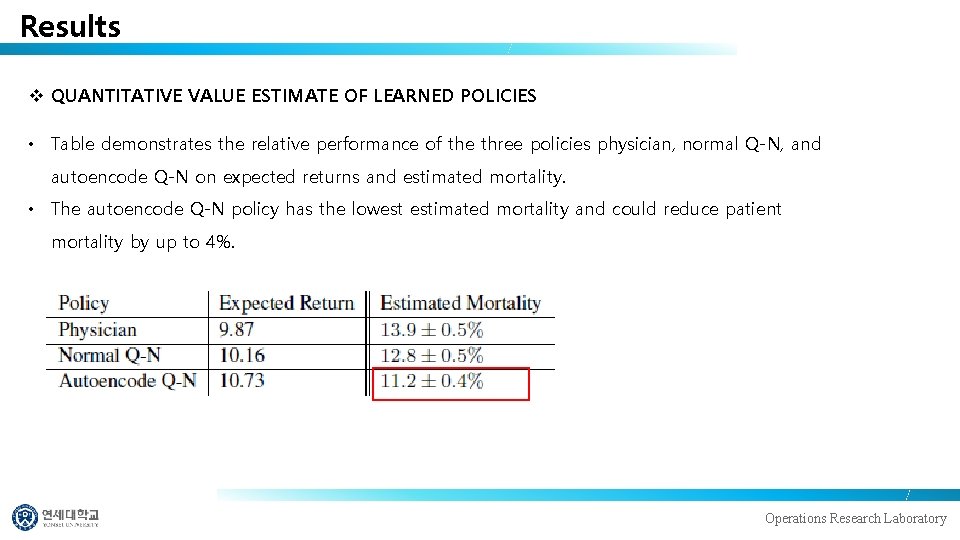
Results v QUANTITATIVE VALUE ESTIMATE OF LEARNED POLICIES • Table demonstrates the relative performance of the three policies physician, normal Q-N, and autoencode Q-N on expected returns and estimated mortality. • The autoencode Q-N policy has the lowest estimated mortality and could reduce patient mortality by up to 4%. Operations Research Laboratory
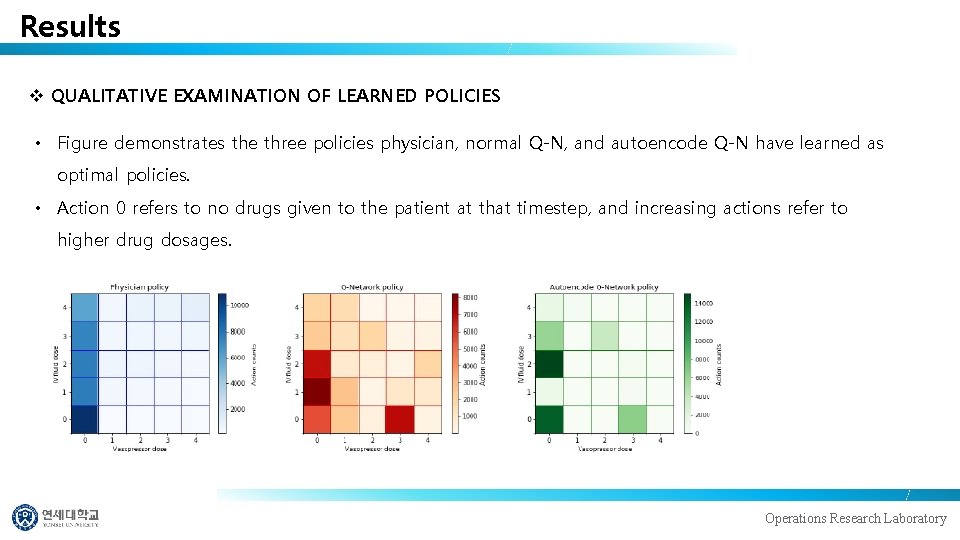
Results v QUALITATIVE EXAMINATION OF LEARNED POLICIES • Figure demonstrates the three policies physician, normal Q-N, and autoencode Q-N have learned as optimal policies. • Action 0 refers to no drugs given to the patient at that timestep, and increasing actions refer to higher drug dosages. Operations Research Laboratory
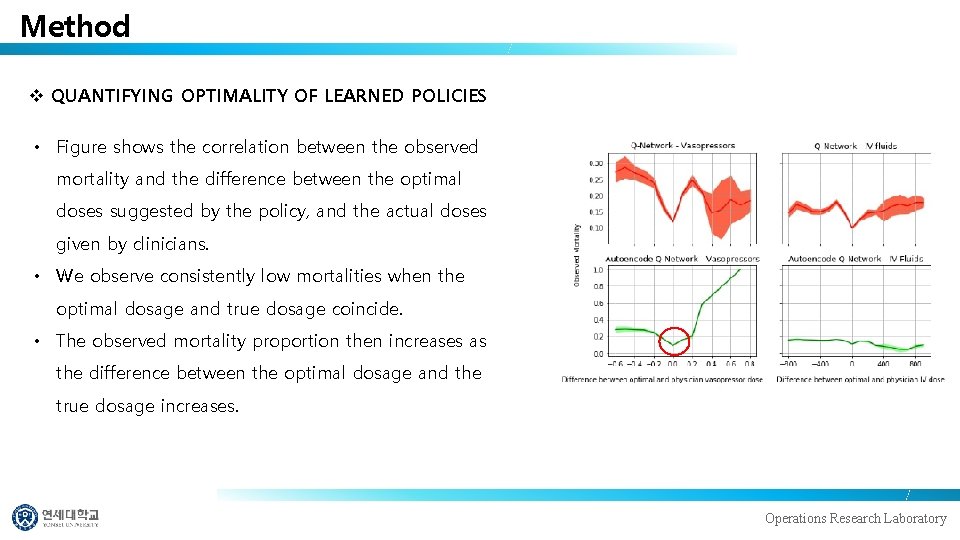
Method v QUANTIFYING OPTIMALITY OF LEARNED POLICIES • Figure shows the correlation between the observed mortality and the difference between the optimal doses suggested by the policy, and the actual doses given by clinicians. • We observe consistently low mortalities when the optimal dosage and true dosage coincide. • The observed mortality proportion then increases as the difference between the optimal dosage and the true dosage increases. Operations Research Laboratory
Conclusion • This paper demonstrated that using continuous state space modeling found policies that could reduce patient mortality in the hospital by 1. 8 -3. 6% • The learned policies are also clinically interpretable, and could be used to provide clinical decision support in the ICU. • This is the first extensive application of novel deep reinforcement learning techniques to medical informatics. Operations Research Laboratory
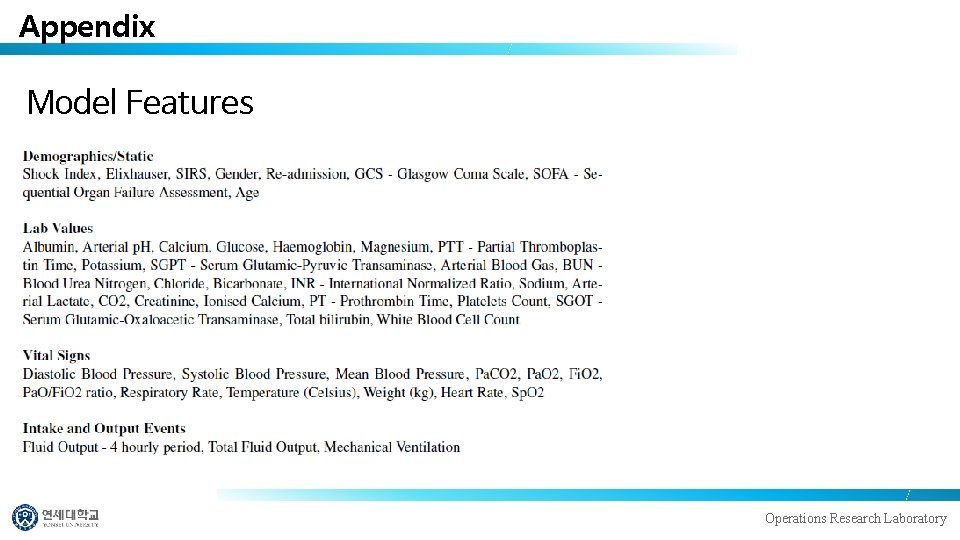
Appendix Model Features Operations Research Laboratory
Thank you Q&A Operations Research Laboratory