
Continuous Professional Development Dr Mahmoud Salah Dept of


- Slides: 55
Continuous Professional Development Dr. Mahmoud Salah Dept. of Medical Education College of Medicine King Saud University
Contents 1. Competence and its different levels 2. Continuous Professional Development (CPD) 3. Reflection and reflective practice 4. Mentorship 5. Roles of mentor and mentee. 6. Professionalism and mentorship
SPECIFIC OBJECTIVES 1. Describe Competence 2. Identify different levels of competence? 3. Recognize essential elements of continuous Professional development 4. Apply the reflective learning in day to day learning 5. Describe the concept of Mentoring. 6. Identify the roles of Mentor and Mentee. 7. Recognize what is to be expected from Mentoring 8. Practice the professionalism through Mentoring.
What is CPD examples for it Think in pairs
What is CPD? CPD refers to any activity, formal or informal, that helps you develop your skills and knowledge, and enhances your professional practice. CPD has been defined as “a process of lifelong systematic learning for all individuals and teams which meets the needs of patients and delivers the health outcomes and healthcare priorities of the institute and which enables professionals to expand fulfil their potential”.
Examples of CPD • training courses and workshops • studying for a qualification or accreditation • online courses/webinars/podcasts • observation (as either observer or person being observed) • mentoring • peer group exchange, eg via Teach. Meets/ Twitter groups/Google groups/professional exchange • visiting other schools/colleges • attending exhibitions and conferences • international visits and exchanges • self-reflection, personal reading or research.
Who is responsible for CPD? • personal responsibility to keep up to date • institute has a responsibility to ensure that our team keeps up to date.
Introduction: Why CPD • Health system cannot deliver high quality patients' care without a well-trained health workforce of sufficient capacity and competencies/ capabilities
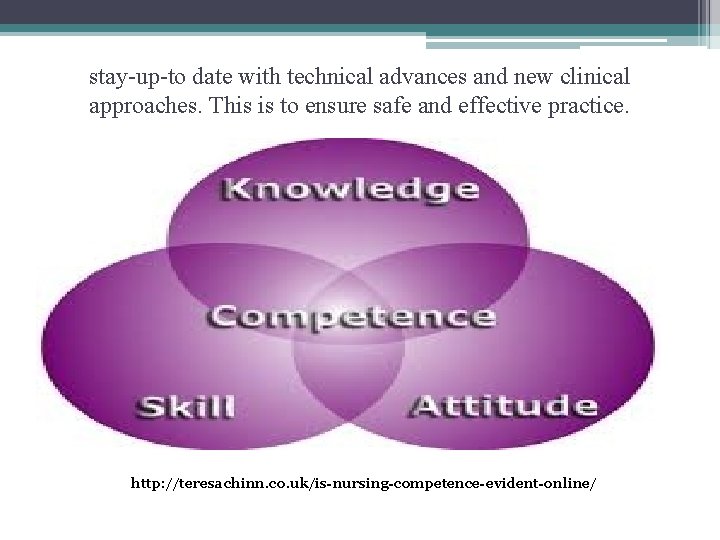
stay-up-to date with technical advances and new clinical approaches. This is to ensure safe and effective practice. http: //teresachinn. co. uk/is-nursing-competence-evident-online/
Features of effective CPD • Personalised – ie built on individual identified needs and requirements. • Relevant – relates to your teaching theory and/ or subject specialism and the needs of learners. • Sustained – New skills and ideas need time to take hold; experimentation and refinement is the best way to embed new ideas into your classroom practice.
Features of effective CPD…. . cont. • Supported – by coaching or mentoring from experienced colleagues. • Collaborative –with your fellow teachers and colleagues
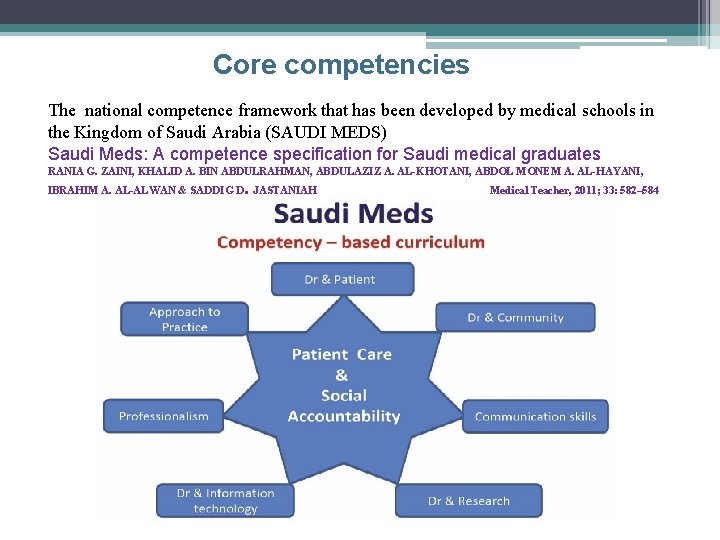
Core competencies The national competence framework that has been developed by medical schools in the Kingdom of Saudi Arabia (SAUDI MEDS) Saudi Meds: A competence specification for Saudi medical graduates RANIA G. ZAINI, KHALID A. BIN ABDULRAHMAN, ABDULAZIZ A. AL-KHOTANI, ABDOL MONEM A. AL-HAYANI, . IBRAHIM A. AL-ALWAN & SADDIG D JASTANIAH Medical Teacher, 2011; 33: 582– 584
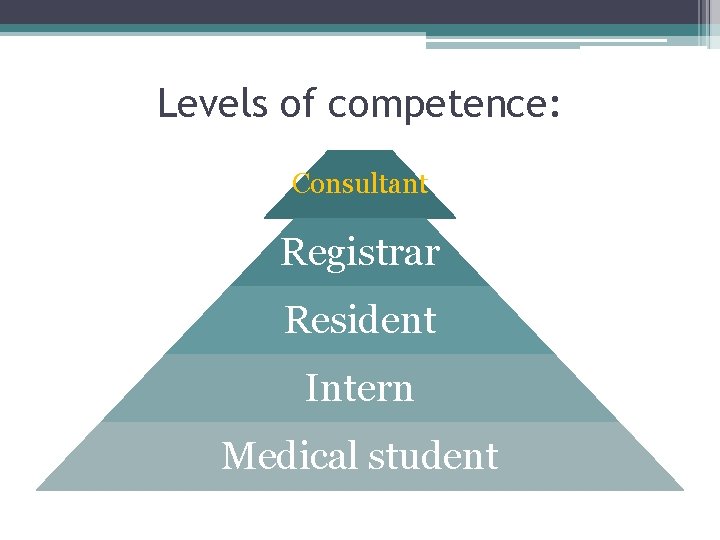
Levels of competence: Consultant Registrar Resident Intern Medical student
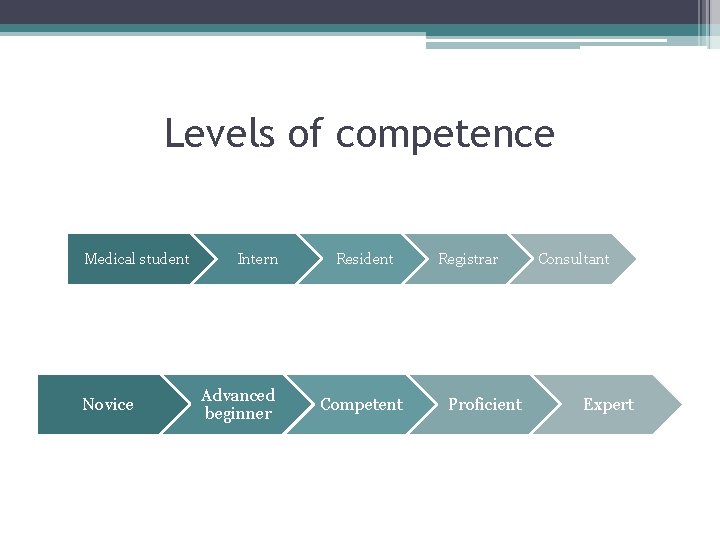
Levels of competence Medical student Novice Intern Advanced beginner Resident Competent Registrar Proficient Consultant Expert
Think, Pair & Share Every five of you. What is your definition of COMPETENCE ?
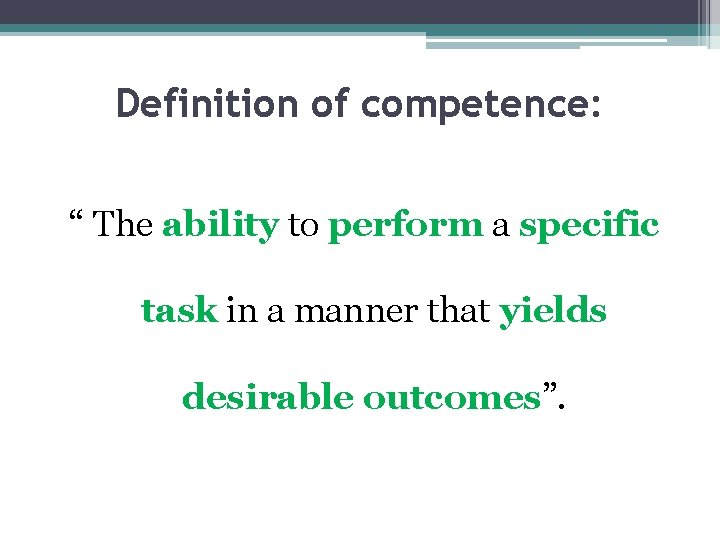
Definition of competence: “ The ability to perform a specific task in a manner that yields desirable outcomes”.
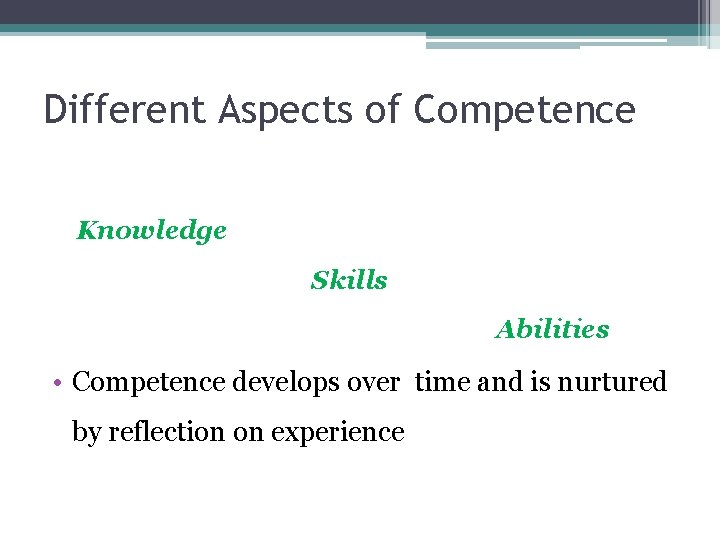
Different Aspects of Competence Knowledge Skills Abilities • Competence develops over time and is nurtured by reflection on experience
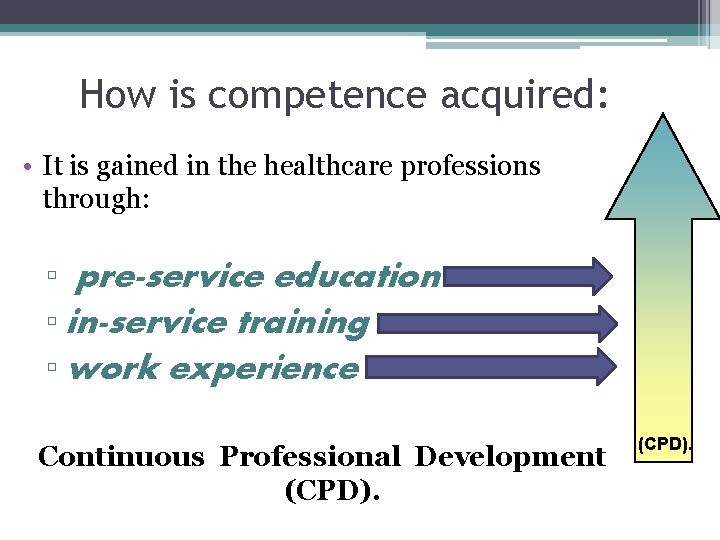
How is competence acquired: • It is gained in the healthcare professions through: ▫ pre-service education ▫ in-service training ▫ work experience Continuous Professional Development (CPD).
Think Pair & Share Every five of you Are you involved in CPD
How can we achieve CPD? .
q Lecture programs q. Conferences q. Workshops q. CME courses q. Others …. .
How can we achieve CPD? Many methods have been tried in the past Currently, Reflective Practice/Learning is the most favoured
What is the Reflective Learning
Reflective practice concept is a practice-based professional learning in which students, trainees, and doctors learn from their own professional experience rather than just knowledge transfer. Reflection is a metacognitive process that creates greater understanding of both the self and the situation so that future actions can be informed by this understanding.
What is Metacognition? Cognition about cognition Thinking about thinking Knowing about knowing It is an awareness and understanding of one's own thought process.
Reflection • Reflection relates to a complex and deliberate process of thinking about and interpreting experience, in order to learn from it. • Reflection : stages e. g. An awareness of uncomfortable feeling Examination of situation Exploration of alternative actions Reflective thoughts results in action
What is Reflective Learning? Cont: Systematic revisiting of a learning experience with a view to learning from it Why reflection? Key to become a lifelong learner – if not most learning opportunities are lost
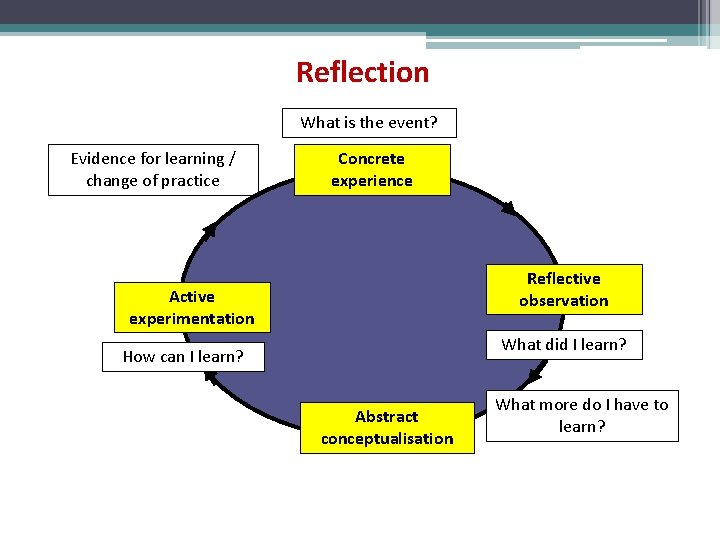
Reflective log: a simplified version 1. What is the learning event? 2. What did I learn? 3. What more do I have to learn? 4. How can I learn it? 5. Evidence for further learning / change of practice?
A scenario (3) : • A 55 year old man came to clinic with complaint of low back pain (LBP). • You have examined his back which was ok. His height was 160 cm, and weight is 100 kg. • You would like to manage this patient’s LBP contributed due to his excess body weight.
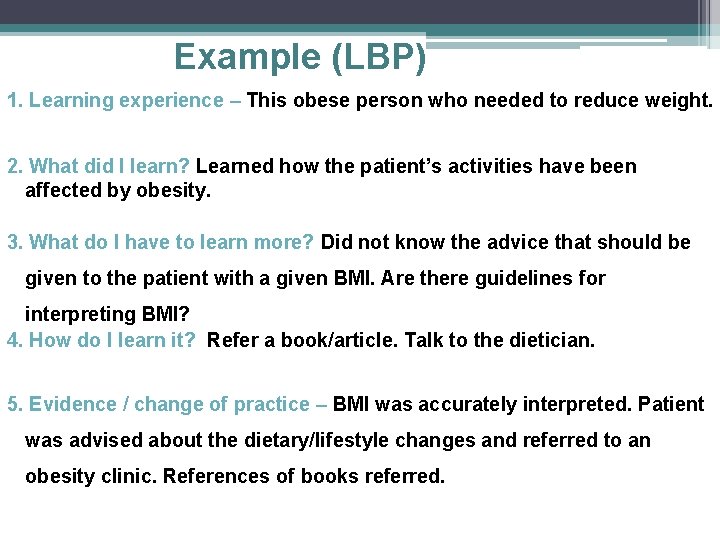
Example (LBP) 1. Learning experience – This obese person who needed to reduce weight. 2. What did I learn? Learned how the patient’s activities have been affected by obesity. 3. What do I have to learn more? Did not know the advice that should be given to the patient with a given BMI. Are there guidelines for interpreting BMI? 4. How do I learn it? Refer a book/article. Talk to the dietician. 5. Evidence / change of practice – BMI was accurately interpreted. Patient was advised about the dietary/lifestyle changes and referred to an obesity clinic. References of books referred.
Reflective practice 1. Reflection-in action 2. Reflection-on action
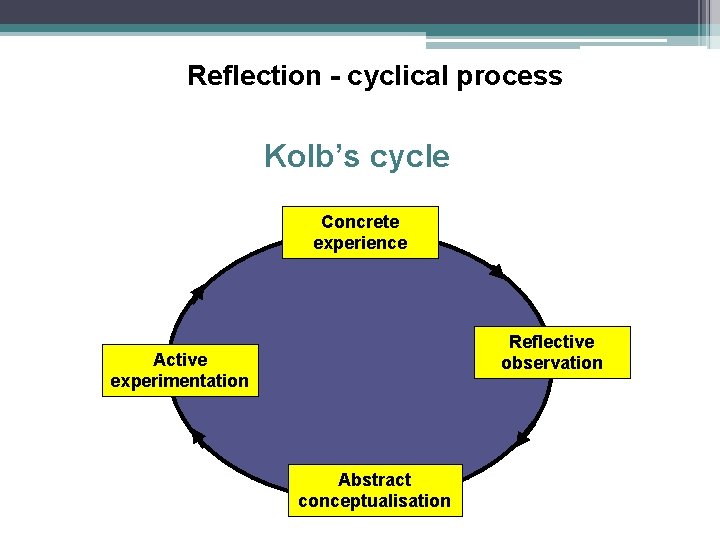
Reflection - cyclical process Kolb’s cycle Concrete experience Reflective observation Active experimentation Abstract conceptualisation
Reflection What is the event? Evidence for learning / change of practice Concrete experience Reflective observation Active experimentation What did I learn? How can I learn? Abstract conceptualisation What more do I have to learn?
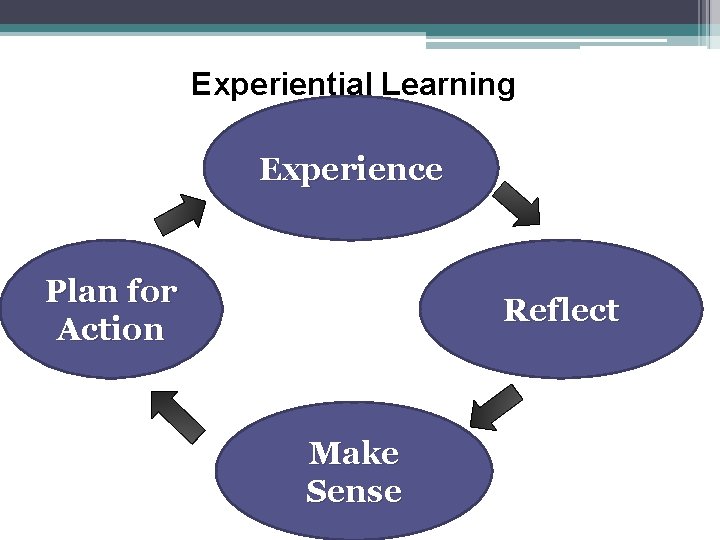
Experiential Learning Experience Plan for Action Reflect Make Sense
Long Life Learning (LLL) Medical students need to be effective lifelong learners in order to continue to develop personally and practice professionally. This demands an encouragement of diverse learning styles. It means applying adult learning principles, student autonomy, self-learning, experiential learning reflective learning, computer assisted learning, distance learning, e -learning, use of skill learning laboratories.
What is the Life long learning and give examples Think in pairs
What is lifelong learning? • it’s voluntary, rather than compulsory, and is completely self-motivated – with the main goal being to improve personal or professional development.
How is it learned? • Lifelong learning can be through formal training, or something less structured. • By instruction or coaching, but also includes any form of self-taught learning. • Our daily interactions with our colleagues, and the knowledge and behaviors we learn both inside and outside of work, can be classified as lifelong learning.
What are some examples of lifelong learning? • • Internships Professional courses Teaching yourself a new language Studying a new subject Learning to use new pieces of technology Playing a new game or sport Adding to your skillset during employment Gaining knowledge and learned behaviors from your environment
What are the benefits of lifelong learning? • To gain a new qualification • To add to your transferable skills • To increase your employability and promotion prospects • To earn more money • To fill a skills gap • To broaden your knowledge • To better contribute to the community • Mental stimulation • Personal and professional satisfaction
Tips for lifelong learning • Utilise technology –online resources, e. Books, distance learning course, join forums to continue your development. • Ask your employer – for personal development planning. • Stay motivated • Add some structure – Try setting aside the same amount of time for studying each night, or each week, make sure you stick to it, and try and write down a goal for each session. Take your learning seriously, and you’re far more likely to stick to it.
Tips for lifelong learning…cont • Take every opportunity – It isn’t just a new certification you can gain from lifelong learning. There are plenty of opportunities out there to add to your knowledge, from taking a class in the local community centre, to joining reading groups or even watching webinars. • Don’t make excuses –there are no barriers to lifelong learning. Free courses, nothing stopping you simply picking up a book and learning about a new subject. So, no matter how young or old you are, and no matter how much time you have, there’s something out there for you.
What is monitoring Think in pairs
Mentoring Definition ‘Off-line help by one person to another in making significant transitions in knowledge work or thinking’ (Clutterbuck 1990) ‘To help and support people to manage their own learning in order to maximise their potential, develop their skills, improve their performance and become the person they want to be’ (Parsloe, 1992)
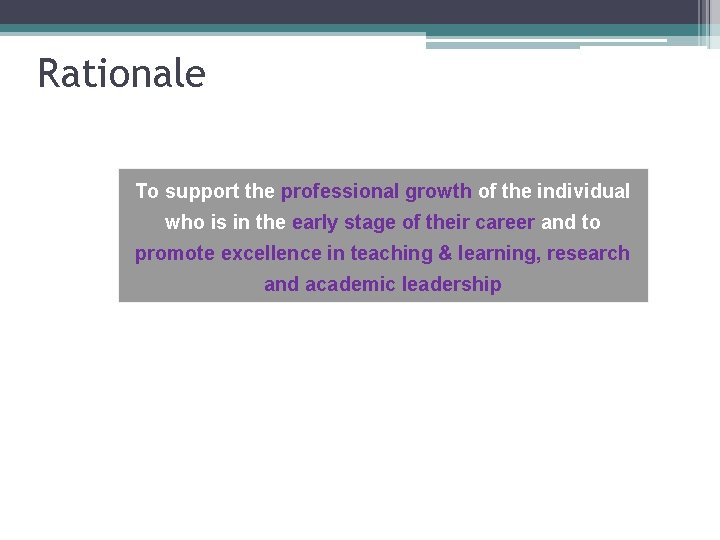
Rationale To support the professional growth of the individual who is in the early stage of their career and to promote excellence in teaching & learning, research and academic leadership
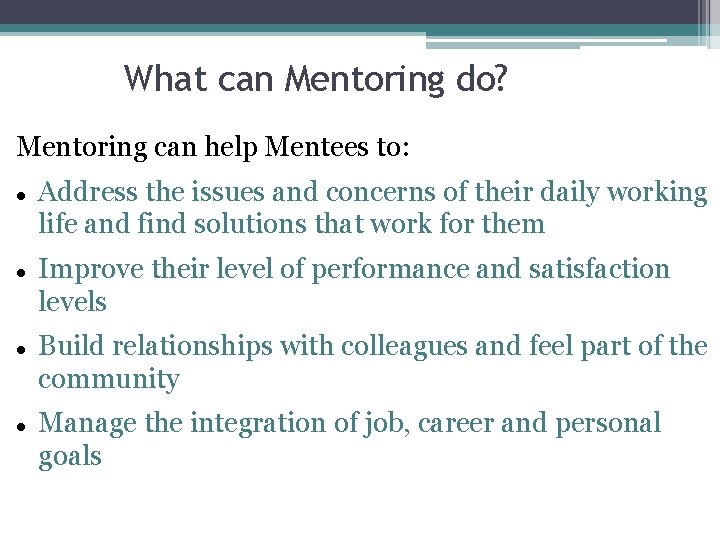
What can Mentoring do? Mentoring can help Mentees to: Address the issues and concerns of their daily working life and find solutions that work for them Improve their level of performance and satisfaction levels Build relationships with colleagues and feel part of the community Manage the integration of job, career and personal goals
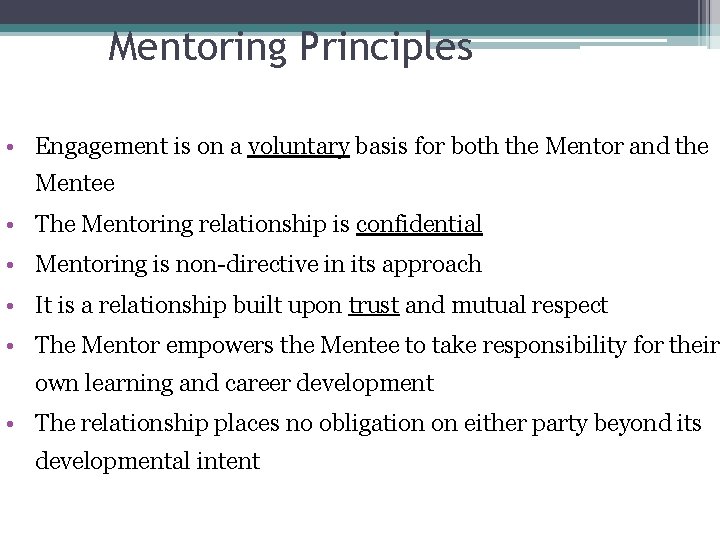
Mentoring Principles • Engagement is on a voluntary basis for both the Mentor and the Mentee • The Mentoring relationship is confidential • Mentoring is non-directive in its approach • It is a relationship built upon trust and mutual respect • The Mentor empowers the Mentee to take responsibility for their own learning and career development • The relationship places no obligation on either party beyond its developmental intent
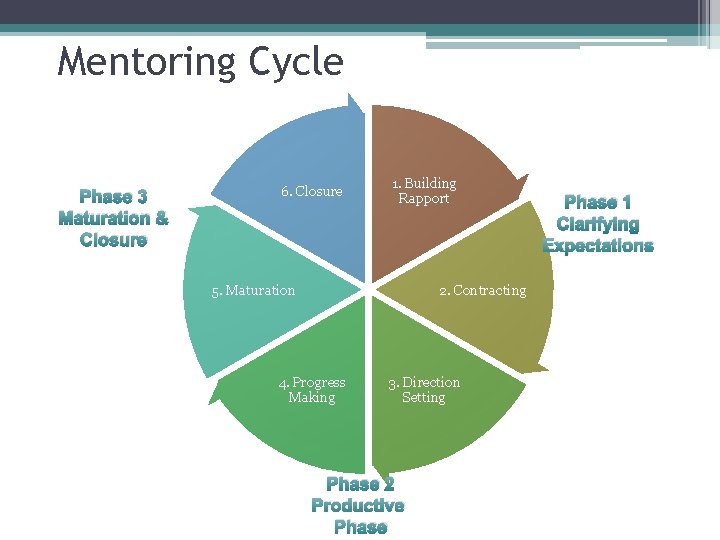
Mentoring Cycle Phase 3 Maturation & Closure 6. Closure 1. Building Rapport 5. Maturation 2. Contracting 4. Progress Making 3. Direction Setting Phase 2 Productive Phase 1 Clarifying Expectations
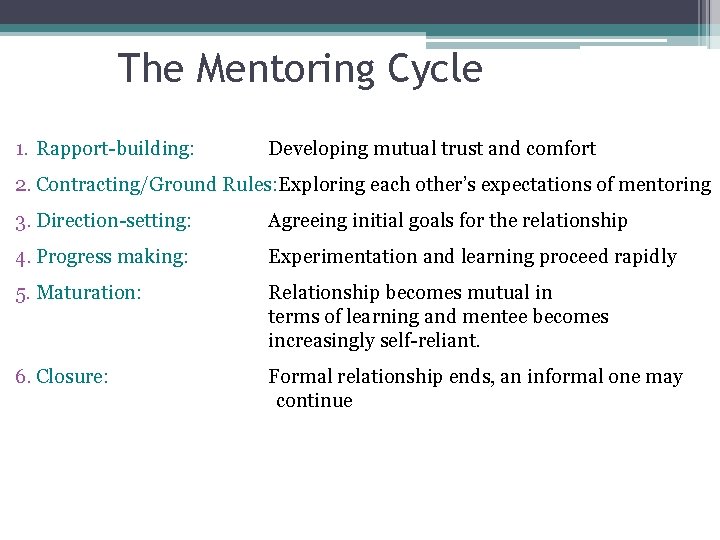
The Mentoring Cycle 1. Rapport-building: Developing mutual trust and comfort 2. Contracting/Ground Rules: Exploring each other’s expectations of mentoring 3. Direction-setting: Agreeing initial goals for the relationship 4. Progress making: Experimentation and learning proceed rapidly 5. Maturation: Relationship becomes mutual in terms of learning and mentee becomes increasingly self-reliant. 6. Closure: Formal relationship ends, an informal one may continue
Skills Required By Mentors • Ability to build rapport with the mentee • Communication skills • Feedback skills • Questioning skills • Listening skills • Interpersonal skills
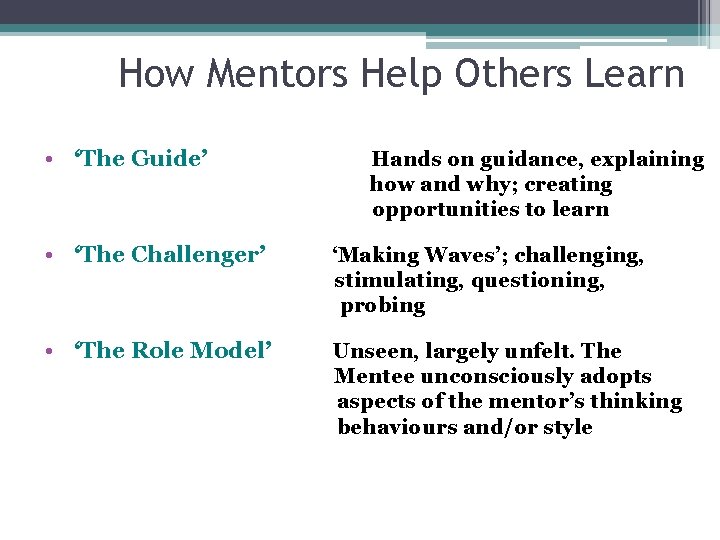
How Mentors Help Others Learn • ‘The Guide’ Hands on guidance, explaining how and why; creating opportunities to learn • ‘The Challenger’ ‘Making Waves’; challenging, stimulating, questioning, probing • ‘The Role Model’ Unseen, largely unfelt. The Mentee unconsciously adopts aspects of the mentor’s thinking behaviours and/or style
Summary: Competence Acquired through Continuous Professional Development Acquired through Reflection & Reflective Practice
References • Bin Abdulrahman KA. 2011. Saudi Arabia does not need an Abraham Flexner. Med Teach 33: 74– 75. • Bin Abdulrahman KA. 2008. The current status of medical education in the Gulf Cooperation Council countries. Ann Saudi Med 28(2): 83– 88 • Davis D, Galbraith R. continuing medical education effect on practice performance: effectiveness of continuing medical education: American College of chest physicians Evidence-based educational guidelines. Chest 2009; 135 (3 Suppl): 42 S • Gibbs, Graham, Great Britain. Further Education Unit. Learning by Doing: a guide to Teaching& Learning methods Fur Edu Unit. London 1988. • Kolb, Alice Y, David A. Learning Styles and learning spaces: enhancing experiential learning in higher education. Acad Manag Lear Edu. 2005; 4(2): 193212. • Pba. Continuing professional development registration standard. Physiotherapy board of Australia. http: //www. physiotherapyboard. gov. au/registration-standard • Saudi Meds: A competence specification for Saudi medical graduates RANIA G. ZAINI, KHALID A. BIN ABDULRAHMAN, ABDULAZIZ A. AL-KHOTANI, ABDOL MONEM A. AL-HAYANI, IBRAHIM A. AL- ALWAN & SADDIG D.
THANK YOU VERY MUCH & &