
Continuous price and flow dynamics of Tradable mobility

Continuous price and flow dynamics of Tradable mobility credits Hongbo YE and Hai YANG The Hong Kong University of Science and ISTTT 20 17/07/2013 Technology
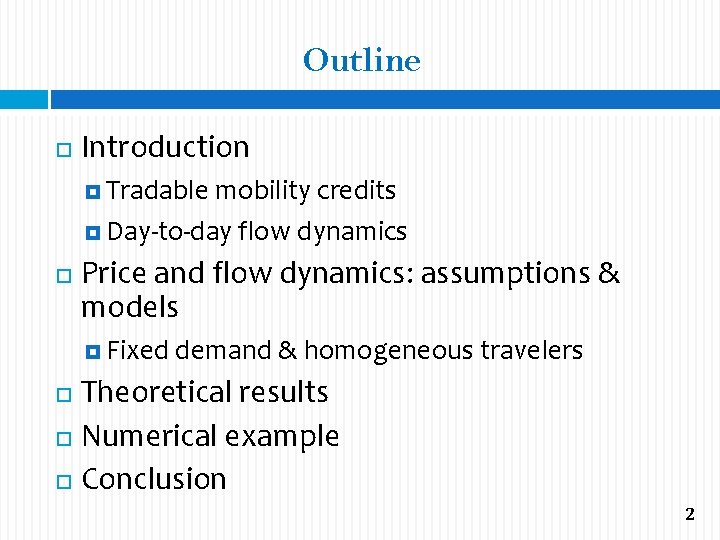
Outline Introduction Tradable mobility credits Day-to-day flow dynamics Price and flow dynamics: assumptions & models Fixed demand & homogeneous travelers Theoretical results Numerical example Conclusion 2

1. Introduction
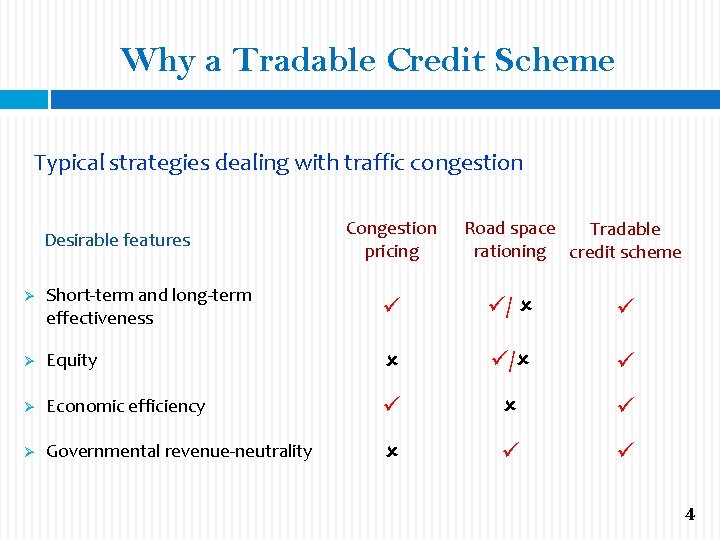
Why a Tradable Credit Scheme Typical strategies dealing with traffic congestion Desirable features Congestion pricing Road space Tradable rationing credit scheme Ø Short-term and long-term effectiveness / Ø Equity / Ø Economic efficiency Ø Governmental revenue-neutrality 4
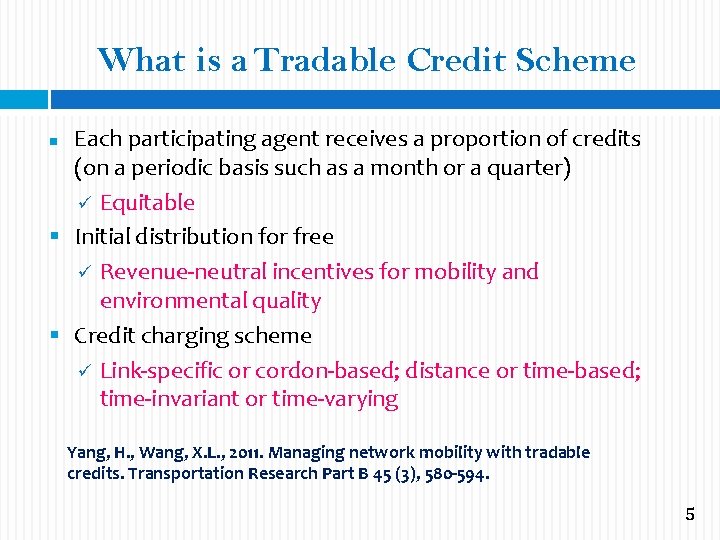
What is a Tradable Credit Scheme Each participating agent receives a proportion of credits (on a periodic basis such as a month or a quarter) Equitable § Initial distribution for free Revenue-neutral incentives for mobility and environmental quality § Credit charging scheme Link-specific or cordon-based; distance or time-based; time-invariant or time-varying Yang, H. , Wang, X. L. , 2011. Managing network mobility with tradable credits. Transportation Research Part B 45 (3), 580 -594. 5
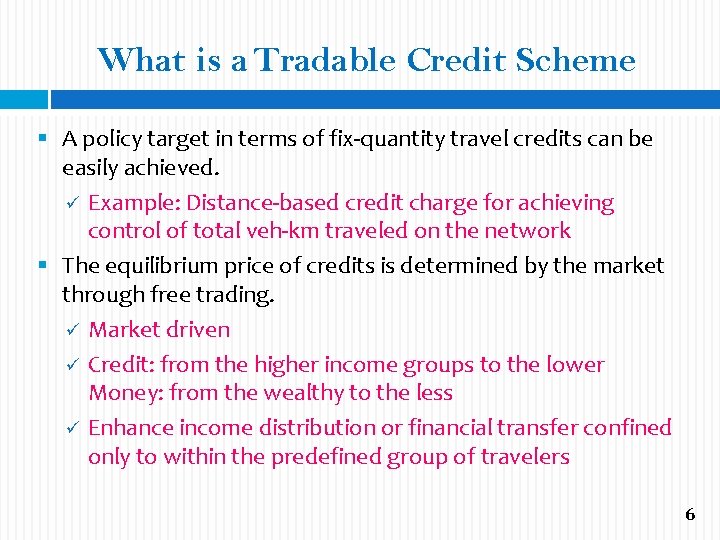
What is a Tradable Credit Scheme § A policy target in terms of fix-quantity travel credits can be easily achieved. Example: Distance-based credit charge for achieving control of total veh-km traveled on the network § The equilibrium price of credits is determined by the market through free trading. Market driven Credit: from the higher income groups to the lower Money: from the wealthy to the less Enhance income distribution or financial transfer confined only to within the predefined group of travelers 6
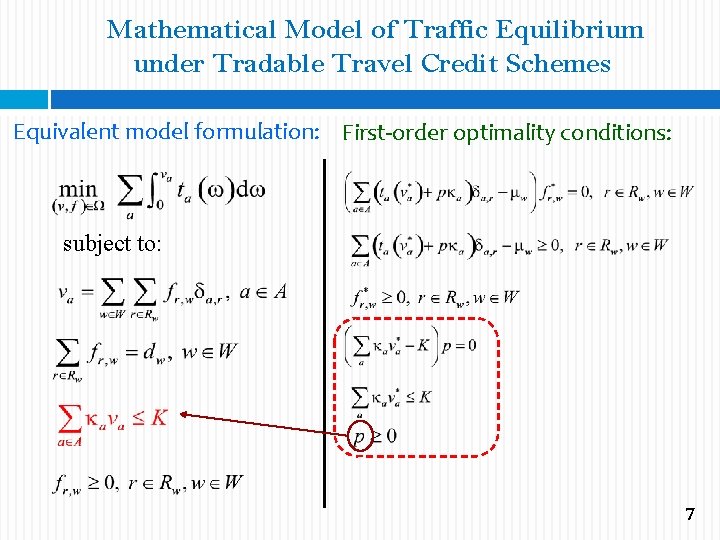
Mathematical Model of Traffic Equilibrium under Tradable Travel Credit Schemes Equivalent model formulation: First-order optimality conditions: subject to: 7

Traffic Equilibrium and Market Equilibrium with Tradable Credits: An Example 8
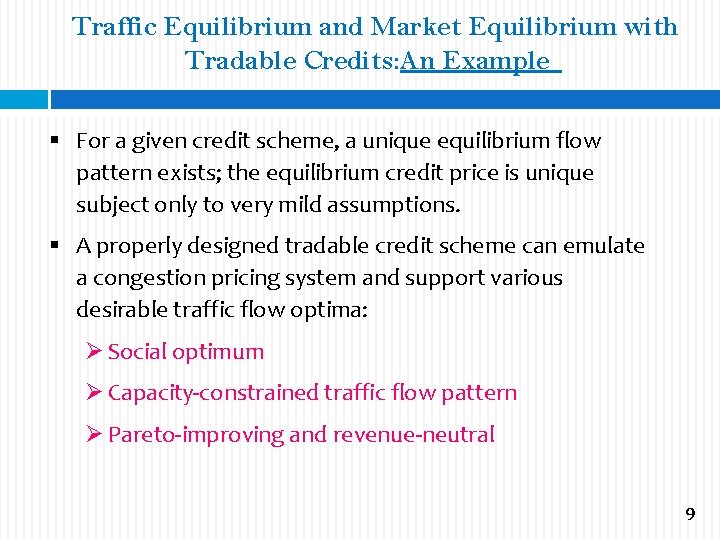
Traffic Equilibrium and Market Equilibrium with Tradable Credits: An Example § For a given credit scheme, a unique equilibrium flow pattern exists; the equilibrium credit price is unique subject only to very mild assumptions. § A properly designed tradable credit scheme can emulate a congestion pricing system and support various desirable traffic flow optima: Ø Social optimum Ø Capacity-constrained traffic flow pattern Ø Pareto-improving and revenue-neutral 9
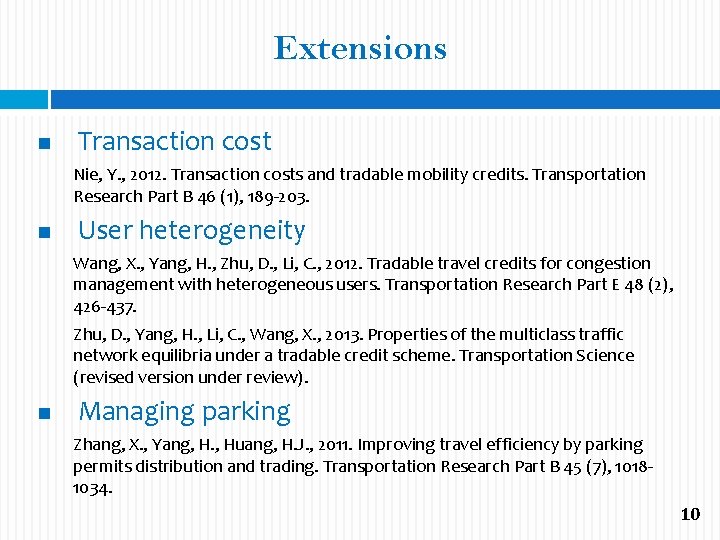
Extensions Transaction cost Nie, Y. , 2012. Transaction costs and tradable mobility credits. Transportation Research Part B 46 (1), 189 -203. User heterogeneity Wang, X. , Yang, H. , Zhu, D. , Li, C. , 2012. Tradable travel credits for congestion management with heterogeneous users. Transportation Research Part E 48 (2), 426 -437. Zhu, D. , Yang, H. , Li, C. , Wang, X. , 2013. Properties of the multiclass traffic network equilibria under a tradable credit scheme. Transportation Science (revised version under review). Managing parking Zhang, X. , Yang, H. , Huang, H. J. , 2011. Improving travel efficiency by parking permits distribution and trading. Transportation Research Part B 45 (7), 10181034. 10
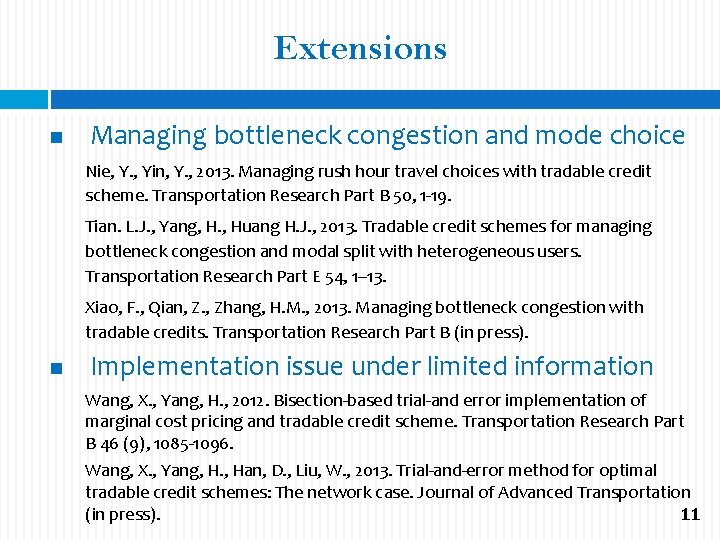
Extensions Managing bottleneck congestion and mode choice Nie, Y. , Yin, Y. , 2013. Managing rush hour travel choices with tradable credit scheme. Transportation Research Part B 50, 1 -19. Tian. L. J. , Yang, H. , Huang H. J. , 2013. Tradable credit schemes for managing bottleneck congestion and modal split with heterogeneous users. Transportation Research Part E 54, 1– 13. Xiao, F. , Qian, Z. , Zhang, H. M. , 2013. Managing bottleneck congestion with tradable credits. Transportation Research Part B (in press). Implementation issue under limited information Wang, X. , Yang, H. , 2012. Bisection-based trial-and error implementation of marginal cost pricing and tradable credit scheme. Transportation Research Part B 46 (9), 1085 -1096. Wang, X. , Yang, H. , Han, D. , Liu, W. , 2013. Trial-and-error method for optimal tradable credit schemes: The network case. Journal of Advanced Transportation (in press). 11
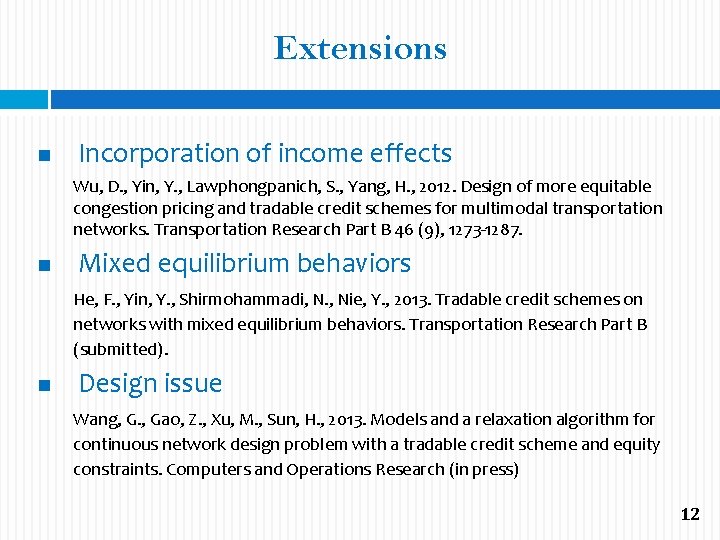
Extensions Incorporation of income effects Wu, D. , Yin, Y. , Lawphongpanich, S. , Yang, H. , 2012. Design of more equitable congestion pricing and tradable credit schemes for multimodal transportation networks. Transportation Research Part B 46 (9), 1273 -1287. Mixed equilibrium behaviors He, F. , Yin, Y. , Shirmohammadi, N. , Nie, Y. , 2013. Tradable credit schemes on networks with mixed equilibrium behaviors. Transportation Research Part B (submitted). Design issue Wang, G. , Gao, Z. , Xu, M. , Sun, H. , 2013. Models and a relaxation algorithm for continuous network design problem with a tradable credit scheme and equity constraints. Computers and Operations Research (in press) 12

Our Motive 13
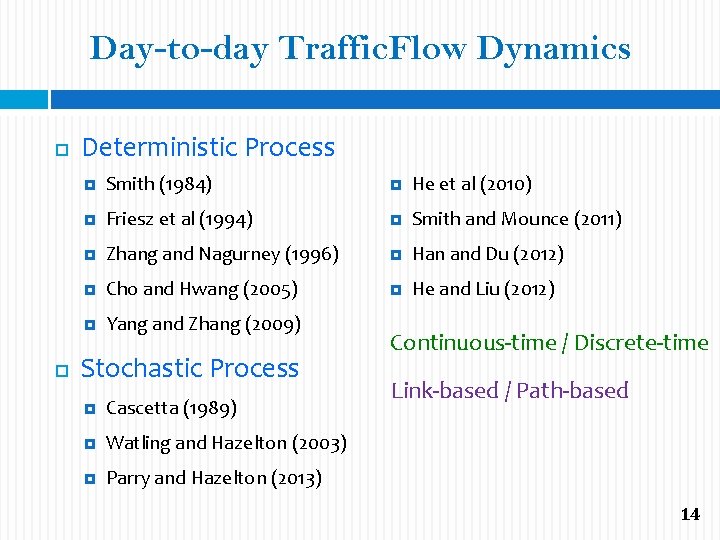
Day-to-day Traffic. Flow Dynamics Deterministic Process Smith (1984) He et al (2010) Friesz et al (1994) Smith and Mounce (2011) Zhang and Nagurney (1996) Han and Du (2012) Cho and Hwang (2005) He and Liu (2012) Yang and Zhang (2009) Stochastic Process Cascetta (1989) Watling and Hazelton (2003) Parry and Hazelton (2013) Continuous-time / Discrete-time Link-based / Path-based 14
Day-to-day Traffic Flow Dynamics Travelers’ perception on travel time and learning behavior Horowitz (1984) Cantarella and Cascetta (1995) Watling (1999) Bie and Lo (2010) 15

2. Model Description
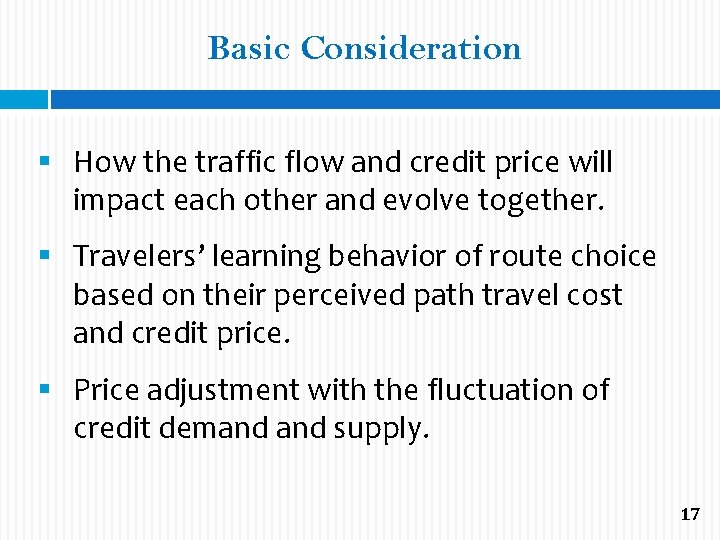
Basic Consideration § How the traffic flow and credit price will impact each other and evolve together. § Travelers’ learning behavior of route choice based on their perceived path travel cost and credit price. § Price adjustment with the fluctuation of credit demand supply. 17

Notations 18

Path Choice ① Travelers’ path choice. Probabilities for travelers choosing paths depend on the perceived travel costs on all the paths. 20
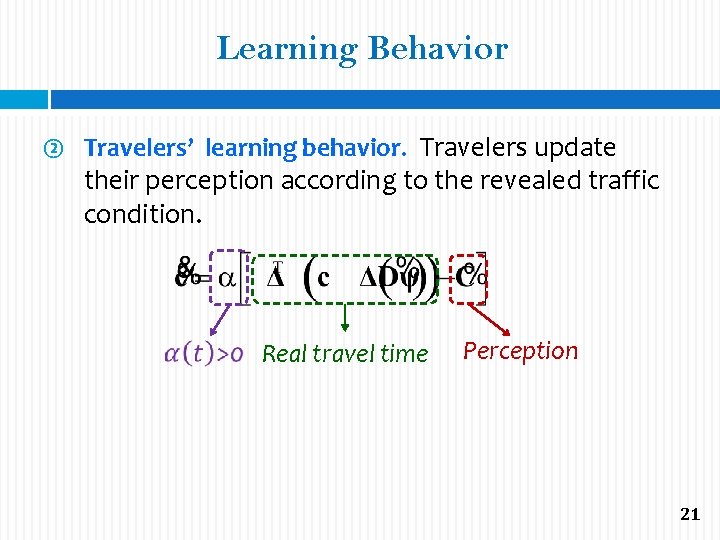
Learning Behavior ② Travelers’ learning behavior. Travelers update their perception according to the revealed traffic condition. Real travel time Perception 21
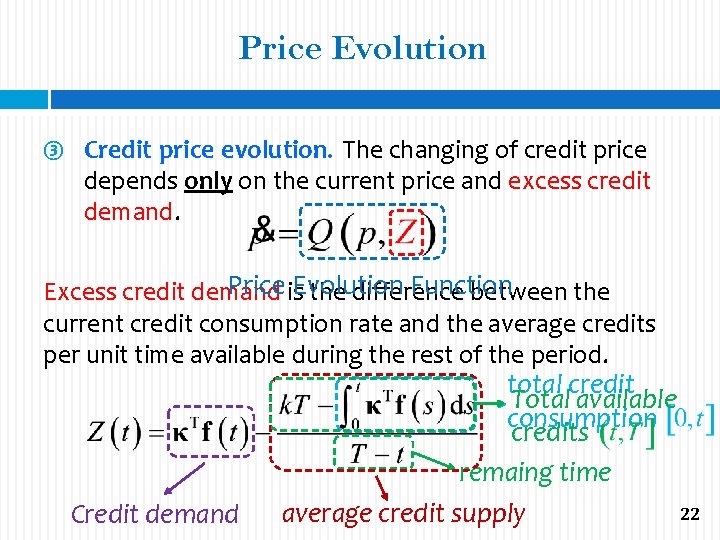
Price Evolution ③ Credit price evolution. The changing of credit price depends only on the current price and excess credit demand. Price is. Evolution Function Excess credit demand the difference between the current credit consumption rate and the average credits per unit time available during the rest of the period. Credit demand total credit Total available consumption credits remaing time 22 average credit supply
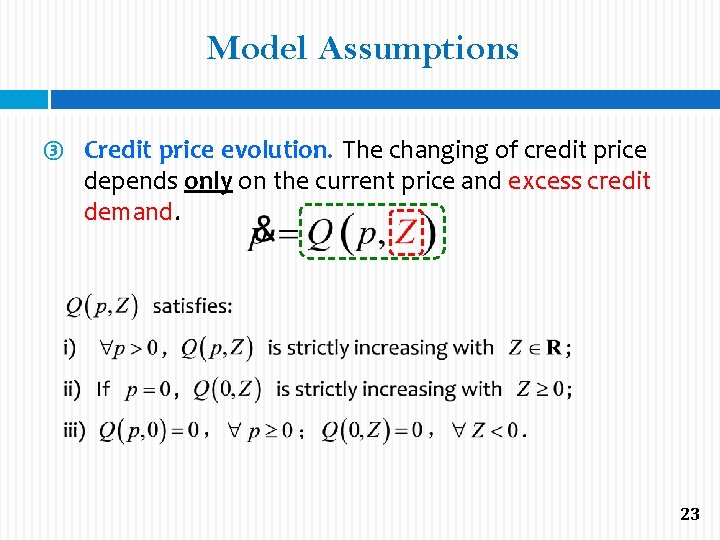
Model Assumptions ③ Credit price evolution. The changing of credit price depends only on the current price and excess credit demand. 23
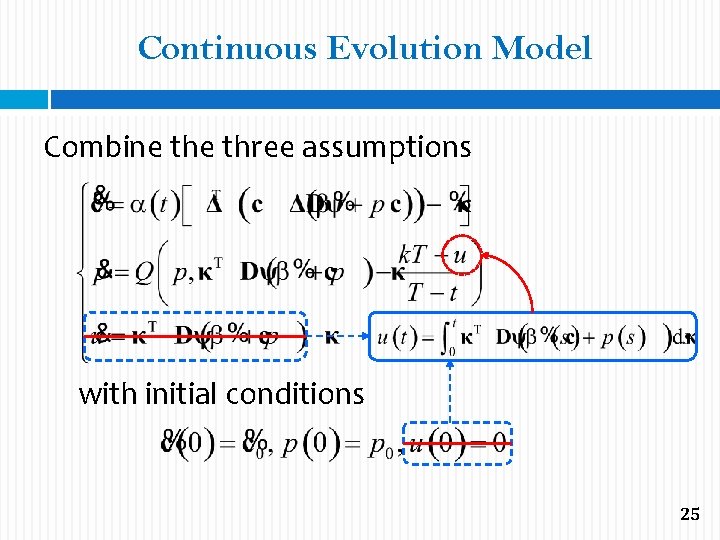
Continuous Evolution Model Combine three assumptions with initial conditions 25

3. Theoretical Results

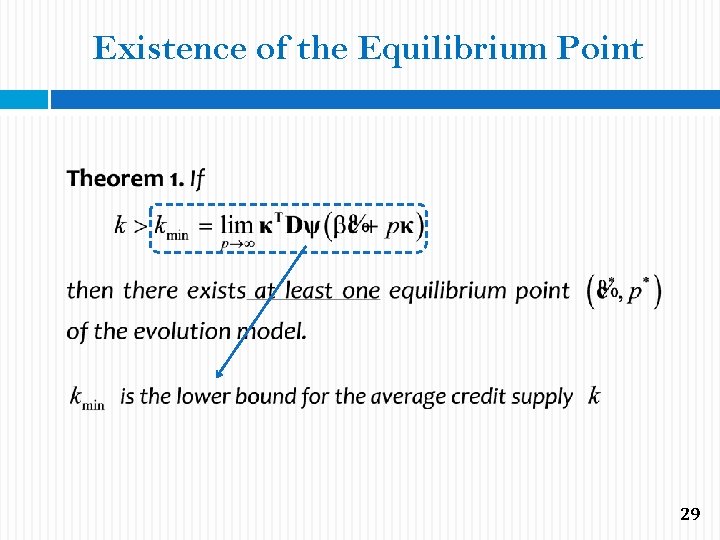
Existence of the Equilibrium Point Every continuous function from a convex compact subset of a Euclidean space to itself has a fixed point. Fixed-point Problem Brouwer’s fixed point theorem 28
Existence of the Equilibrium Point 29

Uniqueness of the Equilibrium Point 30
System Stability time-variant system time-invariant system 31

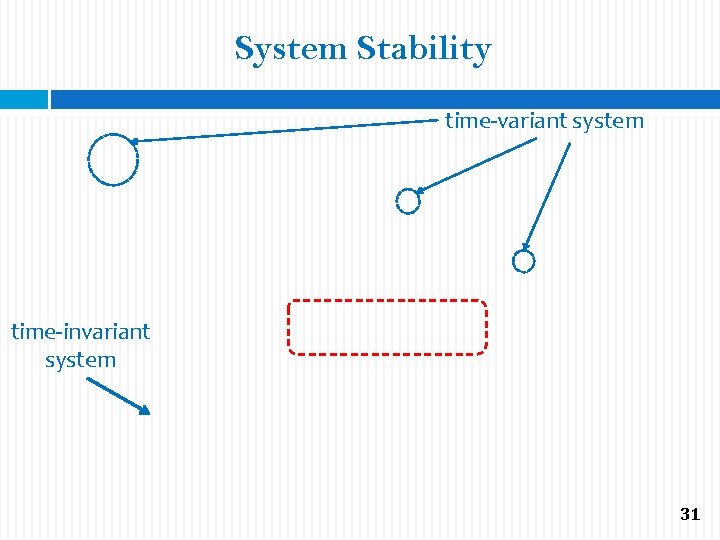
System Stability 32

System Stability 33

System Stability 34

4. Numerical Example

Numerical Example 36
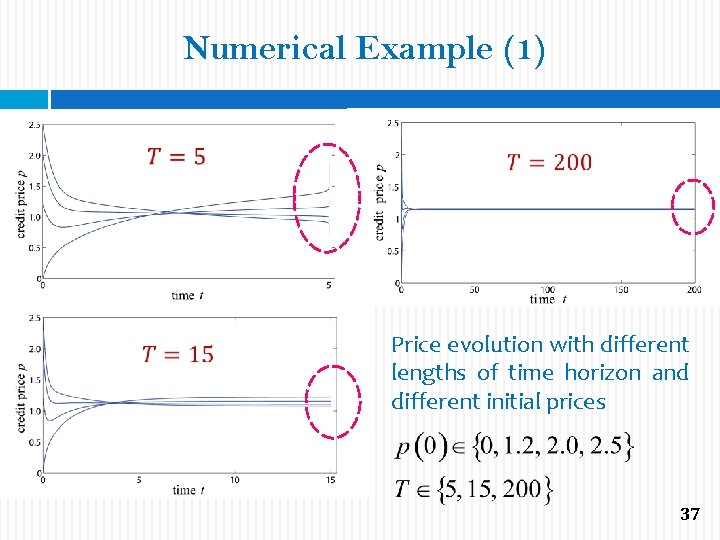
Numerical Example (1) Price evolution with different lengths of time horizon and different initial prices 37
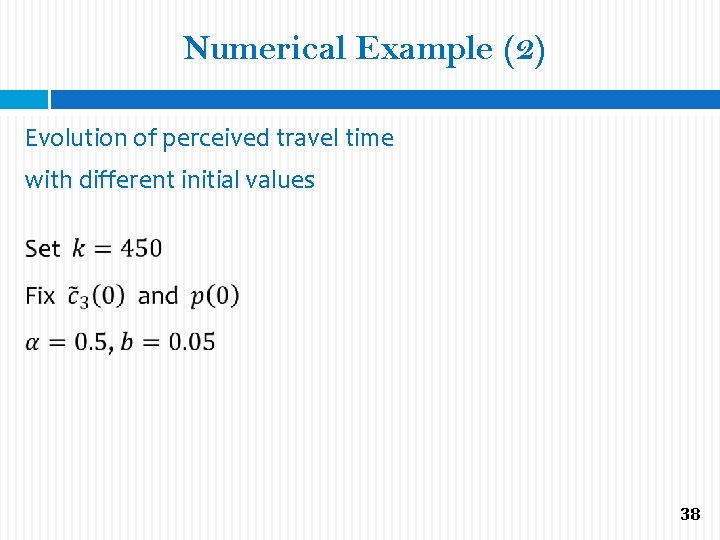
Numerical Example (2) Evolution of perceived travel time with different initial values 38
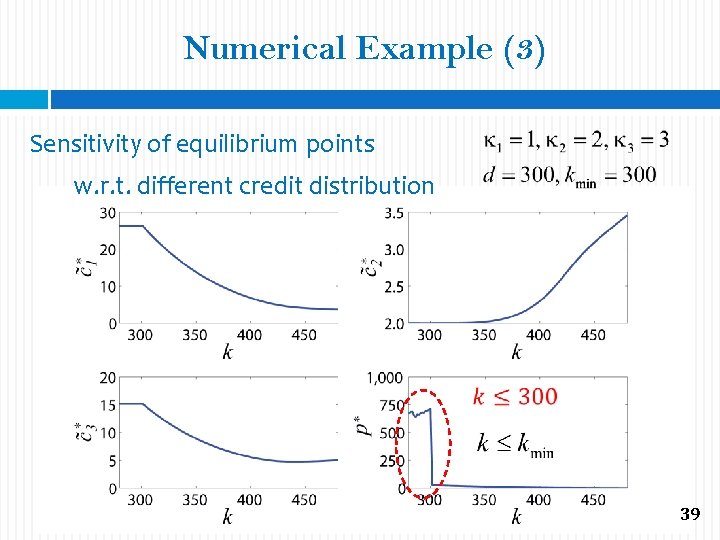
Numerical Example (3) Sensitivity of equilibrium points w. r. t. different credit distribution 39
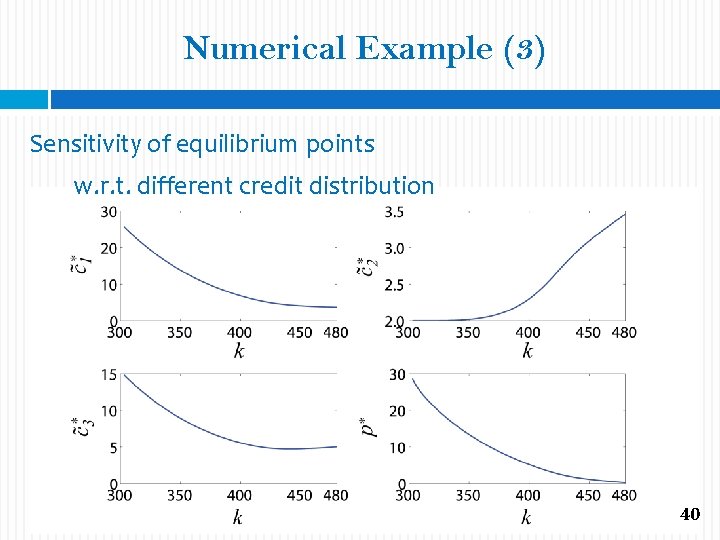
Numerical Example (3) Sensitivity of equilibrium points w. r. t. different credit distribution 40

5. Conclusion
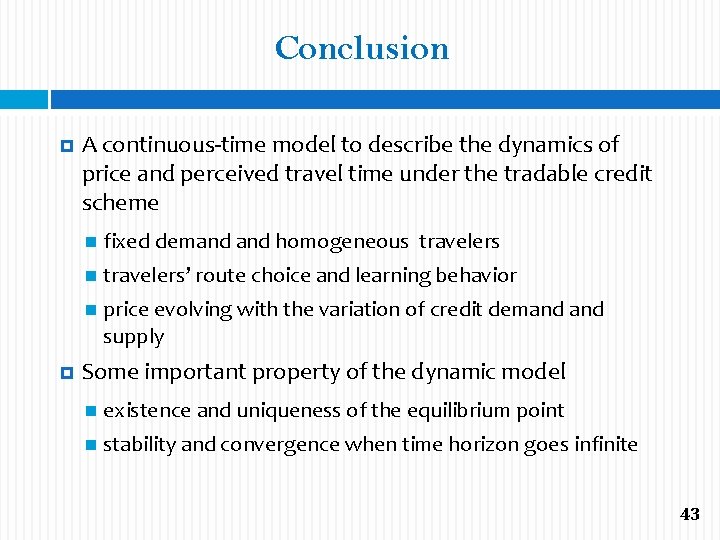
Conclusion A continuous-time model to describe the dynamics of price and perceived travel time under the tradable credit scheme fixed demand homogeneous travelers’ route choice and learning behavior price evolving with the variation of credit demand supply Some important property of the dynamic model existence and uniqueness of the equilibrium point stability and convergence when time horizon goes infinite 43

THANK YOU !
- Slides: 40