
Continuous Palliative Sedation Therapy A Canadian Framework Alyssa
![Kaplan–Meier survival curves for cohort A [palliative sedation therapy (PST)] and cohort B (no](https://slidetodoc.com/presentation_image_h2/51635408b915692fd339551e224dc5cd/image-40.jpg "Kaplan–Meier survival curves for cohort A [palliative sedation therapy (PST)] and cohort B (no")

- Slides: 73
Continuous Palliative Sedation Therapy : A Canadian Framework Alyssa Boyd, CCFP, FCFP, CAC-PC Associate Clinic Professor, Mc. Master University Medical Director, Campbell House Hospice, Collingwood
Objectives Defining and understanding palliative sedation (including intermittent and continuous) Indications for continuous palliative sedation therapy (with focus on thorough assessment leading up to decision for PST) Medications, Titration and Assessment of the sedation Common Misconceptions and Ethical Dilemmas Explore ways to talk about this with families, patients and Health Care providers Differentiating between Continuous Palliative Sedation and MAID
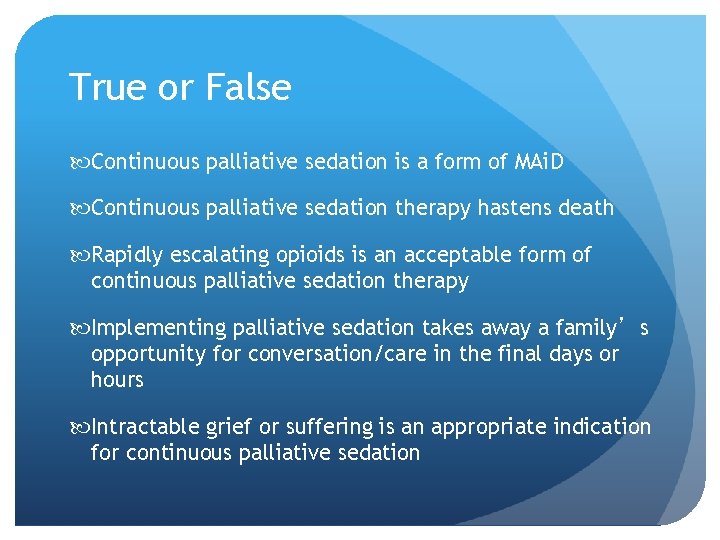
True or False Continuous palliative sedation is a form of Euthanasia Continuative Palliative Sedation Hastens Death Rapidly escalating opioids is an acceptable form of palliative sedation Implementing a palliative sedation takes away a family’s opportunity for conversation with their loved one in the final days or hours Intractable grief or suffering is an appropriate indication for continuous palliative sedation
Case #1 : COPD Susan is a 54 yo woman with end stage COPD. � She has been admitted to hospital with “pain all over” Her visiting nurse had noted increased anxiety and hopelessness in past week Susan says she is tired of being sick and exhausted, and wants to be put to sleep She is angry that terminal sedation hasn’t been offered
Case #1 Continued • Susan lives with her spouse and adult children, all working full time. Susan experiences dyspnea with activity but is able to transfer independently to commode or wheelchair. She is alert with no evidence of confusion. She is not suicidal. She is cachectic and tachypneic Her prognosis is estimated in months. She takes medication erratically for symptom control Adapted from : cases. pallimed. org/2008/11/palliative-sedationtherapy. html
Questions for Case #1 What is Continuous Palliative Sedation Therapy? Does Susan Meet the Criteria?
Definition – Terminal Sedation The Intentional use of Pharmacologic agents to reduce a patient’s level of consciousness Done in the context of intolerable and refractory symptoms Done via the proportional and monitored use of non opioid sedatives Considered in patients who have advanced, progressive illness and in whom death is usually within days or weeks
Types of Sedation § Natural Sedation : normal part of dying process progressive, expected, combination of factors and organ shutdown Consequential Sedation : unintended but predictable effect of medications used at end of life - sometimes transient or relieved by dose reductions Respite Sedation : intentional sedation for agreed upon period of time, 24 -48 hr then lifted to see if alt treatment has worked Terminal Sedation : intentional sedation for the relief of suffering in context of refractory symptom
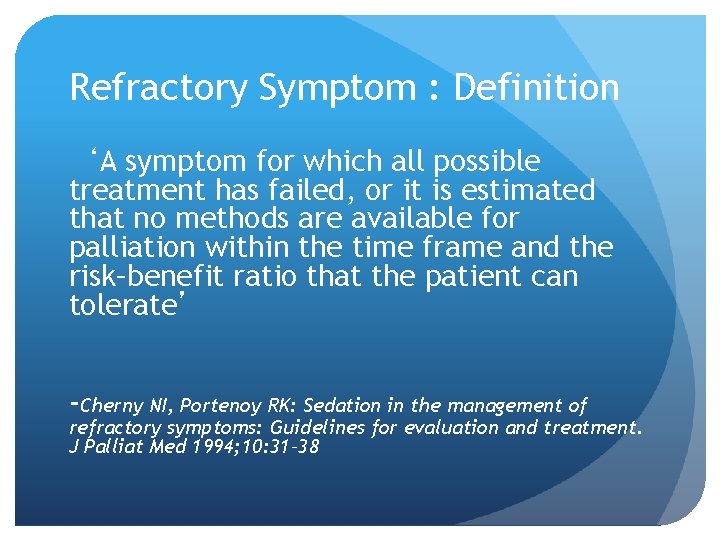
Refractory Symptom : Definition ‘A symptom for which all possible treatment has failed, or it is estimated that no methods are available for palliation within the time frame and the risk–benefit ratio that the patient can tolerate’ -Cherny NI, Portenoy RK: Sedation in the management of refractory symptoms: Guidelines for evaluation and treatment. J Palliat Med 1994; 10: 31– 38
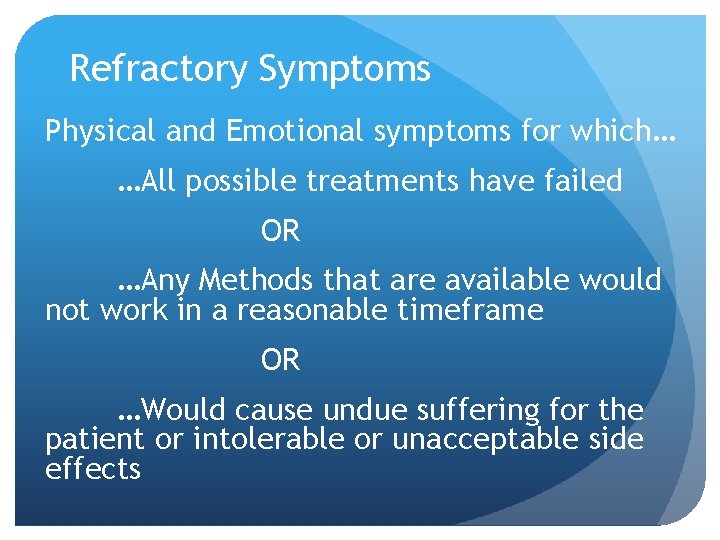
Refractory Symptoms Physical and Emotional symptoms for which… …All possible treatments have failed OR …Any Methods that are available would not work in a reasonable timeframe OR …Would cause undue suffering for the patient or intolerable or unacceptable side effects
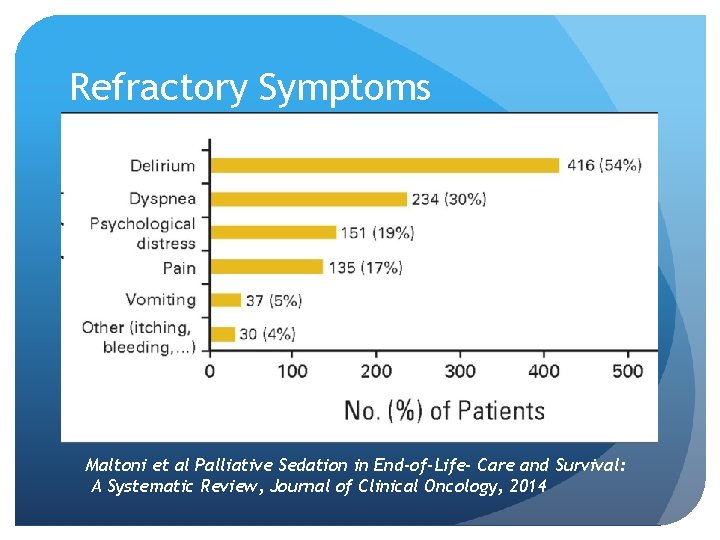
Refractory Symptoms Maltoni et al Palliative Sedation in End-of-Life- Care and Survival: A Systematic Review, Journal of Clinical Oncology, 2014
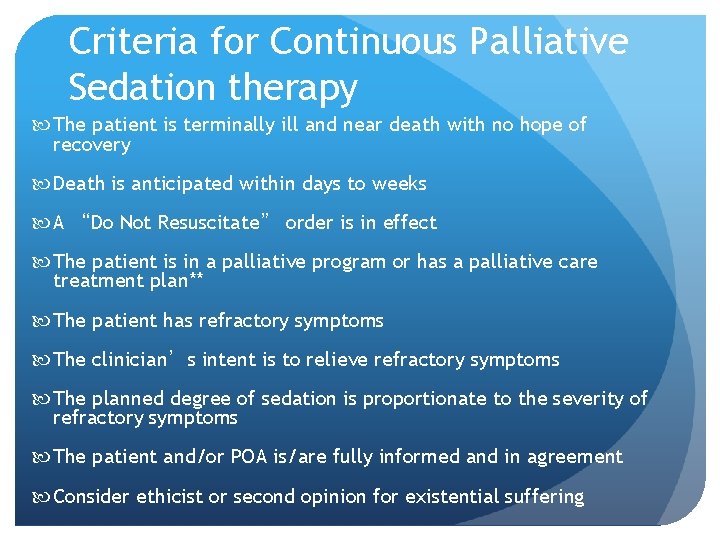
Criteria for Continuous Palliative Sedation therapy The patient is terminally ill and near death with no hope of recovery Death is anticipated within days to weeks A “Do Not Resuscitate” order is in effect The patient is in a palliative program or has a palliative care treatment plan** The patient has refractory symptoms The clinician’s intent is to relieve refractory symptoms The planned degree of sedation is proportionate to the severity of refractory symptoms The patient and/or POA is/are fully informed and in agreement Consider ethicist or second opinion for existential suffering
Case #1 : Questions Does Susan meet the criteria for Continuous Palliative Sedation Therapy?
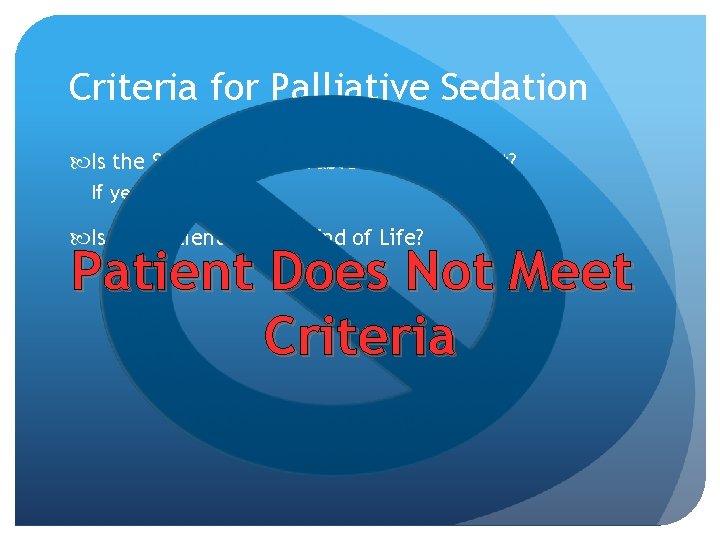
Criteria for Palliative Sedation Is the Symptom Intolerable for the Patient? If yes then…. Is the Patient Near to End of Life? Patient Does Not Meet Criteria
Case #1 : Outcome A family meeting is held where Susan expresses her frustration that no one can stay at home with her during the day The request for ‘palliative sedation’ is acknowledged and the process is explained Susan is informed that her symptoms can be treated more effectively Around the clock opioids are initiated instead of ‘as needed’ for relief of dyspnea and pain and a comprehensive plan is put in place for her anxiety, depression and sense of isolation
Case #2 70 yo man with end stage COPD (emphysema) Home O 2 since 2010 FEV 1 17% as of 2014 PFTs Narcotics for breathlessness Frequent admissions for COPD Discussing options of lung transplant until… Developed Ischemic bowel July 2015
Case 2 Prolonged admission for ischemic bowel July 2015 : ICU, Afib, COPD, wound infections, failed rehab and d/c home Consulted Oct 20 th for disposition and to follow at home : PPS 30% and bedbound Ambivalent, unable to plan for ACP or disposition Too stable for the local residential hospice Discharged home (Dec 22 nd!) against most of the teams’ advice
Case #2 PCA pump Hydromorphone COPD action plan, Methotrimeprazine (Nozinan) in home Rate of readmission increased to about monthly Jan to May 2016 for COPDE/dehydration/pneumonia Ongoing difficulties with Advanced Care Planning June weekend – Friday- he is readmitted
Case #2 PCA running 0. 2 mg/hr with 0. 5 mg Hydromorphone being pressed q 20 mins prn for bolus In hospital has had a few separate boluses 1 -2 mg IV q 10 min prn Has had Methotrimeprazine (Nozinan) 12. 5 mg subcut Has had Lorazepam 2 mg sublingual GASPING for air Sats 70%
Quick Goals of Care Discussion at Bedside “JUST MAKE ME COMFORTABLE” DNR – as per previous discussions : No intubation, no CPR He had on previous admissions agreed to Bi. PAP Declined Bi. PAP “I CAN’T TAKE THIS! I CAN’T BREATHE!” Consistent with previous wishes : Willing to have steroids and antibiotics
Questions for Case #2 Does the patient meet criteria for Continuous Palliative Sedation Therapy?
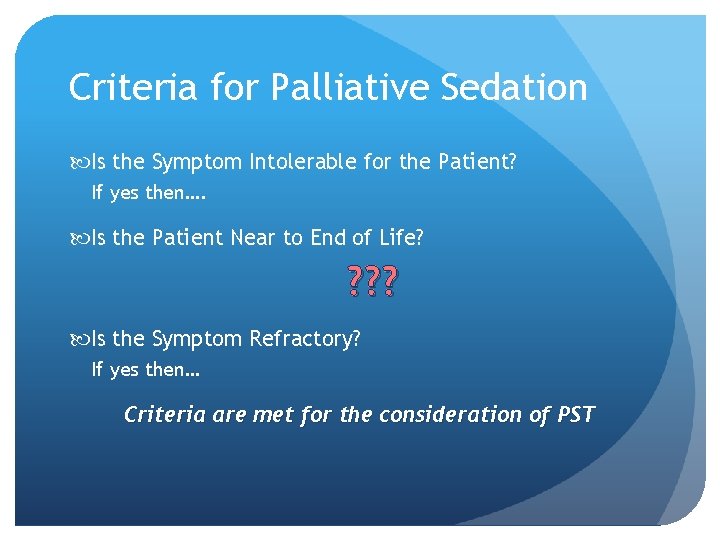
Criteria for Palliative Sedation Is the Symptom Intolerable for the Patient? If yes then…. Is the Patient Near to End of Life? ? ? ? Is the Symptom Refractory? If yes then… Criteria are met for the consideration of PST
Questions : Case #2 How do we Initiate Continuous Palliative Sedation Therapy?
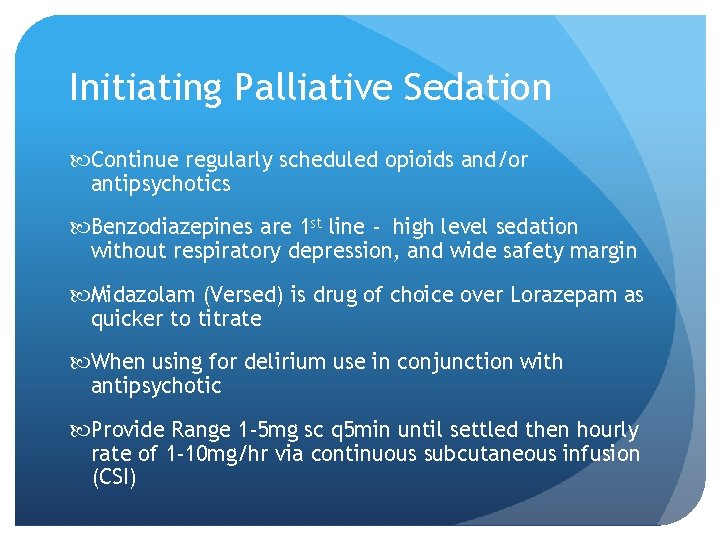
Initiating Palliative Sedation Continue regularly scheduled opioids and/or antipsychotics Benzodiazepines are 1 st line - high level sedation without respiratory depression, and wide safety margin Midazolam (Versed) is drug of choice over Lorazepam as quicker to titrate When using for delirium use in conjunction with antipsychotic Provide Range 1 -5 mg sc q 5 min until settled then hourly rate of 1 -10 mg/hr via continuous subcutaneous infusion (CSI)
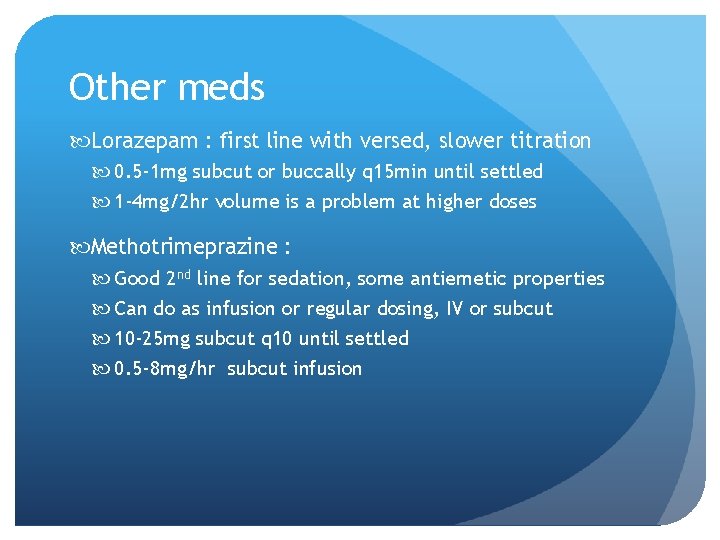
Other meds Lorazepam : first line with versed, slower titration 0. 5 -1 mg subcut or buccally q 15 min until settled 1 -4 mg/2 hr volume is a problem at higher doses Methotrimeprazine : Good 2 nd line for sedation, some antiemetic properties Can do as infusion or regular dosing, IV or subcut 10 -25 mg subcut q 10 until settled 0. 5 -8 mg/hr subcut infusion
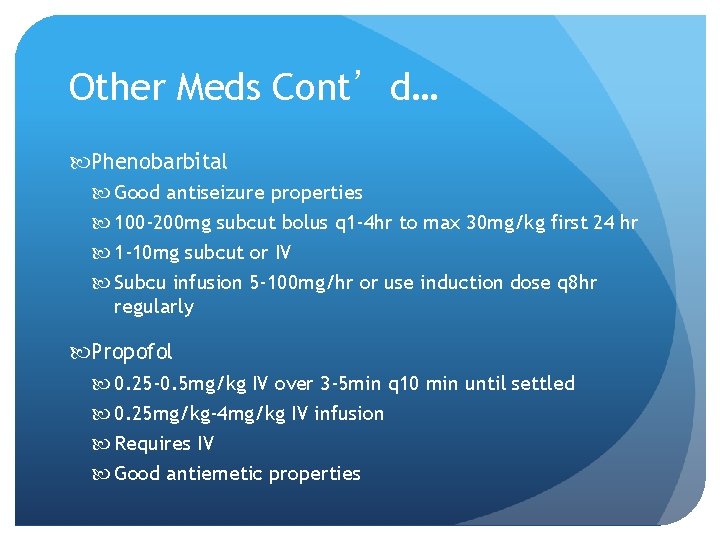
Other Meds Cont’d… Phenobarbital Good antiseizure properties 100 -200 mg subcut bolus q 1 -4 hr to max 30 mg/kg first 24 hr 1 -10 mg subcut or IV Subcu infusion 5 -100 mg/hr or use induction dose q 8 hr regularly Propofol 0. 25 -0. 5 mg/kg IV over 3 -5 min q 10 min until settled 0. 25 mg/kg-4 mg/kg IV infusion Requires IV Good antiemetic properties
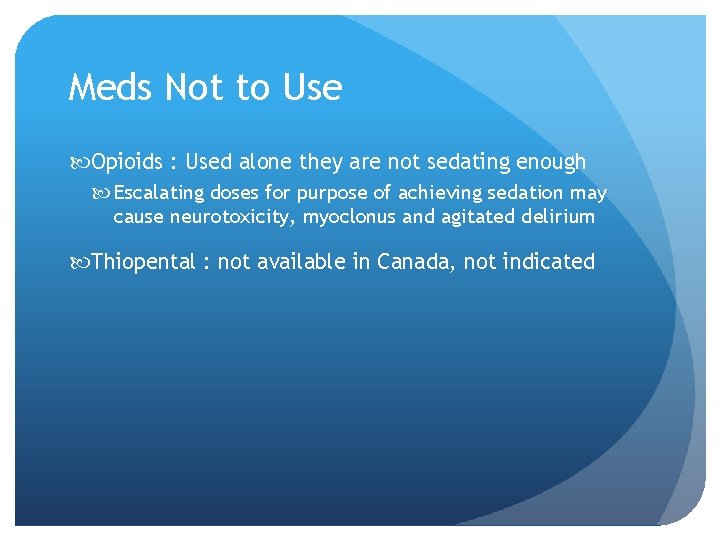
Meds Not to Use Opioids : Used alone they are not sedating enough Escalating doses for purpose of achieving sedation may cause neurotoxicity, myoclonus and agitated delirium Thiopental : not available in Canada, not indicated
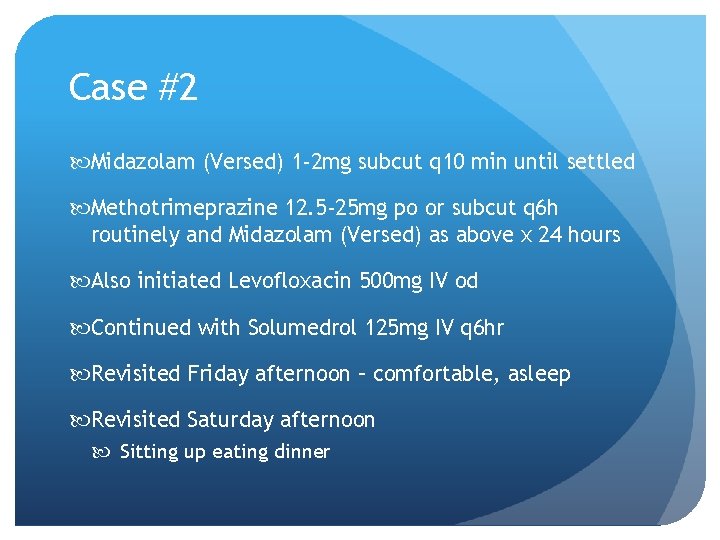
Case #2 Midazolam (Versed) 1 -2 mg subcut q 10 min until settled Methotrimeprazine 12. 5 -25 mg po or subcut q 6 h routinely and Midazolam (Versed) as above x 24 hours Also initiated Levofloxacin 500 mg IV od Continued with Solumedrol 125 mg IV q 6 hr Revisited Friday afternoon – comfortable, asleep Revisited Saturday afternoon Sitting up eating dinner
Case #3 64 yo woman with metastatic ovarian cancer Well known to PC team x 3 years and was doing well Was travelling to a tertiary centre for routine F/U and had nausea in car on way down Was admitted to the tertiary hospital with “malignant bowel obstruction” and transferred back to rural home town for end of life care Was sent to hospital versus home to be assessed by local physician
Case #3 Meds : Octretotide, antiemetics, pain meds (previously on Tylenol) Pt NPO Offered N/G tube but patient previously stated that she would NEVER want one and was “sticking to it” Slight improvement- tolerating sips PPS 20% Transferred to hospice
Case #3 Gradual increase weakness, abdominal distention, remained unable to eat and drink Any sip of fluid would be vomited back up Nausea otherwise well controlled on Haloperidol subcut CT scan after considering PEG (percutaneous endoscopic gastrostomy): megacolon and obstruction, no ascites
Case #3 PEG tube wasn’t an option Rectal decompression x 2 unsuccessful and uncomfortable Patient was competent and afraid of perforation – “sudden agony” Patient ++ distressed by inability to drink anything ++thirsty despite good mouth care (mouthcote, ice chips etc. )
Questions for Case #3 Does the patient meet criteria for Continuous Palliative Sedation?
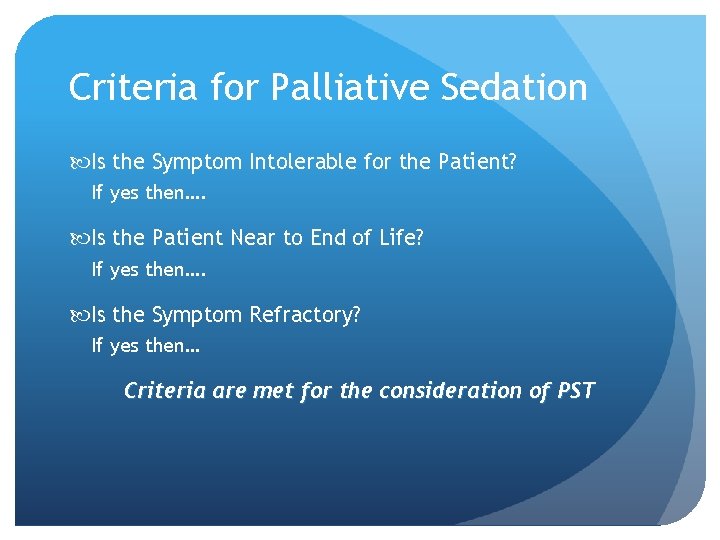
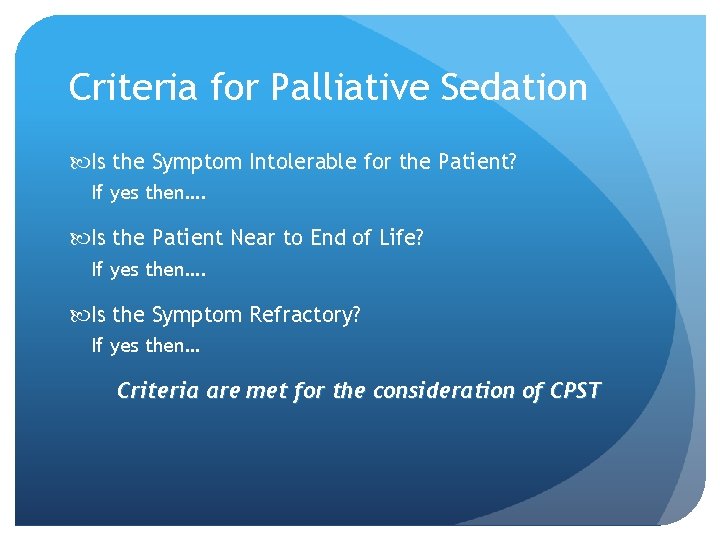
Criteria for Palliative Sedation Is the Symptom Intolerable for the Patient? If yes then…. Is the Patient Near to End of Life? If yes then…. Is the Symptom Refractory? If yes then… Criteria are met for the consideration of PST
Case #3 Patient opted for continuous palliative sedation and requested she be made “unaware of her surroundings” Family also agree with continuous palliative sedation and Midazolam infusion is initiated at 3 mg/hr with parameters to increase dose to keep patient sedated Unfortunately family called MD in distress as nurses often turned down the Midazolam (Versed) drip Charting reports “patient appears comfortable” and no adjustments to Versed drip made even when conscious When confronted with this one of nurses accused MD of hastening death and attempting to euthanize patient
Case #3 : Questions What is the difference between Continuous Palliative Sedation Therapy and MAi. D?
How does CPST Differ from Euthanasia? 1. It has the intent to provide symptom relief, not hastening of death 2. It is a proportionate intervention. CPST and its outcome should be carefully monitored and documented 3. The death of the patient is not a criteria De Graeff A, Dean M: Palliative sedation therapy in the last weeks of life: A literature review and recommendations for standards. J Palliat Med 2007; 10: 67– 85
Palliative Sedation Therapy Does not Hasten Death Maltoni M, et al: Palliative Sedation Therapy Does Not Hasten Death: Results from a Prospective Multicenter Study. Ann Oncol 2009; 20: 1163– 1169. Trying to prove whether “doctrine of double effect” was needed 518 patients enrolled in 2 arms at hospice – Cohort A required PST and were matched by age/gender/admitting symptom and Karnovsky performance scale but who did not require it Therapeutic approach was clinically driven Primary endpoint : overall survival
Results 267 Cohort A and 251 Cohort B Prevalence of PST 25% across the 4 Hospices Survival time was calculated as # full days from time of admission to death No statistically significant difference found in LOS Control group mean survival was 9 d vs 12 d for PST group Kaplan-Meier survival curve superimposed the two show no difference
Kaplan–Meier survival curves for cohort A [palliative sedation therapy (PST)] and cohort B (no PST). M. Maltoni et al. Ann Oncol 2009; 20: 1163 -1169 © The Author 2009. Published by Oxford University Press on behalf of the European Society for Medical Oncology. All rights reserved. For permissions, please email: journals. permissions@oxfordjournals. org
Questions for Case #3 How should we be monitoring and charting about Continuous Palliative Sedation for effectiveness?
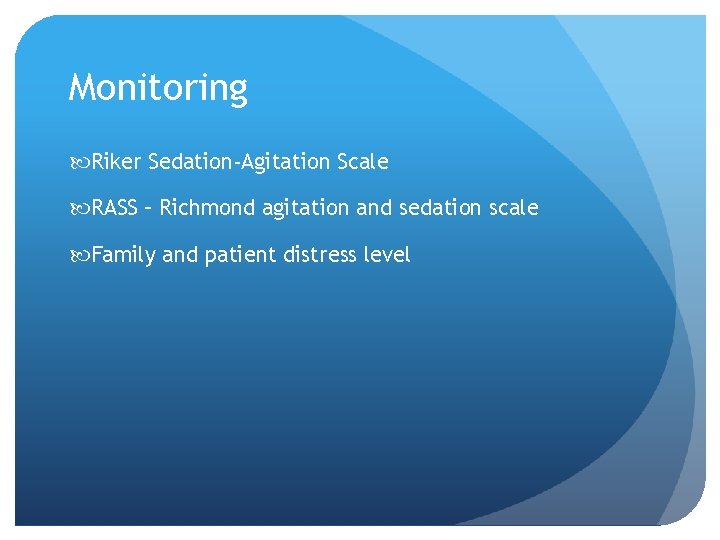
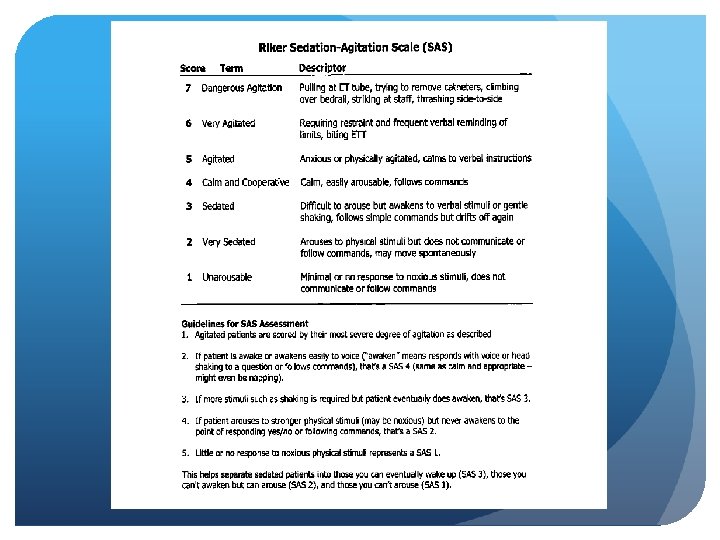
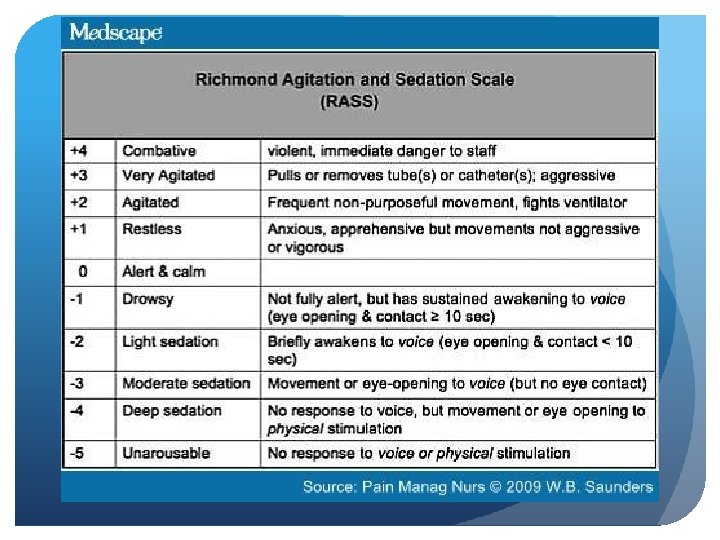
Monitoring Riker Sedation-Agitation Scale RASS – Richmond agitation and sedation scale Family and patient distress level
RASS score
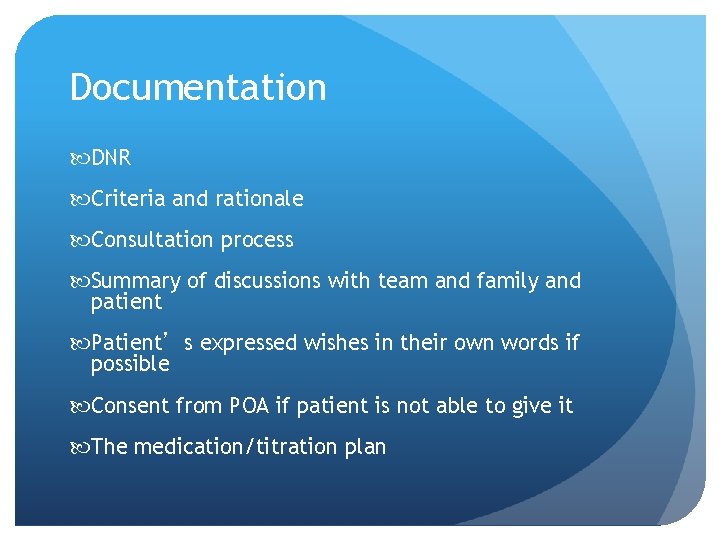
Documentation DNR Criteria and rationale Consultation process Summary of discussions with team and family and patient Patient’s expressed wishes in their own words if possible Consent from POA if patient is not able to give it The medication/titration plan
Case # 3 : Outcome Team meeting was held Notes left on front of chart and on RASS scale informing of intent of sedation Patient often required increases in her Midazolam (Versed) subcut infusion Died peacefully 3 days later
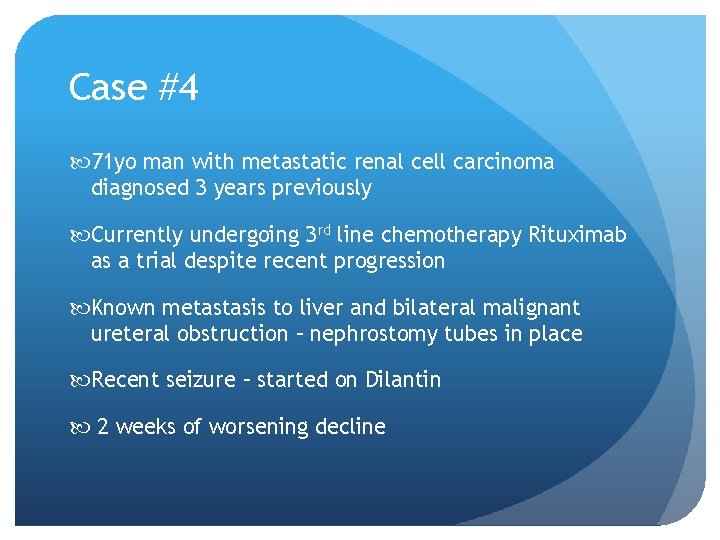
Case #4 71 yo man with metastatic renal cell carcinoma diagnosed 3 years previously Currently undergoing 3 rd line chemotherapy Rituximab as a trial despite recent progression Known metastasis to liver and bilateral malignant ureteral obstruction – nephrostomy tubes in place Recent seizure – started on Dilantin 2 weeks of worsening decline
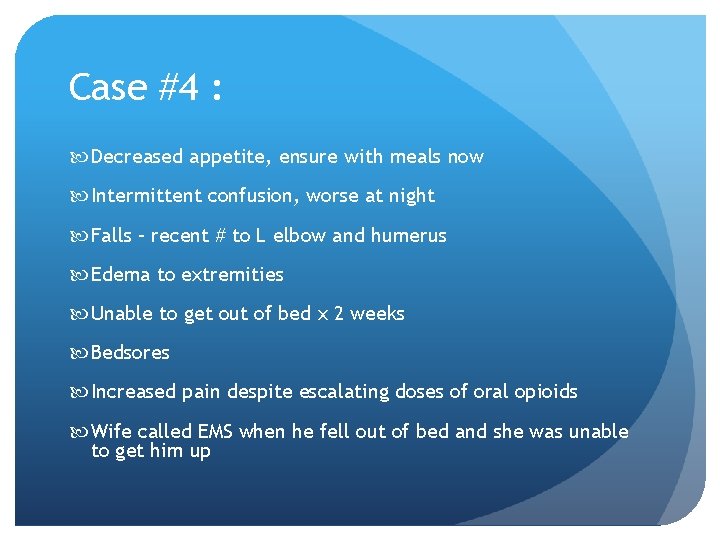
Case #4 : Decreased appetite, ensure with meals now Intermittent confusion, worse at night Falls – recent # to L elbow and humerus Edema to extremities Unable to get out of bed x 2 weeks Bedsores Increased pain despite escalating doses of oral opioids Wife called EMS when he fell out of bed and she was unable to get him up
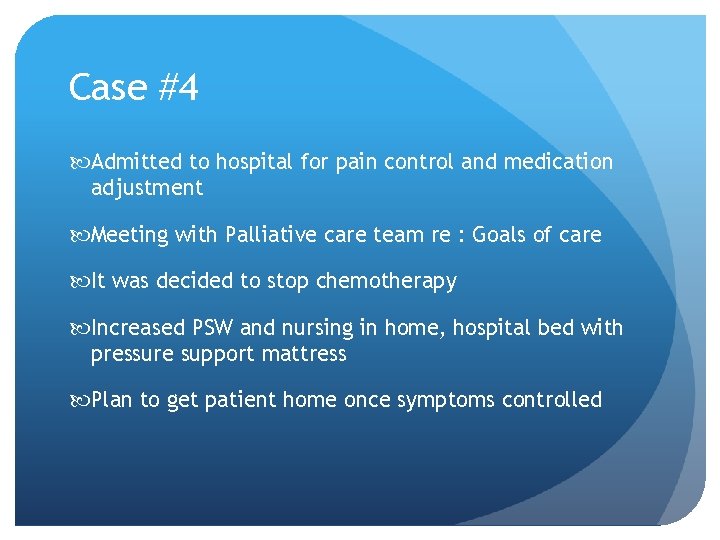
Case #4 Admitted to hospital for pain control and medication adjustment Meeting with Palliative care team re : Goals of care It was decided to stop chemotherapy Increased PSW and nursing in home, hospital bed with pressure support mattress Plan to get patient home once symptoms controlled
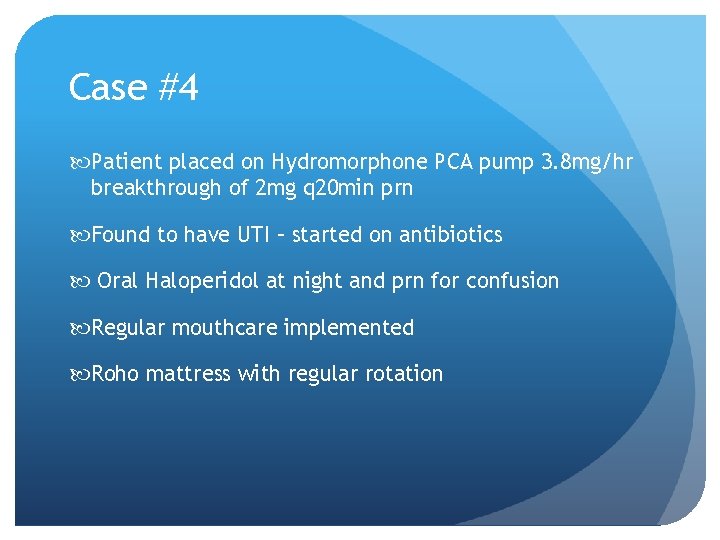
Case #4 Patient placed on Hydromorphone PCA pump 3. 8 mg/hr breakthrough of 2 mg q 20 min prn Found to have UTI – started on antibiotics Oral Haloperidol at night and prn for confusion Regular mouthcare implemented Roho mattress with regular rotation
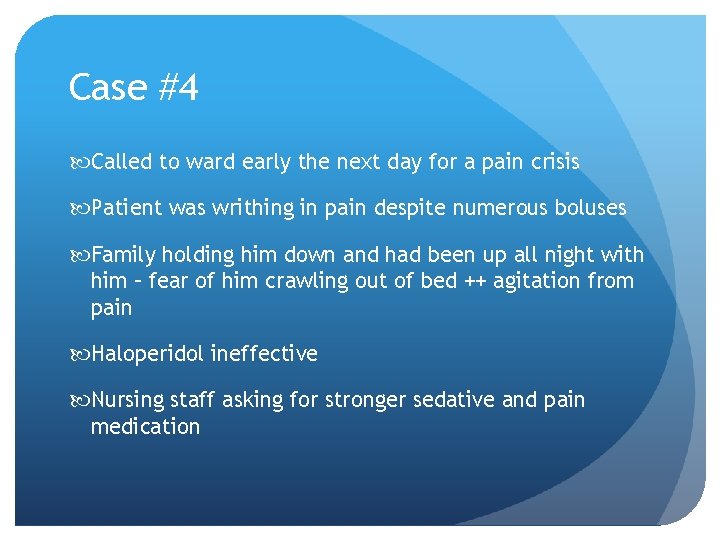
Case #4 Called to ward early the next day for a pain crisis Patient was writhing in pain despite numerous boluses Family holding him down and had been up all night with him – fear of him crawling out of bed ++ agitation from pain Haloperidol ineffective Nursing staff asking for stronger sedative and pain medication
Questions for Case #3 Does the patient meet criteria for Continuous Palliative Sedation?
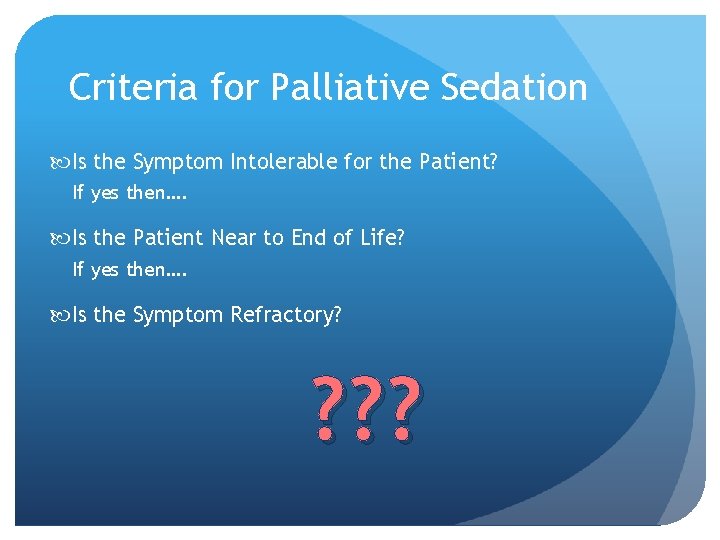
Criteria for Palliative Sedation Is the Symptom Intolerable for the Patient? If yes then…. Is the Patient Near to End of Life? If yes then…. Is the Symptom Refractory? ? ? ?
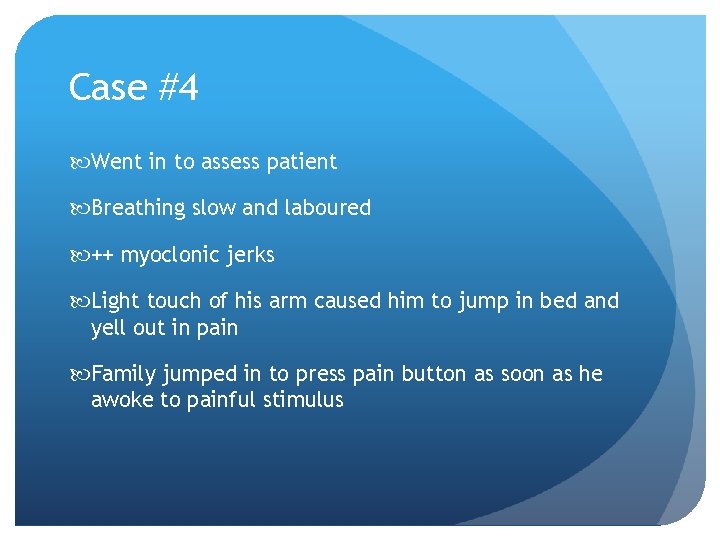
Case #4 Went in to assess patient Breathing slow and laboured ++ myoclonic jerks Light touch of his arm caused him to jump in bed and yell out in pain Family jumped in to press pain button as soon as he awoke to painful stimulus
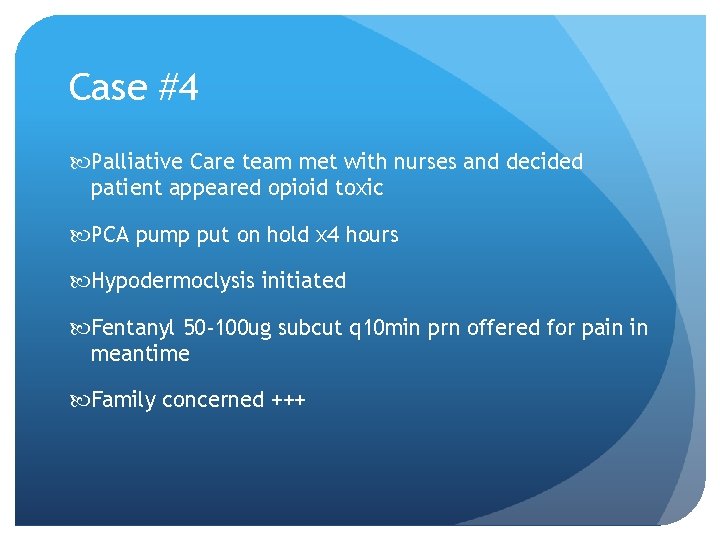
Case #4 Palliative Care team met with nurses and decided patient appeared opioid toxic PCA pump put on hold x 4 hours Hypodermoclysis initiated Fentanyl 50 -100 ug subcut q 10 min prn offered for pain in meantime Family concerned +++
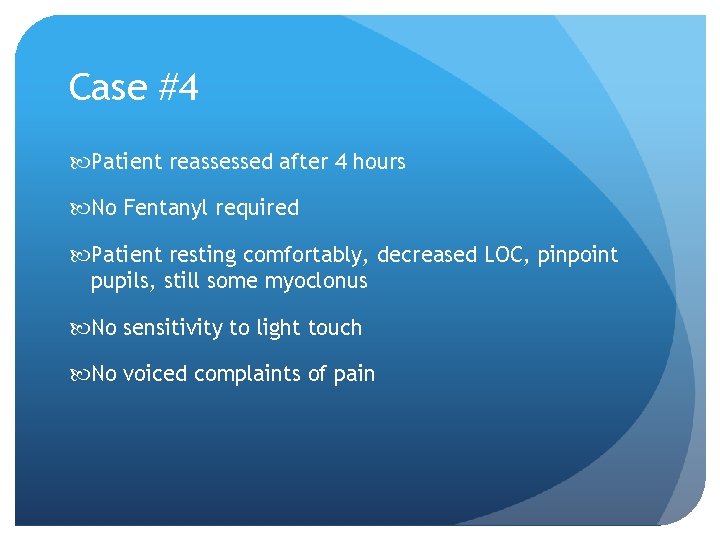
Case #4 Patient reassessed after 4 hours No Fentanyl required Patient resting comfortably, decreased LOC, pinpoint pupils, still some myoclonus No sensitivity to light touch No voiced complaints of pain
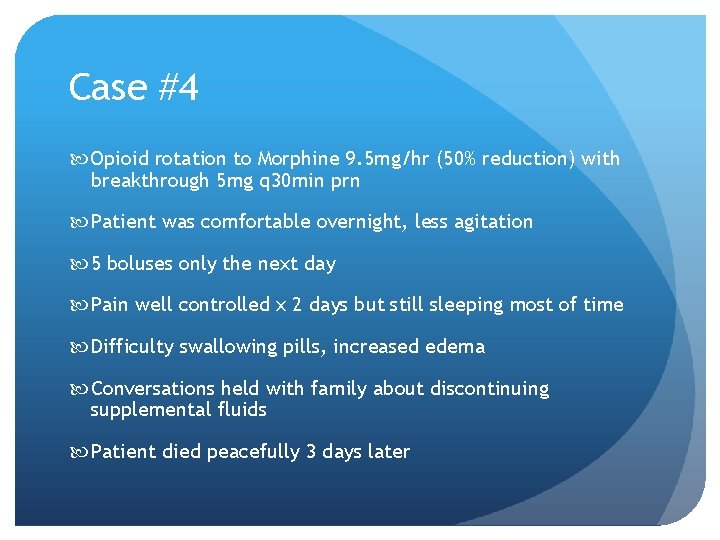
Case #4 Opioid rotation to Morphine 9. 5 mg/hr (50% reduction) with breakthrough 5 mg q 30 min prn Patient was comfortable overnight, less agitation 5 boluses only the next day Pain well controlled x 2 days but still sleeping most of time Difficulty swallowing pills, increased edema Conversations held with family about discontinuing supplemental fluids Patient died peacefully 3 days later
Case #5 41 yo woman with metastatic colon cancer x 3 years 2 young children : 5 and 7 yo, home schooled Consulted end of summer after the patient was found to have metastasis to lung and liver On home O 2 prn for comfort PPS 80% Phone intake Had narcotics prn to take to the cottage, Ritalin added for symtpoms of fatigue
Case #5 Early August : Admission to local hospital for nausea and pain control 3 phone calls in span of 1 hour Goals of care still same – needed to be able to parent kids Quick admission – started Hydromorph Contin, routine meds for nausea D/C plans: D/C home but patient really wanted “one more weekend at the cottage”
Case 5 cont Increasing problems with pain and nausea at home Daily phone calls from visiting nurses Hydromorph Contin 9 mg bid, 2 mg po q 1 hprn breakthrough Using Ondansetron 8 mg po q 8 hr routine, Haldol 1 mg po q 6 hr, Lorazepam 0. 25 mg po q 6 hr, Dexamethasone 4 mg po od Home Visit Decision to come to hospice to help with pain, nausea and protect kids
Case #5 PCA Pain pump : well controlled Nausea much better controlled + Insomnia the night before Family time together in quiet room - Husband feeling more settled Patient continues to feel quite anxious PPS 40% Patient at this point asks for continuous palliative sedation therapy: she finds she just “Watches the clock” and is “ready to go”
Questions for Case #3 Does the patient meet criteria for Continuous Palliative Sedation Therapy?
Criteria for Palliative Sedation Is the Symptom Intolerable for the Patient? If yes then…. Is the Patient Near to End of Life? Patient Does Not Meet Criteria
Case #5 Cont Time spent exploring CPST with patient and husband Organized Minister to come Mother to sit with her in morning when lonely Better sleeping pills at night Promised to discuss this again on Friday
Case #5 Pastor came in to see her- not much help Sleeping better at night Suffering ++ “I’m done with this” No longer swallowing – gags on food, can’t tolerate liquids Hardly able to stay awake for conversation Husband now on board
Questions for Case #3 NOW Does the patient meet criteria for Continuous Palliative Sedation?
Criteria for Palliative Sedation Is the Symptom Intolerable for the Patient? If yes then…. Is the Patient Near to End of Life? If yes then…. Is the Symptom Refractory? If yes then… Criteria are met for the consideration of CPST
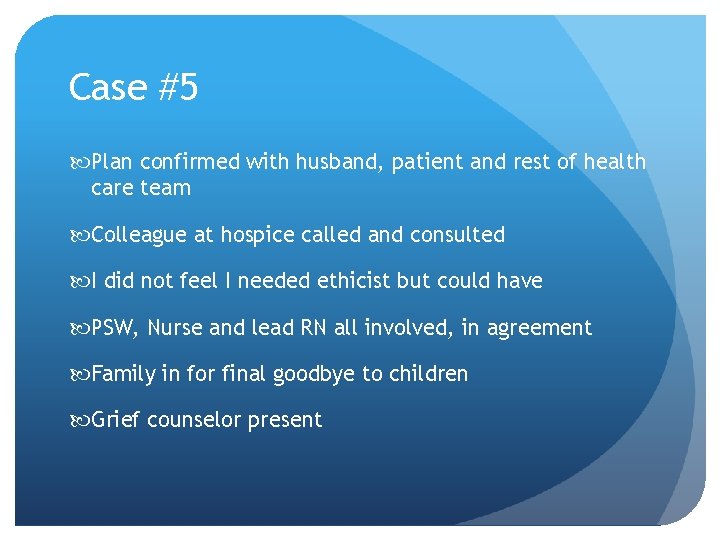
Case #5 Plan confirmed with husband, patient and rest of health care team Colleague at hospice called and consulted I did not feel I needed ethicist but could have PSW, Nurse and lead RN all involved, in agreement Family in for final goodbye to children Grief counselor present
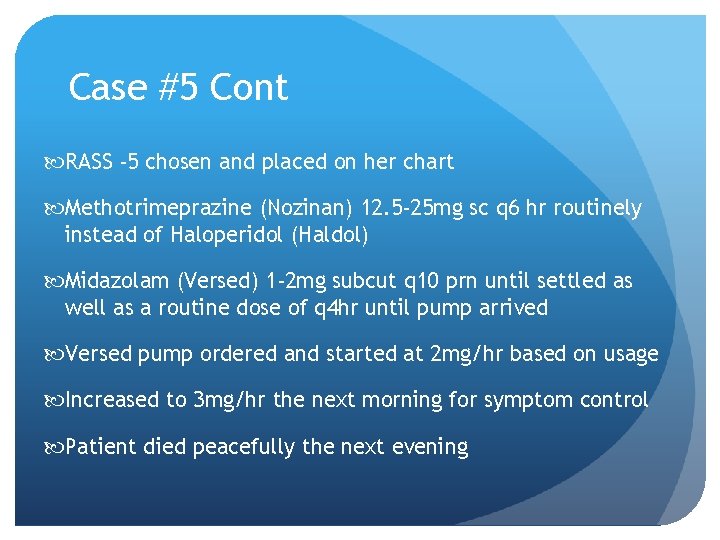
Case #5 Cont RASS -5 chosen and placed on her chart Methotrimeprazine (Nozinan) 12. 5 -25 mg sc q 6 hr routinely instead of Haloperidol (Haldol) Midazolam (Versed) 1 -2 mg subcut q 10 prn until settled as well as a routine dose of q 4 hr until pump arrived Versed pump ordered and started at 2 mg/hr based on usage Increased to 3 mg/hr the next morning for symptom control Patient died peacefully the next evening
Did we Learn Anything Today? ?
True or False Continuous palliative sedation is a form of MAi. D Continuous palliative sedation therapy hastens death Rapidly escalating opioids is an acceptable form of continuous palliative sedation therapy Implementing palliative sedation takes away a family’s opportunity for conversation/care in the final days or hours Intractable grief or suffering is an appropriate indication for continuous palliative sedation
Additional References Framework for Continuous Palliative Sedation Therapy (CPST) in Canada Dean MM et al JOURNAL OF PALLIATIVE MEDICINE Volume 15, Number 8, 2012 pgs 870 -879 Mary Ann Liebert, Inc. DOI: 10. 1089/jpm. 2011. 0498 http: //www. chpca. net/media/343120 final_cpst_framework. pdf Bill C 277 : Framework of Palliative Care in Canada http: //www. parl. ca/Document. Viewer/en/42 -1/bill/C-277/royalassent
Additional References https: //www. cspcp. ca/wp-content/uploads/2017/11/CSPCPStatement-CPST-FINAL. pdf This contains links to Fraser Health Authority in BC, Ottawa, Quebec and Waterloo- Wellington protocols.