
Continuous Bioreactors Chemostat with Recycle Ch EE 481
Continuous Bioreactors – Chemostat with Recycle Ch. EE 481 a
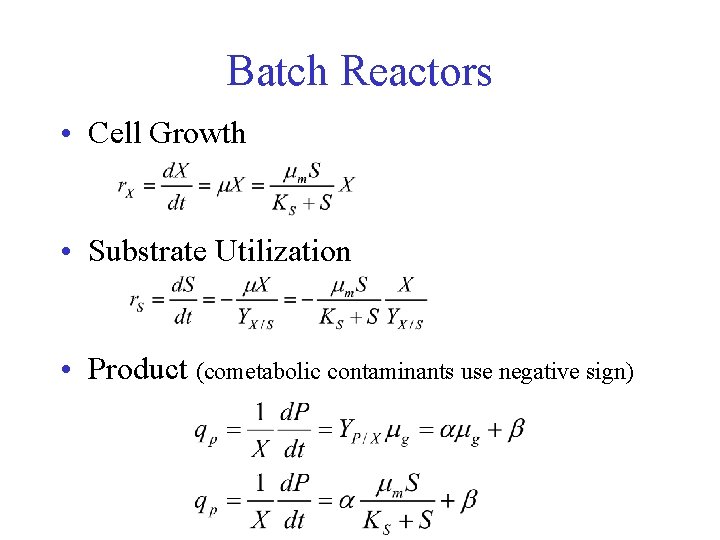
Batch Reactors • Cell Growth • Substrate Utilization • Product (cometabolic contaminants use negative sign)
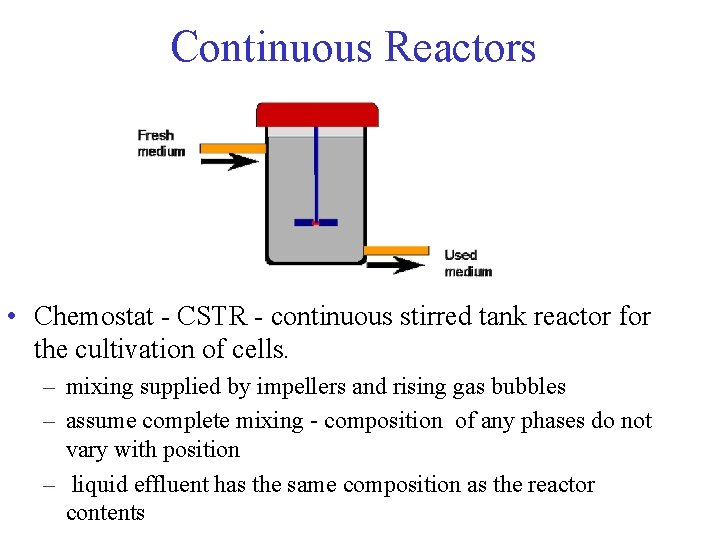
Continuous Reactors • Chemostat - CSTR - continuous stirred tank reactor for the cultivation of cells. – mixing supplied by impellers and rising gas bubbles – assume complete mixing - composition of any phases do not vary with position – liquid effluent has the same composition as the reactor contents
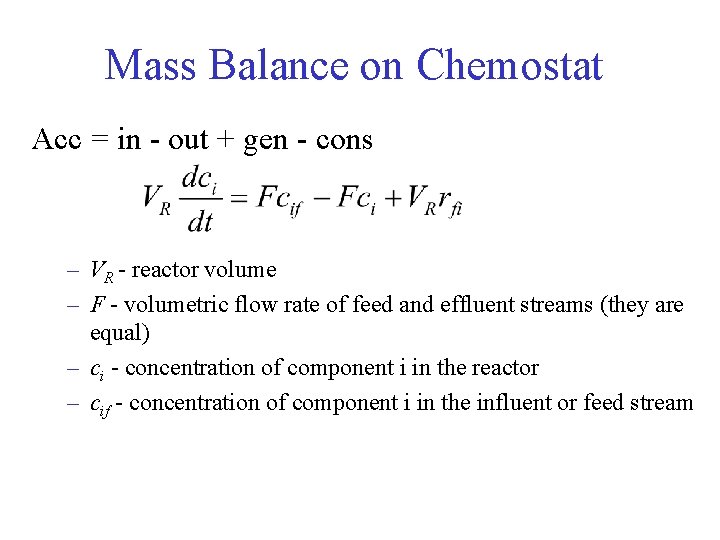
Mass Balance on Chemostat Acc = in - out + gen - cons – VR - reactor volume – F - volumetric flow rate of feed and effluent streams (they are equal) – ci - concentration of component i in the reactor – cif - concentration of component i in the influent or feed stream
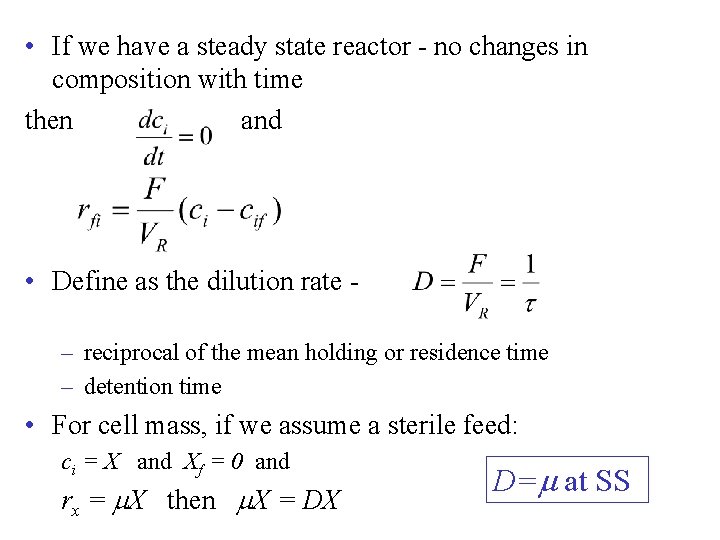
• If we have a steady state reactor - no changes in composition with time then and • Define as the dilution rate – reciprocal of the mean holding or residence time – detention time • For cell mass, if we assume a sterile feed: ci = X and Xf = 0 and rx = m. X then m. X = DX D=m at SS
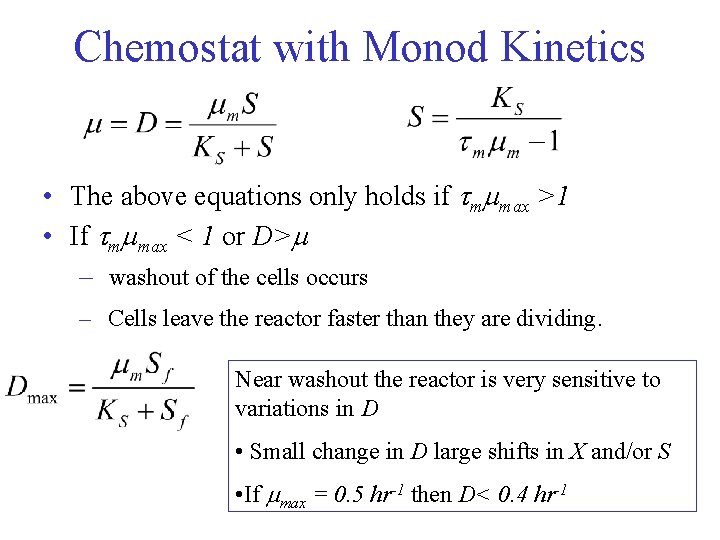
Chemostat with Monod Kinetics • The above equations only holds if tmmmax >1 • If tmmmax < 1 or D>m – washout of the cells occurs – Cells leave the reactor faster than they are dividing. Near washout the reactor is very sensitive to variations in D • Small change in D large shifts in X and/or S • If mmax = 0. 5 hr-1 then D< 0. 4 hr-1
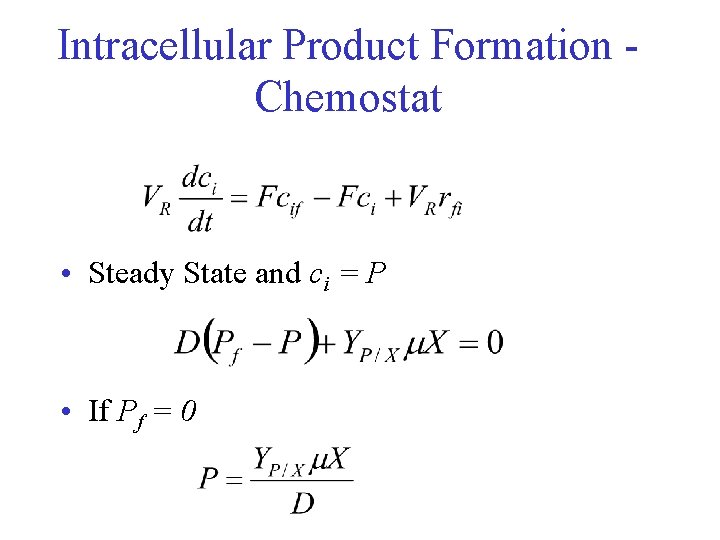
Intracellular Product Formation Chemostat • Steady State and ci = P • If Pf = 0
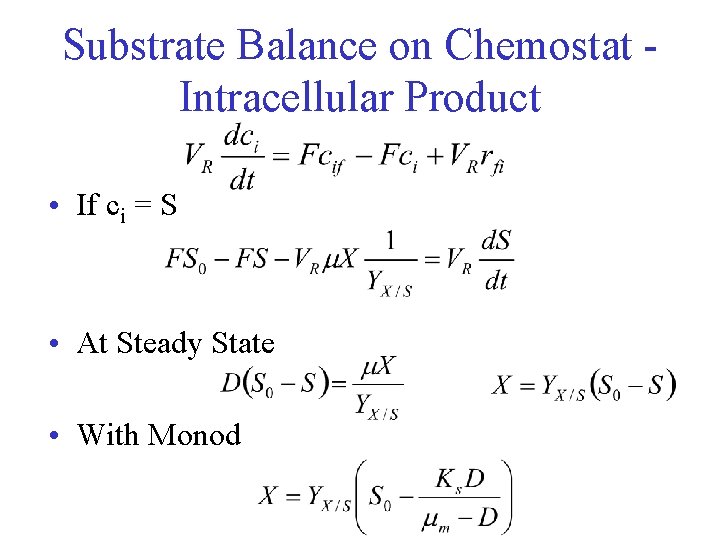
Substrate Balance on Chemostat Intracellular Product • If ci = S • At Steady State • With Monod
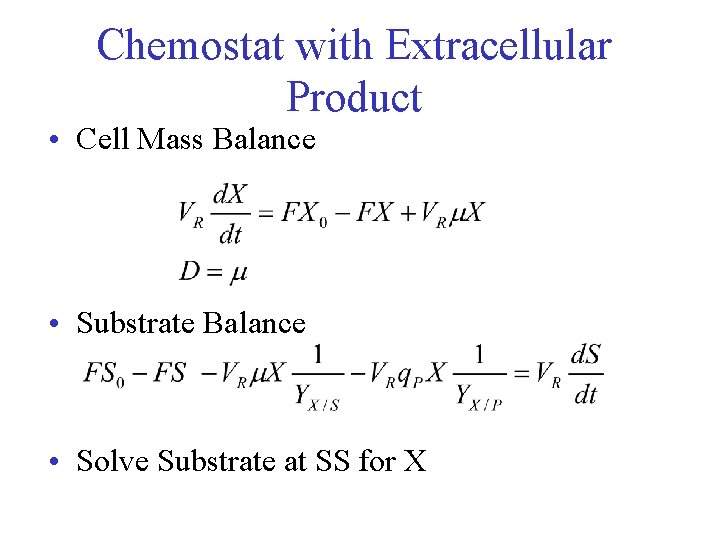
Chemostat with Extracellular Product • Cell Mass Balance • Substrate Balance • Solve Substrate at SS for X
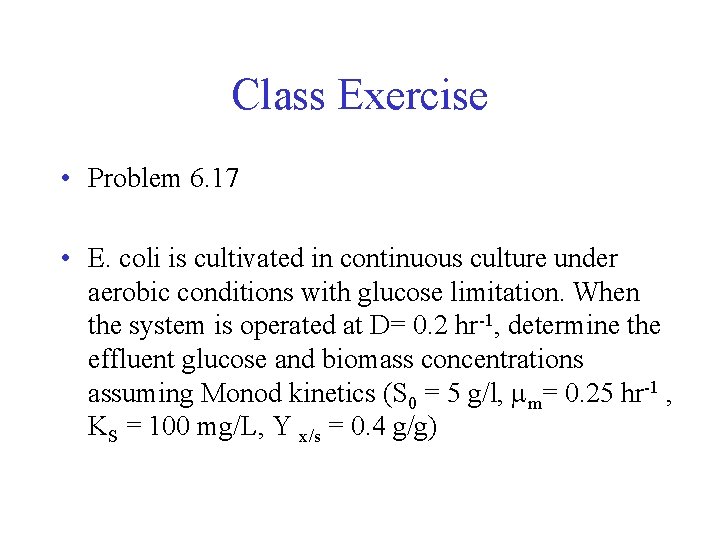
Class Exercise • Problem 6. 17 • E. coli is cultivated in continuous culture under aerobic conditions with glucose limitation. When the system is operated at D= 0. 2 hr-1, determine the effluent glucose and biomass concentrations assuming Monod kinetics (S 0 = 5 g/l, mm= 0. 25 hr-1 , KS = 100 mg/L, Y x/s = 0. 4 g/g)
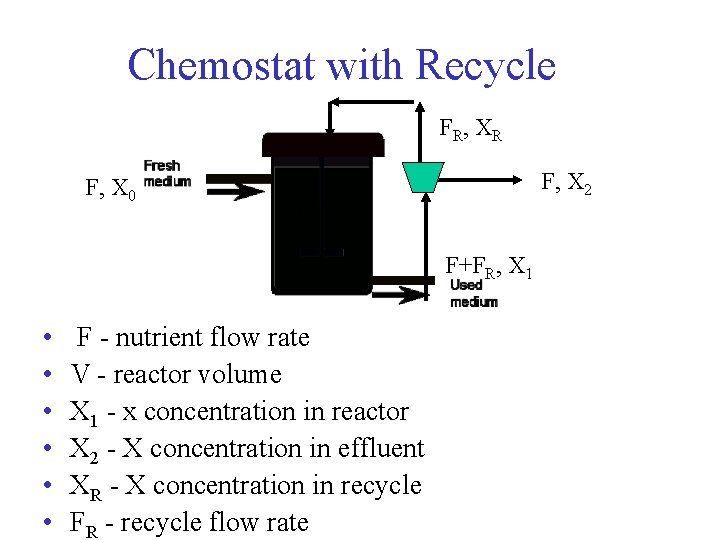
Chemostat with Recycle FR , XR F, X 0 F, X 2 V, X 1 F+FR, X 1 • • • F - nutrient flow rate V - reactor volume X 1 - x concentration in reactor X 2 - X concentration in effluent XR - X concentration in recycle FR - recycle flow rate
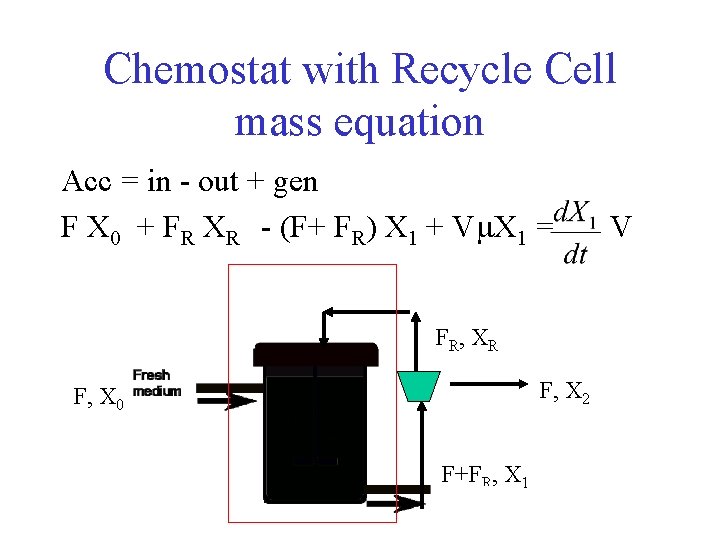
Chemostat with Recycle Cell mass equation Acc = in - out + gen F X 0 + FR XR - (F+ FR) X 1 + Vm. X 1 = FR , XR F, X 0 F, X 2 V, X 1 F+FR, X 1 V
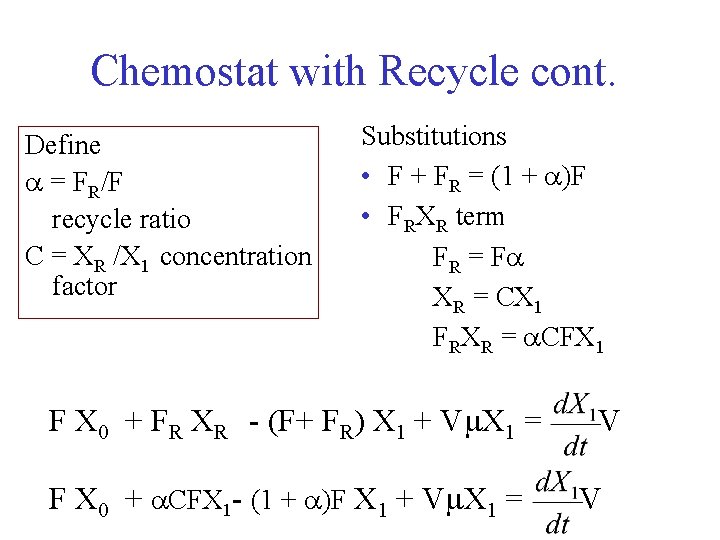
Chemostat with Recycle cont. Define a = FR/F recycle ratio C = XR /X 1 concentration factor Substitutions • F + FR = (1 + a)F • FRXR term FR = Fa XR = CX 1 FRXR = a. CFX 1 F X 0 + FR XR - (F+ FR) X 1 + Vm. X 1 = F X 0 + a. CFX 1 - (1 + a)F X 1 + Vm. X 1 = V V
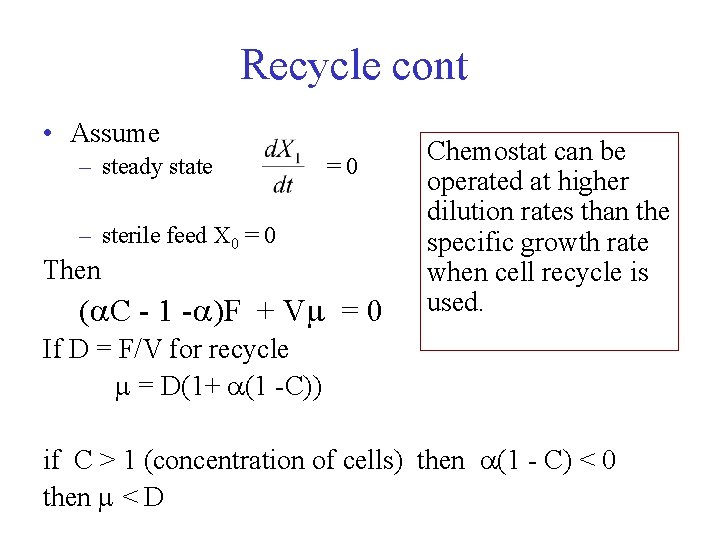
Recycle cont • Assume – steady state =0 – sterile feed X 0 = 0 Then (a. C - 1 -a)F + Vm = 0 Chemostat can be operated at higher dilution rates than the specific growth rate when cell recycle is used. If D = F/V for recycle m = D(1+ a(1 -C)) if C > 1 (concentration of cells) then a(1 - C) < 0 then m < D
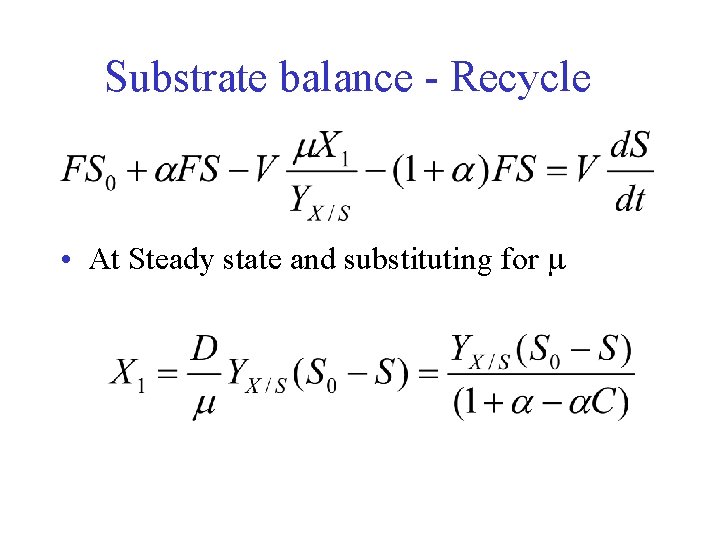
Substrate balance - Recycle • At Steady state and substituting for m
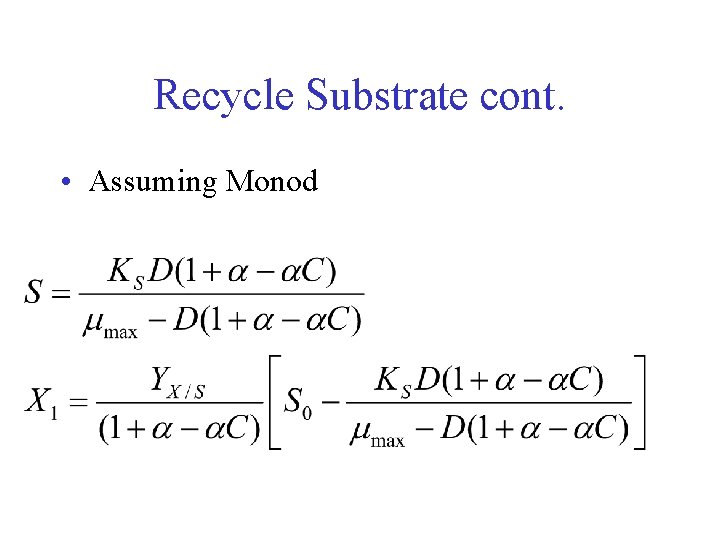
Recycle Substrate cont. • Assuming Monod
In Class Exercise • Consider a 1000 L CSTR in which biomass is being produced with glucose as the substrate. The microbial system follows a Monod relations with mm = 0. 4 hr – 1, KS = 1. 5 g/L, and yield factor = 0. 5 g/g. If S 0 = 10 g/L glucose and F = 100 L/h: – What is the specific biomass production rate (g/l-h) at SS? – If recycle is used with a recycle stream of 10 L/h and a recycle biomass concentration five times as large as that in the reactor exit, what would be the new specific biomass production rate?
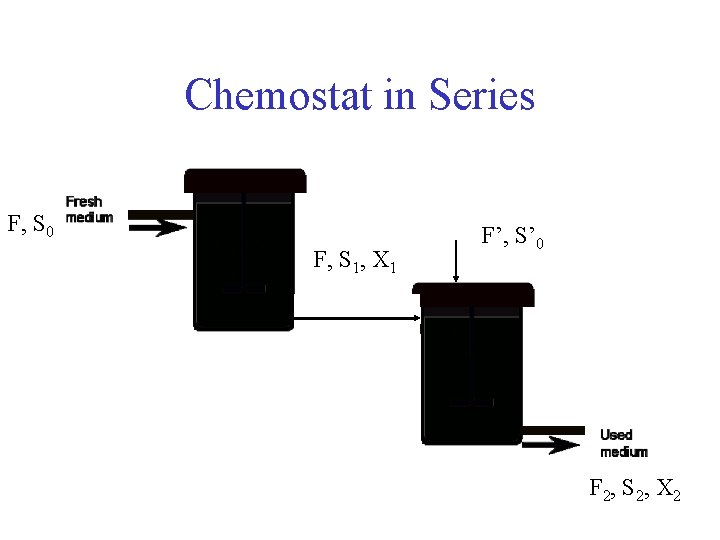
Chemostat in Series F, S 0 V 1, X 1, S 1 F, S 1, X 1 F’, S’ 0 V 2, X 2, S 2 F 2, S 2, X 2
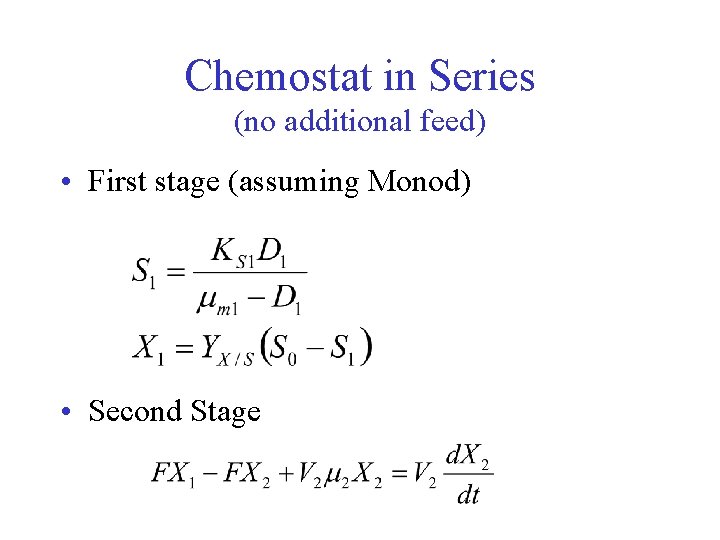
Chemostat in Series (no additional feed) • First stage (assuming Monod) • Second Stage
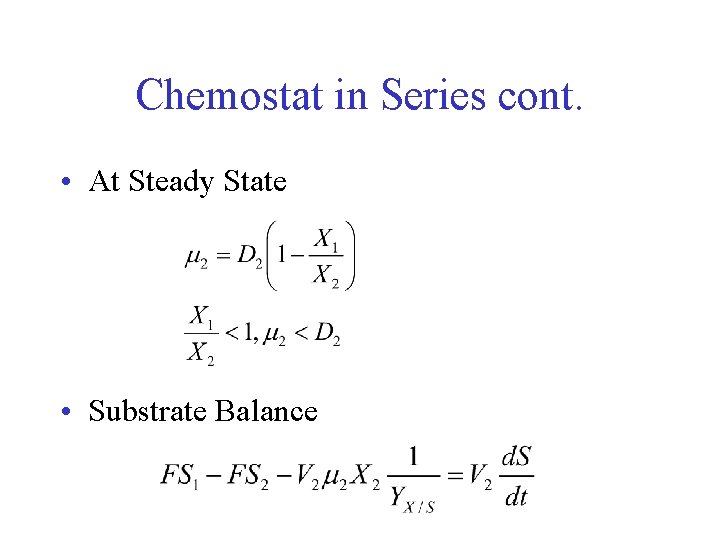
Chemostat in Series cont. • At Steady State • Substrate Balance
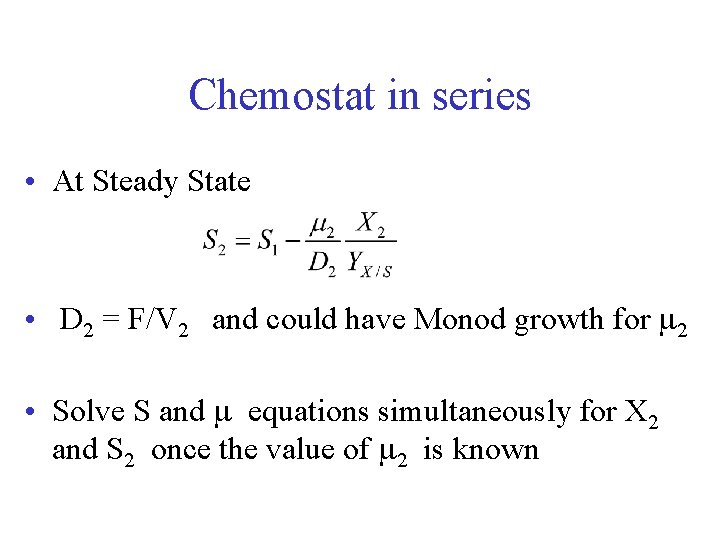
Chemostat in series • At Steady State • D 2 = F/V 2 and could have Monod growth for m 2 • Solve S and m equations simultaneously for X 2 and S 2 once the value of m 2 is known
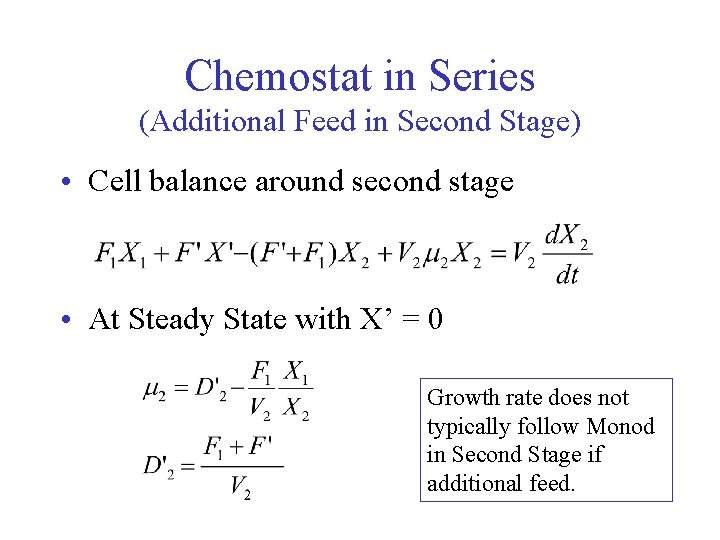
Chemostat in Series (Additional Feed in Second Stage) • Cell balance around second stage • At Steady State with X’ = 0 Growth rate does not typically follow Monod in Second Stage if additional feed.
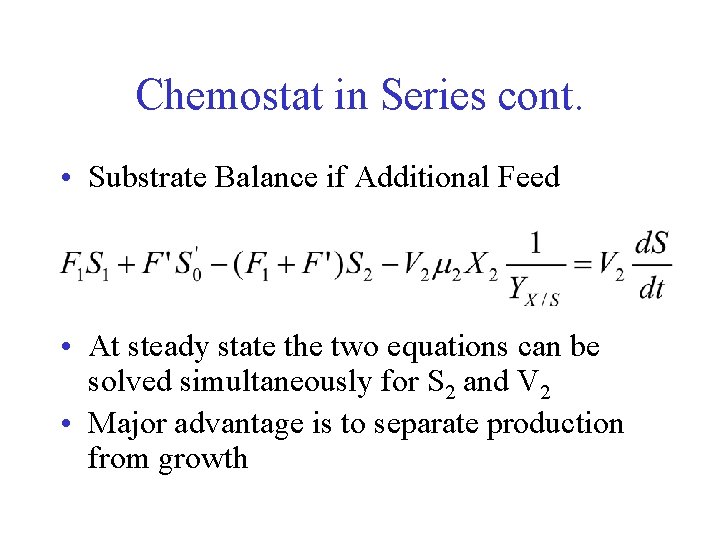
Chemostat in Series cont. • Substrate Balance if Additional Feed • At steady state the two equations can be solved simultaneously for S 2 and V 2 • Major advantage is to separate production from growth
In Class Example – 9. 2 • In a two stage chemostat system, the volumes of the first and second reactors are 500 L and 300 L respectively. The first reactor is used for biomass production and the second is for a secondary metabolite formation. The feed flow rate to the first reactor is F = 100 L/h, and the glucose concentration is 5. 0 g/L. Use the following constants for the cells. mm = 0. 3 h-1, Ks = 0. 1 g/L Y X/S= 0. 4 g/g • Determine the cell and glucose concentrations after the first stage. • Assume that growth is negligible in the second stage and the specific rate of product formation is q. P = 0. 02 g. P/g cell hr, and Y P/S = 0. 6 g. P/g. S. Determine the product and substrate concentrations in the effluent of the second reactor.
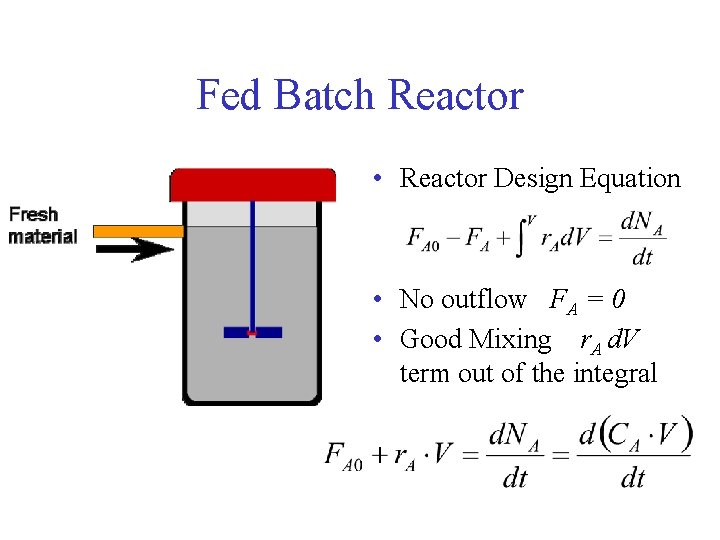
Fed Batch Reactor • Reactor Design Equation • No outflow FA = 0 • Good Mixing r. A d. V term out of the integral
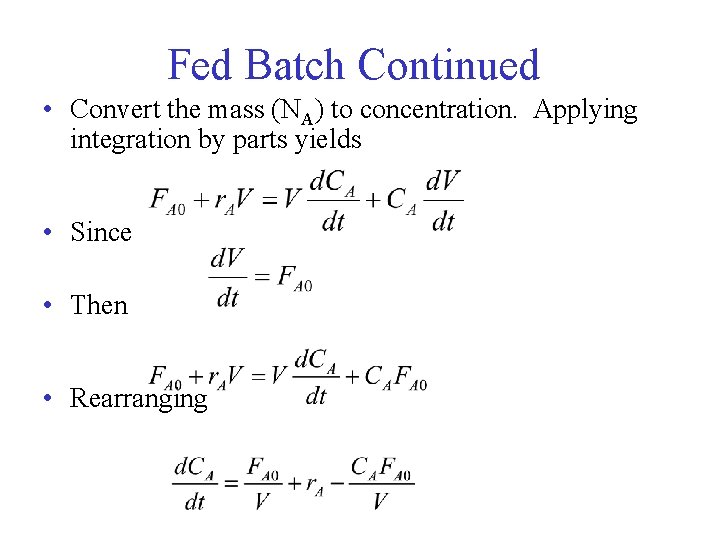
Fed Batch Continued • Convert the mass (NA) to concentration. Applying integration by parts yields • Since • Then • Rearranging
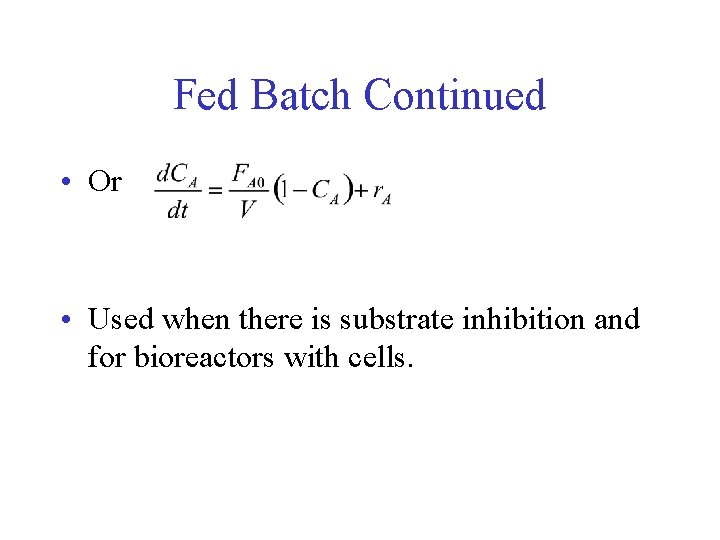
Fed Batch Continued • Or • Used when there is substrate inhibition and for bioreactors with cells.
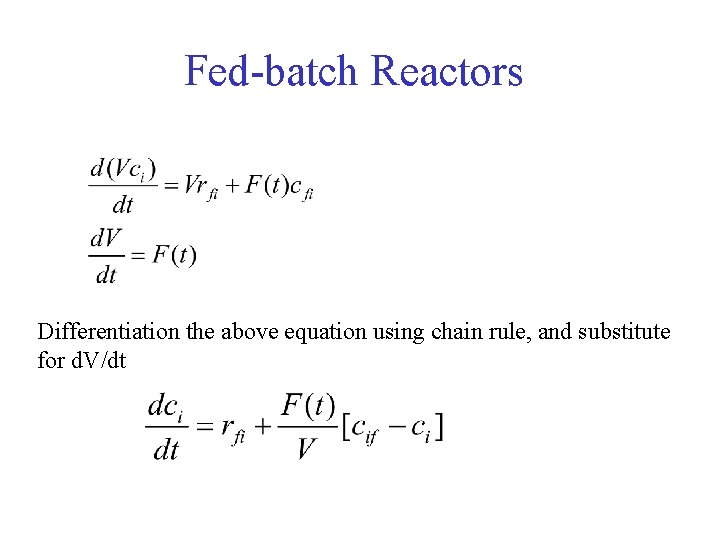
Fed-batch Reactors Differentiation the above equation using chain rule, and substitute for d. V/dt
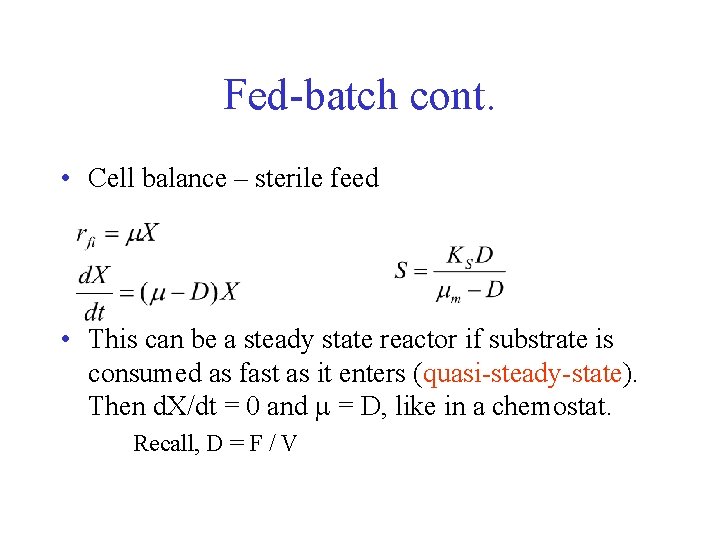
Fed-batch cont. • Cell balance – sterile feed • This can be a steady state reactor if substrate is consumed as fast as it enters (quasi-steady-state). Then d. X/dt = 0 and m = D, like in a chemostat. Recall, D = F / V
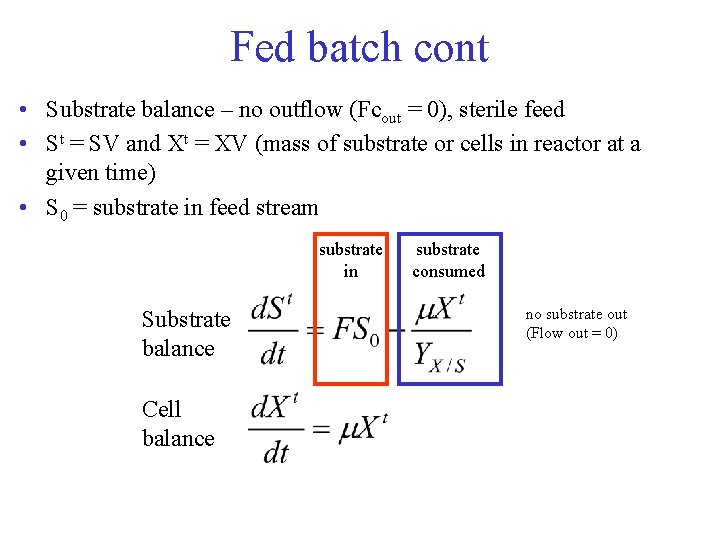
Fed batch cont • Substrate balance – no outflow (Fcout = 0), sterile feed • St = SV and Xt = XV (mass of substrate or cells in reactor at a given time) • S 0 = substrate in feed stream substrate in Substrate balance Cell balance substrate consumed no substrate out (Flow out = 0)
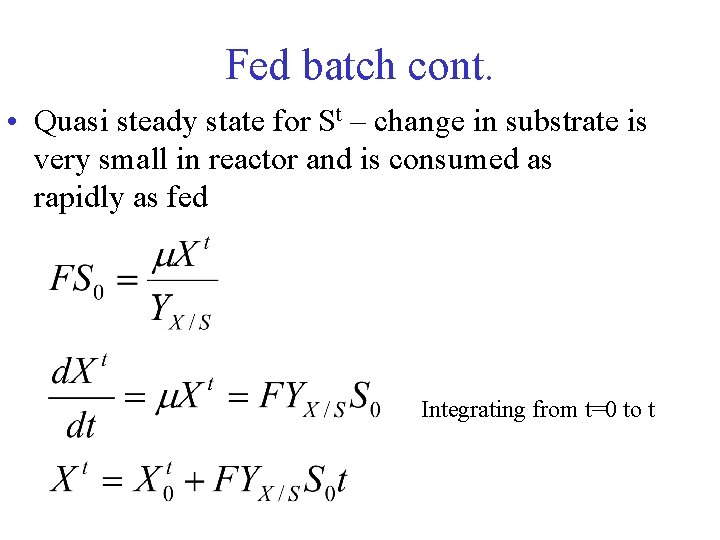
Fed batch cont. • Quasi steady state for St – change in substrate is very small in reactor and is consumed as rapidly as fed Integrating from t=0 to t
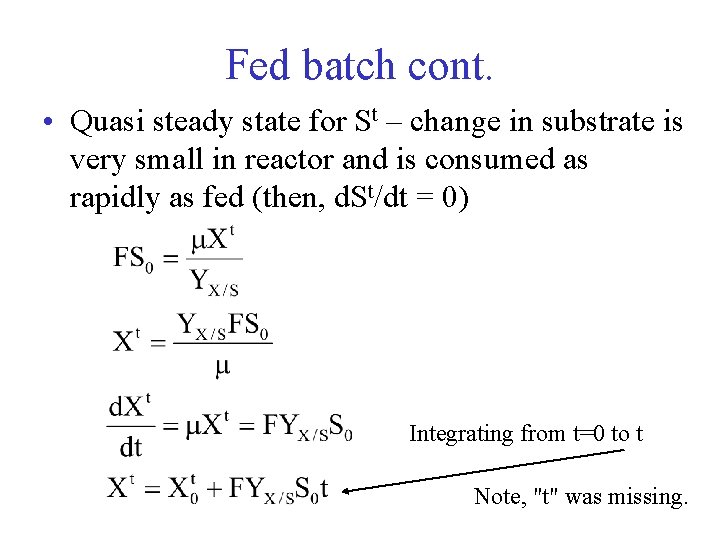
Fed batch cont. • Quasi steady state for St – change in substrate is very small in reactor and is consumed as rapidly as fed (then, d. St/dt = 0) Integrating from t=0 to t Note, "t" was missing.
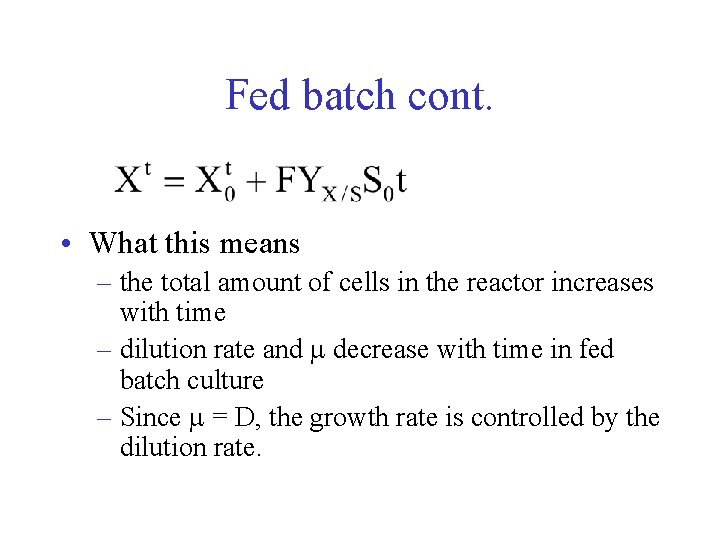
Fed batch cont. • What this means – the total amount of cells in the reactor increases with time – dilution rate and m decrease with time in fed batch culture – Since m = D, the growth rate is controlled by the dilution rate.
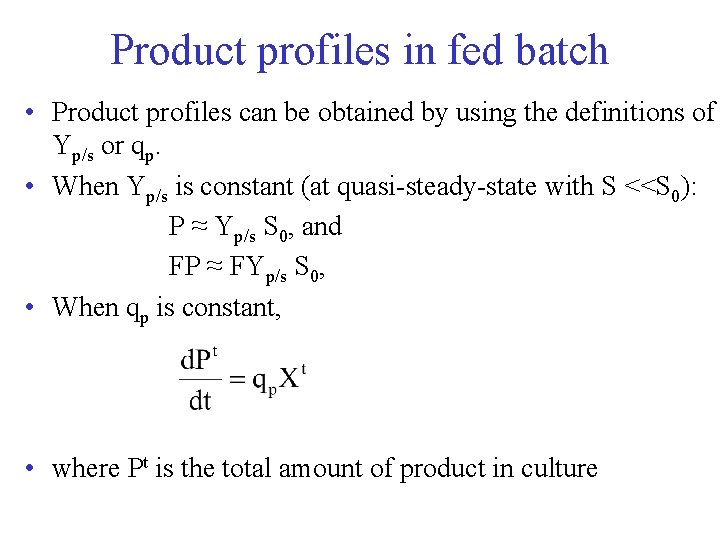
Product profiles in fed batch • Product profiles can be obtained by using the definitions of Yp/s or qp. • When Yp/s is constant (at quasi-steady-state with S <<S 0): P ≈ Yp/s S 0, and FP ≈ FYp/s S 0, • When qp is constant, • where Pt is the total amount of product in culture
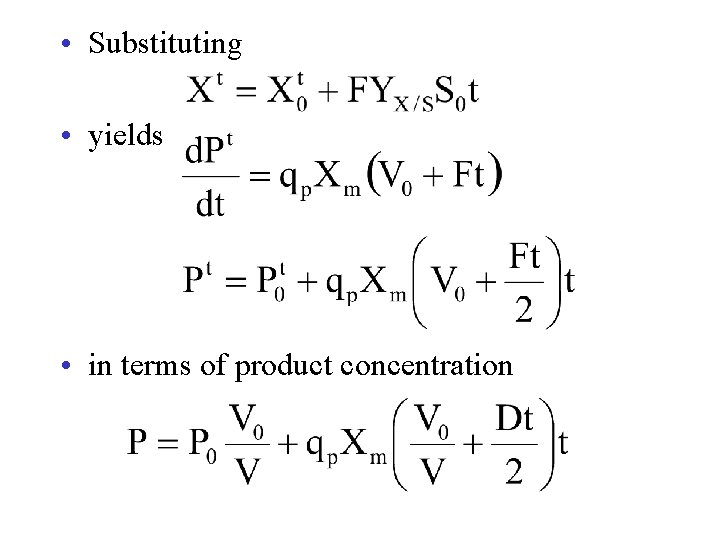
• Substituting • yields • in terms of product concentration
Class Exercise – 9. 4 • Penicillin is produced in a fed-batch culture with the intermittent addition of glucose solution to the culture medium. The initial culture volume at quasi-steady state is V 0= 500 L, and the glucose containing nutrient solution is added with a flow rate of F = 50 L/h. X 0 = 20 g/L, S 0 = 300 g/L, mm = 0. 2 h-1, Ks = 0. 5 g/L and Y x/s= 0. 3 g/g • Determine culture volume at t = 10 h • Determine concentration of glucose at t = 10 h • Determine the concentration and total amount of cells at t = 10 h • If qp = 0. 05 g product. g cells h and P 0 = 0. 1 g/L, determine the product concentration at t = 10 h
- Slides: 36