
Continuity Equation Statement of conservation of mass Several
- Slides: 9
Continuity Equation
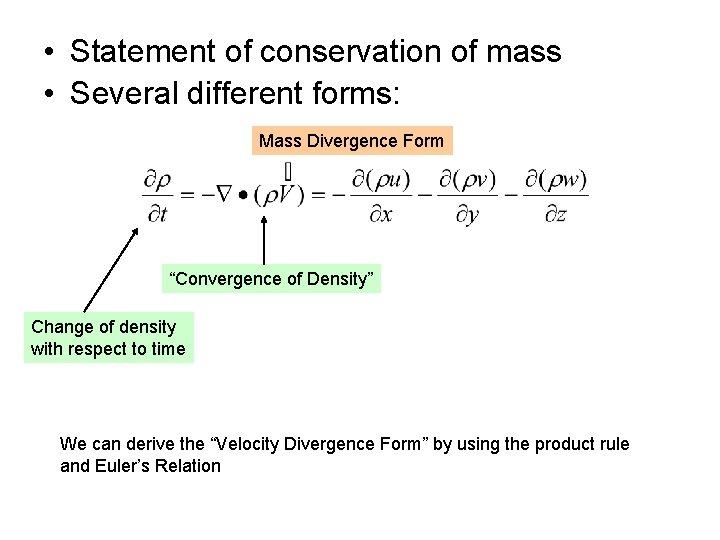
• Statement of conservation of mass • Several different forms: Mass Divergence Form “Convergence of Density” Change of density with respect to time We can derive the “Velocity Divergence Form” by using the product rule and Euler’s Relation
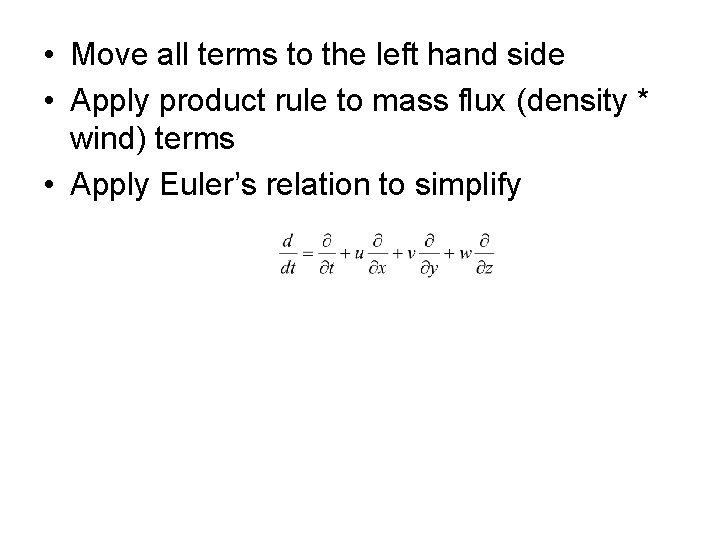
• Move all terms to the left hand side • Apply product rule to mass flux (density * wind) terms • Apply Euler’s relation to simplify
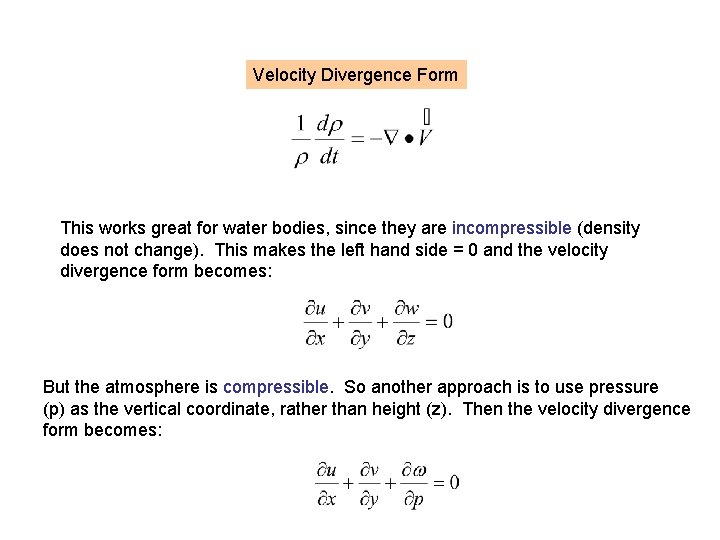
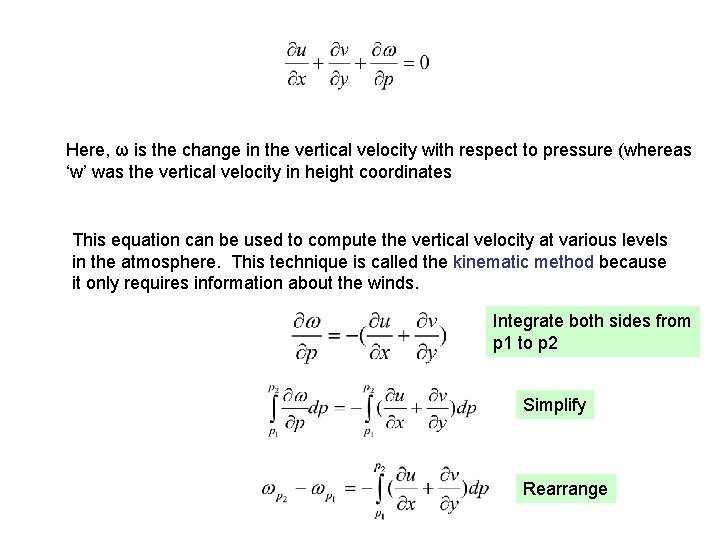
Velocity Divergence Form This works great for water bodies, since they are incompressible (density does not change). This makes the left hand side = 0 and the velocity divergence form becomes: But the atmosphere is compressible. So another approach is to use pressure (p) as the vertical coordinate, rather than height (z). Then the velocity divergence form becomes:
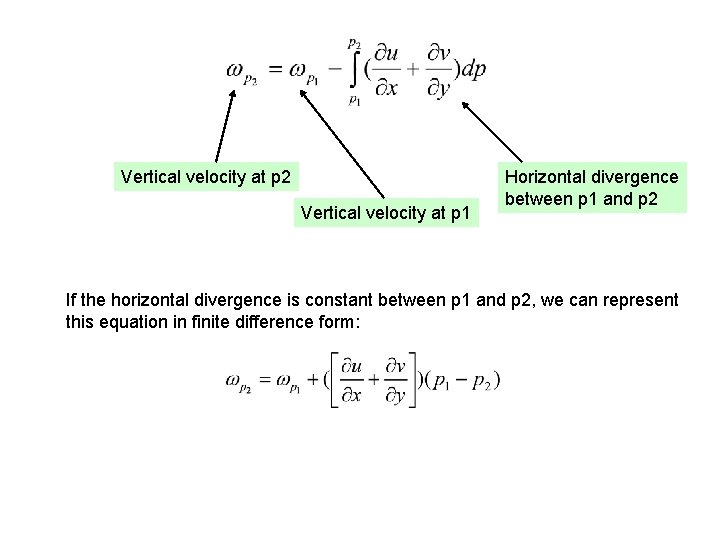
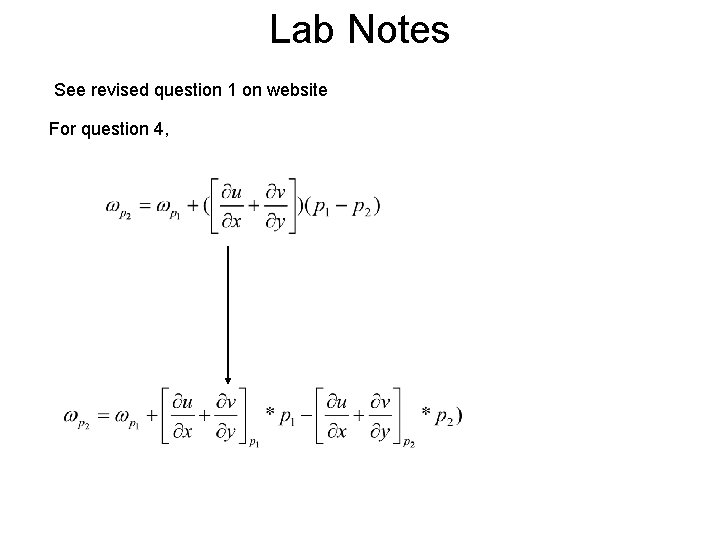
Here, ω is the change in the vertical velocity with respect to pressure (whereas ‘w’ was the vertical velocity in height coordinates This equation can be used to compute the vertical velocity at various levels in the atmosphere. This technique is called the kinematic method because it only requires information about the winds. Integrate both sides from p 1 to p 2 Simplify Rearrange
Vertical velocity at p 2 Vertical velocity at p 1 Horizontal divergence between p 1 and p 2 If the horizontal divergence is constant between p 1 and p 2, we can represent this equation in finite difference form:
Lab Notes See revised question 1 on website For question 4,