
Continued on next slide Answers 1 The phrases
- Slides: 46
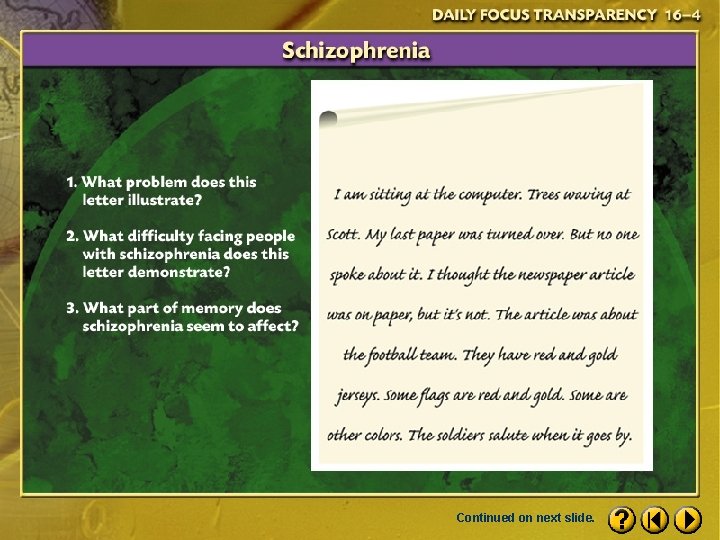
Continued on next slide.
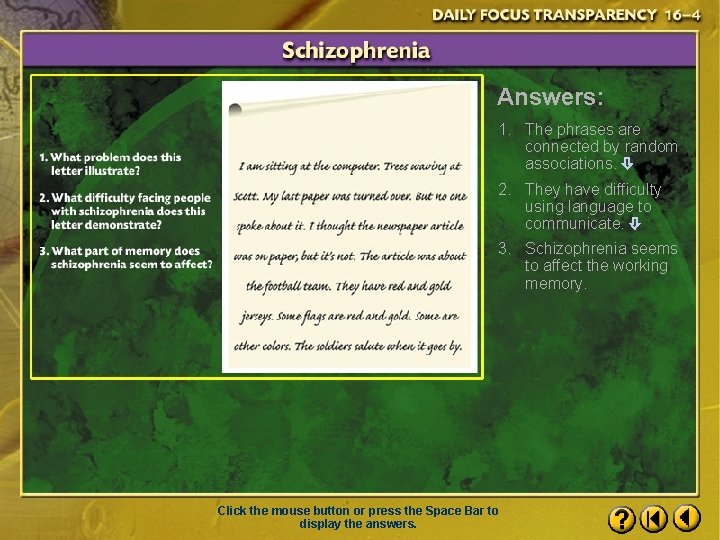
Answers: 1. The phrases are connected by random associations. 2. They have difficulty using language to communicate. 3. Schizophrenia seems to affect the working memory. Click the mouse button or press the Space Bar to display the answers.
Reader’s Guide Main Idea – Schizophrenia involves disordered thoughts. Mood disorders involve disturbances in the experience and expressions of depression. Objectives – Describe the disorder of schizophrenia. – Describe several theories that try to explain mood disorders. Click the mouse button or press the Space Bar to display the information. Section 4 begins on page 465 of your textbook.
Reader’s Guide (cont. ) Vocabulary – schizophrenia – delusions – hallucinations – major depressive disorder – bipolar disorder Click the Speaker button to listen to Exploring Psychology. Click the mouse button or press the Space Bar to display the information. Section 4 begins on page 465 of your textbook.
Introduction • Sufferers of schizophrenia often have difficulty using language to communicate. • This confused language may result because schizophrenia affects the working memory, which is used to form sentences. • Psychologists are making progress in furthering our understanding of schizophrenia–the most complex and severe psychological problem we encounter. Click the mouse button or press the Space Bar to display the information.
What is Schizophrenia? • Schizophrenia is a problem of cognition, but it also involves emotion, perception, and motor functions. • Schizophrenia affects 1 in 100 people worldwide (British Columbia Schizophrenia Society, 1997), but the odds increase to 1 in 10 if schizophrenia is already in the family. Click the mouse button or press the Space Bar to display the information.
What is Schizophrenia? (cont. ) • Schizophrenia involves confused and disordered thoughts and perceptions. • With schizophrenia, a person’s thought processes are somewhat disturbed, and the person has lost contact with reality to a considerable extent. • Schizophrenia is not a single problem; it has no single cause or cure. schizophrenia a group of disorders characterized by confused and disconnected thoughts, emotions, and perceptions Click the mouse button or press the Space Bar to display the information.
What is Schizophrenia? (cont. ) • Schizophrenia is a collection of symptoms that indicates an individual has serious difficulty trying to meet the demands of life. • Many people with schizophrenia experience delusions and hallucinations. • A person with schizophrenia may show a number of other symptoms as well. delusions a false belief that a person maintains in the face of contrary evidence hallucinations perceptions that have no direct external cause Click the mouse button or press the Space Bar to display the information.
What is Schizophrenia? (cont. ) • One other symptom is incoherence, or a marked decline in thought processes. • Another symptom is disturbances of affect, or emotions that are inappropriate for the circumstances. • An individual with schizophrenia may display severe deterioration in normal movement, which may occur as slowed movement, nonmovement, or as highly agitated behavior. • They may also show a marked decline in previous levels of functioning. Click the mouse button or press the Space Bar to display the information.
Types of Schizophrenia • Psychologists classify schizophrenia into several subtypes. • The paranoid type, involves hallucinations and delusions, including grandeur. • People with the catatonic type may remain motionless for long periods. • Symptoms of the disorganized type include incoherent language, inappropriate emotions, giggling for no apparent reason, generally disorganized motor behavior, and hallucinations and delusions. Click the mouse button or press the Space Bar to display the information.
Types of Schizophrenia (cont. ) • The diagnostic label remission type is applied to anyone whose symptoms are completely gone or still exist but are not severe enough to have earned a diagnosis of schizophrenia in the first place. • The undifferentiated type encompasses the basic symptoms of schizophrenia. • Schizophrenia is a very complex condition, and treatment is long-term and usually requires hospitalization. Click the mouse button or press the Space Bar to display the information.
Types of Schizophrenia (cont. ) • Long-term institutionalization sometimes leads to a patient who is burned out–one who is unlikely to function normally in society. • Although recovery from schizophrenia is possible, no real cure for schizophrenia exists. Click the mouse button or press the Space Bar to display the information.
Causes of Schizophrenia • There are many theories on the cause of schizophrenia, and just as certainly, there is disagreement. • In all likelihood, the ultimate cause is an interaction of environmental, genetic, and biochemical factors. Click the mouse button or press the Space Bar to display the information.
Biological Influences • Genetics is almost certainly involved in causing schizophrenia since the odds of developing it are ten times greater if it is already in the family. • Psychologists cannot specify the exact contribution hereditary factors make to schizophrenia (Carson & Sanislow, 1992). Click the mouse button or press the Space Bar to display the information.
Biochemistry and Physiology • Some psychologists believe that psychosis is due largely to chemical imbalances in the brain. • Chemical problems may also be involved in schizophrenia. • The dopamine hypothesis suggests that an excess of dopamine at selected synapses is related to a diagnosis of schizophrenia. • It is hard to tell whether these chemical imbalances are the cause of schizophrenia or the result of it. Click the mouse button or press the Space Bar to display the information.
Biochemistry and Physiology (cont. ) • The use of CAT and MRI scans has led to the discovery that the brains of people with schizophrenia often show signs of deteriorated brain tissue (Pearlson et al. , 1989).
Family and Interactions • From Freud onward, it has been tempting to blame the family situation in childhood for problems that develop during adulthood. • Studies show that families of individuals who later develop schizophrenia are often on the verge of falling apart. • Another frequent finding is that family members organize themselves around the very unusual, demanding, or maladaptive behavior of one member of the family. Click the mouse button or press the Space Bar to display the information.
Family and Interactions (cont. ) In Summary • At this point, psychologists do not know which of these theories is correct. • The diathesis-stress hypothesis states that an individual may have inherited a predisposition toward schizophrenia. • Explaining the causes of schizophrenia is perhaps the most complex research problem psychologists face. Click the mouse button or press the Space Bar to display the information.
Mood Disorders • We all experience mood swings and even occasional depression is a common experience. • These individuals often get the sense that their depression will go on forever and that there is nothing they can do to change it. • As a result, their emotions hamper their ability to function effectively. • In extreme cases, a mood may cause individuals to lose touch with reality or seriously threaten their health or lives. Click the mouse button or press the Space Bar to display the information.
Major Depressive Disorder • Individuals suffering from major depressive disorder spend at least two weeks feeling depressed, sad, anxious, fatigued, and agitated, experiencing a reduced ability to function and interact with others. • To be diagnosed as depression, these feelings cannot be attributed to bereavement (the loss of a loved one). major depressive disorder severe form of depression that interferes with function, concentration, and mental and physical well-being. Click the mouse button or press the Space Bar to display the information.
Major Depressive Disorder (cont. ) • This disorder is marked by at least four of the following symptoms: – problems with eating, sleeping, thinking, concentrating, or decision making – lacking energy – thinking about suicide – feeling worthless or guilty Click the mouse button or press the Space Bar to display the information.
Bipolar Disorder • One type of mood disorder is bipolar disorder, in which individuals are excessively and inappropriately happy or unhappy. • These reactions may take the form of high elation, hopeless depression, or an alternation between the two. bipolar disorder in which an individual alternates between feelings of mania (euphoria) and depression Click the mouse button or press the Space Bar to display the information.
Bipolar Disorder (cont. ) • In the manic phase, a person experiences elation, extreme confusion, distractibility, and racing thoughts. • In the depressive phase, the individual is overcome by feelings of failure, sinfulness, worthlessness, and despair. • Some people experience occasional episodes of a manic-type or depressivetype reaction, separated by long intervals of relatively normal behavior. Click the mouse button or press the Space Bar to display the information.
Bipolar Disorder (cont. ) • Others exhibit almost no normal behavior, cycling instead from periods of manic-type reactions to equally intense depressivetype reactions. • Some theorists have speculated that the manic periods serve as an attempt to ward off the underlying hopelessness of the depressive periods. • Others believe that mania can be traced to the same biochemical disorder responsible for depression. Click the mouse button or press the Space Bar to display the information.
Seasonal Affective Disorder • There are people who develop a deep depression in the midst of winter. • These people are victims of seasonal affective disorder, or SAD. • People suffering from SAD tend to sleep and eat excessively during their depressed periods. • Researchers have proposed that the hormone melatonin may play a role. Click the mouse button or press the Space Bar to display the information.
Seasonal Affective Disorder (cont. ) • The less light available (in winter), the more melatonin is secreted by the brain’s pineal gland. • Many SAD sufferers can be treated by sitting under bright fluorescent lights during the evening or early morning hours. Click the mouse button or press the Space Bar to display the information.
Explaining Mood Disorders • Psychological factors underlying mood disorders include certain personality traits, amount of social support, and the ability to deal with stressful situations. • Beck (1983) believes that depressed people draw illogical conclusions about themselves–they blame themselves for normal problems. • As described in Chapter 9, Martin Seligman (1975) believes that depression is caused by a feeling of learned helplessness. Click the mouse button or press the Space Bar to display the information.
Explaining Mood Disorders (cont. ) • Psychologists developed theories to provide a physiological or biological explanation of depression. • Researchers are currently searching for the neurotransmitters that cause mood disorders. • They are also looking at genetic factors and faulty brain structure and function as possible causes. • Many causes of depression may result from an interaction of biological and psychological factors. Click the mouse button or press the Space Bar to display the information.
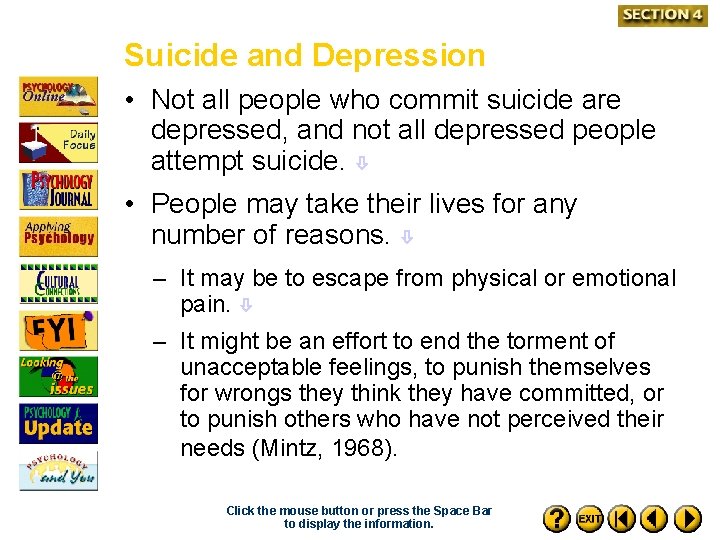
Suicide and Depression • Not all people who commit suicide are depressed, and not all depressed people attempt suicide. • People may take their lives for any number of reasons. – It may be to escape from physical or emotional pain. – It might be an effort to end the torment of unacceptable feelings, to punish themselves for wrongs they think they have committed, or to punish others who have not perceived their needs (Mintz, 1968). Click the mouse button or press the Space Bar to display the information.
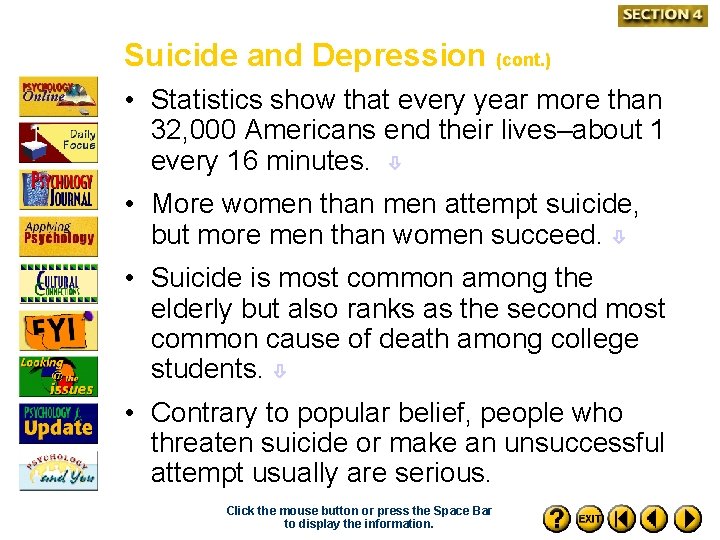
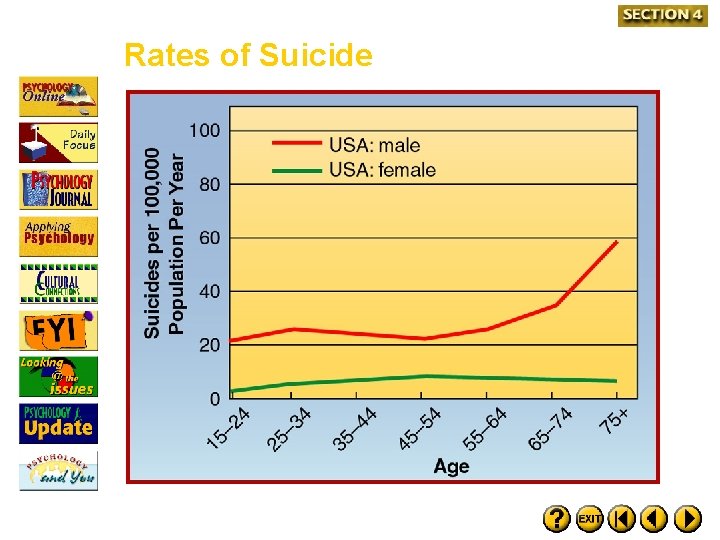
Suicide and Depression (cont. ) • Statistics show that every year more than 32, 000 Americans end their lives–about 1 every 16 minutes. • More women than men attempt suicide, but more men than women succeed. • Suicide is most common among the elderly but also ranks as the second most common cause of death among college students. • Contrary to popular belief, people who threaten suicide or make an unsuccessful attempt usually are serious. Click the mouse button or press the Space Bar to display the information.
Rates of Suicide
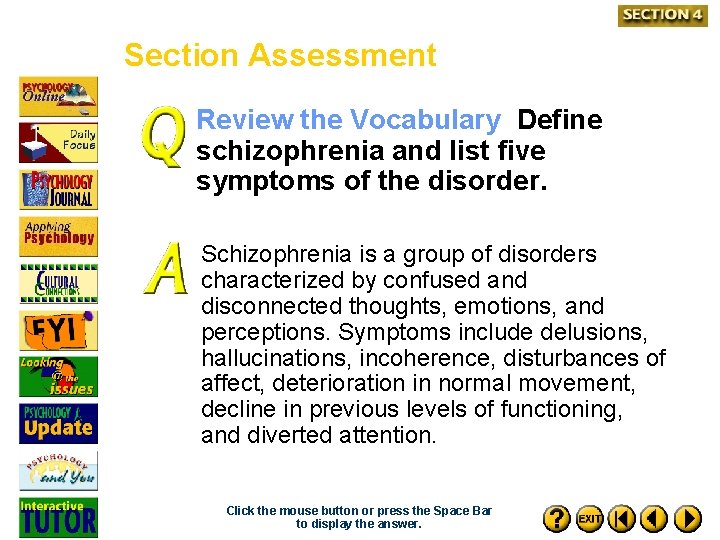
Section Assessment Review the Vocabulary Define schizophrenia and list five symptoms of the disorder. Schizophrenia is a group of disorders characterized by confused and disconnected thoughts, emotions, and perceptions. Symptoms include delusions, hallucinations, incoherence, disturbances of affect, deterioration in normal movement, decline in previous levels of functioning, and diverted attention. Click the mouse button or press the Space Bar to display the answer.
Section Assessment (cont. ) Visualize the Main Idea Use a graphic organizer similar to the on page 473 of your textbook to identify types of schizophrenia. Types of schizophrenia are paranoid types, disorganized type, remission type, undifferentiated type, and catatonic type. Click the mouse button or press the Space Bar to display the answer.
Section Assessment (cont. ) Recall Information What is the diathesis-stress hypothesis? How does it explain the development of schizophrenia? It theorizes that an individual may have inherited a predisposition toward schizophrenia that will only develop if exposed to an environment of certain stressors. Click the mouse button or press the Space Bar to display the answer.
Section Assessment (cont. ) Think Critically Recall the last time you failed or did not do well at something. What kind of explanation did you offer for your failure? Was this explanation pessimistic or optimistic? Explain. How did your explanation affect your mood or feelings? Answers will vary. Explore the differences between a pessimistic and an optimistic outlook. Click the mouse button or press the Space Bar to display the answer.
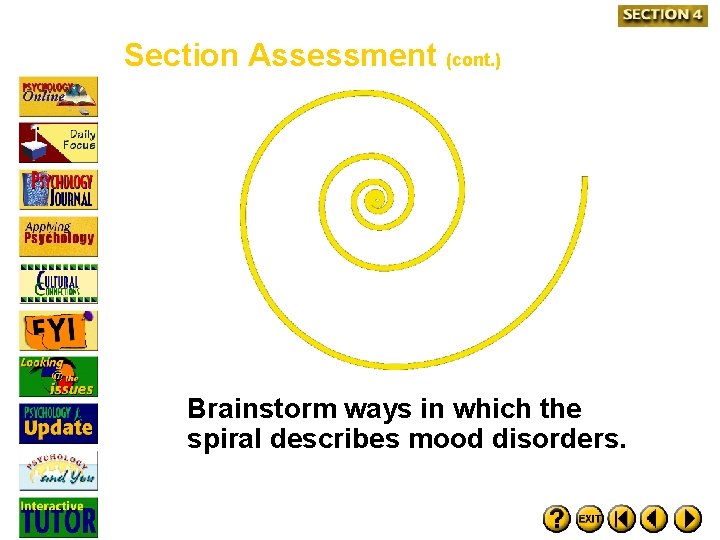
Section Assessment (cont. ) Brainstorm ways in which the spiral describes mood disorders.
Section 4: Schizophrenia and Mood Disorders • Schizophrenia is a collection of symptoms relating to impairments in cognition, emotion, perception, and motor movement. • Psychologists have classified several types of schizophrenia. • Types of mood disorders are major depressive disorder, bipolar disorder, and seasonal affective disorder. Click the mouse button or press the Space Bar to display the information.
FYI 4. 1 In April 1997, the world was shocked by the mass suicide of Marshall Applewhite and 38 followers of the Heaven’s Gate cult. Psychologists identify Applewhite and many other cult leaders as schizophrenic. Many of his followers had borderline personalities.
Cultural Connections 4. 1 Researchers at the Institute for Basic Psychiatry Research at the Aarhus University Hospital in Denmark analyzed 2, 669 people diagnosed with schizophrenia. They examined several risk factors including family history of mental illness, time of the year that the people were born, and where the people lived during their childhoods. The study confirmed that a family history of schizophrenia was the primary risk factor. Continued on next slide.
Cultural Connections 4. 2 The study also found that those born in February and March and those living in urban environments ran a higher risk of developing schizophrenia. Researchers concluded that the time and place factors lend support to the viral theory of schizophrenia by saying, “Viruses are more abundant in winter and are more likely to spread in crowded urban environments. ” Source: Talan, J. (1999, February 25) New schizophrenia risks found. Newsday, A 24.
Bipolar Disorder A study published in the May 1999 issue of the Archives of General Psychiatry indicates that omega-3 fatty acids found in fish oil may relieve the symptoms of bipolar disorder. The study involved a small sample of people being treated for bipolar disorder at the Brigham and Women’s Hospital in Boston, Massachusetts. Researchers acknowledge that further research using larger samples is needed before a theory can be proposed.
Effects of Diagnosis on Treatment • In the early 1970 s, David Rosenhan and seven other researchers became pseudopatients at psychiatric hospitals. • All were admitted to hospitals after complaining of hearing disembodied voices and were diagnosed as schizophrenic. • Stays in the hospital ranged from one week to two months. • After admission, none exhibited any abnormal behaviors, yet none of the hospital staff ever recognized them as normal. Continued on next slide. Click the mouse button or press the Space Bar to display the information.
Effects of Diagnosis on Treatment • Interestingly, many of the patients in the hospitals suspected that the pseudopatients did not belong. • What does this research study indicate about the effect of diagnosis on how a person is treated? • How can a diagnosis become a self-fulfilling prophecy? Click the mouse button or press the Space Bar to display the information.
Mental illnesses have been a common topic for films. View one pair of the following films: – Bipolar disorder: Blue Sky (1994) and A Fine Madness (1966) or Mr. Jones (1991) and The Snake Pit (1947) – Schizophrenia: Awakenings (1990) and Possessed (1947) After viewing the films, write an essay comparing and contrasting the treatment of the characters and society’s view of the disorder. Click the mouse button or press the Space Bar to display the information.
• Read the Psychology and You feature on page 473 of your textbook. • Discuss the following: How can allowing a person to talk about their feelings help them overcome suicidal thoughts? Click the mouse button or press the Space Bar to display the information.
• Read the Psychology and You feature on page 473 of your textbook. • Discuss the following: How can allowing a person to talk about their feelings help them overcome suicidal thoughts? Click the mouse button or press the Space Bar to display the information.