
Continue Nonverbal Interpreting Nonverbal message Facial expressionsix emotions
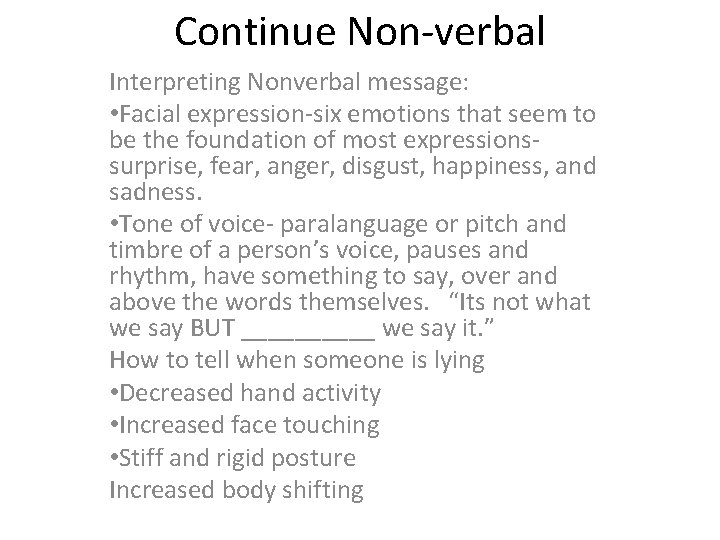
Continue Non-verbal Interpreting Nonverbal message: • Facial expression-six emotions that seem to be the foundation of most expressionssurprise, fear, anger, disgust, happiness, and sadness. • Tone of voice- paralanguage or pitch and timbre of a person’s voice, pauses and rhythm, have something to say, over and above the words themselves. “Its not what we say BUT _____ we say it. ” How to tell when someone is lying • Decreased hand activity • Increased face touching • Stiff and rigid posture Increased body shifting
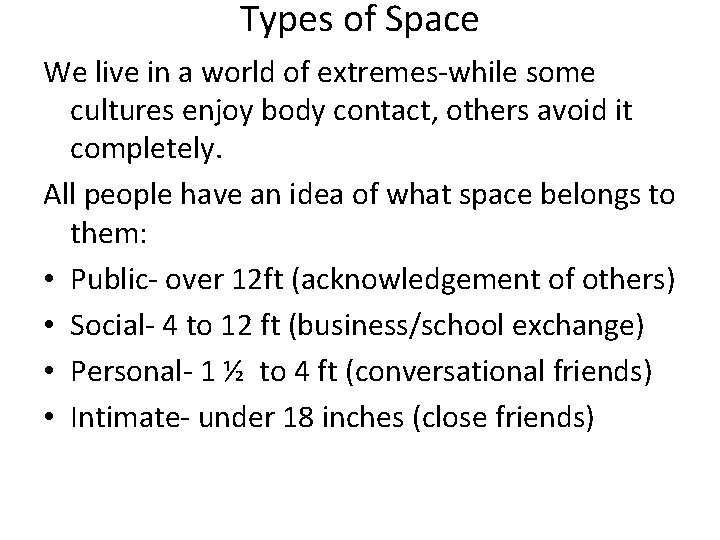
Types of Space We live in a world of extremes-while some cultures enjoy body contact, others avoid it completely. All people have an idea of what space belongs to them: • Public- over 12 ft (acknowledgement of others) • Social- 4 to 12 ft (business/school exchange) • Personal- 1 ½ to 4 ft (conversational friends) • Intimate- under 18 inches (close friends)
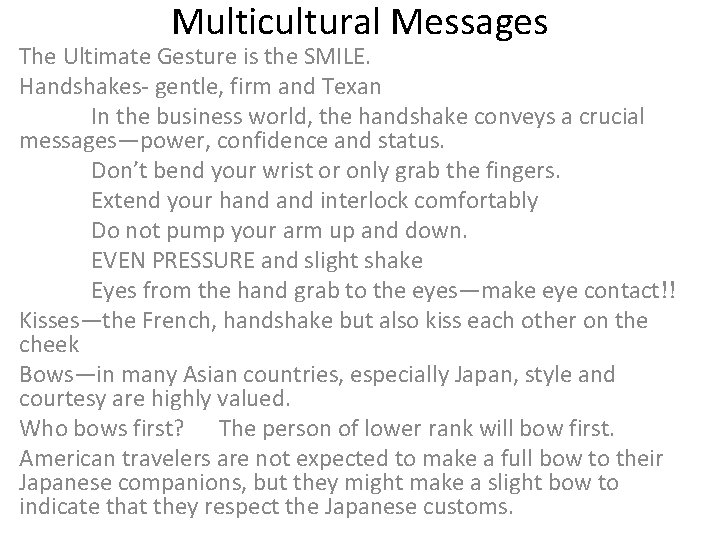
Multicultural Messages The Ultimate Gesture is the SMILE. Handshakes- gentle, firm and Texan In the business world, the handshake conveys a crucial messages—power, confidence and status. Don’t bend your wrist or only grab the fingers. Extend your hand interlock comfortably Do not pump your arm up and down. EVEN PRESSURE and slight shake Eyes from the hand grab to the eyes—make eye contact!! Kisses—the French, handshake but also kiss each other on the cheek Bows—in many Asian countries, especially Japan, style and courtesy are highly valued. Who bows first? The person of lower rank will bow first. American travelers are not expected to make a full bow to their Japanese companions, but they might make a slight bow to indicate that they respect the Japanese customs.
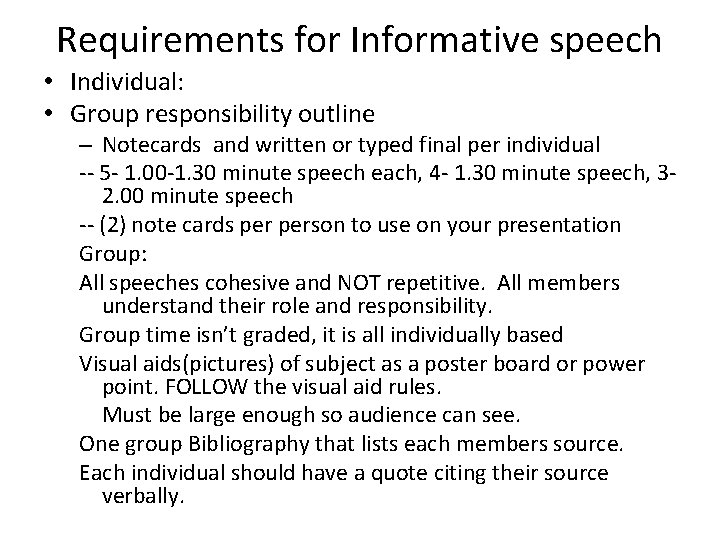
Requirements for Informative speech • Individual: • Group responsibility outline – Notecards and written or typed final per individual -- 5 - 1. 00 -1. 30 minute speech each, 4 - 1. 30 minute speech, 32. 00 minute speech -- (2) note cards person to use on your presentation Group: All speeches cohesive and NOT repetitive. All members understand their role and responsibility. Group time isn’t graded, it is all individually based Visual aids(pictures) of subject as a poster board or power point. FOLLOW the visual aid rules. Must be large enough so audience can see. One group Bibliography that lists each members source. Each individual should have a quote citing their source verbally.
- Slides: 4