
Contextual Crowd Intelligence Beng Chin Ooi National University
Contextual Crowd Intelligence Beng Chin Ooi National University of Singapore www. comp. nus. edu. sg/~ooibc
Crowd Intelligence • Use of crowd in contributing “useful” contents – Further use of these contents to infer, ascertain and enhance • Use of crowd in doing what machines cannot do well -- Crowdsourcing – Entity Resolution • Are “IBM” and “Big Blue” the same company? – Classification • What make is the car in the image? – Subjective Sorting • Which pictures better visualize “the Great Wall”? – Others: Translation, Tagging, etc. – Simple and domain dependent • Privacy is a major obstacle Can we exploit the human intelligence a bit more?
“Embedding” Crowdsourcing in DBMS • Most applications are industry/domain specific -users are the experts • Exceptional cases that are important but may be too hard to formalize and rules/patterns may be evolving over times • Knowledge management at work • Making humans who are subject matter experts as part of the feedback loop to continuously enhance the database processing a hybrid human-machine DB processing
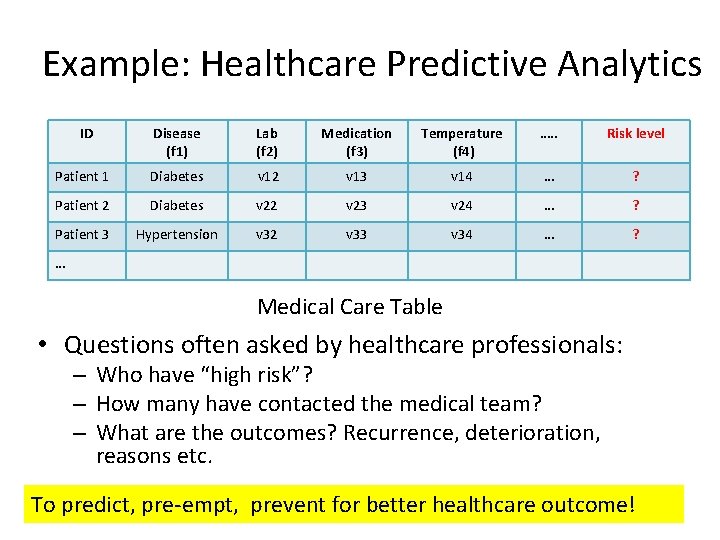
Example: Healthcare Predictive Analytics ID Disease (f 1) Lab (f 2) Medication (f 3) Temperature (f 4) …. . Risk level Patient 1 Diabetes v 12 v 13 v 14 … ? Patient 2 Diabetes v 22 v 23 v 24 … ? Patient 3 Hypertension v 32 v 33 v 34 … ? … Medical Care Table • Questions often asked by healthcare professionals: – Who have “high risk”? – How many have contacted the medical team? – What are the outcomes? Recurrence, deterioration, reasons etc. To predict, pre-empt, prevent for better healthcare outcome!
Possible Approach • Build a rule-based system to assess the risks • Difficulty: Missing the class labels of the training samples • Approach: Leverage the crowd to derive the class labels for the training samples – Doctors are HIT workers for filling the missing labels and testing the system – The quality of workers is expected to be high • Towards hybrid human-machine processing
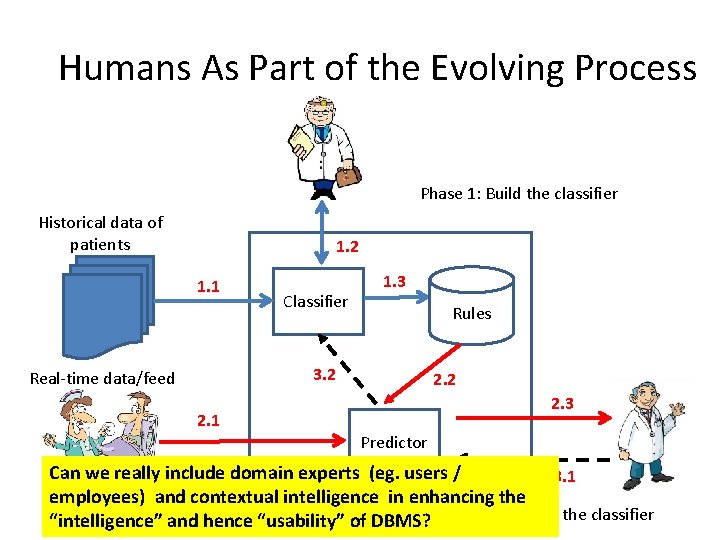
Humans As Part of the Evolving Process Phase 1: Build the classifier Historical data of patients 1. 2 1. 1 Classifier 1. 3 Rules 3. 2 Real-time data/feed 2. 1 2. 2 2. 3 Predictor Can we really include domain experts (eg. users / 3. 1 employees) and contextual intelligence in enhancing the 2: Predict the severity “intelligence”Phase and hence “usability” of DBMS? Phase 3: Adjust the classifier
Possible Impacts • Reduce “localization/customization” • Improve accuracy on Analytics • Expert users decide on “best practices” More effective decision making
- Slides: 7