
Contextual Components Outline of an Ethnography of Communication
- Slides: 15
Contextual Components: Outline of an Ethnography of Communication Chapter 4
Language in Context n n Context = cultural and social situation How does context affect language? ¡ Malinowski (1884 -1942) n n ¡ Translation requires knowledge of context Context can shift meanings Indirection n Saving Face.
Communicative Competence n Ability to speak a language “well” ¡ ¡ n Ability to use your language “correctly” In a variety of social situations Compare with Linguistic Competence ¡ Ability to produce (and recognize) grammatically correct expressions n Chomsky’s “ideal speaker” ¡ Not distracted by environment.
Some Environmental “Distractions” n n When ‘bad’ means ‘good’ When is not appropriate to respond honestly Different words/expressions among cultures/subcultures Greetings and address terms ¡ ¡ n ‘Hello’ / ‘Hi’ / ‘Sup!’ Usted vs. tu, vosotros/vois How do you learn these “rules? ” ¡ Ethnography of Speaking….
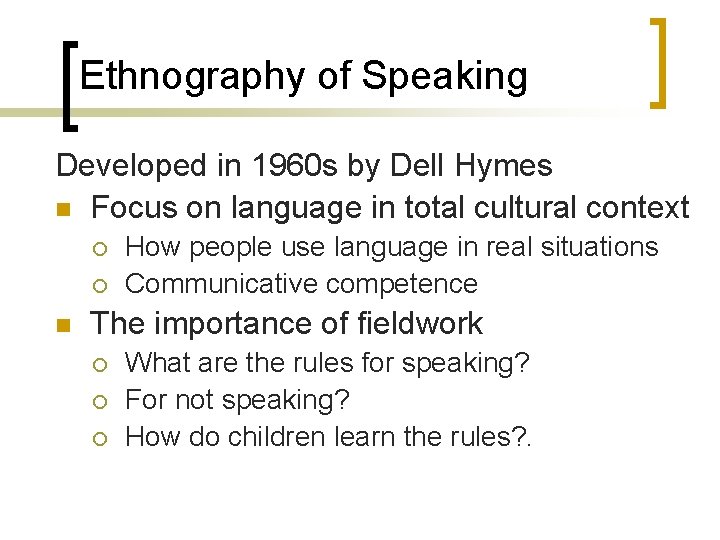
Ethnography of Speaking Developed in 1960 s by Dell Hymes n Focus on language in total cultural context ¡ ¡ n How people use language in real situations Communicative competence The importance of fieldwork ¡ ¡ ¡ What are the rules for speaking? For not speaking? How do children learn the rules? .
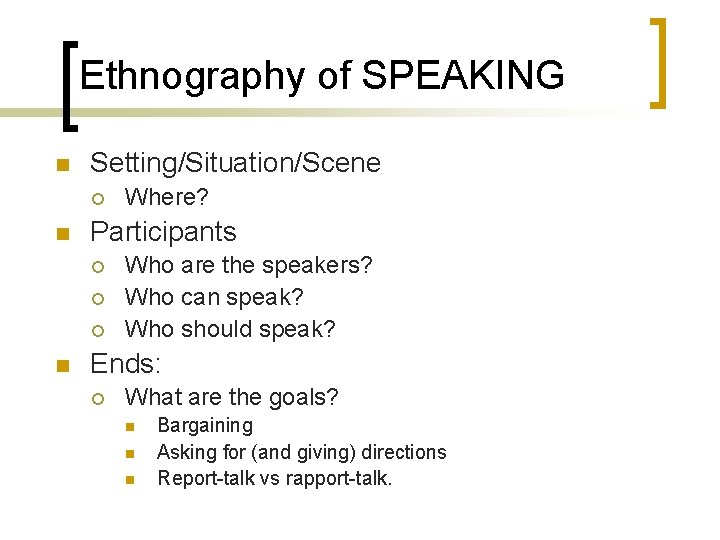
Ethnography of SPEAKING n Setting/Situation/Scene ¡ n Participants ¡ ¡ ¡ n Where? Who are the speakers? Who can speak? Who should speak? Ends: ¡ What are the goals? n n n Bargaining Asking for (and giving) directions Report-talk vs rapport-talk.
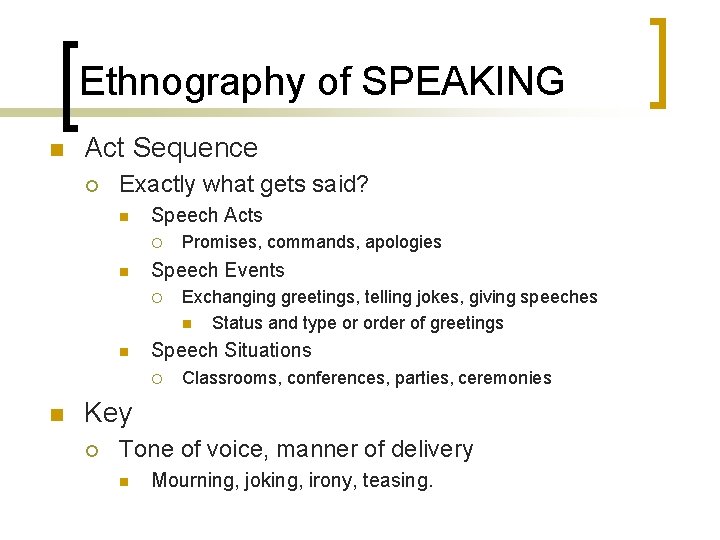
Ethnography of SPEAKING n Act Sequence ¡ Exactly what gets said? n Speech Acts ¡ n Speech Events ¡ n Exchanging greetings, telling jokes, giving speeches n Status and type or order of greetings Speech Situations ¡ n Promises, commands, apologies Classrooms, conferences, parties, ceremonies Key ¡ Tone of voice, manner of delivery n Mourning, joking, irony, teasing.
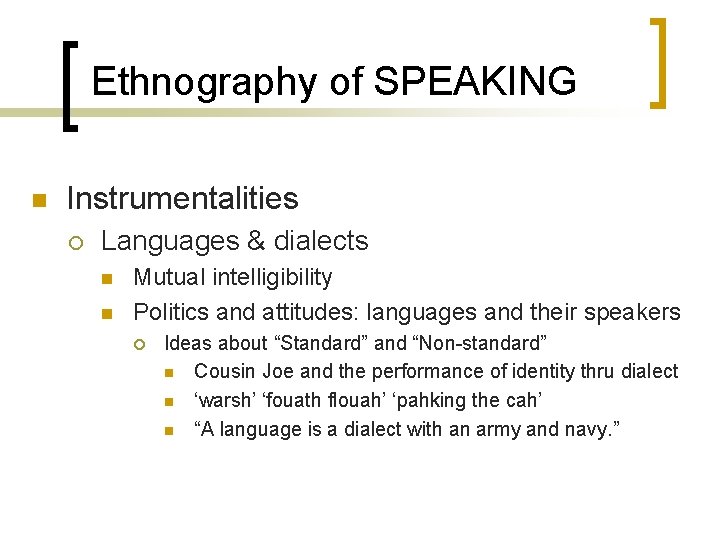
Ethnography of SPEAKING n Instrumentalities ¡ Languages & dialects n n Mutual intelligibility Politics and attitudes: languages and their speakers ¡ Ideas about “Standard” and “Non-standard” n Cousin Joe and the performance of identity thru dialect n ‘warsh’ ‘fouath flouah’ ‘pahking the cah’ n “A language is a dialect with an army and navy. ”
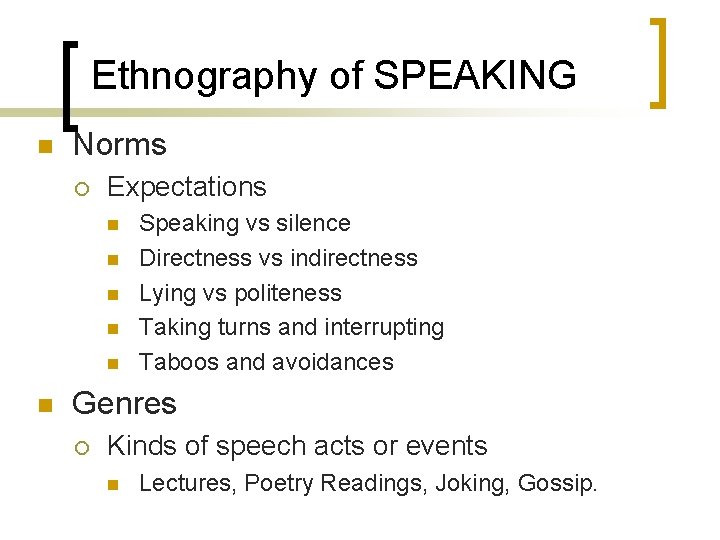
Ethnography of SPEAKING n Norms ¡ Expectations n n n Speaking vs silence Directness vs indirectness Lying vs politeness Taking turns and interrupting Taboos and avoidances Genres ¡ Kinds of speech acts or events n Lectures, Poetry Readings, Joking, Gossip.
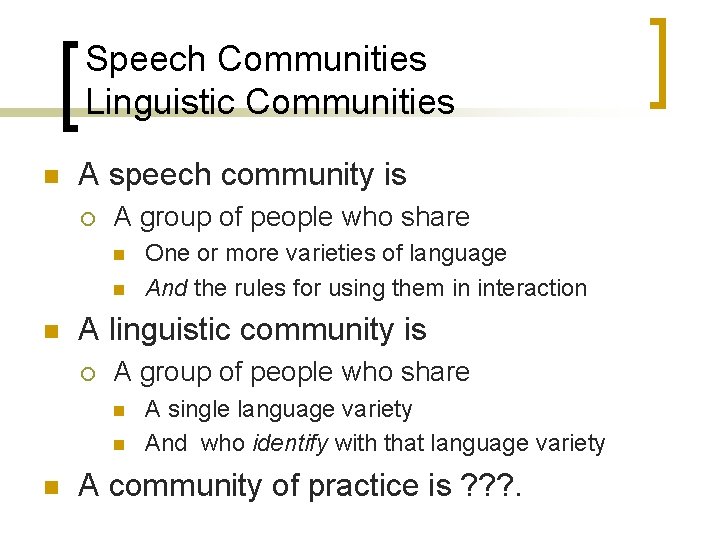
Speech Communities Linguistic Communities n A speech community is ¡ A group of people who share n n n A linguistic community is ¡ A group of people who share n n n One or more varieties of language And the rules for using them in interaction A single language variety And who identify with that language variety A community of practice is ? ? ? .
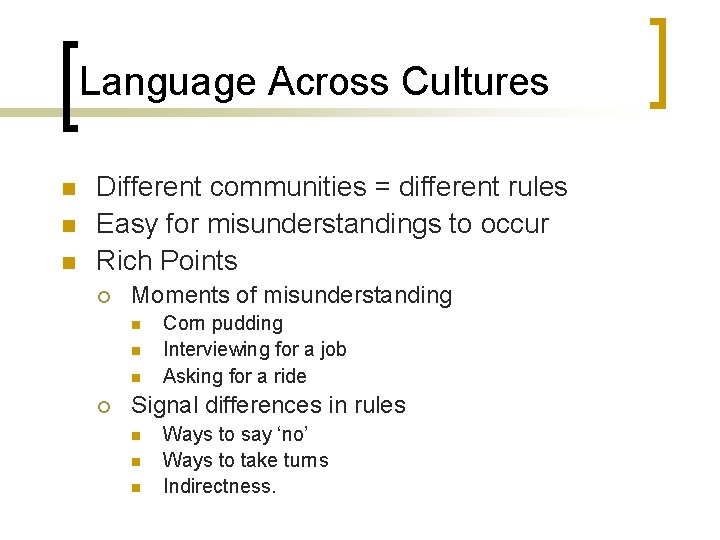
Language Across Cultures n n n Different communities = different rules Easy for misunderstandings to occur Rich Points ¡ Moments of misunderstanding n n n ¡ Corn pudding Interviewing for a job Asking for a ride Signal differences in rules n n n Ways to say ‘no’ Ways to take turns Indirectness.
Communicative Interactions Chapter 5
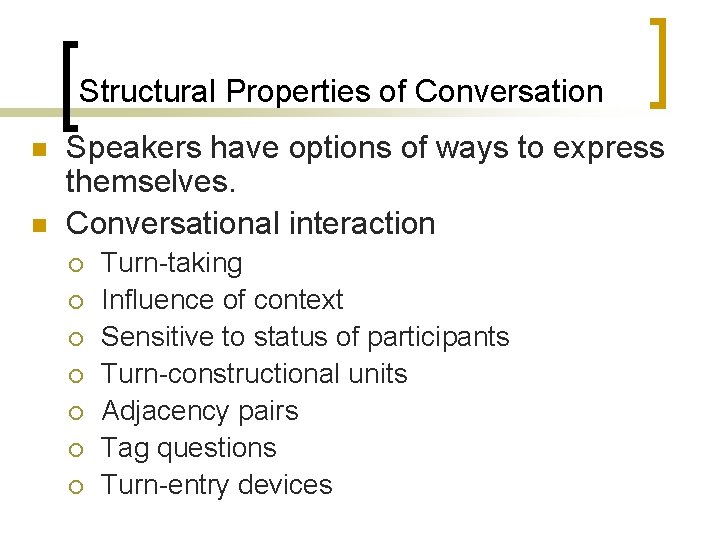
Structural Properties of Conversation n n Speakers have options of ways to express themselves. Conversational interaction ¡ ¡ ¡ ¡ Turn-taking Influence of context Sensitive to status of participants Turn-constructional units Adjacency pairs Tag questions Turn-entry devices
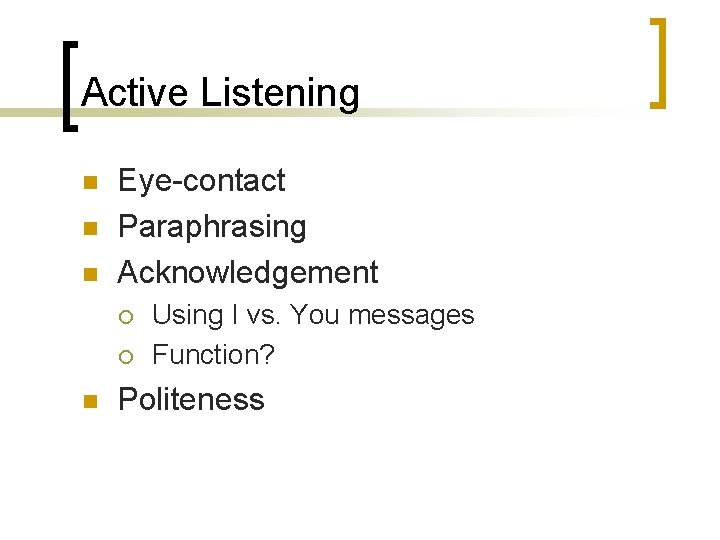
Active Listening n n n Eye-contact Paraphrasing Acknowledgement ¡ ¡ n Using I vs. You messages Function? Politeness
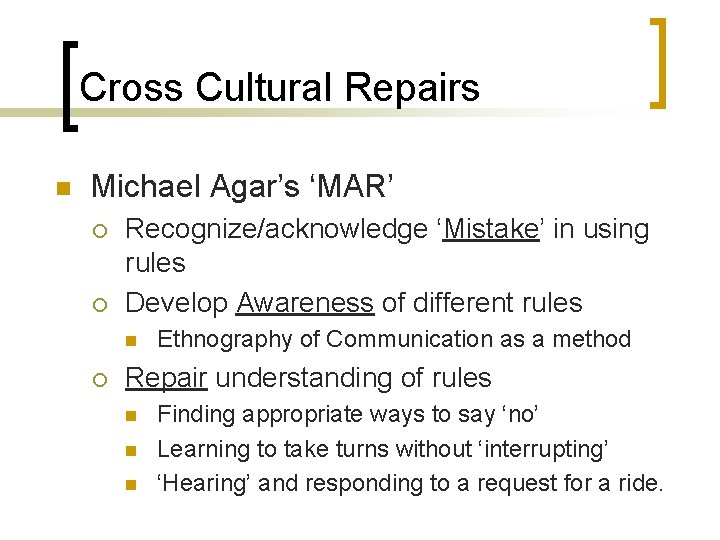
Cross Cultural Repairs n Michael Agar’s ‘MAR’ ¡ ¡ Recognize/acknowledge ‘Mistake’ in using rules Develop Awareness of different rules n ¡ Ethnography of Communication as a method Repair understanding of rules n n n Finding appropriate ways to say ‘no’ Learning to take turns without ‘interrupting’ ‘Hearing’ and responding to a request for a ride.