
Context Of the Organization ISO 9001 2015 Bob

“Context Of the Organization” ISO 9001: 2015 Bob Deysher Senior Consultant Quality Support Group, Inc. bob. deysher@qualitysupportgroup. com © 2015 QSG, Inc. © 2014

Expected Outcome Understand how “Context of the Organization” is integrated into your Quality Management System or Is ISO 9001: 2015 a template for an effective Quality Management System or an effective Business Management System? QMS BMS © 2015 QSG, Inc. 2

Agenda (*) • Understand the Organization and its Context – Analyzing the External Environment – Analyzing the Internal Environment • Understanding the Needs and Expectations of Interested Parties • Determining the Scope of the Quality Management System • Leadership • Putting it all Together (*) ISO 9004 is used extensively in preparing this presentation © 2015 QSG, Inc. 3

ISO 9001: 2015 Structure 4 Context of the organization 5 Leadership Understanding of the organization and its context Understanding the needs and expectations of interested parties Scope of management systems 6 Planning for the quality management system Leadership and commitment Action to address risk and opportunity Quality policy Quality objectives Organizational roles, responsibilities and authorities 8 Operations 7 Support Resources Competence 9 Performance and evaluation Operations planning and control Monitoring, measurement. analysis and evaluation General Determination of requirements for products and services Internal audit Nonconformity and corrective action Design and development of products and services Management review Awareness Planning of changes Communication QMS Documented Information 10 Improvement Control of externally provided products and services Check Continual Improvement Act Production and service provisions Plan Release of products and services Control of nonconforming process outputs, products and services © 2015 QSG, Inc. Do 4

Understanding the Organization and its Context This is a New Requirement The organization should understand their internal and external environments • Determine the issues that are relevant to the organization in both environments • Assess those issues, and if not mitigated, which could prevent the success of quality management system implementation • Using these issues, understand how they will influence the quality changes in their organization on a continual basis. ISO 9001, clause 4. 1 © 2015 QSG, Inc. 5

Understanding the Organization and its Context Analyzing the External Environment • Your organization may already be doing this type of analysis • Are you doing any strategic planning, market research, or benchmarking which identifies external issues which are being acted on in your business/quality management system? • Does it drive your Vision, Mission, Quality Policy, Strategic Planning, Business Objectives, Policy Deployment, etc. ? • Can you demonstrate how you are doing it? • Unfortunaterly, ISO 9001: 2015 provides no suggested methods to analyze the context of an organization © 2015 QSG, Inc. 6

Understanding the Organization and its Context Analyzing the External Environment • There are many models that can help an organization understand the strategic nature of their industry and how they fit into that environment. • In the absence of any demonstrable activities, SWOT is a simple model. S - Strengths W - Weakness O - Opportunities T - Threats © 2015 QSG, Inc. 7

Understanding the Organization and its Context Analyzing the Internal Environment Understanding the structure/hierarchy and positions of the organization related to the scope at the levels: • Who sets the policies and strategic directions of the organization? • Who coordinates and manages the operations? • Who is involved in production, service and support activities? © 2015 QSG, Inc. 8

Understanding the Organization and its Context Analyzing the Internal Environment It is necessary to identify the structures comprising the various bodies and relations between them (hierarchical and functional). • These include segregation of duties, responsibilities, authority and communication within the organization that should be studied. • The functions outsourced to the subcontractors should also be identified. © 2015 QSG, Inc. 9

Understanding the Organization and its Context Analyzing the Internal Environment The structure of the organization may be of different types: • The divisional structure: each division is under the authority of a division director responsible for strategic, administrative and operational decisions within this unit. • The functional structure: functional authority exercised over proceedings, the nature of work and sometimes the decisions or planning (e. g. production, information technology, human resources, marketing. . . ). © 2015 QSG, Inc. 10

Understanding the Organization and its Context Analyzing the Internal Environment The organizational chart is an excellent tool to get to understand the internal environment. • It shows, using a scheme, the structure of the organization. • This representation shows the links of subordination and delegation of authority, but also dependencies. • Even if the chart illustrates that no formal authority exists, based upon the links, the information flows can be deduced. © 2015 QSG, Inc. 11
Understanding the Needs and Expectations of Interested Parties This is a New Requirement. The organization shall determine: a) The interested parties that are relevant to the quality management system b) Interested parties add value to the organizations and c) The requirements of these interested parties that are relevant to the quality management system. ISO 9001, clause 4. 2 © 2015 QSG, Inc. 12

Understanding the Needs and Expectations of Interested Parties Interested parties are individuals and other entities that add value to the organization – Meeting the needs and expectations of interested parties contributes to the achievement of sustained success by the organization. – Needs and expectations of interested parties can take a wide variety of forms, including collaboration, cooperation, negotiation, outsourcing, or by terminating an activity. © 2015 QSG, Inc. 13

Interested Parties, Needs, & Expectations (Continued) Interested party Needs and expectations Customers Quality, price, & delivery of products and services Owners/Share Holders Sustained profitability Transparency People in the organization Good work environment Job security Recognition and reward Suppliers & partners Mutual benefit and continuity Society Environmental protection Ethical behavior Compliance with statutory and regulatory requirements NOTE Although most organizations use similar descriptions for their interested parties (e. g. customers, owners/shareholders, suppliers and partners, people in the organization), the composition of those categories can differ significantly over time and between organizations, industries, nations and cultures. © 2015 QSG, Inc. 14

Your Environment Competitor Customer Supplier Community Your Organization People Products/Services Processes Regulatory Body Customer Supplier Competitor Supplier’s Supplier © 2015 QSG, Inc. Customer’s Customer 15

Determining the Scope of the Quality Management System • Requirements to determine the scope are more extensive in ISO 9001. – External and internal issues need to be considered – Requirements of relevant interested parties need to be considered – Products and services of the organization need definition • The term “exclusion” was replaced by “requirement that cannot be applied”. – Use your scope document to explain that every ISO 9001 requirement is mandatory and may only be excluded if it cannot be applied. ISO 9001, clause 4. 3 © 2015 QSG, Inc. 16
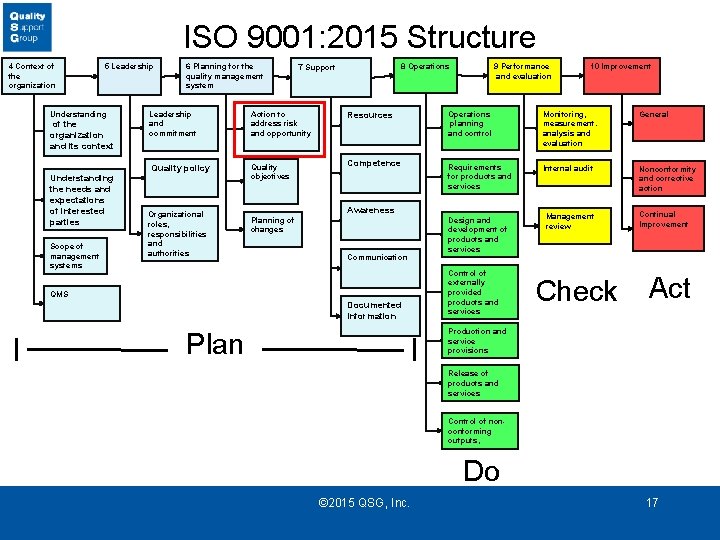
ISO 9001: 2015 Structure 4 Context of the organization 5 Leadership Understanding of the organization and its context Understanding the needs and expectations of interested parties Scope of management systems 6 Planning for the quality management system Leadership and commitment Action to address risk and opportunity Quality policy Quality objectives Organizational roles, responsibilities and authorities 8 Operations 7 Support Resources Competence 9 Performance and evaluation Operations planning and control Monitoring, measurement. analysis and evaluation General Requirements for products and services Internal audit Nonconformity and corrective action Design and development of products and services Management review Awareness Planning of changes Communication QMS Documented Information 10 Improvement Control of externally provided products and services Check Continual Improvement Act Production and service provisions Plan Release of products and services Control of nonconforming outputs, Do © 2015 QSG, Inc. 17

Actions to Address Risks and Opportunities Consider the issues referred to in the Context of the Organization determine the risks and opportunities that need to be addressed to: • Assure that the quality management system can achieve its intended result(s); • Enhance desirable effects • Prevent, or reduce, undesired effects; • Achieve improvement. © 2015 QSG, Inc. 18

Actions to Address Risks and Opportunities Considering risk and opportunities the issues referred in the Context of Organization identify actions to address these risks and opportunities; • How to: – Integrate and implement the actions into your QMS – Evaluate the effectiveness of actions. Actions taken to address risks and opportunities shall be proportionate to the potential impact on the conformity of products and services. © 2015 QSG, Inc. 19

Actions to Address Risks and Opportunities NOTE Options to address risks and opportunities can include: • Avoiding risk, • Taking risk in order to pursue an opportunity • Eliminate the risk source • Change the likelihood or consequences • Sharing the risk, • Retaining risk by informed decision. © 2015 QSG, Inc. 20

Actions to Address Risks and Opportunities NOTE Opportunities can • Lead to the adoption of new practices • Launch new products, • Open new markets, • Address new clients, • Build partnerships, • Use new technology • Others to address the organization’s or its customers’ needs. © 2015 QSG, Inc. 21

Putting it all Together © 2015 QSG, Inc. 22

Environmental Scanning • Strategic—Focuses on Long-Term Needs within the organizational context to ensure the QMS/BMS is appropriate. • Tactical—Focuses on the Processes within the organizational context to ensure QMS/BMS is effective. • Operational—Focuses on the Metrics within the organizational context to ensure QMS/BMS is efficient. © 2015 QSG, Inc. 23
Strategic • Review the vision, mission, charter, purpose, values, and historical evolution for the organization. • Identify the internal and external customers, vendors, competitors, and the trends affecting the operation of the organization. • Speak with the all level of people within the organization to obtain their perspectives, opinions, values, and needs. © 2015 QSG, Inc. 24

Tactical • Be cognizant of the high-level process workflows for the organization. • Identify similarities and differences in the structure and major workflows with a comparable/similar organization providing the same product or service. • Speak with managers and leaders within the organization to obtain their thoughts, opinions, ideas, and challenges. © 2015 QSG, Inc. 25

Operational • Review forms, logs, records, software, and equipment used in performing tasks within the organizational context (Management Review Rollup). • Become familiar with job descriptions and the work environment where the work is performed. • Observe workers performing the actual tasks; speak with those doing the work to understand their frustrations and why work is done certain ways. © 2015 QSG, Inc. 26

External/Internal Environment + Interested Parties Aligns Strategy and Execution Strategy Objectives Systematically develops and links plans from organizational vision to operational tactics QMS/BMS Scope Products Services QMS © 2015 QSG, Inc. 27

Questions? ? ? © 2015 QSG, Inc. 28

References • ISO 9000 Introduction and Support Package: Guidance on the Concept and Use of the Process Approach for management systems, ISO/TC 176/SC 2/N 544 R 3 • ISO 9001: 2015 • ISO 9004: 2009 • Urgo & Associates; The Policies & Procedures Authority Newsletter • Transition Course; PECB © 2015 QSG, Inc. 29
- Slides: 29