
Context Dell Hymes 1976 puts some standards in


- Slides: 5
Context Dell Hymes (1976) puts some standards in order to fully understand any context : It is important theory in investigating situational contxt.
Elements of investigating context: Setting Participants Purpose Genr Channel
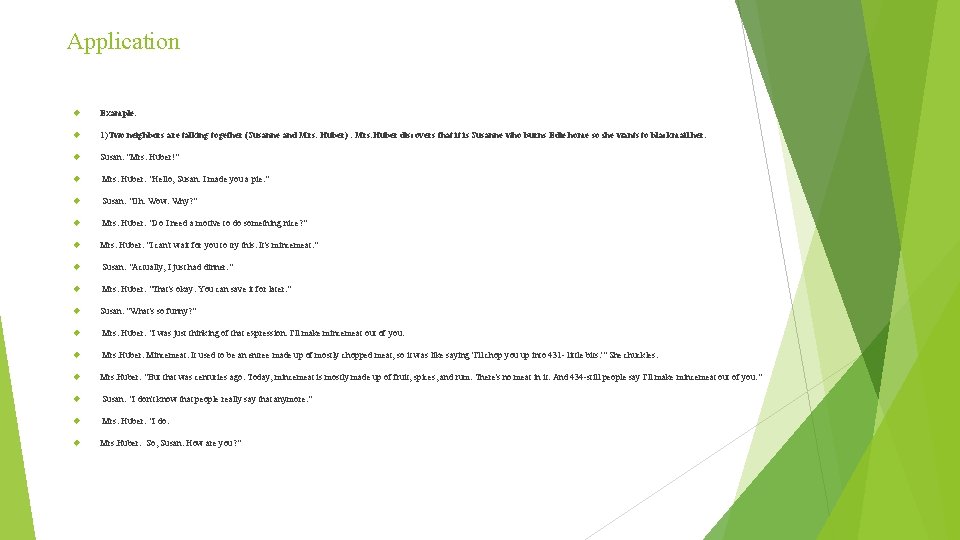
Application Example: 1)Two neighbors are talking together (Susanne and Mrs. Huber). Mrs. Huber discovers that it is Susanne who burns Edie home so she wants to blackmail her: Susan: "Mrs. Huber!" Mrs. Huber: "Hello, Susan. I made you a pie. " Susan: "Oh. Wow. Why? " Mrs. Huber: "Do I need a motive to do something nice? " Mrs. Huber: "I can't wait for you to try this. It's mincemeat. " Susan: "Actually, I just had dinner. " Mrs. Huber: "That's okay. You can save it for later. " Susan: "What's so funny? " Mrs. Huber: "I was just thinking of that expression: I'll make mincemeat out of you. Mrs. Huber: Mincemeat. It used to be an entree made up of mostly chopped meat, so it was like saying 'I'll chop you up into 431 - little bits. '" She chuckles. Mrs. Huber: "But that was centuries ago. Today, mincemeat is mostly made up of fruit, spices, and rum. There's no meat in it. And 434 -still people say I'll make mincemeat out of you. " Susan: "I don't know that people really say that anymore. " Mrs. Huber: "I do. Mrs. Huber: So, Susan. How are you? "
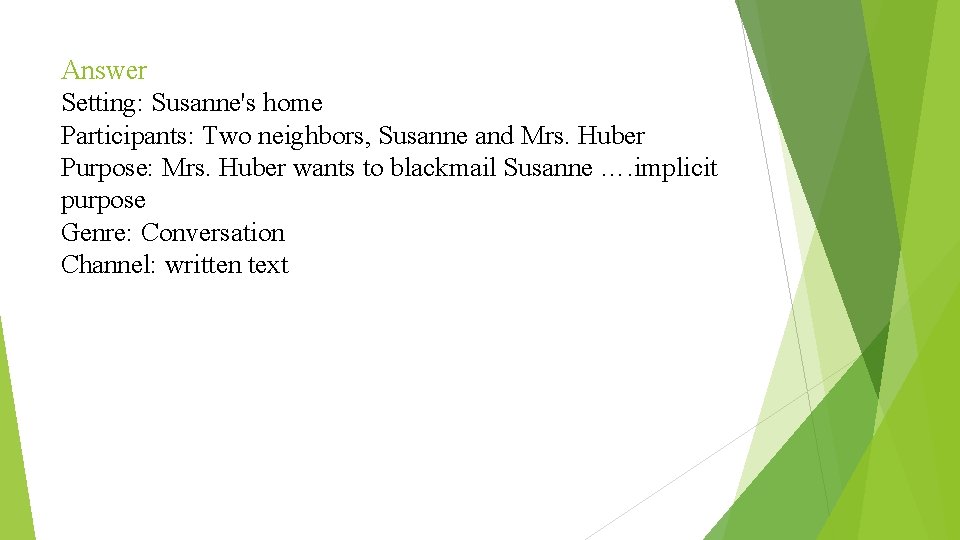
Answer Setting: Susanne's home Participants: Two neighbors, Susanne and Mrs. Huber Purpose: Mrs. Huber wants to blackmail Susanne …. implicit purpose Genre: Conversation Channel: written text