
Contestability Upper 6 th Micro Market Structures Intro

Contestability Upper 6 th Micro Market Structures
Intro to Contestability Mr O’Grady
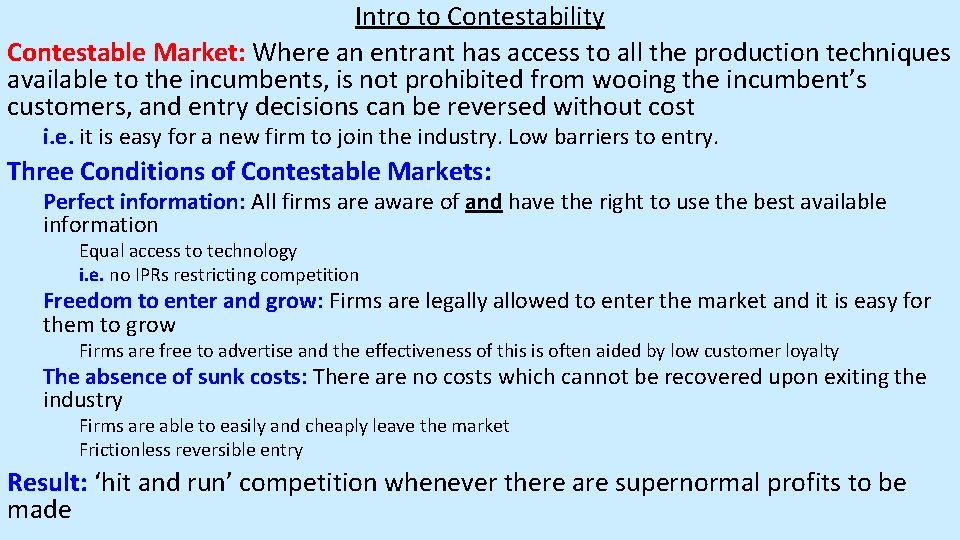
Intro to Contestability Contestable Market: Where an entrant has access to all the production techniques available to the incumbents, is not prohibited from wooing the incumbent’s customers, and entry decisions can be reversed without cost i. e. it is easy for a new firm to join the industry. Low barriers to entry. Three Conditions of Contestable Markets: Perfect information: All firms are aware of and have the right to use the best available information Equal access to technology i. e. no IPRs restricting competition Freedom to enter and grow: Firms are legally allowed to enter the market and it is easy for them to grow Firms are free to advertise and the effectiveness of this is often aided by low customer loyalty The absence of sunk costs: There are no costs which cannot be recovered upon exiting the industry Firms are able to easily and cheaply leave the market Frictionless reversible entry Result: ‘hit and run’ competition whenever there are supernormal profits to be made

Impacts of Contestability Mr O’Grady
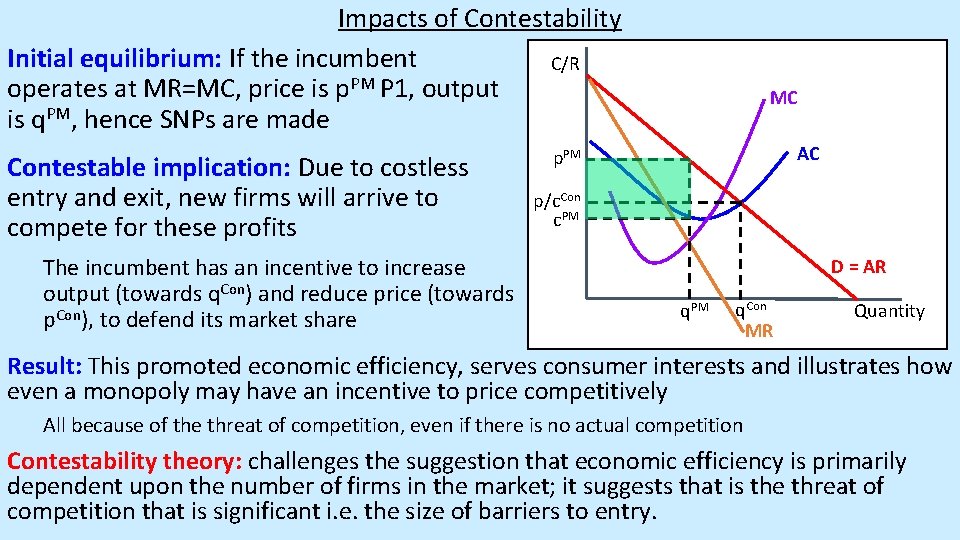
Impacts of Contestability Initial equilibrium: If the incumbent C/R operates at MR=MC, price is p. PM P 1, output is q. PM, hence SNPs are made Contestable implication: Due to costless entry and exit, new firms will arrive to compete for these profits The incumbent has an incentive to increase output (towards q. Con) and reduce price (towards p. Con), to defend its market share MC AC p. PM p/c. Con c. PM D = AR q. PM q. Con MR Quantity Result: This promoted economic efficiency, serves consumer interests and illustrates how even a monopoly may have an incentive to price competitively All because of the threat of competition, even if there is no actual competition Contestability theory: challenges the suggestion that economic efficiency is primarily dependent upon the number of firms in the market; it suggests that is the threat of competition that is significant i. e. the size of barriers to entry.
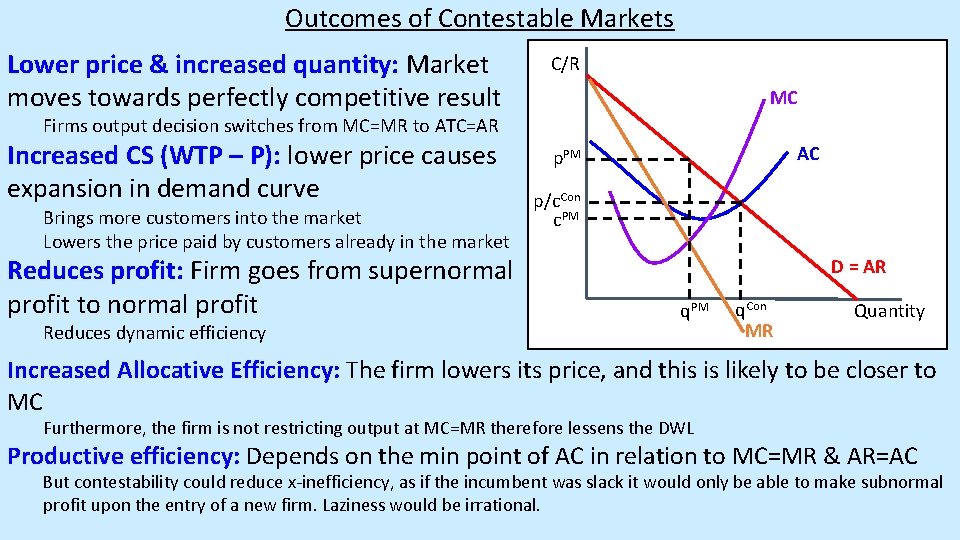
Outcomes of Contestable Markets Lower price & increased quantity: Market moves towards perfectly competitive result C/R Increased CS (WTP – P): lower price causes expansion in demand curve p. PM MC Firms output decision switches from MC=MR to ATC=AR Brings more customers into the market Lowers the price paid by customers already in the market Reduces profit: Firm goes from supernormal profit to normal profit Reduces dynamic efficiency AC p/c. Con c. PM D = AR q. PM q. Con MR Quantity Increased Allocative Efficiency: The firm lowers its price, and this is likely to be closer to MC Furthermore, the firm is not restricting output at MC=MR therefore lessens the DWL Productive efficiency: Depends on the min point of AC in relation to MC=MR & AR=AC But contestability could reduce x-inefficiency, as if the incumbent was slack it would only be able to make subnormal profit upon the entry of a new firm. Laziness would be irrational.

Factors Promoting Contestability Mr O’Grady
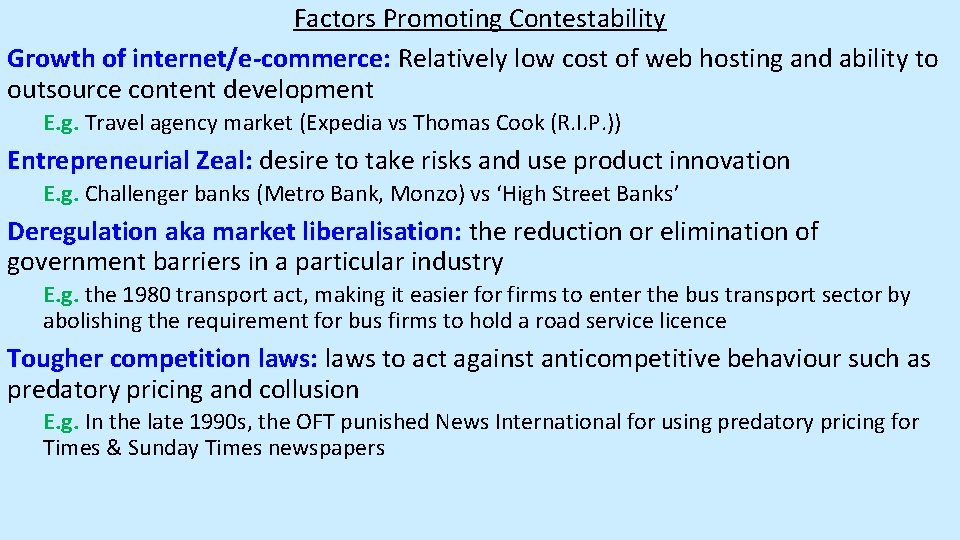
Factors Promoting Contestability Growth of internet/e-commerce: Relatively low cost of web hosting and ability to outsource content development E. g. Travel agency market (Expedia vs Thomas Cook (R. I. P. )) Entrepreneurial Zeal: desire to take risks and use product innovation E. g. Challenger banks (Metro Bank, Monzo) vs ‘High Street Banks’ Deregulation aka market liberalisation: the reduction or elimination of government barriers in a particular industry E. g. the 1980 transport act, making it easier for firms to enter the bus transport sector by abolishing the requirement for bus firms to hold a road service licence Tougher competition laws: laws to act against anticompetitive behaviour such as predatory pricing and collusion E. g. In the late 1990 s, the OFT punished News International for using predatory pricing for Times & Sunday Times newspapers

Evaluation of Contestable Markets Theory Contestability Mr O’Grady
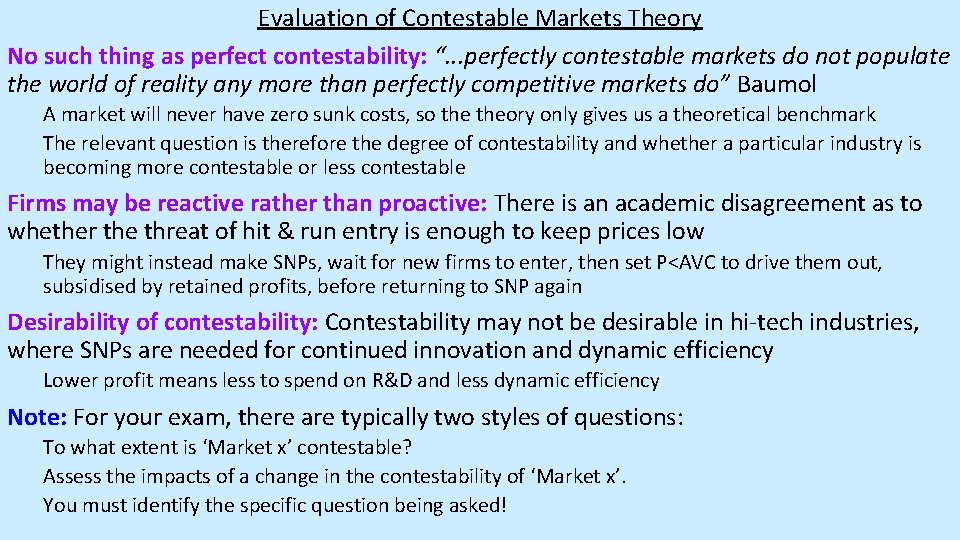
Evaluation of Contestable Markets Theory No such thing as perfect contestability: “. . . perfectly contestable markets do not populate the world of reality any more than perfectly competitive markets do” Baumol A market will never have zero sunk costs, so theory only gives us a theoretical benchmark The relevant question is therefore the degree of contestability and whether a particular industry is becoming more contestable or less contestable Firms may be reactive rather than proactive: There is an academic disagreement as to whether the threat of hit & run entry is enough to keep prices low They might instead make SNPs, wait for new firms to enter, then set P<AVC to drive them out, subsidised by retained profits, before returning to SNP again Desirability of contestability: Contestability may not be desirable in hi-tech industries, where SNPs are needed for continued innovation and dynamic efficiency Lower profit means less to spend on R&D and less dynamic efficiency Note: For your exam, there are typically two styles of questions: To what extent is ‘Market x’ contestable? Assess the impacts of a change in the contestability of ‘Market x’. You must identify the specific question being asked!

Where next? Don’t forget to SUBSCRIBE! Visit our website: www. smootheconomics. co. uk Find more resources, extension materials, details of courses, competitions, and more! Follow our socials: Instagram: @smootheconomics Twitter: @Smooth. Economics Facebook: @Smooth. Economics
- Slides: 11