
Contents Physical layer for IEEE 802 11 b
Contents Physical layer for IEEE 802. 11 b • Channel allocation • Modulation and coding • PHY layer frame structure Physical layer for IEEE 802. 11 a/g • Channel allocation • Modulation and coding • OFDM basics • PHY layer frame structure Δίκτυα Υπολογιστών II Δρ. Γεώργιος Δημητρακόπουλος
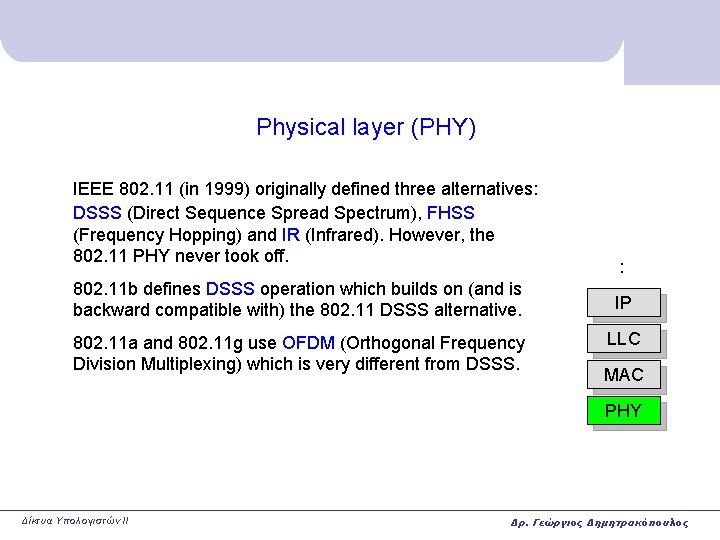
Physical layer (PHY) IEEE 802. 11 (in 1999) originally defined three alternatives: DSSS (Direct Sequence Spread Spectrum), FHSS (Frequency Hopping) and IR (Infrared). However, the 802. 11 PHY never took off. 802. 11 b defines DSSS operation which builds on (and is backward compatible with) the 802. 11 DSSS alternative. 802. 11 a and 802. 11 g use OFDM (Orthogonal Frequency Division Multiplexing) which is very different from DSSS. : IP LLC MAC PHY Δίκτυα Υπολογιστών II Δρ. Γεώργιος Δημητρακόπουλος
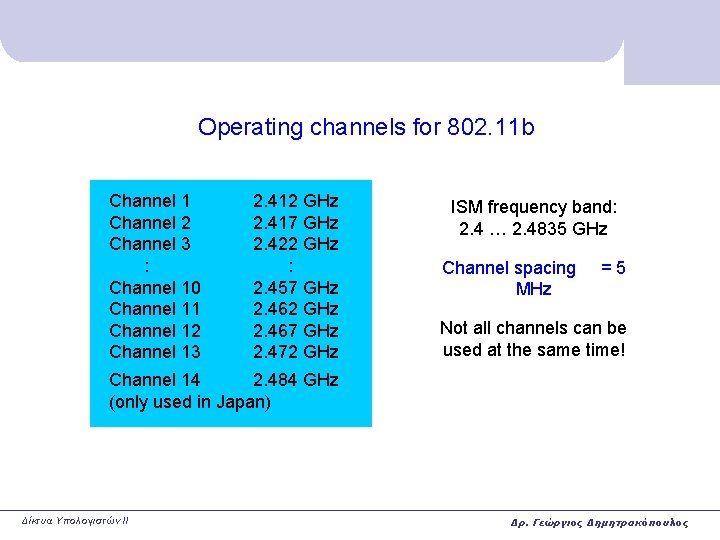
Operating channels for 802. 11 b Channel 1 Channel 2 Channel 3 : Channel 10 Channel 11 Channel 12 Channel 13 2. 412 GHz 2. 417 GHz 2. 422 GHz : 2. 457 GHz 2. 462 GHz 2. 467 GHz 2. 472 GHz ISM frequency band: 2. 4 … 2. 4835 GHz Channel spacing MHz =5 Not all channels can be used at the same time! Channel 14 2. 484 GHz (only used in Japan) Δίκτυα Υπολογιστών II Δρ. Γεώργιος Δημητρακόπουλος

Channels used in different regulatory domains Regulatory domain US (FCC) / Canada France Spain Europe (ETSI) Japan Allowed channels 1 to 11 10 to 13 10 to 11 1 to 13 14 Most 802. 11 b products use channel 10 as the default operating channel Δίκτυα Υπολογιστών II Δρ. Γεώργιος Δημητρακόπουλος
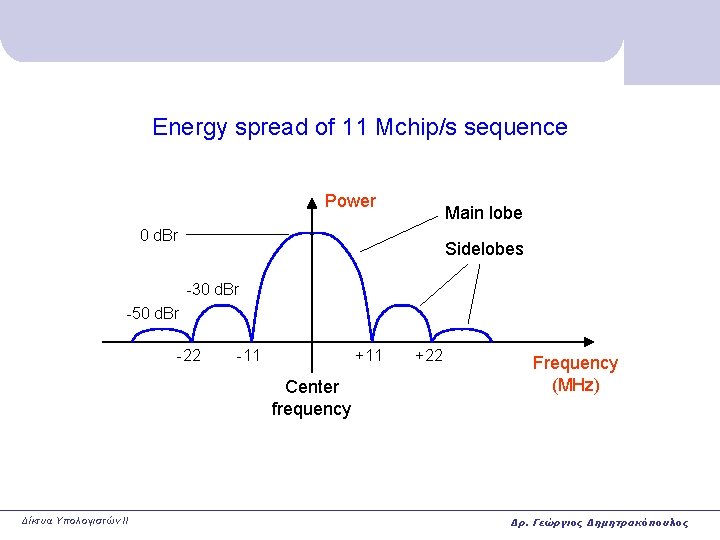
Energy spread of 11 Mchip/s sequence Power Main lobe 0 d. Br Sidelobes -30 d. Br -50 d. Br -22 -11 +11 Center frequency Δίκτυα Υπολογιστών II +22 Frequency (MHz) Δρ. Γεώργιος Δημητρακόπουλος
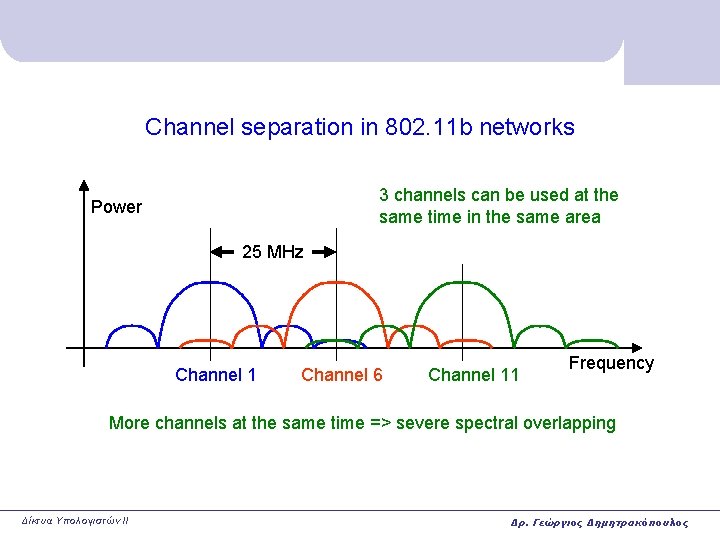
Channel separation in 802. 11 b networks 3 channels can be used at the same time in the same area Power 25 MHz Channel 1 Channel 6 Channel 11 Frequency More channels at the same time => severe spectral overlapping Δίκτυα Υπολογιστών II Δρ. Γεώργιος Δημητρακόπουλος
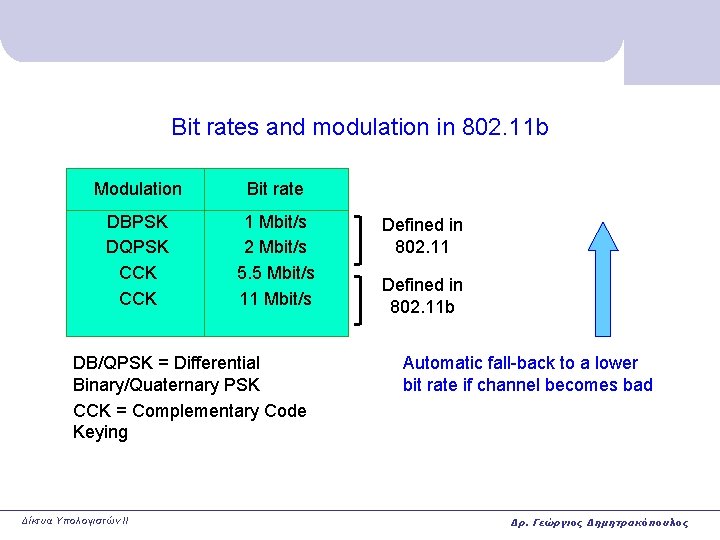
Bit rates and modulation in 802. 11 b Modulation Bit rate DBPSK DQPSK CCK 1 Mbit/s 2 Mbit/s 5. 5 Mbit/s 11 Mbit/s DB/QPSK = Differential Binary/Quaternary PSK CCK = Complementary Code Keying Δίκτυα Υπολογιστών II Defined in 802. 11 b Automatic fall-back to a lower bit rate if channel becomes bad Δρ. Γεώργιος Δημητρακόπουλος

Encoding with 11 -chip Barker sequence (Used only at 1 and 2 Mbit/s, CCK is used at higher bit rates) Bit sequence 0 bit 1 bit Barker sequence Transmitted chip sequence Δίκτυα Υπολογιστών II Δρ. Γεώργιος Δημητρακόπουλος

Differential quadrature phase shift keying (Used at the higher bit rates in one form or another) QPSK symbols in the complex plane: DQPSK encoding table Im p/2 p 3 p/2 Δίκτυα Υπολογιστών II 0 Re Bit pattern Phase shift w. r. t. previous symbol 00 01 11 10 0 p/2 p 3 p/2 Δρ. Γεώργιος Δημητρακόπουλος
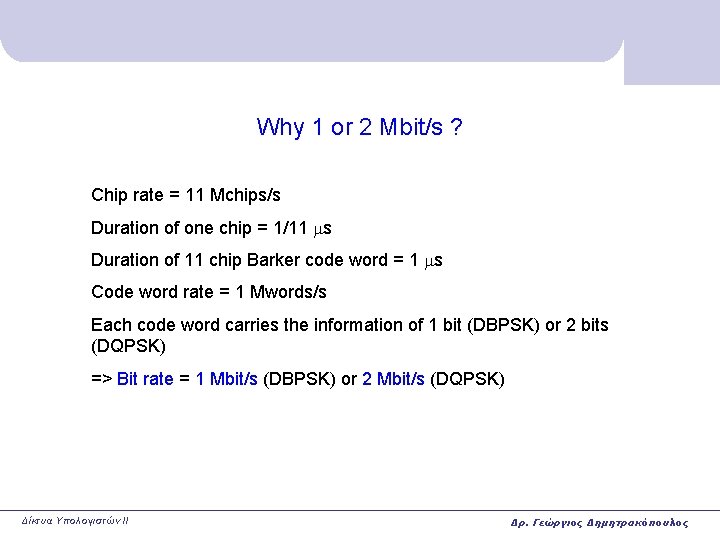
Why 1 or 2 Mbit/s ? Chip rate = 11 Mchips/s Duration of one chip = 1/11 ms Duration of 11 chip Barker code word = 1 ms Code word rate = 1 Mwords/s Each code word carries the information of 1 bit (DBPSK) or 2 bits (DQPSK) => Bit rate = 1 Mbit/s (DBPSK) or 2 Mbit/s (DQPSK) Δίκτυα Υπολογιστών II Δρ. Γεώργιος Δημητρακόπουλος
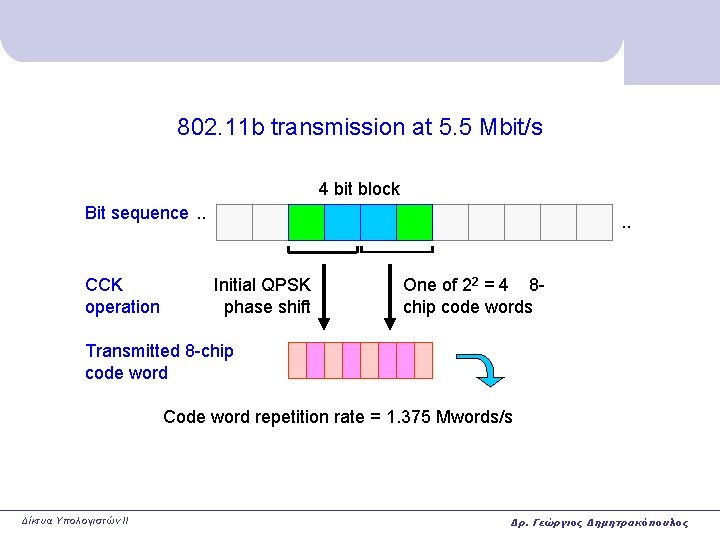
802. 11 b transmission at 5. 5 Mbit/s 4 bit block Bit sequence. . CCK operation Initial QPSK phase shift One of 22 = 4 8 chip code words Transmitted 8 -chip code word Code word repetition rate = 1. 375 Mwords/s Δίκτυα Υπολογιστών II Δρ. Γεώργιος Δημητρακόπουλος
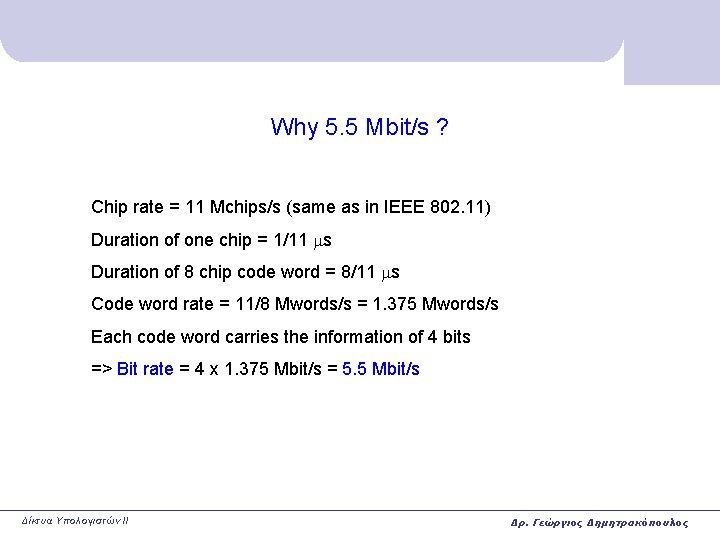
Why 5. 5 Mbit/s ? Chip rate = 11 Mchips/s (same as in IEEE 802. 11) Duration of one chip = 1/11 ms Duration of 8 chip code word = 8/11 ms Code word rate = 11/8 Mwords/s = 1. 375 Mwords/s Each code word carries the information of 4 bits => Bit rate = 4 x 1. 375 Mbit/s = 5. 5 Mbit/s Δίκτυα Υπολογιστών II Δρ. Γεώργιος Δημητρακόπουλος
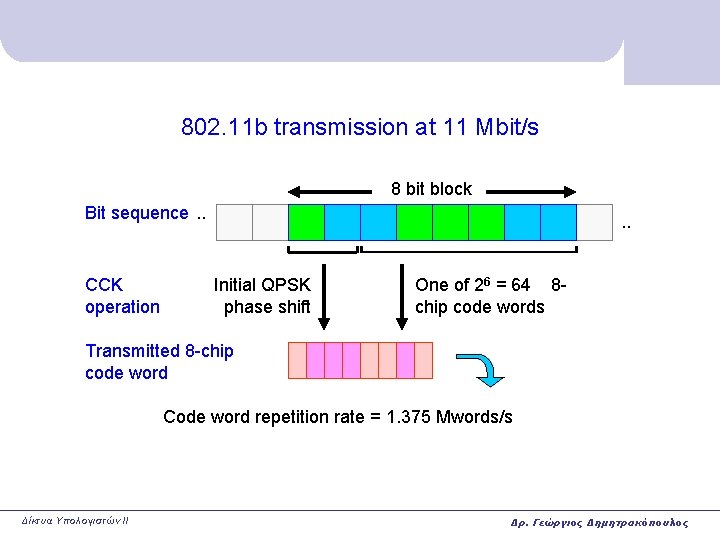
802. 11 b transmission at 11 Mbit/s 8 bit block Bit sequence. . CCK operation Initial QPSK phase shift One of 26 = 64 8 chip code words Transmitted 8 -chip code word Code word repetition rate = 1. 375 Mwords/s Δίκτυα Υπολογιστών II Δρ. Γεώργιος Δημητρακόπουλος
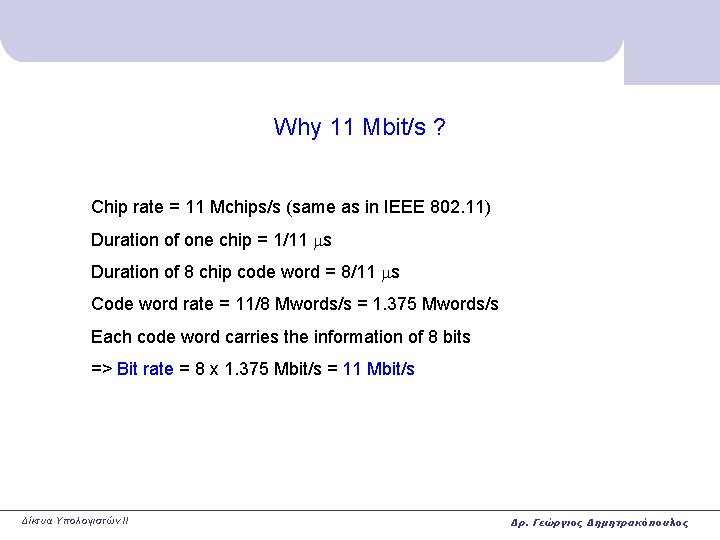
Why 11 Mbit/s ? Chip rate = 11 Mchips/s (same as in IEEE 802. 11) Duration of one chip = 1/11 ms Duration of 8 chip code word = 8/11 ms Code word rate = 11/8 Mwords/s = 1. 375 Mwords/s Each code word carries the information of 8 bits => Bit rate = 8 x 1. 375 Mbit/s = 11 Mbit/s Δίκτυα Υπολογιστών II Δρ. Γεώργιος Δημητρακόπουλος
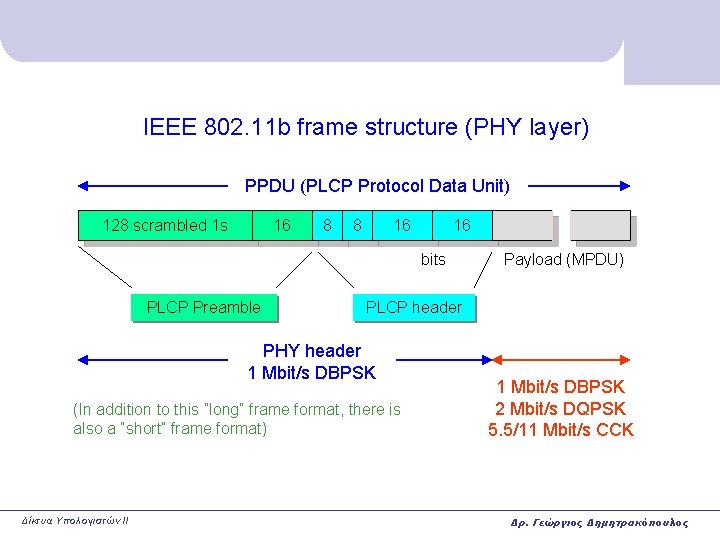
IEEE 802. 11 b frame structure (PHY layer) PPDU (PLCP Protocol Data Unit) 128 scrambled 1 s 16 8 8 16 16 bits PLCP Preamble PLCP header PHY header 1 Mbit/s DBPSK (In addition to this ”long” frame format, there is also a ”short” frame format) Δίκτυα Υπολογιστών II Payload (MPDU) 1 Mbit/s DBPSK 2 Mbit/s DQPSK 5. 5/11 Mbit/s CCK Δρ. Γεώργιος Δημητρακόπουλος
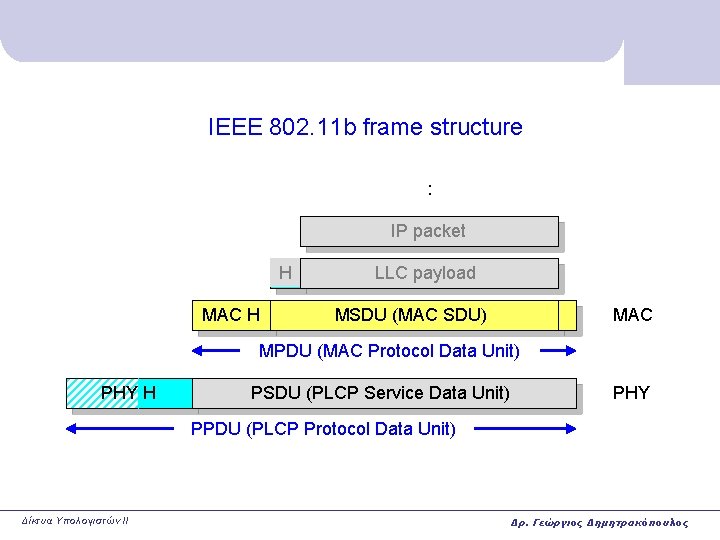
IEEE 802. 11 b frame structure : IP packet H MAC H LLC payload MSDU (MAC SDU) MAC MPDU (MAC Protocol Data Unit) PHY H PSDU (PLCP Service Data Unit) PHY PPDU (PLCP Protocol Data Unit) Δίκτυα Υπολογιστών II Δρ. Γεώργιος Δημητρακόπουλος
IEEE 802. 11 a/g This physical layer implementation is based on OFDM (Orthogonal Frequency Division Multiplexing). The information is carried over the radio medium using orthogonal subcarriers. A channel (16. 25 MHz wide) is divided into 52 subcarriers (48 subcarriers for data and 4 subcarriers serving as pilot signals). Subcarriers are modulated using BPSK, QPSK, 16 -QAM, or 64 -QAM, and coded using convolutional codes (R = 1/2, 2/3, and 3/4), depending on the data rate. Δίκτυα Υπολογιστών II Δρ. Γεώργιος Δημητρακόπουλος
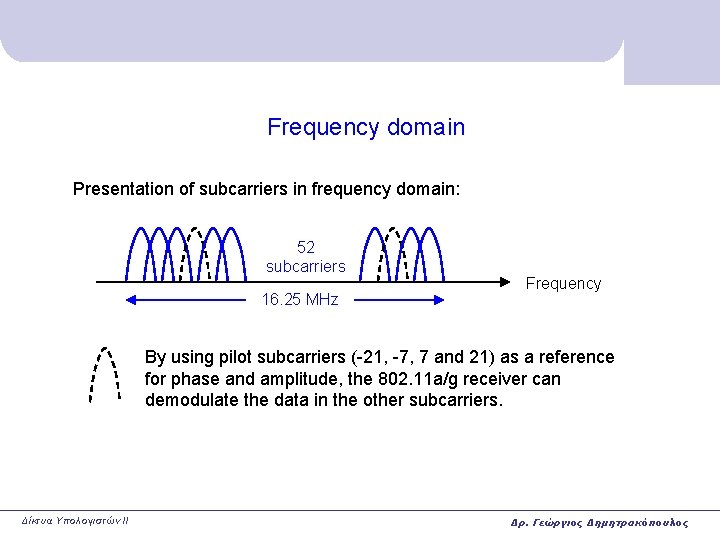
Frequency domain Presentation of subcarriers in frequency domain: 52 subcarriers 16. 25 MHz Frequency By using pilot subcarriers (-21, -7, 7 and 21) as a reference for phase and amplitude, the 802. 11 a/g receiver can demodulate the data in the other subcarriers. Δίκτυα Υπολογιστών II Δρ. Γεώργιος Δημητρακόπουλος
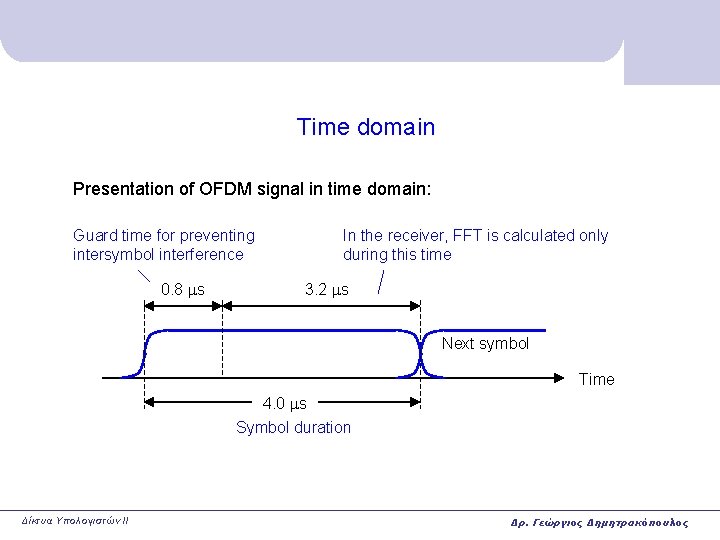
Time domain Presentation of OFDM signal in time domain: Guard time for preventing intersymbol interference 0. 8 ms In the receiver, FFT is calculated only during this time 3. 2 ms Next symbol Time 4. 0 ms Symbol duration Δίκτυα Υπολογιστών II Δρ. Γεώργιος Δημητρακόπουλος

Subcarrier modulation and coding Modulation Bit rate Coding rate Coded bits / symbol Data bits / symbol BPSK QPSK 16 -QAM 64 -QAM 6 Mbit/s 9 Mbit/s 12 Mbit/s 18 Mbit/s 24 Mbit/s 36 Mbit/s 48 Mbit/s 54 Mbit/s 1/2 3/4 2/3 3/4 48 48 96 96 192 288 24 36 48 72 96 144 192 216 Δίκτυα Υπολογιστών II Δρ. Γεώργιος Δημητρακόπουλος
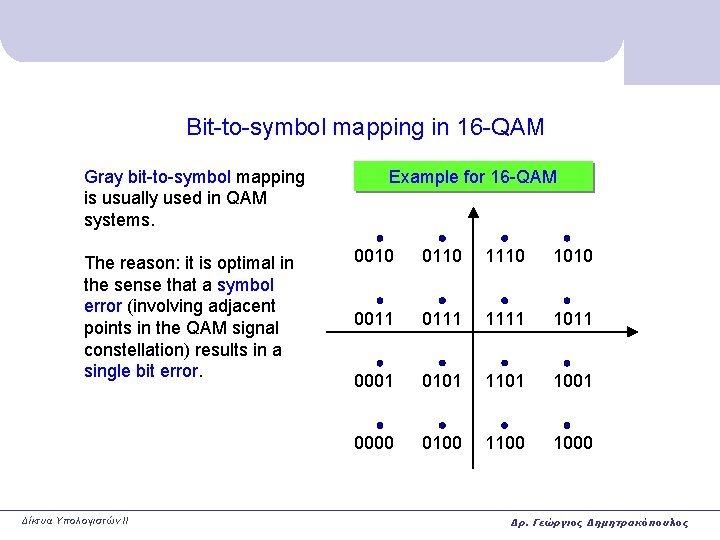
Bit-to-symbol mapping in 16 -QAM Gray bit-to-symbol mapping is usually used in QAM systems. The reason: it is optimal in the sense that a symbol error (involving adjacent points in the QAM signal constellation) results in a single bit error. Δίκτυα Υπολογιστών II Example for 16 -QAM 0010 0110 1010 0011 0111 1011 0001 0101 1001 0000 0100 1000 Δρ. Γεώργιος Δημητρακόπουλος
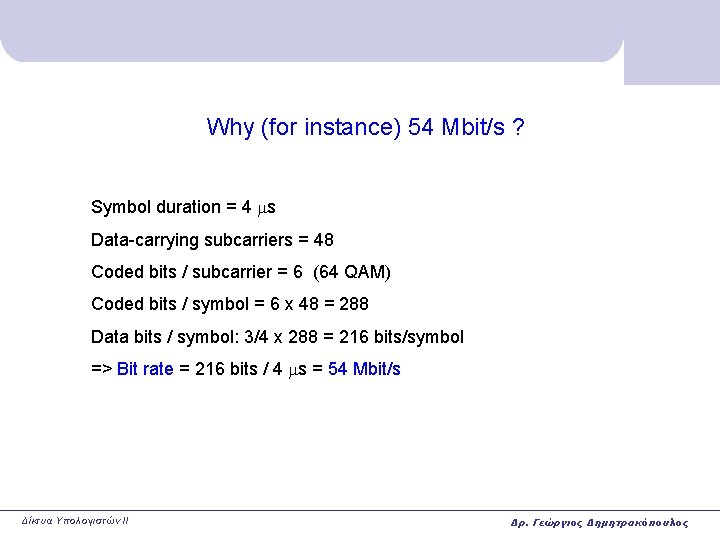
Why (for instance) 54 Mbit/s ? Symbol duration = 4 ms Data-carrying subcarriers = 48 Coded bits / subcarrier = 6 (64 QAM) Coded bits / symbol = 6 x 48 = 288 Data bits / symbol: 3/4 x 288 = 216 bits/symbol => Bit rate = 216 bits / 4 ms = 54 Mbit/s Δίκτυα Υπολογιστών II Δρ. Γεώργιος Δημητρακόπουλος
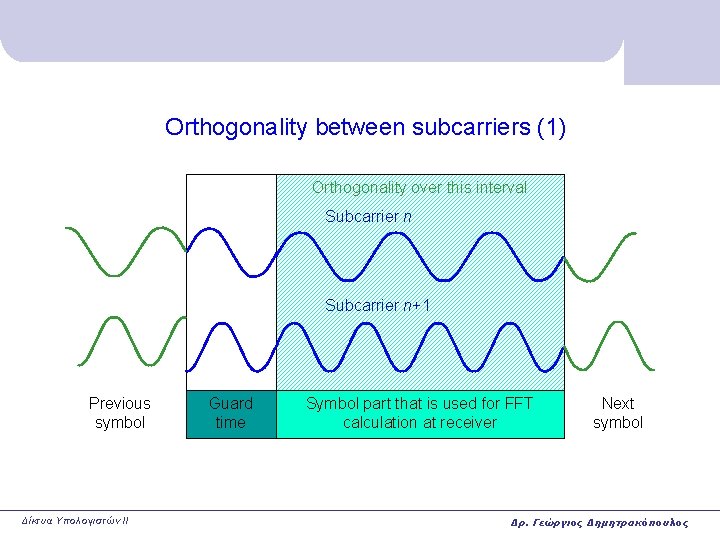
Orthogonality between subcarriers (1) Orthogonality over this interval Subcarrier n+1 Previous symbol Δίκτυα Υπολογιστών II Guard time Symbol part that is used for FFT calculation at receiver Next symbol Δρ. Γεώργιος Δημητρακόπουλος
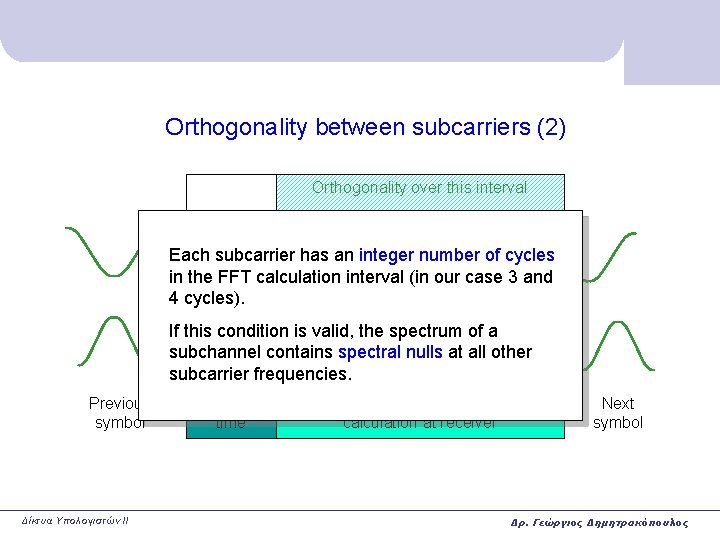
Orthogonality between subcarriers (2) Orthogonality over this interval Subcarrier n Each subcarrier has an integer number of cycles in the FFT calculation interval (in our case 3 and 4 cycles). Subcarrier n+1 If this condition is valid, the spectrum of a subchannel contains spectral nulls at all other subcarrier frequencies. Previous symbol Δίκτυα Υπολογιστών II Guard time Symbol part that is used for FFT calculation at receiver Next symbol Δρ. Γεώργιος Δημητρακόπουλος
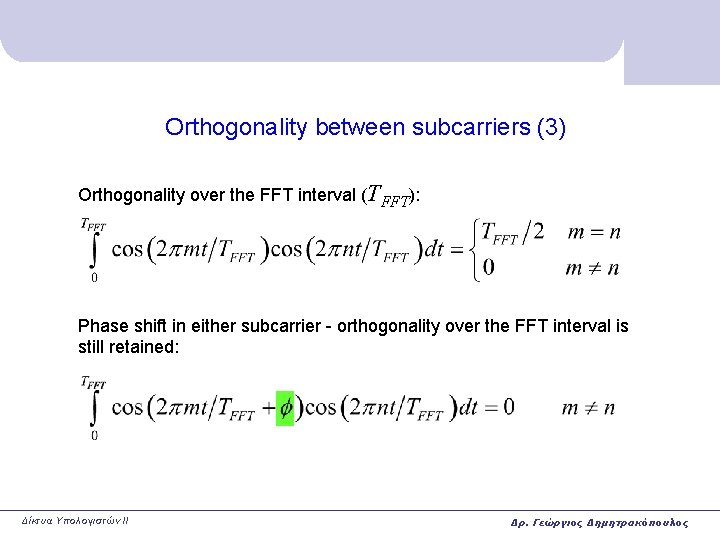
Orthogonality between subcarriers (3) Orthogonality over the FFT interval (TFFT): Phase shift in either subcarrier - orthogonality over the FFT interval is still retained: Δίκτυα Υπολογιστών II Δρ. Γεώργιος Δημητρακόπουλος
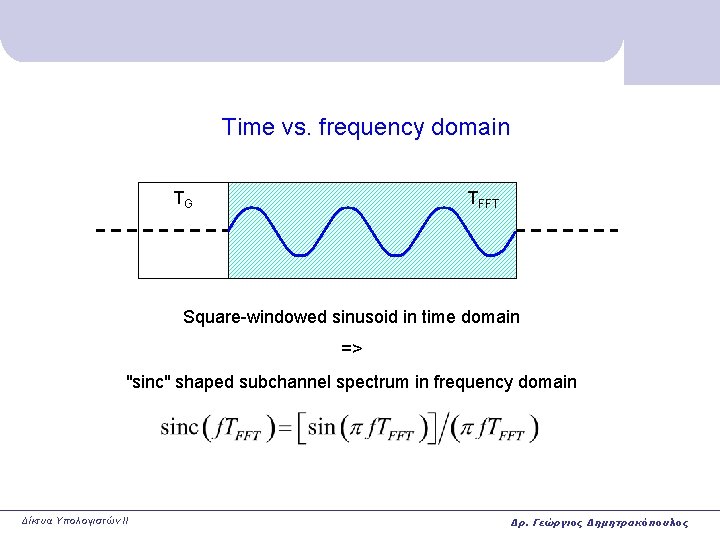
Time vs. frequency domain TG TFFT Square-windowed sinusoid in time domain => "sinc" shaped subchannel spectrum in frequency domain Δίκτυα Υπολογιστών II Δρ. Γεώργιος Δημητρακόπουλος
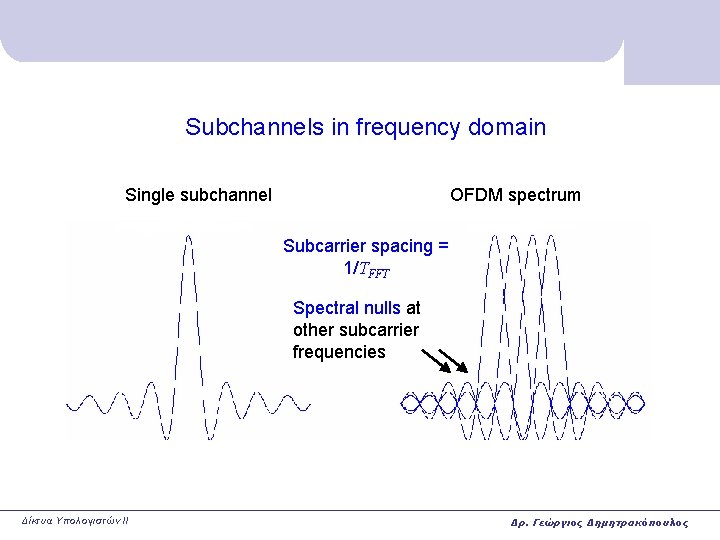
Subchannels in frequency domain Single subchannel OFDM spectrum Subcarrier spacing = 1/TFFT Spectral nulls at other subcarrier frequencies Δίκτυα Υπολογιστών II Δρ. Γεώργιος Δημητρακόπουλος
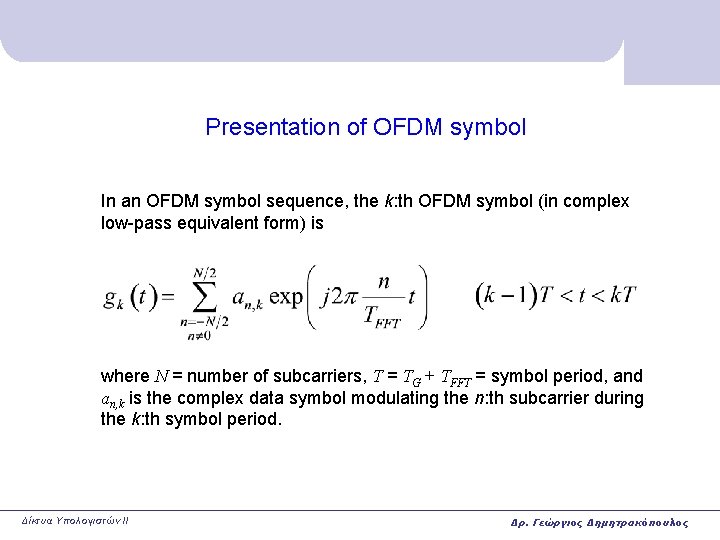
Presentation of OFDM symbol In an OFDM symbol sequence, the k: th OFDM symbol (in complex low-pass equivalent form) is where N = number of subcarriers, T = TG + TFFT = symbol period, and an, k is the complex data symbol modulating the n: th subcarrier during the k: th symbol period. Δίκτυα Υπολογιστών II Δρ. Γεώργιος Δημητρακόπουλος
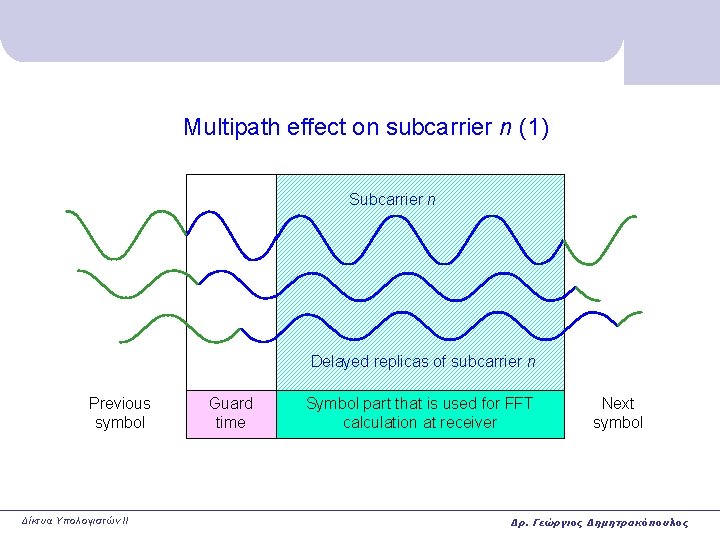
Multipath effect on subcarrier n (1) Subcarrier n Delayed replicas of subcarrier n Previous symbol Δίκτυα Υπολογιστών II Guard time Symbol part that is used for FFT calculation at receiver Next symbol Δρ. Γεώργιος Δημητρακόπουλος
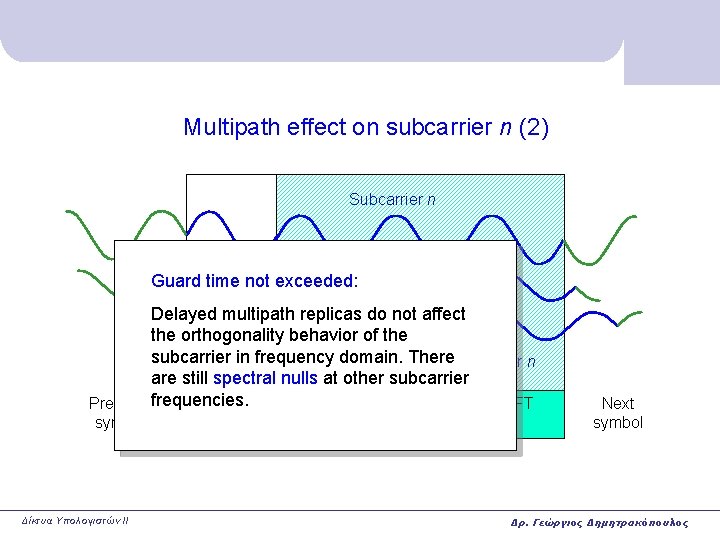
Multipath effect on subcarrier n (2) Subcarrier n Guard time not exceeded: Delayed multipath replicas do not affect the orthogonality behavior of the subcarrier in frequency domain. There Delayed replicas of subcarrier n are still spectral nulls at other subcarrier Previousfrequencies. Guard Symbol part that is used for FFT symbol Δίκτυα Υπολογιστών II time calculation at receiver Next symbol Δρ. Γεώργιος Δημητρακόπουλος
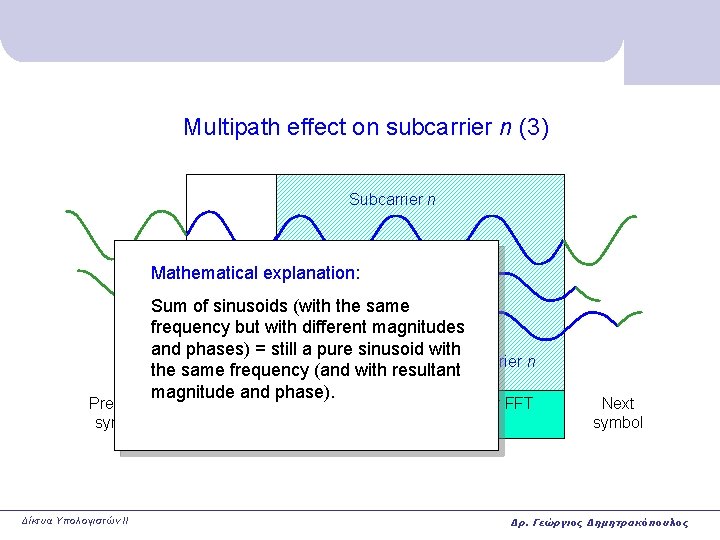
Multipath effect on subcarrier n (3) Subcarrier n Mathematical explanation: Previous symbol Δίκτυα Υπολογιστών II Sum of sinusoids (with the same frequency but with different magnitudes and phases) = still a pure sinusoid with Delayed replicas of subcarrier n the same frequency (and with resultant magnitude and phase). Guard time Symbol part that is used for FFT calculation at receiver Next symbol Δρ. Γεώργιος Δημητρακόπουλος
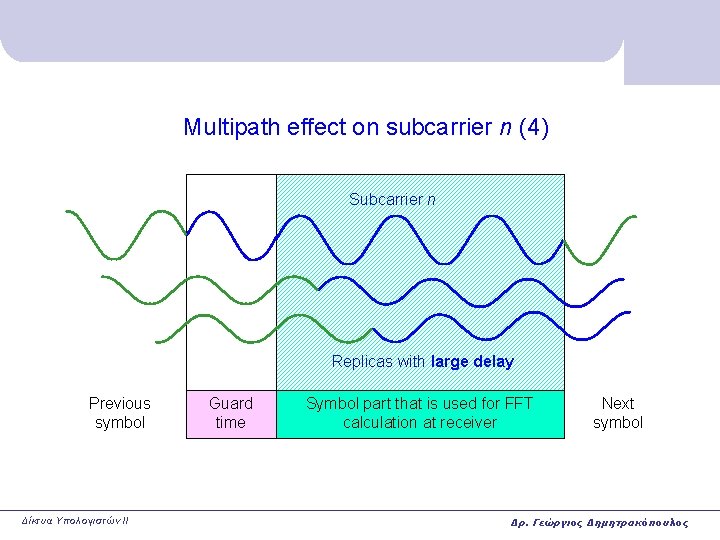
Multipath effect on subcarrier n (4) Subcarrier n Replicas with large delay Previous symbol Δίκτυα Υπολογιστών II Guard time Symbol part that is used for FFT calculation at receiver Next symbol Δρ. Γεώργιος Δημητρακόπουλος
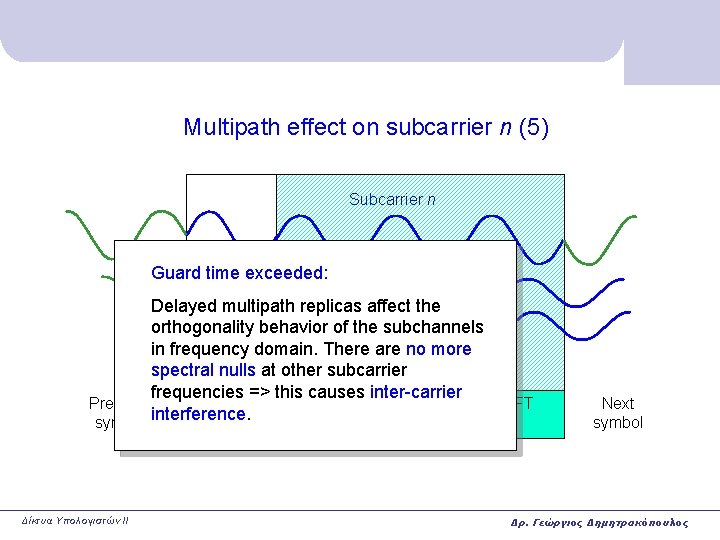
Multipath effect on subcarrier n (5) Subcarrier n Guard time exceeded: Delayed multipath replicas affect the orthogonality behavior of the subchannels in frequency domain. There are no more Replicas with large delay spectral nulls at other subcarrier frequencies => this causes inter-carrier Previous Guard Symbol part that is used for FFT interference. symbol time calculation at receiver Δίκτυα Υπολογιστών II Next symbol Δρ. Γεώργιος Δημητρακόπουλος
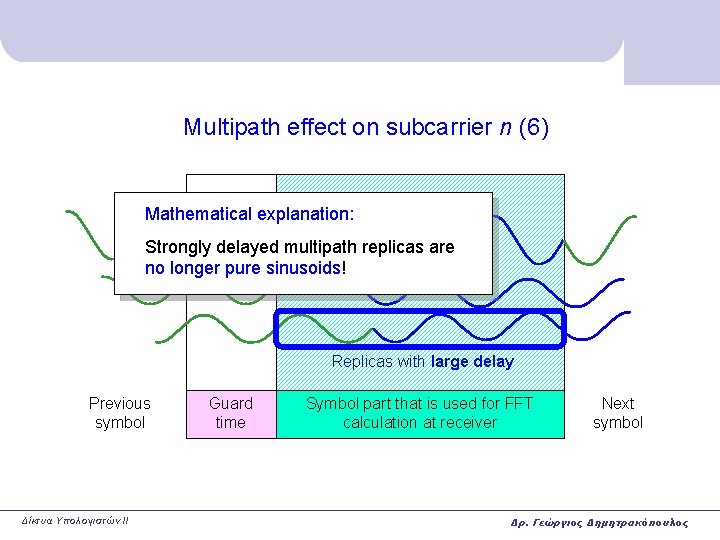
Multipath effect on subcarrier n (6) Subcarrier n Mathematical explanation: Strongly delayed multipath replicas are no longer pure sinusoids! Replicas with large delay Previous symbol Δίκτυα Υπολογιστών II Guard time Symbol part that is used for FFT calculation at receiver Next symbol Δρ. Γεώργιος Δημητρακόπουλος
IEEE 802. 11 a in Europe 802. 11 a was designed in the USA. In Europe, a similar WLAN system – Hiper. LAN 2 – was designed by ETSI (European Telecommunications Standards Institute), intended to be used in the same frequency band (5 GHz). Although Hiper. LAN 2 has not (yet) took off, 802. 11 a devices, when being used in Europe, must include two Hiper. LAN 2 features not required in the USA: • DFS (Dynamic Frequency Selection) • TPC (Transmit Power Control) Δίκτυα Υπολογιστών II Δρ. Γεώργιος Δημητρακόπουλος
IEEE 802. 11 g PHY 802. 11 g is also based on OFDM (and same parameters as 802. 11 a). However, 802. 11 g uses the 2. 4 GHz frequency band, like 802. 11 b (usually: dual mode devices). Since the bandwidth of a 802. 11 b signal is 22 MHz and that of a 802. 11 g signal is 16. 25 MHz, 802. 11 g can easily use the same channel structure as 802. 11 b (i. e. at most three channels at the same time in the same area). 802. 11 g and 802. 11 b stations must be able to share the same channels in the 2. 4 GHz frequency band => interworking required. Δίκτυα Υπολογιστών II Δρ. Γεώργιος Δημητρακόπουλος
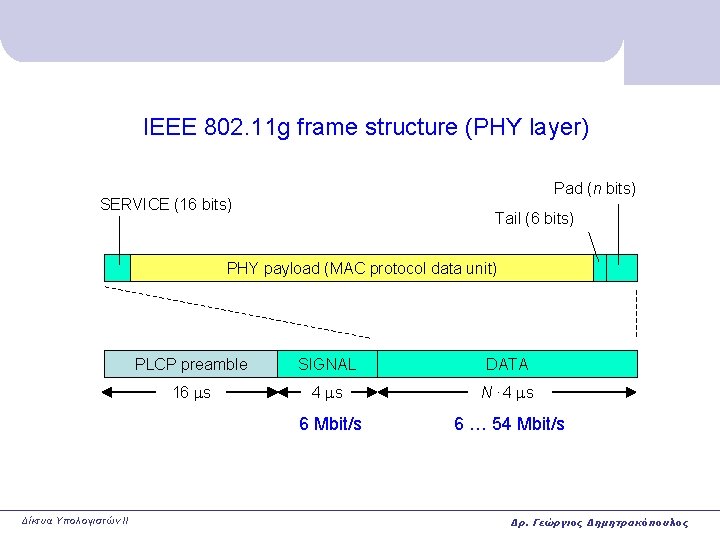
IEEE 802. 11 g frame structure (PHY layer) Pad (n bits) SERVICE (16 bits) Tail (6 bits) PHY payload (MAC protocol data unit) Δίκτυα Υπολογιστών II PLCP preamble SIGNAL DATA 16 ms 4 ms N. 4 ms 6 Mbit/s 6 … 54 Mbit/s Δρ. Γεώργιος Δημητρακόπουλος
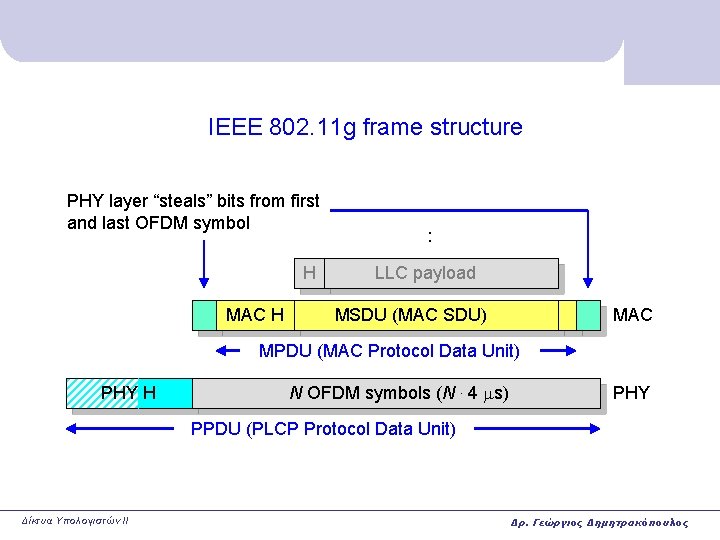
IEEE 802. 11 g frame structure PHY layer “steals” bits from first and last OFDM symbol H MAC H : LLC payload MSDU (MAC SDU) MAC MPDU (MAC Protocol Data Unit) PHY H N OFDM symbols (N. 4 ms) PHY PPDU (PLCP Protocol Data Unit) Δίκτυα Υπολογιστών II Δρ. Γεώργιος Δημητρακόπουλος
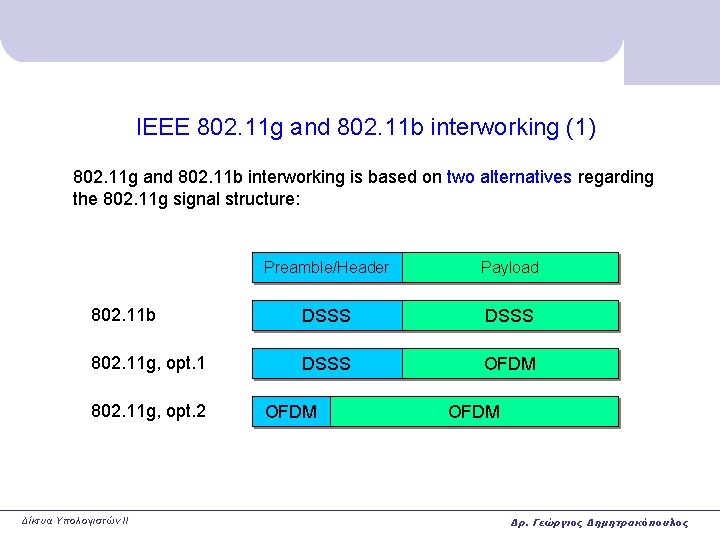
IEEE 802. 11 g and 802. 11 b interworking (1) 802. 11 g and 802. 11 b interworking is based on two alternatives regarding the 802. 11 g signal structure: Preamble/Header Payload 802. 11 b DSSS 802. 11 g, opt. 1 DSSS OFDM 802. 11 g, opt. 2 Δίκτυα Υπολογιστών II OFDM Δρ. Γεώργιος Δημητρακόπουλος
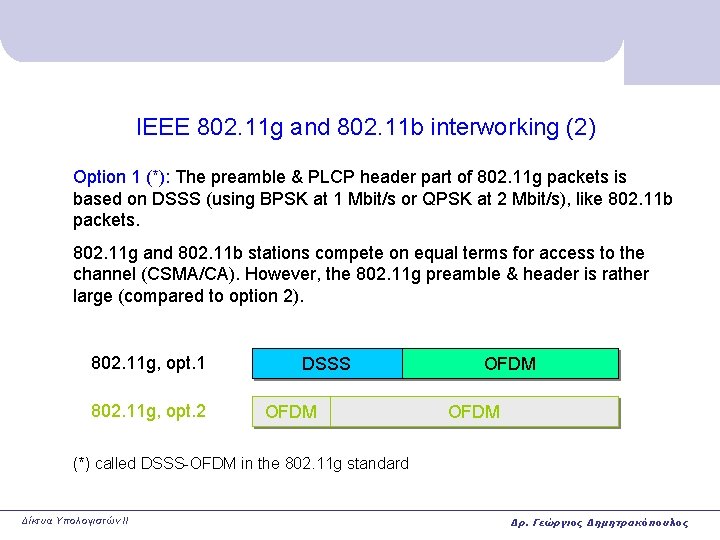
IEEE 802. 11 g and 802. 11 b interworking (2) Option 1 (*): The preamble & PLCP header part of 802. 11 g packets is based on DSSS (using BPSK at 1 Mbit/s or QPSK at 2 Mbit/s), like 802. 11 b packets. 802. 11 g and 802. 11 b stations compete on equal terms for access to the channel (CSMA/CA). However, the 802. 11 g preamble & header is rather large (compared to option 2). 802. 11 g, opt. 1 802. 11 g, opt. 2 DSSS OFDM (*) called DSSS-OFDM in the 802. 11 g standard Δίκτυα Υπολογιστών II Δρ. Γεώργιος Δημητρακόπουλος
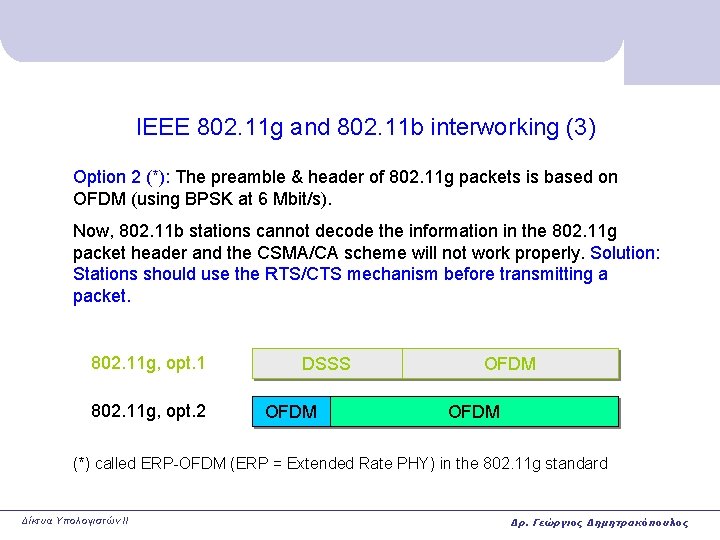
IEEE 802. 11 g and 802. 11 b interworking (3) Option 2 (*): The preamble & header of 802. 11 g packets is based on OFDM (using BPSK at 6 Mbit/s). Now, 802. 11 b stations cannot decode the information in the 802. 11 g packet header and the CSMA/CA scheme will not work properly. Solution: Stations should use the RTS/CTS mechanism before transmitting a packet. 802. 11 g, opt. 1 802. 11 g, opt. 2 DSSS OFDM (*) called ERP-OFDM (ERP = Extended Rate PHY) in the 802. 11 g standard Δίκτυα Υπολογιστών II Δρ. Γεώργιος Δημητρακόπουλος
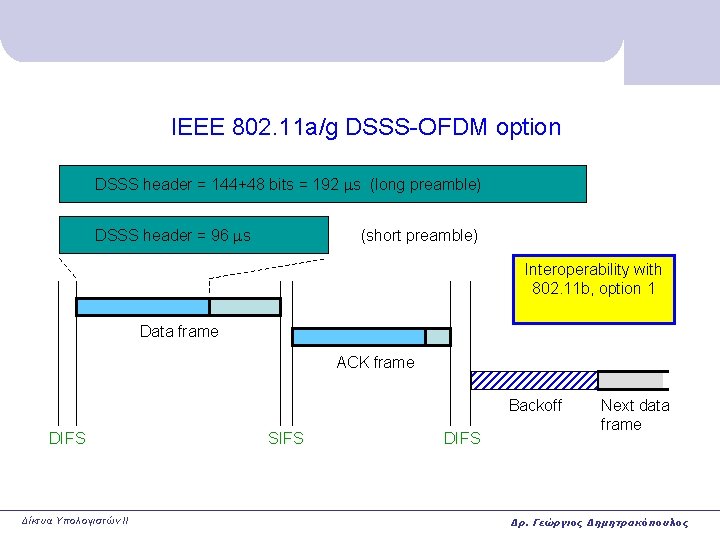
IEEE 802. 11 a/g DSSS-OFDM option DSSS header = 144+48 bits = 192 ms (long preamble) DSSS header = 96 ms (short preamble) Interoperability with 802. 11 b, option 1 Data frame ACK frame Backoff DIFS Δίκτυα Υπολογιστών II SIFS DIFS Next data frame Δρ. Γεώργιος Δημητρακόπουλος
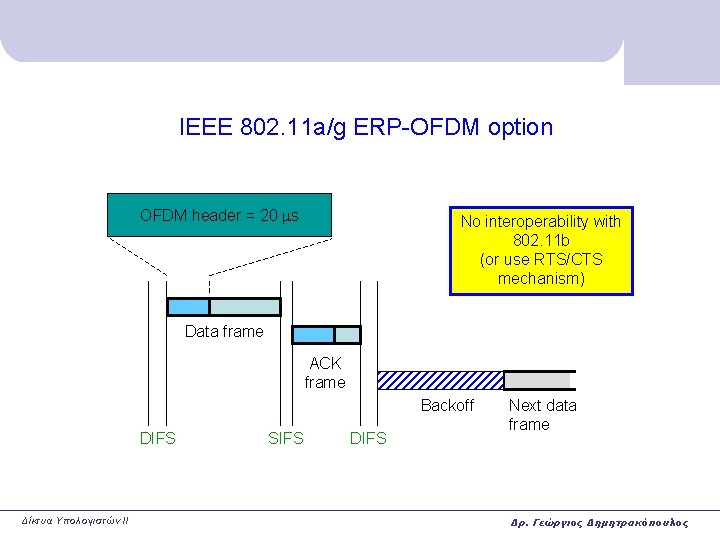
IEEE 802. 11 a/g ERP-OFDM option OFDM header = 20 ms No interoperability with 802. 11 b (or use RTS/CTS mechanism) Data frame ACK frame Backoff DIFS Δίκτυα Υπολογιστών II SIFS DIFS Next data frame Δρ. Γεώργιος Δημητρακόπουλος
- Slides: 43