
Contents Page Articles Laminate newspaper journal or magazine
- Slides: 6
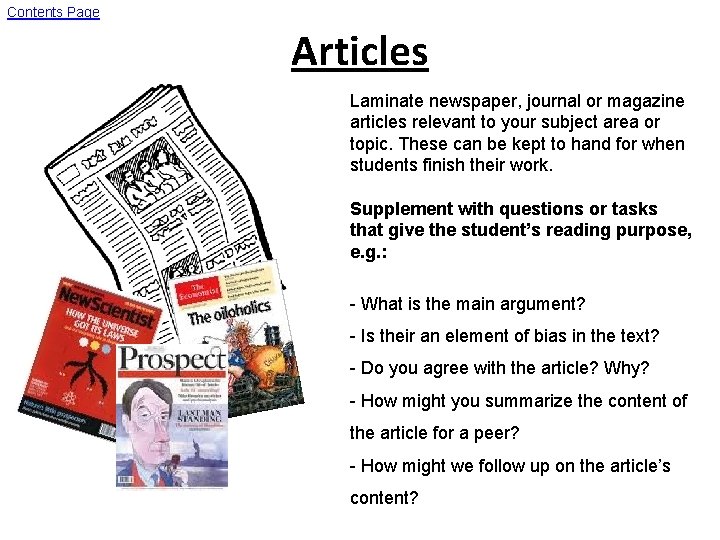
Contents Page Articles Laminate newspaper, journal or magazine articles relevant to your subject area or topic. These can be kept to hand for when students finish their work. Supplement with questions or tasks that give the student’s reading purpose, e. g. : - What is the main argument? - Is their an element of bias in the text? - Do you agree with the article? Why? - How might you summarize the content of the article for a peer? - How might we follow up on the article’s content?
Contents Page Defend Your Consequence A great game to use in all manner of subjects. Students are given a consequence (or cause) for which they must develop a defence. This can be done individually or as a group activity. Example: The most important consequence of not listening to your parents is… - You save your ears from being worn out - You miss potentially life-changing information - You fail to get a complete picture of their world - They might not listen to you - If you don’t listen, how can we say that they have really said anything?
Contents Page Story Time Ask students to write a story centring on some key aspect of the lesson. Or, ask them to write a story in which the learning that has taken place is narrated out in ‘the real world’. Ensure students are challenged by giving criteria – i. e. - The story should convey a deeper meaning about the aspect of the learning. -The story should use an allegory to show the learning. - The story should be a play in which the voices cannot mention the idea of learning directly.
Contents Page In the mind of. . . Give students a figure (historical, celebrity, political etc. ) from whose point of view they must write. For example, in a lesson concerning coastal erosion a student could be challenged to write a piece about the phenomenon from the perspective of the Mayor of Scarborough. Or, in a lesson looking at the origins of human rights, students could be asked to respond from the perspective of a 15 th century monarch (depending on what periods they have studied in history!) or a dictator. Extend by asking students to hot seat in front of the class as the figure, remaining in character whilst they are questioned.
Contents Page Interpretation is a hard skill to develop in any area of life. It requires knowledge of the subject, whatever that may be, a critical, analytical approach to evidence, the ability to question oneself and one’s own motives and much more besides. All the better to challenge students with then! Give a piece of text which is difficult or ambiguous and ask students to interpret it as best they can. Or, give students evidence along with a set of questions that are not directly answered in the material. This means students must interpret and infer from what they have. Extend by pushing students to justify their interpretations and contrast them with alternatives.
Contents Page Looking for Bias is everywhere, the nature of human experience is that it is partial. Ask students to engage with this idea by analysing texts or information related to the lesson to look for bias. Extend by: -Asking for a set of criteria for spotting bias. -Questioning whether bias is ever legitimate. -Challenging students to compare different accounts of the same event or idea and synthesise them into a balanced piece of work.