
Contents of this class class History of protein
- Slides: 59
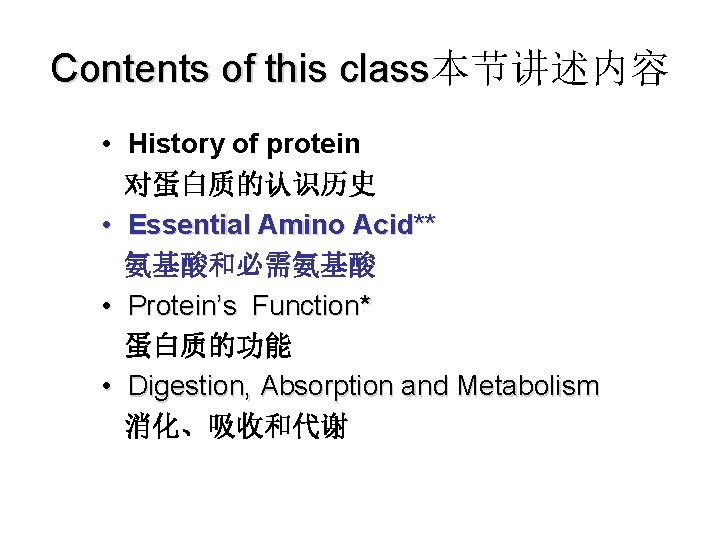
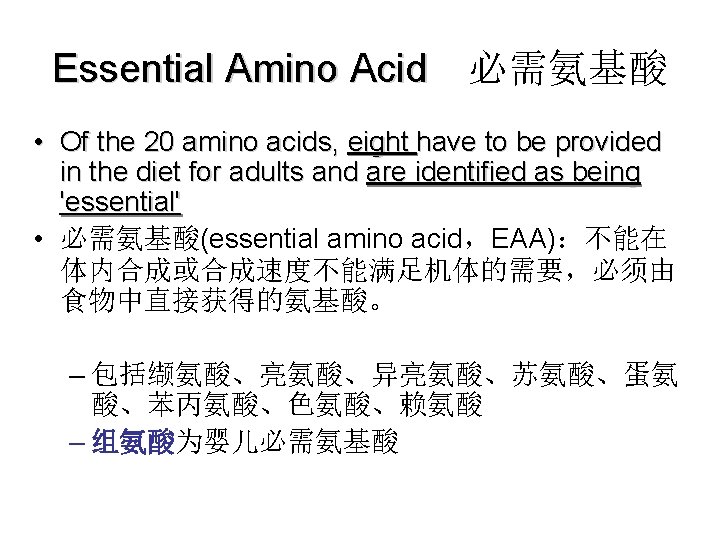
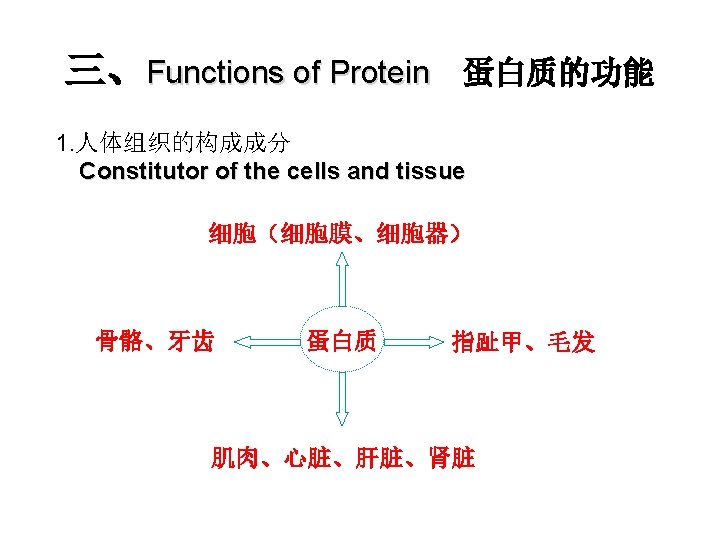
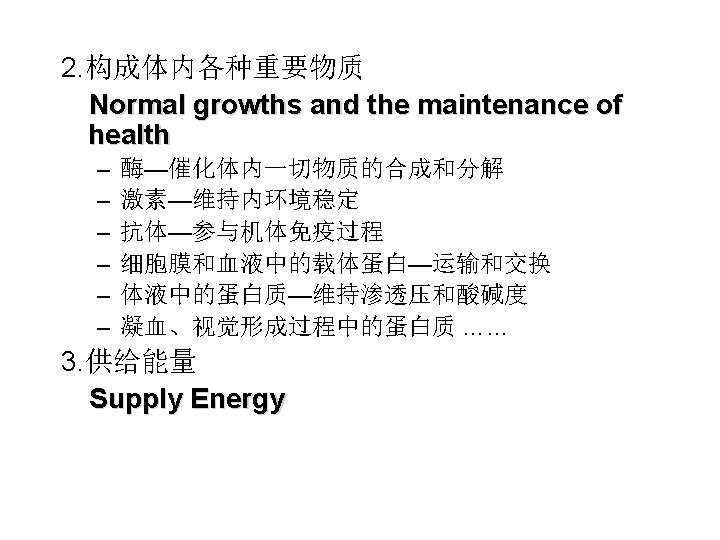
Contents of this class本节讲述内容 class • History of protein 对蛋白质的认识历史 • Essential Amino Acid** 氨基酸和必需氨基酸 • Protein’s Function* 蛋白质的功能 • Digestion, Absorption and Metabolism 消化、吸收和代谢
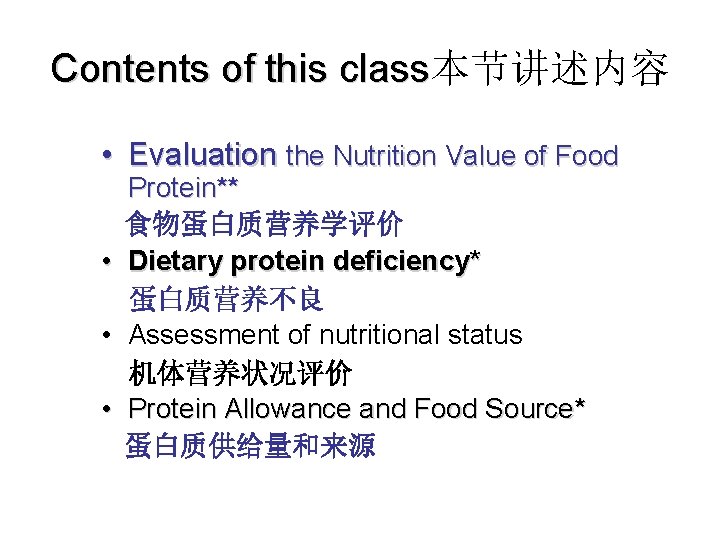
Contents of this class本节讲述内容 class • Evaluation the Nutrition Value of Food Protein** 食物蛋白质营养学评价 • Dietary protein deficiency* 蛋白质营养不良 • Assessment of nutritional status 机体营养状况评价 • Protein Allowance and Food Source* 蛋白质供给量和来源
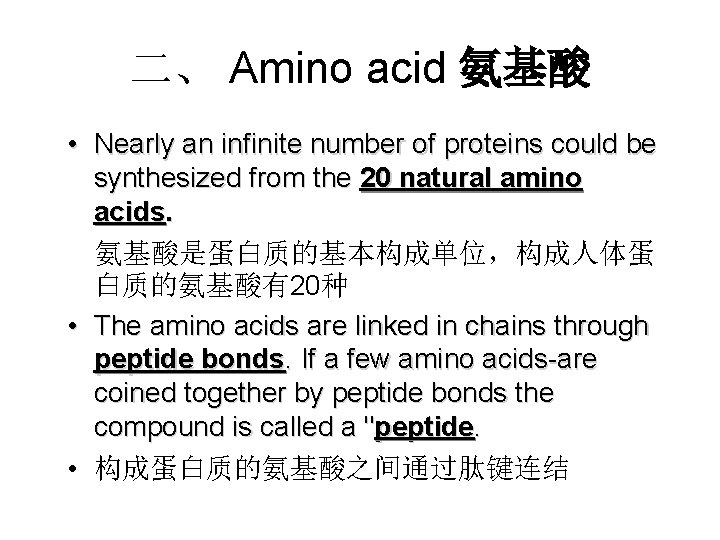
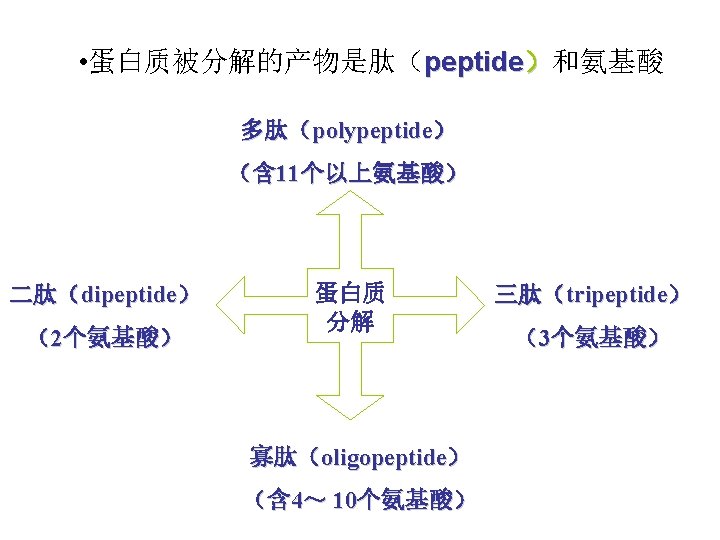
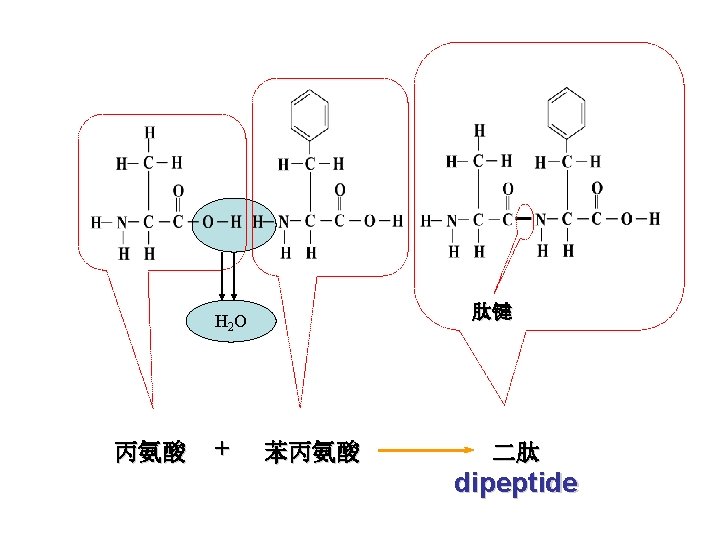
二、 Amino acid 氨基酸 • Nearly an infinite number of proteins could be synthesized from the 20 natural amino acids. 氨基酸是蛋白质的基本构成单位,构成人体蛋 白质的氨基酸有20种 • The amino acids are linked in chains through peptide bonds. If a few amino acids-are coined together by peptide bonds the compound is called a "peptide. • 构成蛋白质的氨基酸之间通过肽键连结
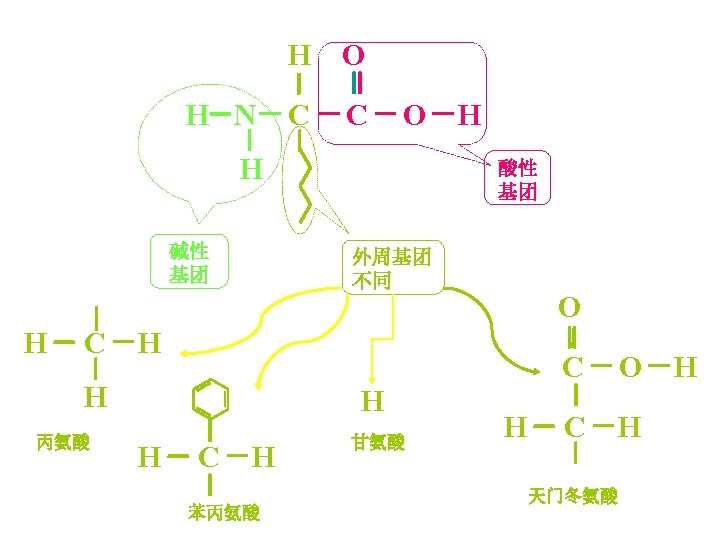
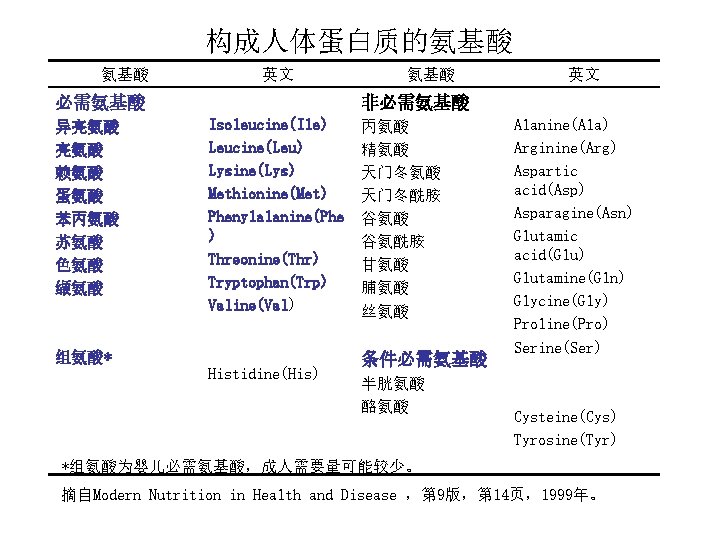
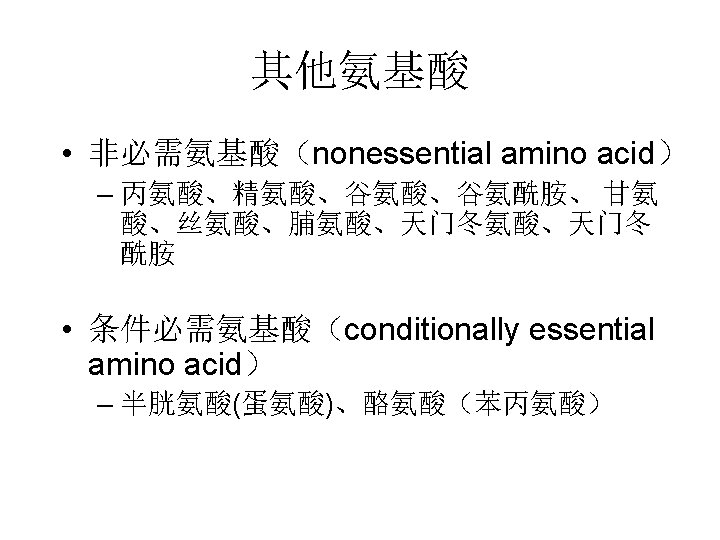
构成人体蛋白质的氨基酸 英文 必需氨基酸 异亮氨酸 赖氨酸 蛋氨酸 苯丙氨酸 苏氨酸 色氨酸 缬氨酸 氨基酸 英文 非必需氨基酸 Isoleucine(Ile) Leucine(Leu) Lysine(Lys) Methionine(Met) Phenylalanine(Phe ) Threonine(Thr) Tryptophan(Trp) Valine(Val) 组氨酸* Histidine(His) 丙氨酸 精氨酸 天门冬酰胺 谷氨酸 谷氨酰胺 甘氨酸 脯氨酸 丝氨酸 条件必需氨基酸 半胱氨酸 酪氨酸 Alanine(Ala) Arginine(Arg) Aspartic acid(Asp) Asparagine(Asn) Glutamic acid(Glu) Glutamine(Gln) Glycine(Gly) Proline(Pro) Serine(Ser) Cysteine(Cys) Tyrosine(Tyr) *组氨酸为婴儿必需氨基酸,成人需要量可能较少。 摘自Modern Nutrition in Health and Disease ,第 9版,第 14页,1999年。
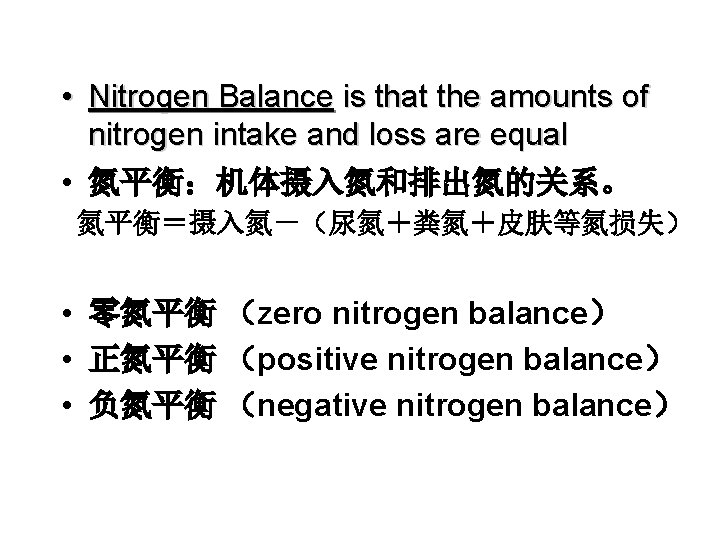
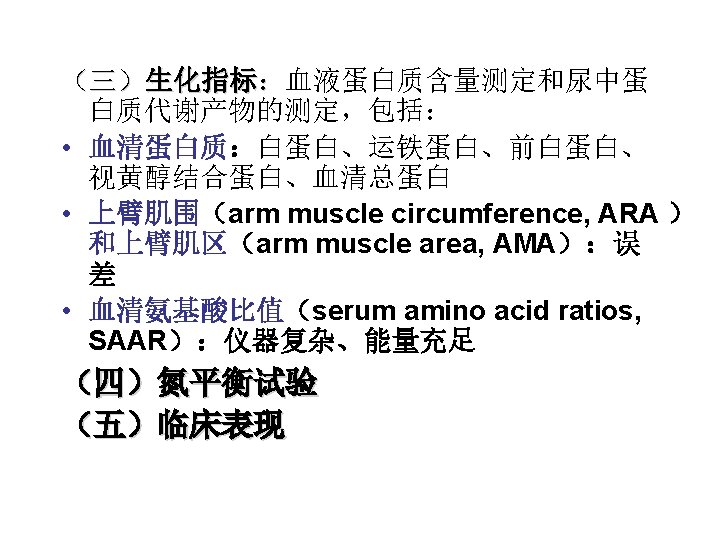
• Nitrogen Balance is that the amounts of nitrogen intake and loss are equal • 氮平衡:机体摄入氮和排出氮的关系。 氮平衡=摄入氮-(尿氮+粪氮+皮肤等氮损失) • 零氮平衡 (zero nitrogen balance) • 正氮平衡 (positive nitrogen balance) • 负氮平衡 (negative nitrogen balance)
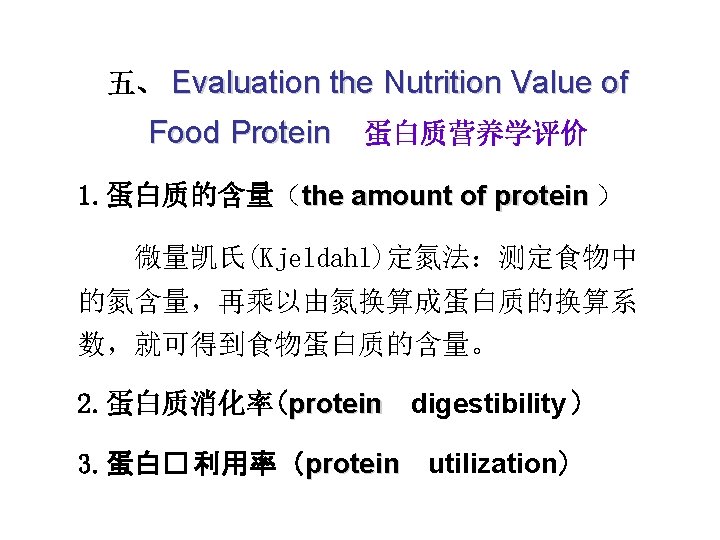
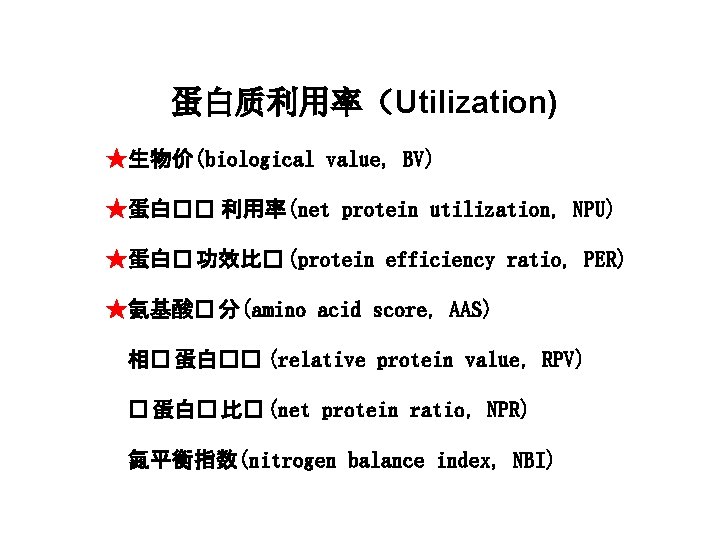
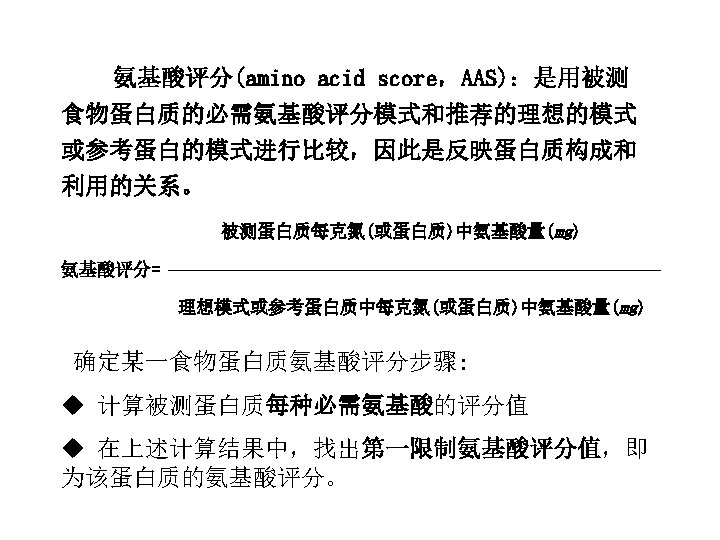
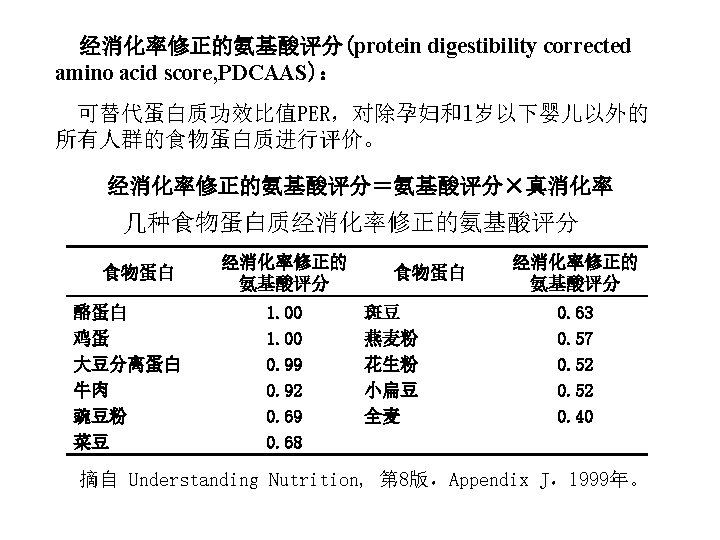
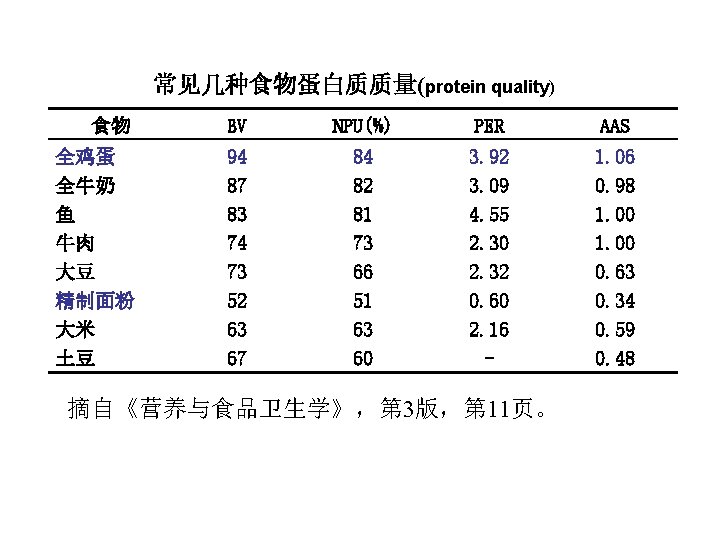
蛋白质利用率(Utilization) ★生物价(biological value,BV) ★蛋白�� 利用率(net protein utilization,NPU) ★蛋白� 功效比� (protein efficiency ratio,PER) ★氨基酸� 分(amino acid score,AAS) 相� 蛋白�� (relative protein value,RPV) � 蛋白� 比� (net protein ratio,NPR) 氮平衡指数(nitrogen balance index,NBI)
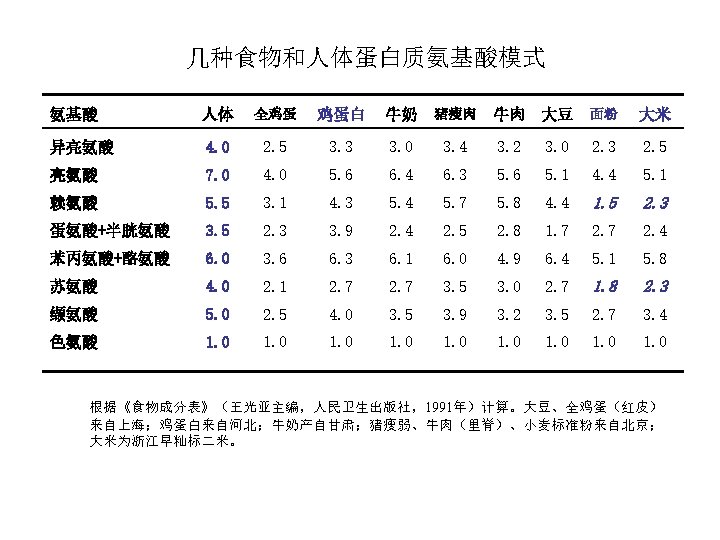
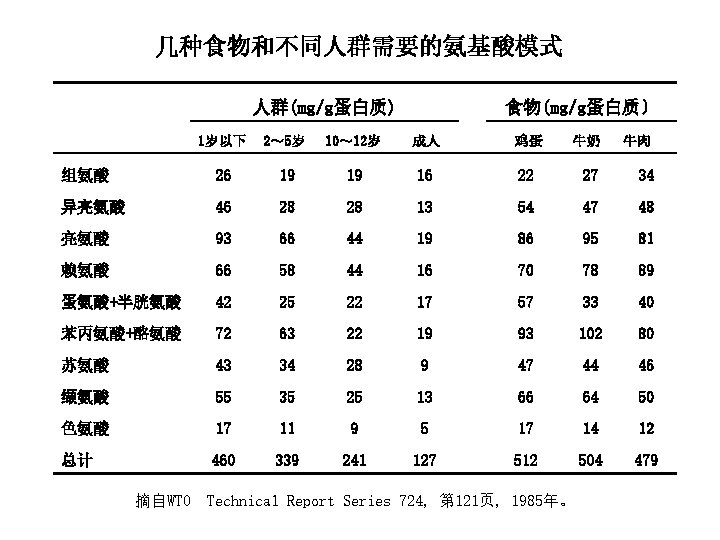
几种食物和不同人群需要的氨基酸模式 人群(mg/g蛋白质) 食物(mg/g蛋白质〕 1岁以下 2~ 5岁 10~ 12岁 成人 鸡蛋 牛奶 牛肉 组氨酸 26 19 19 16 22 27 34 异亮氨酸 46 28 28 13 54 47 48 亮氨酸 93 66 44 19 86 95 81 赖氨酸 66 58 44 16 70 78 89 蛋氨酸+半胱氨酸 42 25 22 17 57 33 40 苯丙氨酸+酪氨酸 72 63 22 19 93 102 80 苏氨酸 43 34 28 9 47 44 46 缬氨酸 55 35 25 13 66 64 50 色氨酸 17 11 9 5 17 14 12 总计 460 339 241 127 512 504 479 摘自WTO Technical Report Series 724, 第 121页, 1985年。
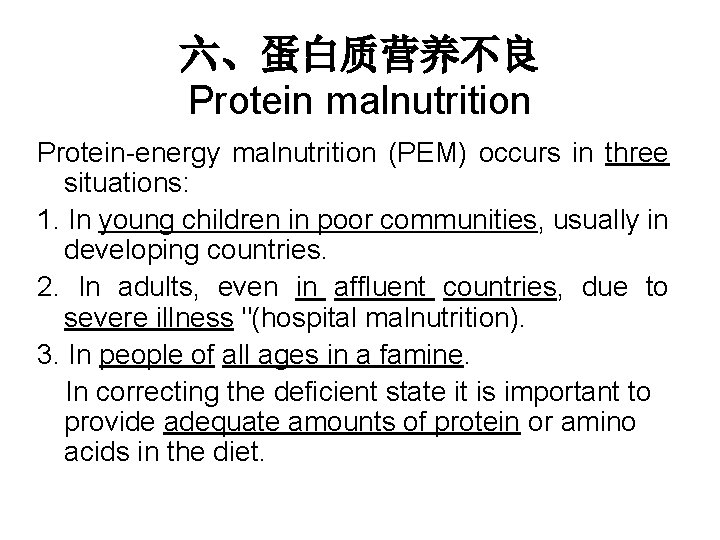
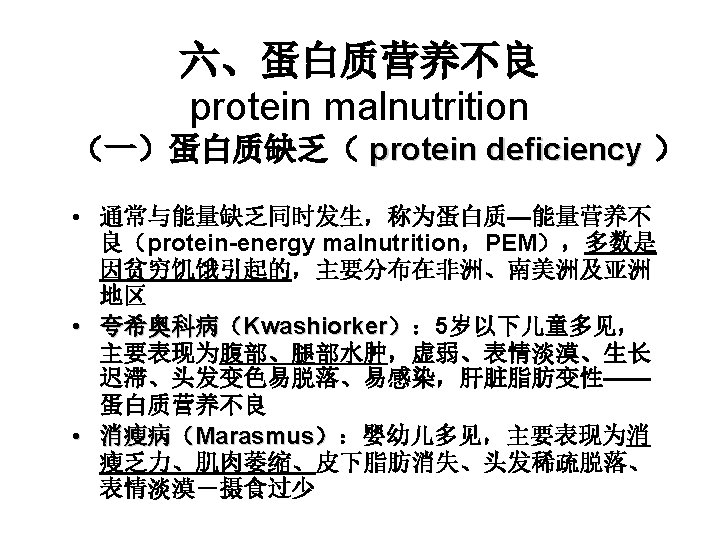
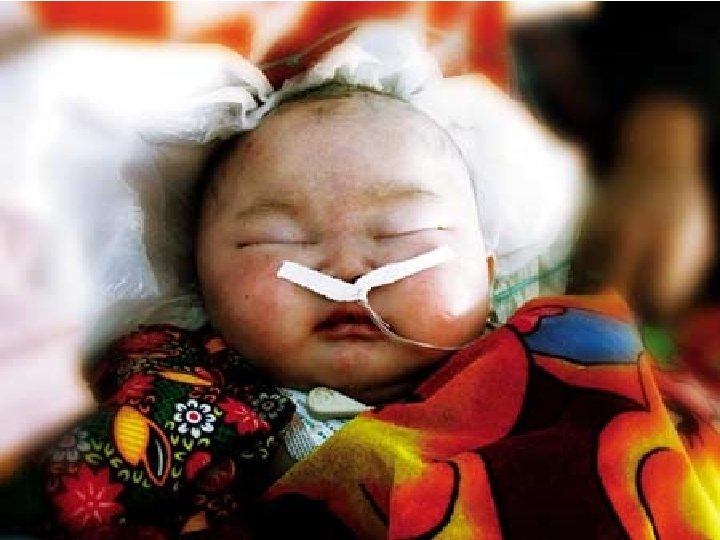
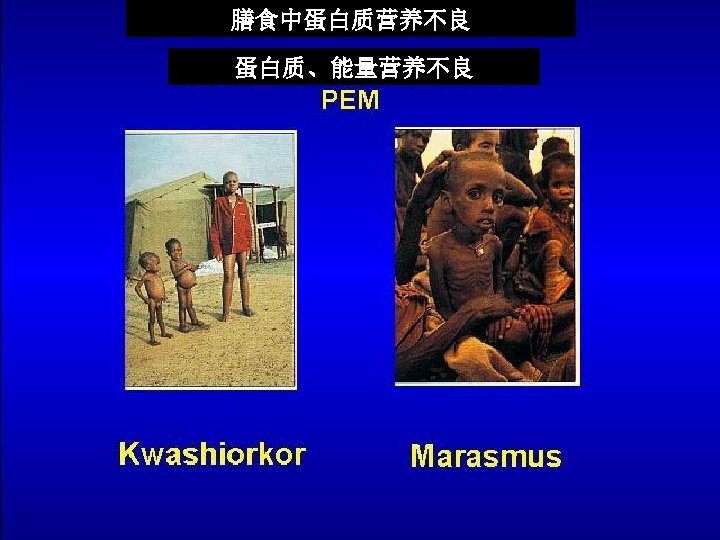
六、蛋白质营养不良 Protein malnutrition Protein-energy malnutrition (PEM) occurs in three situations: 1. In young children in poor communities, usually in developing countries. 2. In adults, even in affluent countries, due to severe illness "(hospital malnutrition). 3. In people of all ages in a famine. In correcting the deficient state it is important to provide adequate amounts of protein or amino acids in the diet.
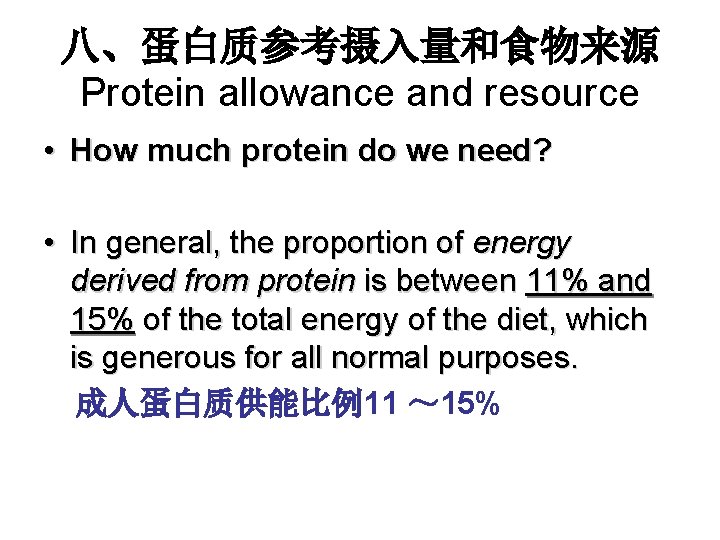
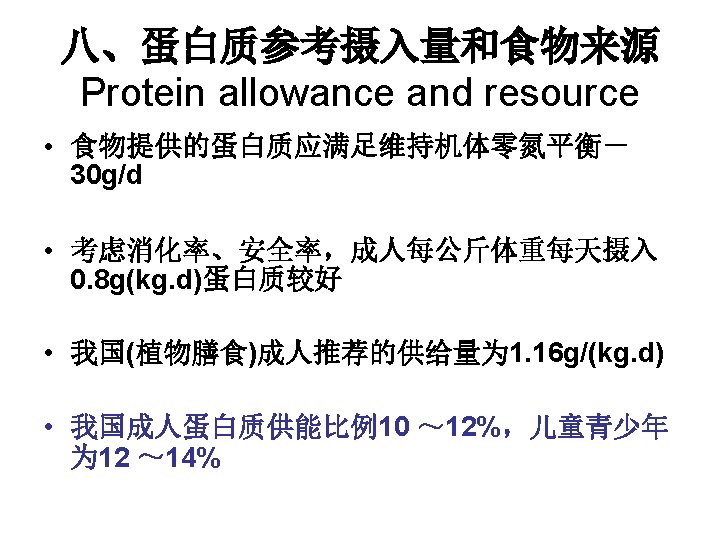
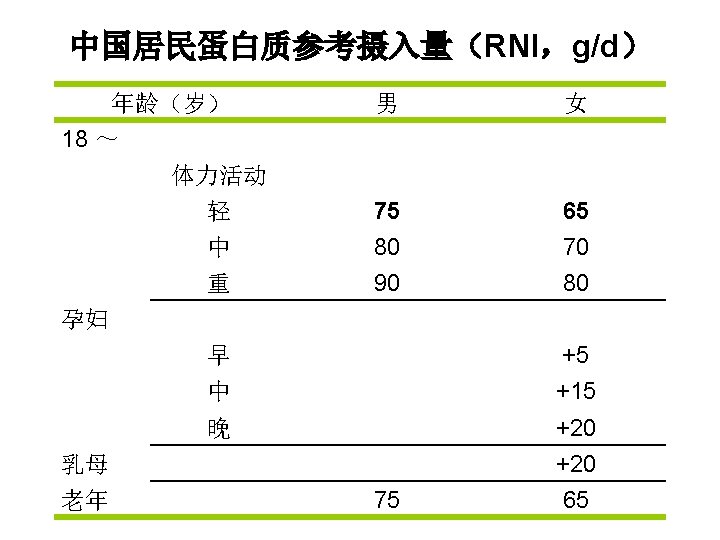
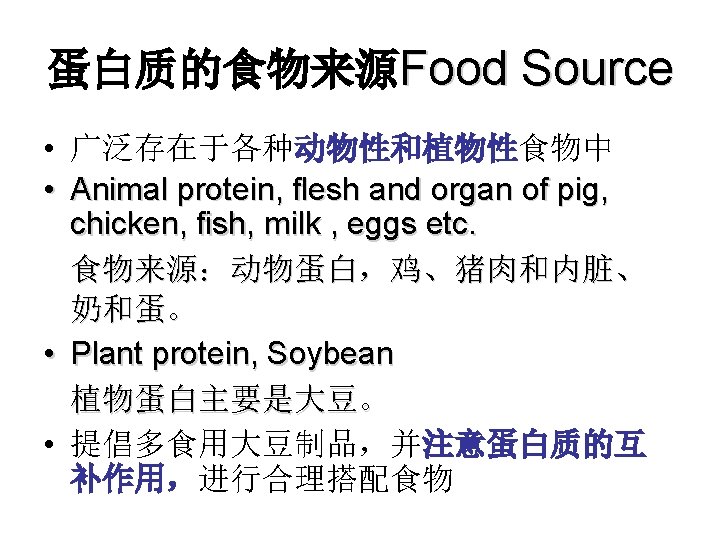
八、蛋白质参考摄入量和食物来源 Protein allowance and resource • How much protein do we need? • In general, the proportion of energy derived from protein is between 11% and 15% of the total energy of the diet, which is generous for all normal purposes. 成人蛋白质供能比例11 ~ 15%
Summary essential AA** 必需氨基酸 evaluation the Nutrition Value of Protein ** 食物蛋白质的营养学评价 protein deficiency * 蛋白质缺乏症 protein Allowance and Food Source* 蛋白质的供给量及食物来源