
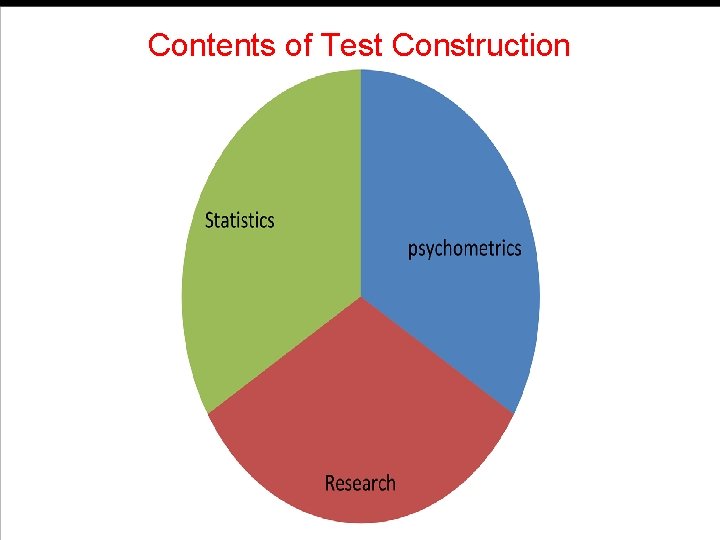
Contents of Test Construction What is test construction
















- Slides: 68
Contents of Test Construction
What is test construction? l. Test construction is about the validity and reliability of assessment and evaluation (i. e. testing, interviewing, research, employment, graduate admission, or by other means of selection process).
An Introduction to Classical and Modern Test Theory Highlights of History of Testing and Assessment
4 min video l https: //www. youtube. com/watch? v=pmg 2 NEL 7390
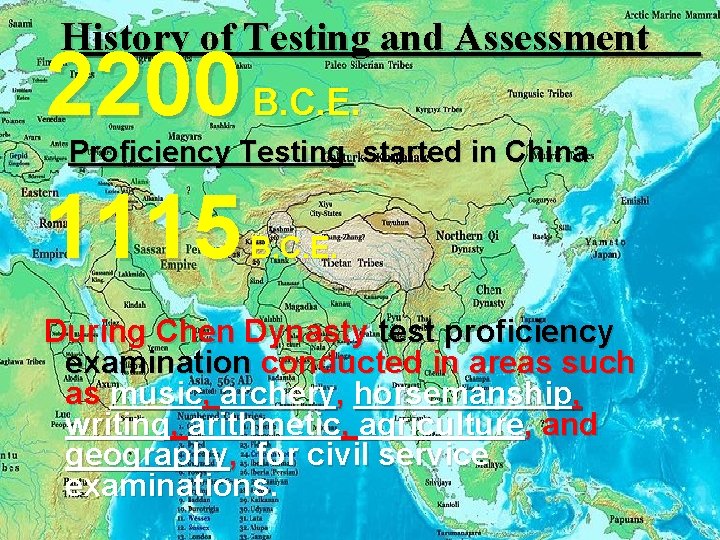
History of Testing and Assessment 2200 B. C. E. Proficiency Testing started in China 1115 B. C. E. During Chen Dynasty test proficiency examination conducted in areas such as music, archery, horsemanship, writing, arithmetic, agriculture, and geography, for civil service examinations.
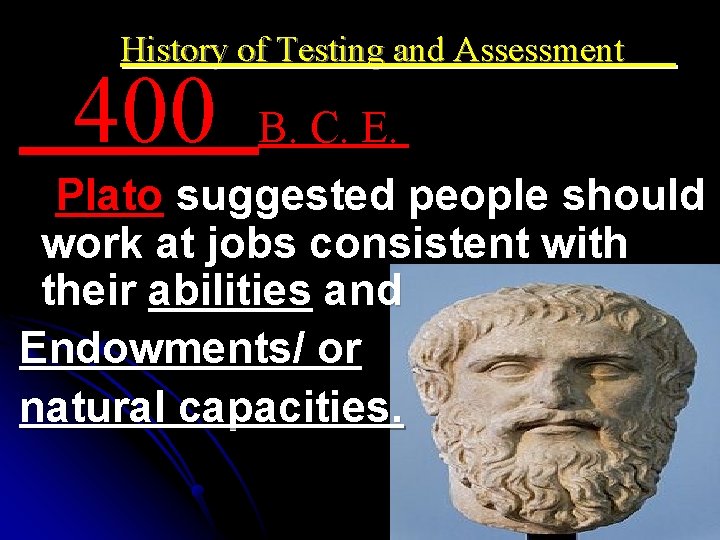
History of Testing and Assessment 400 B. C. E. Plato suggested people should work at jobs consistent with their abilities and Endowments/ or natural capacities.
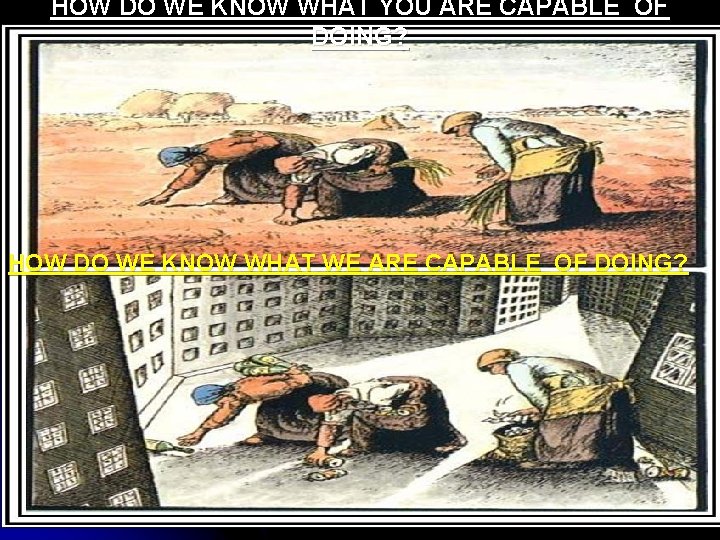
HOW DO WE KNOW WHAT YOU ARE CAPABLE OF DOING? HOW DO WE KNOW WHAT WE ARE CAPABLE OF DOING?
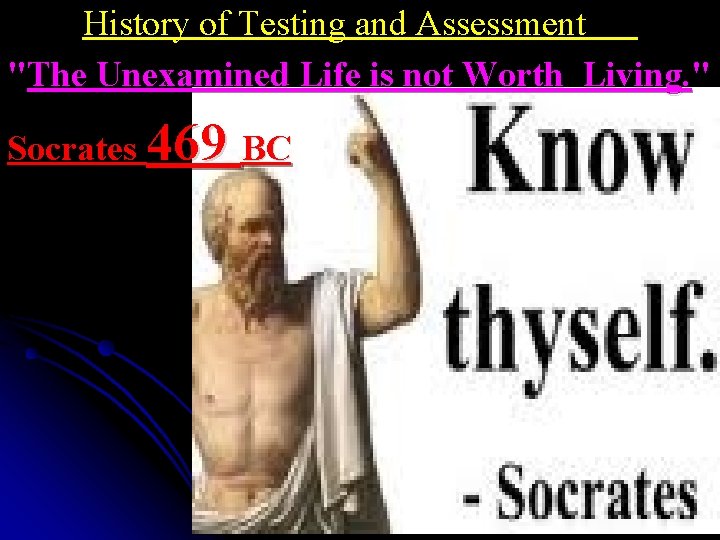
History of Testing and Assessment "The Unexamined Life is not Worth Living. " Socrates 469 BC
History of Testing and Assessment 200 Dark Ages begin Science takes a backseat to faith and superstition.
History of Testing and Assessment 1600 After 1400 years in dark ages we slowly moved from a religion dominated view of the world to a philosophical and scientific view.
History of Testing and Assessment *1800/ Ninteen century Modern-day testing begins
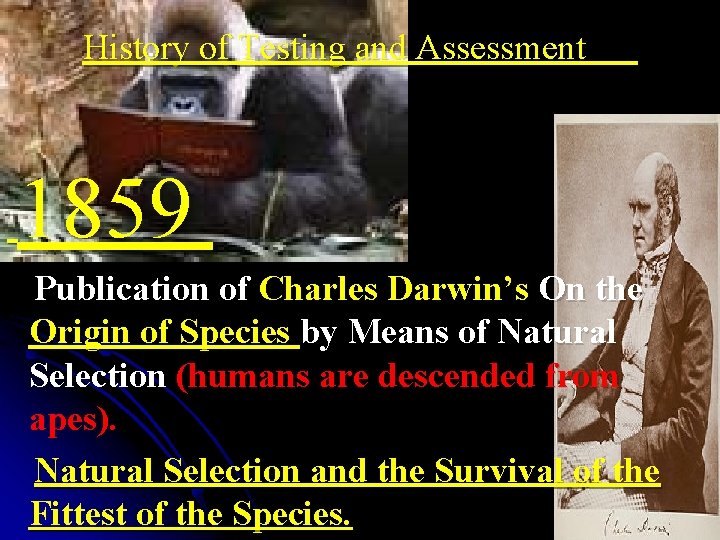
History of Testing and Assessment 1859 Publication of Charles Darwin’s On the Origin of Species by Means of Natural Selection (humans are descended from apes). Natural Selection and the Survival of the Fittest of the Species.
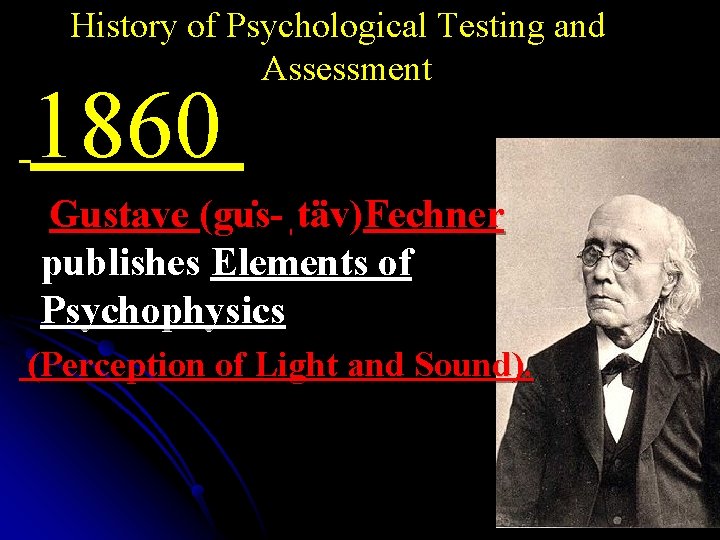
History of Psychological Testing and Assessment 1860 Gustave (gu s-ˌtäv)Fechner publishes Elements of Psychophysics (Perception of Light and Sound).
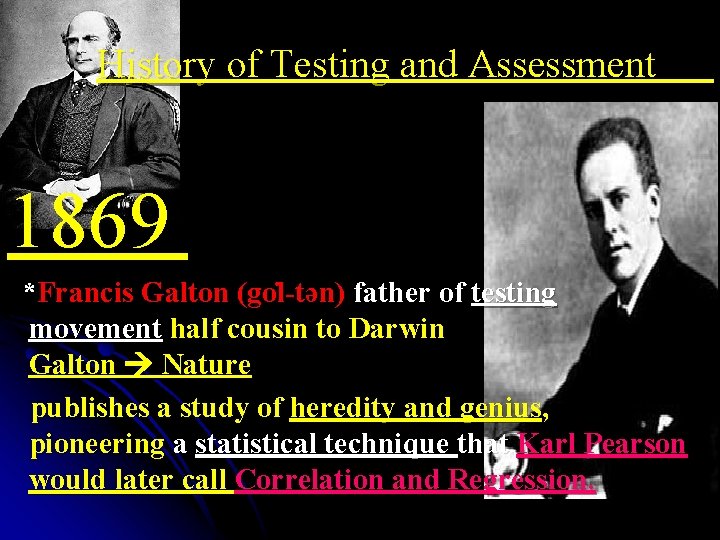
History of Testing and Assessment 1869 *Francis Galton (go l-tən) father of testing movement half cousin to Darwin Galton Nature publishes a study of heredity and genius, pioneering a statistical technique that Karl Pearson would later call Correlation and Regression.
*NATURE VS NURTURE The phrase "Nature versus nurture" was coined by Francis Galton in discussion of the influence of heredity or genes and environment on social advancement. The nature versus nurture concerns the relative importance of an individual's genetic qualities "nature, ” versus environment “nurture, " in determining or causing individual differences in physical and behavioral traits.
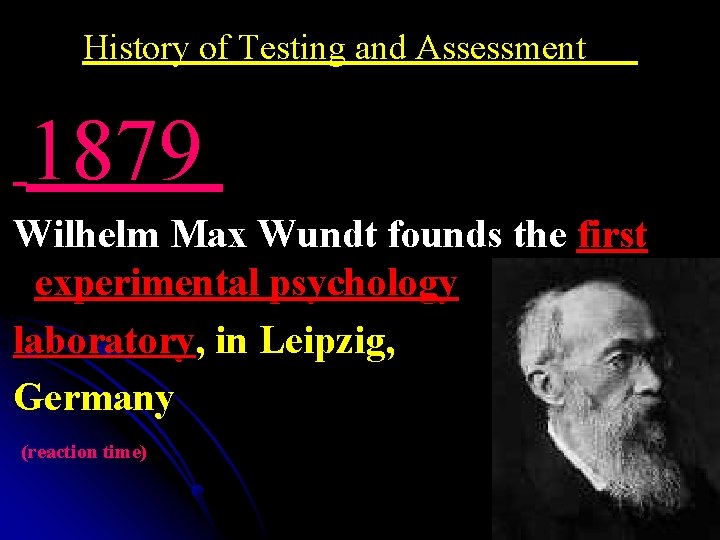
History of Testing and Assessment 1879 Wilhelm Max Wundt founds the first experimental psychology laboratory, in Leipzig, Germany (reaction time)
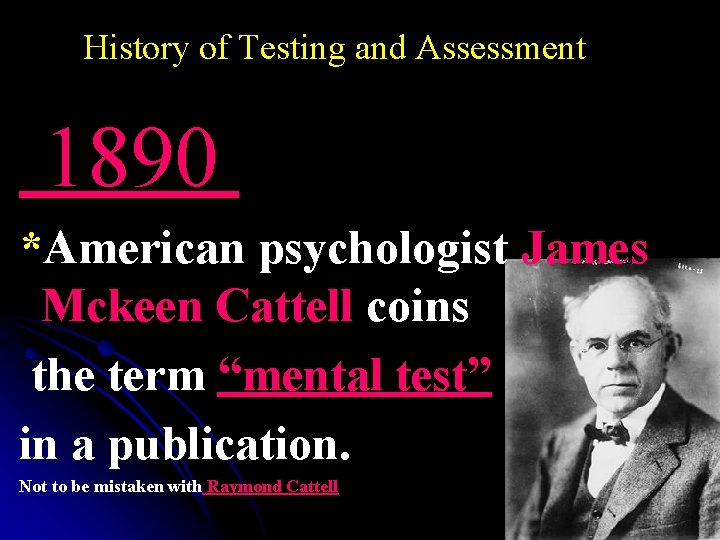
History of Testing and Assessment 1890 *American psychologist James Mckeen Cattell coins the term “mental test” in a publication. Not to be mistaken with Raymond Cattell
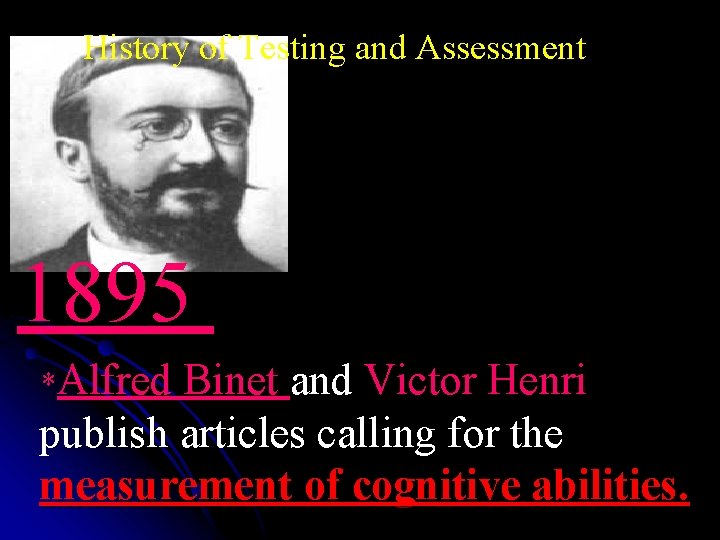
History of Testing and Assessment 1895 *Alfred Binet and Victor Henri publish articles calling for the measurement of cognitive abilities.
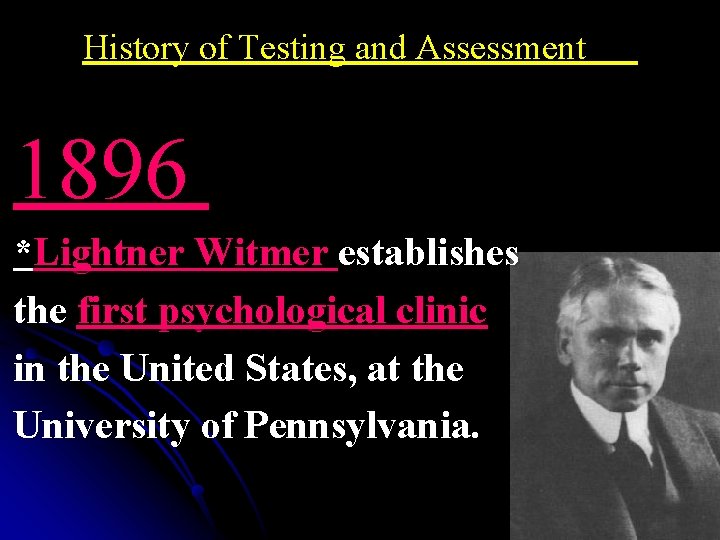
History of Testing and Assessment 1896 *Lightner Witmer establishes the first psychological clinic in the United States, at the University of Pennsylvania.
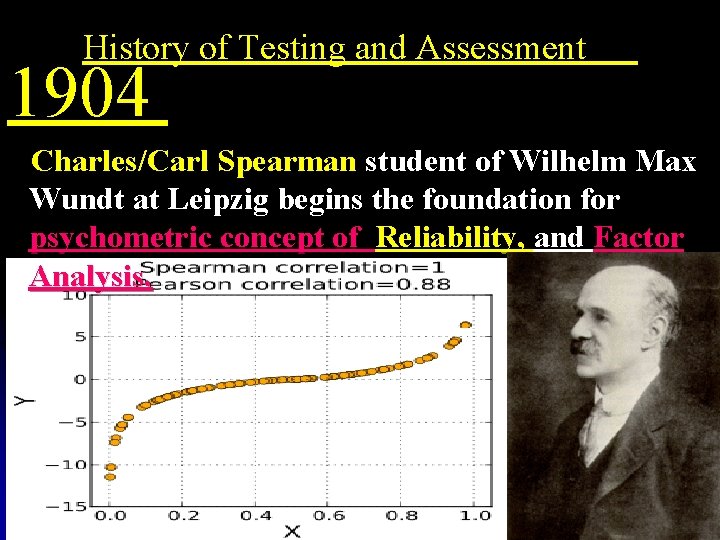
History of Testing and Assessment 1904 Charles/Carl Spearman student of Wilhelm Max Wundt at Leipzig begins the foundation for psychometric concept of Reliability, and Factor Analysis.
History of Testing and Assessment 1905 *Alfered Binet and Theodore Simon published a 30 -item “Measuring Scale of Intelligence. ” Binet-Simon Intelligence Scale launches a new era in measurement.
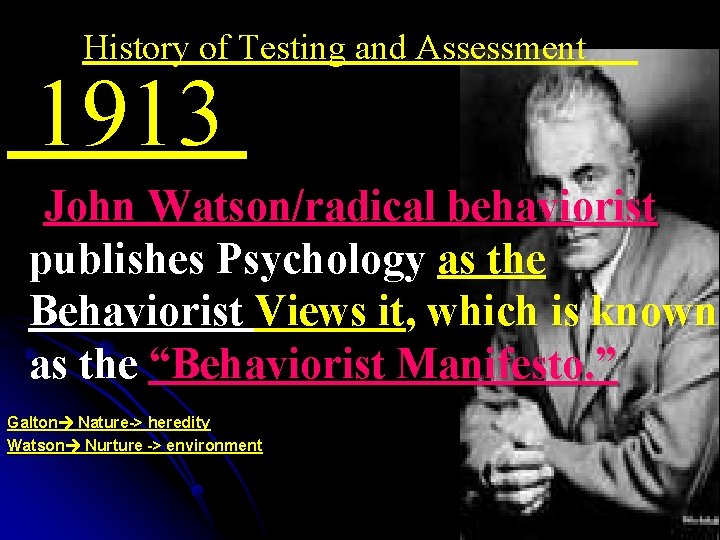
History of Testing and Assessment 1913 John Watson/radical behaviorist publishes Psychology as the Behaviorist Views it, which is known as the “Behaviorist Manifesto. ” Galton Nature-> heredity Watson Nurture -> environment
"Twelve infants" quotation l “Give me a dozen healthy infants, wellformed, and my own specified world to bring them up in and I'll guarantee to take any one at random and train him to become any type of specialist. I might select – doctor, lawyer, artist, merchant-chief and, yes, even beggar-man and thief, regardless of his talents, abilities, vocations, and race of his ancestors. ” John Watson
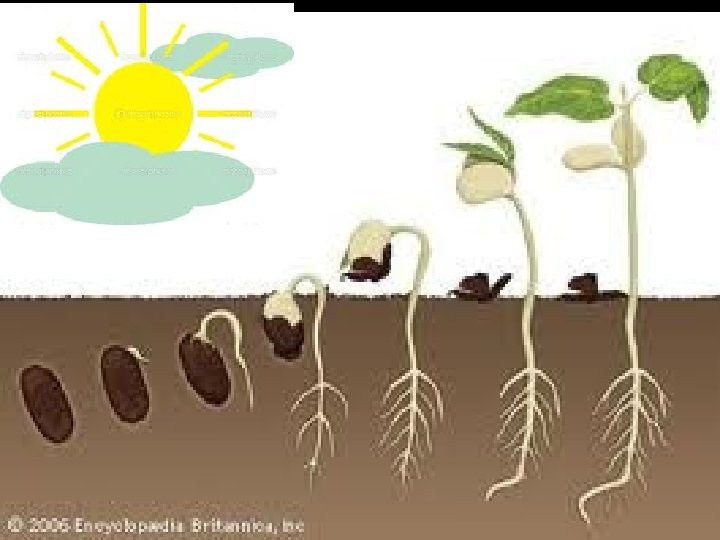
GOOD GENES IN A GOOD ENVIRONMENT, CHANCES OF GROWTH: MAXIMUM
GOOD GENES IN A BAD ENVIRONMENT, CHANCES OF GROWTH: STOPS AT A
BAD/defected GENES IN A GOOD ENVIRONMENT, CHANCES OF GROWTH:
BAD/defected GENES IN A BAD ENVIRONMENT, CHANCES OF GROWTH: WILL NEVER MAKE IT.
We have legs
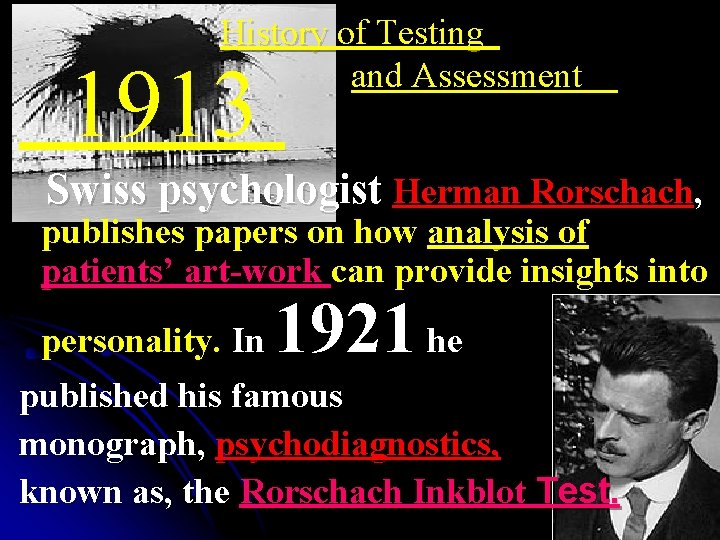
History of Testing and Assessment 1913 Swiss psychologist Herman Rorschach, publishes papers on how analysis of patients’ art-work can provide insights into 1921 personality. In he published his famous monograph, psychodiagnostics, known as, the Rorschach Inkblot Test.
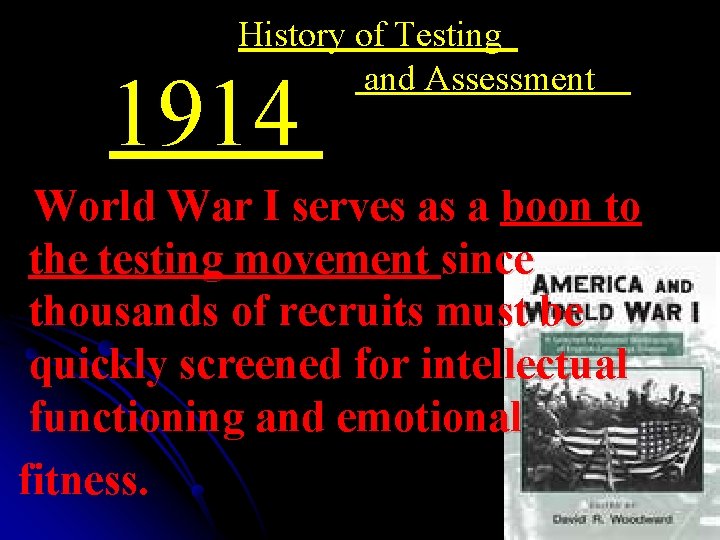
History of Testing and Assessment 1914 World War I serves as a boon to the testing movement since thousands of recruits must be quickly screened for intellectual functioning and emotional fitness.
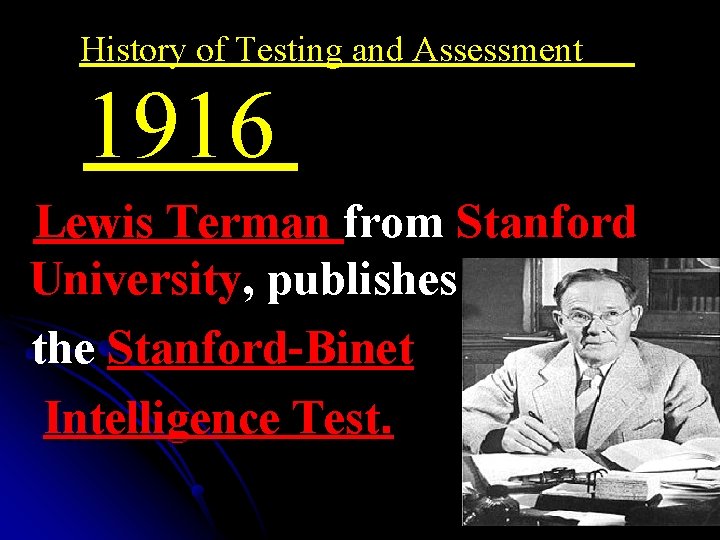
History of Testing and Assessment 1916 Lewis Terman from Stanford University, publishes the Stanford-Binet Intelligence Test.
l 1926 History of Testing and Assessment The development of Scholastic Aptitude Test (SAT) started and administered for the first time.
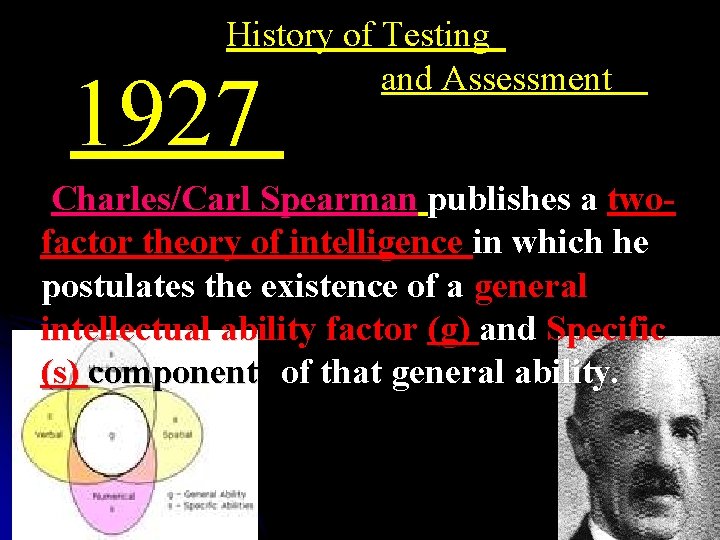
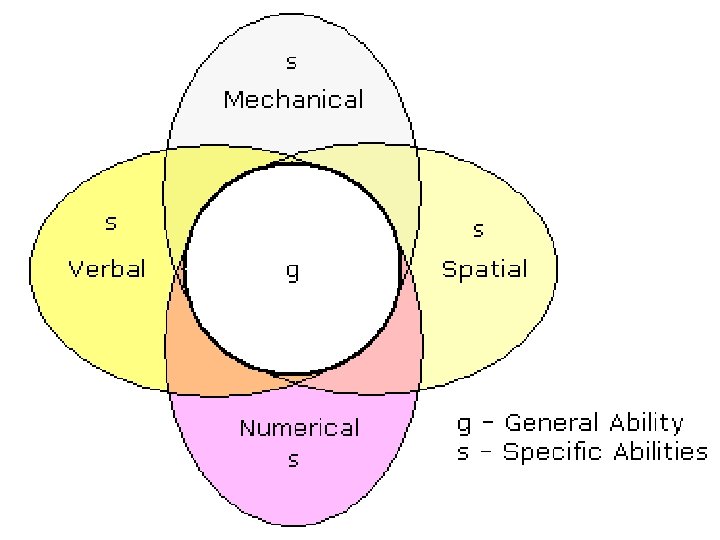
History of Testing and Assessment 1927 Charles/Carl Spearman publishes a twofactor theory of intelligence in which he postulates the existence of a general intellectual ability factor (g) and Specific (s) components of that general ability.
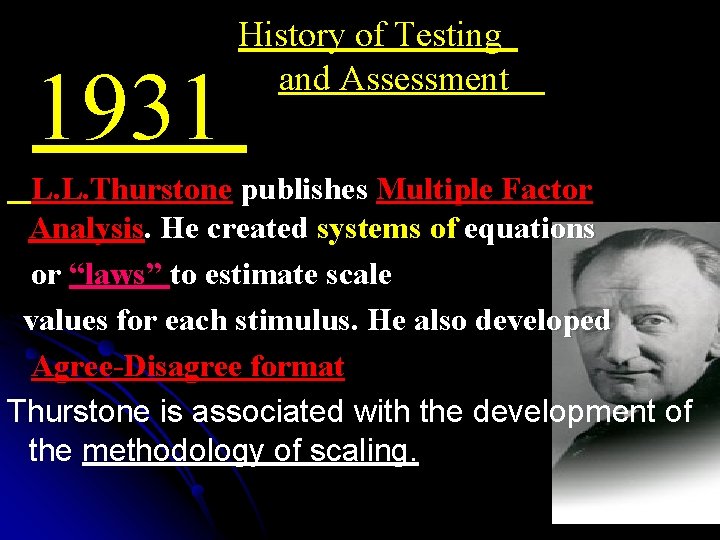
1931 History of Testing and Assessment L. L. Thurstone publishes Multiple Factor Analysis. He created systems of equations or “laws” to estimate scale values for each stimulus. He also developed Agree-Disagree format Thurstone is associated with the development of the methodology of scaling.
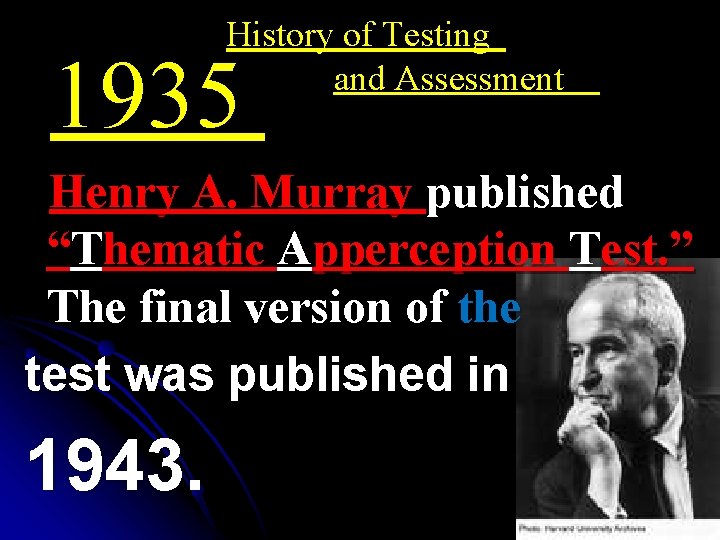
History of Testing and Assessment 1935 Henry A. Murray published “Thematic Apperception Test. ” The final version of the test was published in 1943.
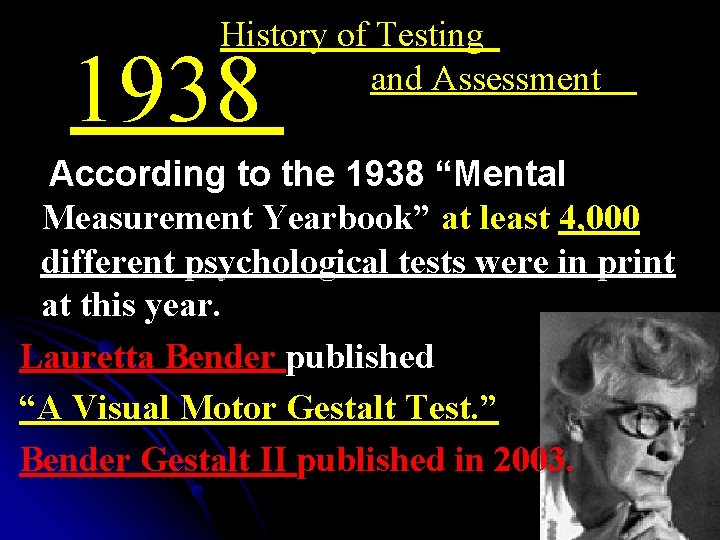
History of Testing and Assessment 1938 According to the 1938 “Mental Measurement Yearbook” at least 4, 000 different psychological tests were in print at this year. Lauretta Bender published “A Visual Motor Gestalt Test. ” Bender Gestalt II published in 2003.
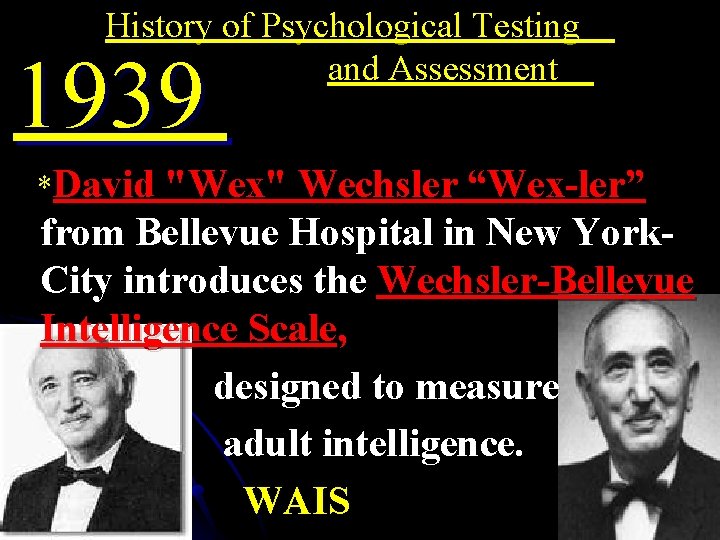
History of Psychological Testing and Assessment 1939 *David "Wex" Wechsler “Wex-ler” from Bellevue Hospital in New York. City introduces the Wechsler-Bellevue Intelligence Scale, designed to measure adult intelligence. WAIS
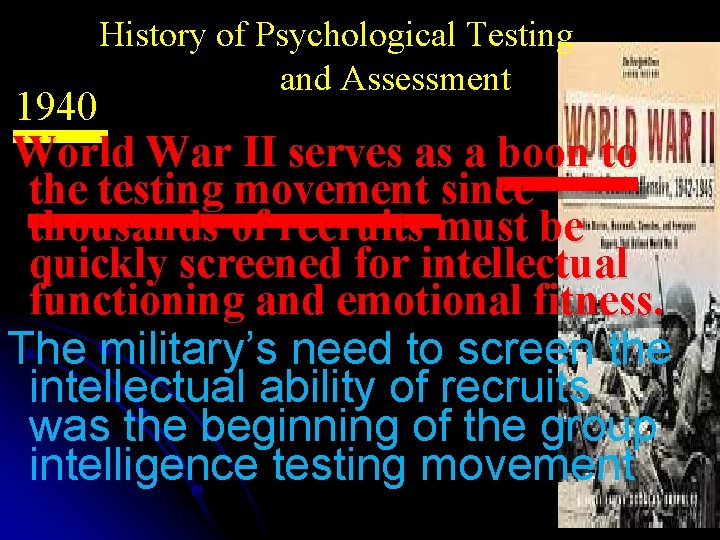
History of Psychological Testing and Assessment 1940 World War II serves as a boon to the testing movement since thousands of recruits must be quickly screened for intellectual functioning and emotional fitness. The military’s need to screen the intellectual ability of recruits was the beginning of the group intelligence testing movement
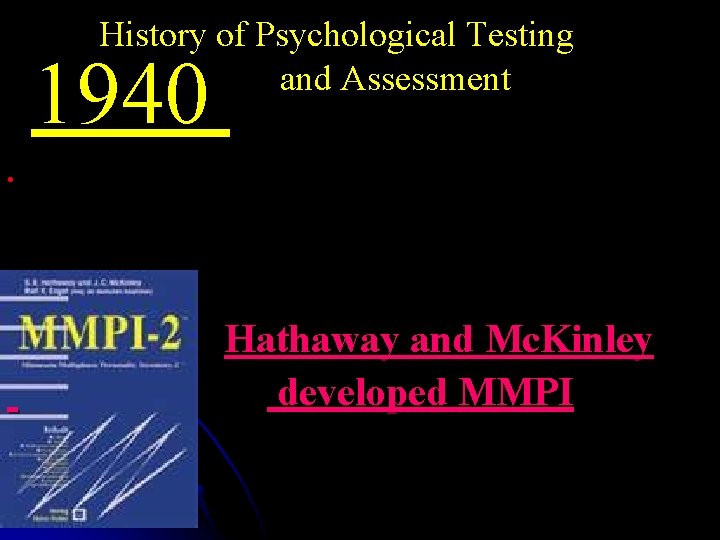
History of Psychological Testing and Assessment 1940. Hathaway and Mc. Kinley developed MMPI
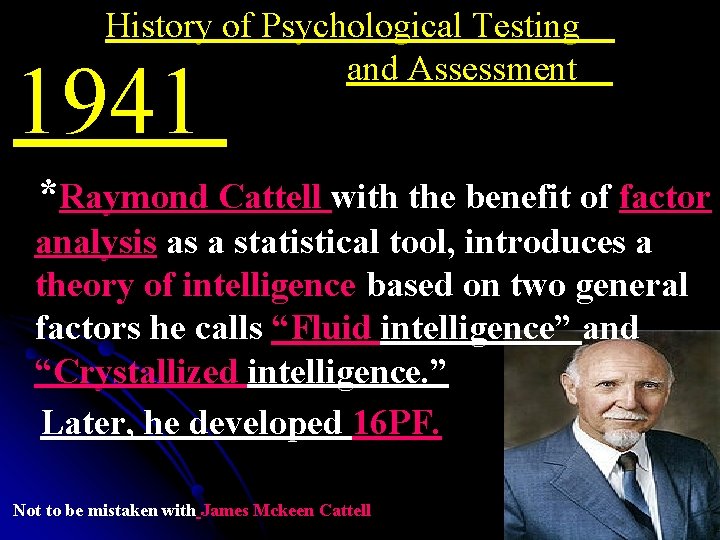
History of Psychological Testing and Assessment 1941 *Raymond Cattell with the benefit of factor analysis as a statistical tool, introduces a theory of intelligence based on two general factors he calls “Fluid intelligence” and “Crystallized intelligence. ” Later, he developed 16 PF. Not to be mistaken with James Mckeen Cattell
History of Psychological Testing and Assessment 1941 Fluid intelligence” involves being able to think, reason, and solve problems (short term memory/working memory). Crystallized intelligence involves knowledge that comes from prior learning and past experiences (long term memory).
History of Psychological Testing and Assessment 1951 Test expert Lee Cronbach introduces “Coefficient Alpha” to measure test reliability. This formula which was the modification of KR-20 calculates the mean of all possible split-half test correlations (reliabilities). Later, it was corrected by Spearman-Brown Prophesy Formula.
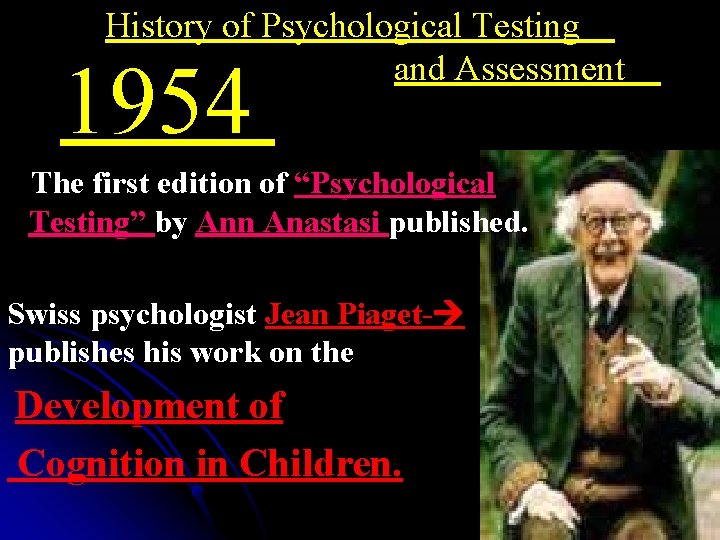
History of Psychological Testing and Assessment 1954 The first edition of “Psychological Testing” by Ann Anastasi published. Swiss psychologist Jean Piaget- publishes his work on the Development of Cognition in Children.
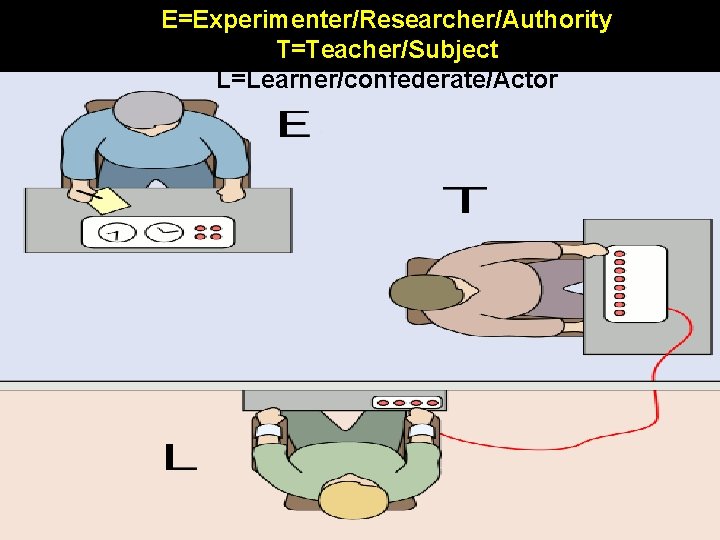
History of Psychological Testing and Assessment 1963 Stanly Milgram publishes “Behavioral Study of Obedience. ” The experimental procedures and measurement methods of his work aroused many questioning on ethical grounds, and eventually lead to the establishment of APA Ethics Committees to oversee measurement procedures.
E=Experimenter/Researcher/Authority T=Teacher/Subject L=Learner/confederate/Actor
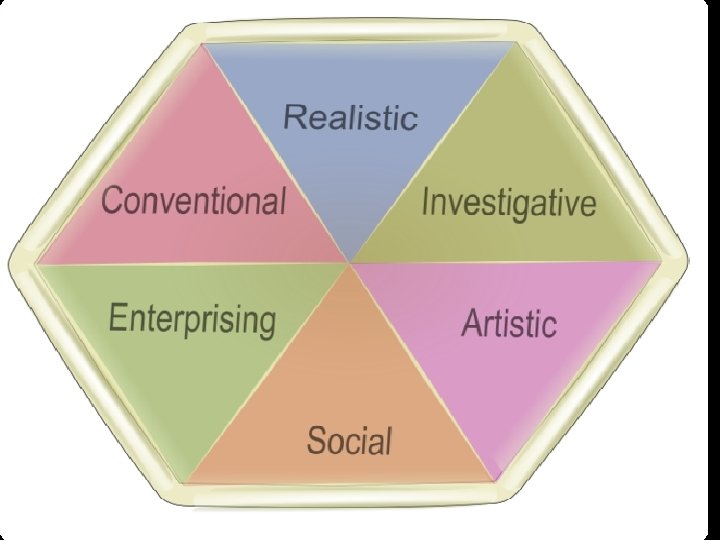
History of Psychological Testing and Assessment 1975 John Holland proposes a classification system consisting of six personality types based on corresponding interest patterns called “ Vocational Preference Inventory. ”
History of Psychological Testing and Assessment 1993 The APA publishes “Guidelines for Providers of Psychological Services to Ethnic Linguistic, and Culturally Diverse Populations. ”
*Key Terms l. Body of Ethics: The body of principles of “right, ” “proper, ” or “good” conduct is referred to as a body of Ethics.
*Americans with Disabilities Act of 1990 (ADA) l. ADA require having an interpreter available to provide job training or job selection testing? i. e. , deaf and mute (government officials are required to have sign language interpreter).
*CASE of Diana v. State Board of Education (1970) l. It ruled that all IQ tests used for placement in special education classes for the mentally disabled must be administered in the language the student is most fluent in?
*Case of Larry P. V. Riles (1979) l it ruled that IQ tests cannot be administered to African American students for the purpose of placement in special education classes?
*Case of Griggs v. Duke Power Company and Albemarle Paper Company v. Moody l. Both cases had the same issue in common. The use of tests that discriminate against minorities because they do not measure the specific skills required for the job.
*The Family Rights and Privacy Act mandates that lparents and students have an opportunity to review their school records and have a right to challenge the contents of school records.
*Rights of Test Takers la. To know why they are being tested. lb. To know the results of the test they took. lc. To know how the test data will be used.
*Privileged Communication l. The “privilege” referred to in the term privileged communication belongs to the test taker.
l. ASSIGNMENT l. Please take the quiz 1, and read the pp #1 for chapter 1 and 2 66
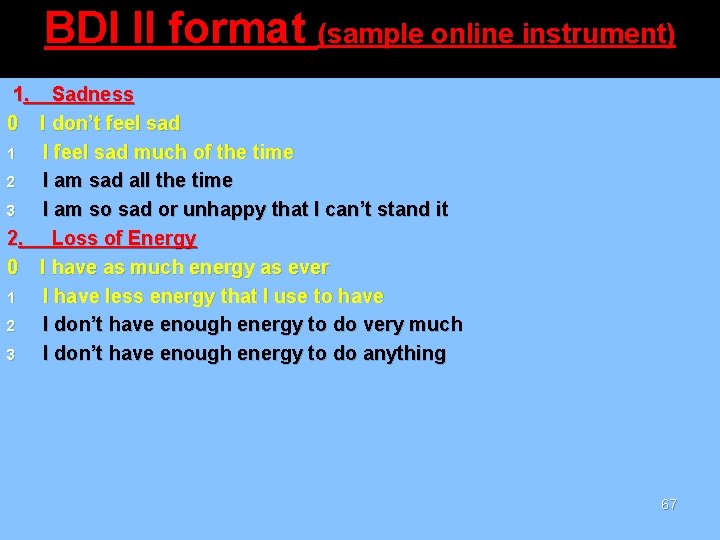
BDI II format (sample online instrument) 1. Sadness 0 I don’t feel sad 1 I feel sad much of the time 2 I am sad all the time 3 I am so sad or unhappy that I can’t stand it 2. Loss of Energy 0 I have as much energy as ever 1 I have less energy that I use to have 2 I don’t have enough energy to do very much 3 I don’t have enough energy to do anything 67
69