
Contents of Part 3 3 Application of ECSS
- Slides: 20
Contents of Part 3 3 Application of ECSS standards in Space projects a. Tailoring: – – What is tailoring The customer-supplier chain The tailoring process The EARM (ECSS applicability requirement matrix) b. Pre-tailoring: – – – Why, what it is, and status Pre-tailoring and tailoring How it works c. Requirement management tools: DOORS databases d. Feedback e. ESA training program on ECSS f. Dissemination of the information © 2015 by European Space Agency ESA Standards Division – August 2014 ESA UNCLASSIFIED – For official use Introduction into the ECSS standardization system Slide 1
COPYRIGHT NOTICE: By using the ECSS Training material, developed by ESA, you agree to the following conditions: 1. The training shall take place at your premises and shall be addressed to your staff (internal participants); 2. In case of a training to be given to external participants, the prior ESA written authorization shall be requested; 3. The ESA Copyright shall always be mentioned on all Training Material used for the purpose of the training and participants shall acknowledge the ESA ownership on such a Copyright; 4. The Training material shall not be used to generate any revenues (i. e. the training and Training Material shall be "free of charge" excl. any expenses for the training organization); 5. Only non-editable PDF files of the Training Material can be distributed to the participants (nor power point presentations); 6. Any deficiency identified in the Training Material shall be reported to the ECSS secretariat; 7. If the Training Material is modified or translated, the ESA Copyright on such edited Training Material shall be clearly mentioned. A copy of the edited Training Material shall be delivered to ESA for information. 8. You shall always hold harmless, indemnify and keep ESA indemnified against any and all costs, damages and expenses incurred by ESA or for which ESA may become liable, with respect to any claim by third parties related to the use of the Training Material. ESA Standards Division – August 2014 ESA UNCLASSIFIED – For official use Introduction into the ECSS standardization system Slide 2
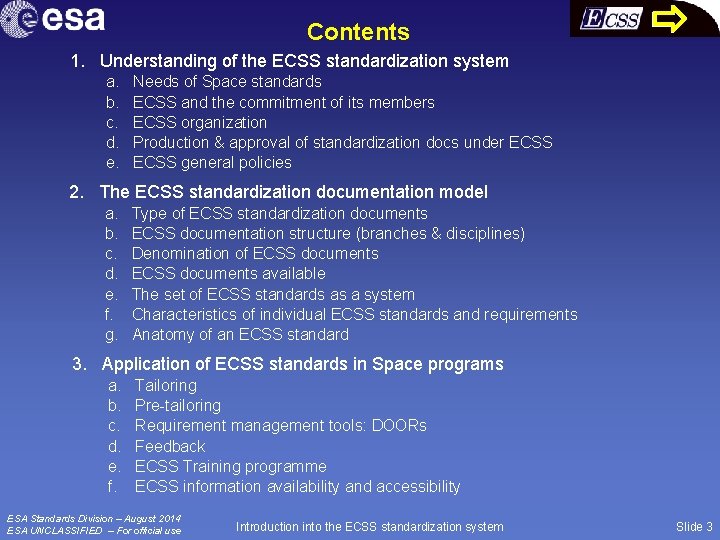
Contents 1. Understanding of the ECSS standardization system a. b. c. d. e. Needs of Space standards ECSS and the commitment of its members ECSS organization Production & approval of standardization docs under ECSS general policies 2. The ECSS standardization documentation model a. b. c. d. e. f. g. Type of ECSS standardization documents ECSS documentation structure (branches & disciplines) Denomination of ECSS documents available The set of ECSS standards as a system Characteristics of individual ECSS standards and requirements Anatomy of an ECSS standard 3. Application of ECSS standards in Space programs a. b. c. d. e. f. Tailoring Pre-tailoring Requirement management tools: DOORs Feedback ECSS Training programme ECSS information availability and accessibility ESA Standards Division – August 2014 ESA UNCLASSIFIED – For official use Introduction into the ECSS standardization system Slide 3
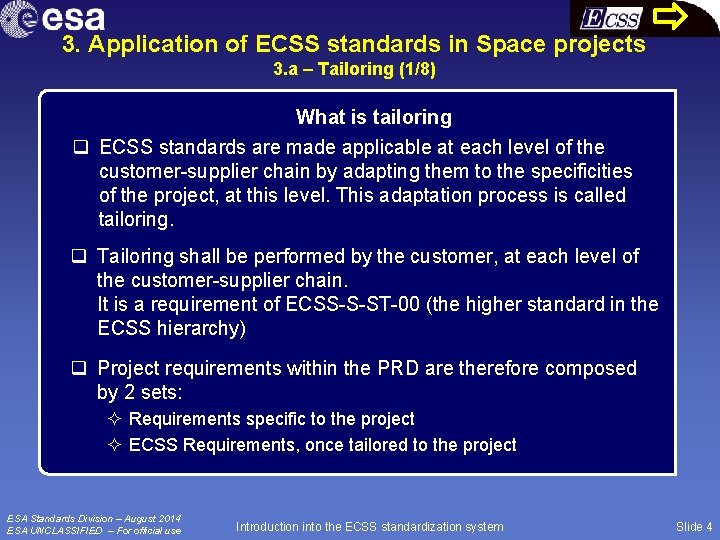
3. Application of ECSS standards in Space projects 3. a – Tailoring (1/8) What is tailoring q ECSS standards are made applicable at each level of the customer-supplier chain by adapting them to the specificities of the project, at this level. This adaptation process is called tailoring. q Tailoring shall be performed by the customer, at each level of the customer-supplier chain. It is a requirement of ECSS-S-ST-00 (the higher standard in the ECSS hierarchy) q Project requirements within the PRD are therefore composed by 2 sets: ² Requirements specific to the project ² ECSS Requirements, once tailored to the project ESA Standards Division – August 2014 ESA UNCLASSIFIED – For official use Introduction into the ECSS standardization system Slide 4
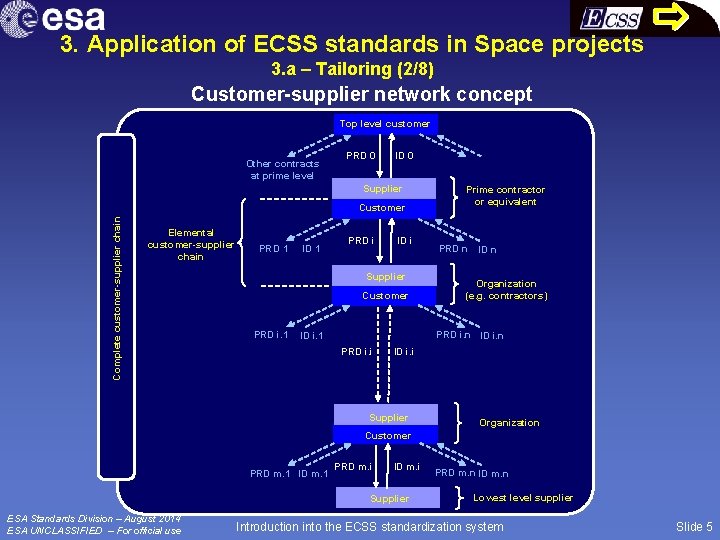
3. Application of ECSS standards in Space projects 3. a – Tailoring (2/8) Customer-supplier network concept Top level customer Other contracts at prime level PRD 0 ID 0 Supplier Complete customer-supplier chain Customer Elemental customer-supplier chain PRD 1 ID 1 PRD i ID i Supplier Customer PRD i. 1 Prime contractor or equivalent PRD n ID n Organization (e. g. contractors) PRD i. n ID i. 1 PRD i. i ID i. i Supplier Organization Customer PRD m. 1 ID m. 1 PRD m. i ID m. i Supplier ESA Standards Division – August 2014 ESA UNCLASSIFIED – For official use PRD m. n ID m. n Lowest level supplier Introduction into the ECSS standardization system Slide 5
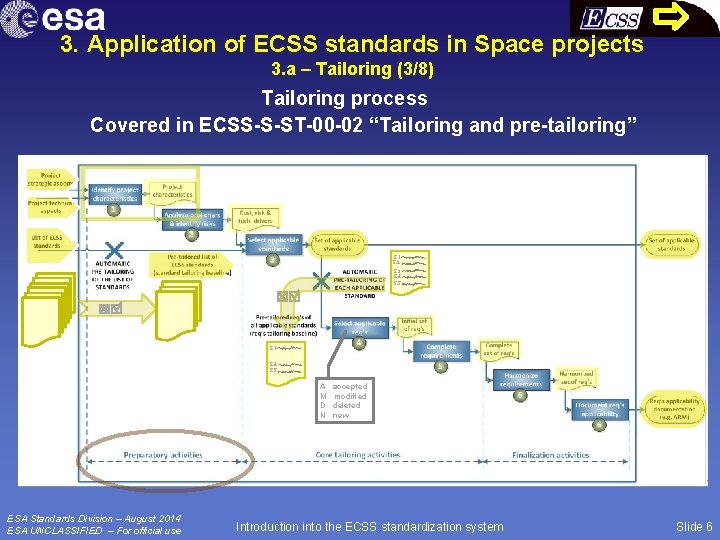
3. Application of ECSS standards in Space projects 3. a – Tailoring (3/8) Tailoring process Covered in ECSS-S-ST-00 -02 “Tailoring and pre-tailoring” 5. 1 5. 2 5. 3 5. 4 5. 5 5. 1 5. 4 5. 5 A M D N ESA Standards Division – August 2014 ESA UNCLASSIFIED – For official use accepted modified deleted new Introduction into the ECSS standardization system Slide 6
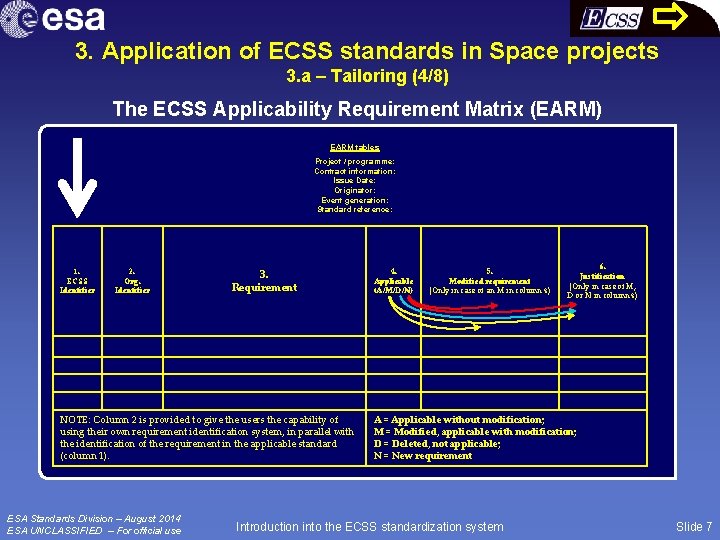
3. Application of ECSS standards in Space projects 3. a – Tailoring (4/8) The ECSS Applicability Requirement Matrix (EARM) EARM tables Project / programme: Contract information: Issue Date: Originator: Event generation: Standard reference: 1. ECSS Identifier 2. Org. Identifier 3. Requirement NOTE: Column 2 is provided to give the users the capability of using their own requirement identification system, in parallel with the identification of the requirement in the applicable standard (column 1). ESA Standards Division – August 2014 ESA UNCLASSIFIED – For official use 4. Applicable (A/M/D/N) 5. Modified requirement (Only in case of an M in column 4) 6. Justification (Only in case of M, D or N in column 4) A = Applicable without modification; M = Modified, applicable with modification; D = Deleted, not applicable; N = New requirement Introduction into the ECSS standardization system Slide 7
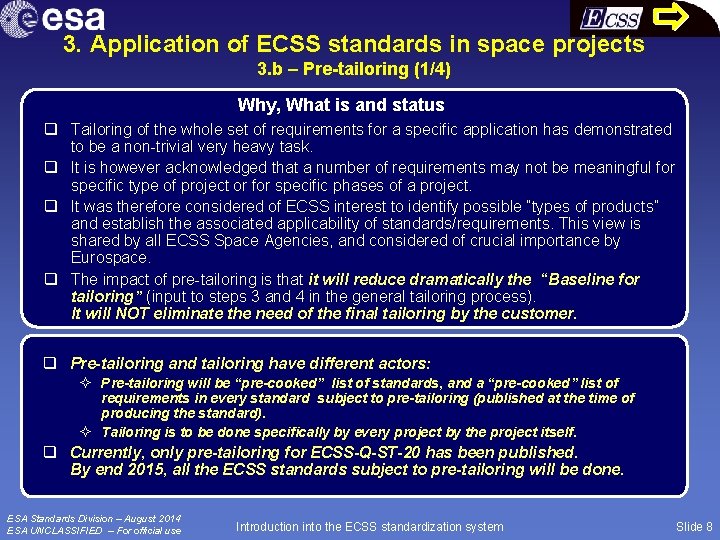
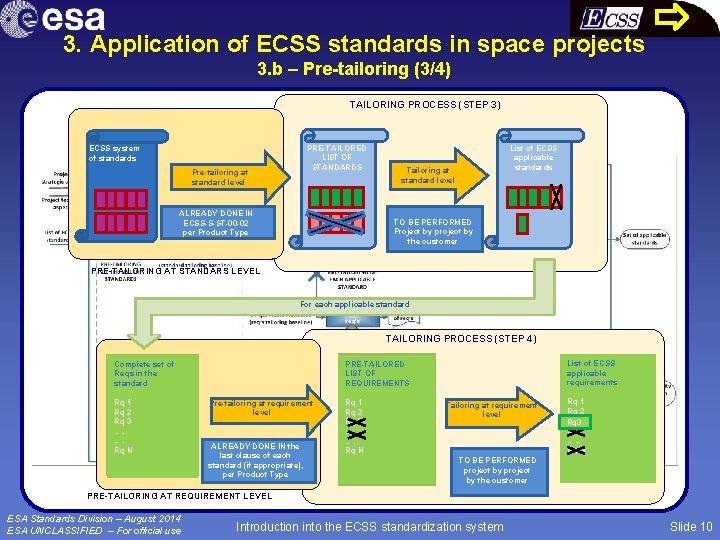
3. Application of ECSS standards in space projects 3. b – Pre-tailoring (1/4) Why, What is and status q Tailoring of the whole set of requirements for a specific application has demonstrated to be a non-trivial very heavy task. q It is however acknowledged that a number of requirements may not be meaningful for specific type of project or for specific phases of a project. q It was therefore considered of ECSS interest to identify possible “types of products” and establish the associated applicability of standards/requirements. This view is shared by all ECSS Space Agencies, and considered of crucial importance by Eurospace. q The impact of pre-tailoring is that it will reduce dramatically the “Baseline for tailoring” (input to steps 3 and 4 in the general tailoring process). It will NOT eliminate the need of the final tailoring by the customer. q Pre-tailoring and tailoring have different actors: ² Pre-tailoring will be “pre-cooked” list of standards, and a “pre-cooked” list of requirements in every standard subject to pre-tailoring (published at the time of producing the standard). ² Tailoring is to be done specifically by every project by the project itself. q Currently, only pre-tailoring for ECSS-Q-ST-20 has been published. By end 2015, all the ECSS standards subject to pre-tailoring will be done. ESA Standards Division – August 2014 ESA UNCLASSIFIED – For official use Introduction into the ECSS standardization system Slide 8
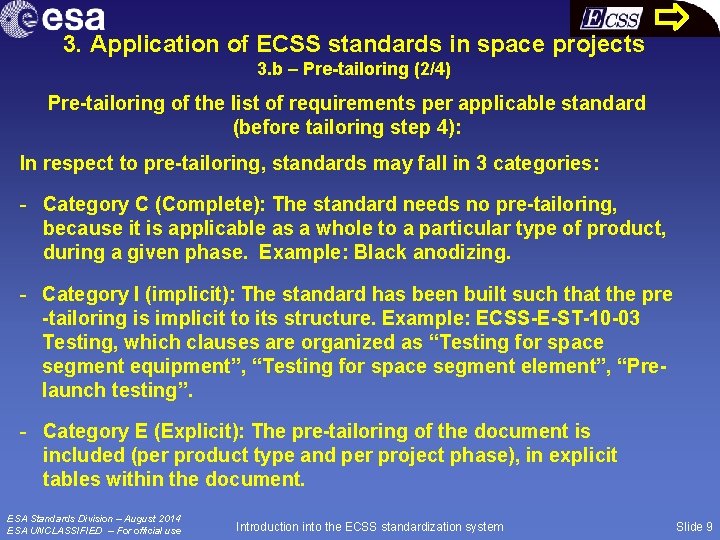
3. Application of ECSS standards in space projects 3. b – Pre-tailoring (2/4) Pre-tailoring of the list of requirements per applicable standard (before tailoring step 4): In respect to pre-tailoring, standards may fall in 3 categories: - Category C (Complete): The standard needs no pre-tailoring, because it is applicable as a whole to a particular type of product, during a given phase. Example: Black anodizing. - Category I (implicit): The standard has been built such that the pre -tailoring is implicit to its structure. Example: ECSS-E-ST-10 -03 Testing, which clauses are organized as “Testing for space segment equipment”, “Testing for space segment element”, “Prelaunch testing”. - Category E (Explicit): The pre-tailoring of the document is included (per product type and per project phase), in explicit tables within the document. ESA Standards Division – August 2014 ESA UNCLASSIFIED – For official use Introduction into the ECSS standardization system Slide 9
3. Application of ECSS standards in space projects 3. b – Pre-tailoring (3/4) TAILORING PROCESS (STEP 3) PRE-TAILORED LIST OF STANDARDS ECSS system of standards Pre-tailoring at standard level ALREADY DONE IN ECSS-S-ST-00 -02 per Product Type List of ECSS applicable standards Tailoring at standard level TO BE PERFORMED Project by project by the customer PRE-TAILORING AT STANDARS LEVEL For each applicable standard TAILORING PROCESS (STEP 4) Complete set of Reqs in the standard Rq 1 Rq 2 Rq 3 …. . Rq N List of ECSS applicable requirements PRE-TAILORED LIST OF REQUIREMENTS Pre-tailoring at requirement level ALREADY DONE IN the last clause of each standard (if appropriate), per Product Type Rq 1 Rq 2 Rq 3 …. . Rq N Tailoring at requirement level Rq 1 Rq 2 Rq 3 …. . Rq N TO BE PERFORMED project by the customer PRE-TAILORING AT REQUIREMENT LEVEL ESA Standards Division – August 2014 ESA UNCLASSIFIED – For official use Introduction into the ECSS standardization system Slide 10
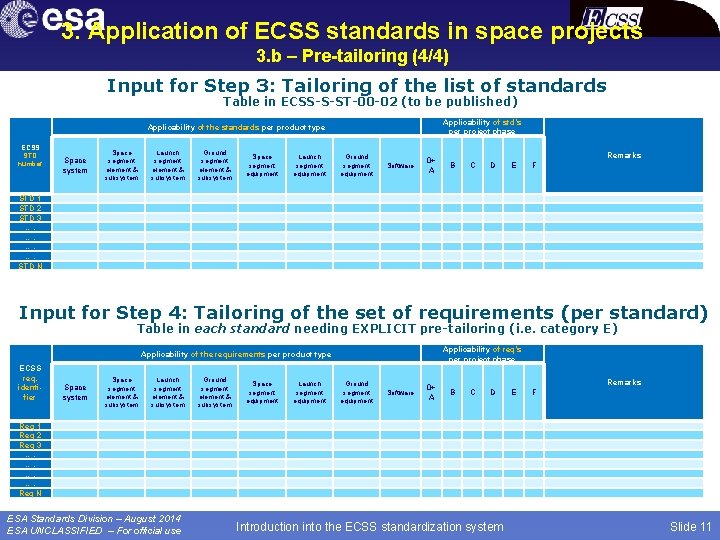
3. Application of ECSS standards in space projects 3. b – Pre-tailoring (4/4) Input for Step 3: Tailoring of the list of standards Table in ECSS-S-ST-00 -02 (to be published) Applicability of std’s per project phase Applicability of the standards per product type ECSS STD number STD 1 STD 2 STD 3 …. …. STD N Space system Space segment element & subsystem Launch segment element & subsystem Ground segment element & subsystem Space segment equipment Launch segment equipment Ground segment equipment Software 0+ A B C D E F Remarks Input for Step 4: Tailoring of the set of requirements (per standard) Table in each standard needing EXPLICIT pre-tailoring (i. e. category E) Applicability of req’s per project phase Applicability of the requirements per product type ECSS req. identifier Space system Space segment element & subsystem Launch segment element & subsystem Ground segment element & subsystem Space segment equipment Launch segment equipment Ground segment equipment Software 0+ A B C D E F Req 1 Req 2 Req 3 …. …. Req N ESA Standards Division – August 2014 ESA UNCLASSIFIED – For official use Remarks Introduction into the ECSS standardization system Slide 11
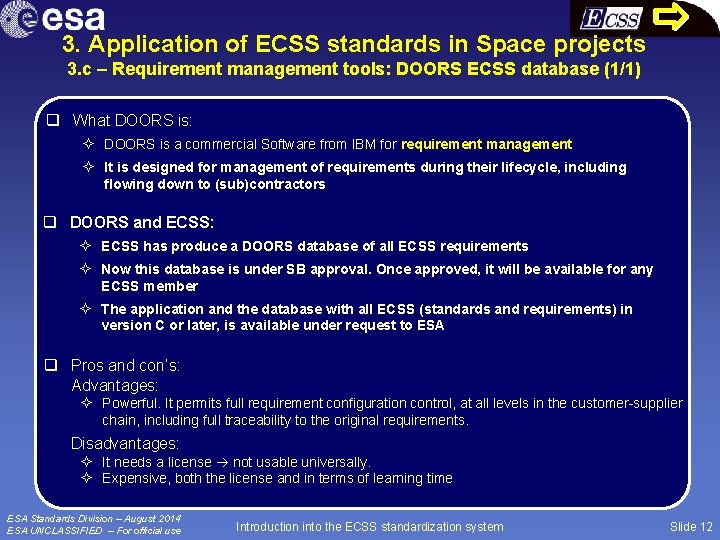
3. Application of ECSS standards in Space projects 3. c – Requirement management tools: DOORS ECSS database (1/1) q What DOORS is: ² DOORS is a commercial Software from IBM for requirement management ² It is designed for management of requirements during their lifecycle, including flowing down to (sub)contractors q DOORS and ECSS: ² ECSS has produce a DOORS database of all ECSS requirements ² Now this database is under SB approval. Once approved, it will be available for any ECSS member ² The application and the database with all ECSS (standards and requirements) in version C or later, is available under request to ESA q Pros and con’s: Advantages: ² Powerful. It permits full requirement configuration control, at all levels in the customer-supplier chain, including full traceability to the original requirements. Disadvantages: ² It needs a license not usable universally. ² Expensive, both the license and in terms of learning time ESA Standards Division – August 2014 ESA UNCLASSIFIED – For official use Introduction into the ECSS standardization system Slide 12
3. Application of ECSS standards in Space projects 3. d – Feedback (1/2) q The process relies on individual inputs provided to ECSS, from each ECSS partners ² Change request (at organizational or individual level) ² Feedback from projects q Each ECSS organization (e. g. ESA) shall implement its own internal Feedback Process è Then Feedback Inputs are collected and merged by the ES and make them available to TA for assessment. q Potential output of the feedback process are: ² Change Request to existing standards ² NWIP (add/modify/split or group standard) ² TA recommendation to improve overall ECSS system (e. g. improve Website, add/remove discipline/branch, standard cancelation, modify drafting rules, . . . ) ESA Standards Division – August 2014 ESA UNCLASSIFIED – For official use Introduction into the ECSS standardization system Slide 13
3. Application of ECSS standards in Space projects 3. d – Feedback (2/2) q Feedback from ECSS user (which includes Space Agencies and Eurospace) is required by the ECSS-S-ST-00 “System description and implementation” (=> i. e. is a requirement to the users) q The Feedback process is defined in D-00 document (=> i. e. is a process for ‘developers’) q At the present, feedback will only apply for Project using ECSS Issue C (or later) q The overall feedback process relies on three pillars ² C-ARM analysis (at Project ITT level) ² Inquiry board and LL & feedback from project at major reviews (PDR/CDR/FAR/CR) ² ECSS Questionnaire (on-line version & TA triggered campaigns) ESA Standards Division – August 2014 ESA UNCLASSIFIED – For official use Introduction into the ECSS standardization system Slide 14
3. Application of ECSS standards in Space projects 3. e – ESA training program on ECSS (1/1) ESA training program on ECSS is structured in three levels: v Level 1: The present module § Subject: An introduction to the ESA Space standardization activities § Duration: 1 module of 0, 5 days (about 3 hrs. ) § Target audience: Anyone dealing with standards and space projects, including engineers, scientists, lawyers and administrative personnel. v Level 2: One module per ECSS discipline § Subject: Individual documents are not generally covered. Disciplines covered: M – Space project management E 10 - SE Q 10/Q 20 – PA/QA E 20 – Electric & electronics Q 30 – Dependability (RAM) E 31 – Thermal control Q 40 – Safety E 32 – Structural Q 60 – EEE components E 33 – Mechanisms Q 70 – MMP&P E 40 – SW engineering Q 80 – SW PA E 60 – Control engineering U 10 – Space debris mitigation E 70 – Ground systems and operations § Duration: 0, 5 days (about 3 hrs. ) per module § Target audience: Users applying the standards at system level, e. g. project managers, system engineers, project engineers, PA managers. Not addressed to experts v Level 3: A module per topic (normally a topic = a standard) § Subject: A module per topic. Only few topics will be developed, e. g. “Testing”, “Load analysis”, “Pointing error”. § Duration: Depending on the topic. Typically, between 0, 5 and 1, 5 days § Target audience: experts and users directly applying individual standards in projects ESA Standards Division – August 2014 ESA UNCLASSIFIED – For official use Introduction into the ECSS standardization system Slide 15
3. Application of ECSS standards in Space projects 3. f – ECSS information availability and accessibility (1/4) ECSS information availability ECSS Website (www. ecss. nl) provides the following up-to-date information: v Latest news on ECSS events, including Public Reviews and latest publications v ECSS organization, including v ECSS members v ECSS representatives in the ECSS bodies (SB and TA) v ECSS ruling documents: policy, procedures, drafting rules, … v All the published documents (Standards, handbooks and TMs), v All available for free (but you need to register and being logged in) v including not only the current versions, but also all the superseded versions v Downloadable one by one, or all at once v The map of all the ECSS hierarchy of documents, both published or under preparation, as presented in the second part of this training v FAQ’s on both ECSS documents and the ECSS Website itself v Video tutorials on performing some tasks in the ECSS Website. ESA Standards Division – August 2014 ESA UNCLASSIFIED – For official use Introduction into the ECSS standardization system Slide 16
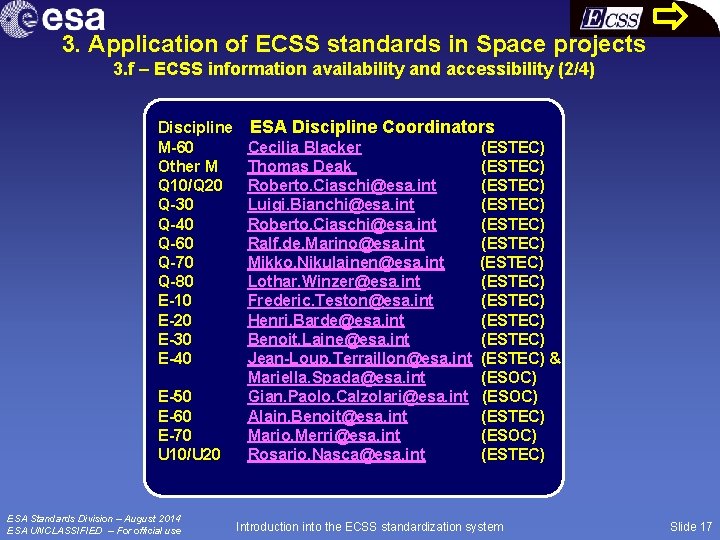
3. Application of ECSS standards in Space projects 3. f – ECSS information availability and accessibility (2/4) Discipline M-60 Other M Q 10/Q 20 Q-30 Q-40 Q-60 Q-70 Q-80 E-10 E-20 E-30 E-40 E-50 E-60 E-70 U 10/U 20 ESA Standards Division – August 2014 ESA UNCLASSIFIED – For official use ESA Discipline Coordinators Cecilia Blacker Thomas Deak Roberto. Ciaschi@esa. int Luigi. Bianchi@esa. int Roberto. Ciaschi@esa. int Ralf. de. Marino@esa. int Mikko. Nikulainen@esa. int Lothar. Winzer@esa. int Frederic. Teston@esa. int Henri. Barde@esa. int Benoit. Laine@esa. int Jean-Loup. Terraillon@esa. int Mariella. Spada@esa. int Gian. Paolo. Calzolari@esa. int Alain. Benoit@esa. int Mario. Merri@esa. int Rosario. Nasca@esa. int (ESTEC) (ESTEC) (ESTEC) & (ESOC) (ESTEC) Introduction into the ECSS standardization system Slide 17
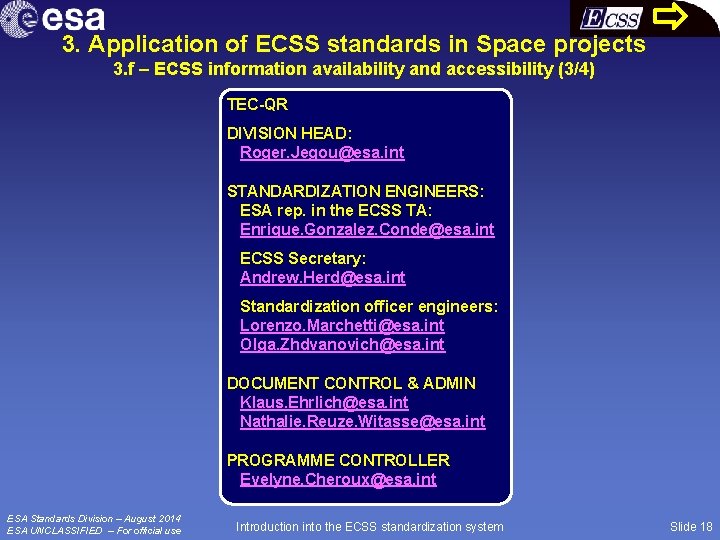
3. Application of ECSS standards in Space projects 3. f – ECSS information availability and accessibility (3/4) TEC-QR DIVISION HEAD: Roger. Jegou@esa. int STANDARDIZATION ENGINEERS: ESA rep. in the ECSS TA: Enrique. Gonzalez. Conde@esa. int ECSS Secretary: Andrew. Herd@esa. int Standardization officer engineers: Lorenzo. Marchetti@esa. int Olga. Zhdvanovich@esa. int DOCUMENT CONTROL & ADMIN Klaus. Ehrlich@esa. int Nathalie. Reuze. Witasse@esa. int PROGRAMME CONTROLLER Evelyne. Cheroux@esa. int ESA Standards Division – August 2014 ESA UNCLASSIFIED – For official use Introduction into the ECSS standardization system Slide 18
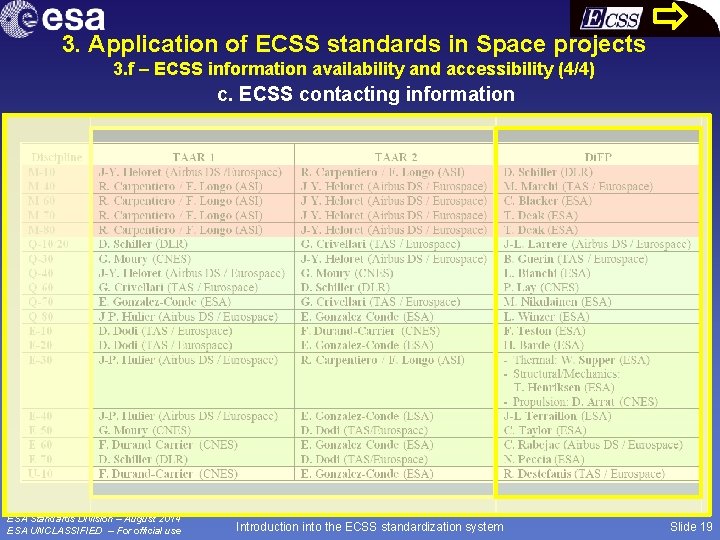
3. Application of ECSS standards in Space projects 3. f – ECSS information availability and accessibility (4/4) c. ECSS contacting information ESA Standards Division – August 2014 ESA UNCLASSIFIED – For official use Introduction into the ECSS standardization system Slide 19
Thanks for your attention ? ESA Standards Division – August 2014 ESA UNCLASSIFIED – For official use Introduction into the ECSS standardization system Slide 20