
Contents Microbes Describe what are microbes Describe the
Contents Microbes Describe what are microbes? Describe the structure of bacteria and viruses How do bacteria and viruses reproduce? Summary quiz 1 of 39 © Boardworks Ltd 2004
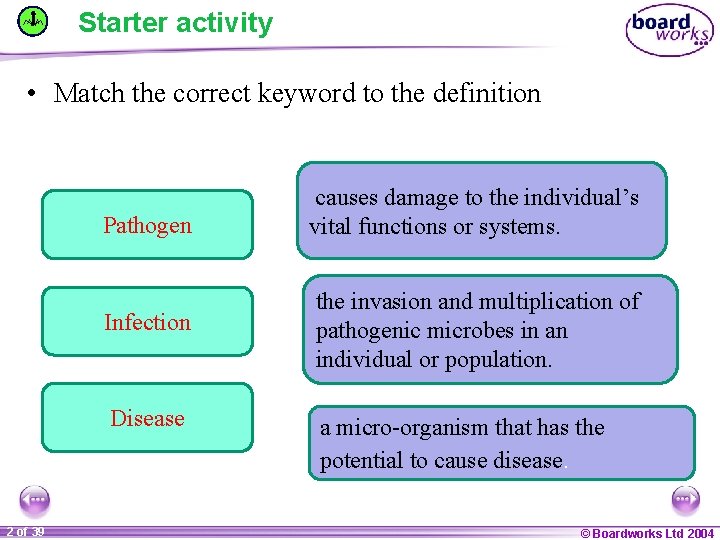
Starter activity • Match the correct keyword to the definition Pathogen Infection Disease 2 of 39 causes damage to the individual’s vital functions or systems. the invasion and multiplication of pathogenic microbes in an individual or population. a micro-organism that has the potential to cause disease. © Boardworks Ltd 2004
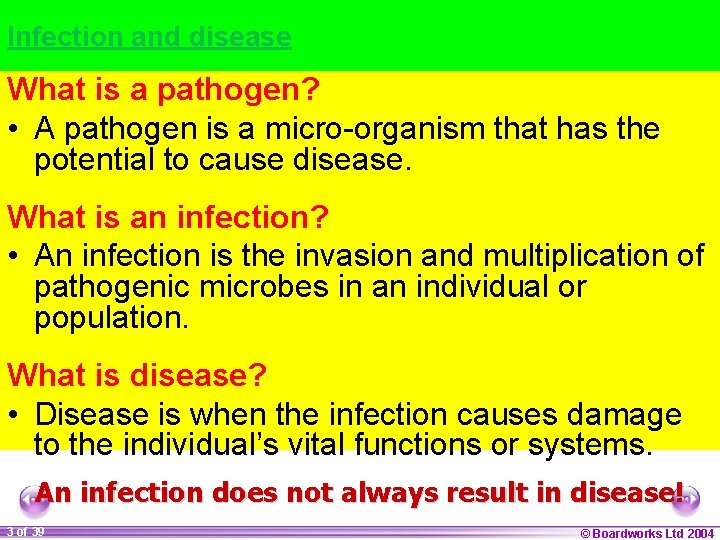
Infection and disease What is a pathogen? • A pathogen is a micro-organism that has the potential to cause disease. What is an infection? • An infection is the invasion and multiplication of pathogenic microbes in an individual or population. What is disease? • Disease is when the infection causes damage to the individual’s vital functions or systems. An infection does not always result in disease! 3 of 39 © Boardworks Ltd 2004
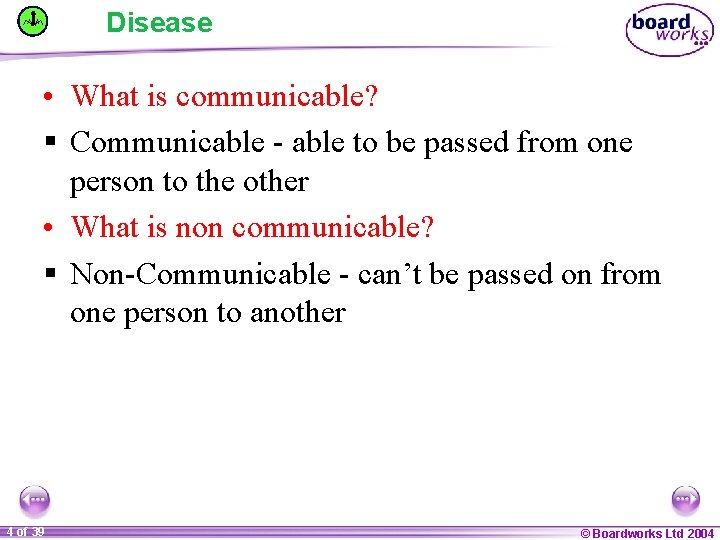
Disease • What is communicable? Communicable - able to be passed from one person to the other • What is non communicable? Non-Communicable - can’t be passed on from one person to another 4 of 39 © Boardworks Ltd 2004
What causes disease? Why do people become ill? People who lead very unhealthy lifestyles sometimes become ill but it is also clear that people can become ill despite leading a healthy lifestyle. Why? Therefore, rather than something being wrong with that person, perhaps something else changes the normal state of the body and causes disease. These were eventually discovered to be… MICROBES 5 of 39 © Boardworks Ltd 2004
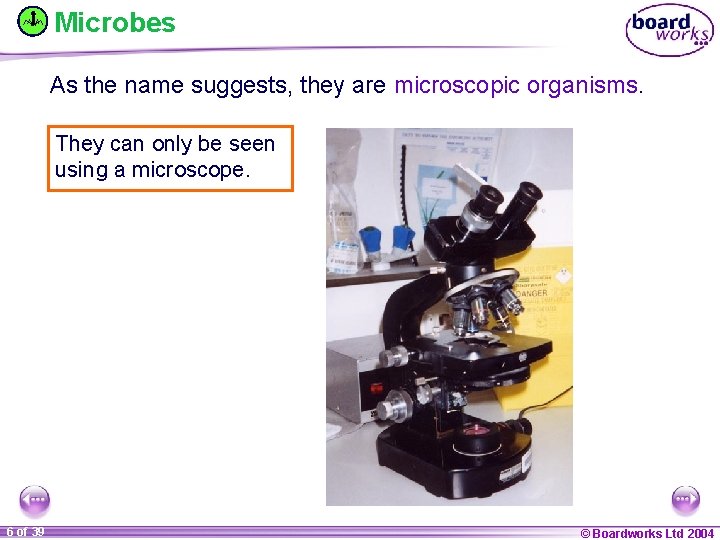
Microbes As the name suggests, they are microscopic organisms. They can only be seen using a microscope. 6 of 39 © Boardworks Ltd 2004
Microbes The two kinds of microbe that we will be dealing with are: BACTERIA VIRUSES Now it is important at this point to remember what it means to be living organism. A living organism must be able to demonstrate that it can perform the seven life processes. 7 of 39 © Boardworks Ltd 2004
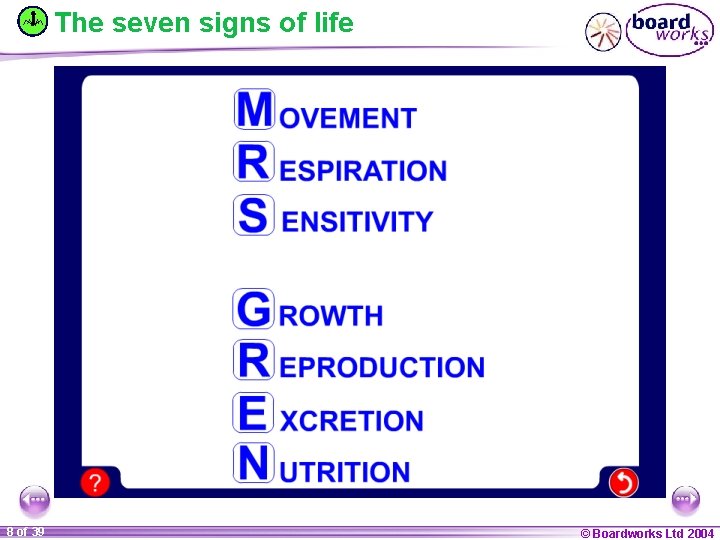
The seven signs of life 8 of 39 © Boardworks Ltd 2004
Microbes The reason for looking back to these 7 characteristics is because although bacteria can perform all of these life processes, viruses cannot reproduce on their own. Does this mean that viruses are non-living? This question is still hotly debated! 9 of 39 © Boardworks Ltd 2004
Micro-organisms are made from cell • They are very small – so usually ONE cell • Cells are the smallest unit of life – they can carry out the 7 characteristics of life • Two types of cell: – Prokaryotic – Eukaryotic 10 of 39 © Boardworks Ltd 2004
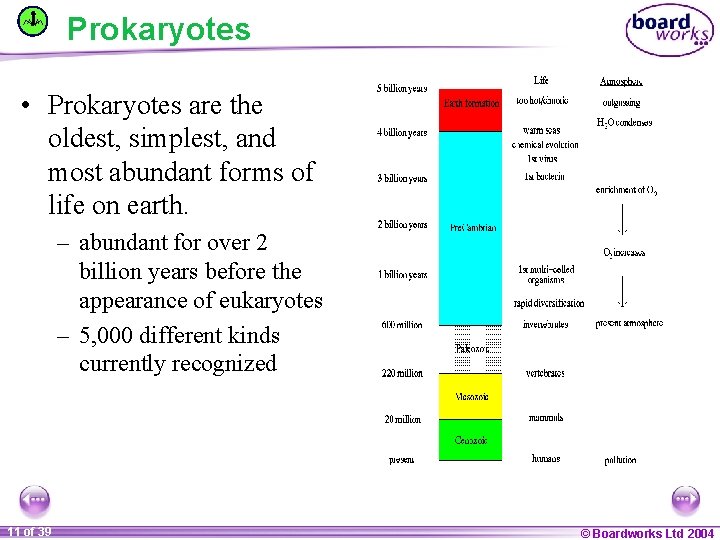
Prokaryotes • Prokaryotes are the oldest, simplest, and most abundant forms of life on earth. – abundant for over 2 billion years before the appearance of eukaryotes – 5, 000 different kinds currently recognized 11 of 39 © Boardworks Ltd 2004
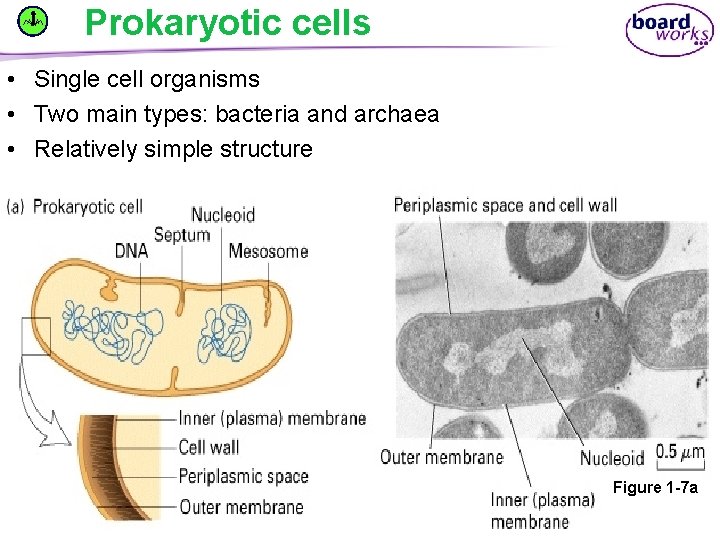
Prokaryotic cells • Single cell organisms • Two main types: bacteria and archaea • Relatively simple structure Figure 1 -7 a 12 of 39 © Boardworks Ltd 2004
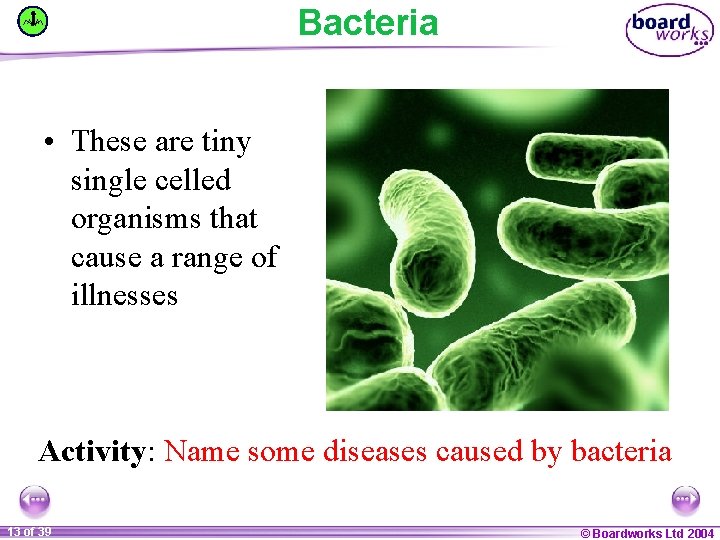
Bacteria • These are tiny single celled organisms that cause a range of illnesses Activity: Name some diseases caused by bacteria 13 of 39 © Boardworks Ltd 2004
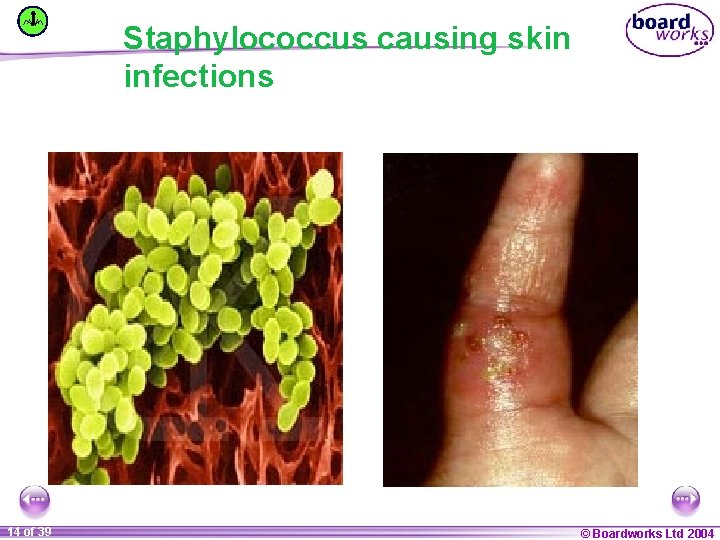
Staphylococcus causing skin infections 14 of 39 © Boardworks Ltd 2004
Bacteria As the bacteria breed successfully they begin to affect the body Symptoms of infection appear Symptoms caused by remains of dead bacteria or substances released by the living bacteria (toxins) Toxins may cause fever Bacteria may directly damage body cells 15 of 39 © Boardworks Ltd 2004
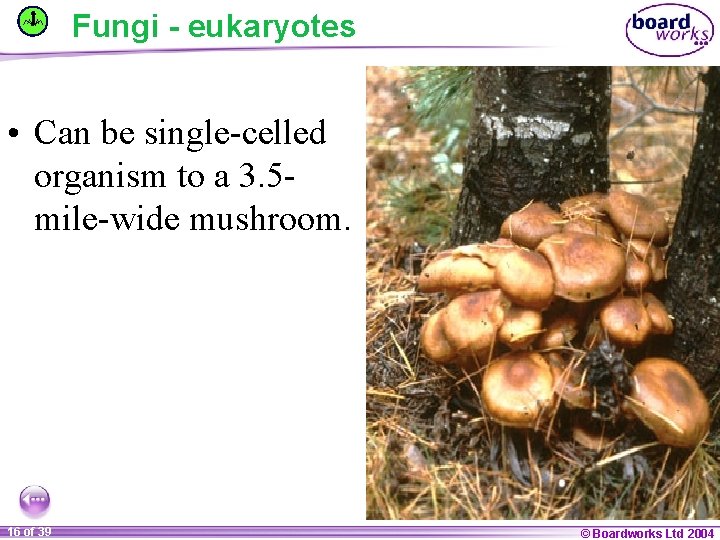
Fungi - eukaryotes • Can be single-celled organism to a 3. 5 mile-wide mushroom. 16 of 39 © Boardworks Ltd 2004
Fungi • These are tiny organisms that can cause a range of infections • They release digestive chemicals onto the surface of the person they grow on. Activity: Name some diseases caused by fungi 17 of 39 © Boardworks Ltd 2004
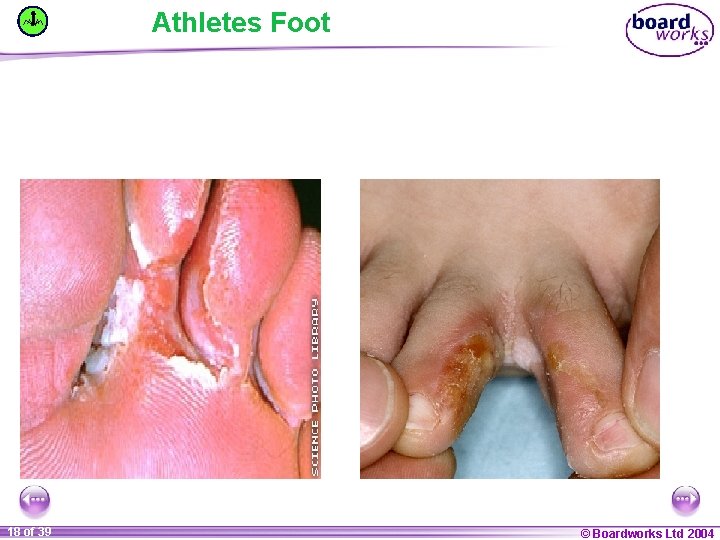
Athletes Foot 18 of 39 © Boardworks Ltd 2004
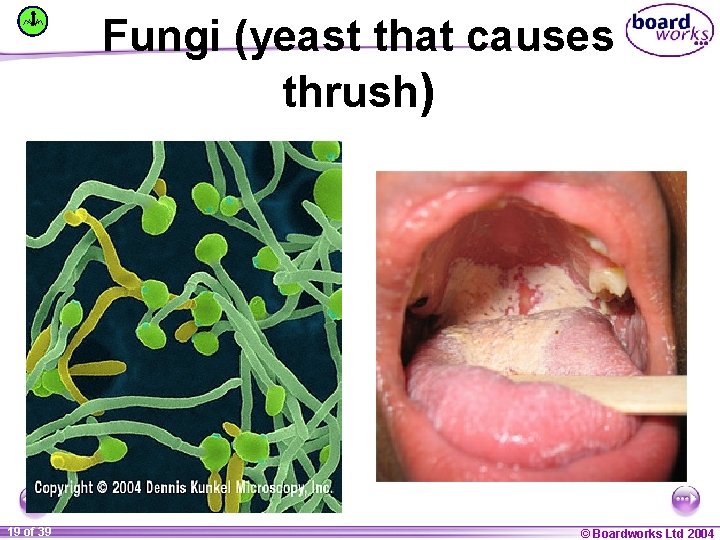
Fungi (yeast that causes thrush) 19 of 39 © Boardworks Ltd 2004
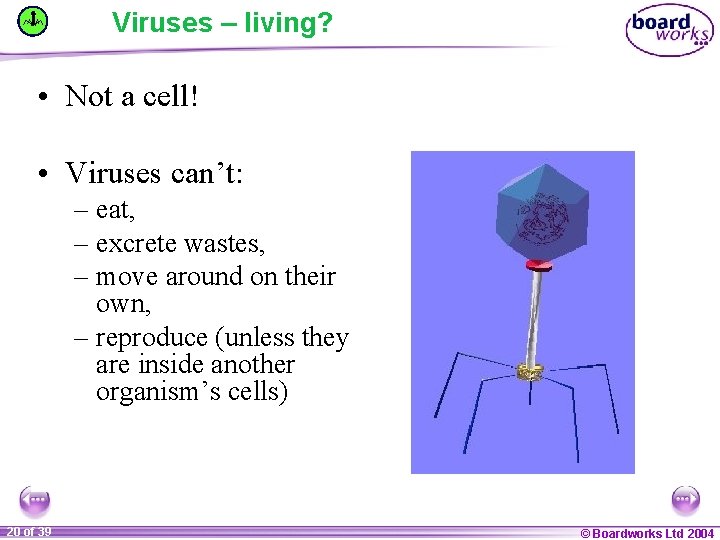
Viruses – living? • Not a cell! • Viruses can’t: – eat, – excrete wastes, – move around on their own, – reproduce (unless they are inside another organism’s cells) 20 of 39 © Boardworks Ltd 2004
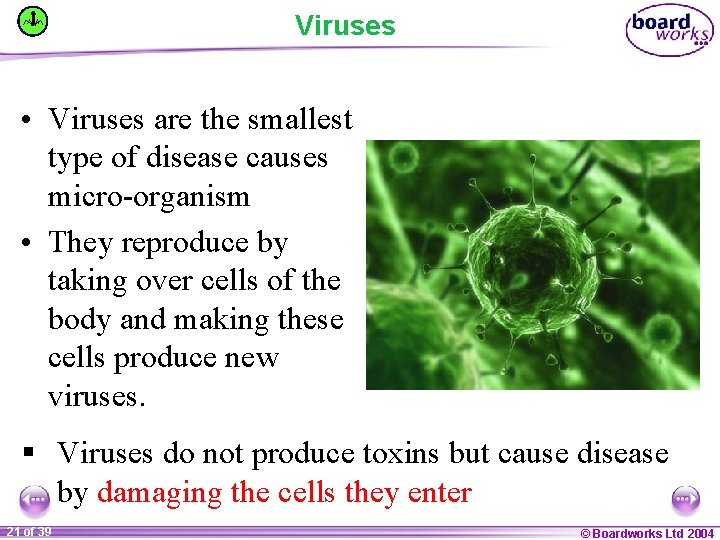
Viruses • Viruses are the smallest type of disease causes micro-organism • They reproduce by taking over cells of the body and making these cells produce new viruses. Viruses do not produce toxins but cause disease by damaging the cells they enter 21 of 39 © Boardworks Ltd 2004
What diseases do these viruses cause? – Rhinovirus attacks cells in nose and throat – HIV attacks cells of immune system – Herpes Simplex Can you think of any other diseases caused by a virus 22 of 39 © Boardworks Ltd 2004
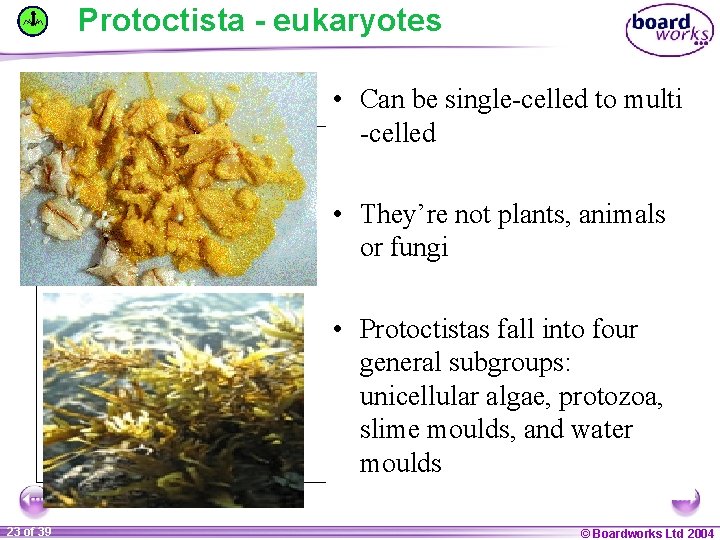
Protoctista - eukaryotes • Can be single-celled to multi -celled • They’re not plants, animals or fungi • Protoctistas fall into four general subgroups: unicellular algae, protozoa, slime moulds, and water moulds 23 of 39 © Boardworks Ltd 2004
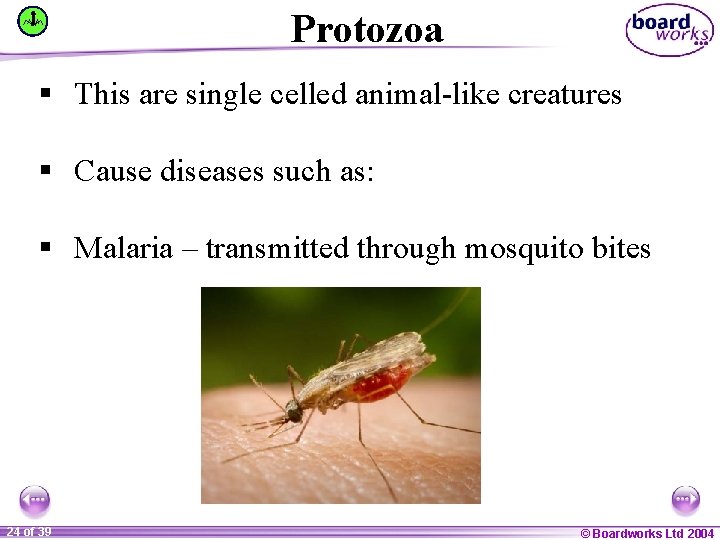
Protozoa This are single celled animal-like creatures Cause diseases such as: Malaria – transmitted through mosquito bites 24 of 39 © Boardworks Ltd 2004
Contents Microbes Describe what are microbes? Describe the structure of bacteria and viruses How do microbes reproduce? Summary quiz 25 of 39 © Boardworks Ltd 2004
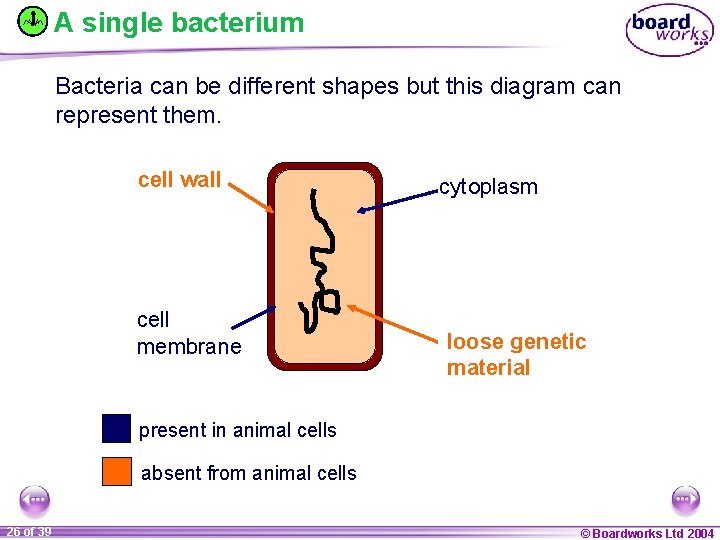
A single bacterium Bacteria can be different shapes but this diagram can represent them. cell wall cell membrane cytoplasm loose genetic material present in animal cells absent from animal cells 26 of 39 © Boardworks Ltd 2004
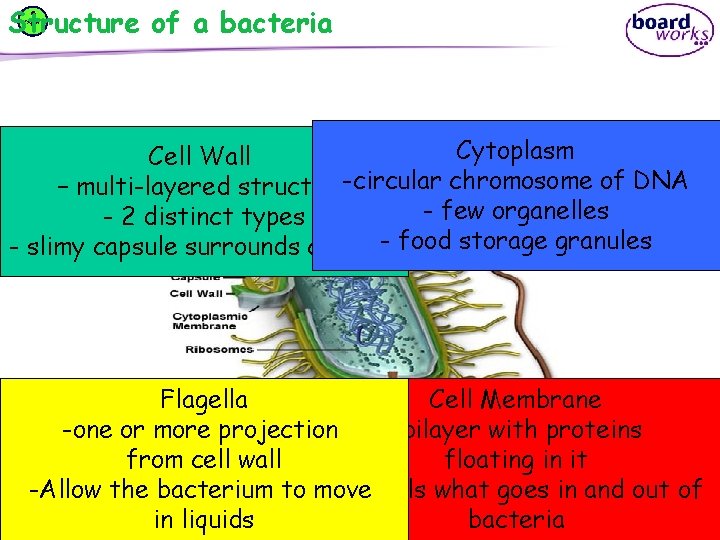
Structure of a bacteria Cytoplasm Cell Wall – multi-layered structure-circular chromosome of DNA - few organelles - 2 distinct types - food storage granules - slimy capsule surrounds cell wall Flagella Cell Membrane -one or more projection – bilayer with proteins from cell wall floating in it -Allow the bacterium to move -controls what goes in and out of in liquids bacteria © Boardworks Ltd 2004 27 of 39
Bacterium So, the bacterium shares some structural characteristics with an animal cell but shows important differences. The most obvious differences are: the absence of a distinct nucleus the presence of a cell wall The other major difference is the size of the cell. To get an idea of how small these cells are, remember that the human body consists of approximately 100 million animal cells. Bacteria cells are 10 -1000 times smaller than animal cells. 28 of 39 © Boardworks Ltd 2004
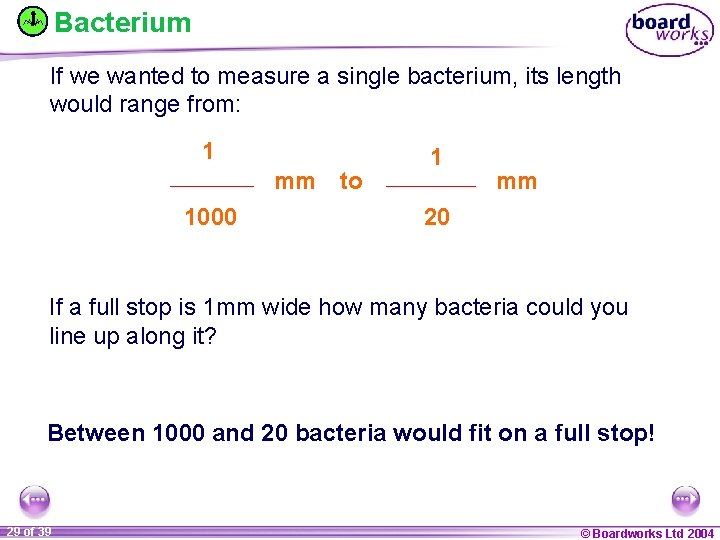
Bacterium If we wanted to measure a single bacterium, its length would range from: 1 mm to 1000 1 mm 20 If a full stop is 1 mm wide how many bacteria could you line up along it? Between 1000 and 20 bacteria would fit on a full stop! 29 of 39 © Boardworks Ltd 2004
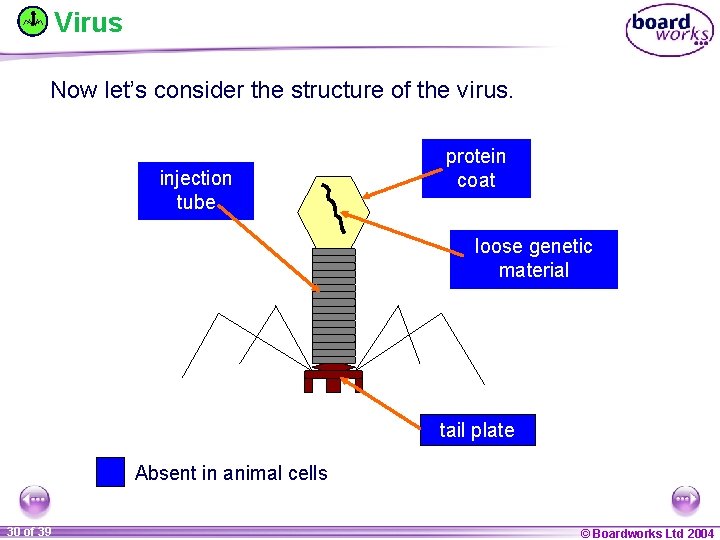
Virus Now let’s consider the structure of the virus. injection tube protein coat loose genetic material tail plate Absent in animal cells 30 of 39 © Boardworks Ltd 2004
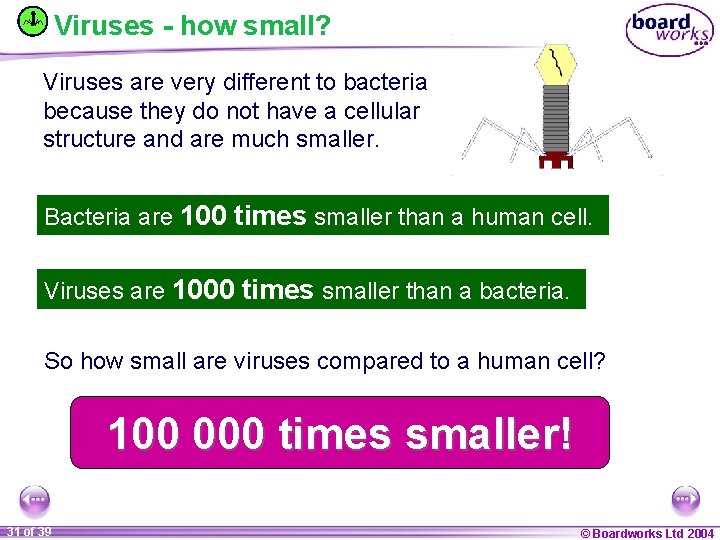
Viruses - how small? Viruses are very different to bacteria because they do not have a cellular structure and are much smaller. Bacteria are 100 times smaller than a human cell. Viruses are 1000 times smaller than a bacteria. So how small are viruses compared to a human cell? 100 000 times smaller! 31 of 39 © Boardworks Ltd 2004
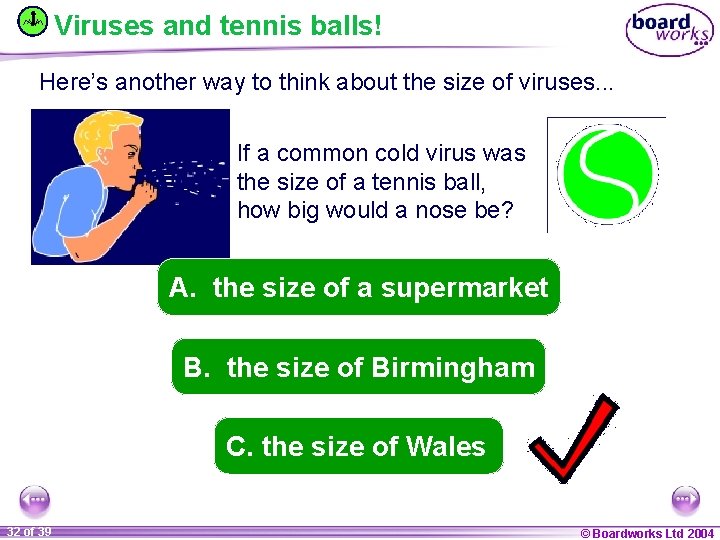
Viruses and tennis balls! Here’s another way to think about the size of viruses. . . If a common cold virus was the size of a tennis ball, how big would a nose be? A. the size of a supermarket B. the size of Birmingham C. the size of Wales 32 of 39 © Boardworks Ltd 2004
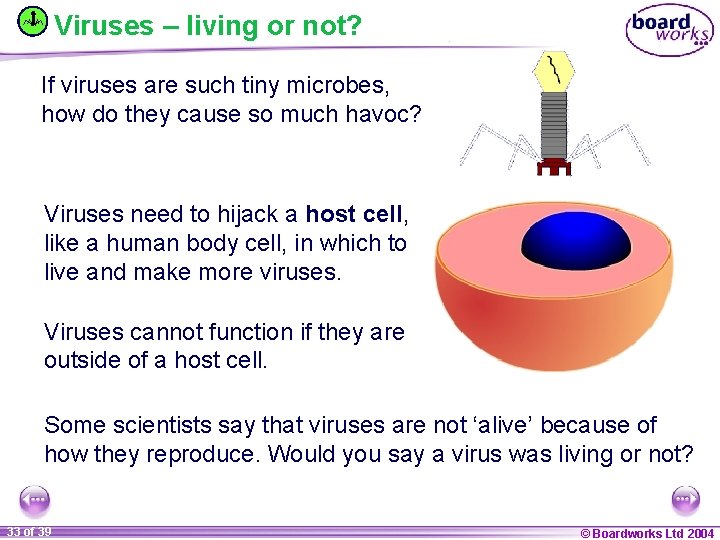
Viruses – living or not? If viruses are such tiny microbes, how do they cause so much havoc? Viruses need to hijack a host cell, like a human body cell, in which to live and make more viruses. Viruses cannot function if they are outside of a host cell. Some scientists say that viruses are not ‘alive’ because of how they reproduce. Would you say a virus was living or not? 33 of 39 © Boardworks Ltd 2004
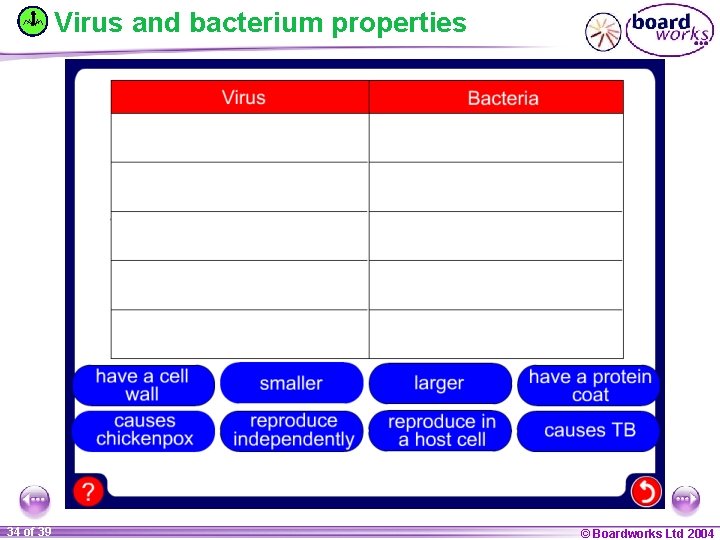
Virus and bacterium properties 34 of 39 © Boardworks Ltd 2004
Contents Microbes Describe what are microbes? Describe the structure of bacteria and viruses How do bacteria and viruses reproduce? Summary quiz 35 of 39 © Boardworks Ltd 2004
Contents Microbes Describe what are microbes? Describe the structure of bacteria and viruses How do bacteria and viruses reproduce? Summary quiz 36 of 39 © Boardworks Ltd 2004
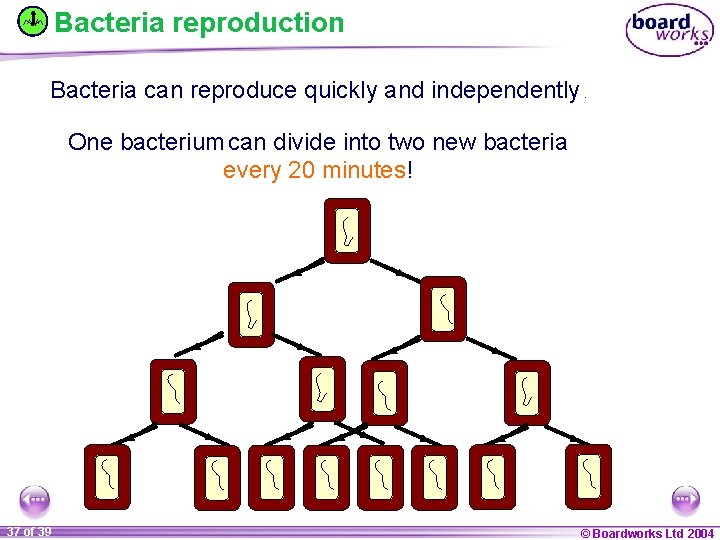
Bacteria reproduction Bacteria can reproduce quickly and independently. One bacterium can divide into two new bacteria every 20 minutes! 37 of 39 © Boardworks Ltd 2004
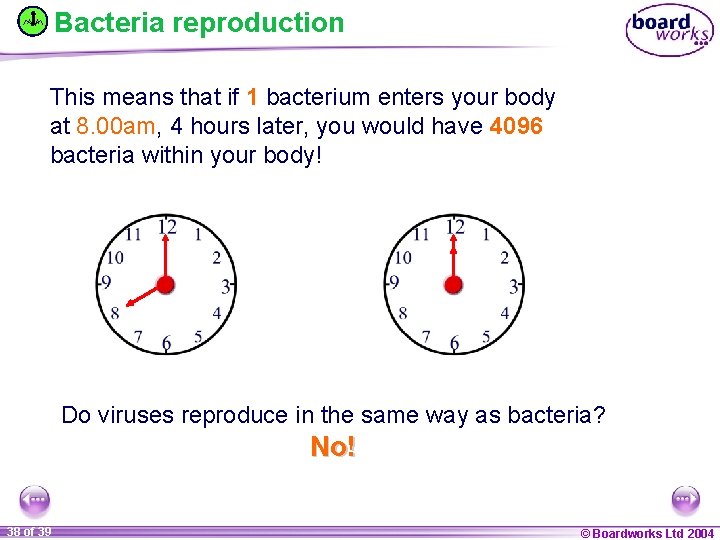
Bacteria reproduction This means that if 1 bacterium enters your body at 8. 00 am, 4 hours later, you would have 4096 bacteria within your body! Do viruses reproduce in the same way as bacteria? No! 38 of 39 © Boardworks Ltd 2004
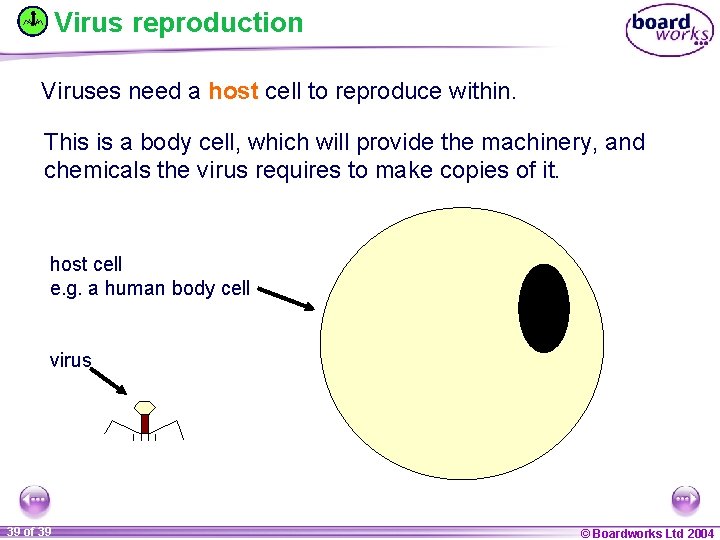
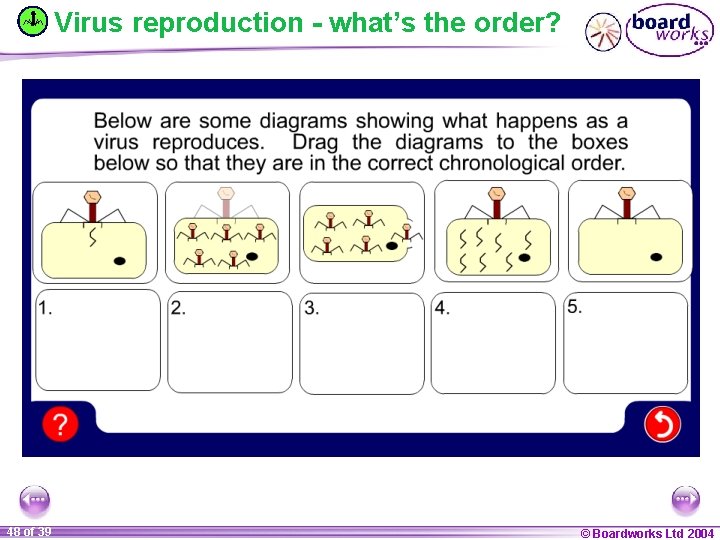
Virus reproduction Viruses need a host cell to reproduce within. This is a body cell, which will provide the machinery, and chemicals the virus requires to make copies of it. host cell e. g. a human body cell virus 39 of 39 © Boardworks Ltd 2004
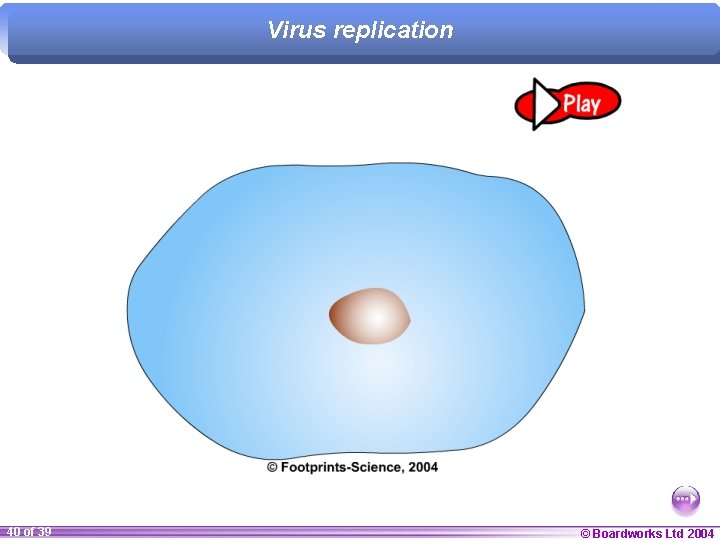
Virus replication 40 of 39 © Boardworks Ltd 2004
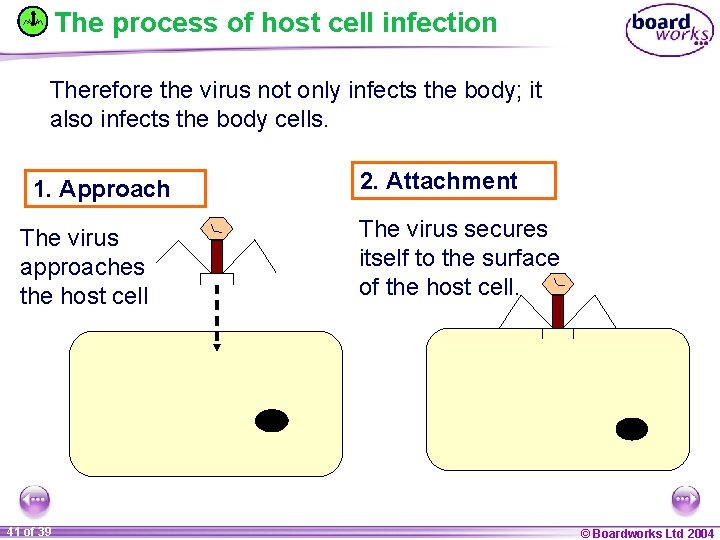
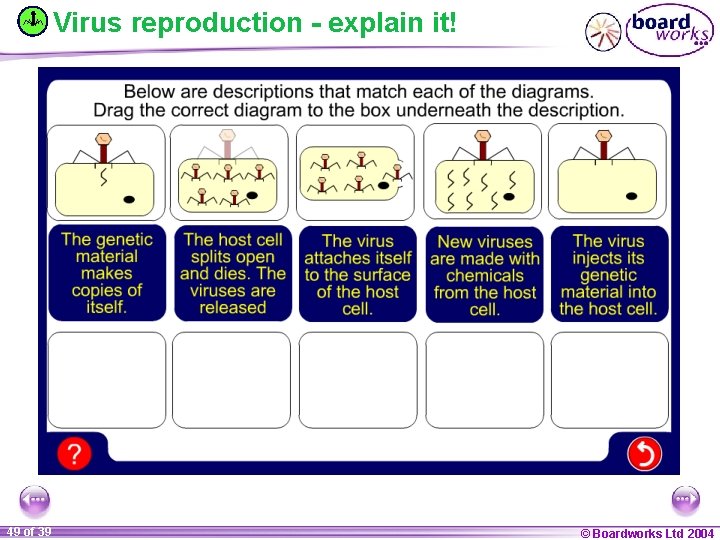
The process of host cell infection Therefore the virus not only infects the body; it also infects the body cells. 1. Approach The virus approaches the host cell 41 of 39 2. Attachment The virus secures itself to the surface of the host cell. © Boardworks Ltd 2004
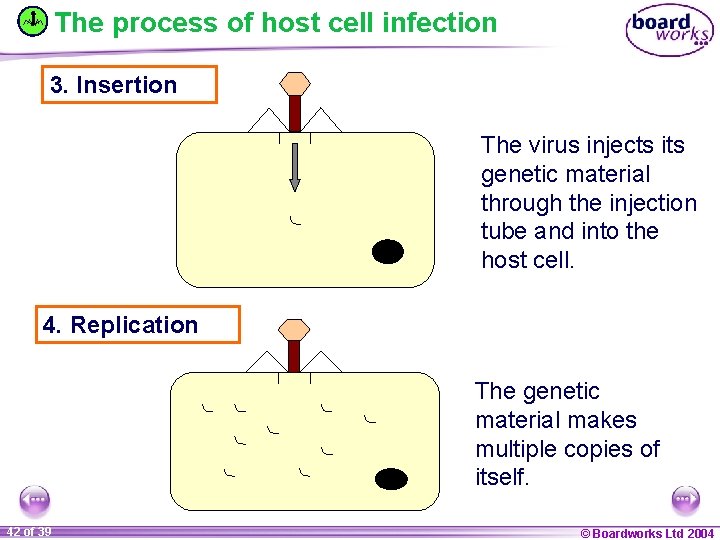
The process of host cell infection 3. Insertion The virus injects its genetic material through the injection tube and into the host cell. 4. Replication The genetic material makes multiple copies of itself. 42 of 39 © Boardworks Ltd 2004
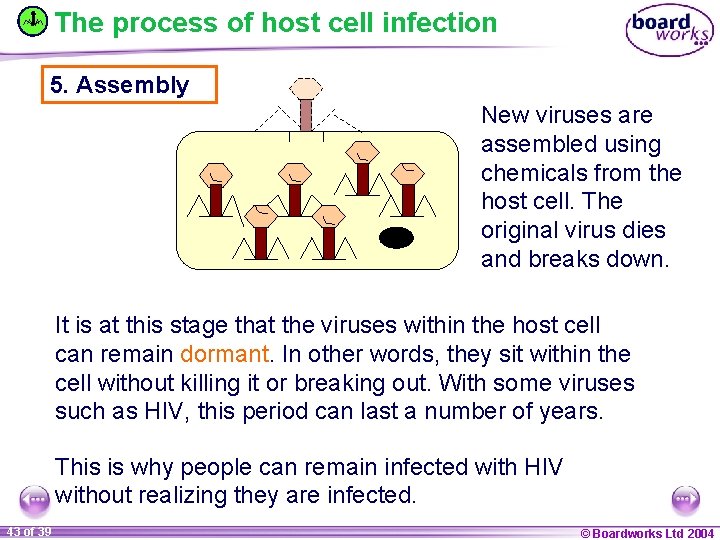
The process of host cell infection 5. Assembly New viruses are assembled using chemicals from the host cell. The original virus dies and breaks down. It is at this stage that the viruses within the host cell can remain dormant. In other words, they sit within the cell without killing it or breaking out. With some viruses such as HIV, this period can last a number of years. This is why people can remain infected with HIV without realizing they are infected. 43 of 39 © Boardworks Ltd 2004
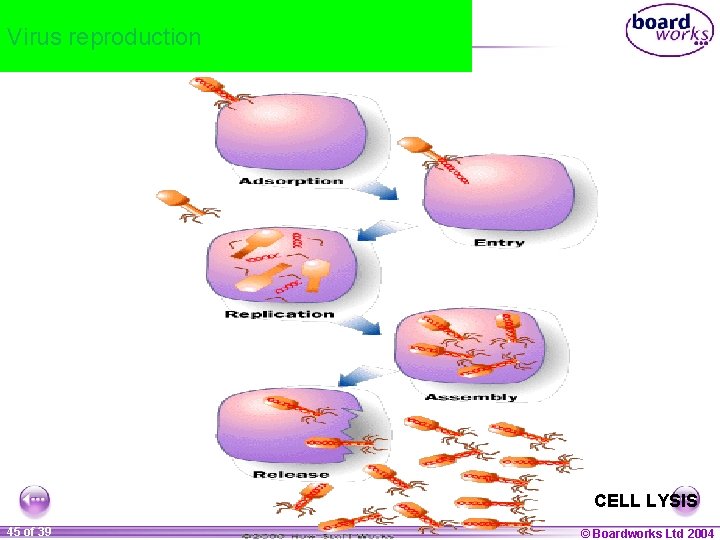
Virus reproduction CELL LYSIS 45 of 39 © Boardworks Ltd 2004
Student task • USE BIOVIEWERS AND OBSERVE SOME SLIDES. • DRAW 2 BACTERIAL, VIRUS, PROTOZOA AND FUNGI CELLS AND WRITE ABOUT THEM USING THE BOOKLETS 46 of 39 © Boardworks Ltd 2004
Common illnesses Most people have suffered from at least one of these illnesses: VIRUSES BACTERIA Influenza (flu) Food poisoning Mumps Sore throats Chickenpox Tuberculosis (TB) Smallpox Tetanus Polio Cholera Rabies Typhoid German measles Whooping cough So, how do these microscopic organisms actually cause illness in such a complex and relatively enormous organism like a human being? 47 of 39 © Boardworks Ltd 2004
Virus reproduction - what’s the order? 48 of 39 © Boardworks Ltd 2004
Virus reproduction - explain it! 49 of 39 © Boardworks Ltd 2004
Microbes quiz 50 of 39 © Boardworks Ltd 2004
- Slides: 49