
Contents l Introduction l Smart Hybrid Damping System

Contents l Introduction l Smart Hybrid Damping System l System Characteristics l Numerical Analysis l Conclusions Structural Dynamics & Vibration Control Lab. , KAIST, Korea 2
l Introduction l Structural Control Systems - Passive control system - Active control system - Semiactive control system Structural Dynamics & Vibration Control Lab. , KAIST, Korea 3
l Passive control system - Vibration control without external power - No adaptability to various external load - Examples: Lead rubber bearing, Viscous damper l Active control system - Vibration control with external power - Adaptability to various loading conditions - Large external power - Examples: Active mass damper, Hydraulic actuator Structural Dynamics & Vibration Control Lab. , KAIST, Korea 4
l Semiactive control system - Change of the characteristics of control devices - Small external power - Reliability of passive system with adaptability of active system - Examples: ER/MR damper, Variable-orifice damper Structural Dynamics & Vibration Control Lab. , KAIST, Korea 5
l Smart Hybrid Damping System l Characteristics of Smart hybrid damping system - Vibration control without external power - Adaptability to various loading conditions l Smart hybrid damping system - EMI System (Electromagnetic Induction System) - Toggle System (Scissor-Jack-Damper System) Structural Dynamics & Vibration Control Lab. , KAIST, Korea 6
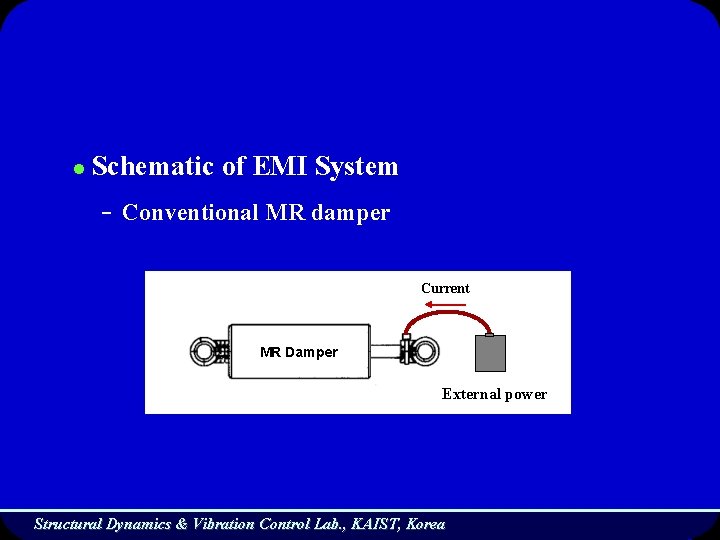
l Schematic of EMI System - Conventional MR damper Current MR Damper External power Structural Dynamics & Vibration Control Lab. , KAIST, Korea
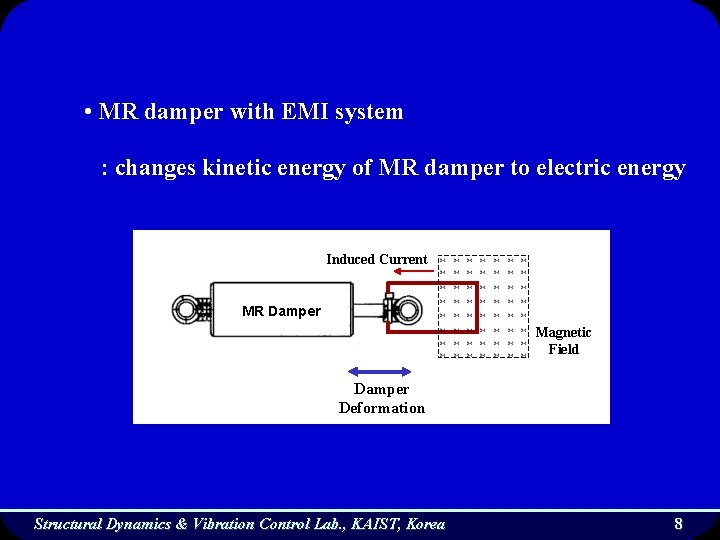
• MR damper with EMI system : changes kinetic energy of MR damper to electric energy Induced Current MR Damper Magnetic Field Damper Deformation Structural Dynamics & Vibration Control Lab. , KAIST, Korea 8
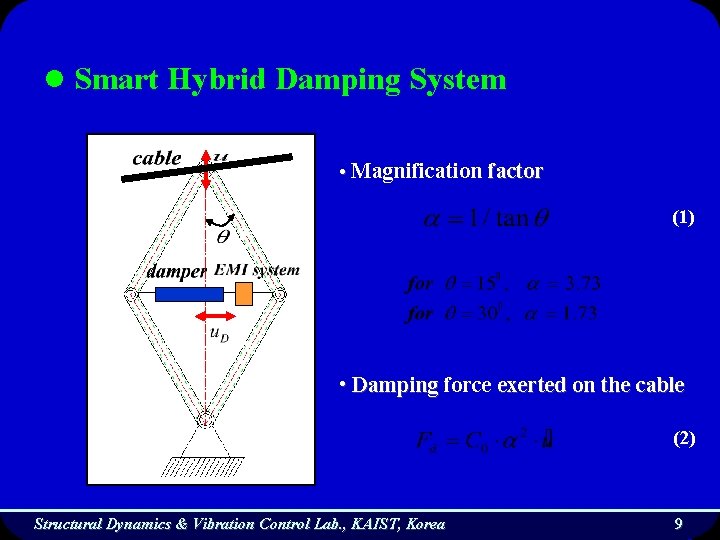
l Smart Hybrid Damping System • Magnification factor (1) • Damping force exerted on the cable (2) Structural Dynamics & Vibration Control Lab. , KAIST, Korea 9
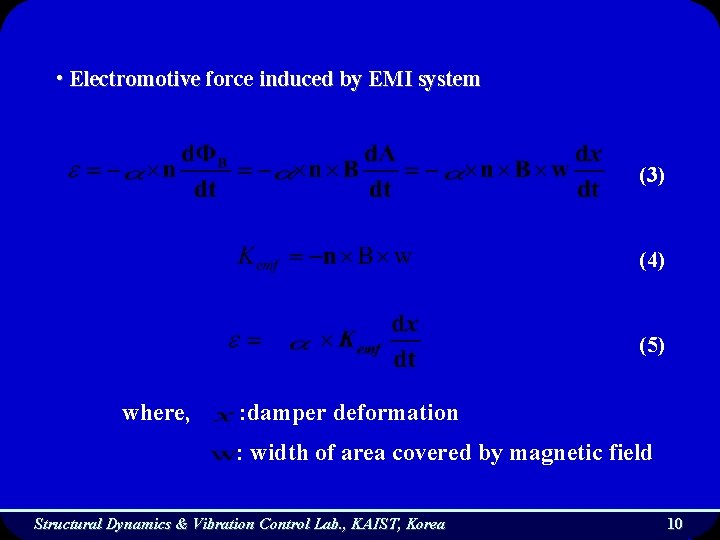
• Electromotive force induced by EMI system (3) (4) (5) where, : damper deformation : width of area covered by magnetic field Structural Dynamics & Vibration Control Lab. , KAIST, Korea 10
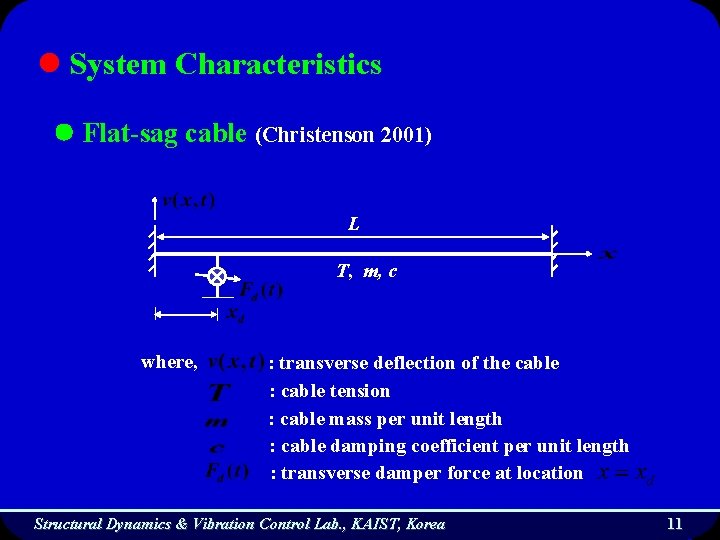
l System Characteristics Flat-sag cable (Christenson 2001) L T, m, c where, : transverse deflection of the cable : cable tension : cable mass per unit length : cable damping coefficient per unit length : transverse damper force at location Structural Dynamics & Vibration Control Lab. , KAIST, Korea 11
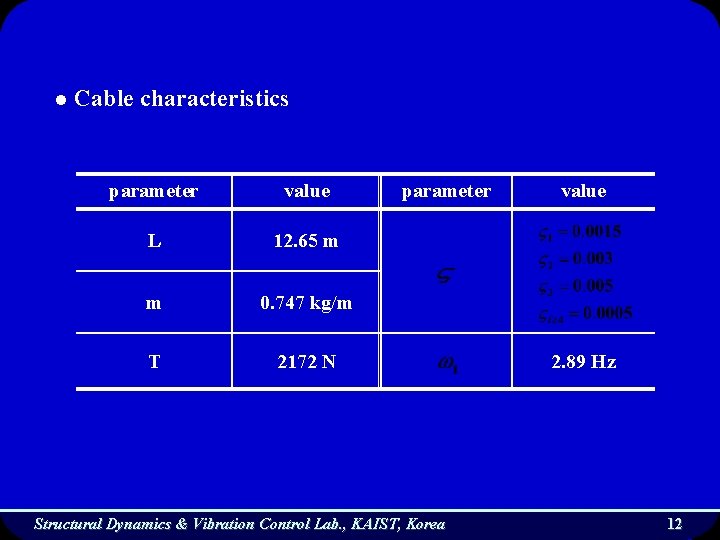
l Cable characteristics parameter value L 12. 65 m m 0. 747 kg/m T 2172 N parameter Structural Dynamics & Vibration Control Lab. , KAIST, Korea value 2. 89 Hz 12
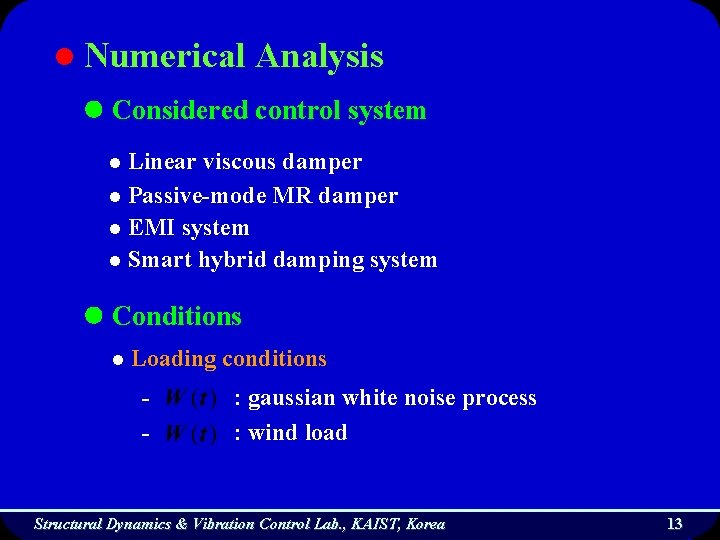
l Numerical Analysis Considered control system Linear viscous damper l Passive-mode MR damper l EMI system l Smart hybrid damping system l Conditions l Loading conditions - : gaussian white noise process : wind load Structural Dynamics & Vibration Control Lab. , KAIST, Korea 13
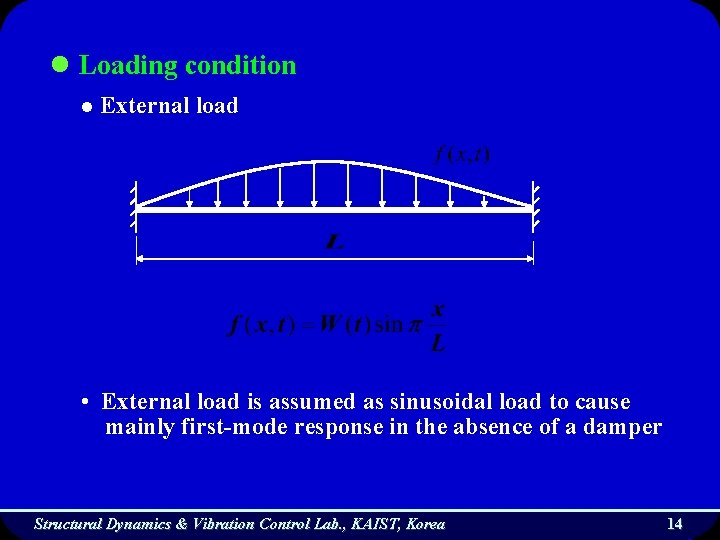
l Loading condition l External load • External load is assumed as sinusoidal load to cause mainly first-mode response in the absence of a damper Structural Dynamics & Vibration Control Lab. , KAIST, Korea 14
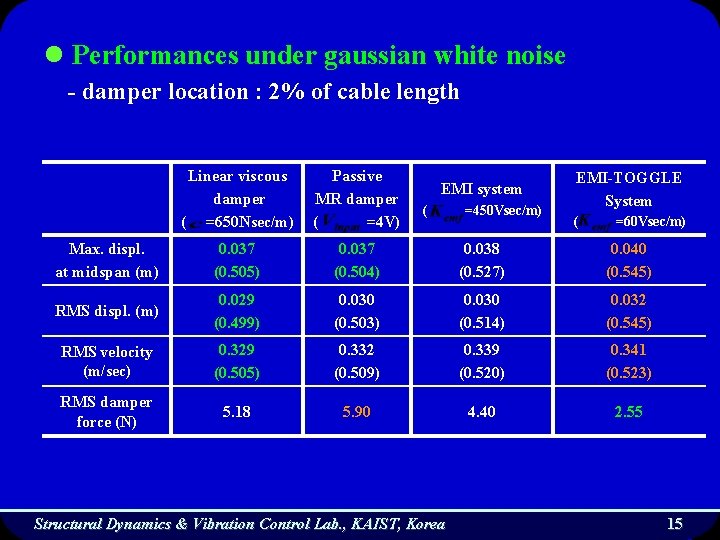
l Performances under gaussian white noise - damper location : 2% of cable length Linear viscous damper ( =650 Nsec/m) Passive MR damper ( =4 V) Max. displ. at midspan (m) 0. 037 (0. 505) 0. 037 (0. 504) 0. 038 (0. 527) 0. 040 (0. 545) RMS displ. (m) 0. 029 (0. 499) 0. 030 (0. 503) 0. 030 (0. 514) 0. 032 (0. 545) RMS velocity (m/sec) 0. 329 (0. 505) 0. 332 (0. 509) 0. 339 (0. 520) 0. 341 (0. 523) RMS damper force (N) 5. 18 5. 90 4. 40 2. 55 EMI system ( Structural Dynamics & Vibration Control Lab. , KAIST, Korea =450 Vsec/m) EMI-TOGGLE System ( =60 Vsec/m) 15
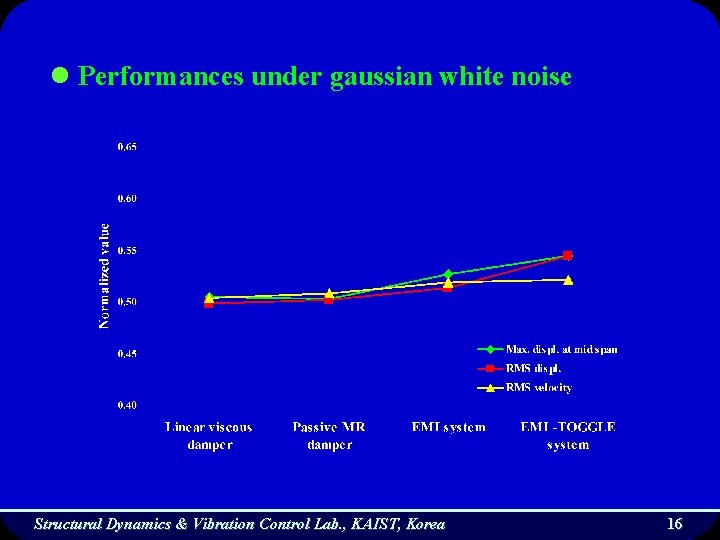
l Performances under gaussian white noise Structural Dynamics & Vibration Control Lab. , KAIST, Korea 16
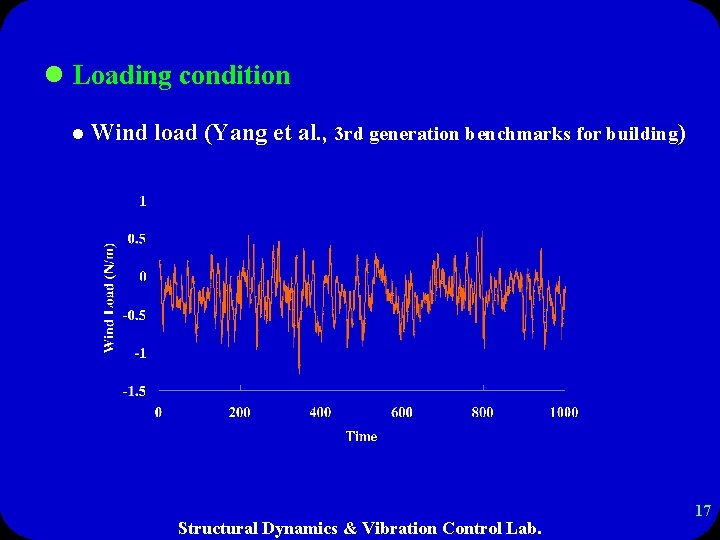
l Loading condition l Wind load (Yang et al. , 3 rd generation benchmarks for building) Structural Dynamics & Vibration Control Lab. 17
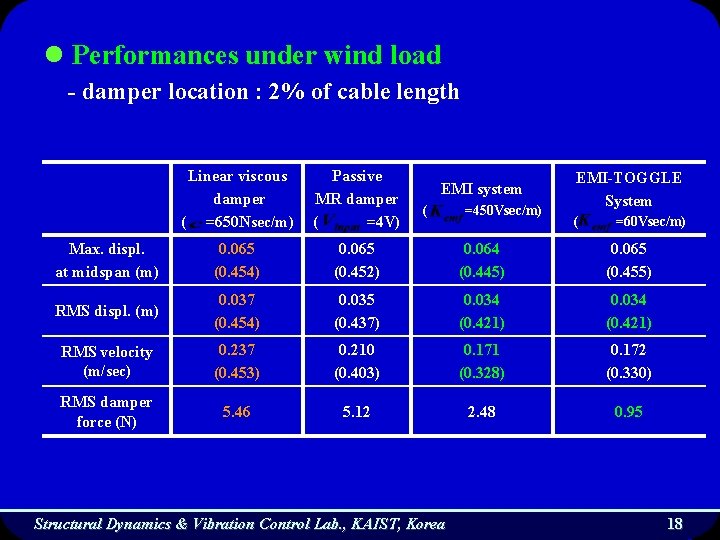
l Performances under wind load - damper location : 2% of cable length Linear viscous damper ( =650 Nsec/m) Passive MR damper ( =4 V) Max. displ. at midspan (m) 0. 065 (0. 454) 0. 065 (0. 452) 0. 064 (0. 445) 0. 065 (0. 455) RMS displ. (m) 0. 037 (0. 454) 0. 035 (0. 437) 0. 034 (0. 421) RMS velocity (m/sec) 0. 237 (0. 453) 0. 210 (0. 403) 0. 171 (0. 328) 0. 172 (0. 330) RMS damper force (N) 5. 46 5. 12 2. 48 0. 95 EMI system ( Structural Dynamics & Vibration Control Lab. , KAIST, Korea =450 Vsec/m) EMI-TOGGLE System ( =60 Vsec/m) 18
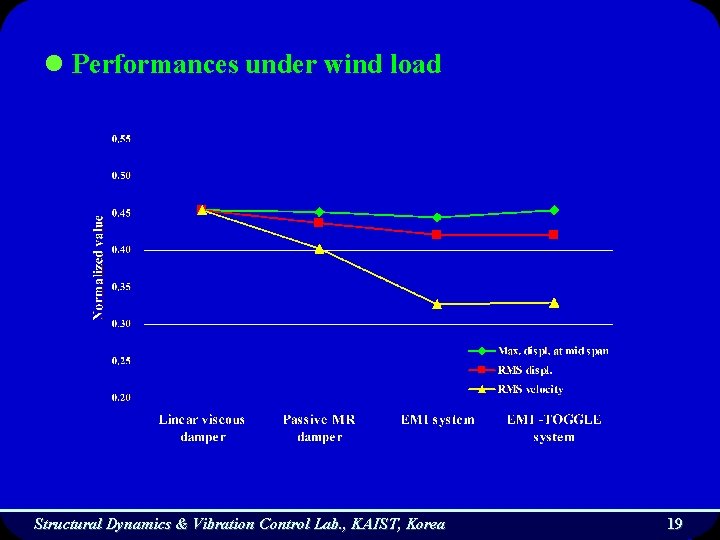
l Performances under wind load Structural Dynamics & Vibration Control Lab. , KAIST, Korea 19
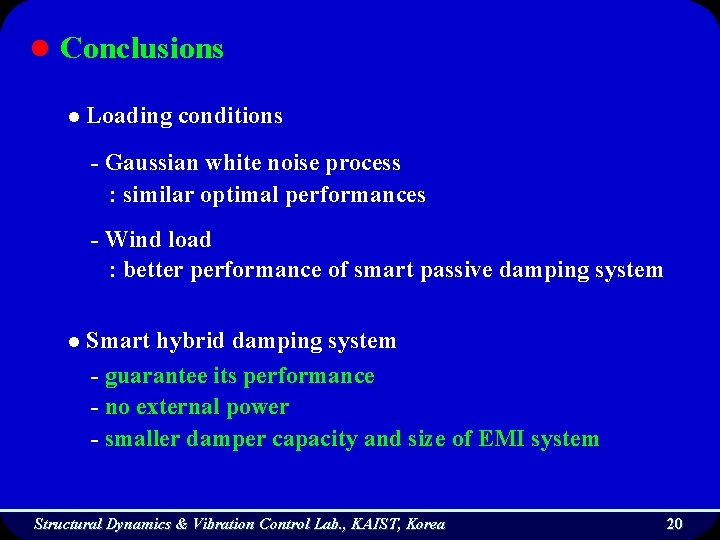
l Conclusions l Loading conditions - Gaussian white noise process : similar optimal performances - Wind load : better performance of smart passive damping system l Smart hybrid damping system - guarantee its performance - no external power - smaller damper capacity and size of EMI system Structural Dynamics & Vibration Control Lab. , KAIST, Korea 20
- Slides: 20