
Contents Introduction Tierra system description Mactierra Results Discussion

![Ancestor 1111 self exam find 0000 [start] bx find 0001 [end] ax calculate size](https://slidetodoc.com/presentation_image_h2/b72e7297f8ad6c464b764f27811d9ab4/image-16.jpg "Ancestor 1111 self exam find 0000 [start] bx find 0001 [end] ax calculate size")


![1111 self exam find 0000 [start] bx find 0001 [end] ax calculate size cx](https://slidetodoc.com/presentation_image_h2/b72e7297f8ad6c464b764f27811d9ab4/image-21.jpg "1111 self exam find 0000 [start] bx find 0001 [end] ax calculate size cx")
![1111 self exam find 0000 ]start] bx find 0001 ]end] ax calculate size cx](https://slidetodoc.com/presentation_image_h2/b72e7297f8ad6c464b764f27811d9ab4/image-24.jpg "1111 self exam find 0000 ]start] bx find 0001 ]end] ax calculate size cx")
![1111 self exam find 0000 [start] bx find 0001 [end] ax calculate size cx](https://slidetodoc.com/presentation_image_h2/b72e7297f8ad6c464b764f27811d9ab4/image-27.jpg "1111 self exam find 0000 [start] bx find 0001 [end] ax calculate size cx")


- Slides: 42
Contents • • • Introduction Tierra system description Mac-tierra Results Discussion
Introduction • Exploration of life in general is limited • Tierra is an artificial life model to explore the origin of diversity
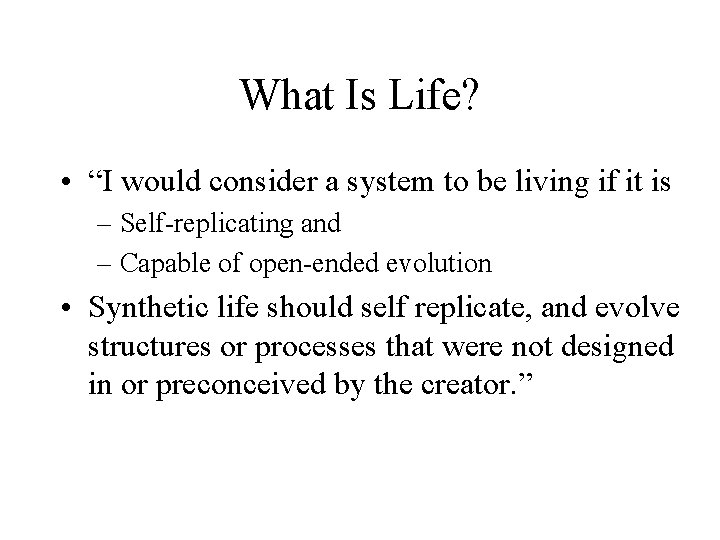
What Is Life? • “I would consider a system to be living if it is – Self-replicating and – Capable of open-ended evolution • Synthetic life should self replicate, and evolve structures or processes that were not designed in or preconceived by the creator. ”
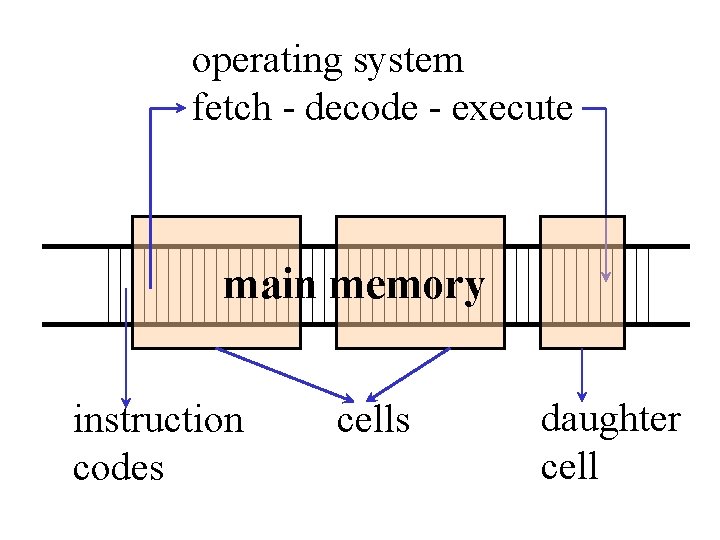
The Tierra Simulator • Virtual parallel computer • Cellularity: each program gets its own memory and CPU time. Each cell can read and execute every instruction but has write permission to its own or its daughter cell • The operating system executes the code of each cell in the computer’s memory
operating system fetch - decode - execute main memory instruction codes cells daughter cell
The Language • Special machine language to be portable and secure • Small instruction set (32 instructions, operands included), that is less fragile when the code is mutated • Jumps: addressing by templates
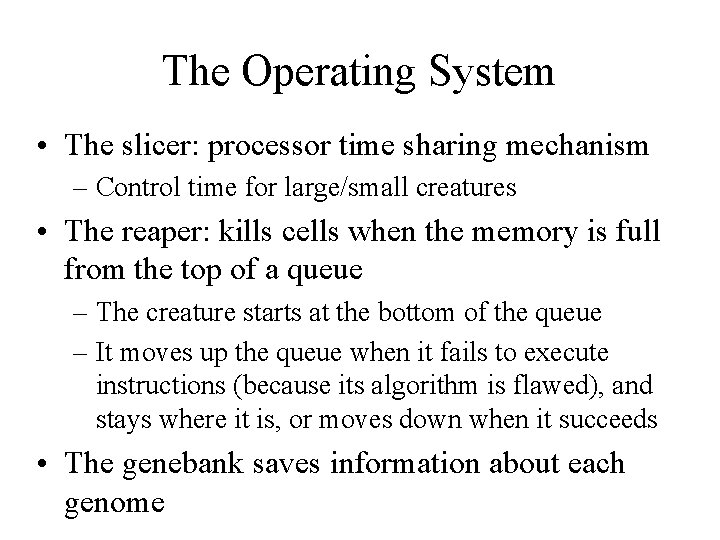
The Operating System • The slicer: processor time sharing mechanism – Control time for large/small creatures • The reaper: kills cells when the memory is full from the top of a queue – The creature starts at the bottom of the queue – It moves up the queue when it fails to execute instructions (because its algorithm is flawed), and stays where it is, or moves down when it succeeds • The genebank saves information about each genome
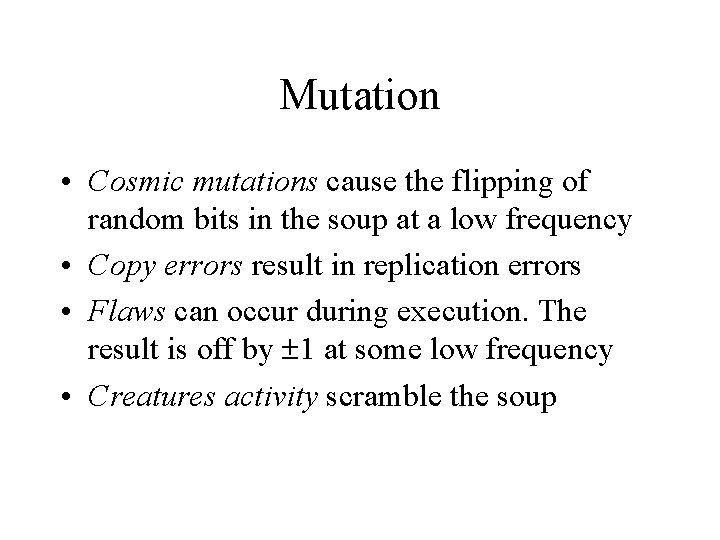
Mutation • Cosmic mutations cause the flipping of random bits in the soup at a low frequency • Copy errors result in replication errors • Flaws can occur during execution. The result is off by 1 at some low frequency • Creatures activity scramble the soup
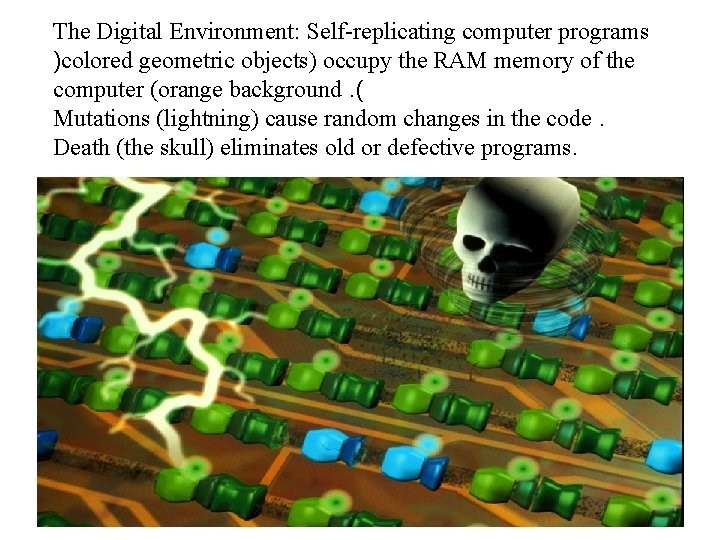
The Digital Environment: Self-replicating computer programs )colored geometric objects) occupy the RAM memory of the computer (orange background. ( Mutations (lightning) cause random changes in the code. Death (the skull) eliminates old or defective programs.
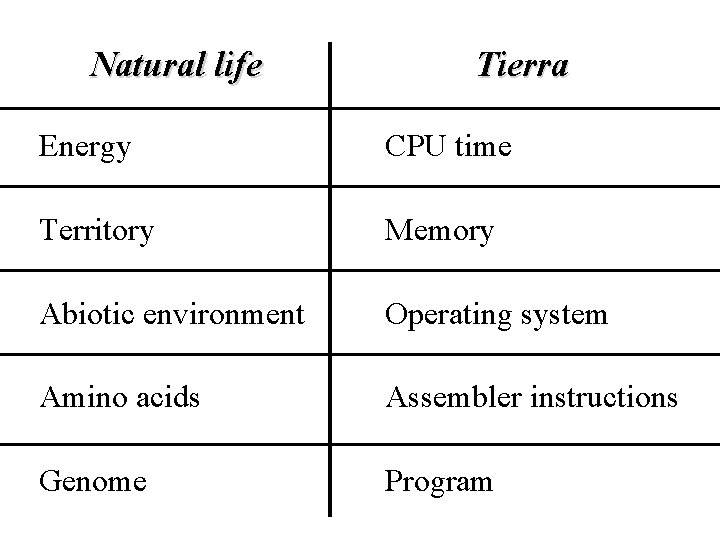
Natural life Tierra Energy CPU time Territory Memory Abiotic environment Operating system Amino acids Assembler instructions Genome Program
The ancestor • The simulation start with one simple self replicating ancestor - 80 instructions. • This ancestor evolve communities of interacting “living” creatures, due to mutations.
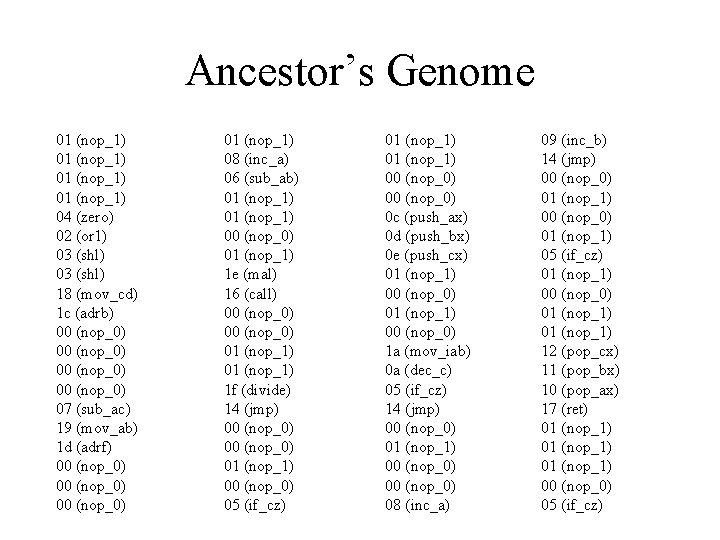
Ancestor’s Genome 01 (nop_1) 04 (zero) 02 (or 1) 03 (shl) 18 (mov_cd) 1 c (adrb) 00 (nop_0) 07 (sub_ac) 19 (mov_ab) 1 d (adrf) 00 (nop_0) 01 (nop_1) 08 (inc_a) 06 (sub_ab) 01 (nop_1) 00 (nop_0) 01 (nop_1) 1 e (mal) 16 (call) 00 (nop_0) 01 (nop_1) 1 f (divide) 14 (jmp) 00 (nop_0) 01 (nop_1) 00 (nop_0) 05 (if_cz) 01 (nop_1) 00 (nop_0) 0 c (push_ax) 0 d (push_bx) 0 e (push_cx) 01 (nop_1) 00 (nop_0) 1 a (mov_iab) 0 a (dec_c) 05 (if_cz) 14 (jmp) 00 (nop_0) 01 (nop_1) 00 (nop_0) 08 (inc_a) 09 (inc_b) 14 (jmp) 00 (nop_0) 01 (nop_1) 05 (if_cz) 01 (nop_1) 00 (nop_0) 01 (nop_1) 12 (pop_cx) 11 (pop_bx) 10 (pop_ax) 17 (ret) 01 (nop_1) 00 (nop_0) 05 (if_cz)
Ancestor 1111 self exam find 0000 [start] bx find 0001 [end] ax calculate size cx 1101 reproduction loop Allocate daughter ax call 0011 (copy procedure( cell division jump 0010 1100 copy procedure Save registers to stack 1010 move |bx| |ax| decrement cx if cx==0 jump 0100 increment ax & bx jump 0101 1011 restore registers return 1110
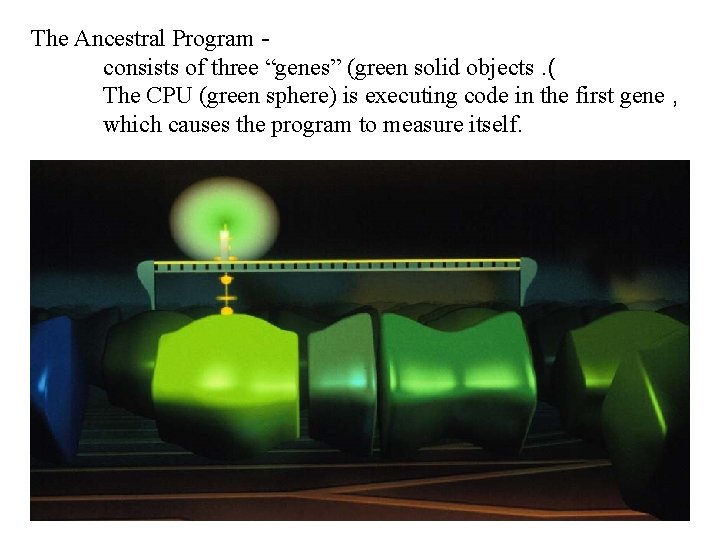
The Ancestral Program consists of three “genes” (green solid objects. ( The CPU (green sphere) is executing code in the first gene , which causes the program to measure itself.
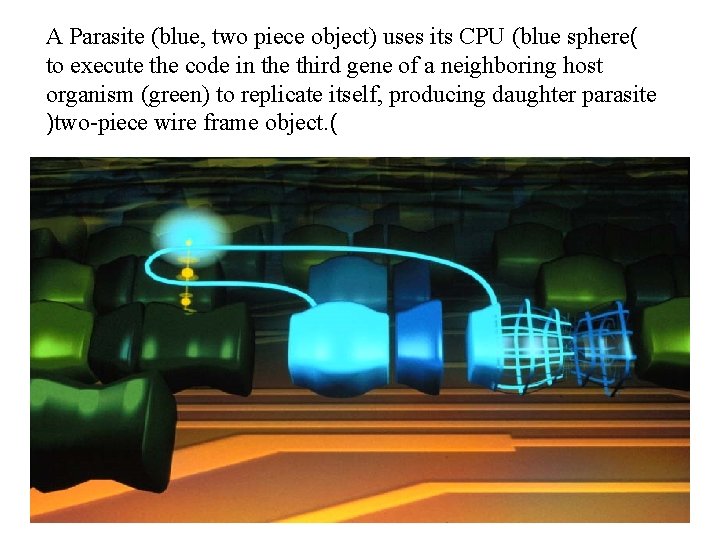
The Parasite • Uses the ancestor’s copy procedure to copy himself • The host is not affected by the parasite • Superior competitor • 45 instructions • Population cycles
1111 self exam find 0000 [start] bx find 0001 [end] ax calculate size cx 1101 reproduction loop Allocate daughter ax call 0011 (copy procedure( cell division jump 0010 1100 copy procedure Save registers to stack 1010 move |bx| |ax| decrement cx if cx==0 jump 0100 increment ax & bx jump 0101 1011 restore registers return 1110 Ancestor & parasite 1111 self exam find 0000 [start] bx find 0001 [end] ax calculate size cx 1101 reproduction loop Allocate daughter ax call 0011 (copy procedure( cell division jump 0010 1110
A Parasite (blue, two piece object) uses its CPU (blue sphere( to execute the code in the third gene of a neighboring host organism (green) to replicate itself, producing daughter parasite )two-piece wire frame object. (
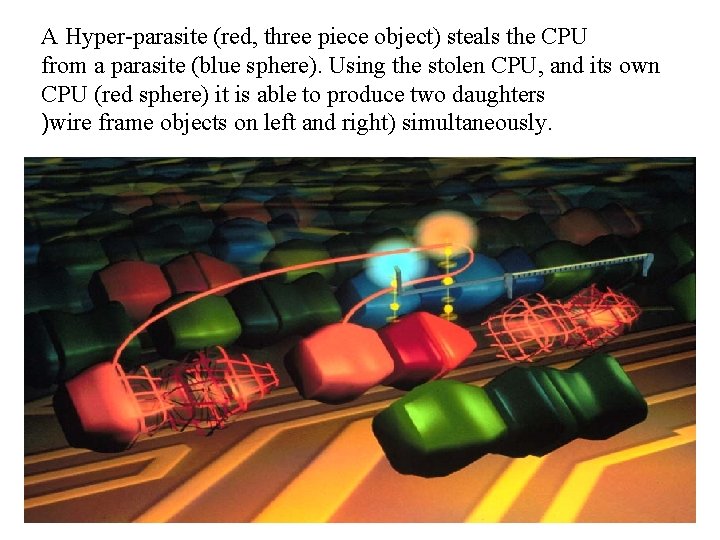
The Hyper-Parasite • Robust self-replicate program by itself • When a parasite tries to use the hyperparasite, the hyper-parasite cause the parasite to replicate the hyper-parasite • Drive the parasites to extinction
1111 self exam find 0000 ]start] bx find 0001 ]end] ax calculate size cx Hyper-parasite 1101 reproduction loop Allocate daughter ax call 0011 cell division jump 0000 1100 copy procedure 1010 move |bx| |ax| decrement cx if cx==0 jump 1100 increment ax & bx jump 0101 1110 parasite 1111 self exam find 0000 [start] bx find 0001 [end] ax calculate size cx 1101 reproduction loop Allocate daughter ax call 0011 (copy procedure( cell division jump 0010 1110
A Hyper-parasite (red, three piece object) steals the CPU from a parasite (blue sphere). Using the stolen CPU, and its own CPU (red sphere) it is able to produce two daughters )wire frame objects on left and right) simultaneously.
Symbionts • Manually created • One contains the self-exam and copy procedure • The other contains the self-exam and reproduction loop • 46 and 64 instructions
1111 self exam find 0000 [start] bx find 0001 [end] ax calculate size cx jump 0010 1100 copy procedure Save registers to stack 1010 move |bx| |ax| decrement cx if cx==0 jump 0100 increment ax & bx jump 0101 1011 restore registers return 1110 symbionts 1111 self exam find 0000 [start] bx find 0001 [end] ax calculate size cx jump 0010 1101 reproduction loop Allocate daughter ax call 0011 (copy procedure( cell division jump 0010 1110
Social Hyper-Parasites • Appear when there is genetic uniformity • Cooperate with the previous social hyperparasite cell • 61 instructions • Jumping templates of size 3
Cheaters: Hyper Parasites • Invade the social system • Position themselves between aggregating hyper parasites to capture the instruction pointer • 27 instructions
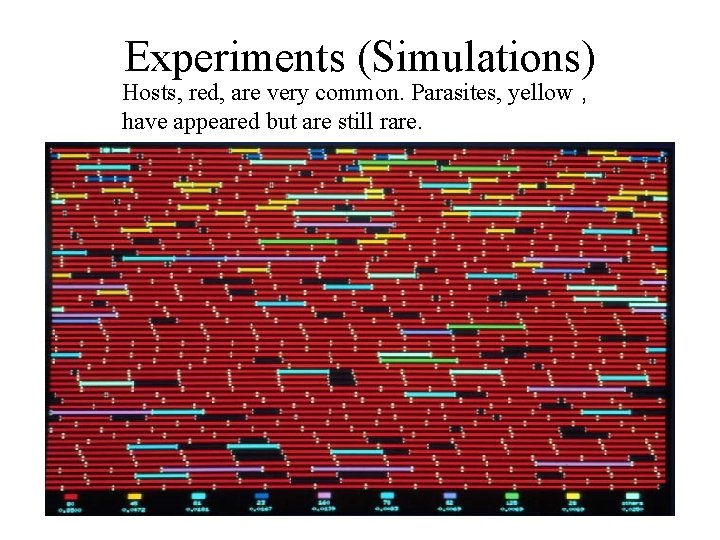
Experiments (Simulations) Hosts, red, are very common. Parasites, yellow , have appeared but are still rare.
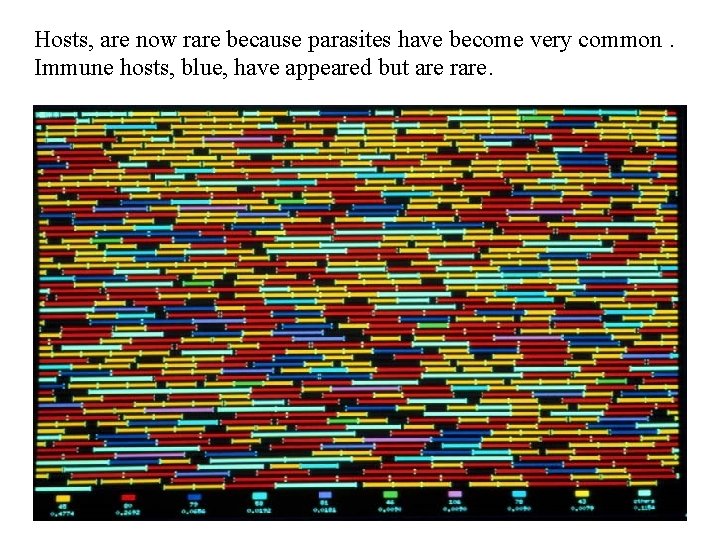
Hosts, are now rare because parasites have become very common. Immune hosts, blue, have appeared but are rare.
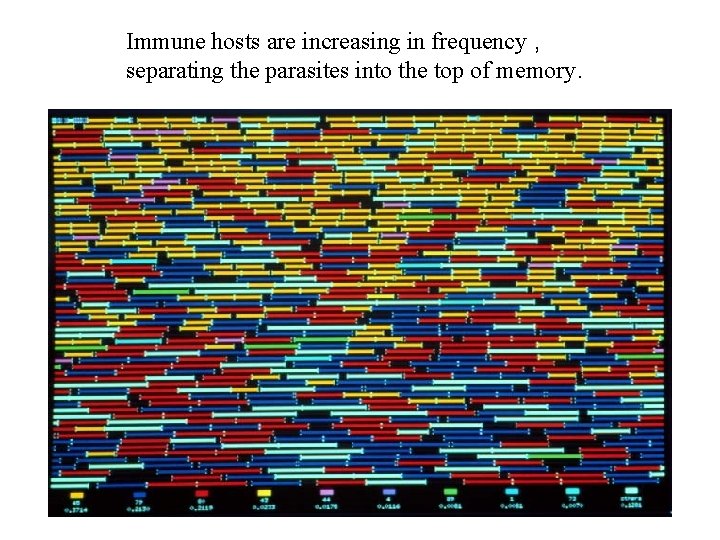
Immune hosts are increasing in frequency , separating the parasites into the top of memory.
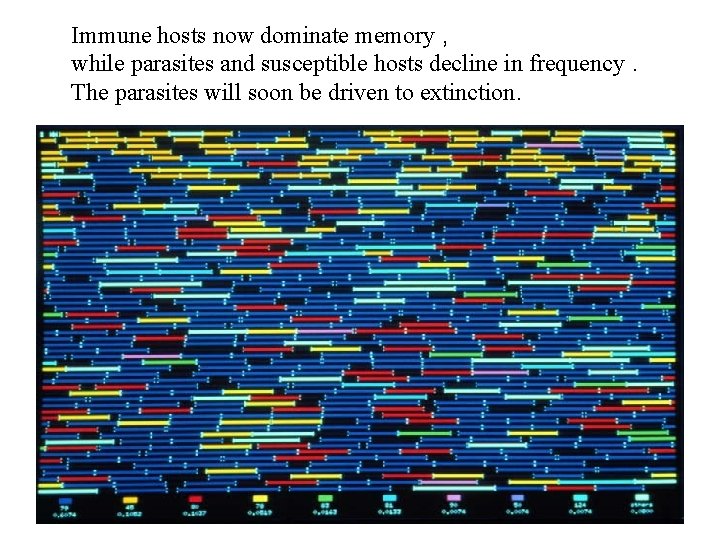
Immune hosts now dominate memory , while parasites and susceptible hosts decline in frequency. The parasites will soon be driven to extinction.
Experiments (Simulations) • Changing parameters: – Mutation rate – Selection for small/large cells • Exploring the ecology in controlled environment – Run two competing cells without mutation – Run a fixed population of cells • Micro/macro scales
Emergence • Cariani defined emergence relative to the expected model as the state when the model no longer describes the system • Emergence types: – Syntactic – Semantic – Pragmatic
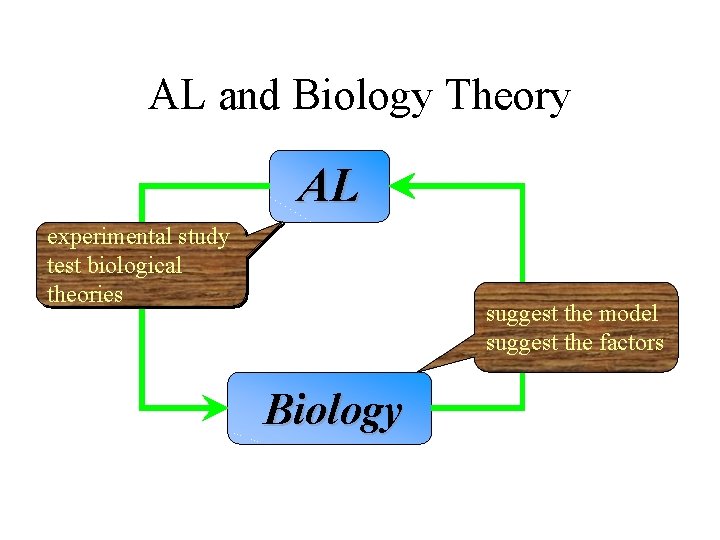
AL and Biology Theory AL experimental study test biological theories suggest the model suggest the factors Biology
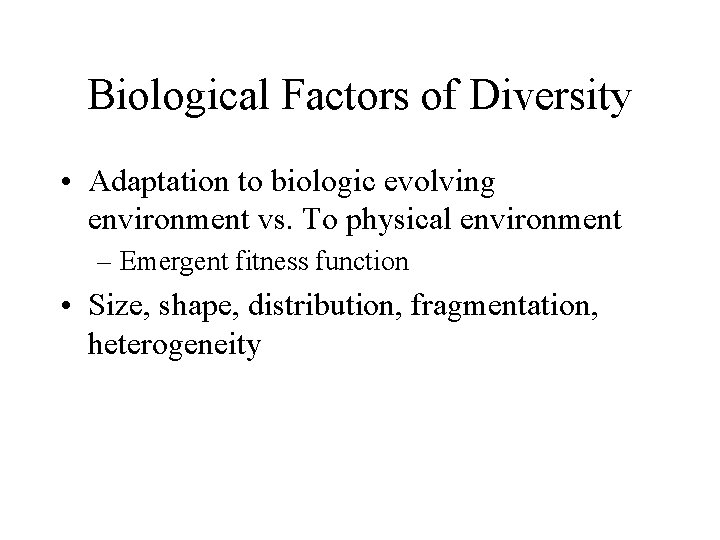
Biological Factors of Diversity • Adaptation to biologic evolving environment vs. To physical environment – Emergent fitness function • Size, shape, distribution, fragmentation, heterogeneity
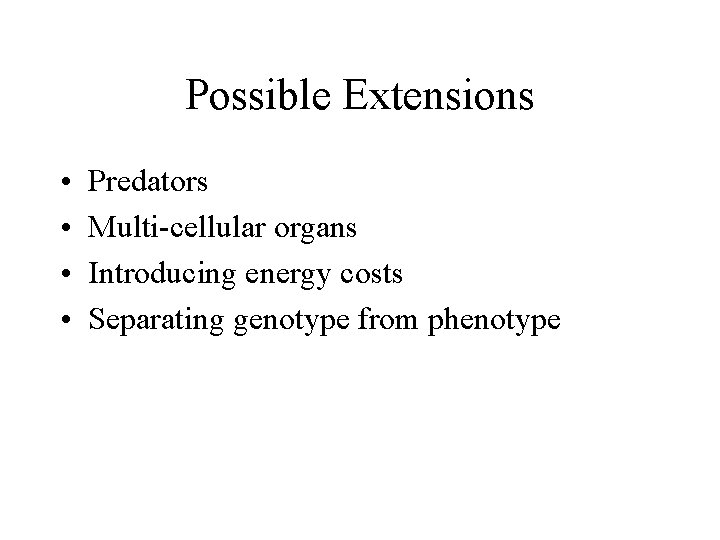
Possible Extensions • • Predators Multi-cellular organs Introducing energy costs Separating genotype from phenotype
Summary • A framework for synthesis of life was presented • Natural-like behavior was detected in the system • This system opens the way for interdisciplinary future research
Resources • The Tierra homepage - Thomas Ray www. hip. atr. co. jp/~ray/tierra. html • Mac Tierra - Simon Fraser www. santfe. edu/~smfr/mactierra. html • Core life - Erik de Neve www. xs 4 all. nl/~alife/corelife. htm