
Contents DSI Strategic Plan 2020 2025 and APP
- Slides: 61
Contents DSI Strategic Plan 2020 - 2025 and APP 2020/21 Chapter 01 14 May 2020 Chapter 01 Chapter 01 0
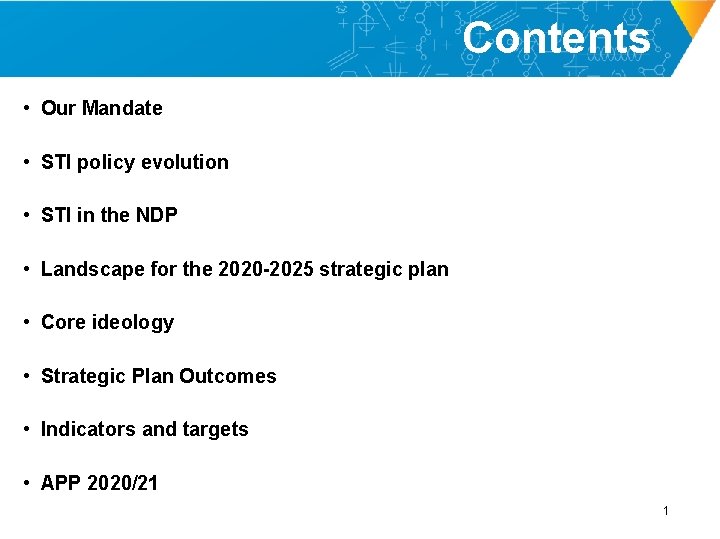
Contents • Our Mandate • STI policy evolution • STI in the NDP • Landscape for the 2020 -2025 strategic plan • Core ideology • Strategic Plan Outcomes • Indicators and targets • APP 2020/21 1
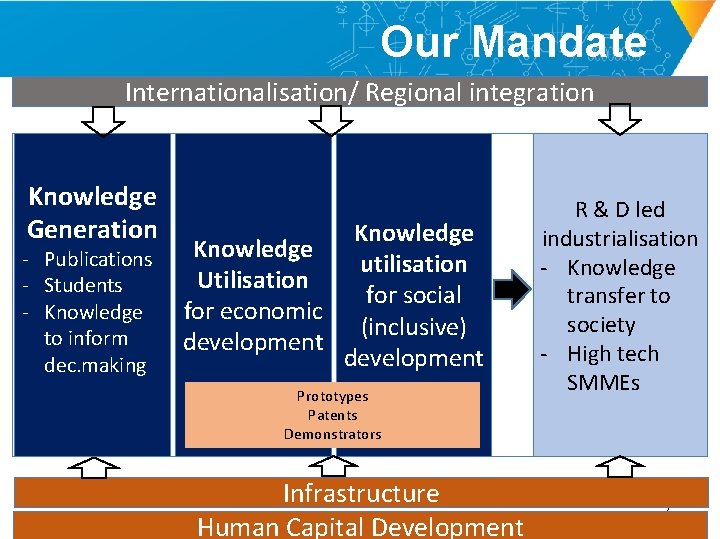
Our Mandate Internationalisation/ Regional integration Knowledge Generation - Publications - Students - Knowledge to inform dec. making Knowledge utilisation Utilisation for social for economic (inclusive) development Prototypes Patents Demonstrators Infrastructure Human Capital Development R & D led industrialisation - Knowledge transfer to society - High tech SMMEs 2
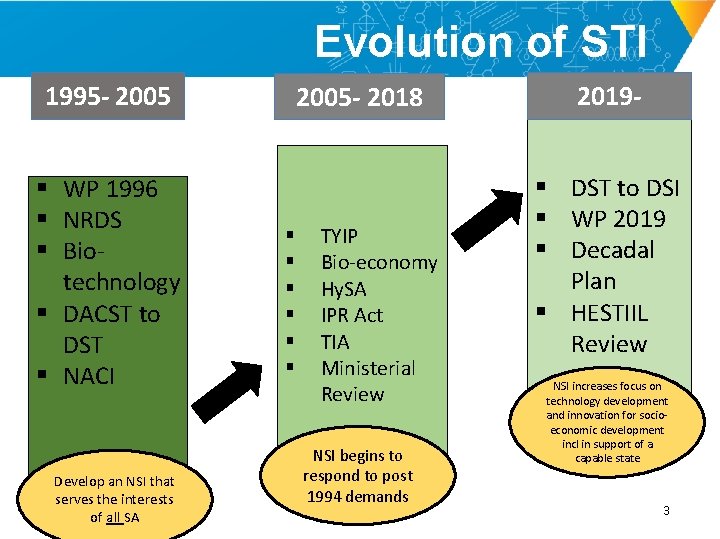
Evolution of STI policy 20192005 - 2018 1995 - 2005 § WP 1996 § NRDS § Biotechnology § DACST to DST § NACI Develop an NSI that serves the interests of all SA § § § TYIP Bio-economy Hy. SA IPR Act TIA Ministerial Review NSI begins to respond to post 1994 demands § DST to DSI § WP 2019 § Decadal Plan § HESTIIL Review NSI increases focus on technology development and innovation for socioeconomic development incl in support of a capable state 3
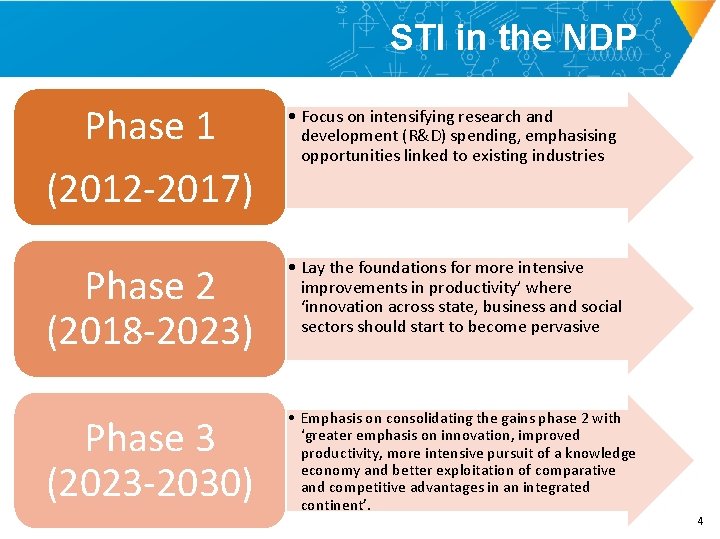
STI in the NDP Phase 1 (2012 -2017) • Focus on intensifying research and development (R&D) spending, emphasising opportunities linked to existing industries Phase 2 (2018 -2023) • Lay the foundations for more intensive improvements in productivity’ where ‘innovation across state, business and social sectors should start to become pervasive Phase 3 (2023 -2030) • Emphasis on consolidating the gains phase 2 with ‘greater emphasis on innovation, improved productivity, more intensive pursuit of a knowledge economy and better exploitation of comparative and competitive advantages in an integrated continent’. 4
What has been our performance to date? 5
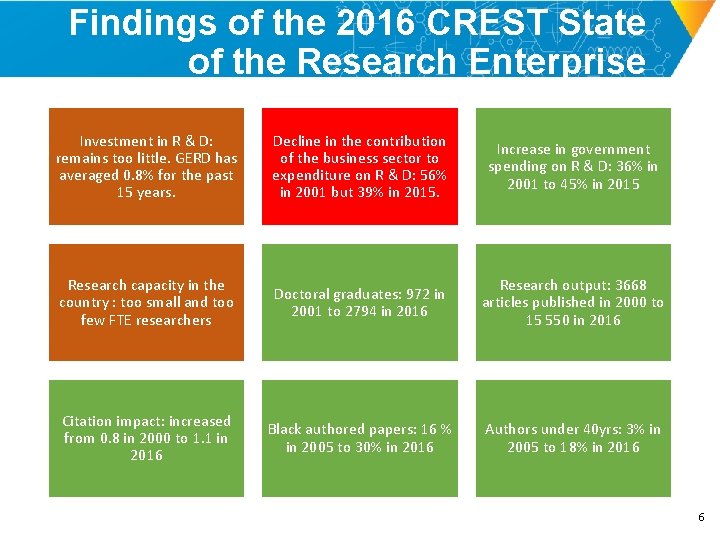
Findings of the 2016 CREST State of the Research Enterprise Investment in R & D: remains too little. GERD has averaged 0. 8% for the past 15 years. Decline in the contribution of the business sector to expenditure on R & D: 56% in 2001 but 39% in 2015. Increase in government spending on R & D: 36% in 2001 to 45% in 2015 Research capacity in the country : too small and too few FTE researchers Doctoral graduates: 972 in 2001 to 2794 in 2016 Research output: 3668 articles published in 2000 to 15 550 in 2016 Citation impact: increased from 0. 8 in 2000 to 1. 1 in 2016 Black authored papers: 16 % in 2005 to 30% in 2016 Authors under 40 yrs: 3% in 2005 to 18% in 2016 6
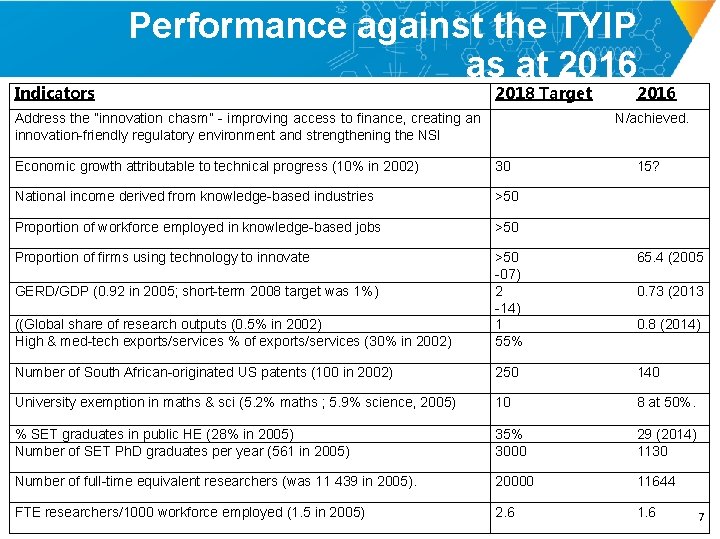
Indicators Performance against the TYIP as at 2016 2018 Target Address the “innovation chasm” - improving access to finance, creating an innovation-friendly regulatory environment and strengthening the NSI 2016 N/achieved. Economic growth attributable to technical progress (10% in 2002) 30 National income derived from knowledge-based industries >50 Proportion of workforce employed in knowledge-based jobs >50 Proportion of firms using technology to innovate 65. 4 (2005 ((Global share of research outputs (0. 5% in 2002) High & med-tech exports/services % of exports/services (30% in 2002) >50 -07) 2 -14) 1 55% Number of South African-originated US patents (100 in 2002) 250 140 University exemption in maths & sci (5. 2% maths ; 5. 9% science, 2005) 10 8 at 50%. % SET graduates in public HE (28% in 2005) Number of SET Ph. D graduates per year (561 in 2005) 35% 3000 29 (2014) 1130 Number of full-time equivalent researchers (was 11 439 in 2005). 20000 11644 FTE researchers/1000 workforce employed (1. 5 in 2005) 2. 6 1. 6 GERD/GDP (0. 92 in 2005; short-term 2008 target was 1%) 15? 0. 73 (2013 0. 8 (2014) 7
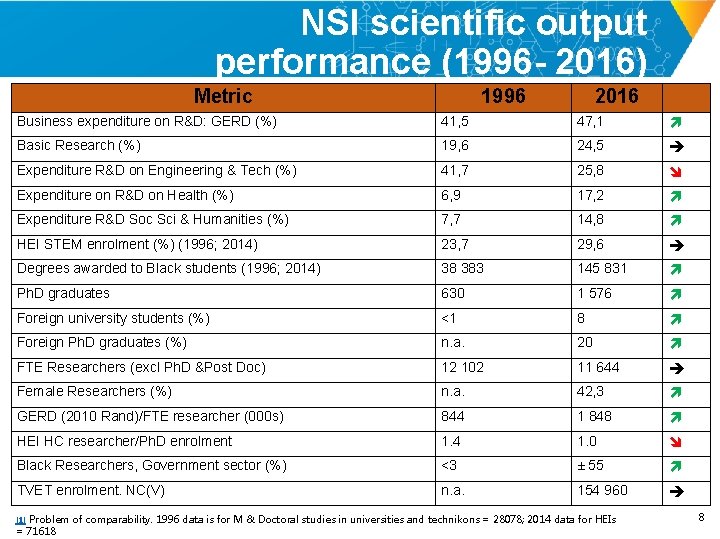
NSI scientific output performance (1996 - 2016) Metric 1996 2016 Business expenditure on R&D: GERD (%) 41, 5 47, 1 Basic Research (%) 19, 6 24, 5 Expenditure R&D on Engineering & Tech (%) 41, 7 25, 8 Expenditure on R&D on Health (%) 6, 9 17, 2 Expenditure R&D Soc Sci & Humanities (%) 7, 7 14, 8 HEI STEM enrolment (%) (1996; 2014) 23, 7 29, 6 Degrees awarded to Black students (1996; 2014) 38 383 145 831 Ph. D graduates 630 1 576 Foreign university students (%) <1 8 Foreign Ph. D graduates (%) n. a. 20 FTE Researchers (excl Ph. D &Post Doc) 12 102 11 644 Female Researchers (%) n. a. 42, 3 GERD (2010 Rand)/FTE researcher (000 s) 844 1 848 HEI HC researcher/Ph. D enrolment 1. 4 1. 0 Black Researchers, Government sector (%) <3 ± 55 TVET enrolment. NC(V) n. a. 154 960 Problem of comparability. 1996 data is for M & Doctoral studies in universities and technikons = 28078; 2014 data for HEIs = 71618 [1] 8
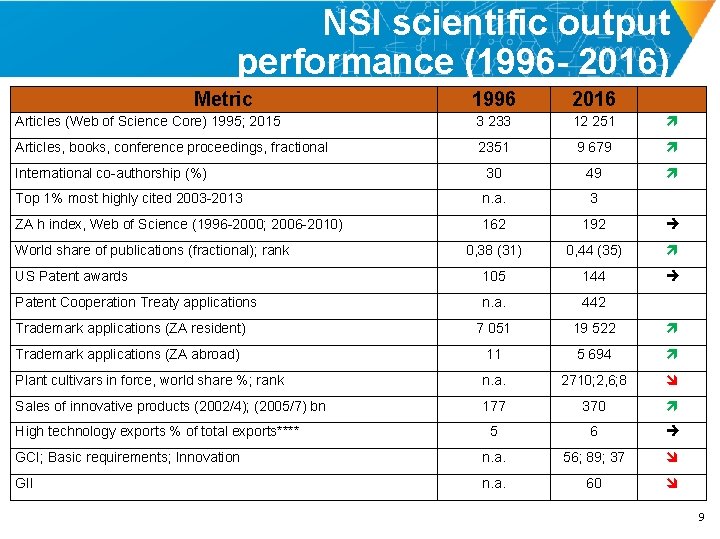
NSI scientific output performance (1996 - 2016) Metric 1996 2016 Articles (Web of Science Core) 1995; 2015 3 233 12 251 Articles, books, conference proceedings, fractional 2351 9 679 International co-authorship (%) 30 49 Top 1% most highly cited 2003 -2013 n. a. 3 ZA h index, Web of Science (1996 -2000; 2006 -2010) 162 192 0, 38 (31) 0, 44 (35) US Patent awards 105 144 Patent Cooperation Treaty applications n. a. 442 Trademark applications (ZA resident) 7 051 19 522 Trademark applications (ZA abroad) 11 5 694 Plant cultivars in force, world share %; rank n. a. 2710; 2, 6; 8 Sales of innovative products (2002/4); (2005/7) bn 177 370 5 6 GCI; Basic requirements; Innovation n. a. 56; 89; 37 GII n. a. 60 World share of publications (fractional); rank High technology exports % of total exports**** 9
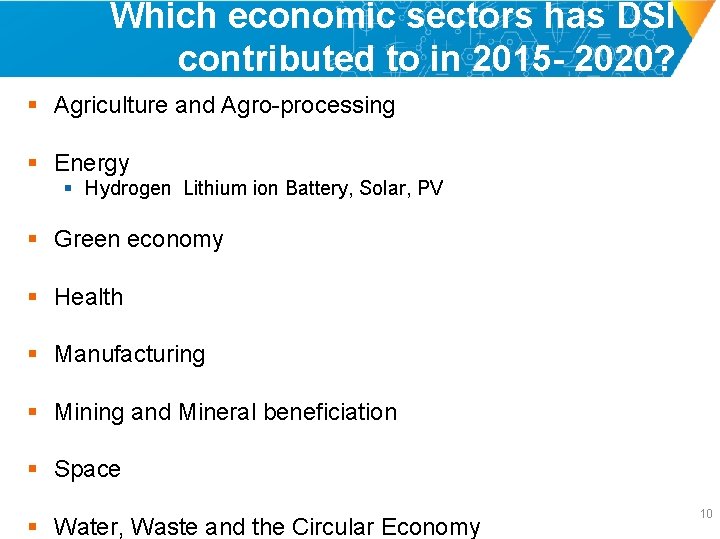
Which economic sectors has DSI contributed to in 2015 - 2020? § Agriculture and Agro-processing § Energy § Hydrogen Lithium ion Battery, Solar, PV § Green economy § Health § Manufacturing § Mining and Mineral beneficiation § Space § Water, Waste and the Circular Economy 10
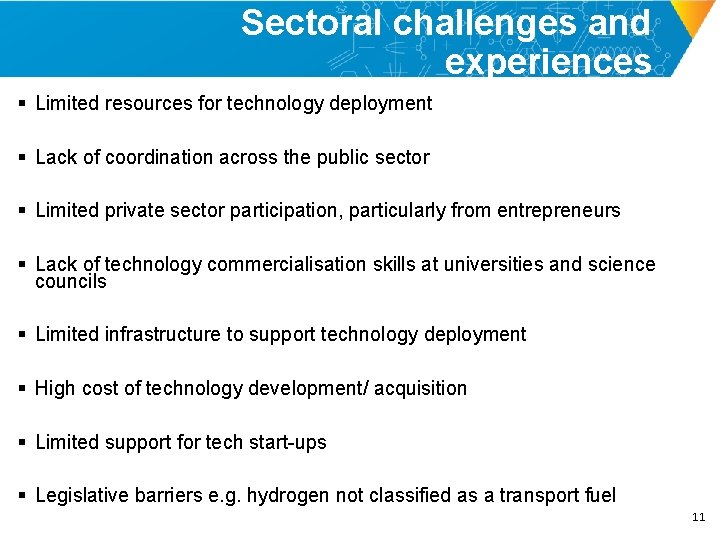
Sectoral challenges and experiences § Limited resources for technology deployment § Lack of coordination across the public sector § Limited private sector participation, particularly from entrepreneurs § Lack of technology commercialisation skills at universities and science councils § Limited infrastructure to support technology deployment § High cost of technology development/ acquisition § Limited support for tech start-ups § Legislative barriers e. g. hydrogen not classified as a transport fuel 11
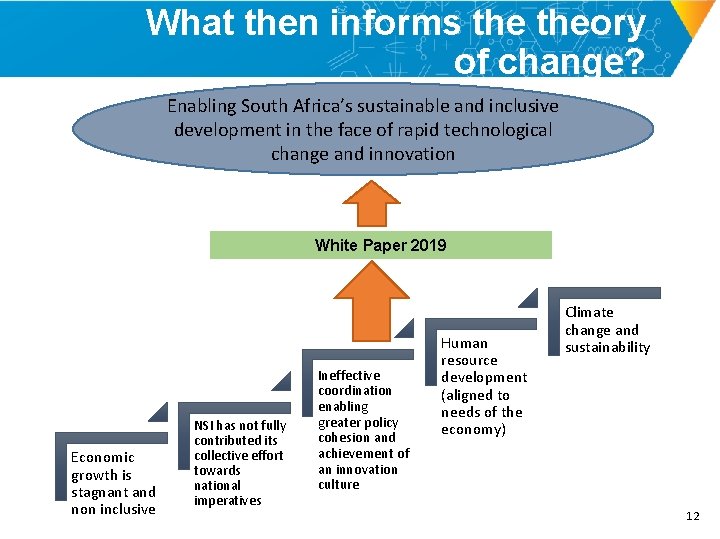
What then informs theory of change? Enabling South Africa’s sustainable and inclusive development in the face of rapid technological change and innovation White Paper 2019 Economic growth is stagnant and non inclusive NSI has not fully contributed its collective effort towards national imperatives Ineffective coordination enabling greater policy cohesion and achievement of an innovation culture Human resource development (aligned to needs of the economy) Climate change and sustainability 12
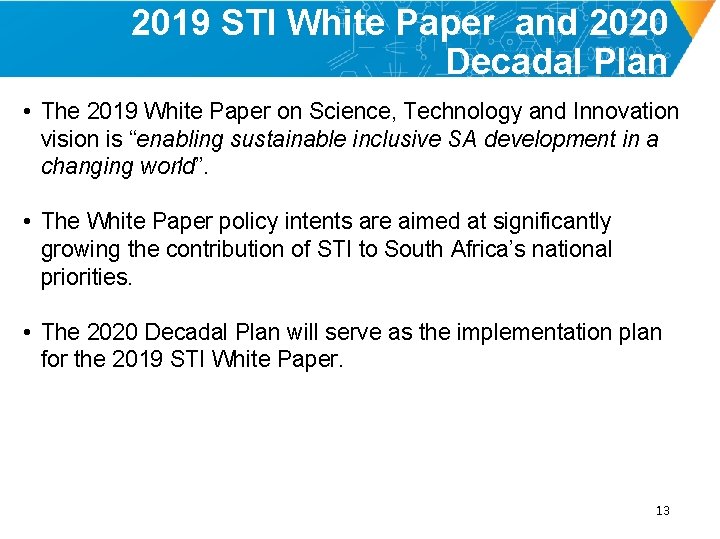
2019 STI White Paper and 2020 Decadal Plan • The 2019 White Paper on Science, Technology and Innovation vision is “enabling sustainable inclusive SA development in a changing world”. • The White Paper policy intents are aimed at significantly growing the contribution of STI to South Africa’s national priorities. • The 2020 Decadal Plan will serve as the implementation plan for the 2019 STI White Paper. 13
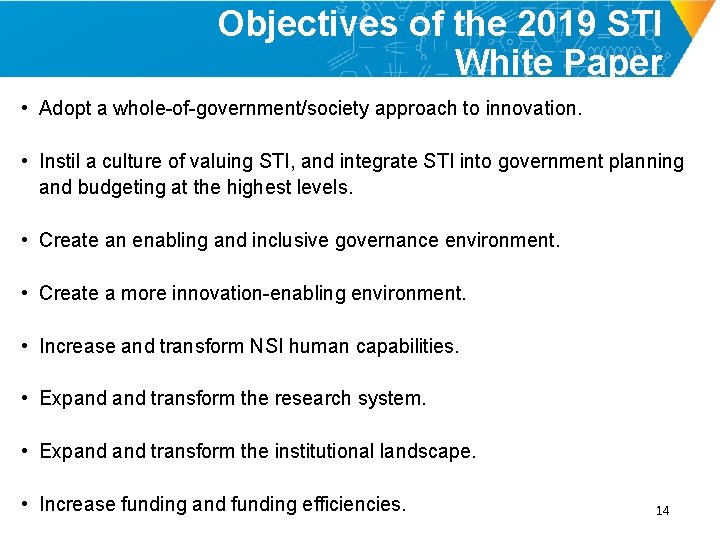
Objectives of the 2019 STI White Paper • Adopt a whole-of-government/society approach to innovation. • Instil a culture of valuing STI, and integrate STI into government planning and budgeting at the highest levels. • Create an enabling and inclusive governance environment. • Create a more innovation-enabling environment. • Increase and transform NSI human capabilities. • Expand transform the research system. • Expand transform the institutional landscape. • Increase funding and funding efficiencies. 14
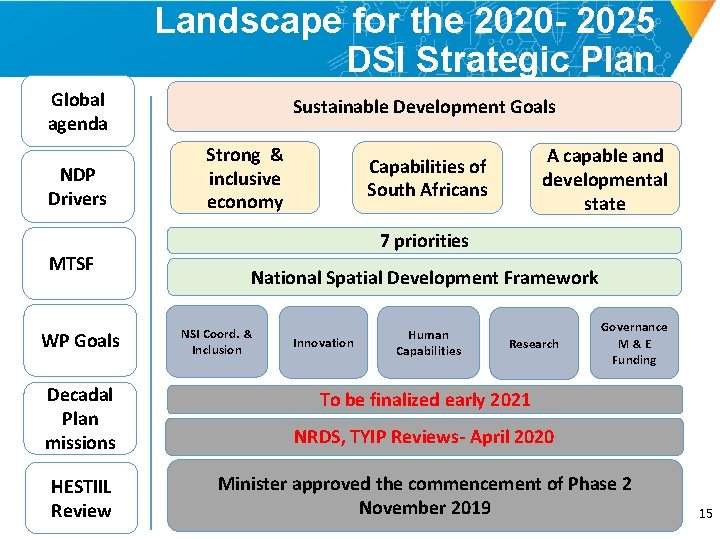
Landscape for the 2020 - 2025 DSI Strategic Plan Global agenda NDP Drivers MTSF Sustainable Development Goals Strong & inclusive economy A capable and developmental state Capabilities of South Africans 7 priorities F WP Goals National Spatial Development Framework NSI Coord. & Inclusion Innovation Human Capabilities Research Governance M&E Funding Decadal Plan missions NRDS, TYIP Reviews- April 2020 HESTIIL Review Minister approved the commencement of Phase 2 November 2019 To be finalized early 2021 15
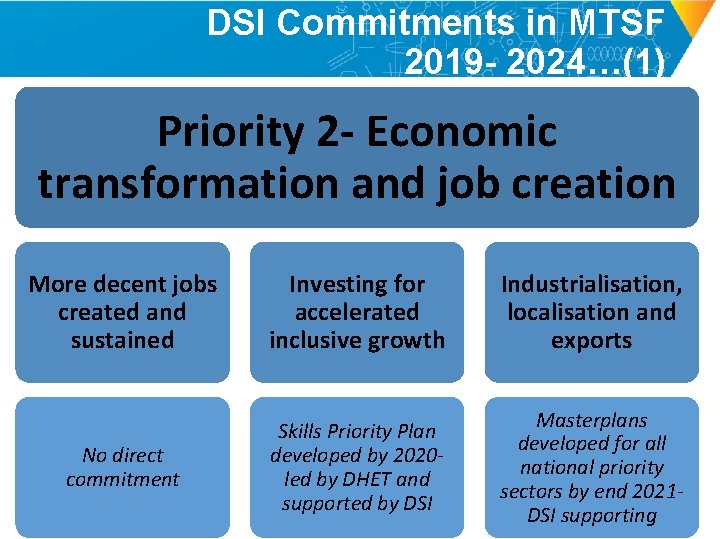
DSI Commitments in MTSF 2019 - 2024…(1) Priority 2 - Economic transformation and job creation More decent jobs created and sustained Investing for accelerated inclusive growth Industrialisation, localisation and exports No direct commitment Skills Priority Plan developed by 2020 led by DHET and supported by DSI Masterplans developed for all national priority sectors by end 2021 DSI supporting
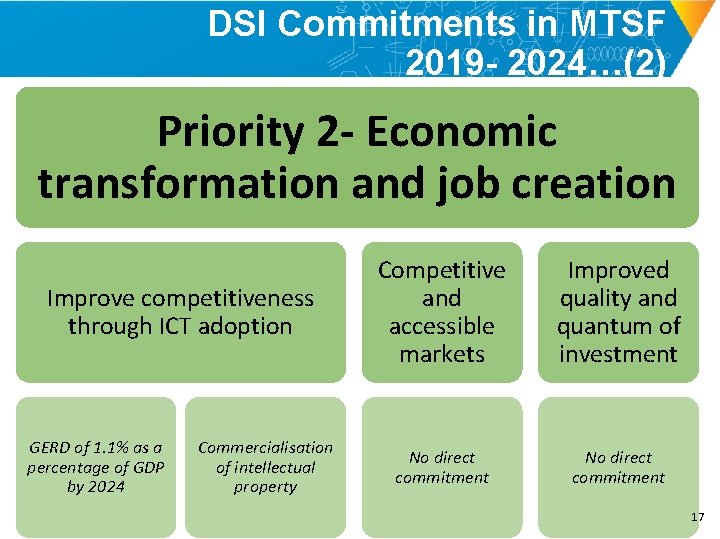
DSI Commitments in MTSF 2019 - 2024…(2) Priority 2 - Economic transformation and job creation Improve competitiveness through ICT adoption GERD of 1. 1% as a percentage of GDP by 2024 Commercialisation of intellectual property Competitive and accessible markets Improved quality and quantum of investment No direct commitment 17
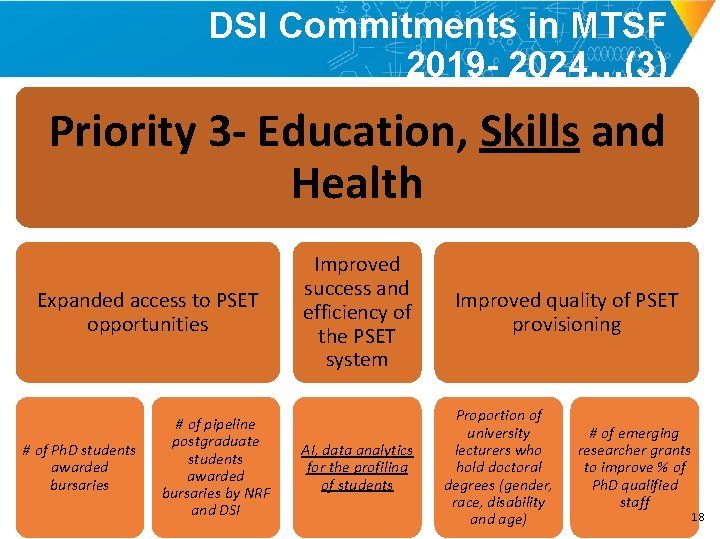
DSI Commitments in MTSF 2019 - 2024…(3) Priority 3 - Education, Skills and Health Expanded access to PSET opportunities # of Ph. D students awarded bursaries # of pipeline postgraduate students awarded bursaries by NRF and DSI Improved success and efficiency of the PSET system AI, data analytics for the profiling of students Improved quality of PSET provisioning Proportion of university lecturers who hold doctoral degrees (gender, race, disability and age) # of emerging researcher grants to improve % of Ph. D qualified staff 18
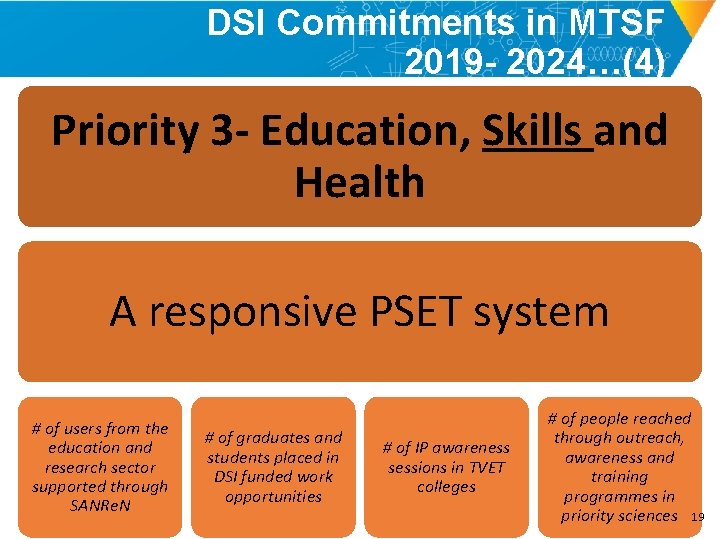
DSI Commitments in MTSF 2019 - 2024…(4) Priority 3 - Education, Skills and Health A responsive PSET system # of users from the education and research sector supported through SANRe. N # of graduates and students placed in DSI funded work opportunities # of IP awareness sessions in TVET colleges # of people reached through outreach, awareness and training programmes in priority sciences 19
Other MTSF aspects of relevance to the DSI and its entities • Women, Youth and people with disability as designated groups • Gender-responsive planning, budgeting and reporting framework • Data disaggregation at planning and M & E • Priority 1 - A Capable, Ethical and Developmental State • Innovation in support of a capable and developmental state • District- Metro Coordination Model to Improve the Coherence and Impact of Government Service Delivery and Development 20
Supporting other priorities of the MTSF • Priority 2: Increase the contribution of digital economy to GDP through 4 IR • Achieving 100% universal broadband by aligning and contributing to the Do. C Satellite Communication Strategy • Priority 3: Education, Skills and Health • TB treatment research success rate • Better diagnostics • TB therapies • Local manufacturing of TB drugs • Development of treatment and prevention technologies for HIV, NCD and maternal health care 21
Supporting other priorities of the MTSF • Priority 4: Consolidating the social wage through reliable and quality basic services • Innovative technology approaches for the delivery of basic services (energy, water, sanitation, roads) • Priority 1: Strengthened government capability to deliver on the developmental agenda • Provide timely, accurate and independent data and information for mega projects monitoring and evaluation 22
Supporting other priorities of the MTSF • Priority 6: Spatial integration, human settlements and local government • Provision of applications and products for precision agriculture, human settlement and water bodies information layers • Demonstrations in partnership with the Department of Mineral Resources and Energy to assess the appropriateness of new technologies such as hydrogen fuel cells to improve service delivery • Provision of information for air quality information system, land cover and land use mapping, frequent information on weather patterns, and human activity on critical resources such as water, land air. • Provision of decision support tools, human settlements layer, water bodies information layer 23
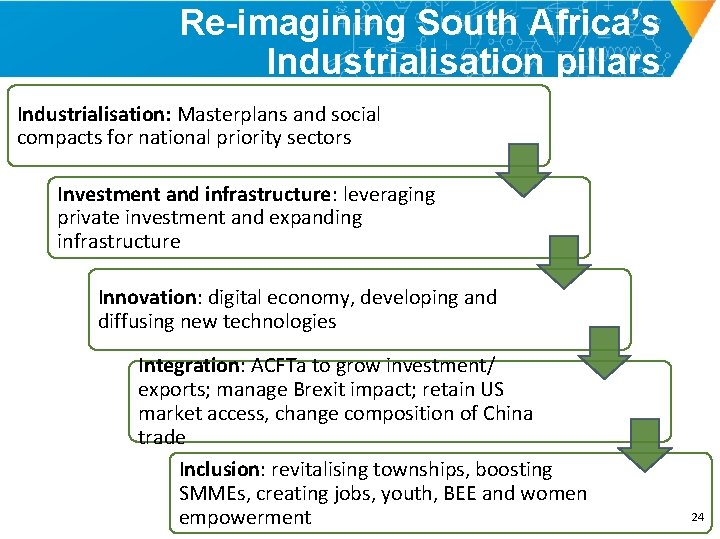
Re-imagining South Africa’s Industrialisation pillars Industrialisation: Masterplans and social compacts for national priority sectors Investment and infrastructure: leveraging private investment and expanding infrastructure Innovation: digital economy, developing and diffusing new technologies Integration: ACFTa to grow investment/ exports; manage Brexit impact; retain US market access, change composition of China trade Inclusion: revitalising townships, boosting SMMEs, creating jobs, youth, BEE and women empowerment 24
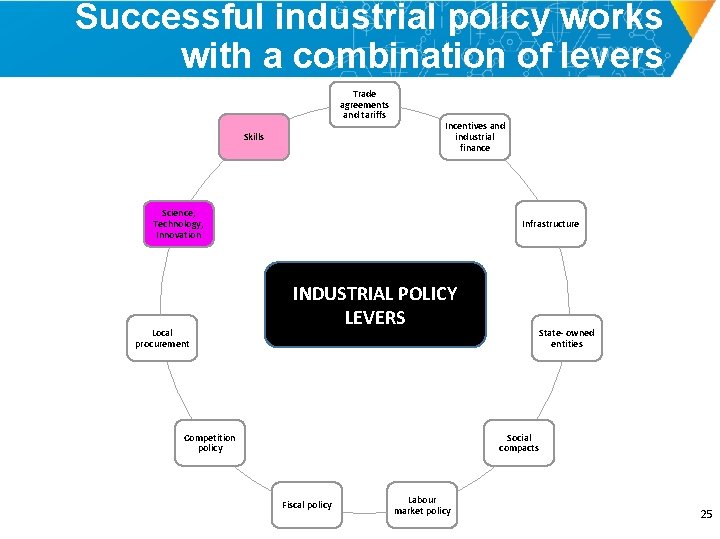
Successful industrial policy works with a combination of levers Trade agreements and tariffs Skills Incentives and industrial finance Science, Technology, Innovation Local procurement Infrastructure INDUSTRIAL POLICY LEVERS Competition policy State- owned entities Social compacts Fiscal policy Labour market policy 25
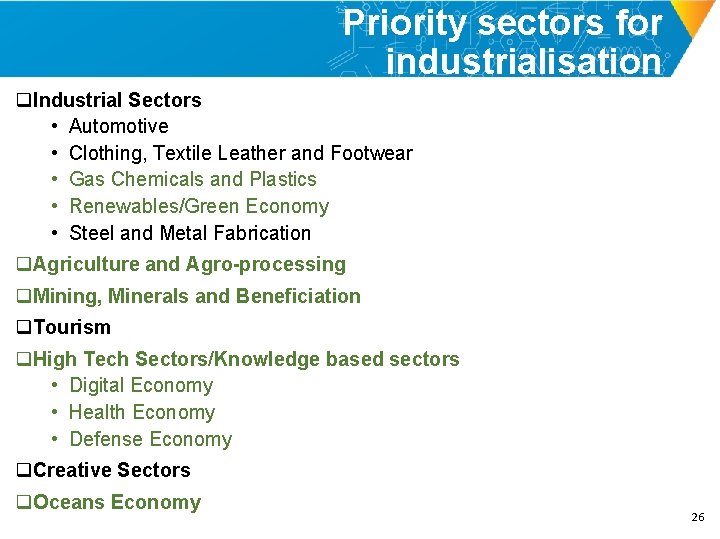
Priority sectors for industrialisation q. Industrial Sectors • Automotive • Clothing, Textile Leather and Footwear • Gas Chemicals and Plastics • Renewables/Green Economy • Steel and Metal Fabrication q. Agriculture and Agro-processing q. Mining, Minerals and Beneficiation q. Tourism q. High Tech Sectors/Knowledge based sectors • Digital Economy • Health Economy • Defense Economy q. Creative Sectors q. Oceans Economy 26
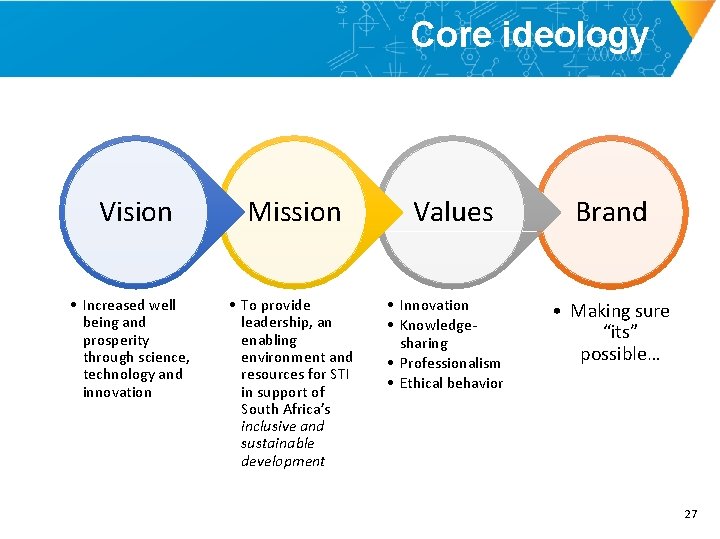
Core ideology Vision • Increased well being and prosperity through science, technology and innovation Mission • To provide leadership, an enabling environment and resources for STI in support of South Africa’s inclusive and sustainable development Values • Innovation • Knowledgesharing • Professionalism • Ethical behavior Brand • Making sure “its” possible… 27
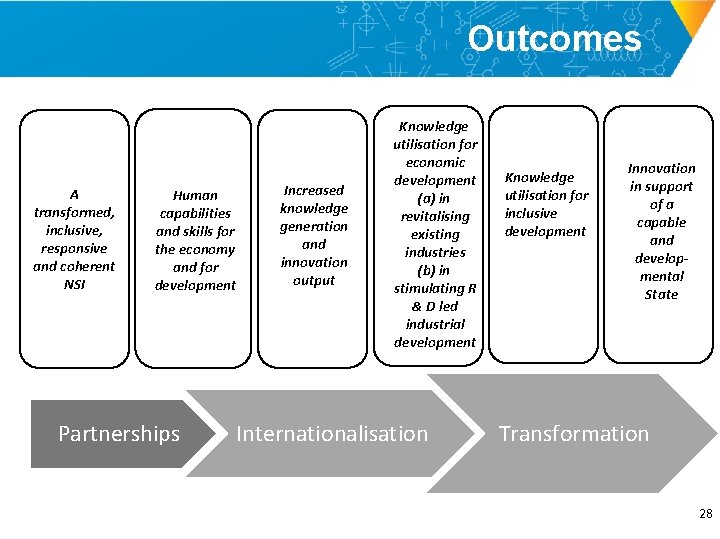
Outcomes A transformed, inclusive, responsive and coherent NSI Human capabilities and skills for the economy and for development Partnerships Increased knowledge generation and innovation output Knowledge utilisation for economic development (a) in revitalising existing industries (b) in stimulating R & D led industrial development Internationalisation Knowledge utilisation for inclusive development Innovation in support of a capable and developmental State Transformation 28
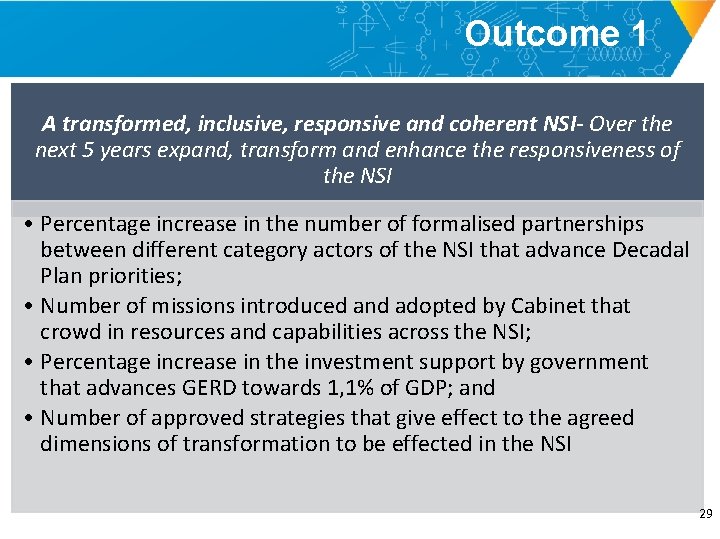
Outcome 1 A transformed, inclusive, responsive and coherent NSI- Over the next 5 years expand, transform and enhance the responsiveness of the NSI • Percentage increase in the number of formalised partnerships between different category actors of the NSI that advance Decadal Plan priorities; • Number of missions introduced and adopted by Cabinet that crowd in resources and capabilities across the NSI; • Percentage increase in the investment support by government that advances GERD towards 1, 1% of GDP; and • Number of approved strategies that give effect to the agreed dimensions of transformation to be effected in the NSI 29
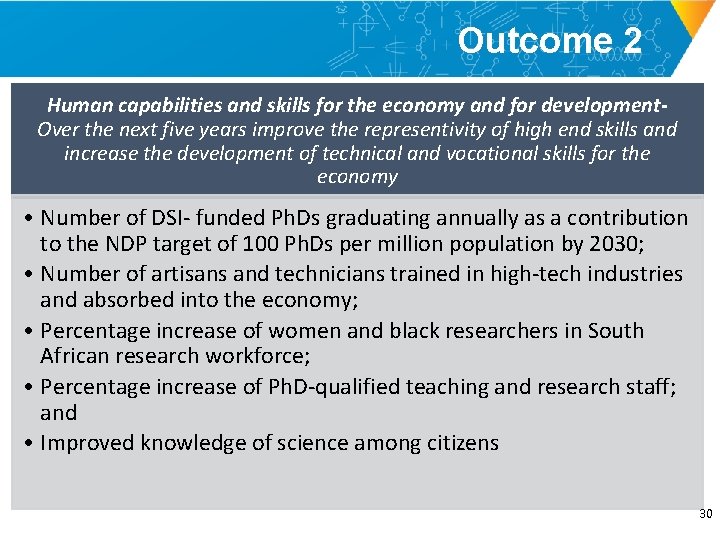
Outcome 2 Human capabilities and skills for the economy and for development. Over the next five years improve the representivity of high end skills and increase the development of technical and vocational skills for the economy • Number of DSI- funded Ph. Ds graduating annually as a contribution to the NDP target of 100 Ph. Ds per million population by 2030; • Number of artisans and technicians trained in high-tech industries and absorbed into the economy; • Percentage increase of women and black researchers in South African research workforce; • Percentage increase of Ph. D-qualified teaching and research staff; and • Improved knowledge of science among citizens 30
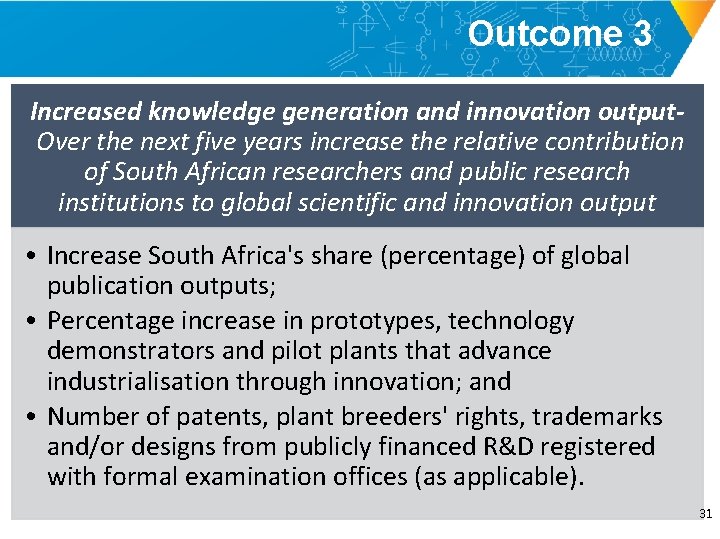
Outcome 3 Increased knowledge generation and innovation output. Over the next five years increase the relative contribution of South African researchers and public research institutions to global scientific and innovation output • Increase South Africa's share (percentage) of global publication outputs; • Percentage increase in prototypes, technology demonstrators and pilot plants that advance industrialisation through innovation; and • Number of patents, plant breeders' rights, trademarks and/or designs from publicly financed R&D registered with formal examination offices (as applicable). 31
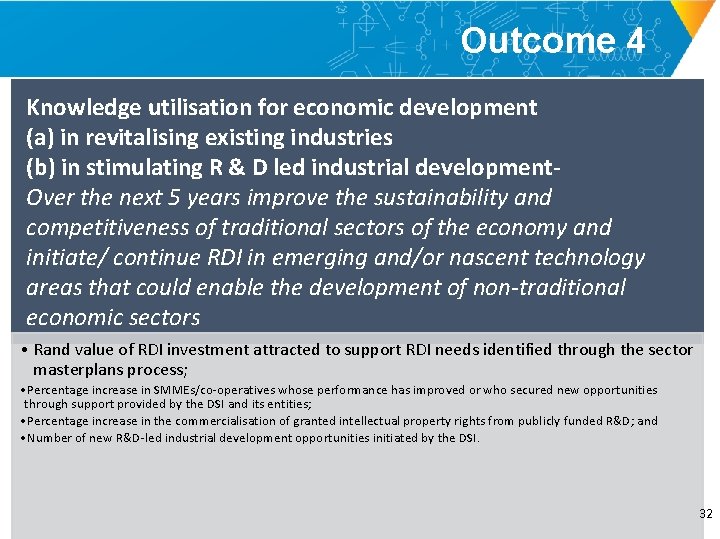
Outcome 4 Knowledge utilisation for economic development (a) in revitalising existing industries (b) in stimulating R & D led industrial development. Over the next 5 years improve the sustainability and competitiveness of traditional sectors of the economy and initiate/ continue RDI in emerging and/or nascent technology areas that could enable the development of non-traditional economic sectors • Rand value of RDI investment attracted to support RDI needs identified through the sector masterplans process; • Percentage increase in SMMEs/co-operatives whose performance has improved or who secured new opportunities through support provided by the DSI and its entities; • Percentage increase in the commercialisation of granted intellectual property rights from publicly funded R&D; and • Number of new R&D-led industrial development opportunities initiated by the DSI. 32
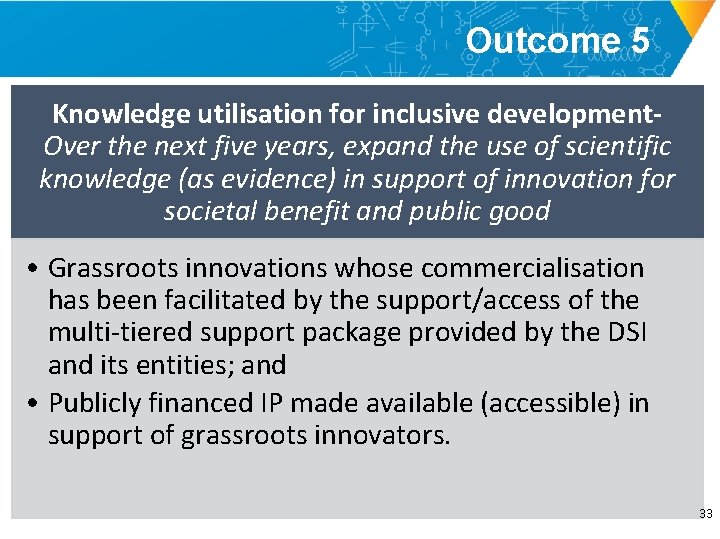
Outcome 5 Knowledge utilisation for inclusive development. Over the next five years, expand the use of scientific knowledge (as evidence) in support of innovation for societal benefit and public good • Grassroots innovations whose commercialisation has been facilitated by the support/access of the multi-tiered support package provided by the DSI and its entities; and • Publicly financed IP made available (accessible) in support of grassroots innovators. 33
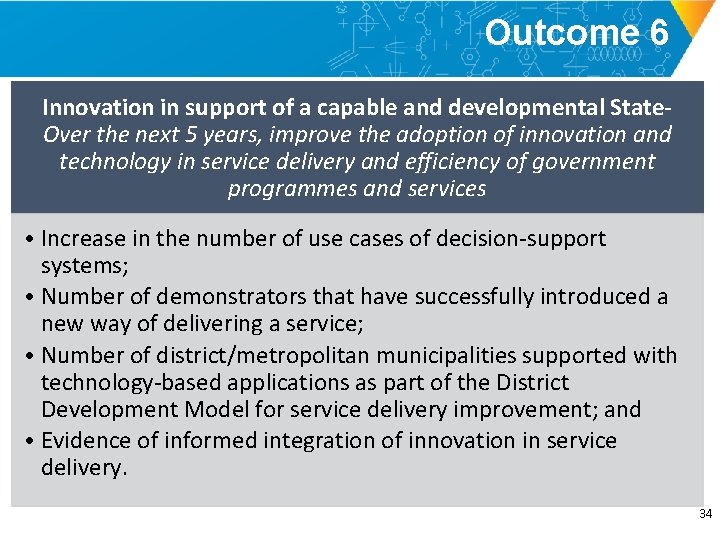
Outcome 6 Innovation in support of a capable and developmental State. Over the next 5 years, improve the adoption of innovation and technology in service delivery and efficiency of government programmes and services • Increase in the number of use cases of decision-support systems; • Number of demonstrators that have successfully introduced a new way of delivering a service; • Number of district/metropolitan municipalities supported with technology-based applications as part of the District Development Model for service delivery improvement; and • Evidence of informed integration of innovation in service delivery. 34
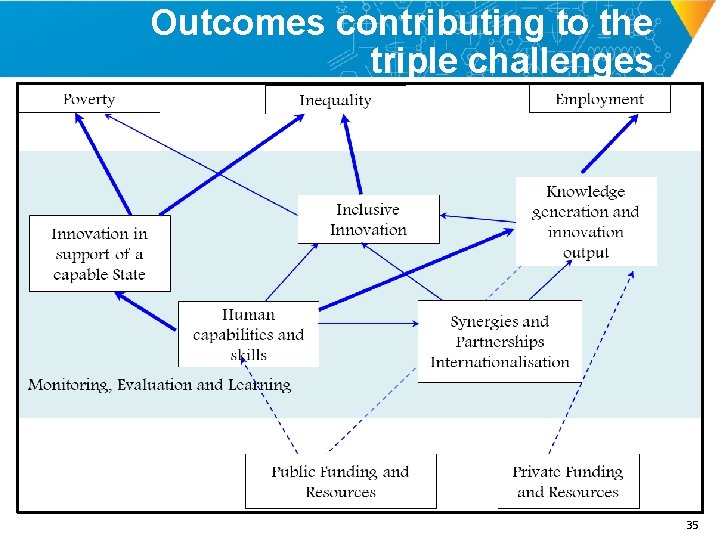
Outcomes contributing to the triple challenges 35
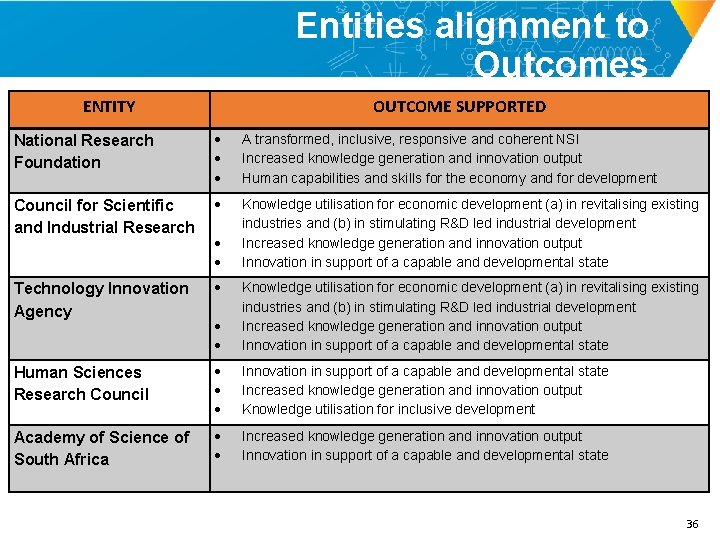
Entities alignment to Outcomes ENTITY OUTCOME SUPPORTED National Research Foundation A transformed, inclusive, responsive and coherent NSI Increased knowledge generation and innovation output Human capabilities and skills for the economy and for development Council for Scientific and Industrial Research Knowledge utilisation for economic development (a) in revitalising existing industries and (b) in stimulating R&D led industrial development Increased knowledge generation and innovation output Innovation in support of a capable and developmental state Technology Innovation Agency Knowledge utilisation for economic development (a) in revitalising existing industries and (b) in stimulating R&D led industrial development Increased knowledge generation and innovation output Innovation in support of a capable and developmental state Human Sciences Research Council Innovation in support of a capable and developmental state Increased knowledge generation and innovation output Knowledge utilisation for inclusive development Academy of Science of South Africa Increased knowledge generation and innovation output Innovation in support of a capable and developmental state 36
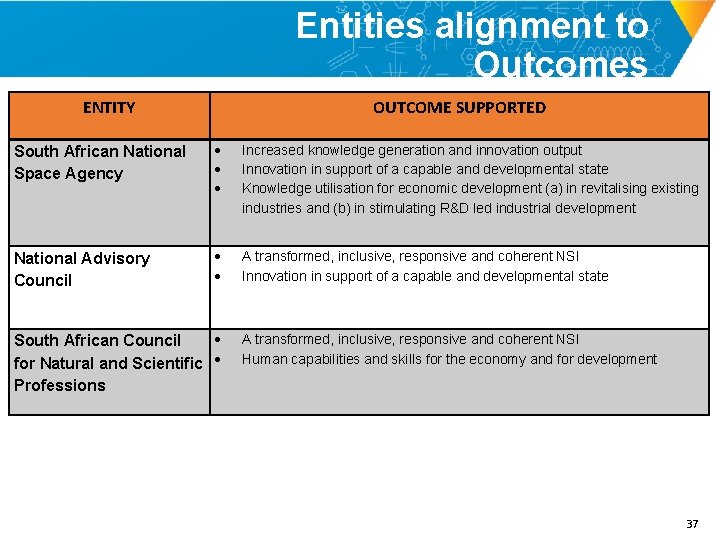
Entities alignment to Outcomes ENTITY OUTCOME SUPPORTED South African National Space Agency Increased knowledge generation and innovation output Innovation in support of a capable and developmental state Knowledge utilisation for economic development (a) in revitalising existing industries and (b) in stimulating R&D led industrial development National Advisory Council A transformed, inclusive, responsive and coherent NSI Innovation in support of a capable and developmental state South African Council for Natural and Scientific Professions A transformed, inclusive, responsive and coherent NSI Human capabilities and skills for the economy and for development 37
Annual Performance Plan 2020/21 38
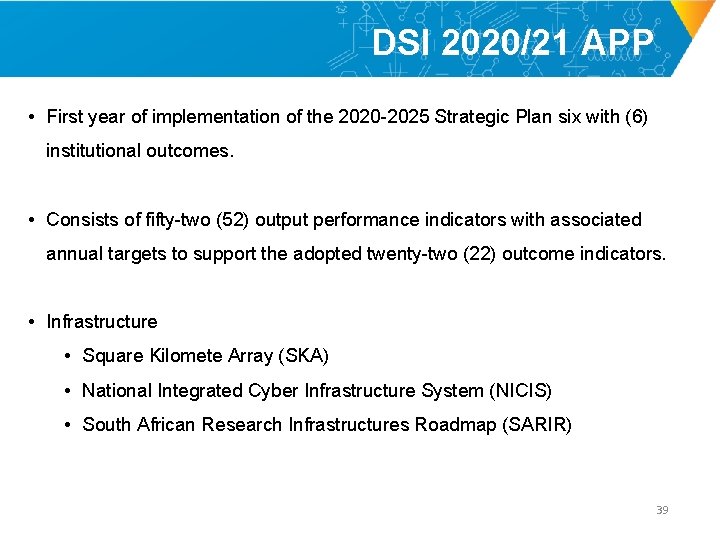
DSI 2020/21 APP • First year of implementation of the 2020 -2025 Strategic Plan six with (6) institutional outcomes. • Consists of fifty-two (52) output performance indicators with associated annual targets to support the adopted twenty-two (22) outcome indicators. • Infrastructure • Square Kilomete Array (SKA) • National Integrated Cyber Infrastructure System (NICIS) • South African Research Infrastructures Roadmap (SARIR) 39
Implementing Outcome 1: A transformed, inclusive, responsive and coherent NSI Planned policy initiatives/ targeted interventions: q Finalise the Decadal Plan which will define critical missions that will attend to between 2020 -2030[coherent] q Finalise the HESTILL review to guide the establishment of new NSI institutions, towards geospatial location and new institutional forms to expedite the implementation of missions and critical research areas [transformed] q Modernisation of sectors of the economy such as manufacturing, agriculture and mining to ensure that these sectors are competitive and can contribute to higher GDP growth [responsive] q Support grassroots innovators and support new entrants into the economy, via targeted RDI instruments [inclusive] 40
Implementing Outcome 2: Human capabilities and skills for the economy and for development Planned policy initiatives/ targeted interventions q The department will expand on the Spatial, Institutional, Demographic and Transdisciplinary transformation agenda in all its strategic science focus areas to improving female representation in scientific workforce and gender imbalance in the NSI; q Support more than 13 300 Honours, Masters and Ph. D students; q Mainstream themes in research grants covering all knowledge fields; and q Support the development of critical high-end skills in selected technology areas such as the bioeconomy, space science and technology, energy, intellectual property management nanotechnology, robotics, photonics and areas of technology convergence that are important in building a knowledge society. 41
Implementing Outcome 3: Increase knowledge generation and innovation outputs Planned policy initiatives/ targeted interventions q Increase South Africa’s research outputs/productivity, and its world share of publications towards the 1% of global output q fast-tracking interventions aimed at Ph. D qualification among non- Ph. D-qualified staff and q Interventions to improve the publishing rate of academics at HDIs to increase research outputs per capita. q The department will measure and track the number of outputs commercialised as a result of support provided in designated areas; e. g. licenses, assignments, options of varying nature (such as directed research, joint ventures and the like), start-ups, spin outs, new companies, etc. q Expand the roll-out of the South African National Research Network (SANRe. N) to TVETs and increase the available broadband capacity to 5800 Gbps. 42
Implementing Outcome 4: knowledge utilisation for economic development in (a) revitalising existing industries and (b) stimulating R&D led industrial development. Planned policy initiatives/ targeted interventions q Introduction of the Sovereign Innovation Fund (So. IF), which will serve as a new financing instrument in partnership between the public and private sectors with the sole purpose of harvesting and commercialising the South African technology innovations for deployment in national and international markets 43
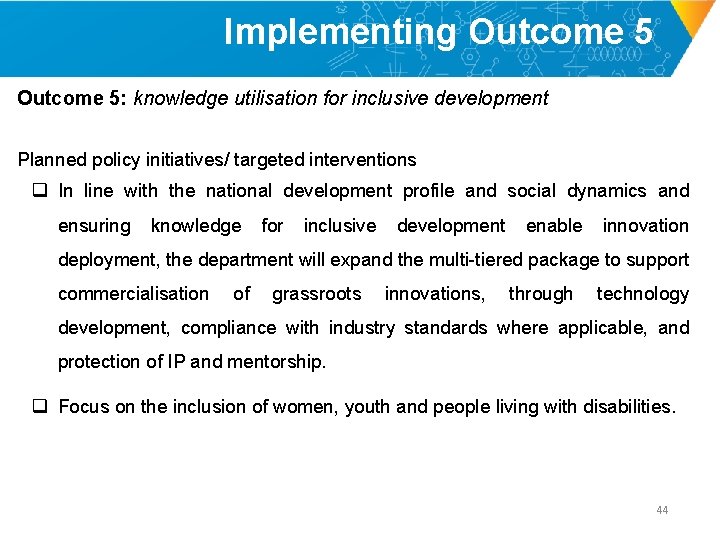
Implementing Outcome 5: knowledge utilisation for inclusive development Planned policy initiatives/ targeted interventions q In line with the national development profile and social dynamics and ensuring knowledge for inclusive development enable innovation deployment, the department will expand the multi-tiered package to support commercialisation of grassroots innovations, through technology development, compliance with industry standards where applicable, and protection of IP and mentorship. q Focus on the inclusion of women, youth and people living with disabilities. 44
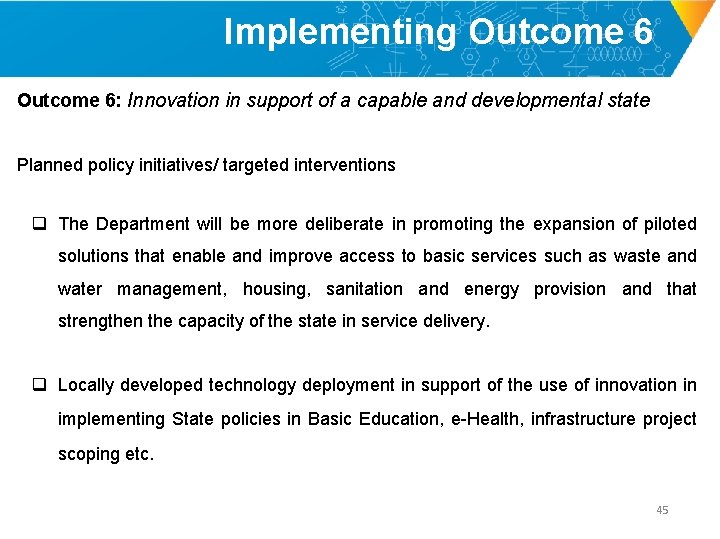
Implementing Outcome 6: Innovation in support of a capable and developmental state Planned policy initiatives/ targeted interventions q The Department will be more deliberate in promoting the expansion of piloted solutions that enable and improve access to basic services such as waste and water management, housing, sanitation and energy provision and that strengthen the capacity of the state in service delivery. q Locally developed technology deployment in support of the use of innovation in implementing State policies in Basic Education, e-Health, infrastructure project scoping etc. 45
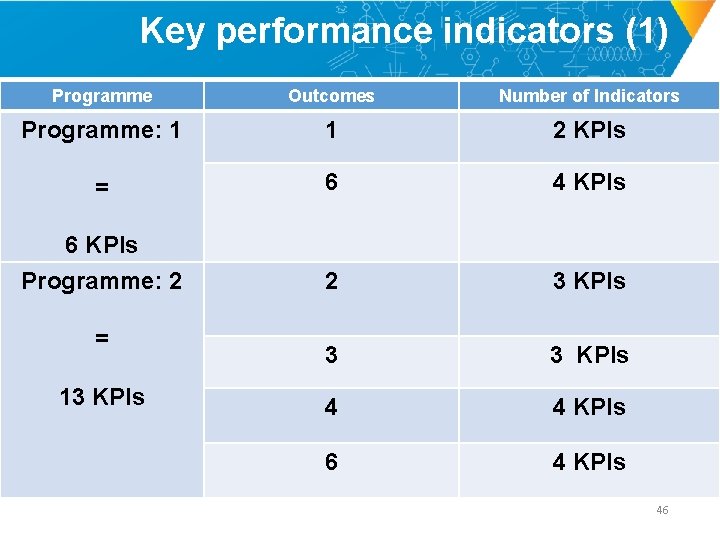
Key performance indicators (1) Programme Outcomes Number of Indicators Programme: 1 1 2 KPIs = 6 4 KPIs 2 3 KPIs 3 3 KPIs 4 4 KPIs 6 KPIs Programme: 2 = 13 KPIs 46
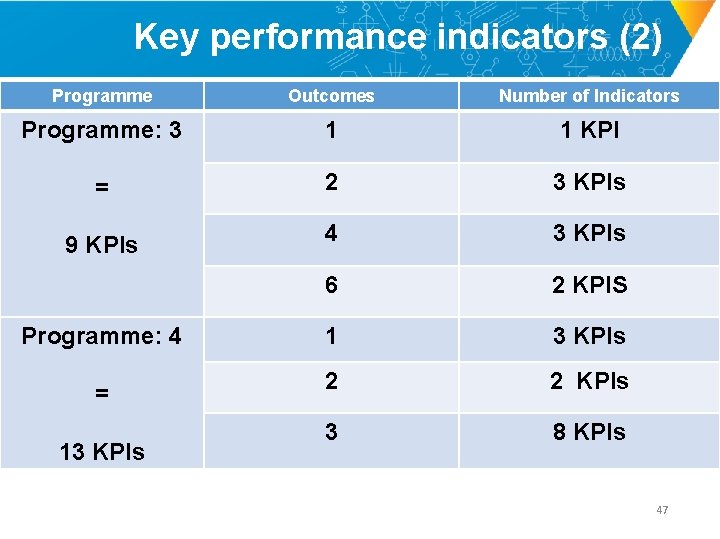
Key performance indicators (2) Programme Outcomes Number of Indicators Programme: 3 1 1 KPI = 2 3 KPIs 4 3 KPIs 6 2 KPIS 1 3 KPIs 2 2 KPIs 3 8 KPIs 9 KPIs Programme: 4 = 13 KPIs 47
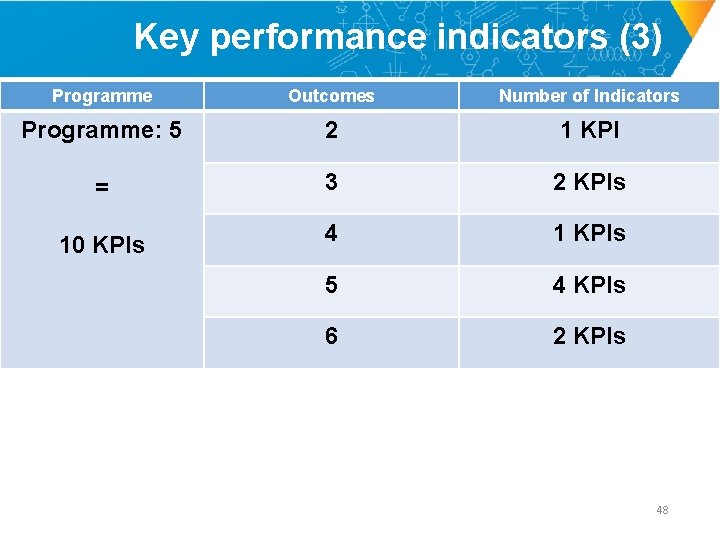
Key performance indicators (3) Programme Outcomes Number of Indicators Programme: 5 2 1 KPI = 3 2 KPIs 4 1 KPIs 5 4 KPIs 6 2 KPIs 10 KPIs 48
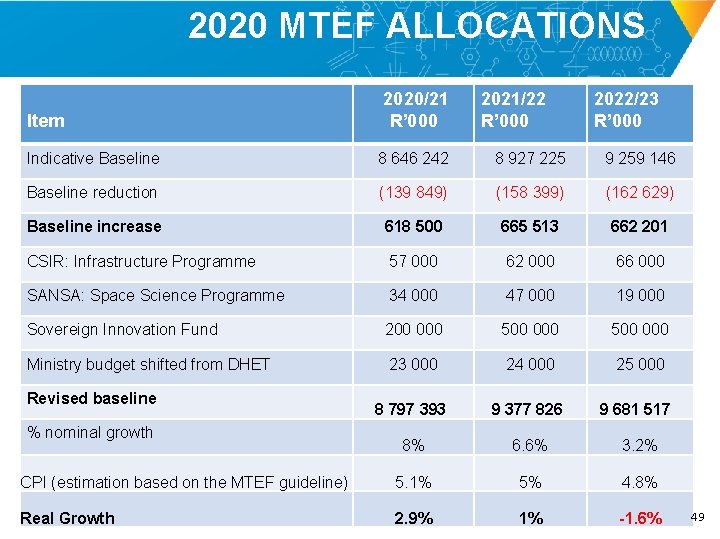
2020 MTEF ALLOCATIONS Item 2020/21 R’ 000 2021/22 R’ 000 2022/23 R’ 000 Indicative Baseline 8 646 242 8 927 225 9 259 146 Baseline reduction (139 849) (158 399) (162 629) Baseline increase 618 500 665 513 662 201 CSIR: Infrastructure Programme 57 000 62 000 66 000 SANSA: Space Science Programme 34 000 47 000 19 000 Sovereign Innovation Fund 200 000 500 000 Ministry budget shifted from DHET 23 000 24 000 25 000 8 797 393 9 377 826 9 681 517 8% 6. 6% 3. 2% CPI (estimation based on the MTEF guideline) 5. 1% 5% 4. 8% Real Growth 2. 9% 1% -1. 6% Revised baseline % nominal growth 49
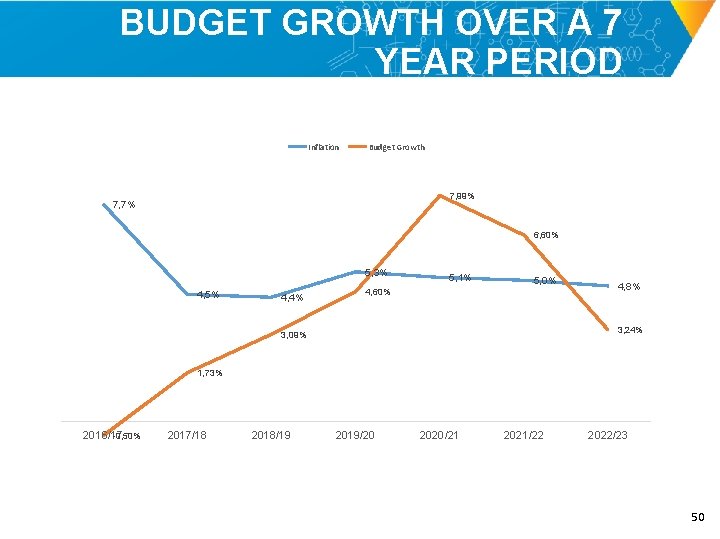
BUDGET GROWTH OVER A 7 YEAR PERIOD Inflation Budget Growth 7, 99% 7, 7% 6, 60% 5, 3% 4, 5% 4, 4% 5, 1% 5, 0% 4, 60% 4, 8% 3, 24% 3, 09% 1, 73% 2016/17 -0, 50% 2017/18 2018/19 2019/20 2020/21 2021/22 2022/23 50
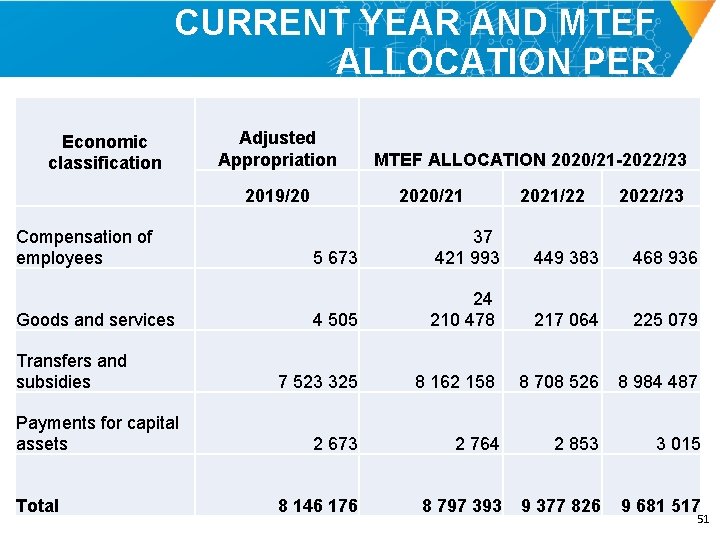
CURRENT YEAR AND MTEF ALLOCATION PER ECONOMIC CLASSIFICATION Economic classification Adjusted Appropriation 2019/20 Compensation of employees Goods and services Transfers and subsidies Payments for capital assets Total MTEF ALLOCATION 2020/21 -2022/23 2020/21 2021/22 2022/23 5 673 37 421 993 449 383 468 936 4 505 24 210 478 217 064 225 079 7 523 325 8 162 158 8 708 526 8 984 487 2 673 2 764 2 853 3 015 8 146 176 8 797 393 9 377 826 9 681 517 51
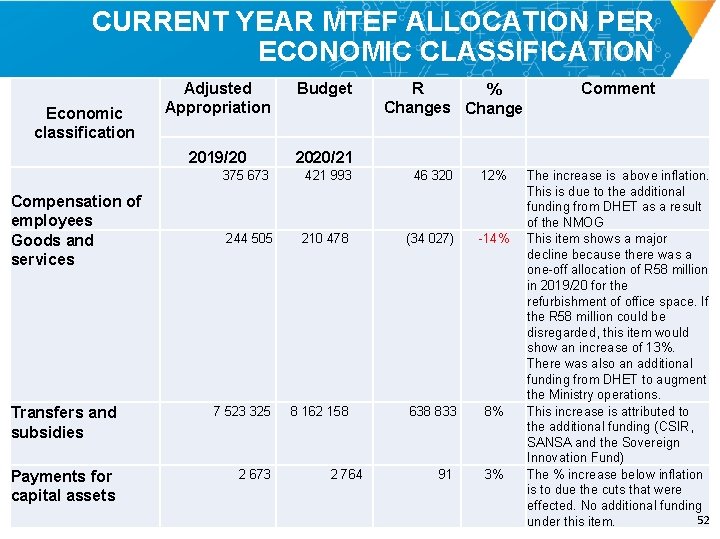
CURRENT YEAR MTEF ALLOCATION PER ECONOMIC CLASSIFICATION Economic classification Adjusted Appropriation Budget 2019/20 2020/21 R % Changes Change 375 673 421 993 46 320 12% 244 505 210 478 (34 027) -14% Transfers and subsidies 7 523 325 8 162 158 638 833 8% Payments for capital assets 2 673 91 3% Compensation of employees Goods and services 2 764 Comment The increase is above inflation. This is due to the additional funding from DHET as a result of the NMOG This item shows a major decline because there was a one-off allocation of R 58 million in 2019/20 for the refurbishment of office space. If the R 58 million could be disregarded, this item would show an increase of 13%. There was also an additional funding from DHET to augment the Ministry operations. This increase is attributed to the additional funding (CSIR, SANSA and the Sovereign Innovation Fund) The % increase below inflation is to due the cuts that were effected. No additional funding 52 under this item.
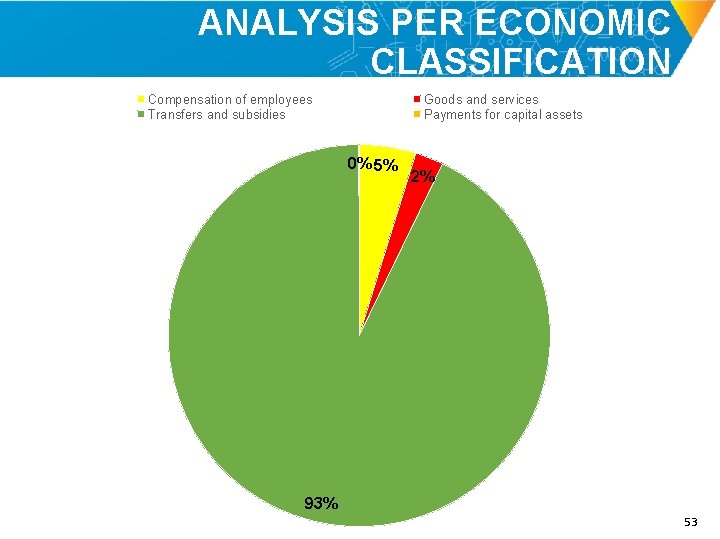
ANALYSIS PER ECONOMIC CLASSIFICATION Compensation of employees Transfers and subsidies Goods and services Payments for capital assets 0% 5% 2% 93% 53
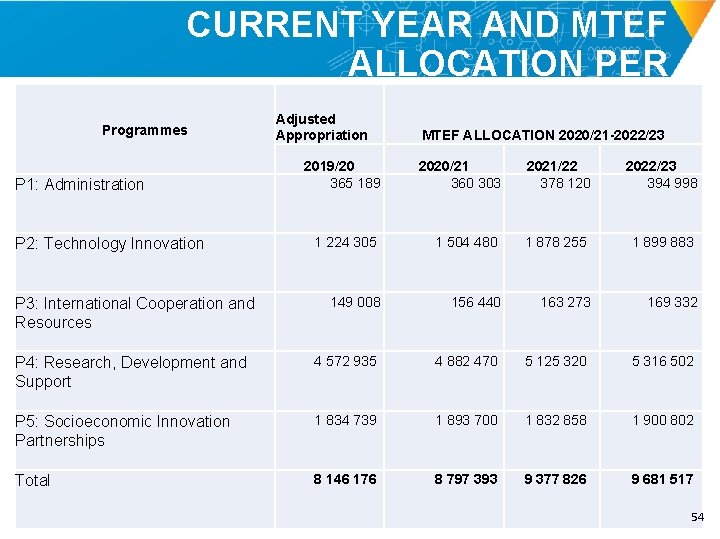
CURRENT YEAR AND MTEF ALLOCATION PER PROGRAMME Programmes Adjusted Appropriation MTEF ALLOCATION 2020/21 -2022/23 2019/20 365 189 2020/21 360 303 2021/22 378 120 2022/23 394 998 1 224 305 1 504 480 1 878 255 1 899 883 149 008 156 440 163 273 169 332 P 4: Research, Development and Support 4 572 935 4 882 470 5 125 320 5 316 502 P 5: Socioeconomic Innovation Partnerships 1 834 739 1 893 700 1 832 858 1 900 802 Total 8 146 176 8 797 393 9 377 826 9 681 517 P 1: Administration P 2: Technology Innovation P 3: International Cooperation and Resources 54
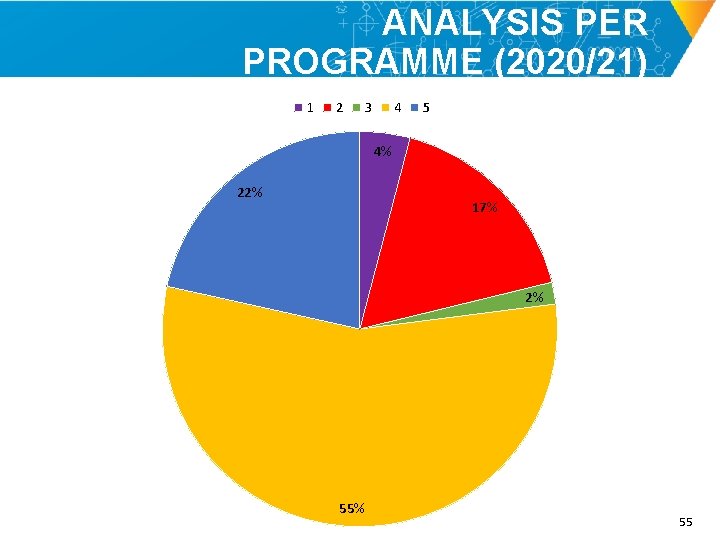
ANALYSIS PER PROGRAMME (2020/21) 1 2 3 4 5 4% 22% 17% 2% 55
ALLOCATIONS TO DSI PUBLIC ENTITIES
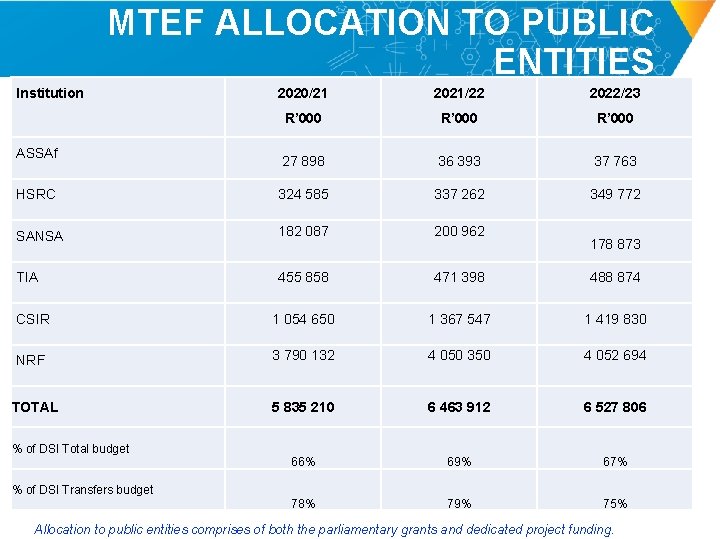
MTEF ALLOCATION TO PUBLIC ENTITIES Institution 2020/21 2021/22 2022/23 R’ 000 27 898 36 393 37 763 HSRC 324 585 337 262 349 772 SANSA 182 087 200 962 TIA 455 858 471 398 488 874 CSIR 1 054 650 1 367 547 1 419 830 NRF 3 790 132 4 050 350 4 052 694 5 835 210 6 463 912 6 527 806 66% 69% 67% 78% 79% 75% ASSAf TOTAL % of DSI Total budget % of DSI Transfers budget 178 873 Allocation to public entities comprises of both the parliamentary grants and dedicated project funding.
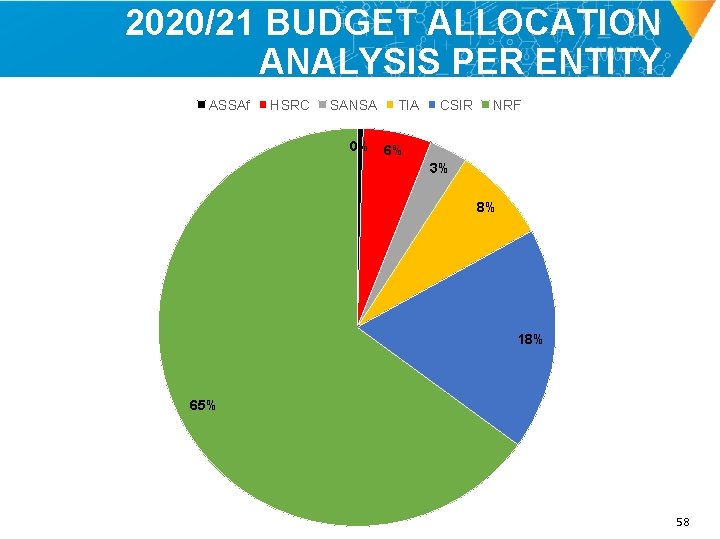
2020/21 BUDGET ALLOCATION ANALYSIS PER ENTITY ASSAf HSRC SANSA TIA CSIR NRF 0% 6% 3% 8% 18% 65% 58
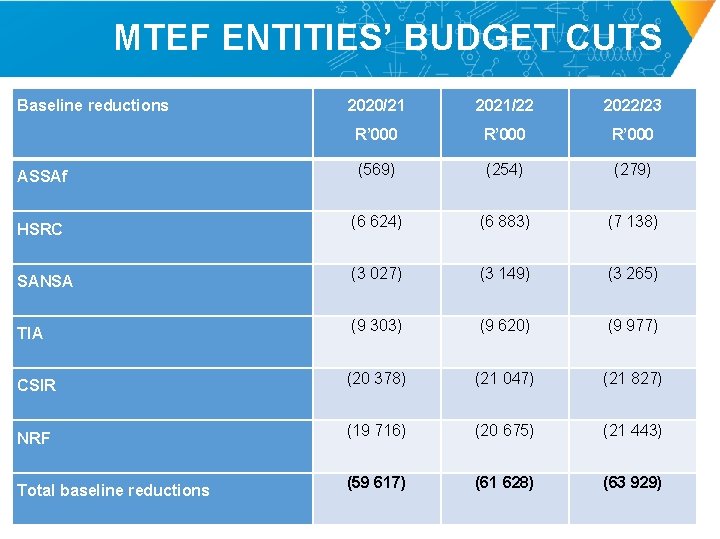
MTEF ENTITIES’ BUDGET CUTS Baseline reductions 2020/21 2021/22 2022/23 R’ 000 ASSAf (569) (254) (279) HSRC (6 624) (6 883) (7 138) SANSA (3 027) (3 149) (3 265) TIA (9 303) (9 620) (9 977) CSIR (20 378) (21 047) (21 827) NRF (19 716) (20 675) (21 443) Total baseline reductions (59 617) (61 628) (63 929)
Dankie Enkosi Ha khensa Re a leboga Ro livhuwa Siyabonga Siyathokoza Thank you 60