
CONTENTS Defining Cyber Crime History of Cyber Crime

CONTENTS �Defining Cyber Crime �History of Cyber Crime �Categories �Prevention �Conclusion
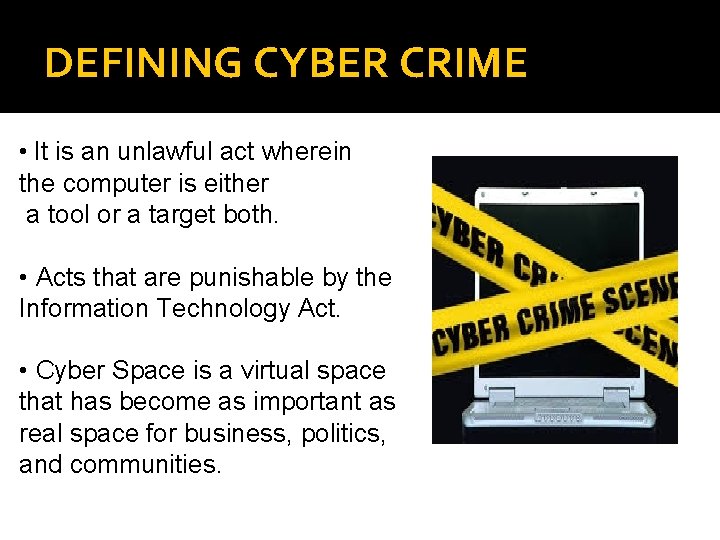
DEFINING CYBER CRIME • It is an unlawful act wherein the computer is either a tool or a target both. • Acts that are punishable by the Information Technology Act. • Cyber Space is a virtual space that has become as important as real space for business, politics, and communities.
History Of Cyber Crime v The first recorded cyber crime took place in the year 1820. - In 1820, Joseph-Marie Jacquard, a textile manufacturer in France, produced the loom. This device allowed the repetition of a series of steps in the weaving of special fabrics.

Categories of Cyber Crime Ø Cyber crime can be divided into 3 major categories: 1. Cyber crime against persons 2. Cyber crime against property 3. Cyber crime against government

First Category • Cyber Crime Against Person - Cyber harassment is a distinct Cyber crime. Various kinds of harassment can and do occur in cyberspace, or through the use of cyberspace. Harassment can be sexual, racial, religious, or other

Second Category • Cyber Crime Against Property - These crimes include computer vandalism (destruction of others' property), transmission of harmful programs, unauthorized trespassing through cyber space, unauthorized possession of computer information.

Third Category • Cyber Crime Against Government - Cyber terrorism is one distinct kind of crime in this category - The growth of internet has shown that the medium of Cyberspace is being used by individuals and groups to threaten the international governments as also to terrorize the citizens of a country.
Prevention v Disable and log off a specific user account to prevent access. v Disable and log off a group of user accounts which access a particular service that is being attacked. v Disable and dismount specific (network) devices, for instance disk devices that are being swamped v Disable specific applications, for example, an e-mail system subjected to a SPAM attack. v Close down an entire system, and divert processing to an alternative or backup service on a secondary network.
Conclusion Ø within the law enforcement agencies, a set of rules must be developed to address the various categories of computer crime. Ø As such, investigators will know what and which materials to search and seize, the electronic evidence to recover, and the chain of custody to maintain.
- Slides: 10