
Contents A Tree density B Species diversity C
Contents • A. Tree density • B. Species diversity • C. Growth conditions of trees
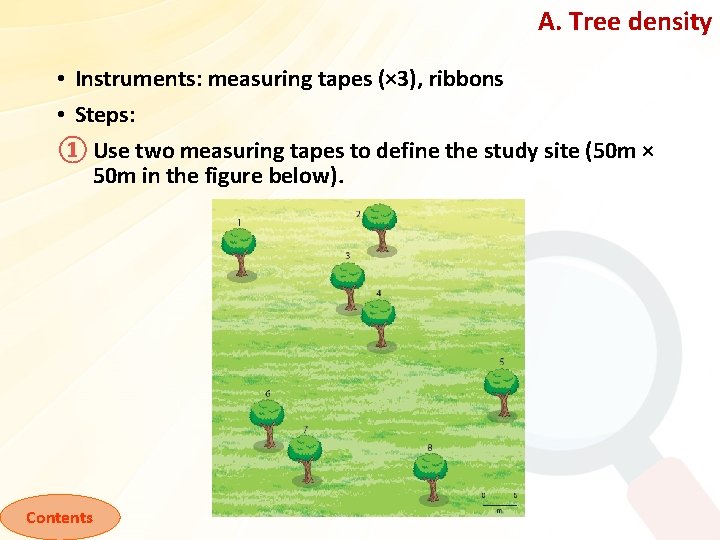
A. Tree density • Instruments: measuring tapes (× 3), ribbons • Steps: ① Use two measuring tapes to define the study site (50 m × 50 m in the figure below). Contents
A. Tree density ② Find out the nearest neighbour of every tree in the site, use a measuring tape to measure the distance between them and record it on a data record sheet. ③ Tie ribbons on the trees as marks after measurements. ④ Sum up all distances and calculate the average value. Then, we get 11. 56 m, the average nearest neighbour distance of trees in the figure. The longer the average nearest neighbour distance, the lower the tree density, and vice versa. Contents
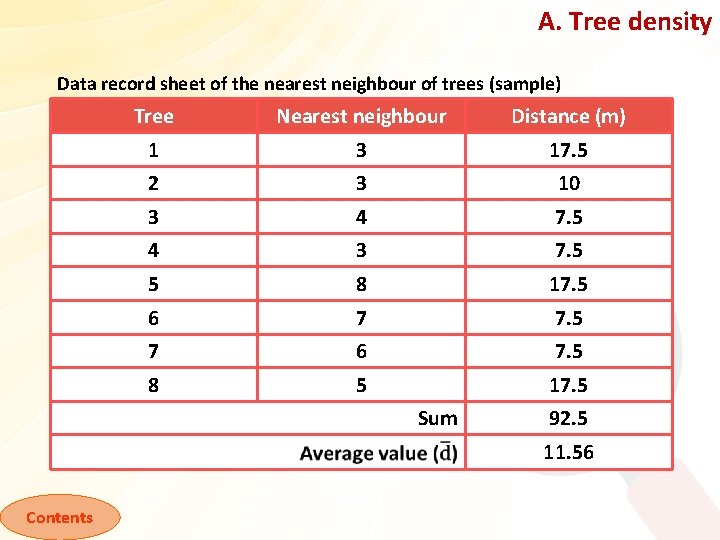
A. Tree density Data record sheet of the nearest neighbour of trees (sample) Tree Nearest neighbour Distance (m) 1 3 17. 5 2 3 10 3 4 7. 5 4 3 7. 5 5 8 17. 5 6 7 7. 5 7 6 7. 5 8 5 17. 5 Sum 92. 5 11. 56 Contents
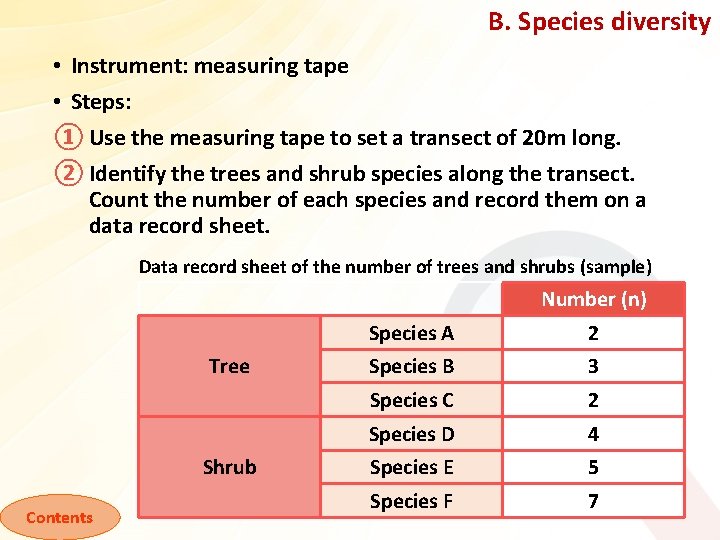
B. Species diversity • Instrument: measuring tape • Steps: ① Use the measuring tape to set a transect of 20 m long. ② Identify the trees and shrub species along the transect. Count the number of each species and record them on a data record sheet. Data record sheet of the number of trees and shrubs (sample) Number (n) Tree Shrub Contents Species A 2 Species B 3 Species C 2 Species D 4 Species E 5 Species F 7

B. Species diversity ③ Using the formula below, calculate the Simpson’s Diversity Index (D) to evaluate the species diversity along the transect. D= 1– Σn(n – 1) , N(N – 1) where n = number of each plant species, N = total number of all plant species The value of the Simpson’s Diversity Index lies between 0 and 1. The larger the value, the higher the species diversity, and vice versa. Contents
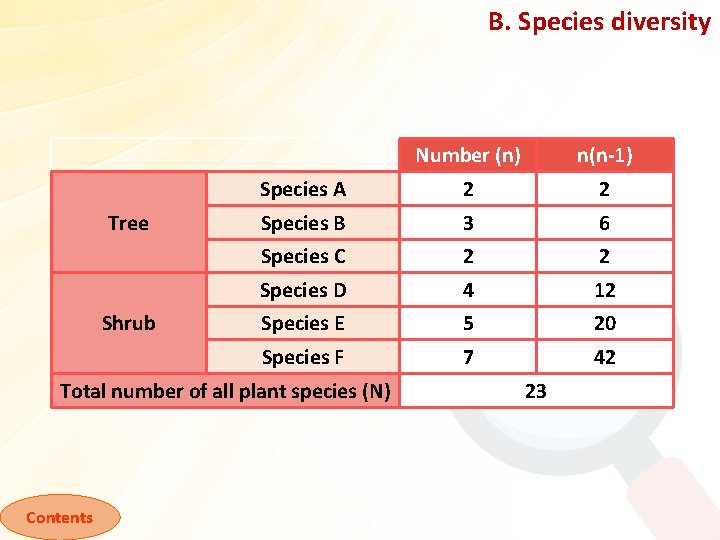
B. Species diversity Tree Shrub Number (n) n(n-1) Species A 2 2 Species B 3 6 Species C 2 2 Species D 4 12 Species E 5 20 Species F 7 42 Total number of all plant species (N) Contents 23
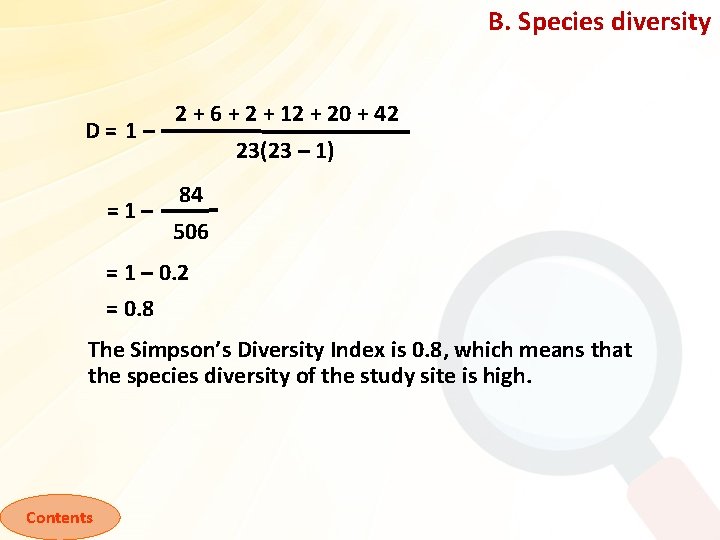
B. Species diversity D= 1– =1– 2 + 6 + 2 + 12 + 20 + 42 23(23 – 1) 84 506 = 1 – 0. 2 = 0. 8 The Simpson’s Diversity Index is 0. 8, which means that the species diversity of the study site is high. Contents
C. Growth conditions of trees i. Tree height • For short plants (e. g. shrubs): Use a meter ruler to measure • For taller plants (e. g. trees): Use an abney level to measure • Instruments: abney level, measuring tape Contents
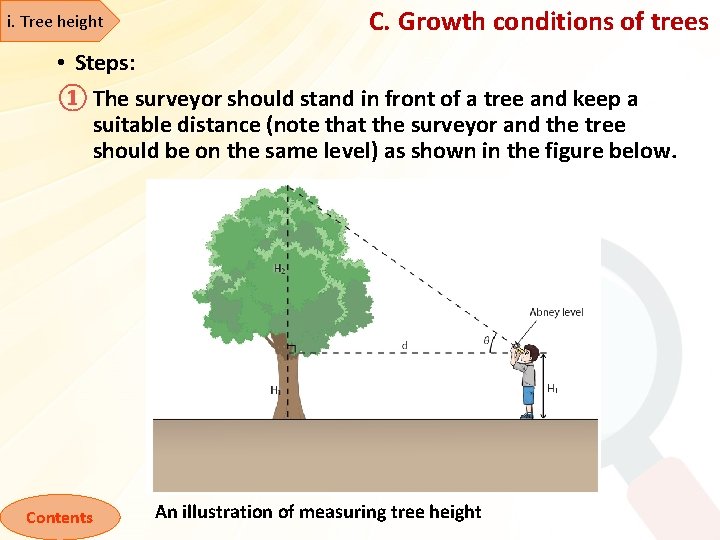
i. Tree height C. Growth conditions of trees • Steps: ① The surveyor should stand in front of a tree and keep a suitable distance (note that the surveyor and the tree should be on the same level) as shown in the figure below. Contents An illustration of measuring tree height
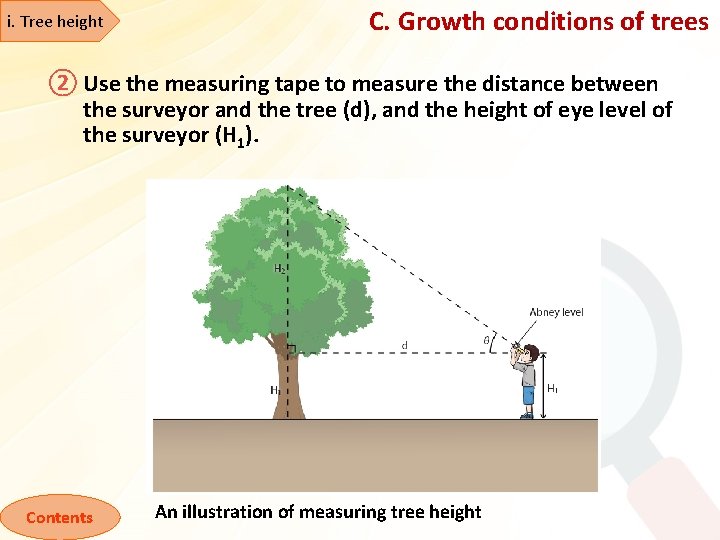
i. Tree height C. Growth conditions of trees ② Use the measuring tape to measure the distance between the surveyor and the tree (d), and the height of eye level of the surveyor (H 1). Contents An illustration of measuring tree height
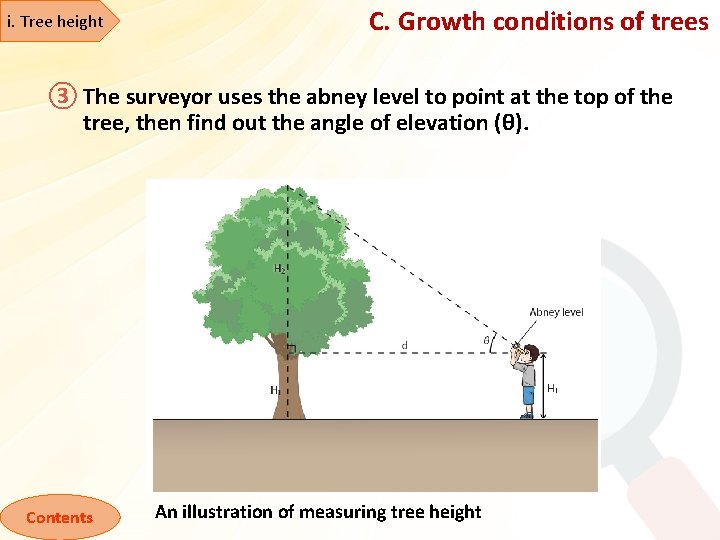
i. Tree height C. Growth conditions of trees ③ The surveyor uses the abney level to point at the top of the tree, then find out the angle of elevation (θ). Contents An illustration of measuring tree height
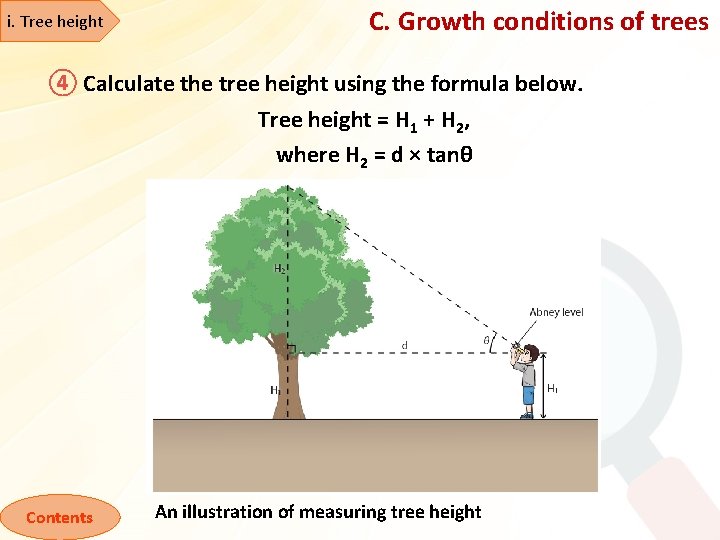
i. Tree height C. Growth conditions of trees ④ Calculate the tree height using the formula below. Tree height = H 1 + H 2, where H 2 = d × tanθ Contents An illustration of measuring tree height
C. Growth conditions of trees ii. Tree girth • Instruments: abney level, measuring tape • Steps: At 4. 5 feet (about 1. 37 m) above the ground, use the measuring tape to surround the tree stem, then measure the tree girth. Contents

End
- Slides: 16