
Contents A Beach profile B Wave type C
Contents • A. Beach profile • B. Wave type • C. Longshore drift • D. Size of sediments • E. Roundness of sediments • F. Seawater quality
A. Beach profile • A beach profile helps us understand the changes in height and gradient of a beach • Levelling: measure the changes in height and gradient more accurately • Angle measurement: more suitable for measuring landforms with longer distance and steeper gradient Contents
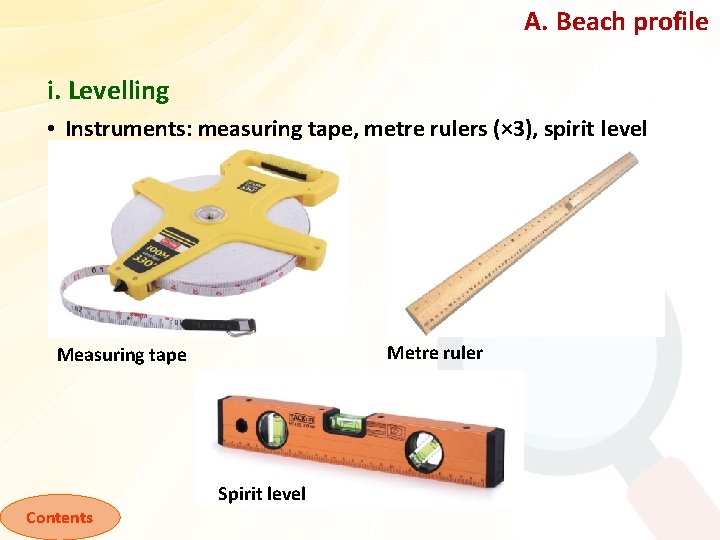
A. Beach profile i. Levelling • Instruments: measuring tape, metre rulers (× 3), spirit level Metre ruler Measuring tape Spirit level Contents
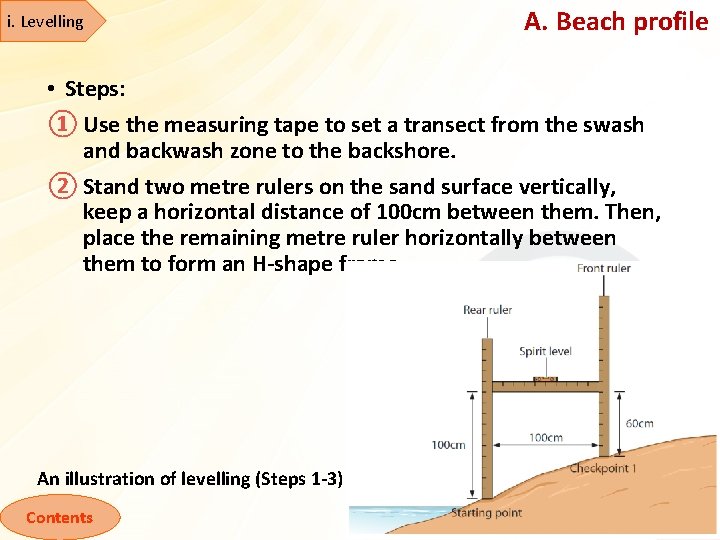
i. Levelling A. Beach profile • Steps: ① Use the measuring tape to set a transect from the swash and backwash zone to the backshore. ② Stand two metre rulers on the sand surface vertically, keep a horizontal distance of 100 cm between them. Then, place the remaining metre ruler horizontally between them to form an H-shape frame. An illustration of levelling (Steps 1 -3) Contents
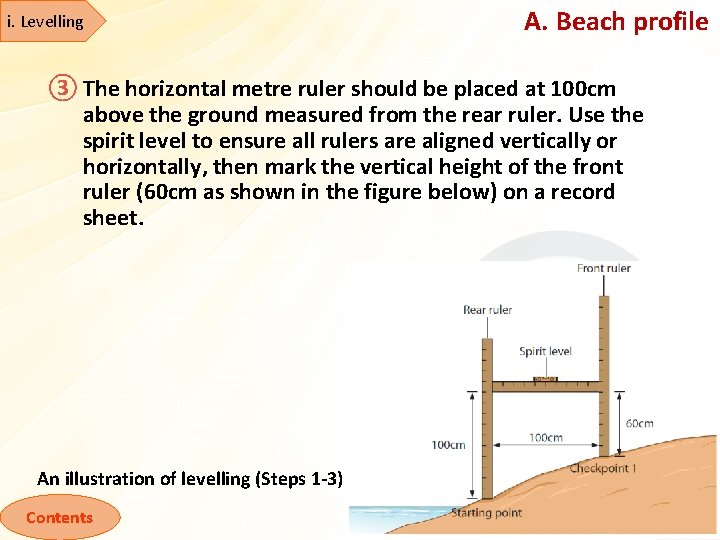
i. Levelling A. Beach profile ③ The horizontal metre ruler should be placed at 100 cm above the ground measured from the rear ruler. Use the spirit level to ensure all rulers are aligned vertically or horizontally, then mark the vertical height of the front ruler (60 cm as shown in the figure below) on a record sheet. An illustration of levelling (Steps 1 -3) Contents
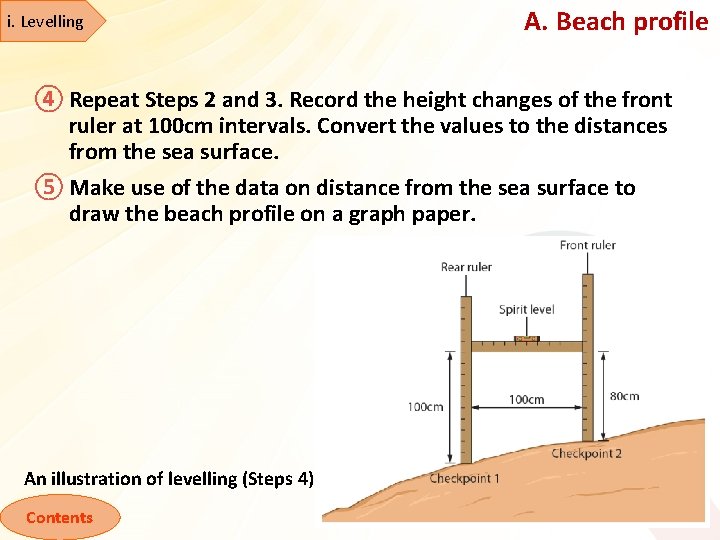
i. Levelling A. Beach profile ④ Repeat Steps 2 and 3. Record the height changes of the front ruler at 100 cm intervals. Convert the values to the distances from the sea surface. ⑤ Make use of the data on distance from the sea surface to draw the beach profile on a graph paper. An illustration of levelling (Steps 4) Contents
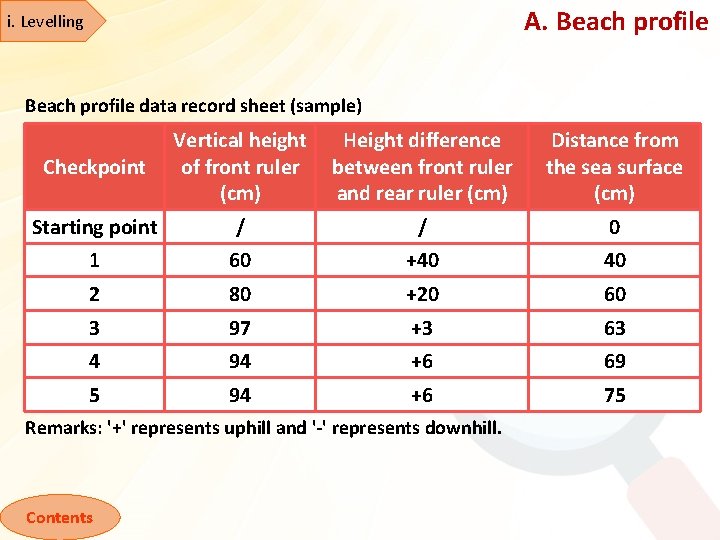
A. Beach profile i. Levelling Beach profile data record sheet (sample) Checkpoint Vertical height of front ruler (cm) Height difference between front ruler and rear ruler (cm) Distance from the sea surface (cm) Starting point / / 0 1 60 +40 40 2 80 +20 60 3 97 +3 63 4 94 +6 69 5 94 +6 75 Remarks: '+' represents uphill and '-' represents downhill. Contents
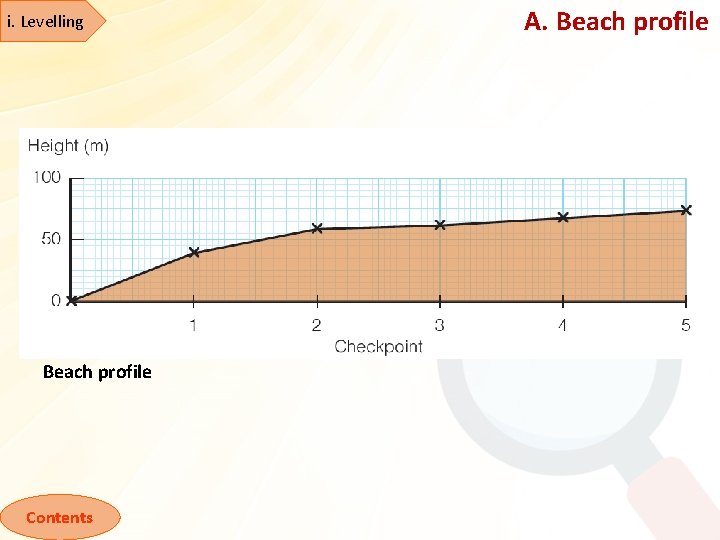
i. Levelling Beach profile Contents A. Beach profile
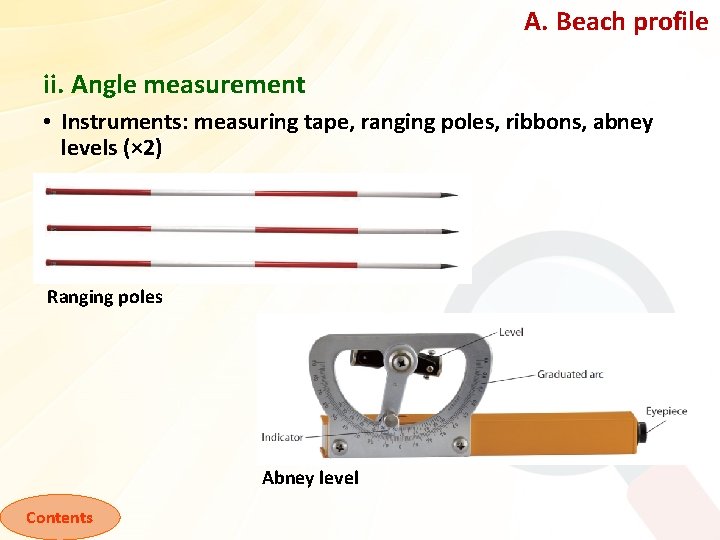
A. Beach profile ii. Angle measurement • Instruments: measuring tape, ranging poles, ribbons, abney levels (× 2) Ranging poles Abney level Contents
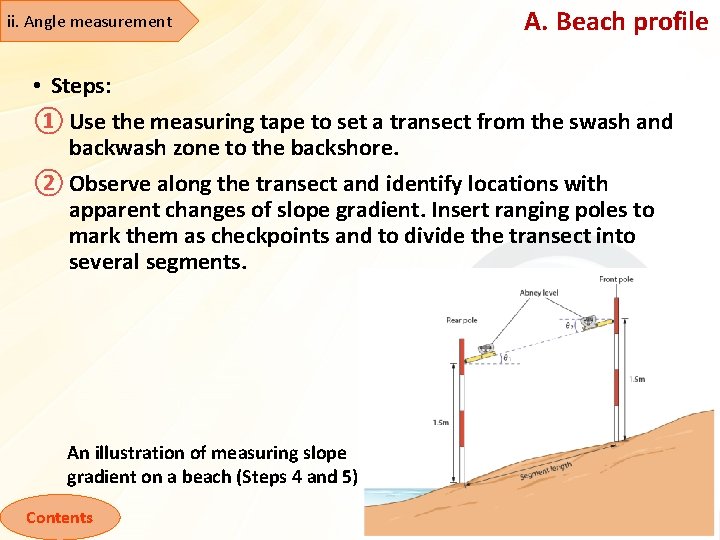
ii. Angle measurement A. Beach profile • Steps: ① Use the measuring tape to set a transect from the swash and backwash zone to the backshore. ② Observe along the transect and identify locations with apparent changes of slope gradient. Insert ranging poles to mark them as checkpoints and to divide the transect into several segments. An illustration of measuring slope gradient on a beach (Steps 4 and 5) Contents
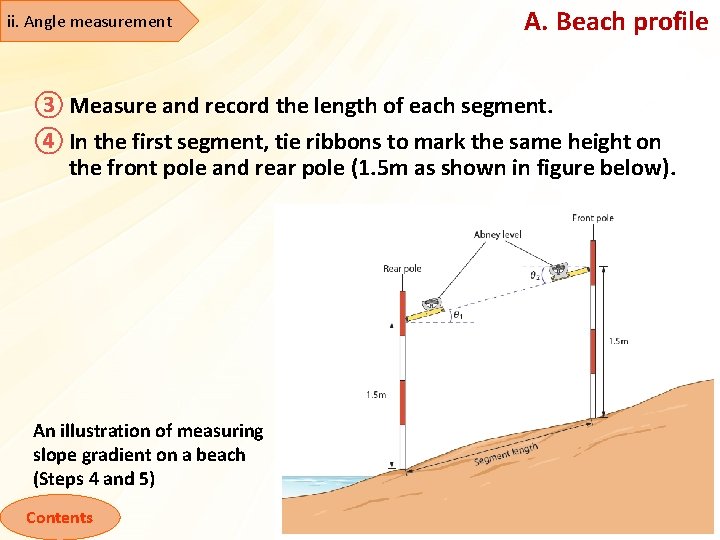
ii. Angle measurement A. Beach profile ③ Measure and record the length of each segment. ④ In the first segment, tie ribbons to mark the same height on the front pole and rear pole (1. 5 m as shown in figure below). An illustration of measuring slope gradient on a beach (Steps 4 and 5) Contents

ii. Angle measurement A. Beach profile ⑤ Two students to use the abney levels to point at the ribbon mark on the other pole. Adjust the indicator of the abney level until an air bubble appears in the middle of the eyepiece, which means the abney level is aligned horizontally. An illustration of measuring slope gradient on a beach (Steps 4 and 5) Contents
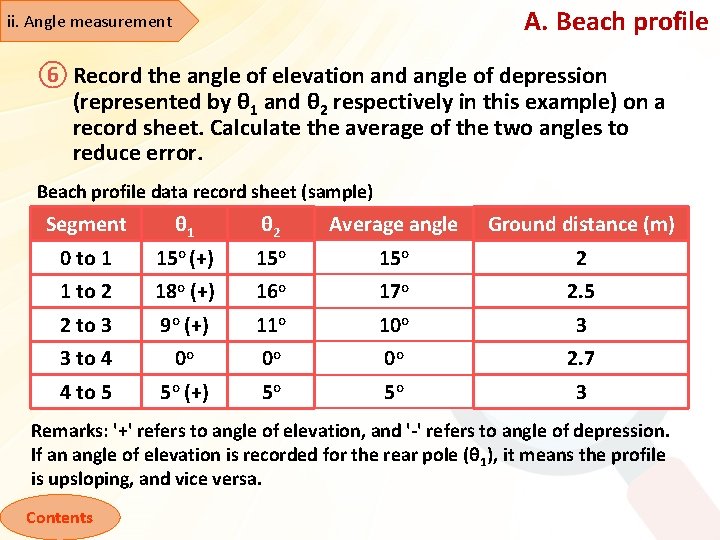
A. Beach profile ii. Angle measurement ⑥ Record the angle of elevation and angle of depression (represented by θ 1 and θ 2 respectively in this example) on a record sheet. Calculate the average of the two angles to reduce error. Beach profile data record sheet (sample) Segment θ 1 θ 2 Average angle Ground distance (m) 0 to 1 15 o (+) 15 o 2 1 to 2 18 o (+) 16 o 17 o 2. 5 2 to 3 9 o (+) 11 o 10 o 3 3 to 4 0 o 0 o 0 o 2. 7 4 to 5 5 o (+) 5 o 5 o 3 Remarks: '+' refers to angle of elevation, and '-' refers to angle of depression. If an angle of elevation is recorded for the rear pole (θ 1), it means the profile is upsloping, and vice versa. Contents
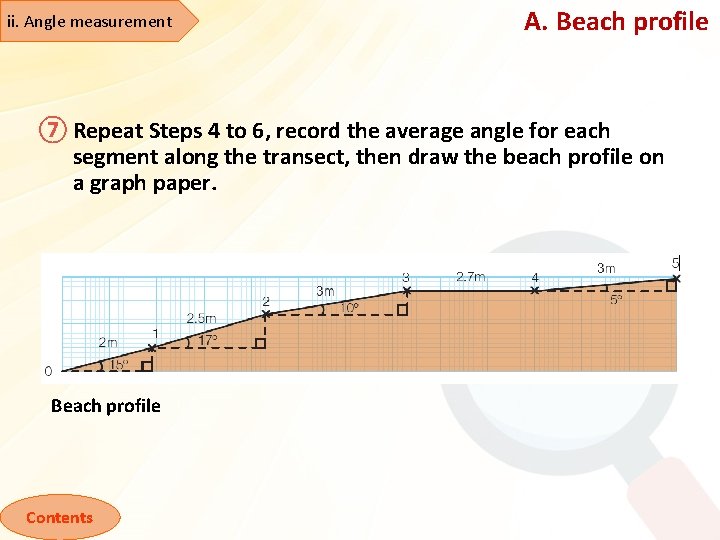
ii. Angle measurement A. Beach profile ⑦ Repeat Steps 4 to 6, record the average angle for each segment along the transect, then draw the beach profile on a graph paper. Beach profile Contents
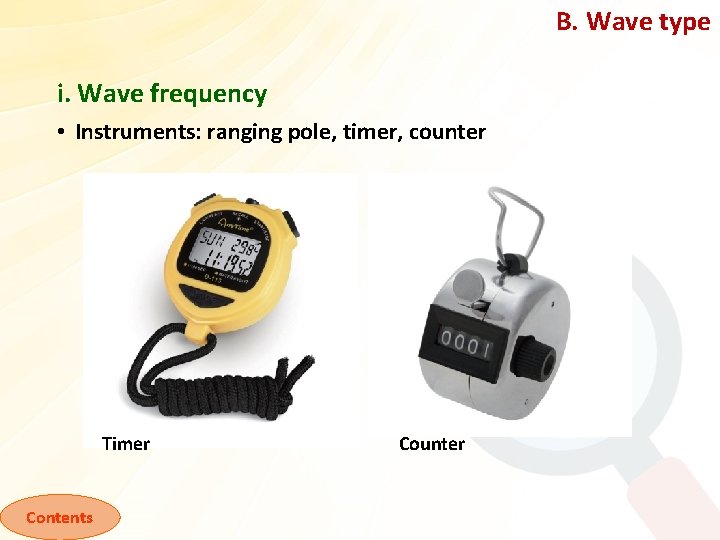
B. Wave type i. Wave frequency • Instruments: ranging pole, timer, counter Timer Contents Counter
i. Wave frequency B. Wave type • Steps: ① Observe the waves and identify the position of the wave breaker. Insert the ranging pole at that position. ② When a wave breaker passes through the ranging pole, start the timer to count for five minutes. ③ Within the five minutes, use the counter to count the number of waves passing through the ranging pole. Then, calculate the average value per minute. Contents
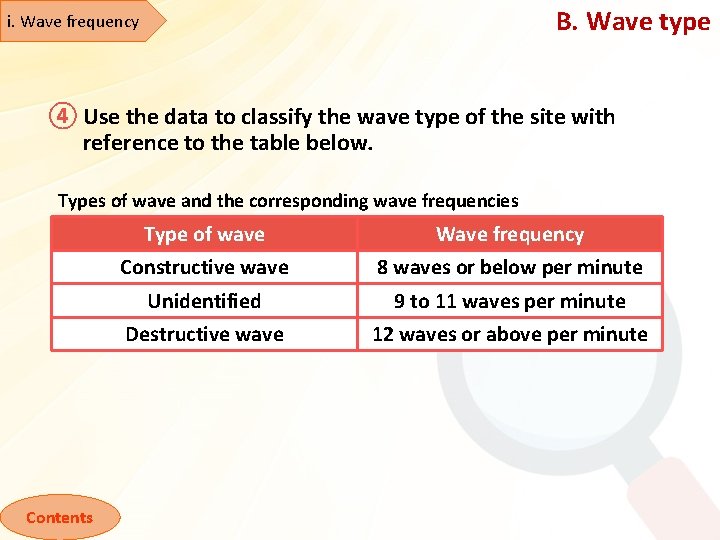
B. Wave type i. Wave frequency ④ Use the data to classify the wave type of the site with reference to the table below. Types of wave and the corresponding wave frequencies Contents Type of wave Wave frequency Constructive wave 8 waves or below per minute Unidentified 9 to 11 waves per minute Destructive wave 12 waves or above per minute
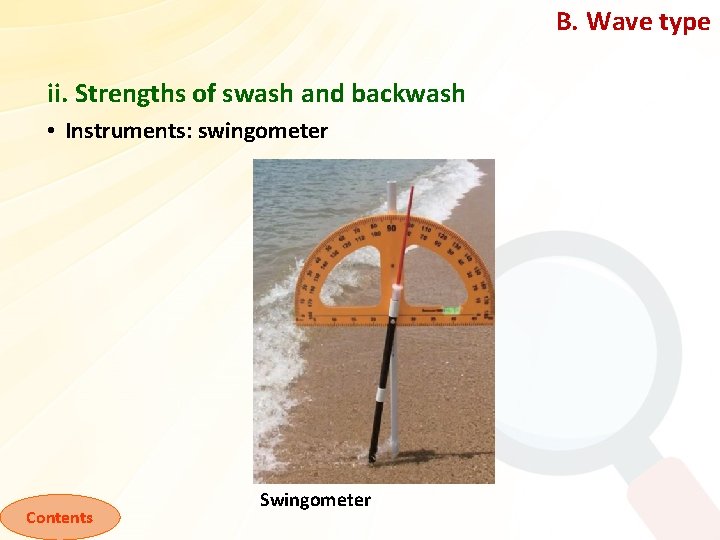
B. Wave type ii. Strengths of swash and backwash • Instruments: swingometer Contents Swingometer
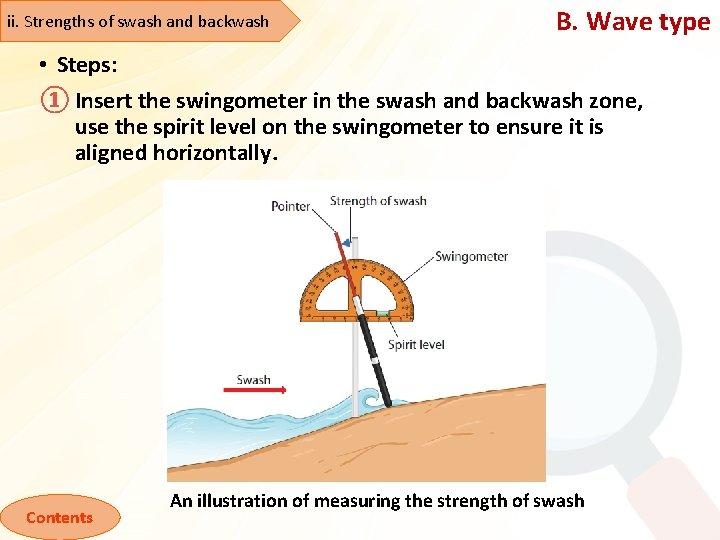
ii. Strengths of swash and backwash B. Wave type • Steps: ① Insert the swingometer in the swash and backwash zone, use the spirit level on the swingometer to ensure it is aligned horizontally. Contents An illustration of measuring the strength of swash
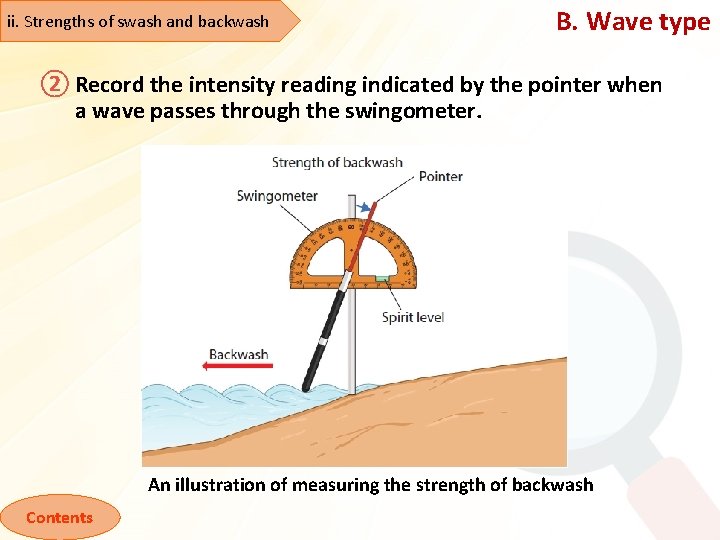
ii. Strengths of swash and backwash B. Wave type ② Record the intensity reading indicated by the pointer when a wave passes through the swingometer. An illustration of measuring the strength of backwash Contents
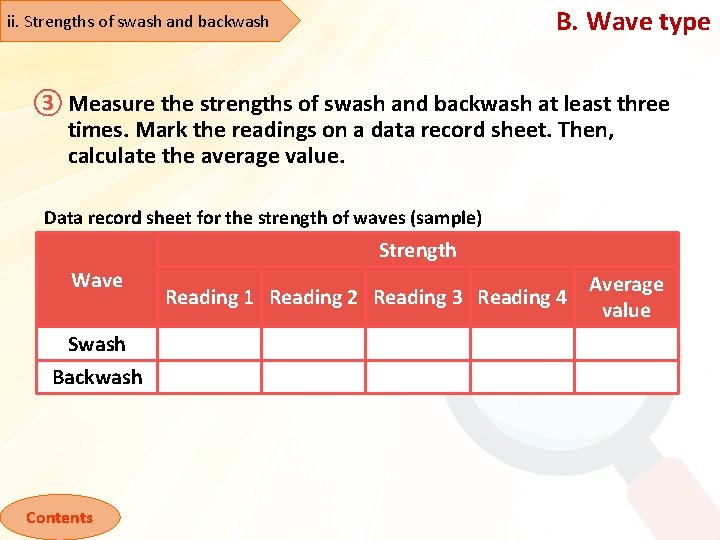
B. Wave type ii. Strengths of swash and backwash ③ Measure the strengths of swash and backwash at least three times. Mark the readings on a data record sheet. Then, calculate the average value. Data record sheet for the strength of waves (sample) Strength Wave Swash Backwash Contents Reading 1 Reading 2 Reading 3 Reading 4 Average value
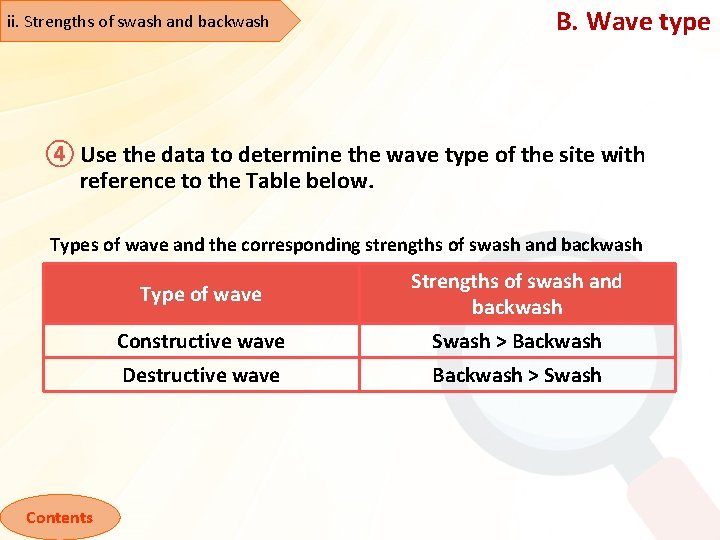
ii. Strengths of swash and backwash B. Wave type ④ Use the data to determine the wave type of the site with reference to the Table below. Types of wave and the corresponding strengths of swash and backwash Contents Type of wave Strengths of swash and backwash Constructive wave Swash > Backwash Destructive wave Backwash > Swash
C. Longshore drift • We can study the phenomenon of longshore drift on a beach by observing the direction and distance travelled by a float • Using a float is simple and less costly • But it can only provide a rough picture of longshore drift, and the data is easily affected by other factors Contents
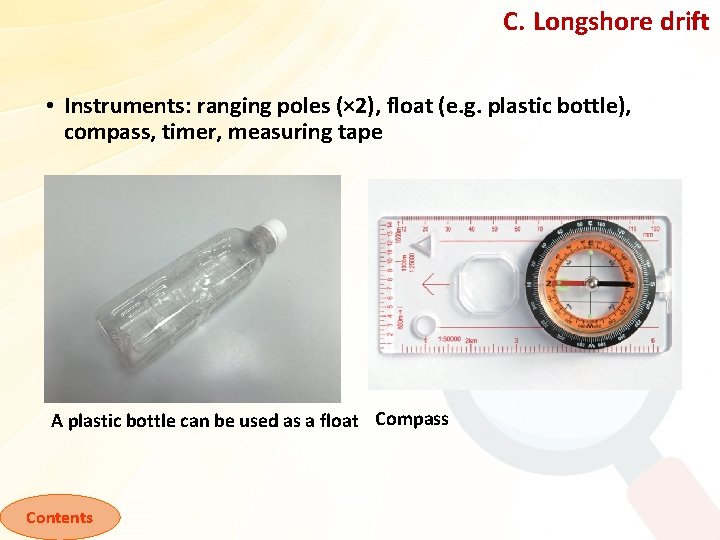
C. Longshore drift • Instruments: ranging poles (× 2), float (e. g. plastic bottle), compass, timer, measuring tape A plastic bottle can be used as a float Compass Contents
C. Longshore drift • Steps: ① Insert a ranging pole in the swash and backwash zone to indicate the starting point. ② Put the float at the starting point. Observe the direction and distance that it travels along the coast. ③ One minute later, insert another ranging pole at the position of the float to indicate the ending point. ④ Use the measuring tape to measure the distance travelled by the float. ⑤ Repeat the steps above at least five times. Consolidate the data collected, then find out the direction and average distance of longshore drift. Contents
D. Size of sediments • For coarse sediments: measure their size with an instrument immediately • For fine sediments: sieve the sediments first, then calculate the weight ratio of particles in different sizes Contents
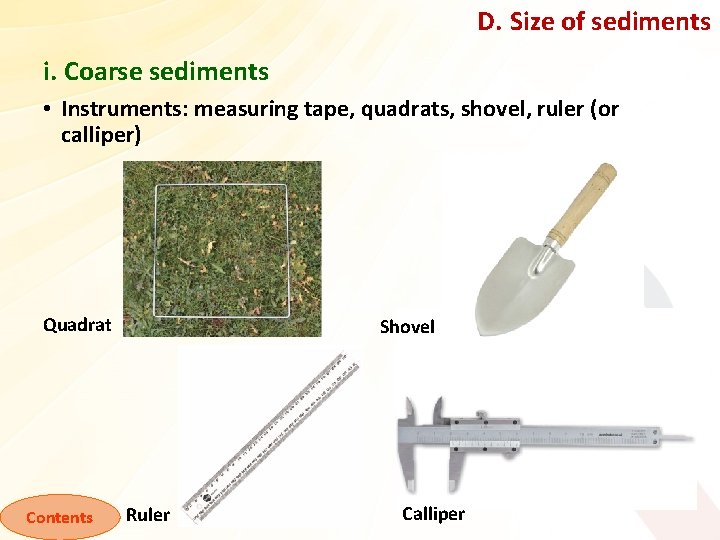
D. Size of sediments i. Coarse sediments • Instruments: measuring tape, quadrats, shovel, ruler (or calliper) Quadrat Contents Shovel Ruler Calliper
i. Coarse sediments D. Size of sediments • Steps: ① Use the measuring tape to set a transect from the swash and backwash zone to the backshore. ② Place the quadrats at fixed intervals (e. g. 10 m) along the transect. ③ In each quadrat, use the shovel to extract sediment samples from 5 cm to 8 cm underneath the sand (choose at least 10 pieces of the largest sediment particles). Contents
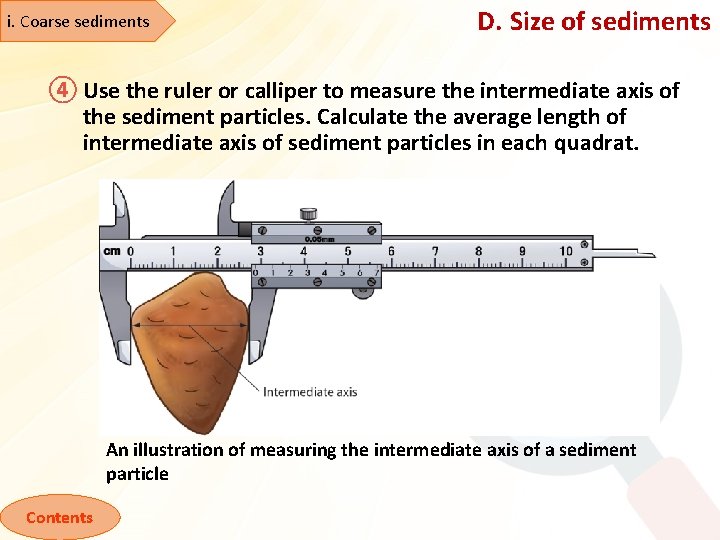
i. Coarse sediments D. Size of sediments ④ Use the ruler or calliper to measure the intermediate axis of the sediment particles. Calculate the average length of intermediate axis of sediment particles in each quadrat. An illustration of measuring the intermediate axis of a sediment particle Contents
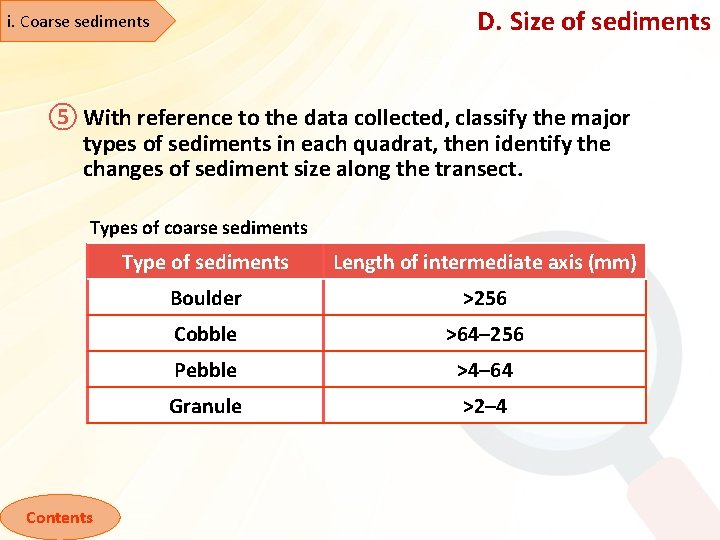
D. Size of sediments i. Coarse sediments ⑤ With reference to the data collected, classify the major types of sediments in each quadrat, then identify the changes of sediment size along the transect. Types of coarse sediments Contents Type of sediments Length of intermediate axis (mm) Boulder >256 Cobble >64– 256 Pebble >4– 64 Granule >2– 4
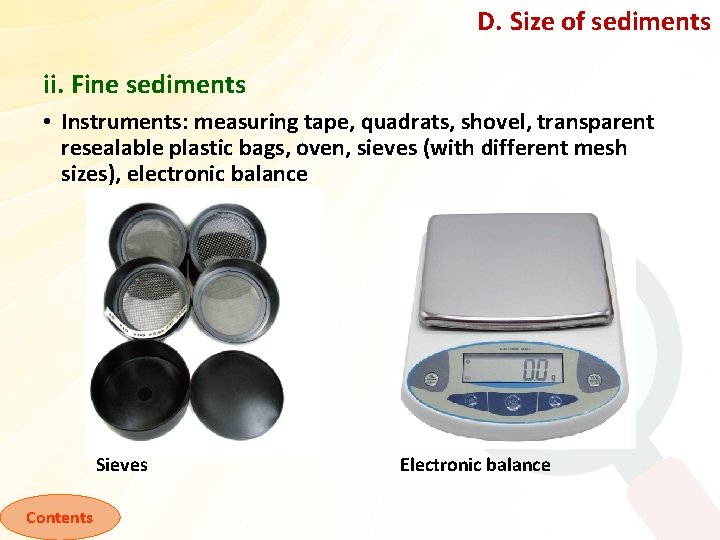
D. Size of sediments ii. Fine sediments • Instruments: measuring tape, quadrats, shovel, transparent resealable plastic bags, oven, sieves (with different mesh sizes), electronic balance Sieves Contents Electronic balance
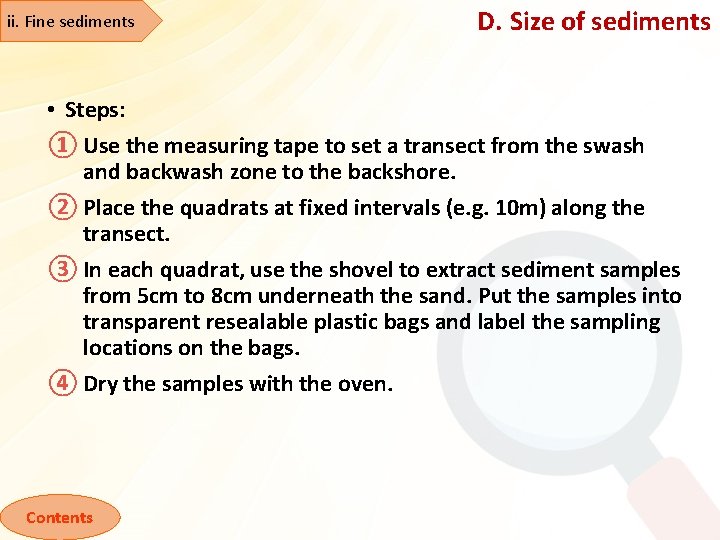
ii. Fine sediments D. Size of sediments • Steps: ① Use the measuring tape to set a transect from the swash and backwash zone to the backshore. ② Place the quadrats at fixed intervals (e. g. 10 m) along the transect. ③ In each quadrat, use the shovel to extract sediment samples from 5 cm to 8 cm underneath the sand. Put the samples into transparent resealable plastic bags and label the sampling locations on the bags. ④ Dry the samples with the oven. Contents
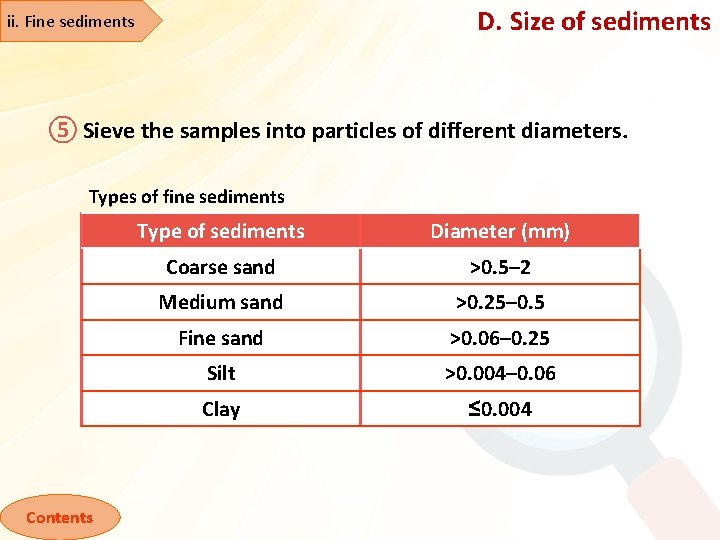
D. Size of sediments ii. Fine sediments ⑤ Sieve the samples into particles of different diameters. Types of fine sediments Contents Type of sediments Diameter (mm) Coarse sand >0. 5– 2 Medium sand >0. 25– 0. 5 Fine sand >0. 06– 0. 25 Silt >0. 004– 0. 06 Clay ≤ 0. 004
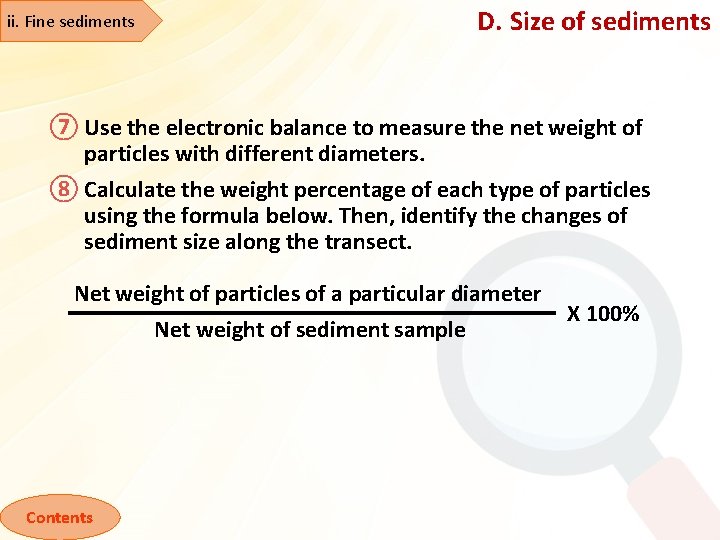
D. Size of sediments ii. Fine sediments ⑦ Use the electronic balance to measure the net weight of particles with different diameters. ⑧ Calculate the weight percentage of each type of particles using the formula below. Then, identify the changes of sediment size along the transect. Net weight of particles of a particular diameter Net weight of sediment sample Contents X 100%
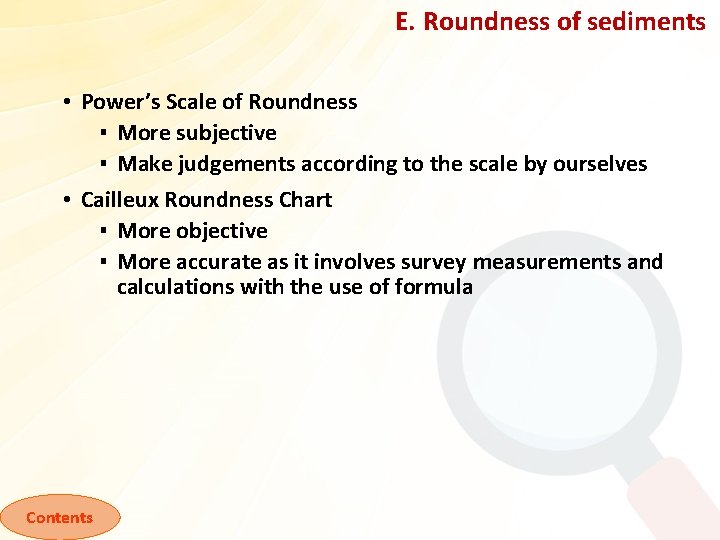
E. Roundness of sediments • Power’s Scale of Roundness ▪ More subjective ▪ Make judgements according to the scale by ourselves • Cailleux Roundness Chart ▪ More objective ▪ More accurate as it involves survey measurements and calculations with the use of formula Contents
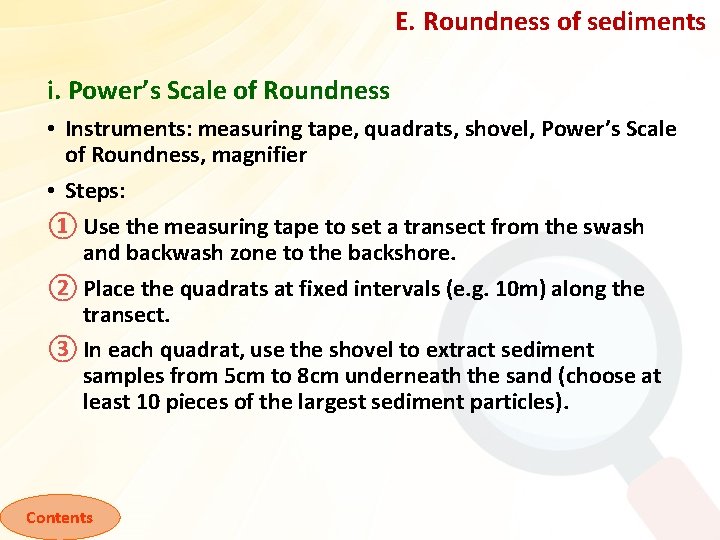
E. Roundness of sediments i. Power’s Scale of Roundness • Instruments: measuring tape, quadrats, shovel, Power’s Scale of Roundness, magnifier • Steps: ① Use the measuring tape to set a transect from the swash and backwash zone to the backshore. ② Place the quadrats at fixed intervals (e. g. 10 m) along the transect. ③ In each quadrat, use the shovel to extract sediment samples from 5 cm to 8 cm underneath the sand (choose at least 10 pieces of the largest sediment particles). Contents
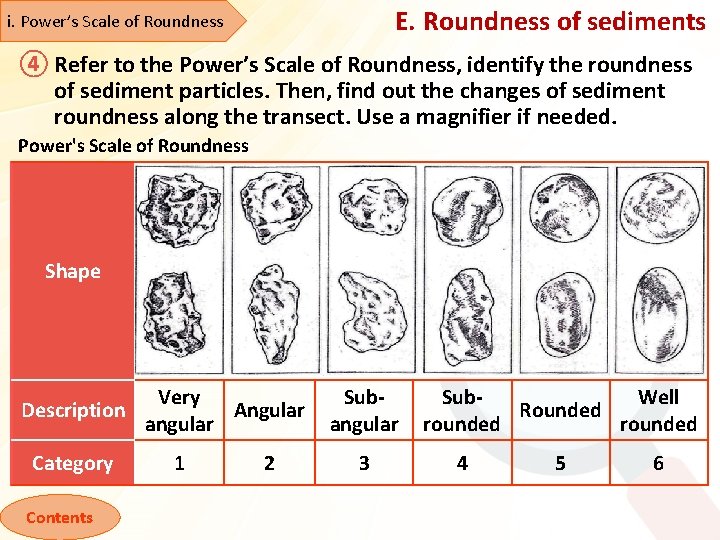
E. Roundness of sediments i. Power’s Scale of Roundness ④ Refer to the Power’s Scale of Roundness, identify the roundness of sediment particles. Then, find out the changes of sediment roundness along the transect. Use a magnifier if needed. Power's Scale of Roundness Shape Description Category Contents Very Angular angular 1 2 Subangular 3 Sub. Well Rounded rounded 4 5 6
E. Roundness of sediments ii. Cailleux Roundness Chart • Instruments: measuring tape, quadrats, shovel, ruler (or calliper), Cailleux Roundness Chart • Steps: ① Use the measuring tape to set a transect from the swash and backwash zone to the backshore. ② Place the quadrats at fixed intervals (e. g. 10 m) along the transect. ③ In each quadrat, use the shovel to extract sediment samples from 5 cm to 8 cm underneath the sand (choose at least 10 pieces of the largest sediment particles). ④ Use the ruler or calliper to measure the length of long axis (L) of the sediment particles. Contents
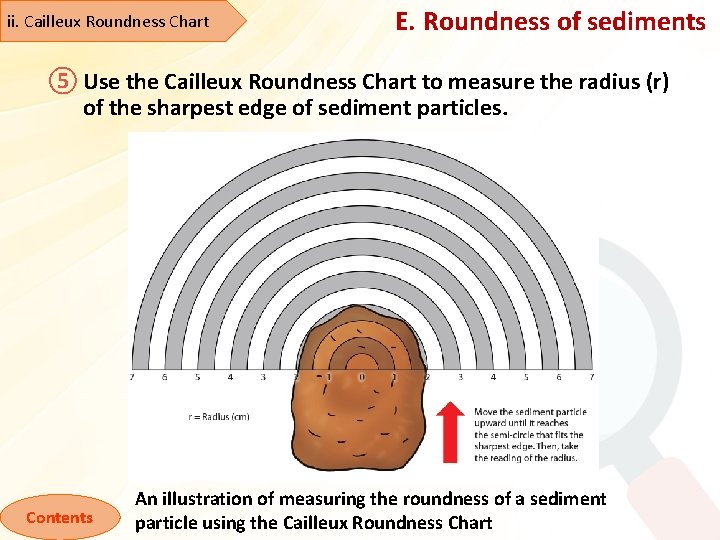
ii. Cailleux Roundness Chart E. Roundness of sediments ⑤ Use the Cailleux Roundness Chart to measure the radius (r) of the sharpest edge of sediment particles. Contents An illustration of measuring the roundness of a sediment particle using the Cailleux Roundness Chart
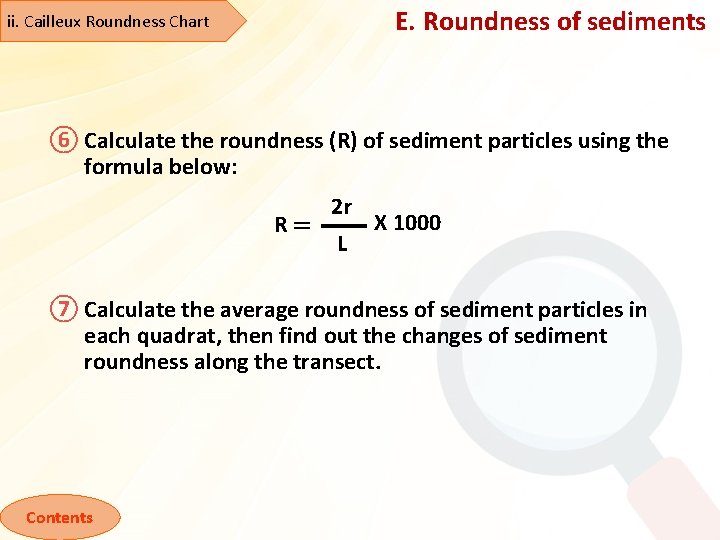
E. Roundness of sediments ii. Cailleux Roundness Chart ⑥ Calculate the roundness (R) of sediment particles using the formula below: R= 2 r L X 1000 ⑦ Calculate the average roundness of sediment particles in each quadrat, then find out the changes of sediment roundness along the transect. Contents
F. Seawater quality • Indicators of seawater quality: ▪ Turbidity refers to the clarity of a water body ▪ p. H value refers to the acidity or alkalinity of a water body ▪ Dissolved oxygen refers to the amount of oxygen dissolved in a water body Contents
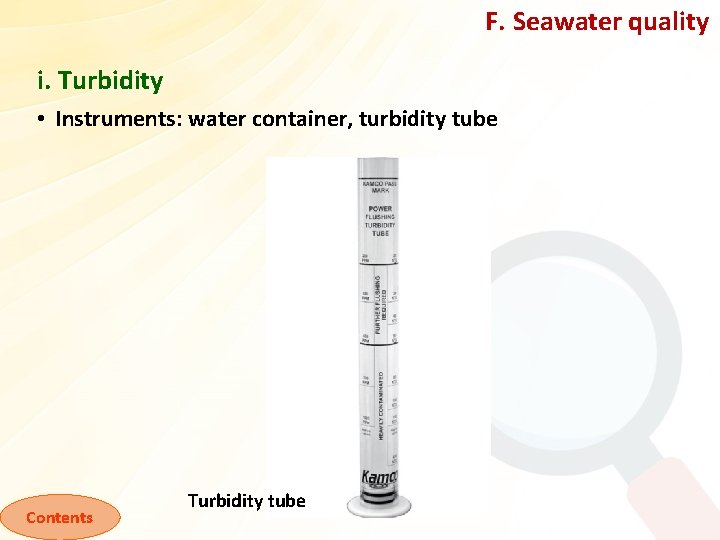
F. Seawater quality i. Turbidity • Instruments: water container, turbidity tube Contents Turbidity tube
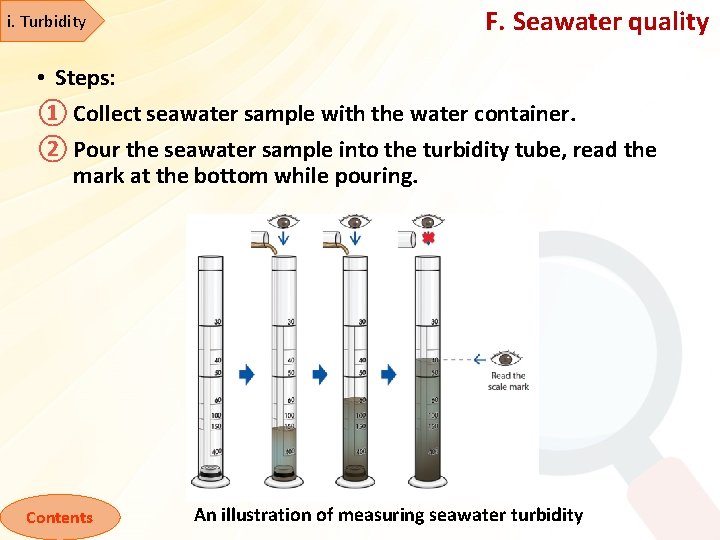
i. Turbidity F. Seawater quality • Steps: ① Collect seawater sample with the water container. ② Pour the seawater sample into the turbidity tube, read the mark at the bottom while pouring. Contents An illustration of measuring seawater turbidity
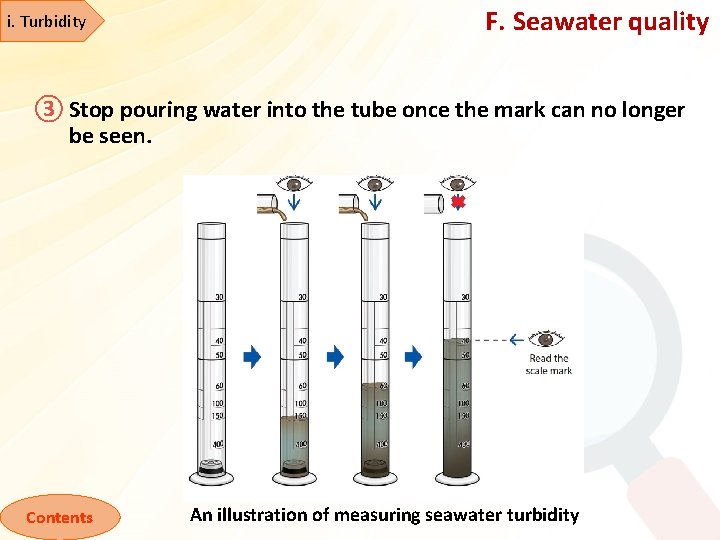
i. Turbidity F. Seawater quality ③ Stop pouring water into the tube once the mark can no longer be seen. Contents An illustration of measuring seawater turbidity
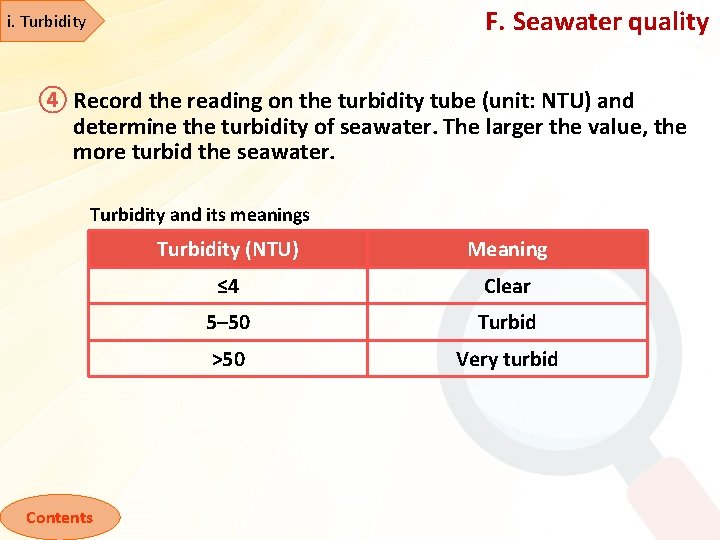
F. Seawater quality i. Turbidity ④ Record the reading on the turbidity tube (unit: NTU) and determine the turbidity of seawater. The larger the value, the more turbid the seawater. Turbidity and its meanings Contents Turbidity (NTU) Meaning ≤ 4 Clear 5– 50 Turbid >50 Very turbid
F. Seawater quality ii. p. H value • p. H meter ▪ More objective ▪ Data accuracy can be guaranteed with clear reading on the meter • p. H papers ▪ Cheaper ▪ Measurements can be taken by more than one person simultaneously Contents
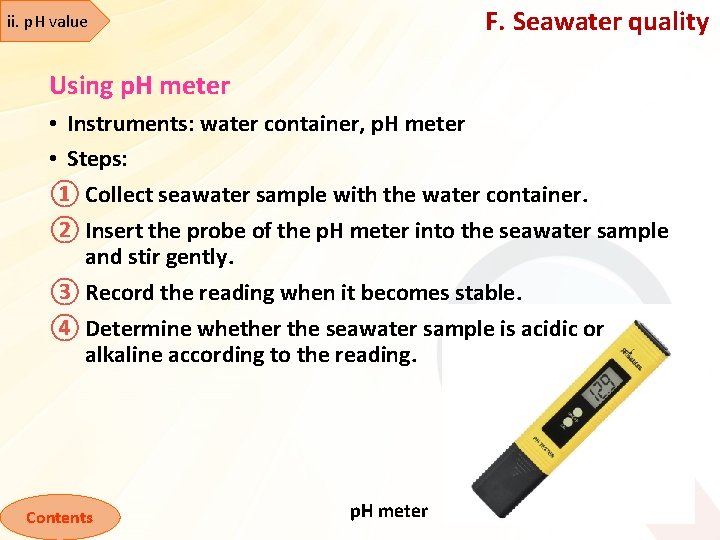
F. Seawater quality ii. p. H value Using p. H meter • Instruments: water container, p. H meter • Steps: ① Collect seawater sample with the water container. ② Insert the probe of the p. H meter into the seawater sample and stir gently. ③ Record the reading when it becomes stable. ④ Determine whether the seawater sample is acidic or alkaline according to the reading. Contents p. H meter

F. Seawater quality ii. p. H value Using p. H papers • Instruments: water container, p. H papers • Steps: ① Collect seawater sample with the water container. ② Drip the seawater sample onto a piece of p. H paper. ③ Observe the colour change of the paper. ④ Determine whether the seawater sample is acidic or alkaline according to the colour. Contents p. H papers
F. Seawater quality iii. Dissolved oxygen • Dissolved oxygen meter ▪ More objective ▪ More accurate ▪ Dissolve oxygen test kit ▪ Cheaper ▪ Can be used by more than one person simultaneously Contents
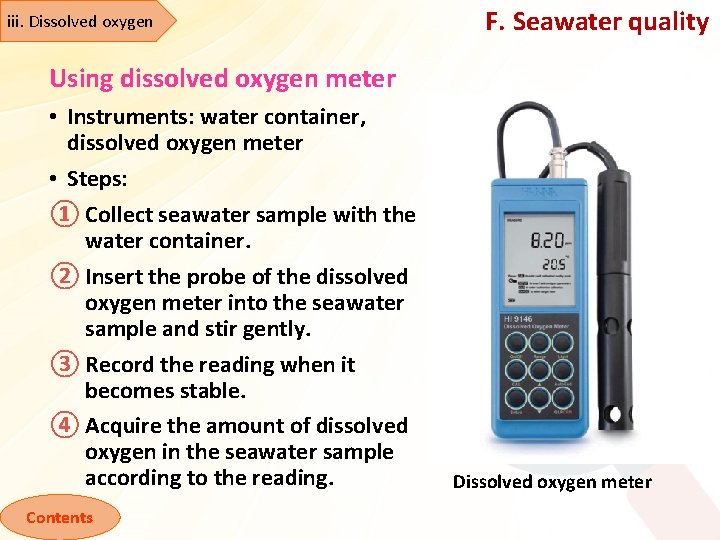
iii. Dissolved oxygen F. Seawater quality Using dissolved oxygen meter • Instruments: water container, dissolved oxygen meter • Steps: ① Collect seawater sample with the water container. ② Insert the probe of the dissolved oxygen meter into the seawater sample and stir gently. ③ Record the reading when it becomes stable. ④ Acquire the amount of dissolved oxygen in the seawater sample according to the reading. Contents Dissolved oxygen meter
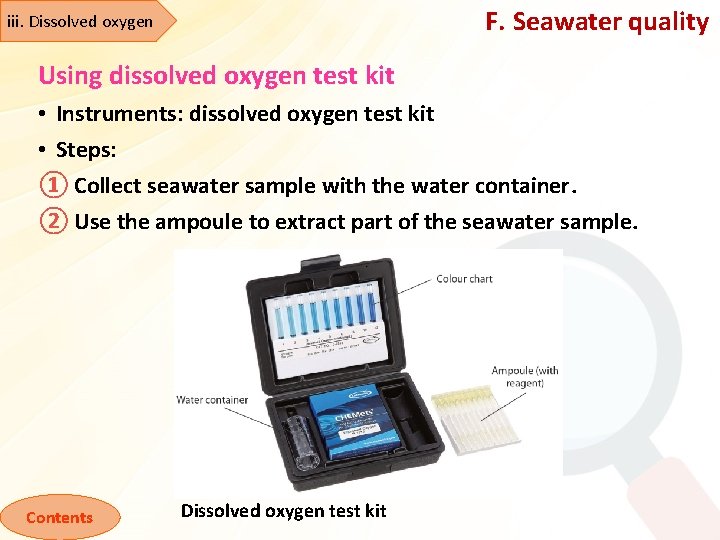
F. Seawater quality iii. Dissolved oxygen Using dissolved oxygen test kit • Instruments: dissolved oxygen test kit • Steps: ① Collect seawater sample with the water container. ② Use the ampoule to extract part of the seawater sample. Contents Dissolved oxygen test kit
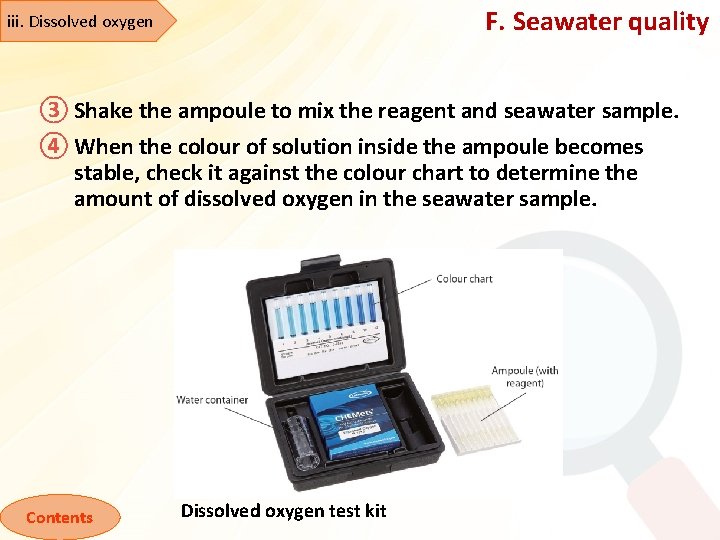
F. Seawater quality iii. Dissolved oxygen ③ Shake the ampoule to mix the reagent and seawater sample. ④ When the colour of solution inside the ampoule becomes stable, check it against the colour chart to determine the amount of dissolved oxygen in the seawater sample. Contents Dissolved oxygen test kit

End
- Slides: 54