
Contents 2 1 Basic concepts 2 Resistive circuits

Contents 2 1. Basic concepts 2. Resistive circuits 3. Nodal and loop analysis techniques 4. Operational amplifiers 5. Additional analysis techniques 6. Capacitance and inductance 7. First and second order transient circuits EMLAB
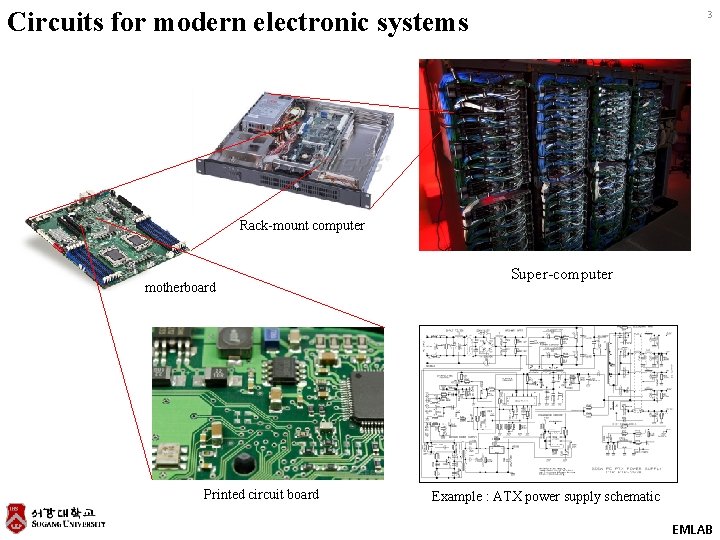
Circuits for modern electronic systems 3 Rack-mount computer motherboard Printed circuit board Super-computer Example : ATX power supply schematic EMLAB
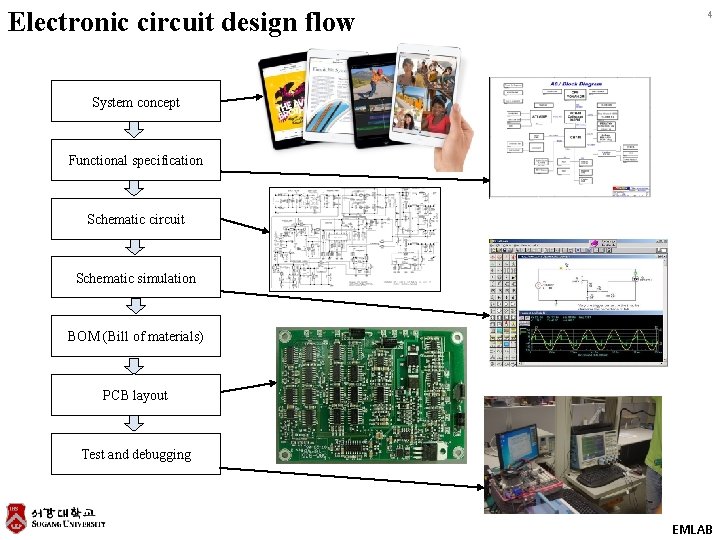
Electronic circuit design flow 4 System concept Functional specification Schematic circuit Schematic simulation BOM (Bill of materials) PCB layout Test and debugging EMLAB
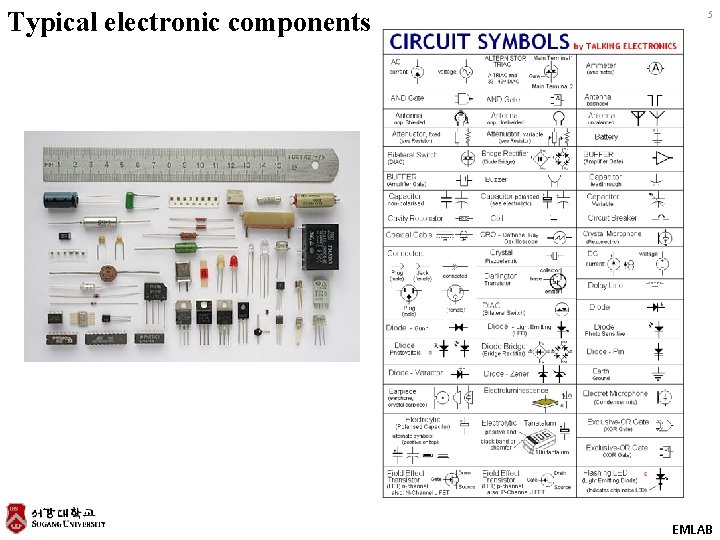
Typical electronic components 5 EMLAB
6 Chapter 1. Basic concepts EMLAB
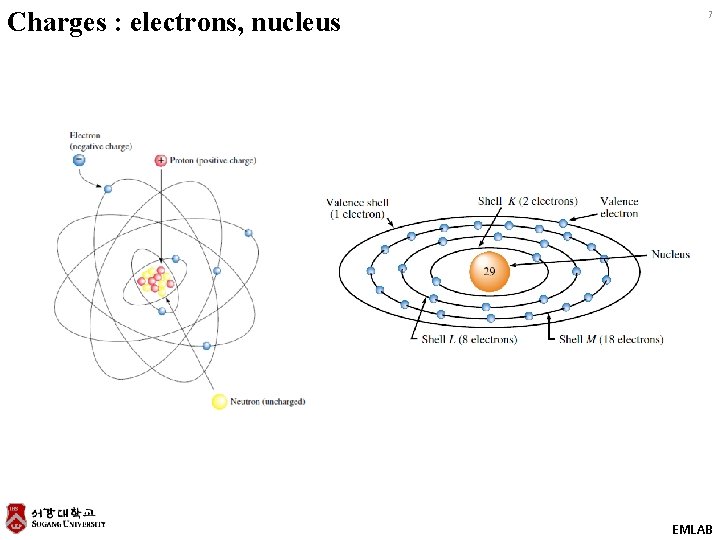
Charges : electrons, nucleus 7 EMLAB
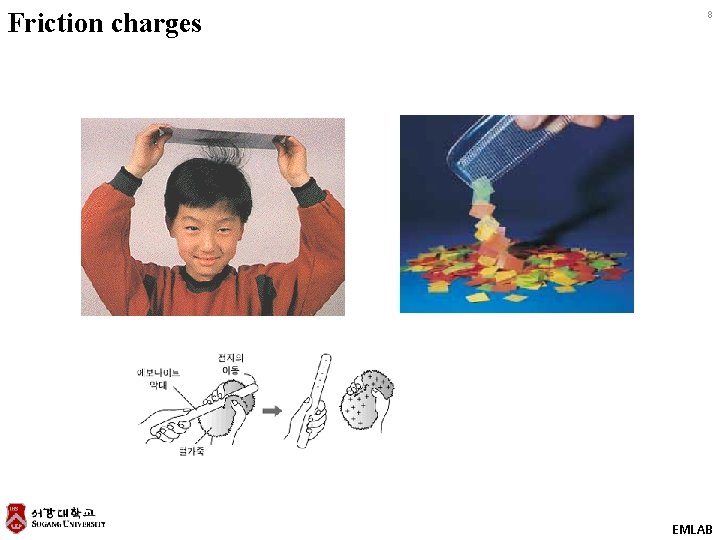
Friction charges 8 EMLAB
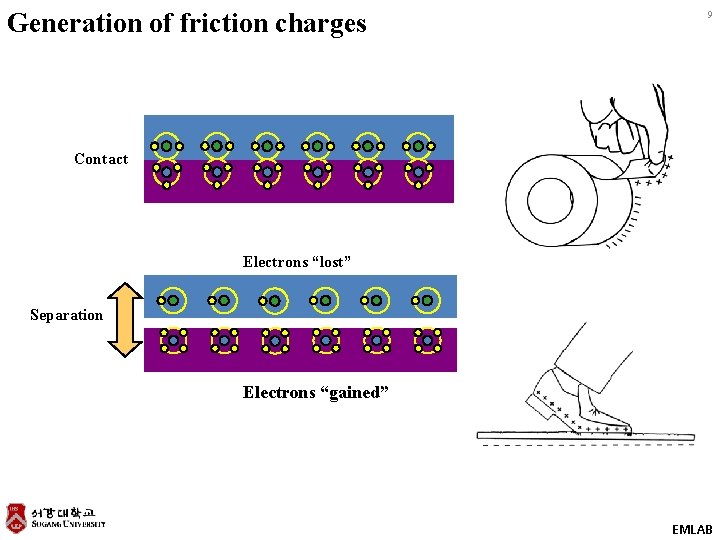
Generation of friction charges 9 Contact Electrons “lost” Separation Electrons “gained” EMLAB
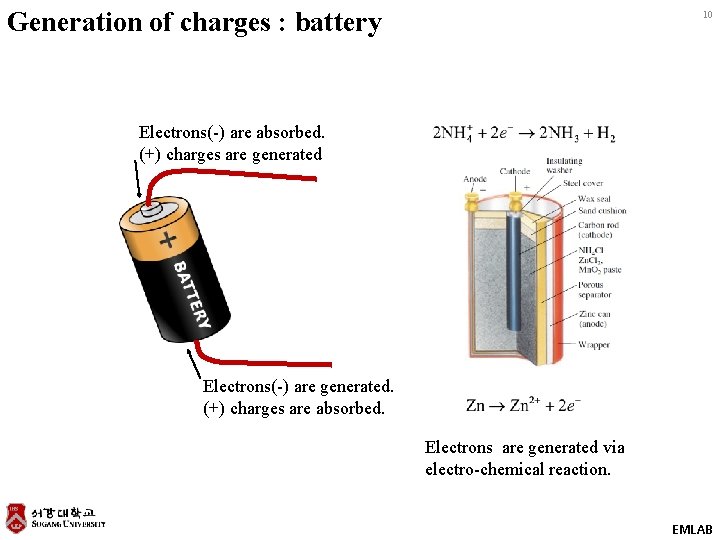
Generation of charges : battery 10 Electrons(-) are absorbed. (+) charges are generated Electrons(-) are generated. (+) charges are absorbed. Electrons are generated via electro-chemical reaction. EMLAB
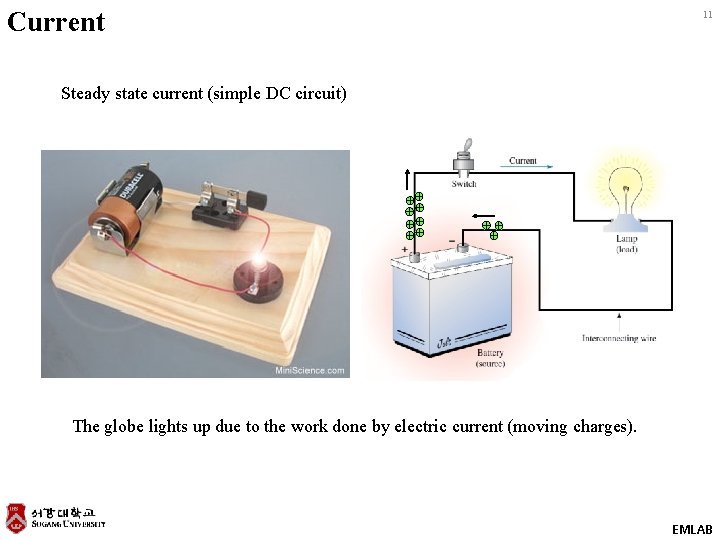
Current 11 Steady state current (simple DC circuit) The globe lights up due to the work done by electric current (moving charges). EMLAB
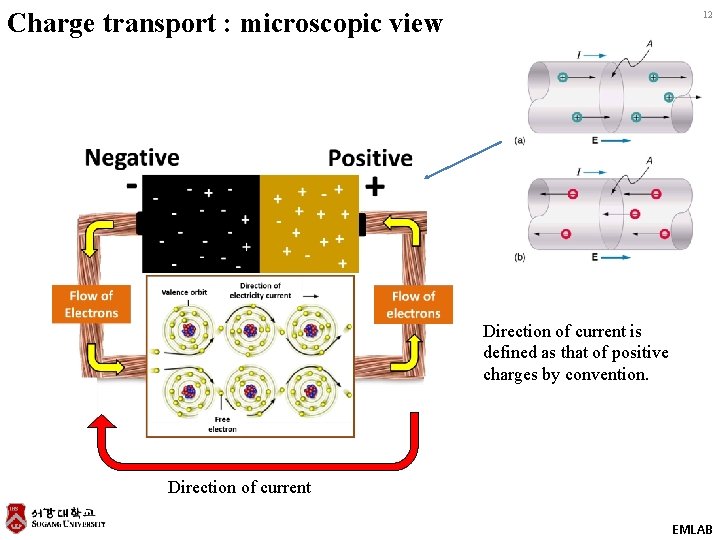
Charge transport : microscopic view 12 Direction of current is defined as that of positive charges by convention. Direction of current EMLAB
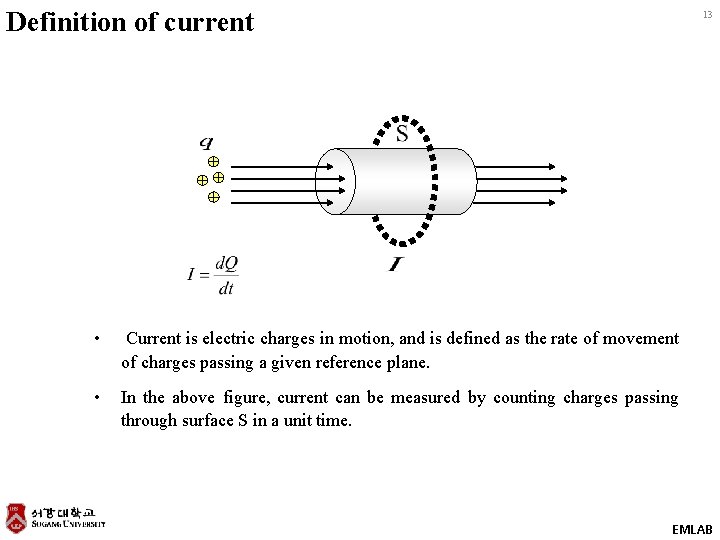
Definition of current 13 • Current is electric charges in motion, and is defined as the rate of movement of charges passing a given reference plane. • In the above figure, current can be measured by counting charges passing through surface S in a unit time. EMLAB
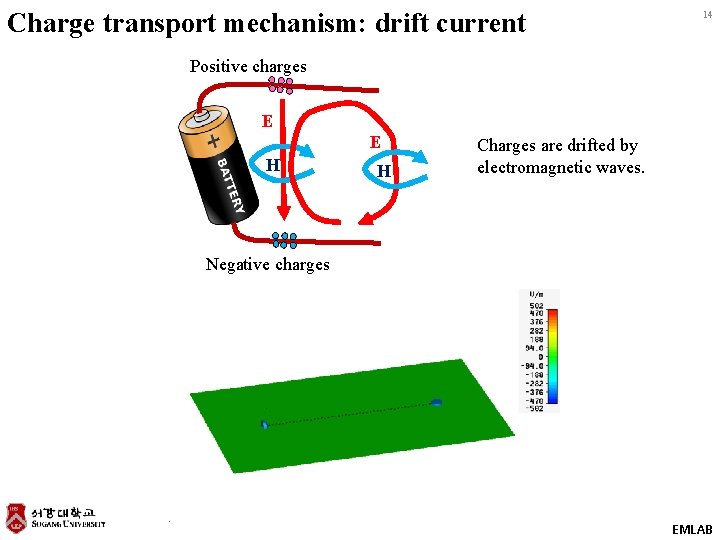
Charge transport mechanism: drift current 14 Positive charges E E H H Charges are drifted by electromagnetic waves. Negative charges EMLAB
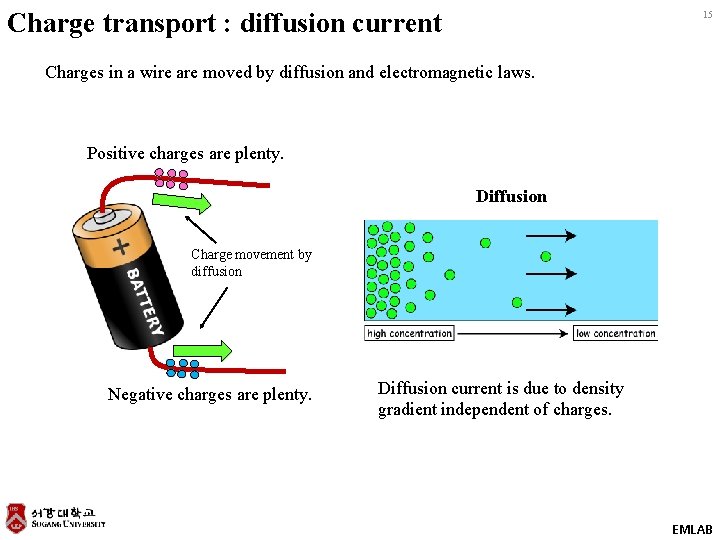
Charge transport : diffusion current 15 Charges in a wire are moved by diffusion and electromagnetic laws. Positive charges are plenty. Diffusion Charge movement by diffusion Negative charges are plenty. Diffusion current is due to density gradient independent of charges. EMLAB
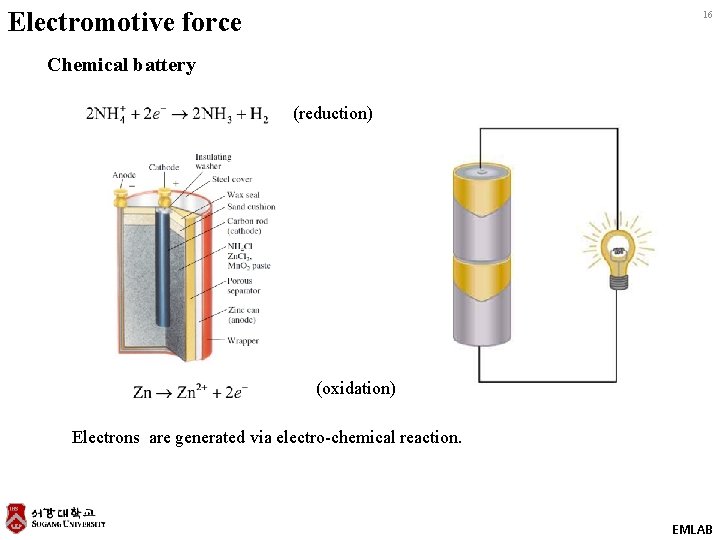
Electromotive force 16 Chemical battery (reduction) (oxidation) Electrons are generated via electro-chemical reaction. EMLAB
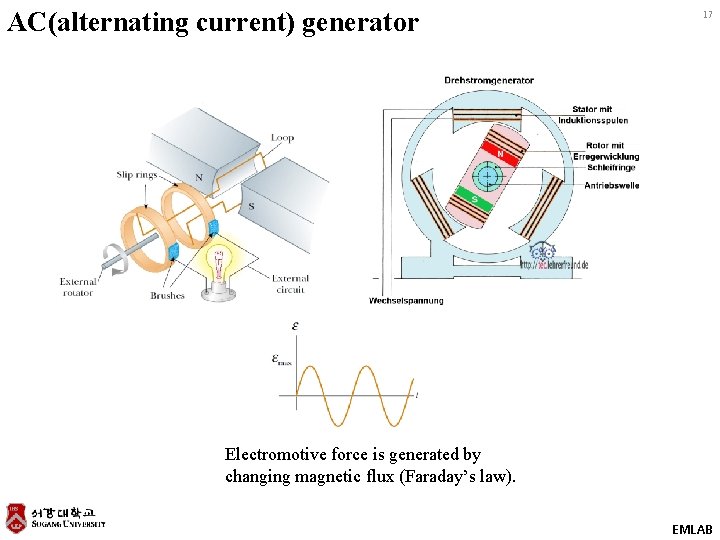
AC(alternating current) generator 17 Electromotive force is generated by changing magnetic flux (Faraday’s law). EMLAB
18 Circuit elements EMLAB
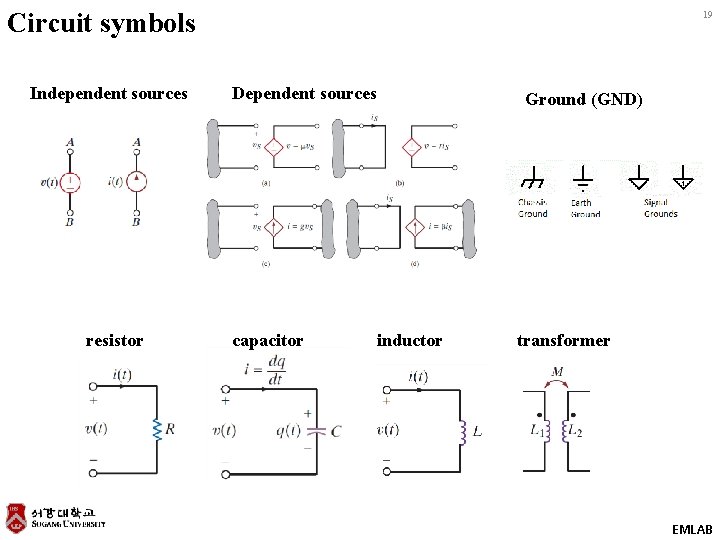
Circuit symbols Independent sources resistor 19 Dependent sources capacitor Ground (GND) inductor transformer EMLAB
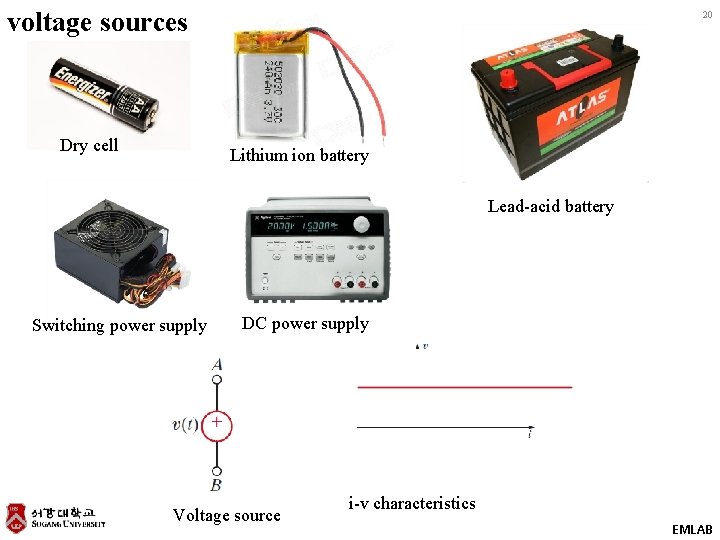
voltage sources Dry cell 20 Lithium ion battery Lead-acid battery Switching power supply DC power supply Voltage source i-v characteristics EMLAB
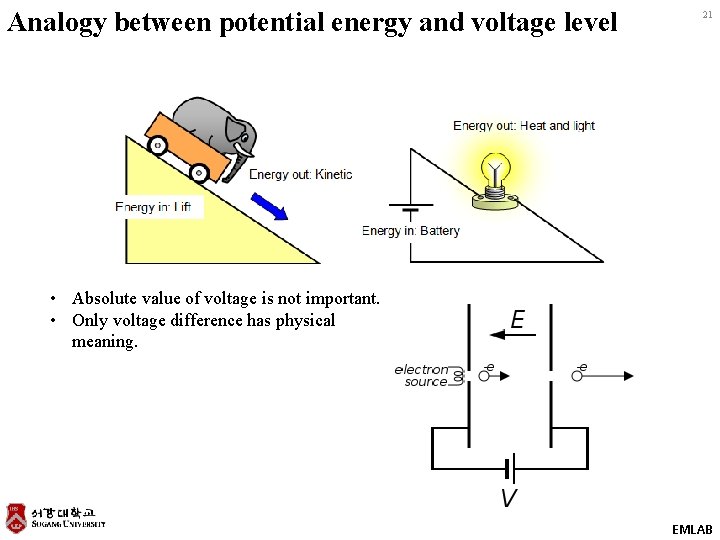
Analogy between potential energy and voltage level 21 • Absolute value of voltage is not important. • Only voltage difference has physical meaning. EMLAB
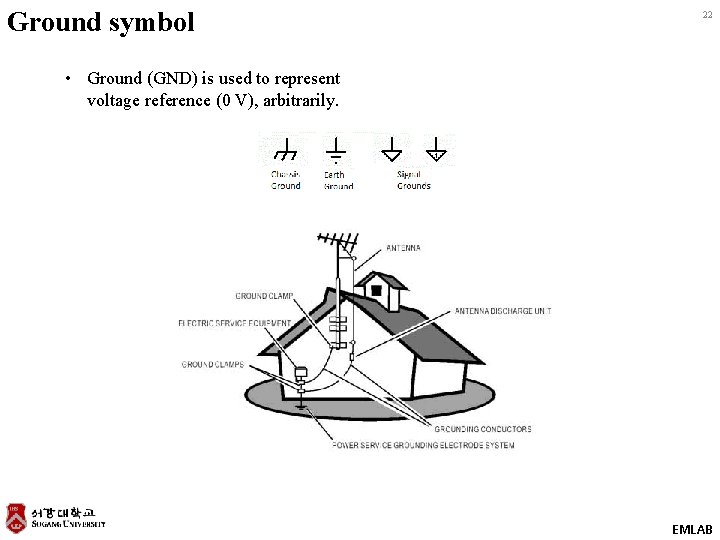
Ground symbol 22 • Ground (GND) is used to represent voltage reference (0 V), arbitrarily. EMLAB
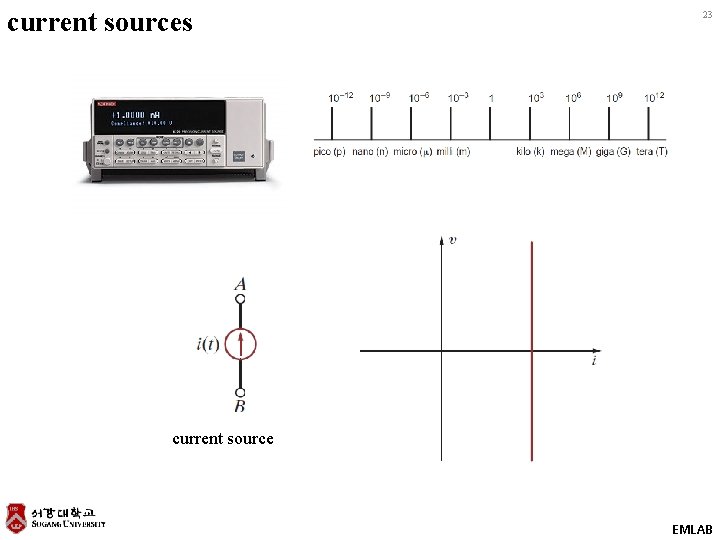
current sources 23 current source EMLAB
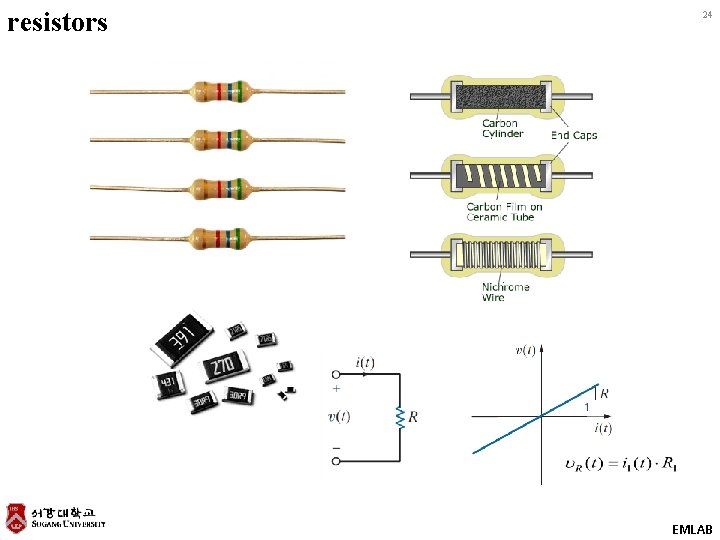
resistors 24 EMLAB
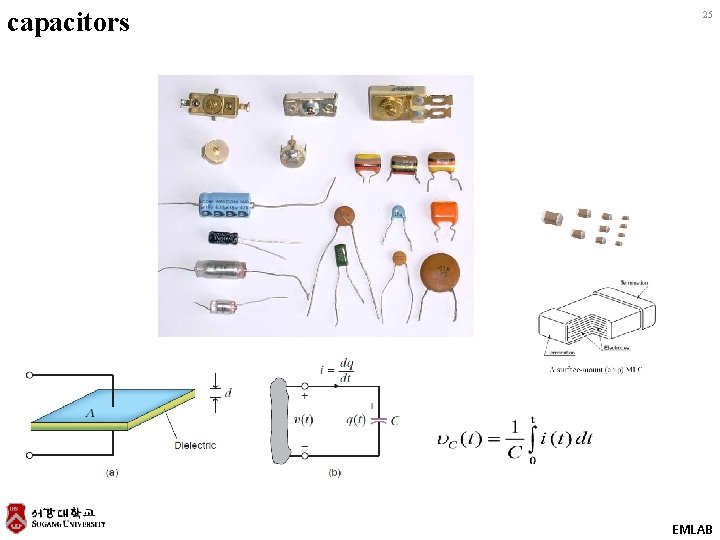
capacitors 25 EMLAB
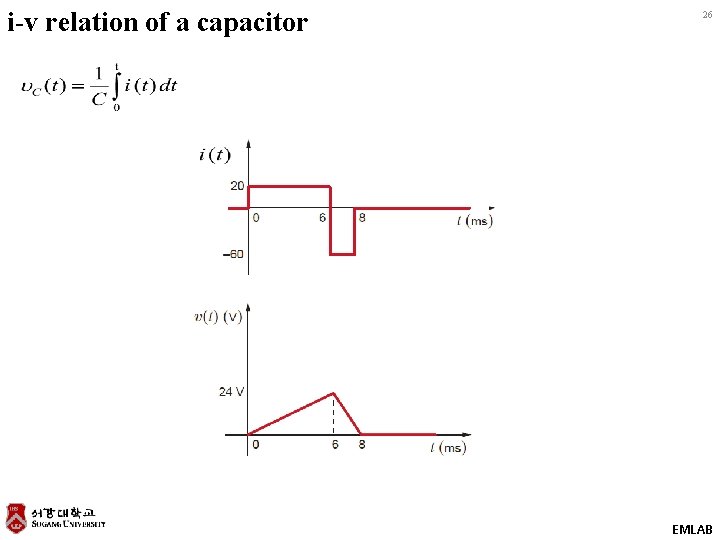
i-v relation of a capacitor 26 EMLAB
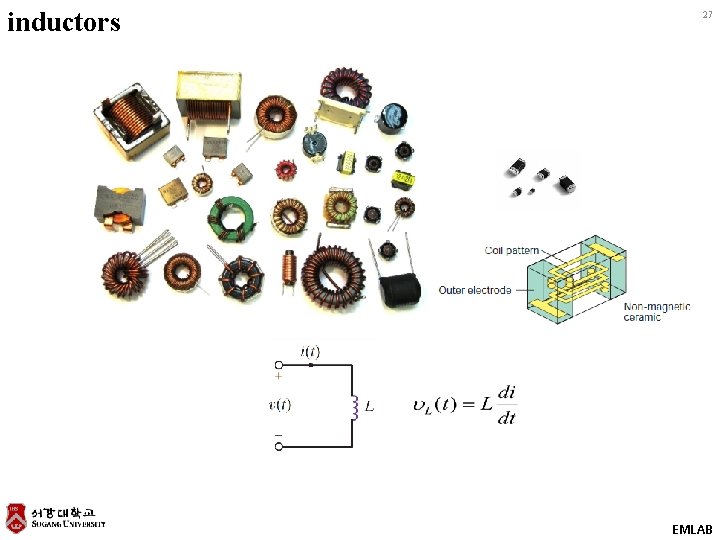
inductors 27 EMLAB
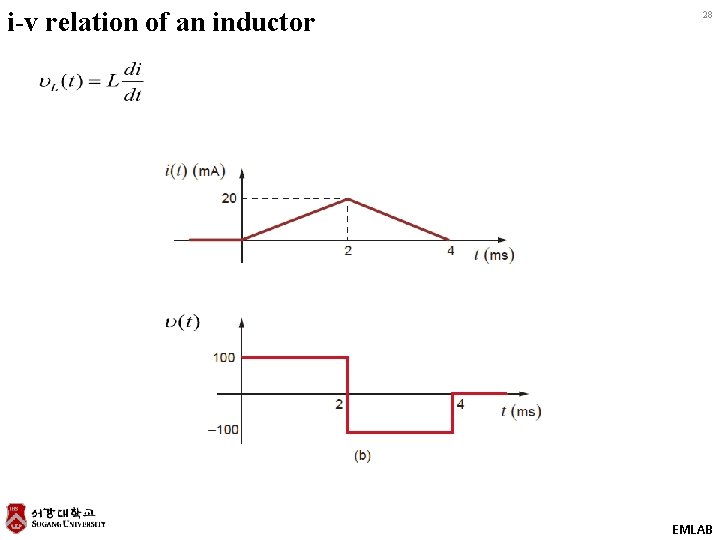
i-v relation of an inductor 28 EMLAB
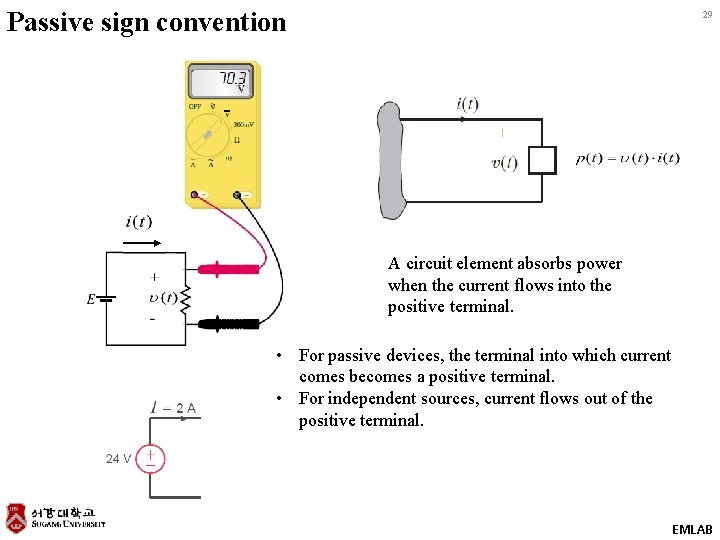
Passive sign convention 29 A circuit element absorbs power when the current flows into the positive terminal. • For passive devices, the terminal into which current comes becomes a positive terminal. • For independent sources, current flows out of the positive terminal. EMLAB
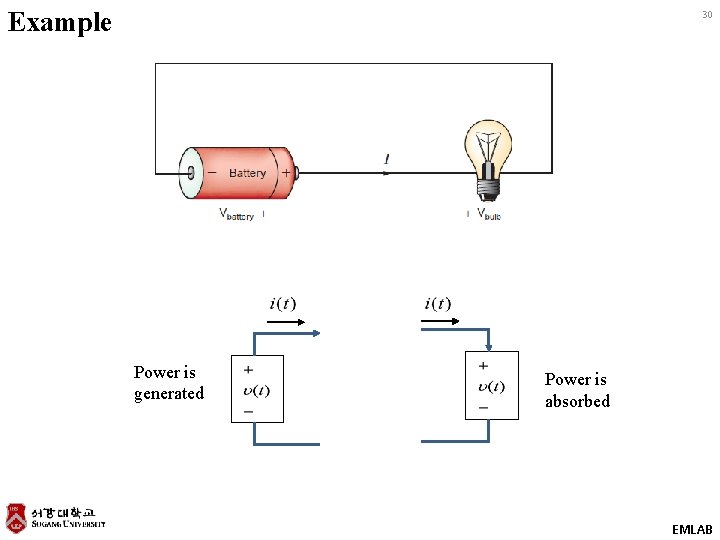
Example 30 Power is generated Power is absorbed EMLAB
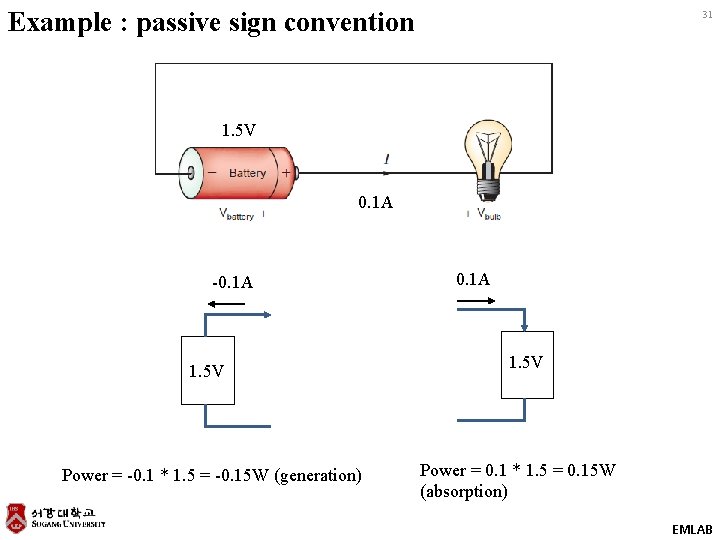
Example : passive sign convention 31 1. 5 V 0. 1 A -0. 1 A 1. 5 V Power = -0. 1 * 1. 5 = -0. 15 W (generation) 0. 1 A 1. 5 V Power = 0. 1 * 1. 5 = 0. 15 W (absorption) EMLAB
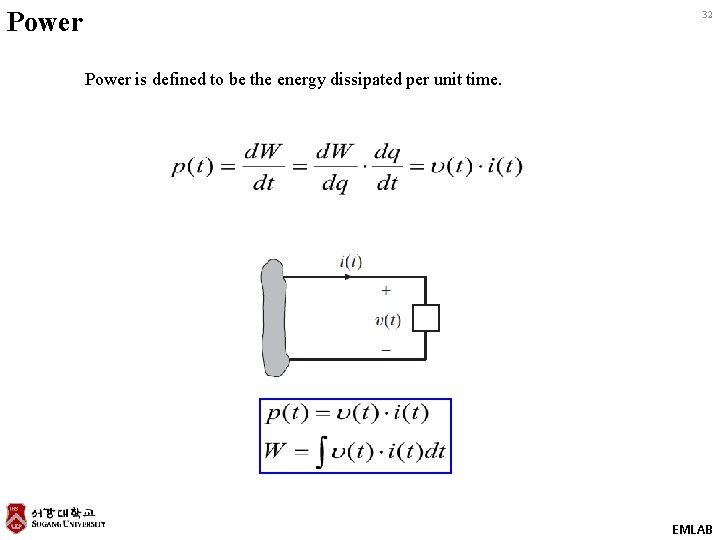
Power 32 Power is defined to be the energy dissipated per unit time. EMLAB
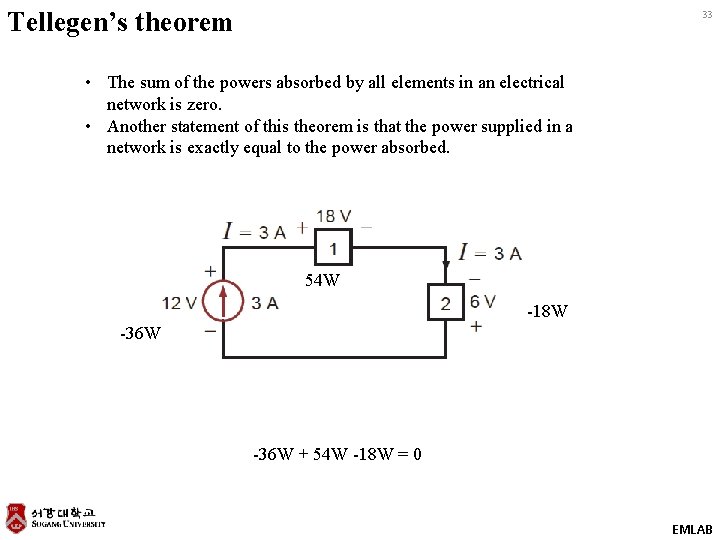
Tellegen’s theorem 33 • The sum of the powers absorbed by all elements in an electrical network is zero. • Another statement of this theorem is that the power supplied in a network is exactly equal to the power absorbed. 54 W -18 W -36 W + 54 W -18 W = 0 EMLAB
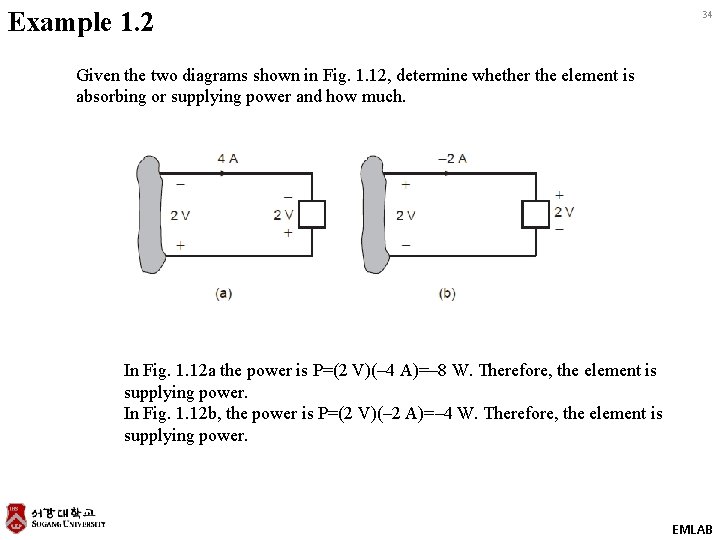
Example 1. 2 34 Given the two diagrams shown in Fig. 1. 12, determine whether the element is absorbing or supplying power and how much. In Fig. 1. 12 a the power is P=(2 V)(– 4 A)=– 8 W. Therefore, the element is supplying power. In Fig. 1. 12 b, the power is P=(2 V)(– 2 A)=– 4 W. Therefore, the element is supplying power. EMLAB
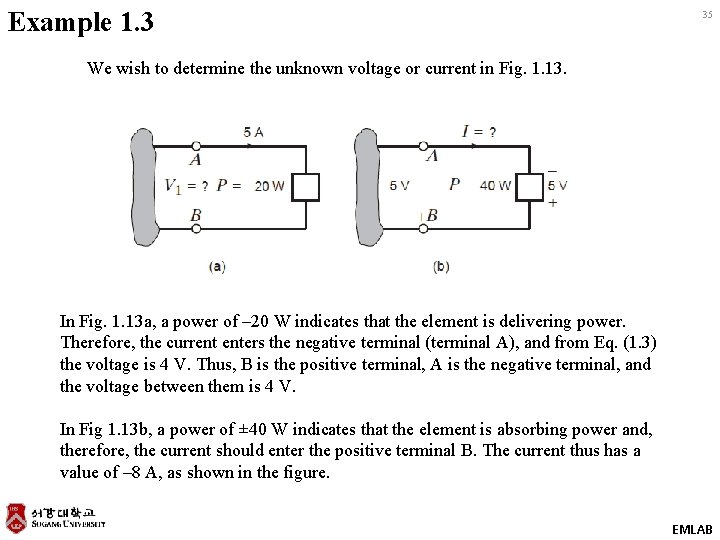
Example 1. 3 35 We wish to determine the unknown voltage or current in Fig. 1. 13. In Fig. 1. 13 a, a power of – 20 W indicates that the element is delivering power. Therefore, the current enters the negative terminal (terminal A), and from Eq. (1. 3) the voltage is 4 V. Thus, B is the positive terminal, A is the negative terminal, and the voltage between them is 4 V. In Fig 1. 13 b, a power of ± 40 W indicates that the element is absorbing power and, therefore, the current should enter the positive terminal B. The current thus has a value of – 8 A, as shown in the figure. EMLAB
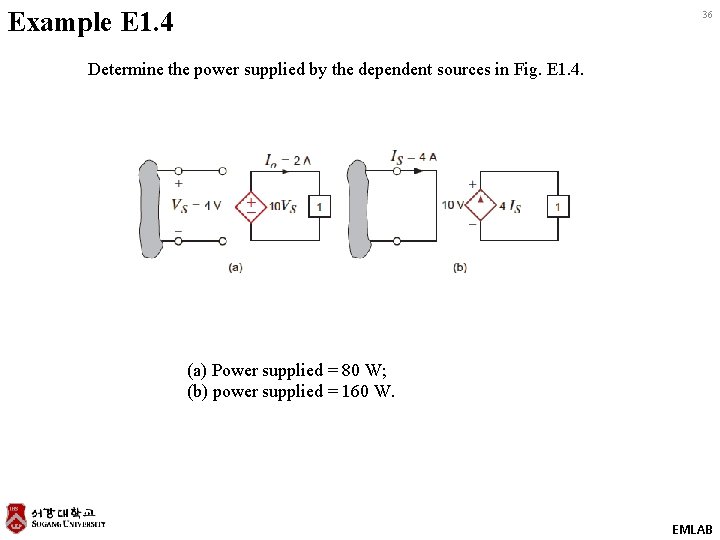
Example E 1. 4 36 Determine the power supplied by the dependent sources in Fig. E 1. 4. (a) Power supplied = 80 W; (b) power supplied = 160 W. EMLAB
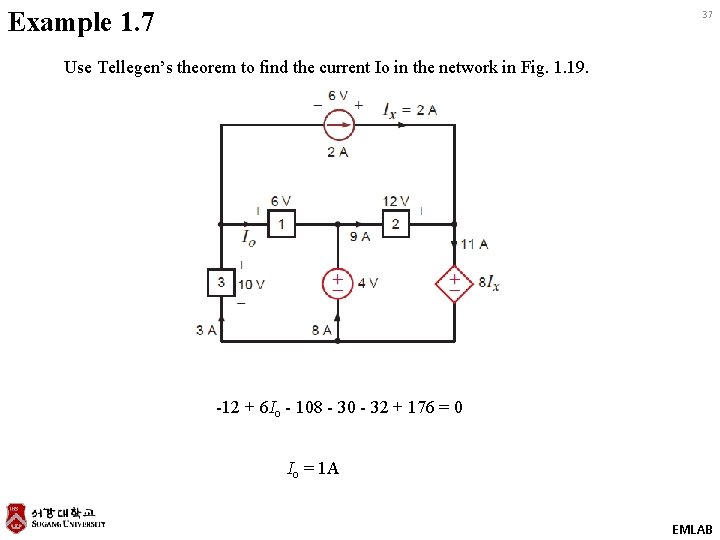
Example 1. 7 37 Use Tellegen’s theorem to find the current Io in the network in Fig. 1. 19. -12 + 6 Io - 108 - 30 - 32 + 176 = 0 Io = 1 A EMLAB
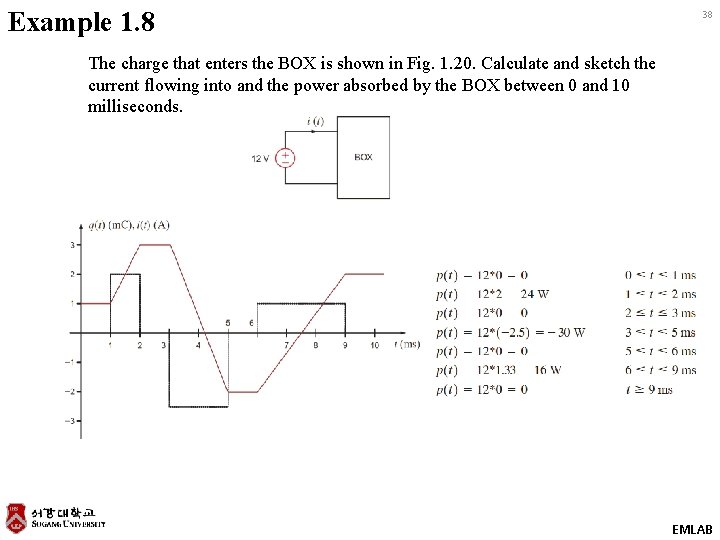
Example 1. 8 38 The charge that enters the BOX is shown in Fig. 1. 20. Calculate and sketch the current flowing into and the power absorbed by the BOX between 0 and 10 milliseconds. EMLAB
- Slides: 38