
Contents 1 CRM Key Concepts Customer acquisitionretention Customer
- Slides: 67
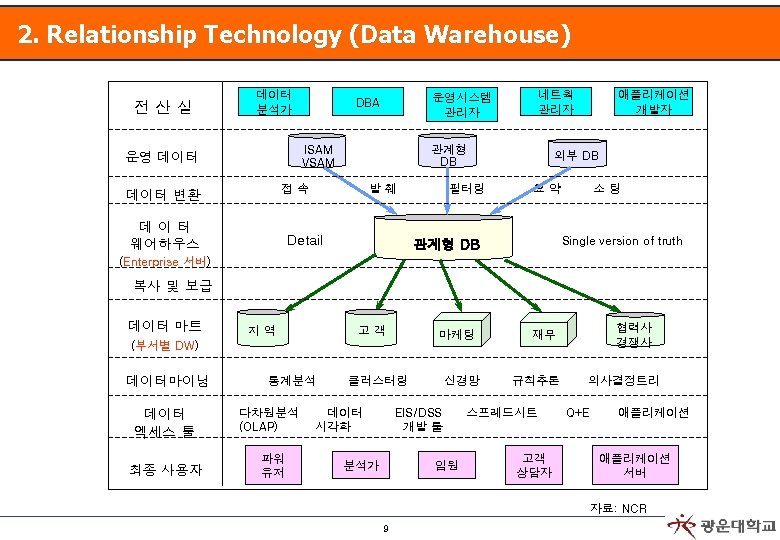
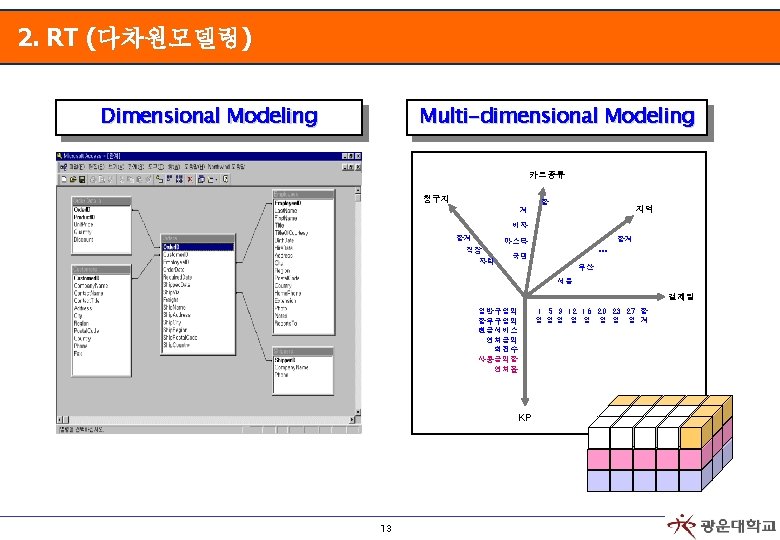
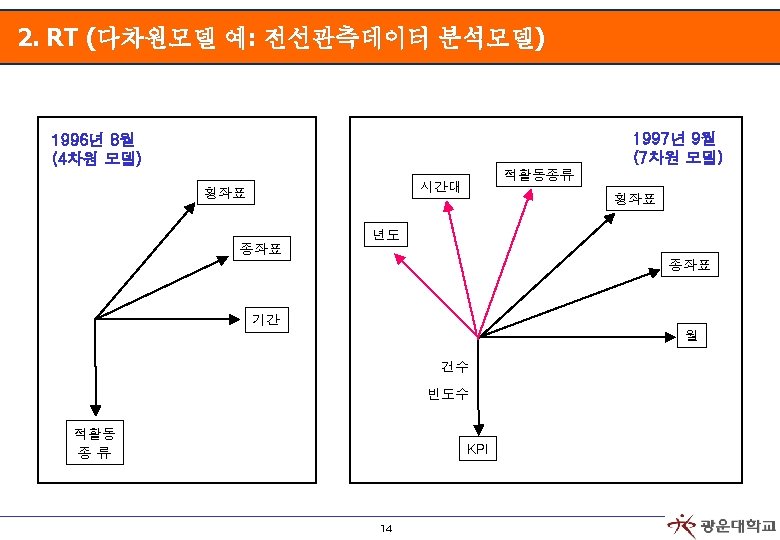
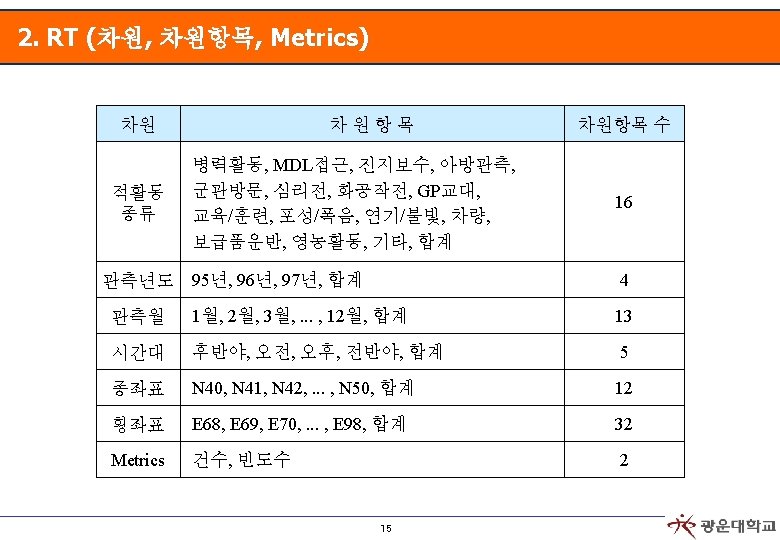
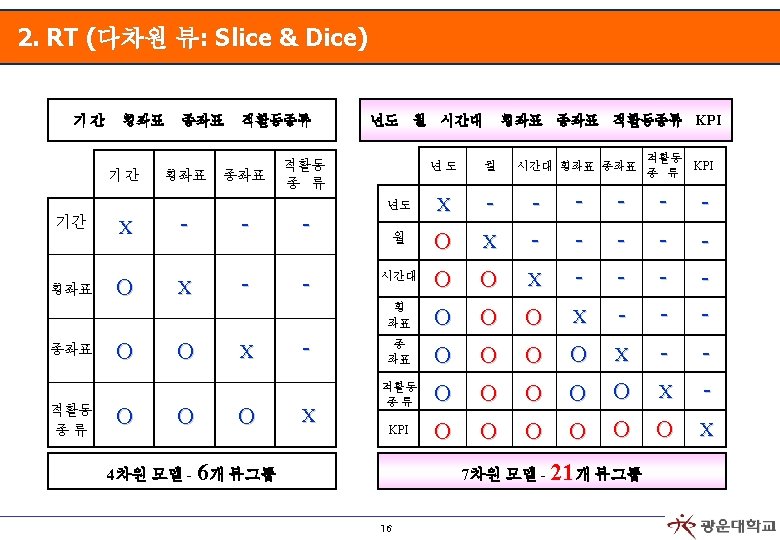
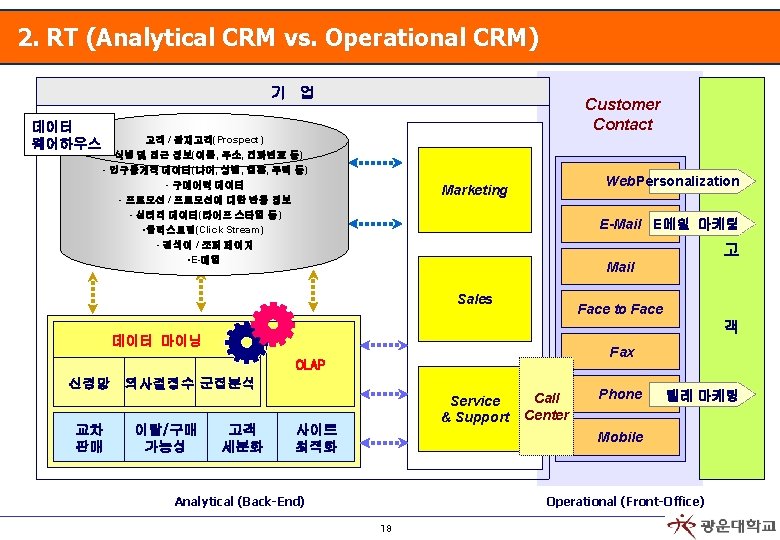
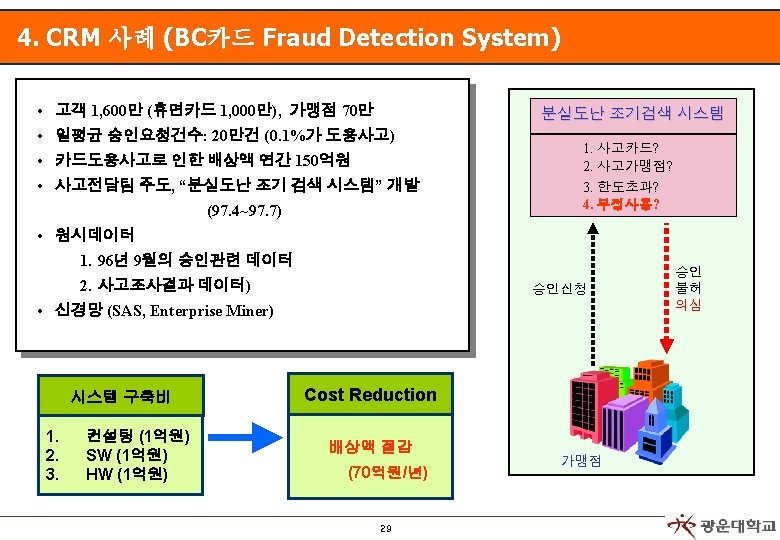
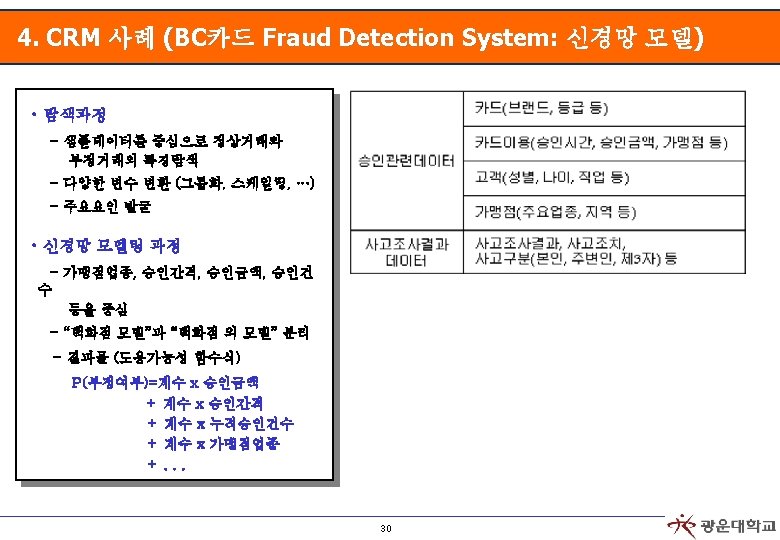
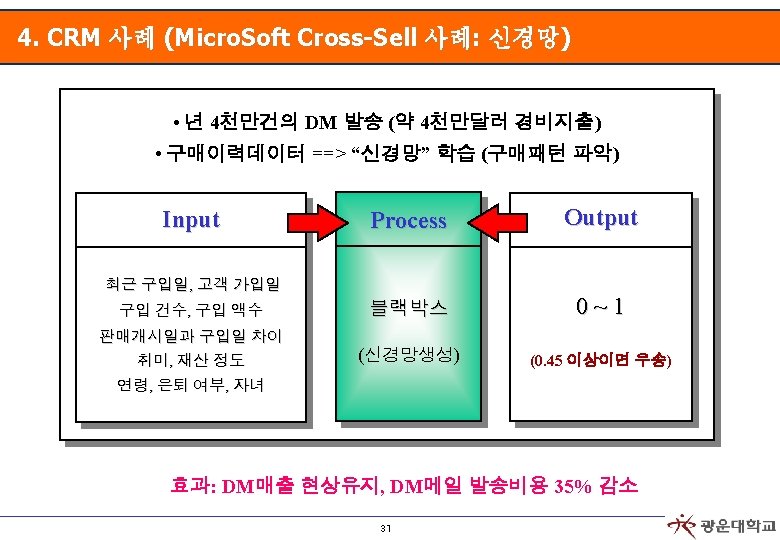
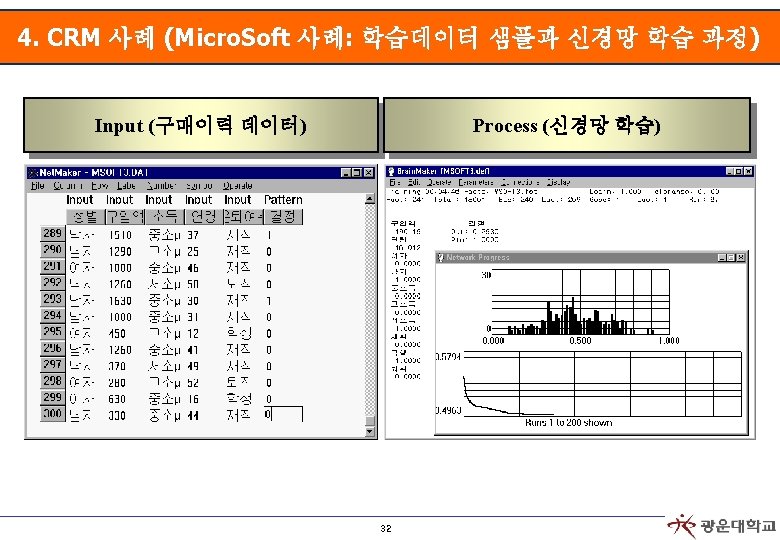
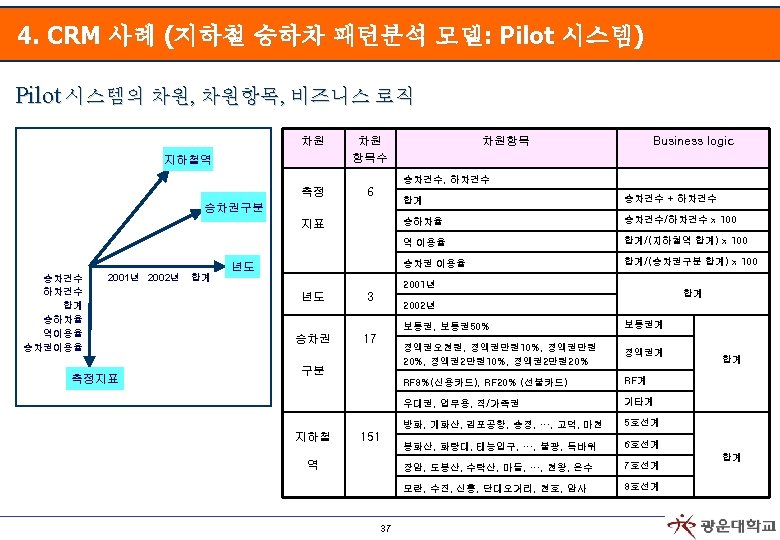
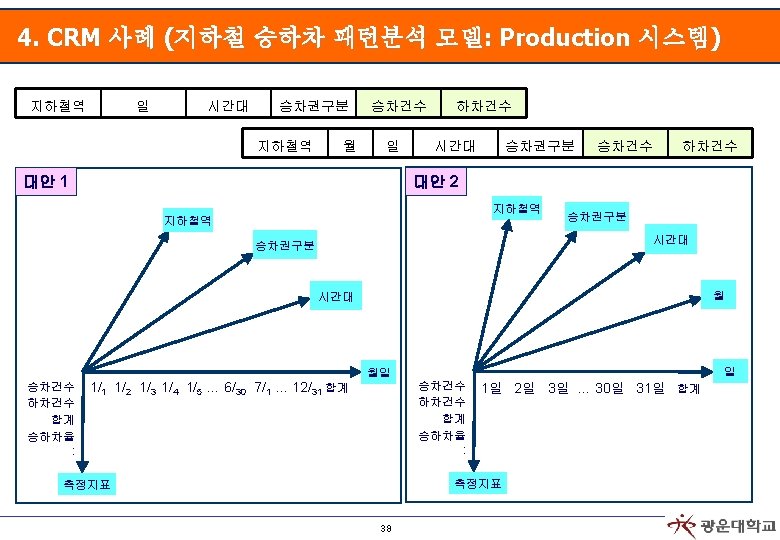
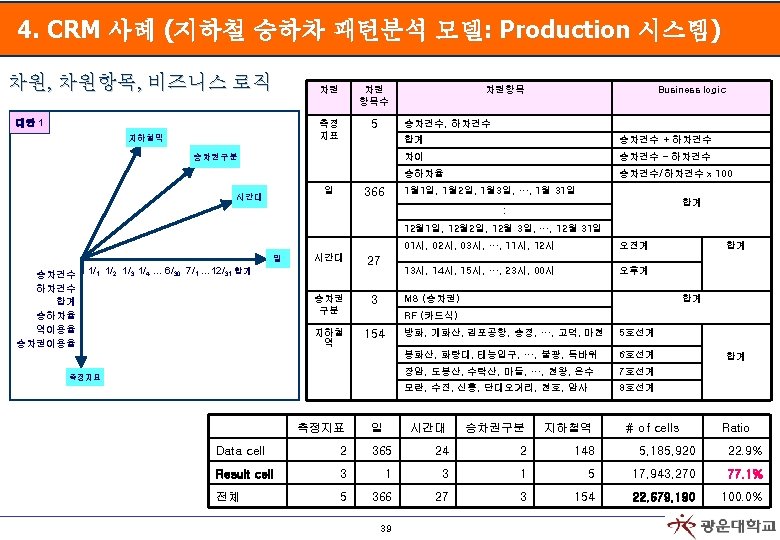
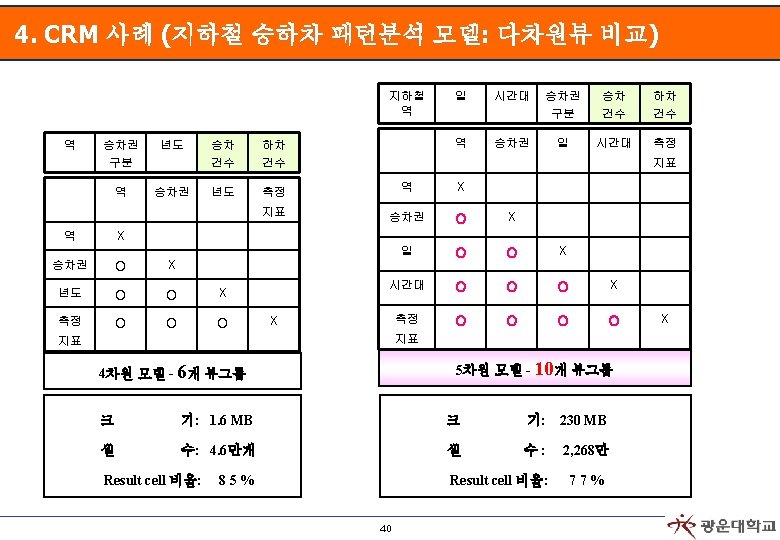
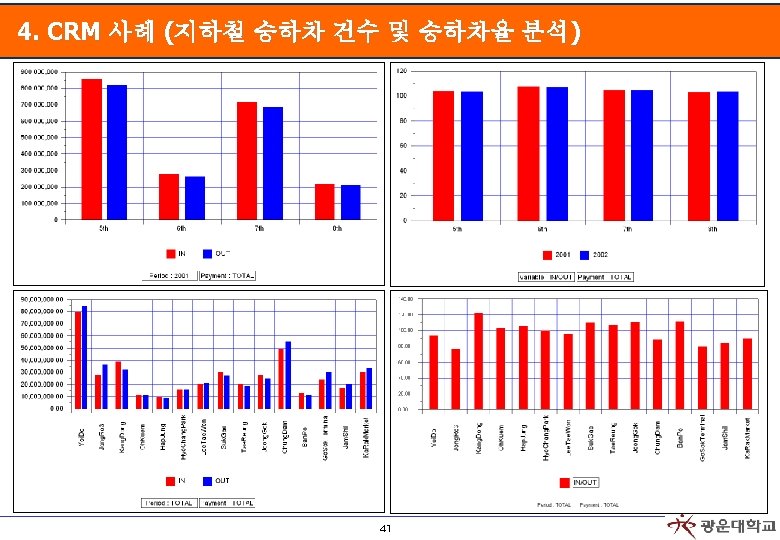
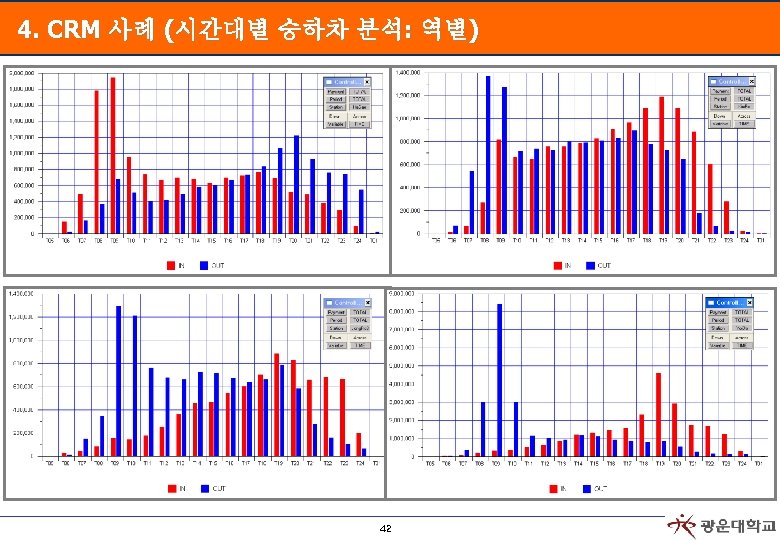
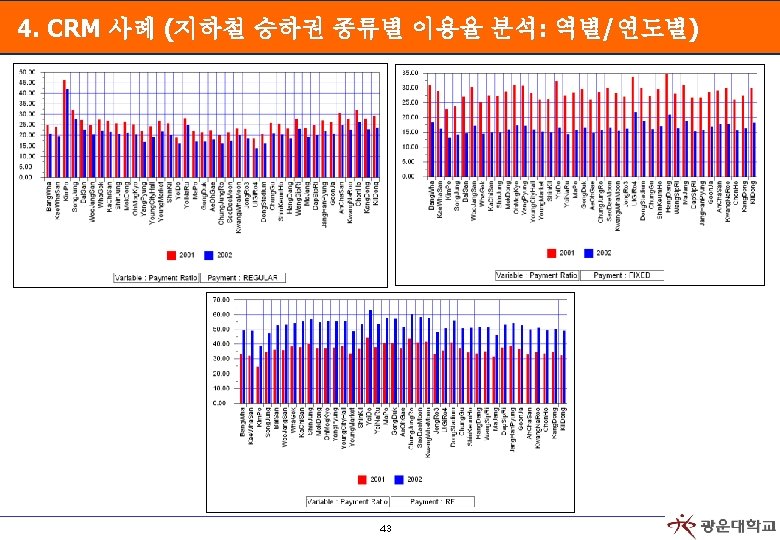
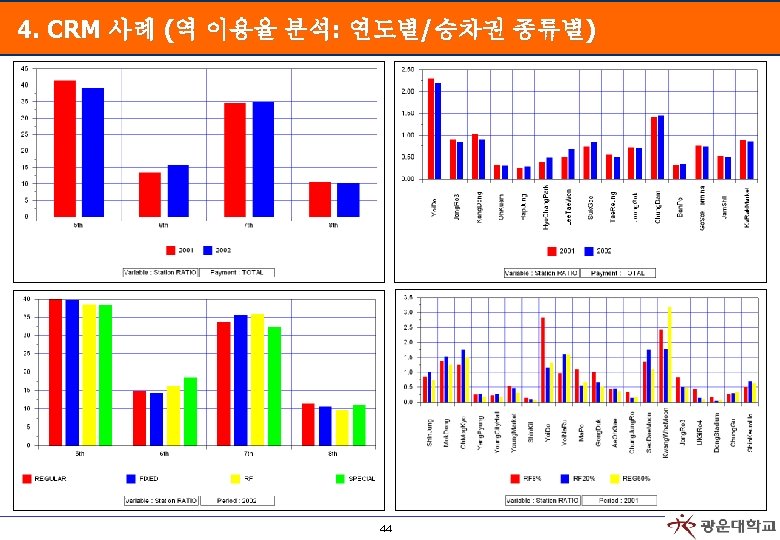
Contents 1. CRM Key Concepts • 고객만족도, 고객로얄티, 로얄티효과, 파레토법칙 • Customer acquisition/retention, Customer Share • 우수고객/손실고객, 고객스코어링 방법: RFM, LTV 2. Relationship Technology • 정보기반 (Data Warehouse, Data Webhouse) • 다차원모델링 (차원, 항목, metrics), 전선관측데이터분석 사례 • CRM 아키텍쳐, CTI, Web-enabled Contact Center • Analytical CRM vs. Operational CRM • 데이터분석 (OLAP, 마이닝) 3. CRM 전략 • CRM 정보기반 • 산업별 CRM 도입방향 4. CRM/e-CRM/SRM 사례 • BC카드 Fraud Detection System 사례 • 마이크로소프트 Cross-Selling 사례 • H백화점 CRM전략 사례 • 지하철 승하차 패턴분석 모델 • 닷컴 웹하우스 구축 사례 (e-CRM) 5. CRM Metrics와 ROI/Value • Meta Group 설문조사, CRM 지출과 ROI분석, CRM 도입 목적 • Framework: Gartner vs. BSC 6. Conclusion • 개념도 • Quantitative and Qualitative Benefits of CRM 2
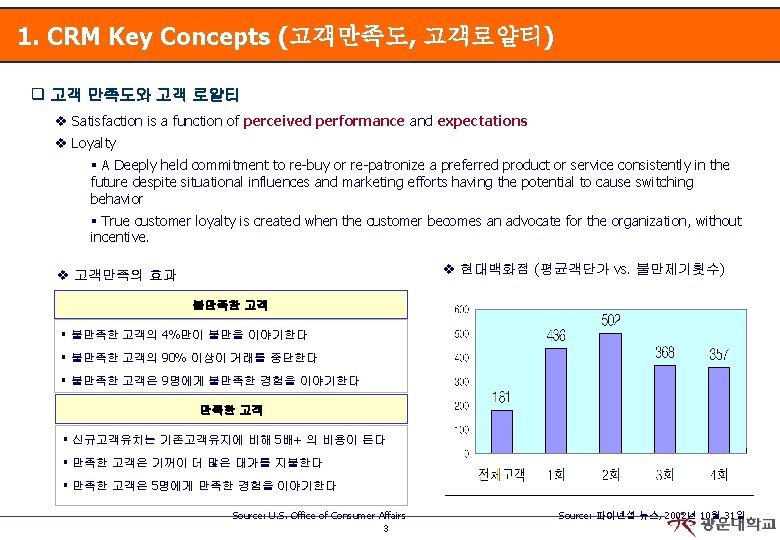
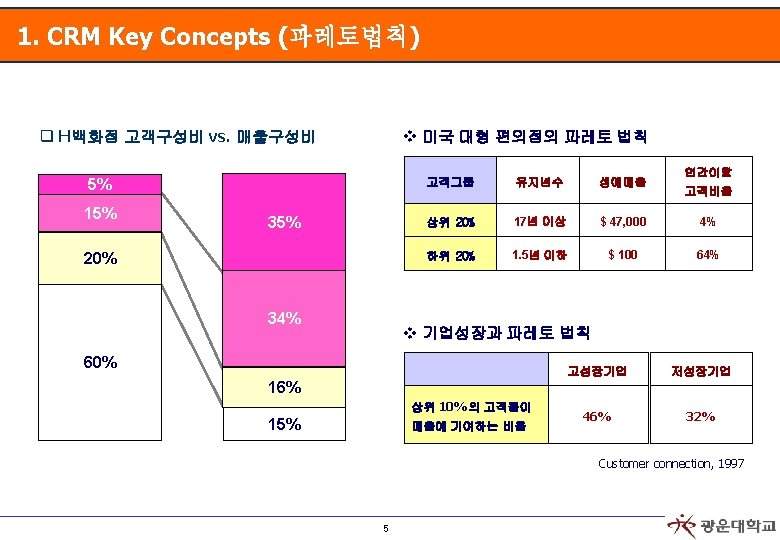
1. CRM Key Concepts (고객만족도, 고객로얄티) q 고객 만족도와 고객 로얄티 v Satisfaction is a function of perceived performance and expectations v Loyalty § A Deeply held commitment to re-buy or re-patronize a preferred product or service consistently in the future despite situational influences and marketing efforts having the potential to cause switching behavior § True customer loyalty is created when the customer becomes an advocate for the organization, without incentive. v 현대백화점 (평균객단가 vs. 불만제기횟수) v 고객만족의 효과 불만족한 고객 § 불만족한 고객의 4%만이 불만을 이야기한다 § 불만족한 고객의 90% 이상이 거래를 중단한다 § 불만족한 고객은 9명에게 불만족한 경험을 이야기한다 만족한 고객 § 신규고객유치는 기존고객유지에 비해 5배+ 의 비용이 든다 § 만족한 고객은 기꺼이 더 많은 대가를 지불한다 § 만족한 고객은 5명에게 만족한 경험을 이야기한다 Source: U. S. Office of Consumer Affairs 3 Source: 파이넨셜 뉴스, 2002년 10월 31일
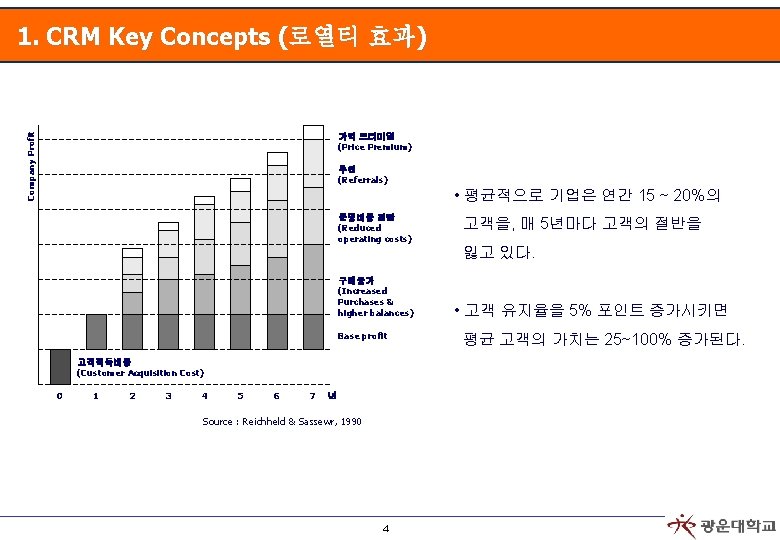
Company Profit 1. CRM Key Concepts (로열티 효과) 가격 프리미엄 (Price Premium) 추천 (Referrals) • 평균적으로 기업은 연간 15 ~ 20%의 운영비용 절감 (Reduced operating costs) 고객을, 매 5년마다 고객의 절반을 잃고 있다. 구매증가 (Increased Purchases & higher balances) Base profit 고객획득비용 (Customer Acquisition Cost) 0 1 2 3 4 5 6 7 년 Source : Reichheld & Sassewr, 1990 4 • 고객 유지율을 5% 포인트 증가시키면 평균 고객의 가치는 25~100% 증가된다.
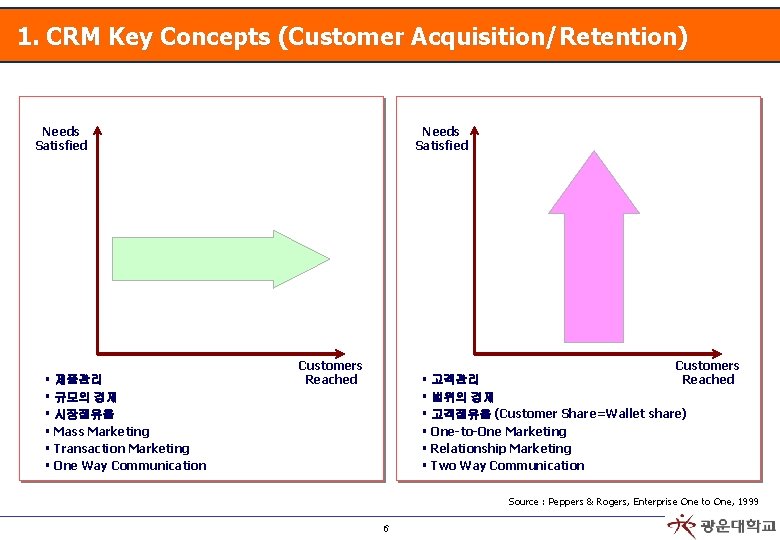
1. CRM Key Concepts (Customer Acquisition/Retention) Needs Satisfied § 제품관리 § 규모의 경제 § 시장점유율 § Mass Marketing § Transaction Marketing § One Way Communication Needs Satisfied Customers Reached Customers § 고객관리 Reached § 범위의 경제 § 고객점유율 (Customer Share=Wallet share) § One-to-One Marketing § Relationship Marketing § Two Way Communication Source : Peppers & Rogers, Enterprise One to One, 1999 6
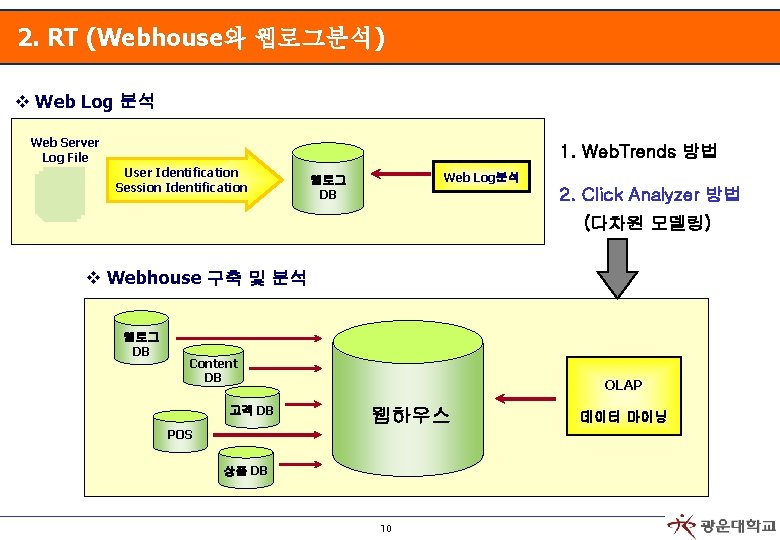
2. RT (Webhouse와 웹로그분석) v Web Log 분석 Web Server Log File 1. Web. Trends 방법 User Identification Session Identification Web Log분석 웹로그 DB 2. Click Analyzer 방법 (다차원 모델링) v Webhouse 구축 및 분석 웹로그 DB Content DB 고객 DB OLAP 웹하우스 POS 상품 DB 10 데이터 마이닝
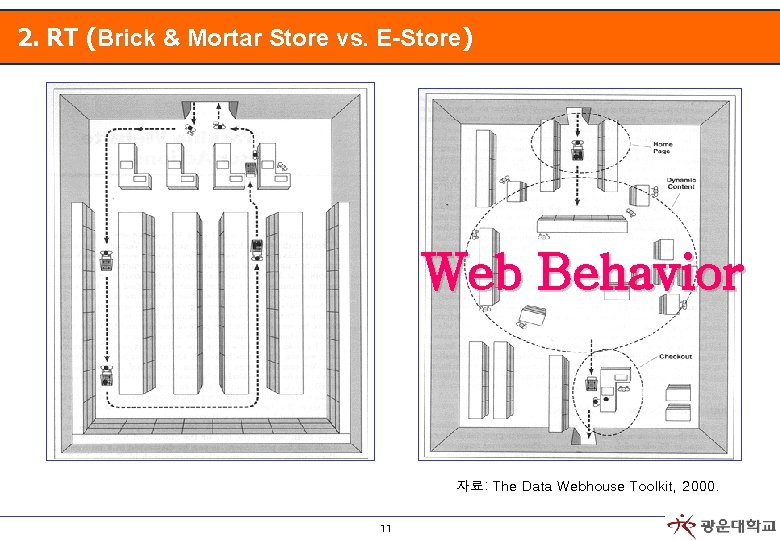
2. RT (Brick & Mortar Store vs. E-Store) Web Behavior 자료: The Data Webhouse Toolkit, 2000. 11
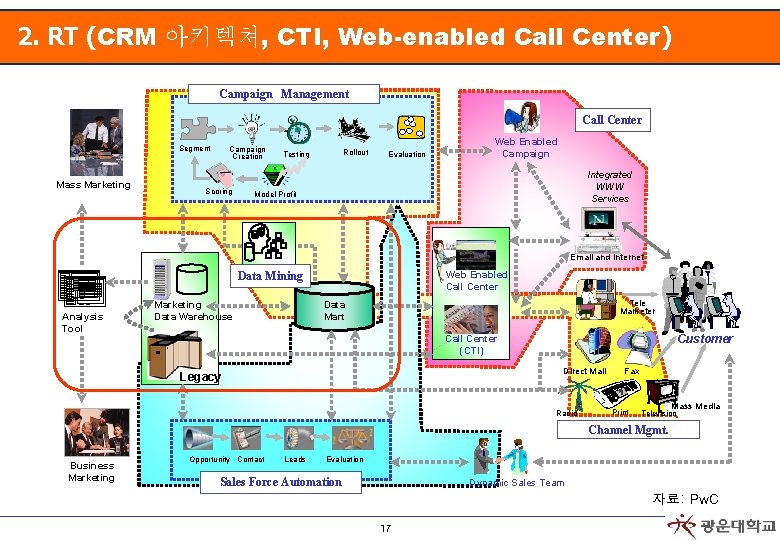
2. RT (CRM 아키텍쳐, CTI, Web-enabled Call Center) Campaign Management Call Center Segment Mass Marketing Campaign Creation Scoring Rollout Testing Evaluation Web Enabled Campaign Integrated WWW Services Model Profit Email and Internet Web Enabled Call Center Data Mining Analysis Tool Marketing Data Warehouse Tele Marketer Data Mart Customer Call Center (CTI) Direct Mail Legacy Radio Fax Print Mass Media Television Channel Mgmt. Business Marketing Opportunity Contact Leads Evaluation Sales Force Automation Dynamic Sales Team 자료: Pw. C 17
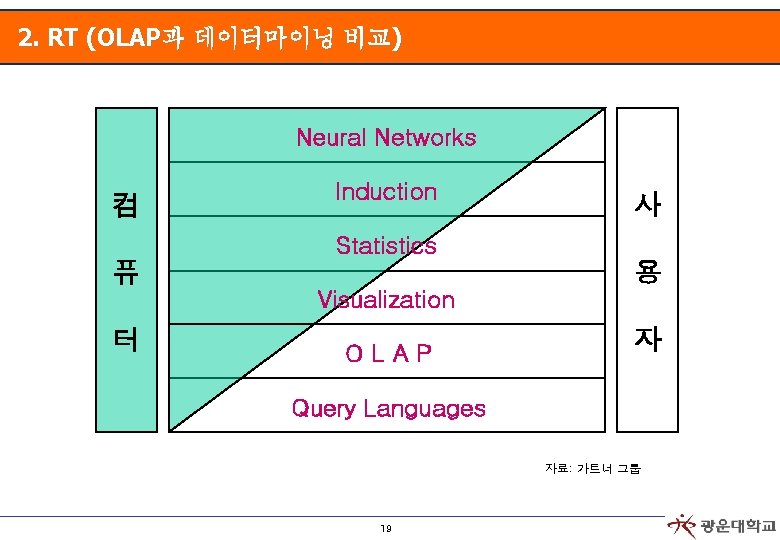
2. RT (OLAP과 데이터마이닝 비교) Neural Networks 컴 Induction 사 Statistics 퓨 용 Visualization 터 OLAP 자 Query Languages 자료: 가트너 그룹 19
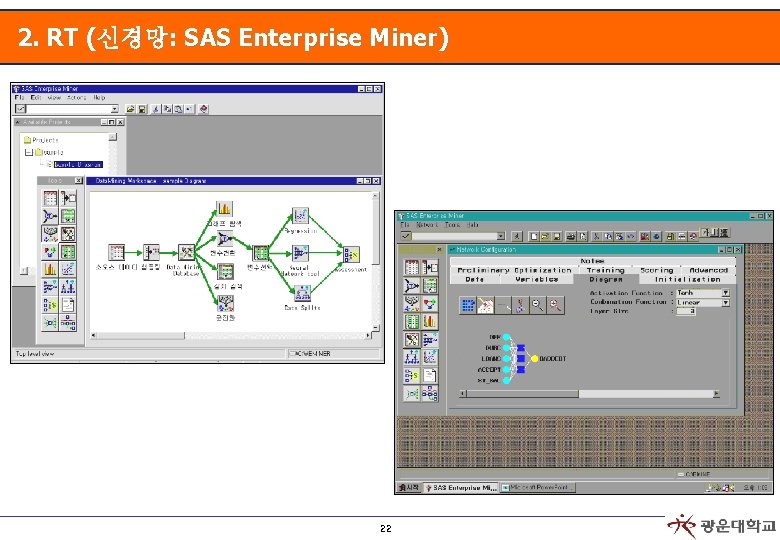
2. RT (신경망: SAS Enterprise Miner) 22
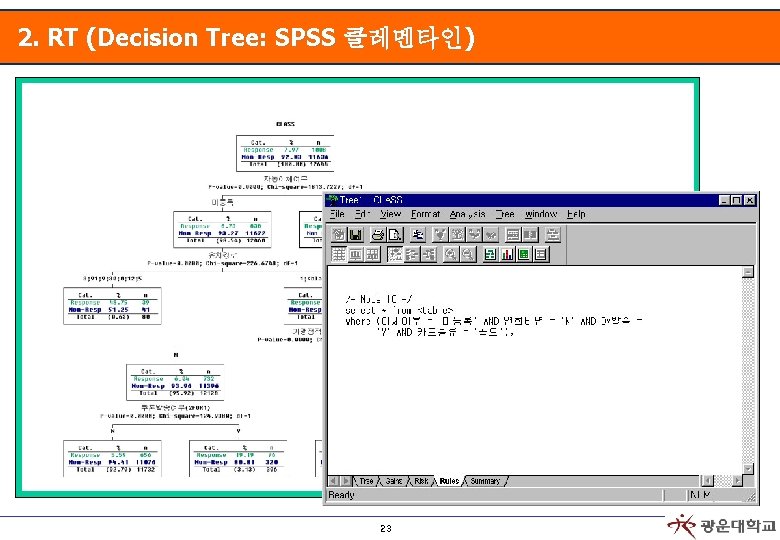
2. RT (Decision Tree: SPSS 클레멘타인) 23
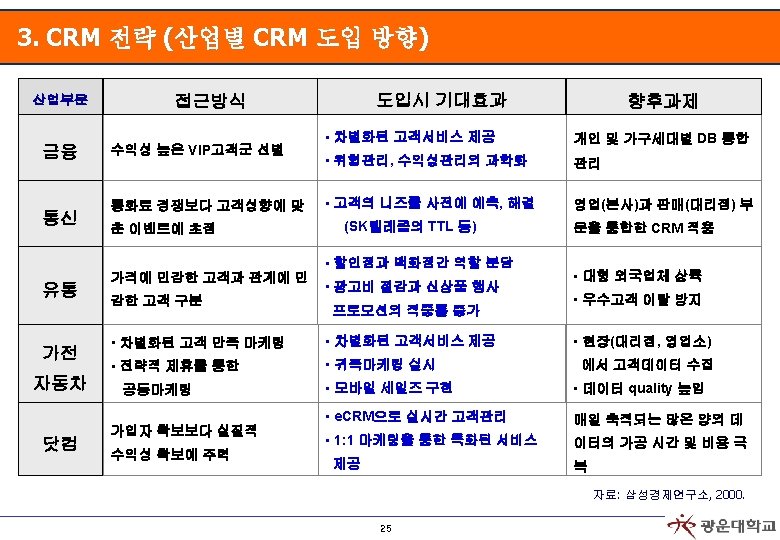
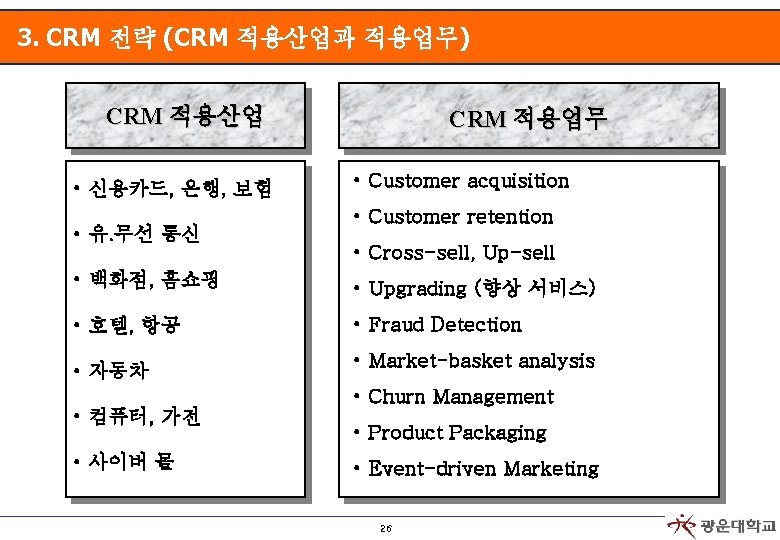
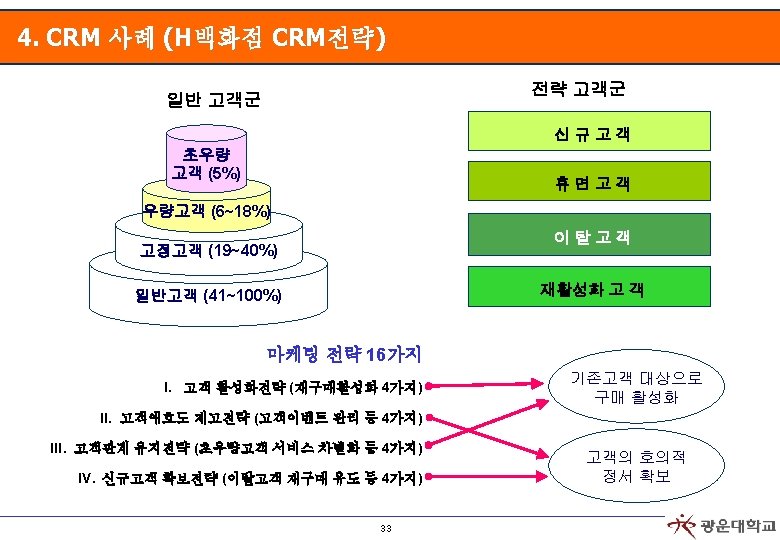
3. CRM 전략 (CRM 적용산업과 적용업무) CRM 적용산업 • 신용카드, 은행, 보험 • 유. 무선 통신 CRM 적용업무 • Customer acquisition • Customer retention • Cross-sell, Up-sell • 백화점, 홈쇼핑 • Upgrading (향상 서비스) • 호텔, 항공 • Fraud Detection • 자동차 • 컴퓨터, 가전 • 사이버 몰 • Market-basket analysis • Churn Management • Product Packaging • Event-driven Marketing 26
4. CRM/e-CRM/SRM 사례 28
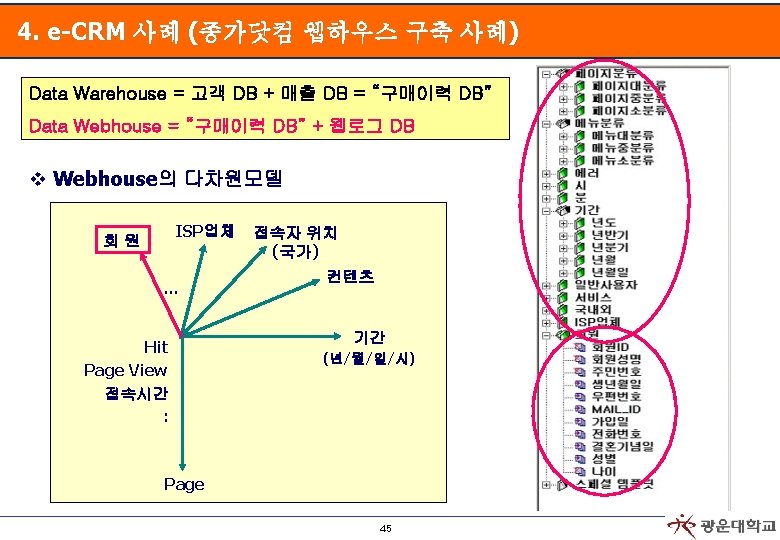
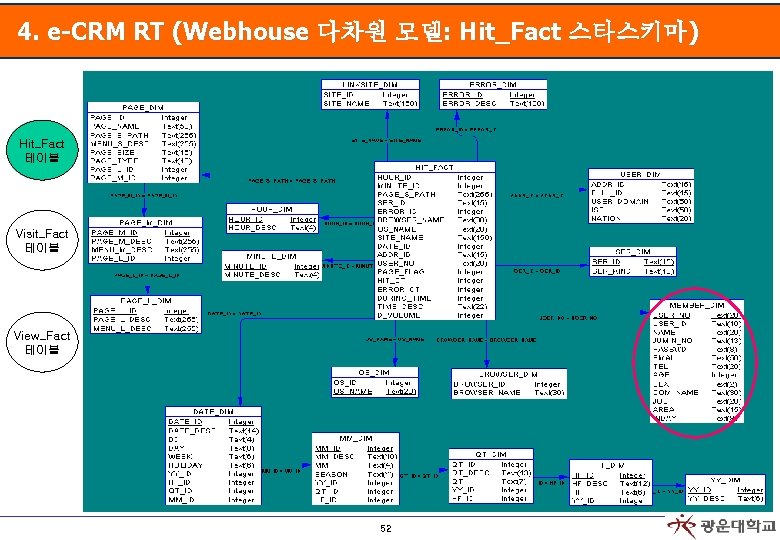
4. e-CRM RT (Webhouse 다차원 모델: Hit_Fact 스타스키마) Hit_Fact 테이블 Visit_Fact 테이블 View_Fact 테이블 52
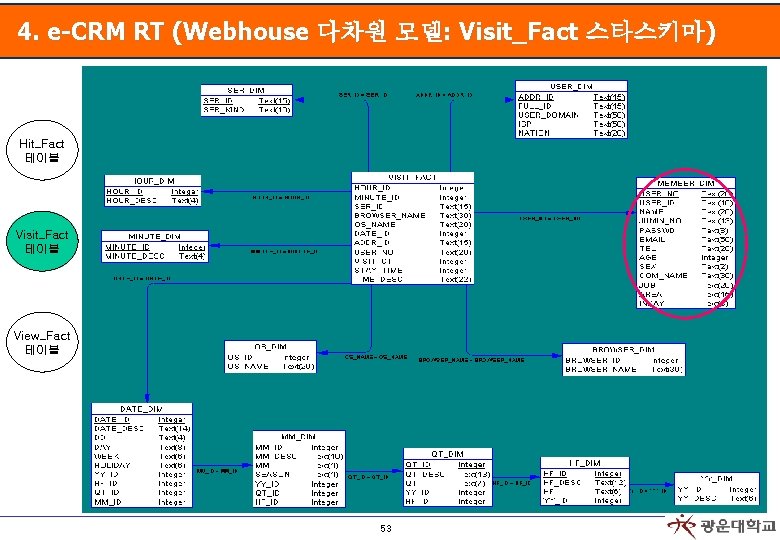
4. e-CRM RT (Webhouse 다차원 모델: Visit_Fact 스타스키마) Hit_Fact 테이블 Visit_Fact 테이블 View_Fact 테이블 53
5. CRM Metrics & ROI 57
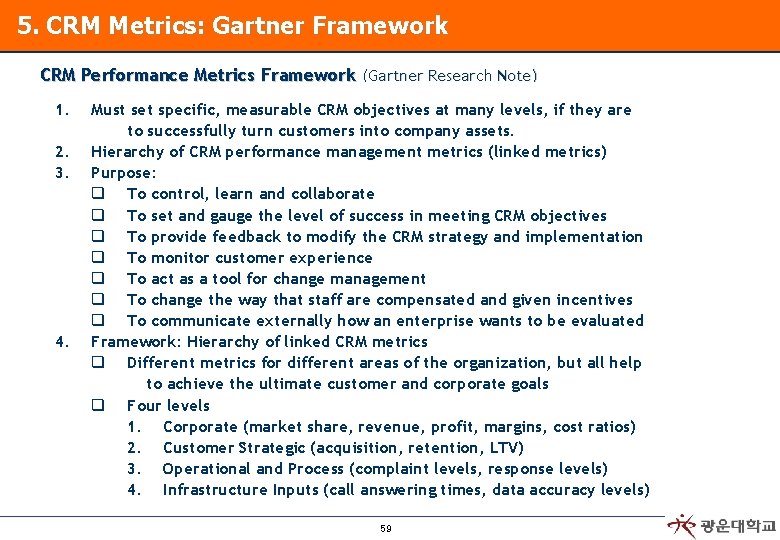
5. CRM Metrics: Gartner Framework CRM Performance Metrics Framework (Gartner Research Note) 1. 2. 3. 4. Must set specific, measurable CRM objectives at many levels, if they are to successfully turn customers into company assets. Hierarchy of CRM performance management metrics (linked metrics) Purpose: q To control, learn and collaborate q To set and gauge the level of success in meeting CRM objectives q To provide feedback to modify the CRM strategy and implementation q To monitor customer experience q To act as a tool for change management q To change the way that staff are compensated and given incentives q To communicate externally how an enterprise wants to be evaluated Framework: Hierarchy of linked CRM metrics q Different metrics for different areas of the organization, but all help to achieve the ultimate customer and corporate goals q Four levels 1. Corporate (market share, revenue, profit, margins, cost ratios) 2. Customer Strategic (acquisition, retention, LTV) 3. Operational and Process (complaint levels, response levels) 4. Infrastructure Inputs (call answering times, data accuracy levels) 59
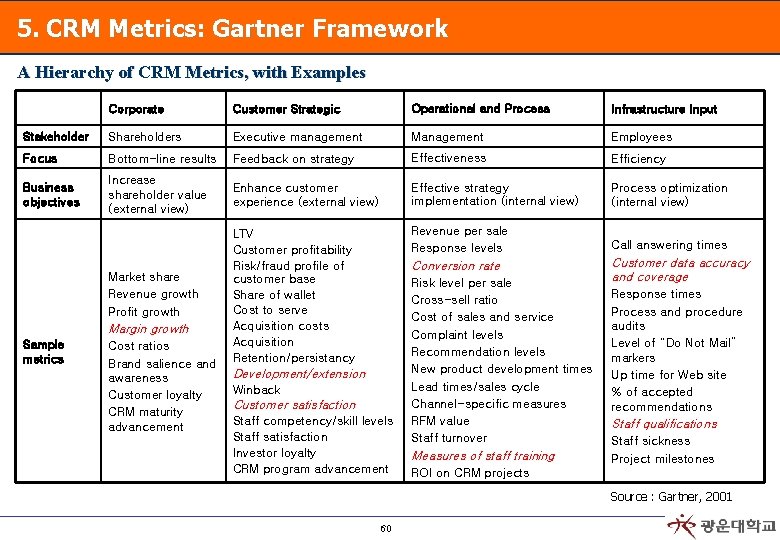
5. CRM Metrics: Gartner Framework A Hierarchy of CRM Metrics, with Examples Corporate Customer Strategic Operational and Process Infrastructure Input Stakeholder Shareholders Executive management Management Employees Focus Bottom-line results Feedback on strategy Effectiveness Efficiency Business objectives Increase shareholder value (external view) Enhance customer experience (external view) Effective strategy implementation (internal view) Process optimization (internal view) Revenue per sale Response levels Call answering times Market share Revenue growth Profit growth LTV Customer profitability Risk/fraud profile of customer base Share of wallet Cost to serve Acquisition costs Acquisition Retention/persistancy Conversion rate Customer data accuracy and coverage Margin growth Sample metrics Cost ratios Brand salience and awareness Customer loyalty CRM maturity advancement Development/extension Winback Customer satisfaction Staff competency/skill levels Staff satisfaction Investor loyalty CRM program advancement Risk level per sale Cross-sell ratio Cost of sales and service Complaint levels Recommendation levels New product development times Lead times/sales cycle Channel-specific measures RFM value Staff turnover Measures of staff training Response times Process and procedure audits Level of “Do Not Mail” markers Up time for Web site % of accepted recommendations Staff qualifications Staff sickness Project milestones ROI on CRM projects Source : Gartner, 2001 60
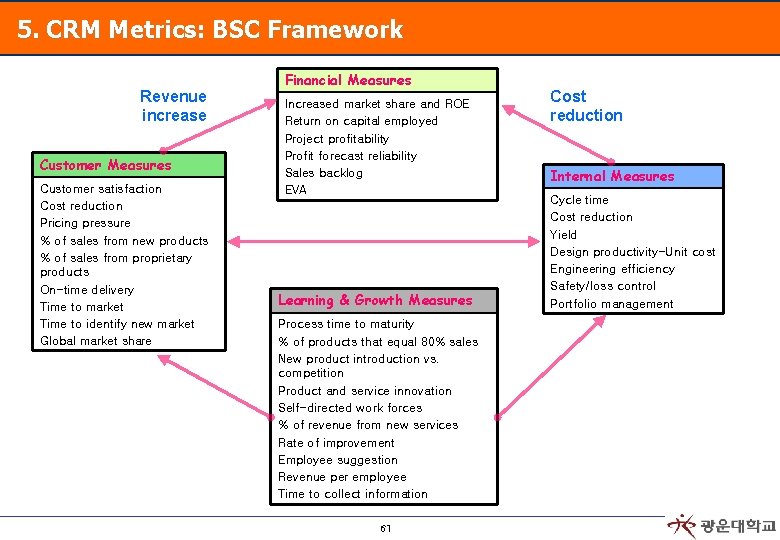
5. CRM Metrics: BSC Framework Revenue increase Customer Measures Customer satisfaction Cost reduction Pricing pressure % of sales from new products % of sales from proprietary products On-time delivery Time to market Time to identify new market Global market share Financial Measures Increased market share and ROE Return on capital employed Project profitability Profit forecast reliability Sales backlog EVA Learning & Growth Measures Process time to maturity % of products that equal 80% sales New product introduction vs. competition Product and service innovation Self-directed work forces % of revenue from new services Rate of improvement Employee suggestion Revenue per employee Time to collect information 61 Cost reduction Internal Measures Cycle time Cost reduction Yield Design productivity-Unit cost Engineering efficiency Safety/loss control Portfolio management
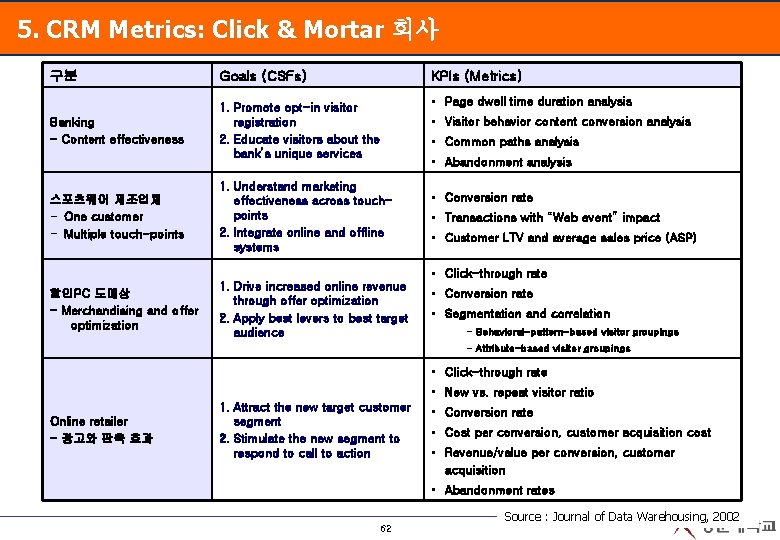
5. CRM Metrics: Click & Mortar 회사 구분 Goals (CSFs) KPIs (Metrics) • Page dwell time duration analysis Banking - Content effectiveness 1. Promote opt-in visitor registration 2. Educate visitors about the bank’s unique services • Visitor behavior content conversion analysis • Common paths analysis • Abandonment analysis 스포츠웨어 제조업체 - One customer - Multiple touch-points 1. Understand marketing effectiveness across touchpoints 2. Integrate online and offline systems 할인PC 도매상 - Merchandising and offer optimization 1. Drive increased online revenue through offer optimization 2. Apply best levers to best target audience • Conversion rate • Transactions with “Web event” impact • Customer LTV and average sales price (ASP) • Click-through rate • Conversion rate • Segmentation and correlation – Behavioral-pattern-based visitor groupings – Attribute-based visitor groupings • Click-through rate • New vs. repeat visitor ratio Online retailer - 광고와 판촉 효과 1. Attract the new target customer segment 2. Stimulate the new segment to respond to call to action • Conversion rate • Cost per conversion, customer acquisition cost • Revenue/value per conversion, customer acquisition • Abandonment rates 62 Source : Journal of Data Warehousing, 2002
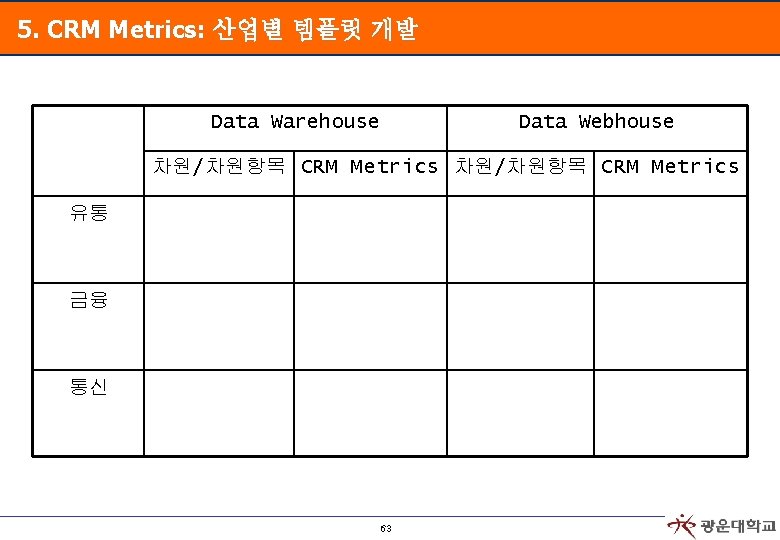
5. CRM Metrics: 산업별 템플릿 개발 Data Warehouse Data Webhouse 차원/차원항목 CRM Metrics 유통 금융 통신 63
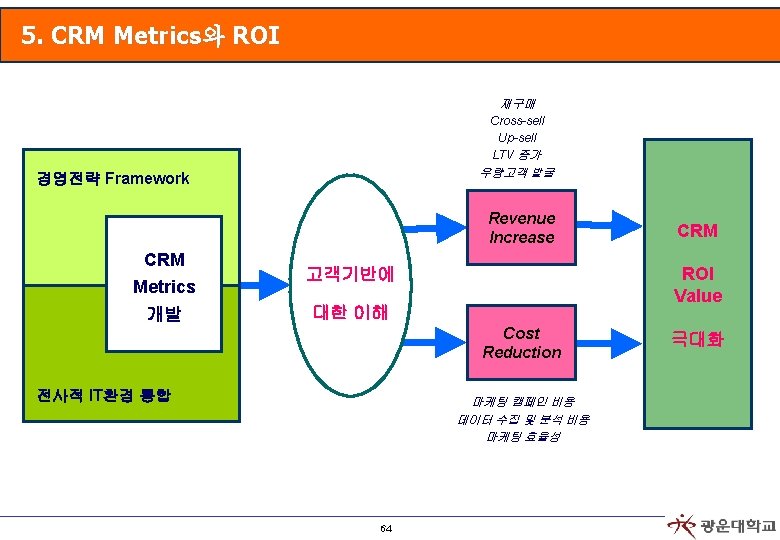
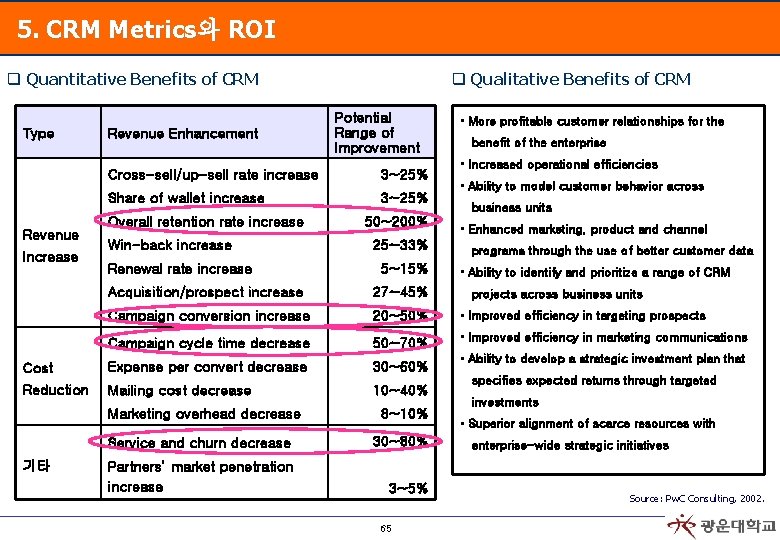
5. CRM Metrics와 ROI q Quantitative Benefits of CRM Type Revenue Increase Revenue Enhancement q Qualitative Benefits of CRM Potential Range of Improvement Cross-sell/up-sell rate increase 3~25% Share of wallet increase 3~25% Overall retention rate increase Win-back increase Renewal rate increase 50~200% 25~33% 5~15% • More profitable customer relationships for the benefit of the enterprise • Increased operational efficiencies • Ability to model customer behavior across business units • Enhanced marketing, product and channel programs through the use of better customer data • Ability to identify and prioritize a range of CRM Acquisition/prospect increase 27~45% Campaign conversion increase 20~50% • Improved efficiency in targeting prospects Campaign cycle time decrease 50~70% • Improved efficiency in marketing communications Cost Expense per convert decrease 30~60% Reduction Mailing cost decrease 10~40% Marketing overhead decrease 기타 8~10% Service and churn decrease 30~80% Partners’ market penetration increase 3~5% 65 projects across business units • Ability to develop a strategic investment plan that specifies expected returns through targeted investments • Superior alignment of scarce resources with enterprise-wide strategic initiatives Source: Pw. C Consulting, 2002.
References 박성진, “Understanding CRM V 1. 0, ” ㈜엠브레인 CRM사업부, 2001년 1월. 이 훈, “현대백화점 CRM적용사례”, 한국데이터마이닝학회 2001 춘계컨퍼런스, COEX 컨벤션센터, 2001년 6월 19일. 조재희, 박성진, OLAP테크놀로지, 시그마인사이트컴, 1999. Brown, Stanley A. and M. Gulycz, Performance Driven CRM, Pw. C Consulting, John Wiley & Sons, 2002 Cotter, Scott, “Pave the Road to E-Business Success With Key Performance Indicators (KPIs), ” Journal of Data Warehousing, Volume 7, Number 3, Summer 2002. Eisenfeld, B. “Ten Steps to Forecasting and Achieving CRM ROI, ” Research Note TG-14 -7338, Gartner, Inc. , November 28, 2001. Kanani, Pratish, “Balanced Scorecards as Business Intelligence, ” www. iemagazine. com/9810/online 1. shtml. Kirkby, J, E. Thompson, and F. Buytendijk, “Getting the Best Out of CRM Performance Metrics, ” Research Note DF-13 -1433, Gartner, Inc. , December 13, 2001. Net. Genesis, “E-Metrics: Business Metrics For The New Economy, ” http: //www. netgen. com/emetrics/, 2000. Meltzer, Michael, “Customer Profitability Just Isn’t Enough, ” AMT Consulting, 2001. Richards, Tom, “Measuring ROI in CRM, ” CRM White paper, Meridien Research, Inc. , April 10, 2001, 66
감사합니다. simon@kw. ac. kr 67