
Content review 1 Osmolarity cos def nos V













- Slides: 43
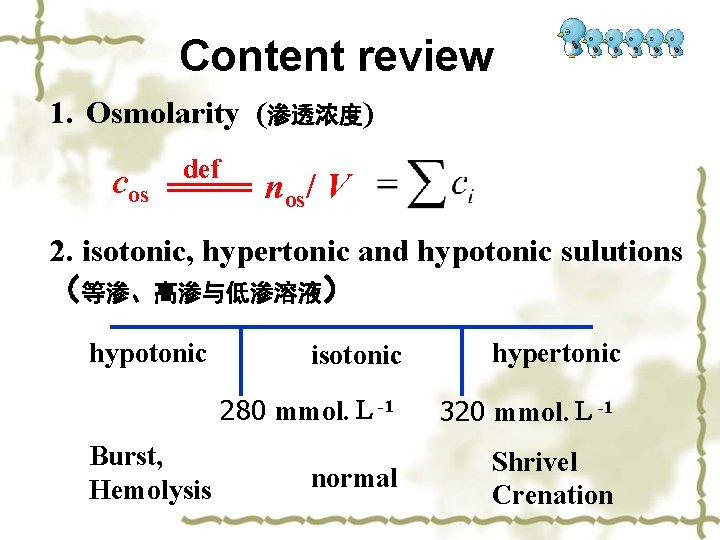
Content review 1. Osmolarity (渗透浓度) cos def nos/ V 2. isotonic, hypertonic and hypotonic sulutions (等渗、高渗与低渗溶液) hypotonic Burst, Hemolysis isotonic hypertonic 280 mmol. L-1 320 mmol. L-1 normal Shrivel Crenation
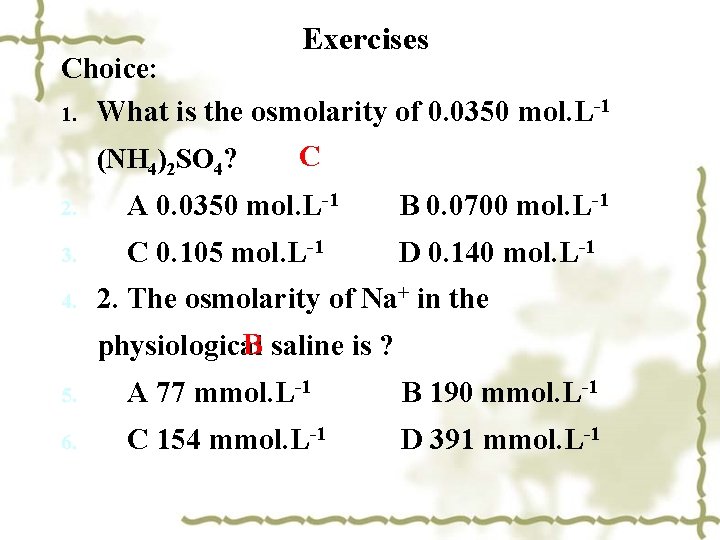
Exercises Choice: 1. What is the osmolarity of 0. 0350 mol. L-1 (NH 4)2 SO 4? C 2. A 0. 0350 mol. L-1 B 0. 0700 mol. L-1 3. C 0. 105 mol. L-1 D 0. 140 mol. L-1 4. 2. The osmolarity of Na+ in the B saline is ? physiological 5. A 77 mmol. L-1 B 190 mmol. L-1 6. C 154 mmol. L-1 D 391 mmol. L-1
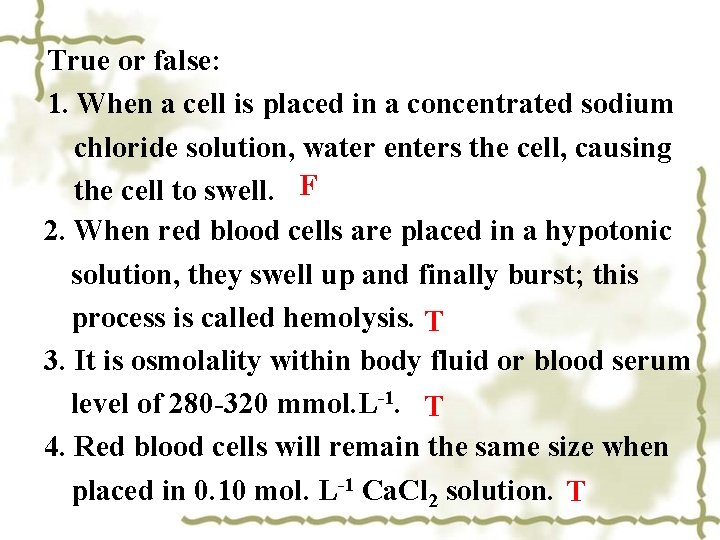
True or false: 1. When a cell is placed in a concentrated sodium chloride solution, water enters the cell, causing the cell to swell. F 2. When red blood cells are placed in a hypotonic solution, they swell up and finally burst; this process is called hemolysis. T 3. It is osmolality within body fluid or blood serum level of 280 -320 mmol. L-1. T 4. Red blood cells will remain the same size when placed in 0. 10 mol. L-1 Ca. Cl 2 solution. T
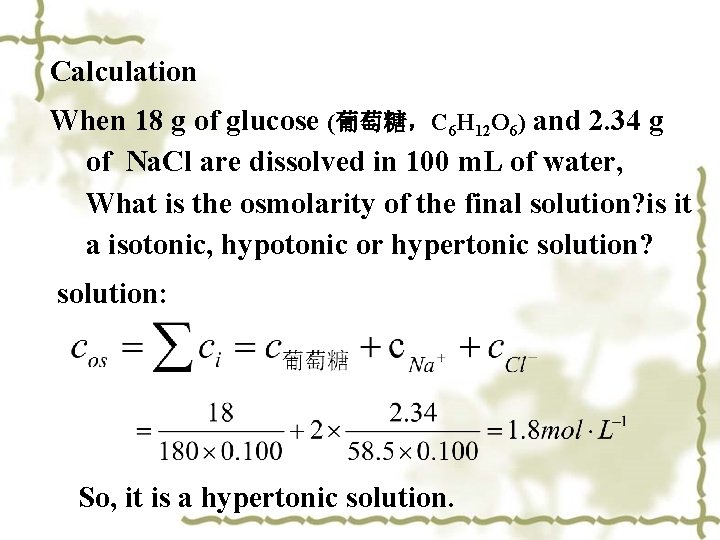
Calculation When 18 g of glucose (葡萄糖,C 6 H 12 O 6) and 2. 34 g of Na. Cl are dissolved in 100 m. L of water, What is the osmolarity of the final solution? is it a isotonic, hypotonic or hypertonic solution? solution: So, it is a hypertonic solution.
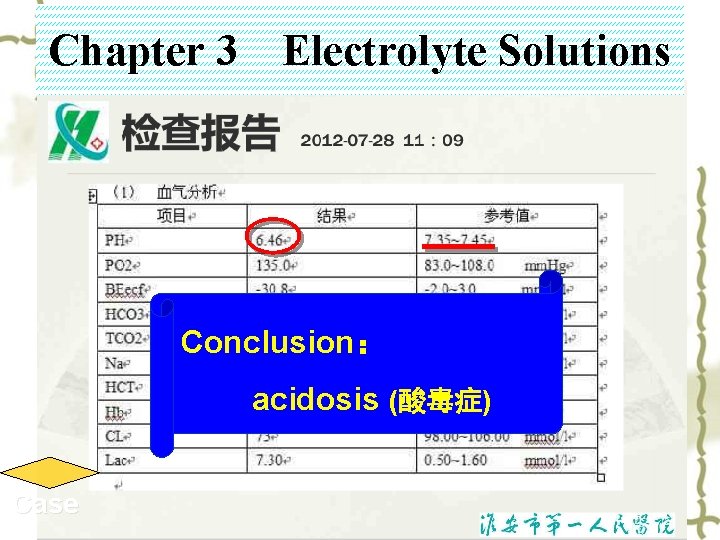
Chapter 3 Electrolyte Solutions Conclusion: acidosis (酸毒症) Case
Chapter 3 Electrolyte Solutions 3. 2 Brønsted-Lowry Acid-Base Theory 3. 4 Solving Problems Involving Acid. Base Equilibria
aims §Identify conjugate acid-base pairs §Determine the relationship between Kb for a base and the Ka of its conjugate acid §Calculate the concentrations of the species present in a solution of a weak acid or base
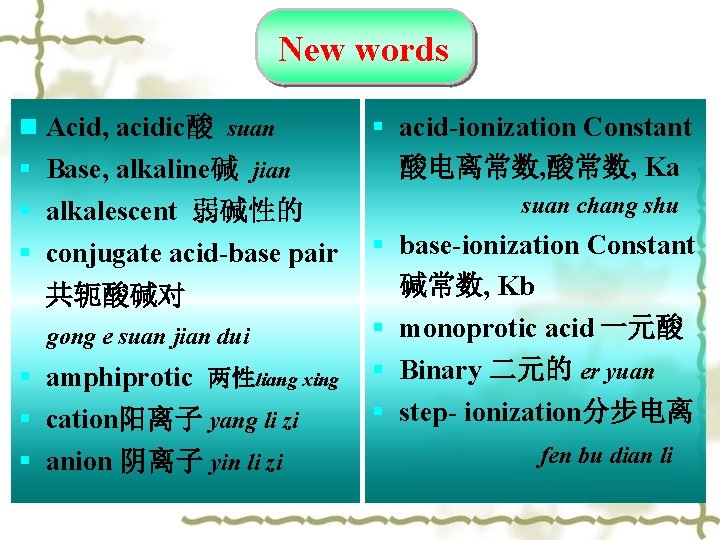
New words n Acid, acidic酸 suan § Base, alkaline碱 jian § alkalescent 弱碱性的 § conjugate acid-base pair 共轭酸碱对 gong e suan jian dui § amphiprotic 两性liang xing § cation阳离子 yang li zi § anion 阴离子 yin li zi § acid-ionization Constant 酸电离常数, 酸常数, Ka suan chang shu § base-ionization Constant 碱常数, Kb § monoprotic acid 一元酸 § Binary 二元的 er yuan § step- ionization分步电离 fen bu dian li
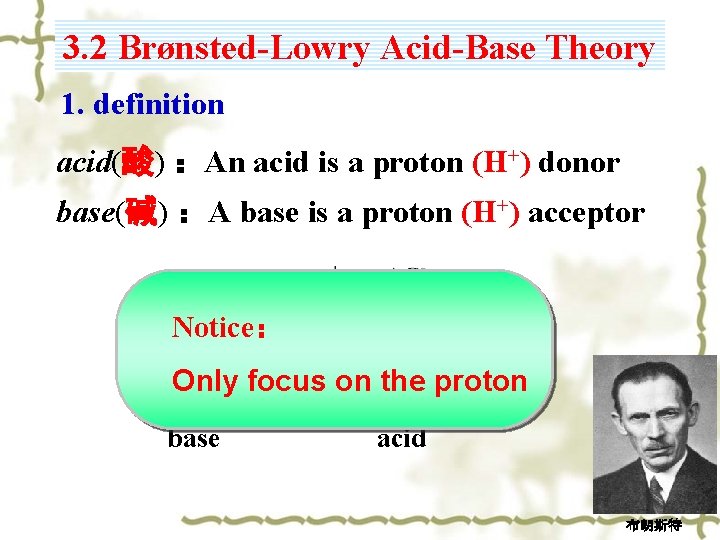
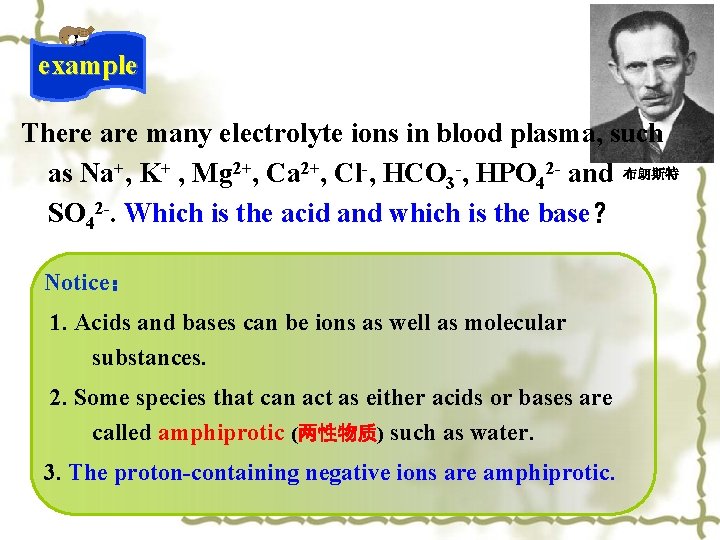
3. 2 Brønsted-Lowry Acid-Base Theory 1. definition acid(酸) :An acid is a proton (H+) donor base(碱) :A base is a proton (H+) acceptor acid Notice: base Only focus on the proton base acid 布朗斯特
example There are many electrolyte ions in blood plasma, such as Na+, K+ , Mg 2+, Ca 2+, Cl-, HCO 3 -, HPO 42 - and 布朗斯特 SO 42 -. Which is the acid and which is the base? Notice: 1. Acids and bases can be ions as well as molecular substances. 2. Some species that can act as either acids or bases are called amphiprotic (两性物质) such as water. 3. The proton-containing negative ions are amphiprotic.
HAc NH 4+ H 3 PO 4 H 2 PO 4- HPO 42- Acid H+ + H+ + Proton + Ac- NH 3 H 2 PO 4 - HPO 42- PO 43- Conjugate base When a acids loses a proton, the species formed is base. The two species are conjugate acid-base pair. Every Brønsted -Lowry acid has a conjugate base, and every base has a conjugate acid.
Example:Write down the conjugate bases of these acids. H 2 O, +NH 3 CH 2 COO- , NH 4+, [Al(H 2 O)6]3+ OH-, NH 2 COO- , NH 3, [Al(OH)(H 2 O)5]2+ H 2 CO 3, HCO 3 -, H 3 PO 4, H 2 PO 4 -, HPO 42 HCO 3 - , CO 32 - , H 2 PO 4 -, HPO 42 -, PO 43 - 分析: Write the formula of the conjugate base of any acid simply by removing a proton.
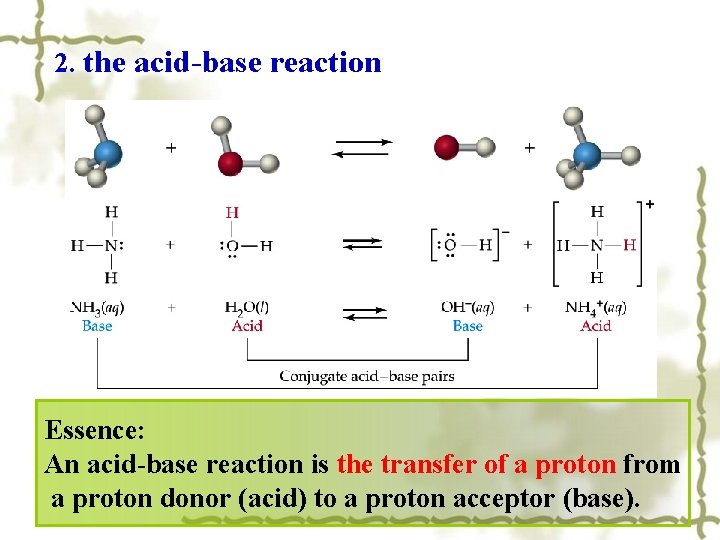
2. the acid-base reaction Essence: An acid-base reaction is the transfer of a proton from a proton donor (acid) to a proton acceptor (base).
Notice: For a given pair of reactants, write the equation for the transfer of only one proton from one species to the other. A Brønsted -Lowry acid-base reaction produces a conjugate acid and base.
The direction for an acid-base reaction is from the stronger acid and base to the weaker acid and base. HB 1 + B 2 stronger acid base B 1+ HB 2 weaker base acid Notice: The strongest acids have the weakest conjugate bases, and the strongest bases have the weakest conjugate acids. Example 4 In the following equations, label each species as an acid or a base. Show the conjugate acid-base pairs. HCO 3 -+ HF H 2 CO 3+ F-
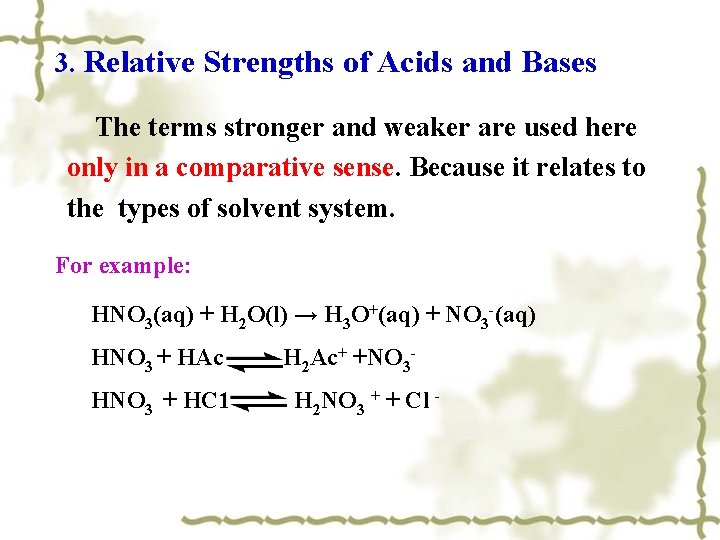
3. Relative Strengths of Acids and Bases The terms stronger and weaker are used here only in a comparative sense. Because it relates to the types of solvent system. For example: HNO 3(aq) + H 2 O(l) → H 3 O+(aq) + NO 3 -(aq) HNO 3 + HAc HNO 3 + HC 1 H 2 Ac+ +NO 3 H 2 NO 3 + + Cl -
Notice Ø The strength of the acid is a measure of its tendency to liberate proton. Ø When you say an acid loses its proton readily, you can also say that its conjugate base does not hold the proton very tightly. The stronger the acid, the weaker is its conjugate base. Ø The direction for an acid-base reaction is from the stronger acid and base to the weaker acid and base.
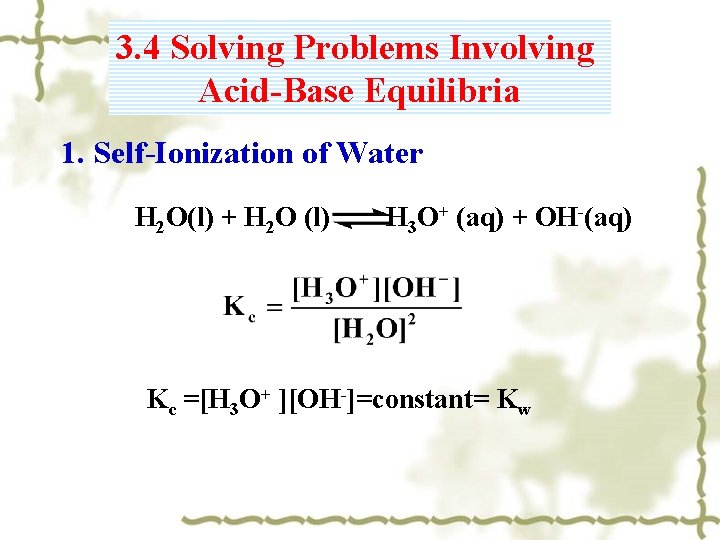
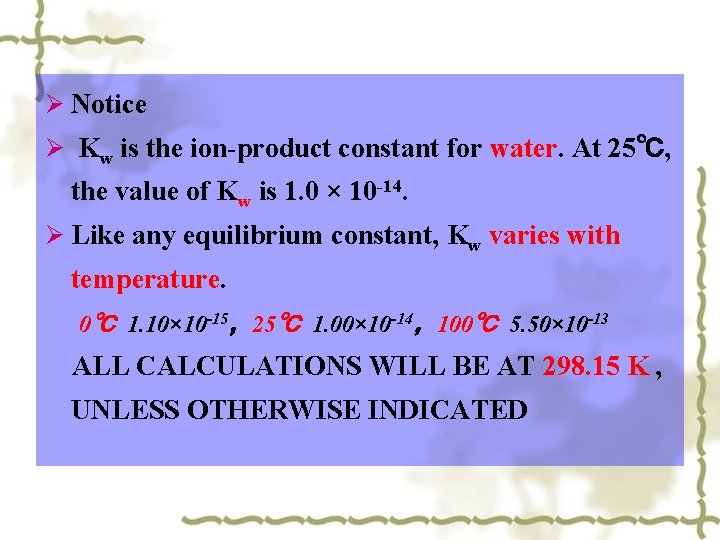
3. 4 Solving Problems Involving Acid-Base Equilibria 1. Self-Ionization of Water H 2 O(l) + H 2 O (l) H 3 O+ (aq) + OH-(aq) Kc =[H 3 O+ ][OH-]=constant= Kw
Ø Notice Ø Kw is the ion-product constant for water. At 25℃, the value of Kw is 1. 0 × 10 -14. Ø Like any equilibrium constant, Kw varies with temperature. 0℃ 1. 10× 10 -15,25℃ 1. 00× 10 -14,100℃ 5. 50× 10 -13 ALL CALCULATIONS WILL BE AT 298. 15 K , UNLESS OTHERWISE INDICATED
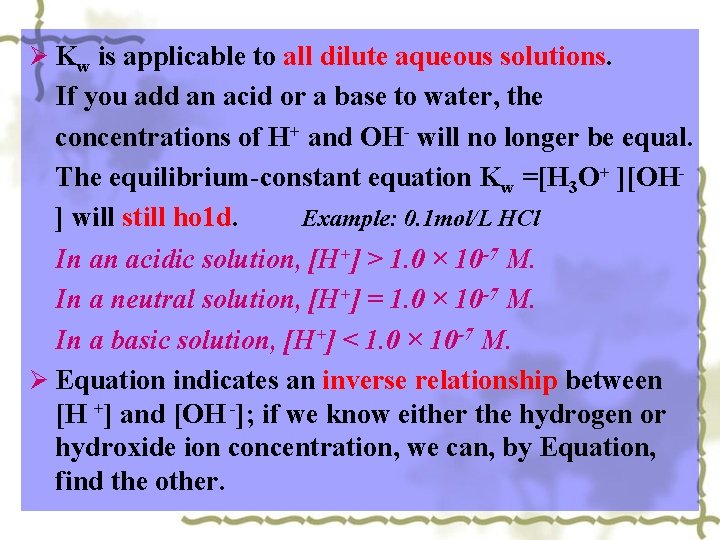
Ø Kw is applicable to all dilute aqueous solutions. If you add an acid or a base to water, the concentrations of H+ and OH- will no longer be equal. The equilibrium-constant equation Kw =[H 3 O+ ][OH] will still ho 1 d. Example: 0. 1 mol/L HCl In an acidic solution, [H+] > 1. 0 × 10 -7 M. In a neutral solution, [H+] = 1. 0 × 10 -7 M. In a basic solution, [H+] < 1. 0 × 10 -7 M. Ø Equation indicates an inverse relationship between [H +] and [OH -]; if we know either the hydrogen or hydroxide ion concentration, we can, by Equation, find the other.
Example: please calculate the concentrations of H+ and OH- for 0. 1 M HCl, pure water and 0. 1 M Na. OH. The equilibrium-constant equation Kw =[H 3 O+ ][OH-] Solution: (1) 0. 1 M HCl (2) [H 3 O+ ] = 0. 1 M (3) [OH-]=Kw/ [H 3 O+ ] = 10 -14/0. 1=10 -13 M (4) (2) pure water (5) [H 3 O+ ] = [OH-]=10 -7 M (3) 0. 1 M Na. OH [OH-] = 0. 1 M [H 3 O+]=Kw/ [H 3 O+ ] = 10 -14/0. 1=10 -13 M
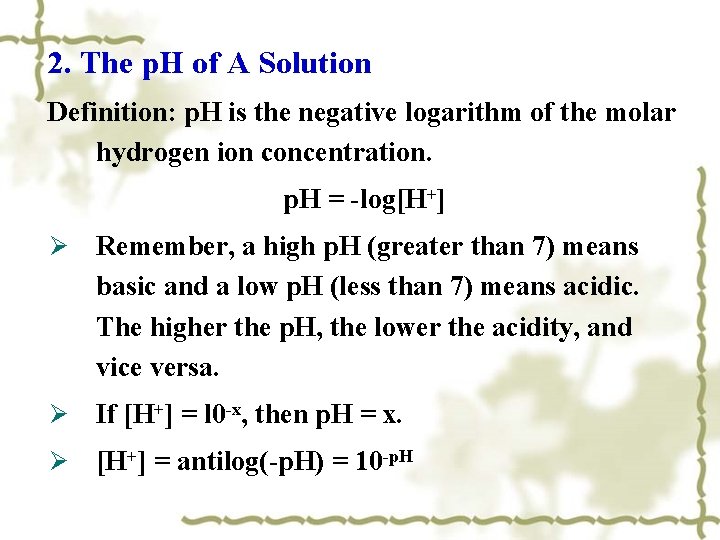
2. The p. H of A Solution Definition: p. H is the negative logarithm of the molar hydrogen ion concentration. p. H = -log[H+] Ø Remember, a high p. H (greater than 7) means basic and a low p. H (less than 7) means acidic. The higher the p. H, the lower the acidity, and vice versa. Ø If [H+] = l 0 -x, then p. H = x. Ø [H+] = antilog(-p. H) = 10 -p. H
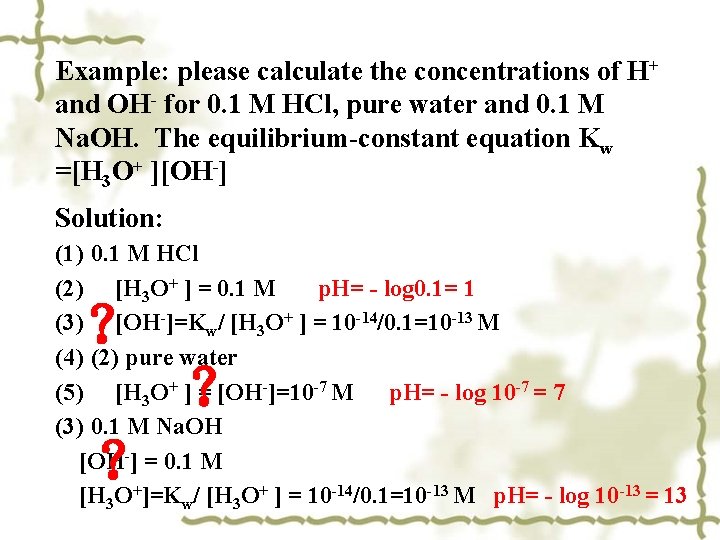
Example: please calculate the concentrations of H+ and OH- for 0. 1 M HCl, pure water and 0. 1 M Na. OH. The equilibrium-constant equation Kw =[H 3 O+ ][OH-] Solution: (1) 0. 1 M HCl (2) [H 3 O+ ] = 0. 1 M p. H= - log 0. 1= 1 (3) [OH-]=Kw/ [H 3 O+ ] = 10 -14/0. 1=10 -13 M (4) (2) pure water (5) [H 3 O+ ] = [OH-]=10 -7 M p. H= - log 10 -7 = 7 (3) 0. 1 M Na. OH [OH-] = 0. 1 M [H 3 O+]=Kw/ [H 3 O+ ] = 10 -14/0. 1=10 -13 M p. H= - log 10 -13 = 13 ? ? ?
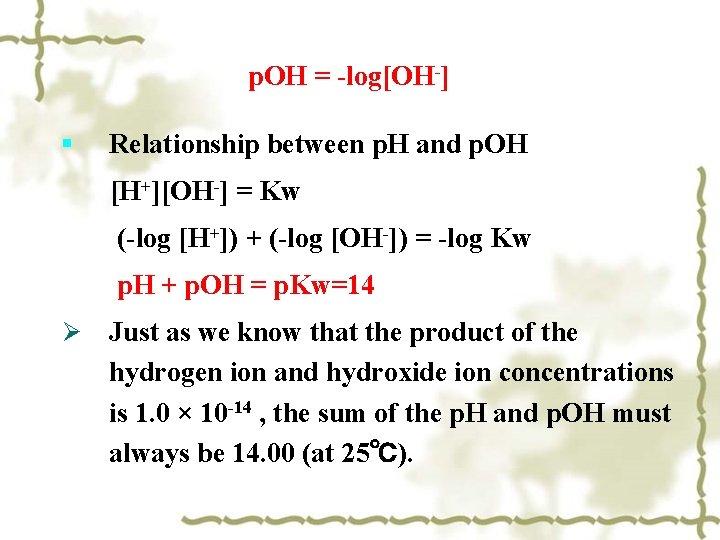
p. OH = -log[OH-] § Relationship between p. H and p. OH [H+][OH-] = Kw (-log [H+]) + (-log [OH-]) = -log Kw p. H + p. OH = p. Kw=14 Ø Just as we know that the product of the hydrogen ion and hydroxide ion concentrations is 1. 0 × 10 -14 , the sum of the p. H and p. OH must always be 14. 00 (at 25℃).
p. H Values for Some Common Solutions § § § § Substance household ammonia milk of magnesia household detergent Sea water blood pure water milk urine black coffee tomato juice wine carbonated beverage vinegar lemon juice human stomach acid p. H 11. 9 10. 5 9. 2 8. 5 7. 4 7. 0 6. 9 6. 0 5. 0 4. 1 3. 5 3. 0 2. 9 2. 2 1. 7
Example : A sample of orange juice has a hydrogen-ion concentration of 2. 9× 10 -4 M. What is the [H 3 O+ ] , [OH-], p. H and p. OH? Solution: [H 3 O+ ] = 2. 9× 10 -4 M p. H = - log(2. 9× 10 -4) = 3. 54 p. OH = 14 -p. H=14 -3. 54=10. 46 [OH-] = 10 -10. 46 M or [OH-] = Kw/ [H 3 O+ ] = 10 -14/(2. 9× 10 -4)=3. 45× 10 -11 M
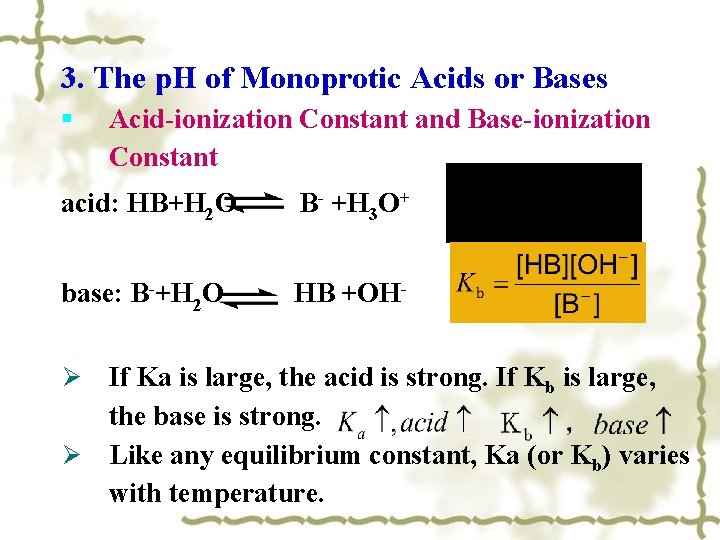
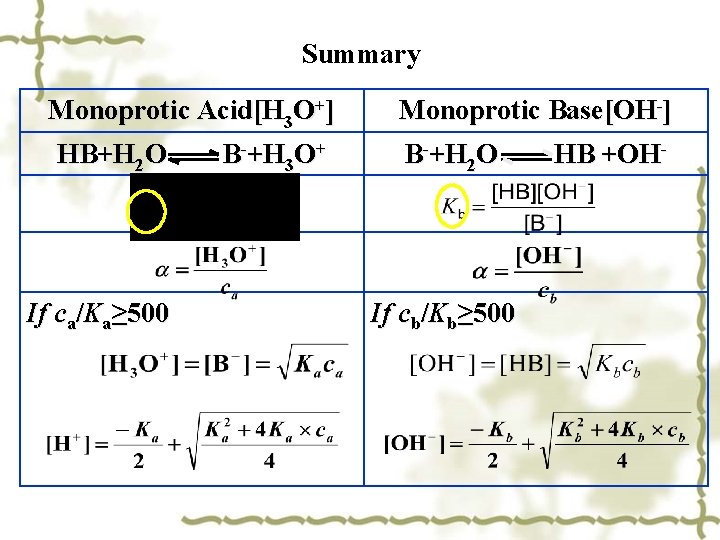
3. The p. H of Monoprotic Acids or Bases § Acid-ionization Constant and Base-ionization Constant acid: HB+H 2 O B- +H 3 O+ base: B-+H 2 O HB +OH- If Ka is large, the acid is strong. If Kb is large, the base is strong. Ø Like any equilibrium constant, Ka (or Kb) varies with temperature. Ø
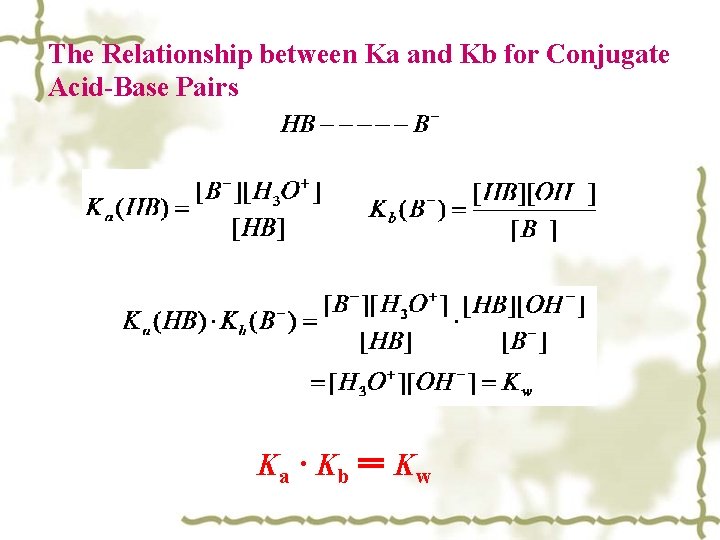
The Relationship between Ka and Kb for Conjugate Acid-Base Pairs Ka · Kb = Kw
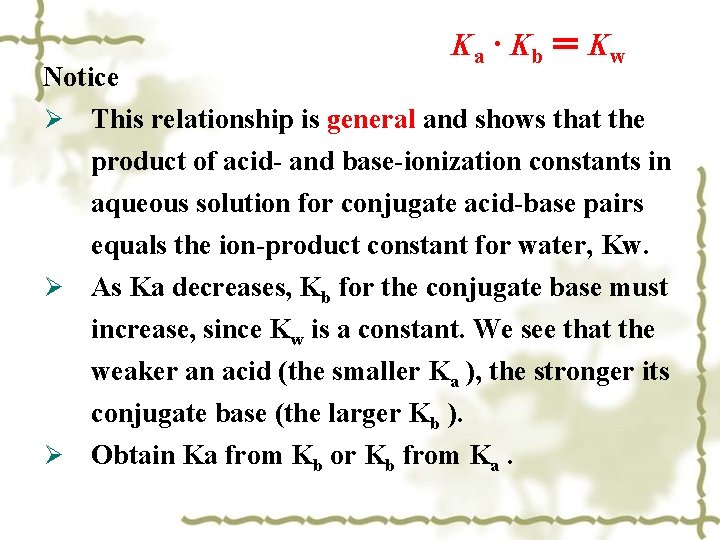
Notice Ø Ka · Kb = Kw This relationship is general and shows that the product of acid- and base-ionization constants in aqueous solution for conjugate acid-base pairs equals the ion-product constant for water, Kw. Ø As Ka decreases, Kb for the conjugate base must increase, since Kw is a constant. We see that the weaker an acid (the smaller Ka ), the stronger its conjugate base (the larger Kb ). Ø Obtain Ka from Kb or Kb from Ka.
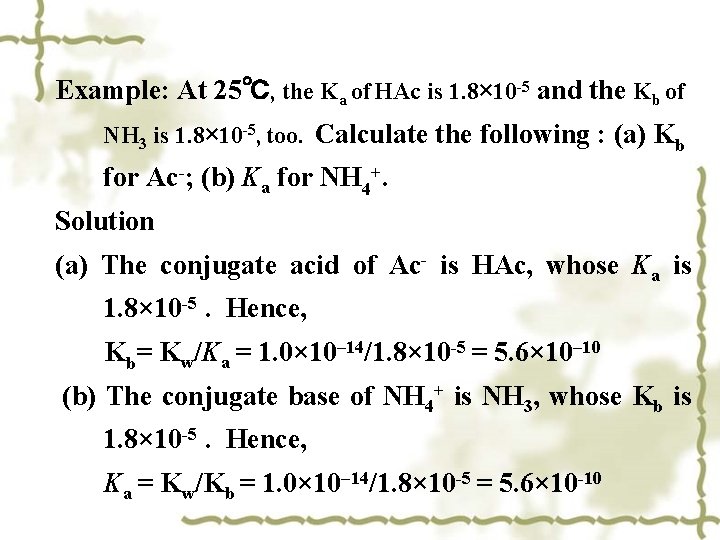
Example: At 25℃, the Ka of HAc is 1. 8× 10 -5 and the Kb of NH 3 is 1. 8× 10 -5, too. Calculate the following : (a) Kb for Ac-; (b) Ka for NH 4+. Solution (a) The conjugate acid of Ac- is HAc, whose Ka is 1. 8× 10 -5. Hence, Kb= Kw/Ka = 1. 0× 10– 14/1. 8× 10 -5 = 5. 6× 10– 10 (b) The conjugate base of NH 4+ is NH 3, whose Kb is 1. 8× 10 -5. Hence, Ka = Kw/Kb = 1. 0× 10– 14/1. 8× 10 -5 = 5. 6× 10 -10
Calculating Concentrations of Species in a Weak Acid Solution (Approximation Method) Procedure Ø Write the equilibrium equation. Ø Set up a table in which you write the starting, change, and equilibrium values of each substance under the balanced equation. Ø Substitute the equilibrium-constant equation for the equilibrium concentrations. Ø Solve the equilibrium-constant equation for the equilibrium concentrations. §
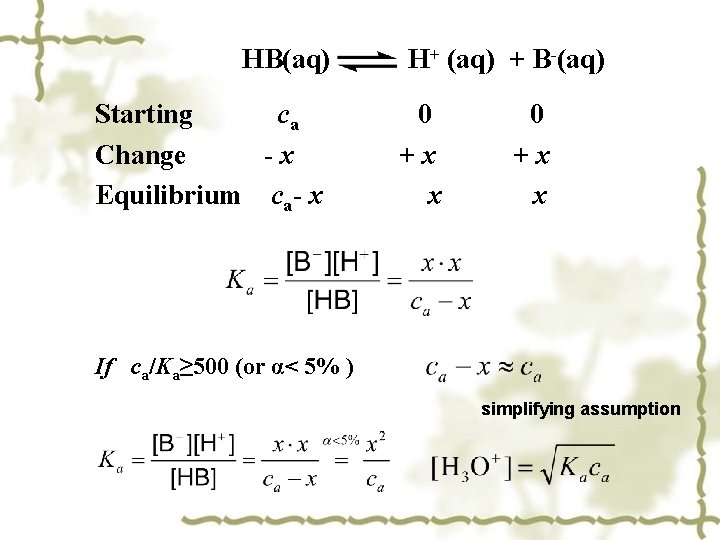
HB(aq) Starting ca Change -x Equilibrium ca- x H+ (aq) + B-(aq) 0 +x x If ca/Ka≥ 500 (or α< 5% ) simplifying assumption
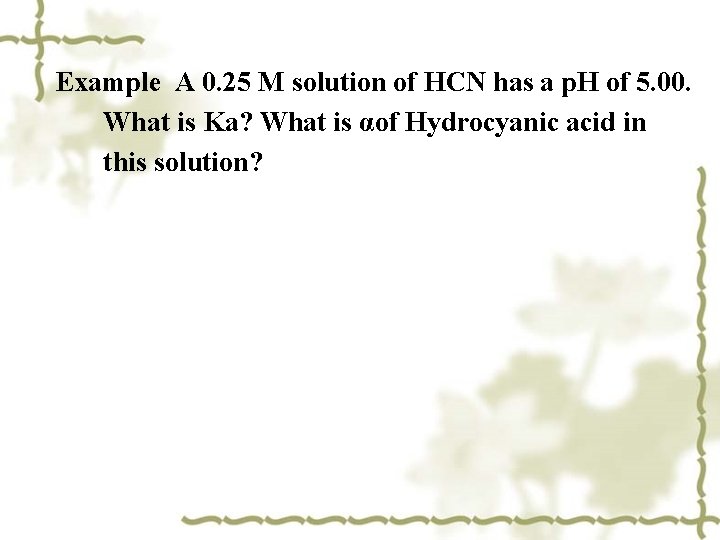
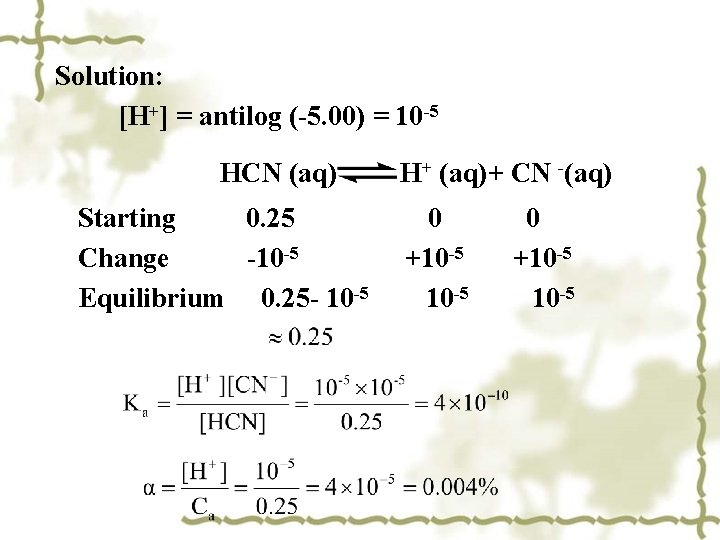
Example A 0. 25 M solution of HCN has a p. H of 5. 00. What is Ka? What is αof Hydrocyanic acid in this solution?
Solution: [H+] = antilog (-5. 00) = 10 -5 HCN (aq) Starting 0. 25 Change -10 -5 Equilibrium 0. 25 - 10 -5 H+ (aq)+ CN -(aq) 0 +10 -5
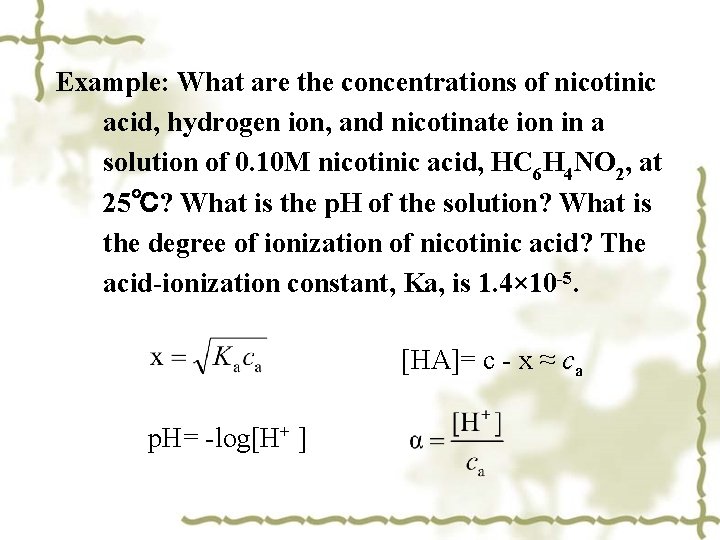
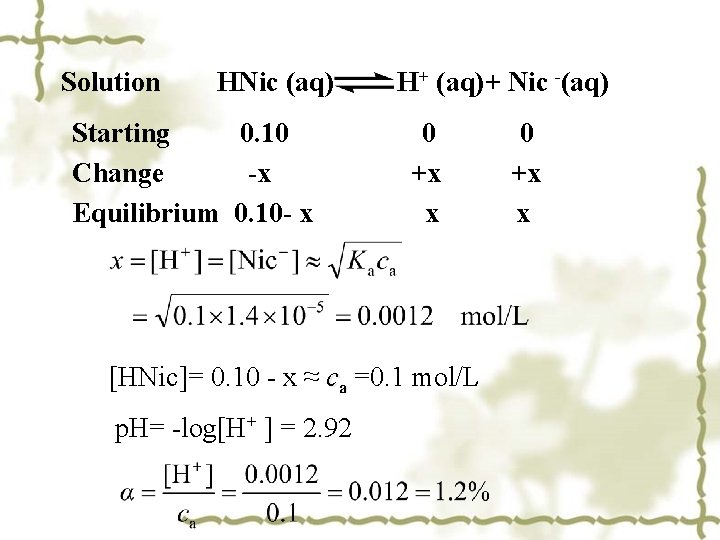
Example: What are the concentrations of nicotinic acid, hydrogen ion, and nicotinate ion in a solution of 0. 10 M nicotinic acid, HC 6 H 4 NO 2, at 25℃? What is the p. H of the solution? What is the degree of ionization of nicotinic acid? The acid-ionization constant, Ka, is 1. 4× 10 -5. [HA]= c - x ≈ ca p. H= -log[H+ ]
Solution HNic (aq) Starting 0. 10 Change -x Equilibrium 0. 10 - x H+ (aq)+ Nic -(aq) 0 +x x [HNic]= 0. 10 - x ≈ ca =0. 1 mol/L p. H= -log[H+ ] = 2. 92 0 +x x
Summary Monoprotic Acid[H 3 O+] HB+H 2 O If ca/Ka≥ 500 B-+H 3 O+ Monoprotic Base[OH-] B-+H 2 O If cb/Kb≥ 500 HB +OH-
Example Morphine, C 17 H 19 NO 3, is administered medically to relieve pain. It is a naturally occurring base, or alkaloid. What is the p. H of a 0. 0075 mol·L-1 solution of morphine at 25 ℃? The base-ionization constant, Kb, is 1. 6× 10 -6 at 25 ℃. Solution
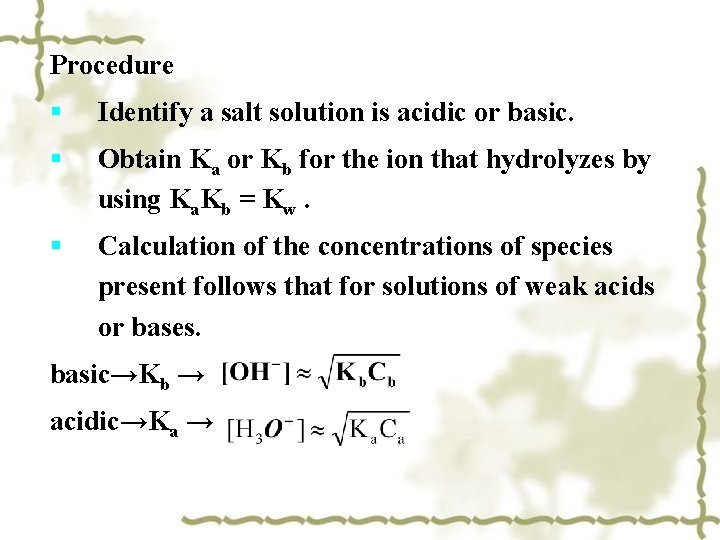
Procedure § Identify a salt solution is acidic or basic. § Obtain Ka or Kb for the ion that hydrolyzes by using Ka. Kb = Kw. § Calculation of the concentrations of species present follows that for solutions of weak acids or bases. basic→Kb → acidic→Ka →
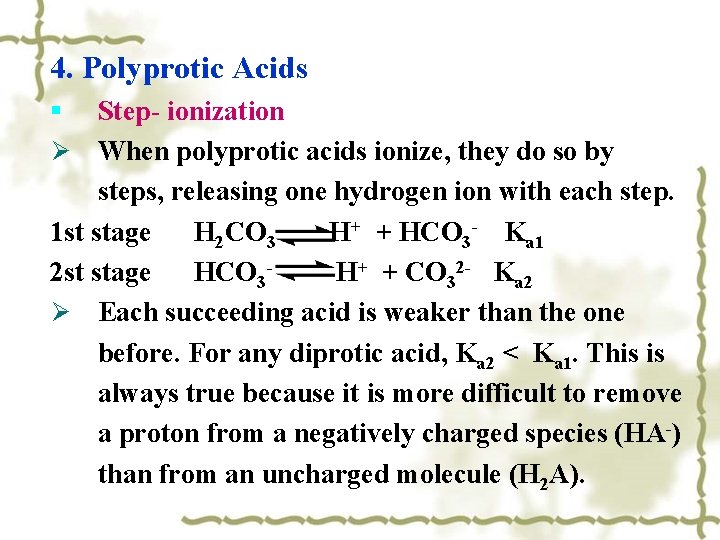
4. Polyprotic Acids Step- ionization Ø When polyprotic acids ionize, they do so by steps, releasing one hydrogen ion with each step. 1 st stage H 2 CO 3 H+ + HCO 3 - Ka 1 2 st stage HCO 3 H+ + CO 32 - Ka 2 Ø Each succeeding acid is weaker than the one before. For any diprotic acid, Ka 2 < Ka 1. This is always true because it is more difficult to remove a proton from a negatively charged species (HA-) than from an uncharged molecule (H 2 A). §
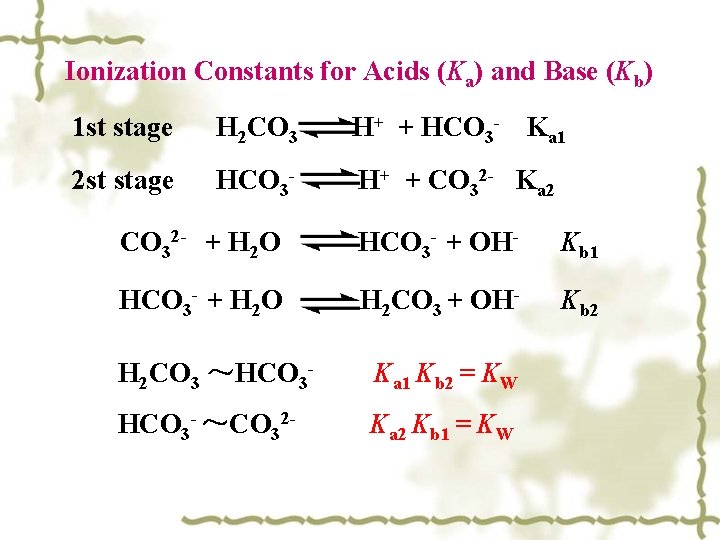
Ionization Constants for Acids (Ka) and Base (Kb) 1 st stage H 2 CO 3 H+ + HCO 3 - Ka 1 2 st stage HCO 3 - H+ + CO 32 - Ka 2 CO 32 - + H 2 O HCO 3 - + OH- Kb 1 HCO 3 - + H 2 O H 2 CO 3 + OH- Kb 2 H 2 CO 3 ~HCO 3 - Ka 1 Kb 2 = KW HCO 3 - ~CO 32 - Ka 2 Kb 1 = KW