
Content MEG II Requirement Positron Spectrometer Positron Timing

- Slides: 26
Content • MEG II Requirement • Positron Spectrometer • Positron Timing Counter • Clustering of Positron Timing Counter Hits • Performance estimation with MC • Analysis with data • Prospects • Summary 2
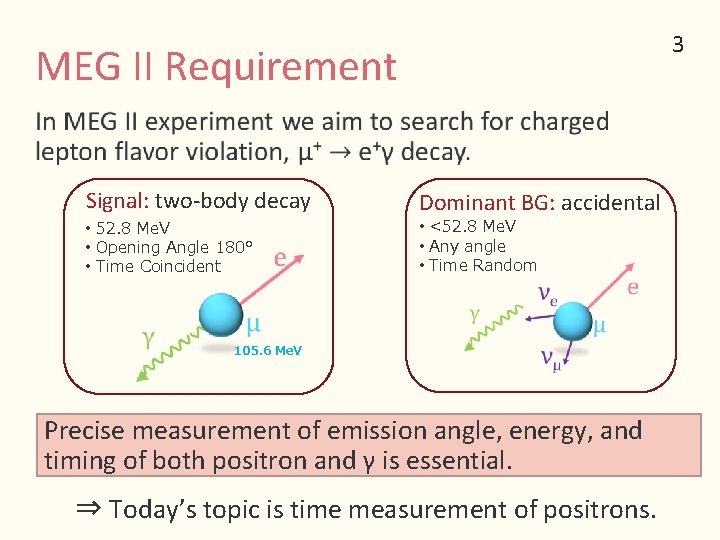
3 MEG II Requirement • Signal: two-body decay • 52. 8 Me. V • Opening Angle 180° • Time Coincident Dominant BG: accidental • <52. 8 Me. V • Any angle • Time Random 105. 6 Me. V Precise measurement of emission angle, energy, and timing of both positron and γ is essential. ⇒ Today’s topic is time measurement of positrons.
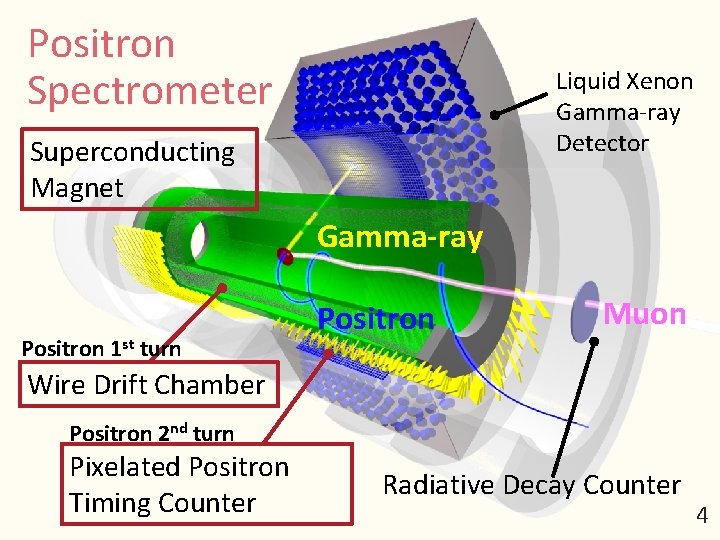
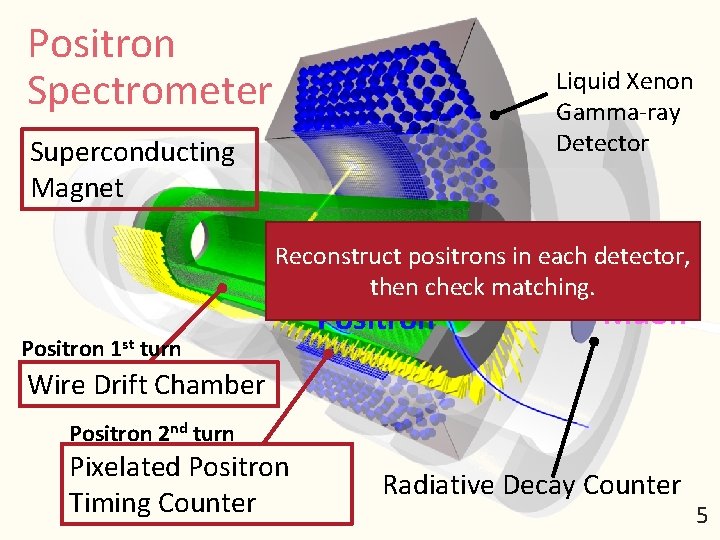
Positron Spectrometer 4 Liquid Xenon Gamma-ray Detector Superconducting Magnet Gamma-ray Positron 1 st turn Positron Muon Wire Drift Chamber Positron 2 nd turn Pixelated Positron Timing Counter Radiative Decay Counter 4
Positron Spectrometer 5 Liquid Xenon Gamma-ray Detector Superconducting Magnet Gamma-ray Reconstruct positrons in each detector, then check matching. Positron 1 st turn Positron Muon Wire Drift Chamber Positron 2 nd turn Pixelated Positron Timing Counter Radiative Decay Counter 5
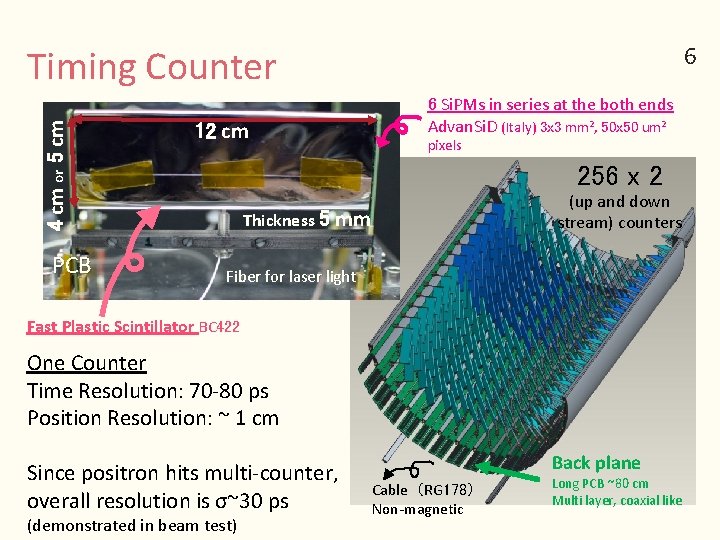
66 4 cm or 5 cm Timing Counter PCB 12 cm 6 Si. PMs in series at the both ends Advan. Si. D (Italy) 3 x 3 mm 2, 50 x 50 um 2 pixels 256 x 2 (up and down stream) counters Thickness 5 mm Fiber for laser light Fast Plastic Scintillator BC 422 One Counter Time Resolution: 70 -80 ps Position Resolution: ~ 1 cm Since positron hits multi-counter, overall resolution is σ~30 ps (demonstrated in beam test) Back plane Cable(RG 178) Non-magnetic Long PCB ~80 cm Multi layer, coaxial like
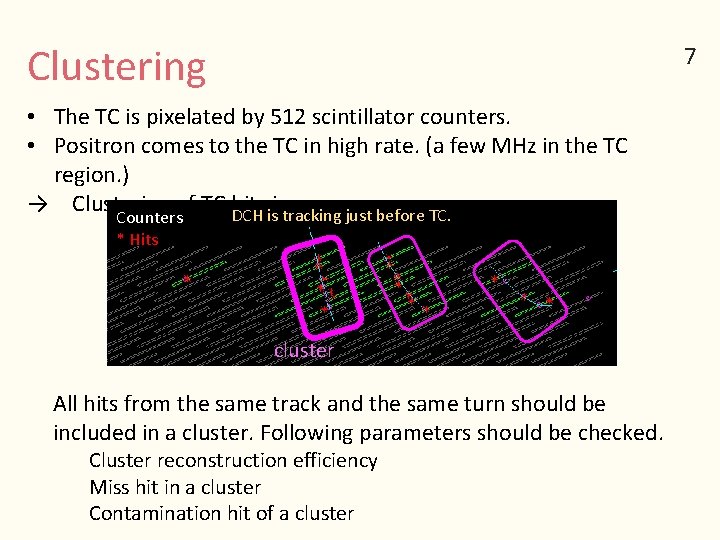
77 Clustering • The TC is pixelated by 512 scintillator counters. • Positron comes to the TC in high rate. (a few MHz in the TC region. ) → Clustering of TC hits is necessary. DCH is tracking just before TC. Counters * Hits cluster All hits from the same track and the same turn should be included in a cluster. Following parameters should be checked. Cluster reconstruction efficiency Miss hit in a cluster Contamination hit of a cluster
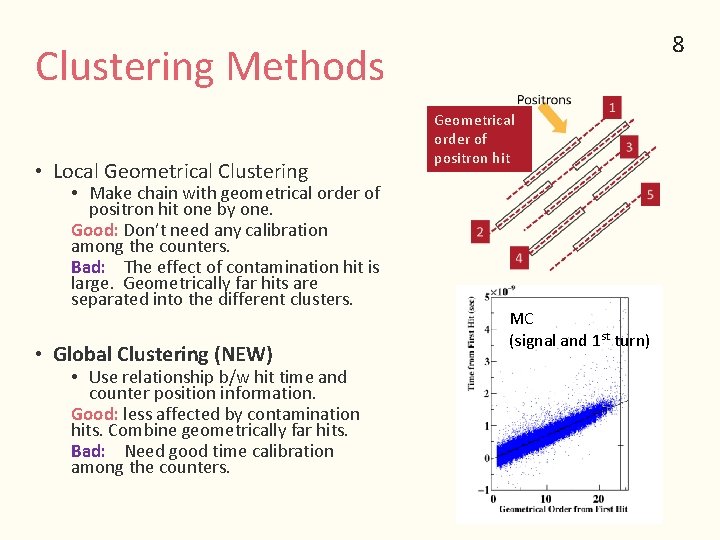
8 Clustering Methods • Local Geometrical Clustering • Make chain with geometrical order of positron hit one by one. Good: Don’t need any calibration among the counters. Bad: The effect of contamination hit is large. Geometrically far hits are separated into the different clusters. • Global Clustering (NEW) • Use relationship b/w hit time and counter position information. Good: less affected by contamination hits. Combine geometrically far hits. Bad: Need good time calibration among the counters. Geometrical order of positron hit MC (signal and 1 st turn)
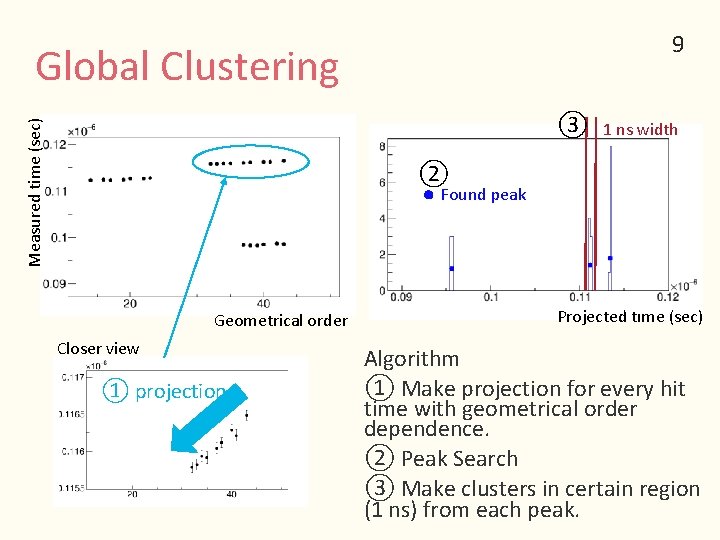
9 Global Clustering Measured time (sec) ③ 1 ns width ② Found peak Geometrical order Closer view ① projection Projected time (sec) Algorithm ① Make projection for every hit time with geometrical order dependence. ② Peak Search ③ Make clusters in certain region (1 ns) from each peak.
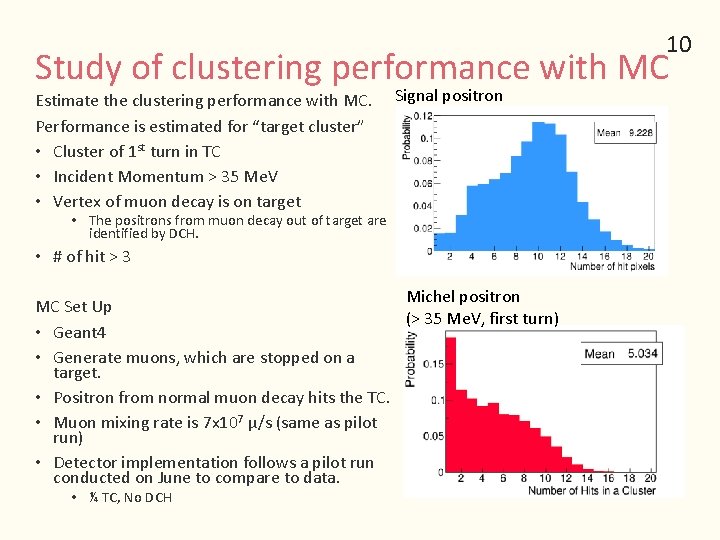
10 Study of clustering performance with MC Estimate the clustering performance with MC. Performance is estimated for “target cluster” • Cluster of 1 st turn in TC • Incident Momentum > 35 Me. V • Vertex of muon decay is on target Signal positron • The positrons from muon decay out of target are identified by DCH. • # of hit > 3 Michel positron MC Set Up (> 35 Me. V, first turn) • Geant 4 • Generate muons, which are stopped on a target. • Positron from normal muon decay hits the TC. • Muon mixing rate is 7 x 10⁷ μ/s (same as pilot run) • Detector implementation follows a pilot run conducted on June to compare to data. • ¼ TC, No DCH
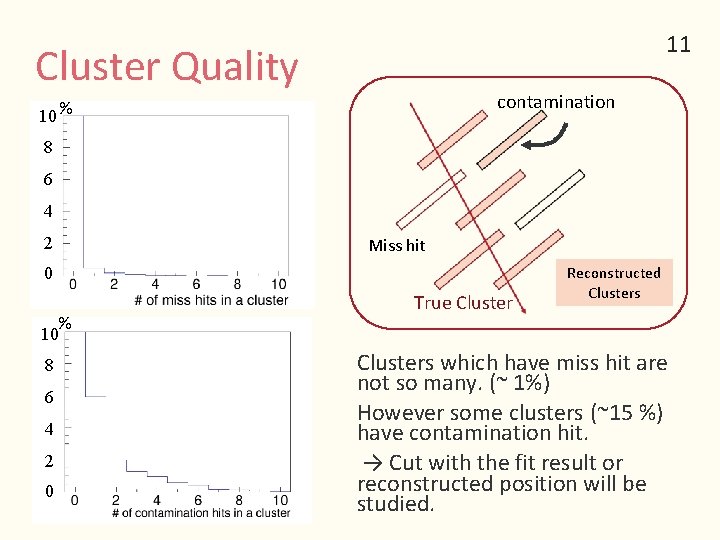
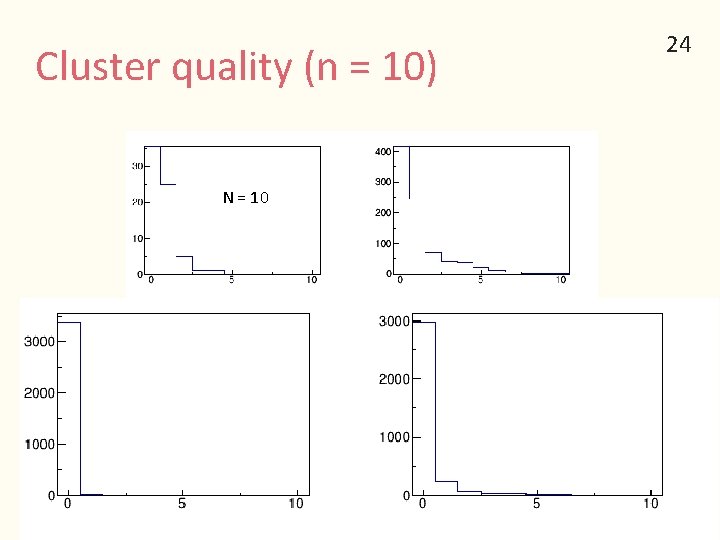
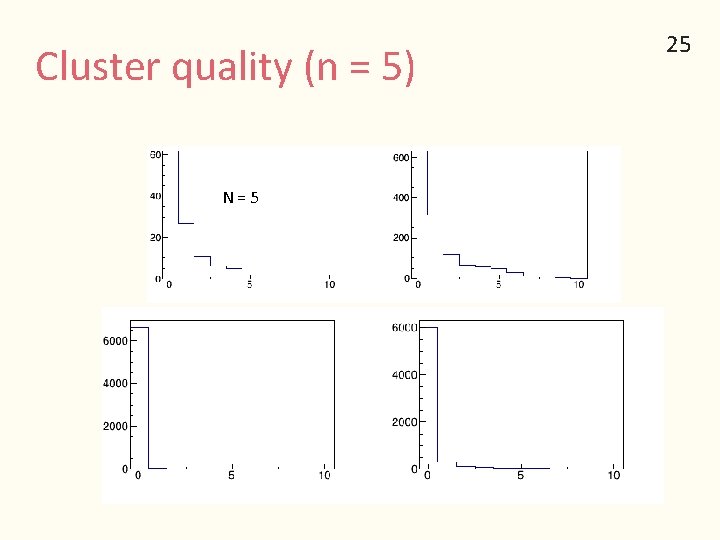
11 Cluster Quality contamination 10 % 8 6 4 2 Miss hit 0 % 10 8 6 4 2 0 True Cluster Reconstructed Clusters which have miss hit are not so many. (~ 1%) However some clusters (~15 %) have contamination hit. → Cut with the fit result or reconstructed position will be studied.
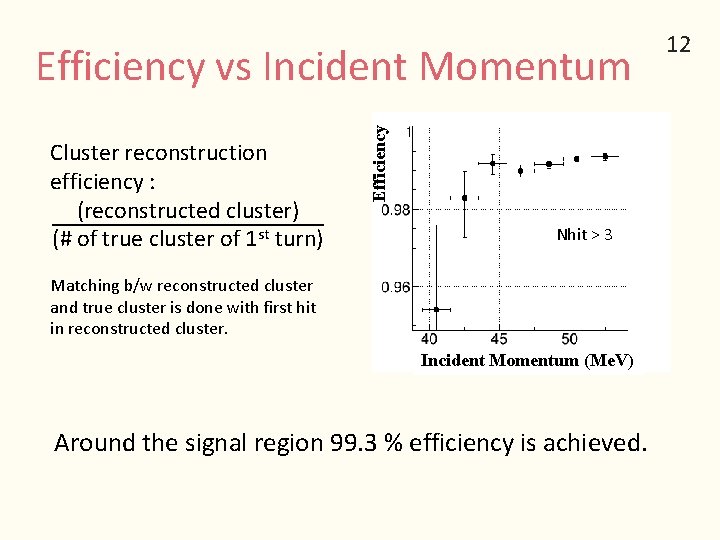
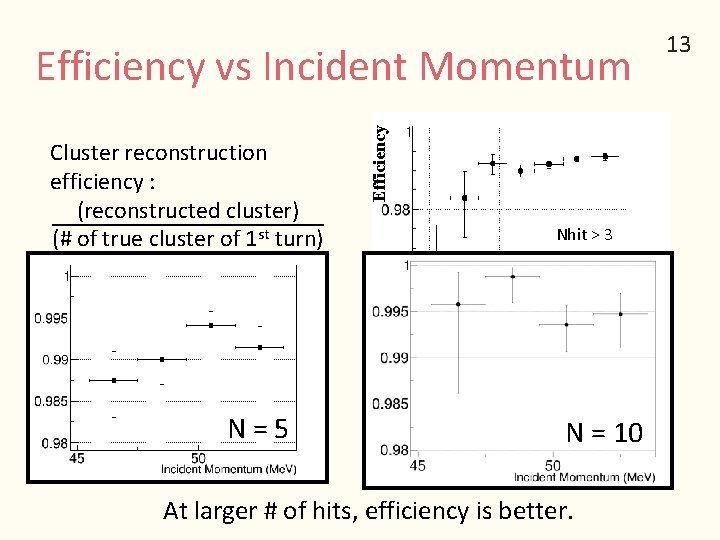
Cluster reconstruction efficiency : (reconstructed cluster) (# of true cluster of 1 st turn) Efficiency vs Incident Momentum Nhit > 3 Matching b/w reconstructed cluster and true cluster is done with first hit in reconstructed cluster. Incident Momentum (Me. V) Around the signal region 99. 3 % efficiency is achieved. 12
Cluster reconstruction efficiency : (reconstructed cluster) (# of true cluster of 1 st turn) Efficiency vs Incident Momentum Nhit > 3 Matching b/w reconstructed cluster and true cluster is done with first hit in reconstructed cluster. Incident Momentum (Me. V) N = 5 N = 10 At larger # of hits, efficiency is better. 13
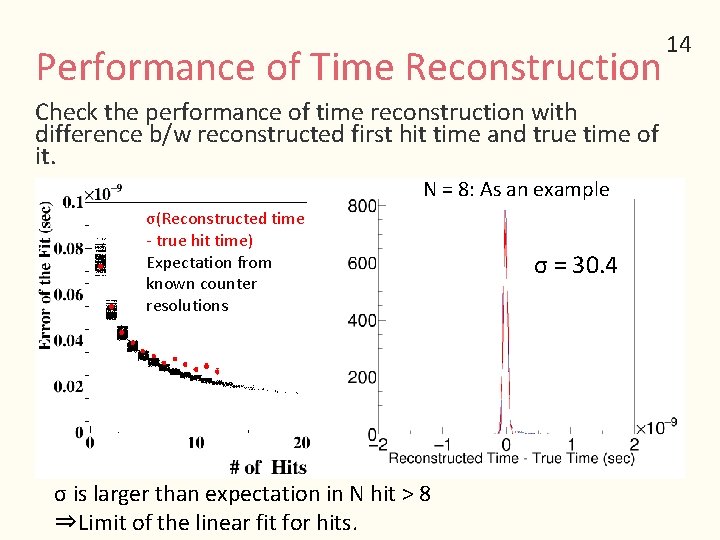
Performance of Time Reconstruction Check the performance of time reconstruction with difference b/w reconstructed first hit time and true time of it. N = 8: As an example σ(Reconstructed time - true hit time) Expectation from known counter resolutions σ is larger than expectation in N hit > 8 ⇒Limit of the linear fit for hits. σ = 30. 4 14
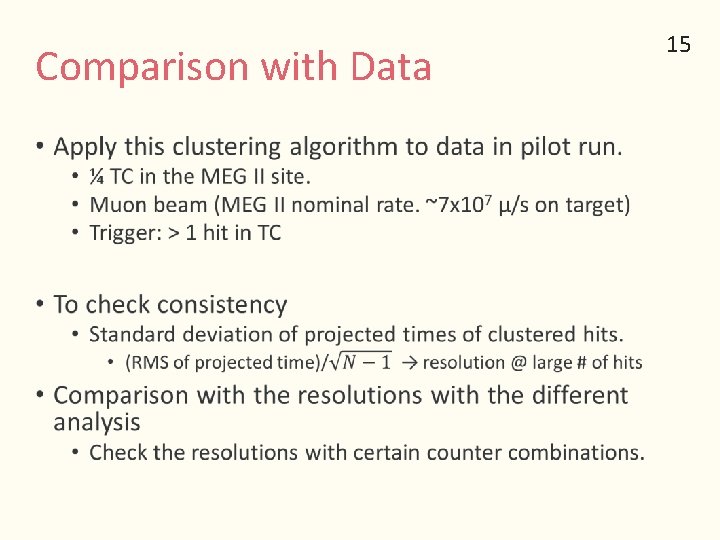
Comparison with Data • 15
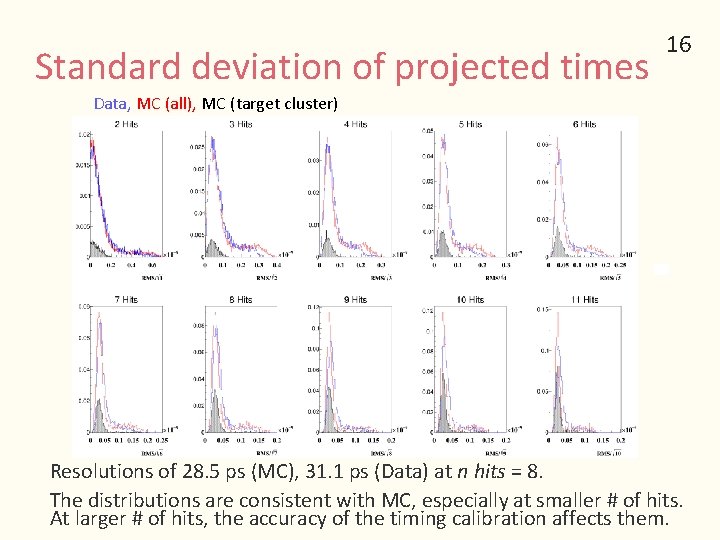
Standard deviation of projected times 16 Data, MC (all), MC (target cluster) Resolutions of 28. 5 ps (MC), 31. 1 ps (Data) at n hits = 8. The distributions are consistent with MC, especially at smaller # of hits. At larger # of hits, the accuracy of the timing calibration affects them.
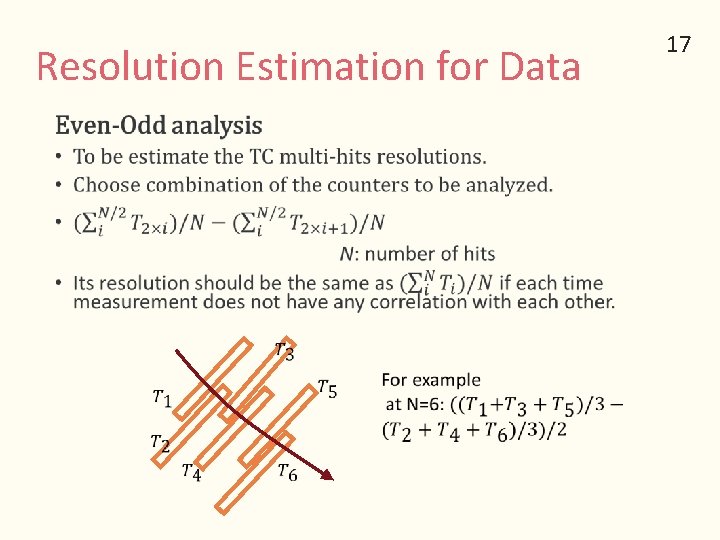
Resolution Estimation for Data • 17
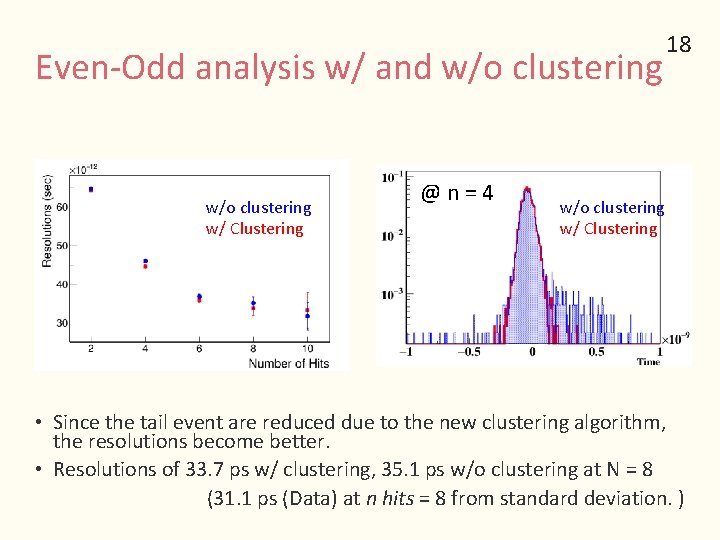
Even-Odd analysis w/ and w/o clustering w/ Clustering @ n = 4 18 w/o clustering w/ Clustering • Since the tail event are reduced due to the new clustering algorithm, the resolutions become better. • Resolutions of 33. 7 ps w/ clustering, 35. 1 ps w/o clustering at N = 8 (31. 1 ps (Data) at n hits = 8 from standard deviation. )
Prospects 19 • Use reconstructed position of TC instead of geometry order • Iteration • Cut contamination hits • Combine miss hits • Combine with DCH reconstruction and the additional iteration.
Summary • 20
Back Up 2 1
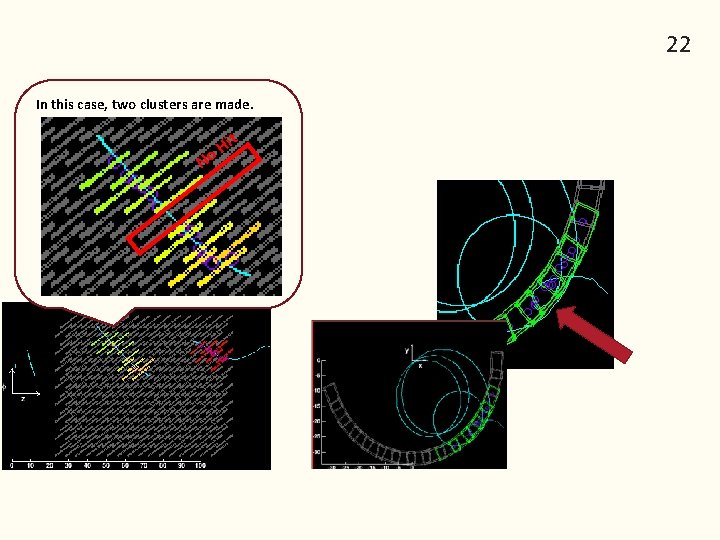
22 In this case, two clusters are made. N it H o
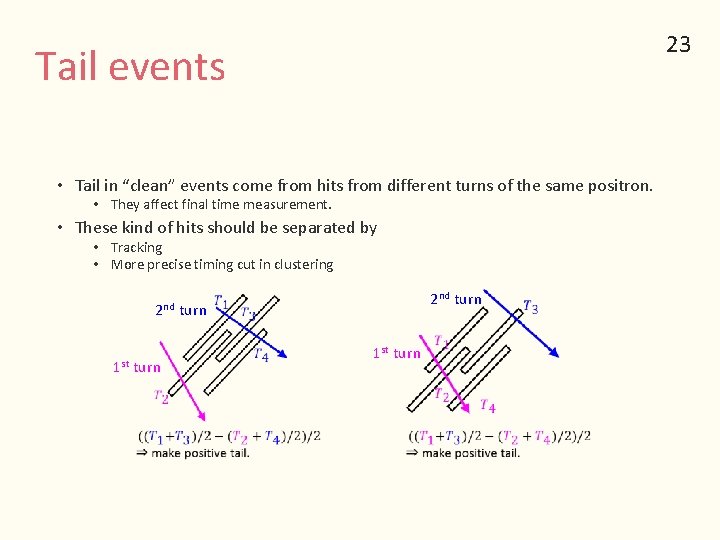
23 Tail events • Tail in “clean” events come from hits from different turns of the same positron. • They affect final time measurement. • These kind of hits should be separated by • Tracking • More precise timing cut in clustering 2 nd turn 1 st turn 2 nd turn 1 st turn
Cluster quality (n = 10) N = 10 24
Cluster quality (n = 5) N = 5 25
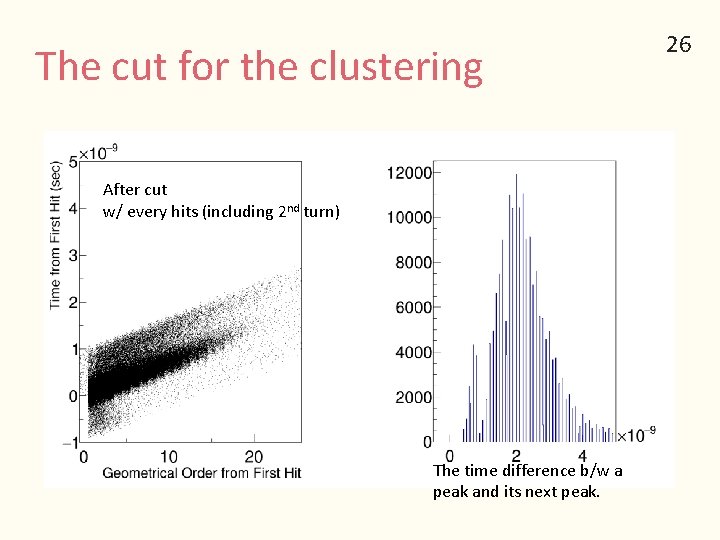
The cut for the clustering After cut w/ every hits (including 2 nd turn) The time difference b/w a peak and its next peak. 26