
Content may be borrowed from other resources See
Content may be borrowed from other resources. See the last slide for acknowledgements! Information Hiding: Watermarking and Steganography Amir Houmansadr CS 660: Advanced Information Assurance Spring 2015
Principles of assurance: CIA • Confidentiality – Keeping data and resources hidden • Integrity – Data integrity (integrity) – Origin integrity (authentication) • Availability – Enabling access to data and resources 2
Confidentiality • Encryption is the main tool – But, sometimes it is not enough! • Examples: – Drug dealer – Military scenario – Whistleblower – Etc. 3
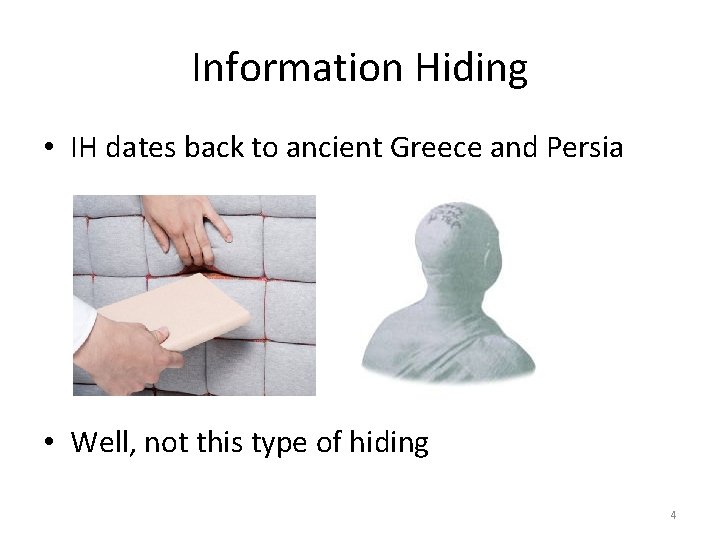
Information Hiding • IH dates back to ancient Greece and Persia • Well, not this type of hiding 4
(Digital) Information Hiding • Definition: Concealing the very existence of some kind of information (e. g. , a series of data bits, the identity of the communicating party, etc. ) for some specific purpose (e. g. , to prove ownership, to remain untraceable, etc. ) 5
Information confidentiality protection • IH does not intend to hide the contents of information – Encryption • Information confidentiality protection tools can be combined with information hiding techniques 6
Applications, or why we need to hide information • Improve confidentiality by hiding the very existence of messages • Prove ownership on digital media • Fingerprint media for trace back • Blocking resistance • Forensics • … 7
Classes of Information Hiding Ø Steganography Ø Digital watermarking Ø Covert channels Ø Anonymous communication Ø Protocol obfuscation • Not a class of information hiding: – Encryption • There are various classifications 8
Steganography • Embedding some information (stegotext) within a digital media (covertext) so that the digital media looks unchanged (imperceptible) to a human/machine 9
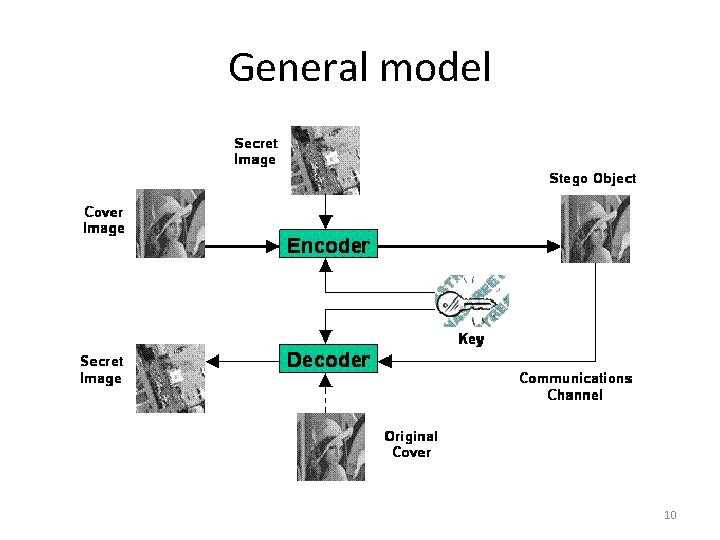
General model 10
Why can we hide? • Because there are unused/redundant data bits in digital media, that changing them will be imperceptible – E. g. , image compression significantly reduces the size of an image by removing some of the redundant information bits. • The unused/redundant data can be used to hide some digital information 11
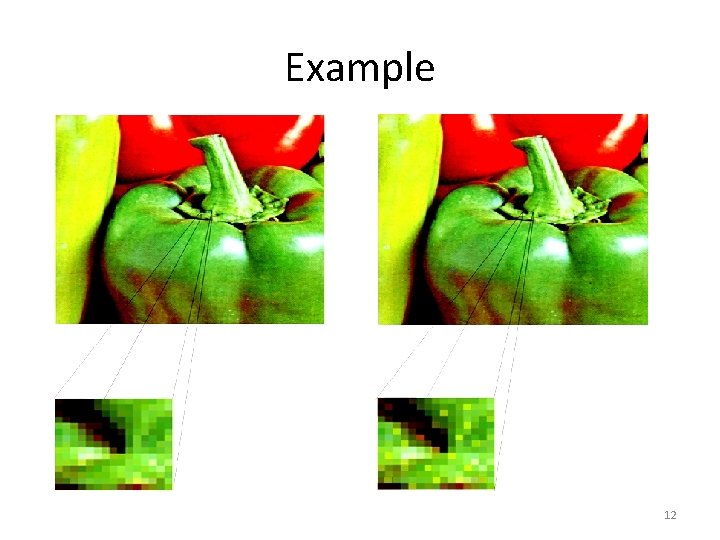
Example 12
Types of Cover Media • We can hide information in pretty much any digital media: – Audio – Image – Video – Graphics – Text files – Software – Digital events (e. g. , timings) – Network traffic 13
Classes of Information Hiding Ø Steganography Ø Digital watermarking Ø Covert channels Ø Anonymous communication Ø Protocol obfuscation • Not a class of information hiding: – Encryption • There are various classifications 14
Digital watermarking • Embedding some information (watermark) within a digital media (covertext) so that the digital media looks unchanged (imperceptible) to a human/machine 15
Watermarking vs. Steganography • Watermarking: – The hidden information itself is not important by itself (no secure), it says something about the covertext • Steganography: – The covertext has no value, it is only there to convey the stegotext. Stegotext is the valuable information, and is independent of covertext. 16
Applications: Watermarking vs. Steganography • Watermarking: – Authenticity: proof of ownership – Fingerprinting: piracy tracking – Integrity: tamper detection – Data augmentation: add meta-data • Steganography – Stealthy communication of messages • Watermarking usually needs lower data capacity 17
Attacks: Watermarking vs. Steganography • Attacker’s objective: – Watermarking: remove the watermark without distorting the covertext, or change the covertext without distoring the watermark – Steganography: detect the presence of the hidden message, and extract it 18
Types of watermarking/steganography • Fragile vs. robust – Fragile is expected to destroy with modifications. Robust is expected to survive noise. 19
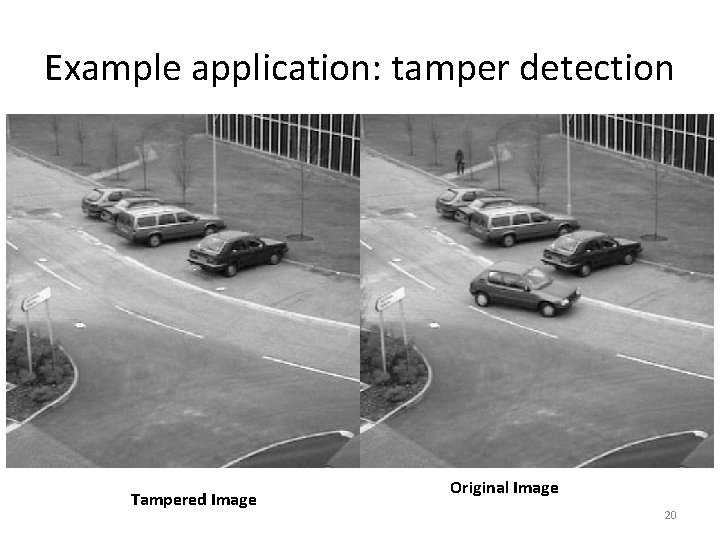
Example application: tamper detection Tampered Image Original Image 20
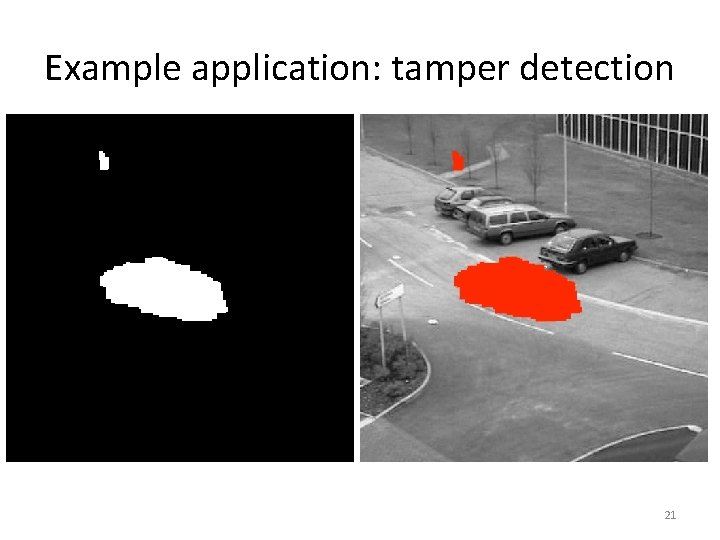
Example application: tamper detection 21
Types of watermarking/steganography • Fragile vs. robust – Fragile is expected to destroy with modifications. Robust is expected to survive noise. • Blind vs. semi-blind vs. non-blind – Blind needs the original covertext for detection. Semiblind needs some information from the insertion, but not the whole covertext. 22
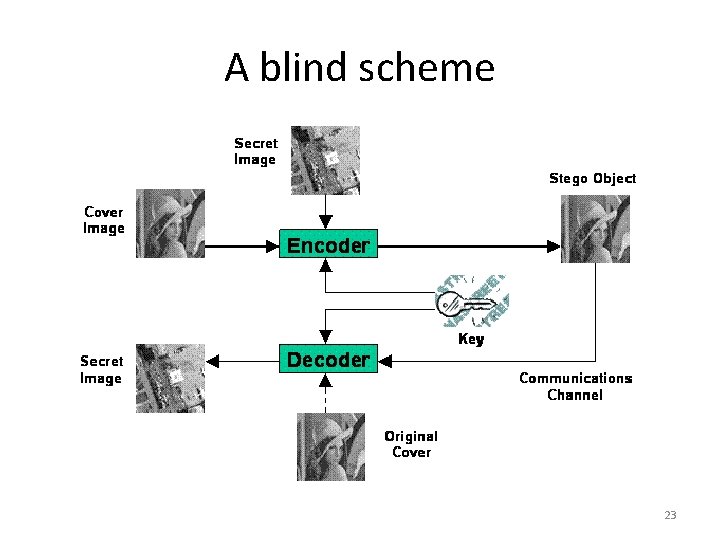
A blind scheme 23
Types of watermarking/steganography • Fragile vs. robust – Fragile is expected to destroy with modifications. Robust is expected to survive noise. • Blind vs. semi-blind vs. non-blind – Blind needs the original covertext for detection. Semiblind needs some information from the insertion, but not the whole covertext. • Pure vs. secret key vs. public key – Pure needs no key for detection. Secret key schemes needs a secret key for both embedding and detection. Public key schemes use a secret key for embedding, a secret key for detection. 24
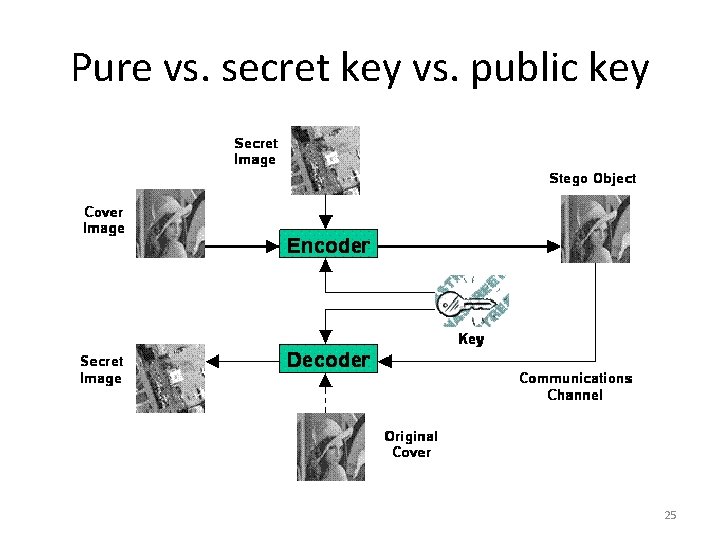
Pure vs. secret key vs. public key 25
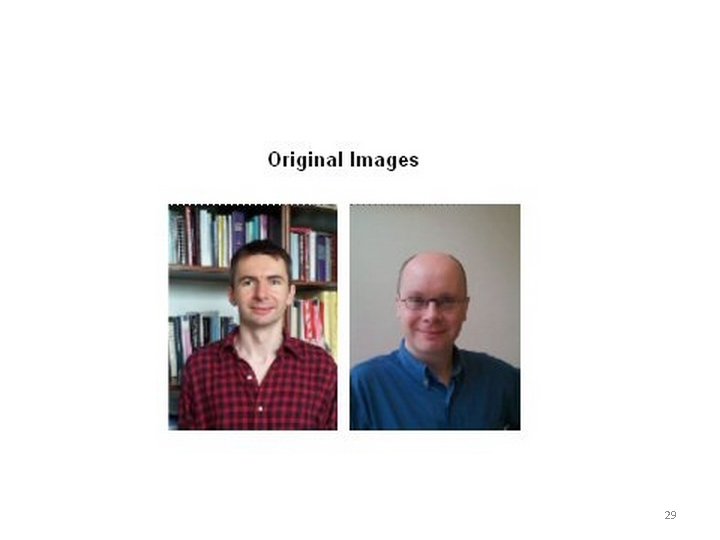
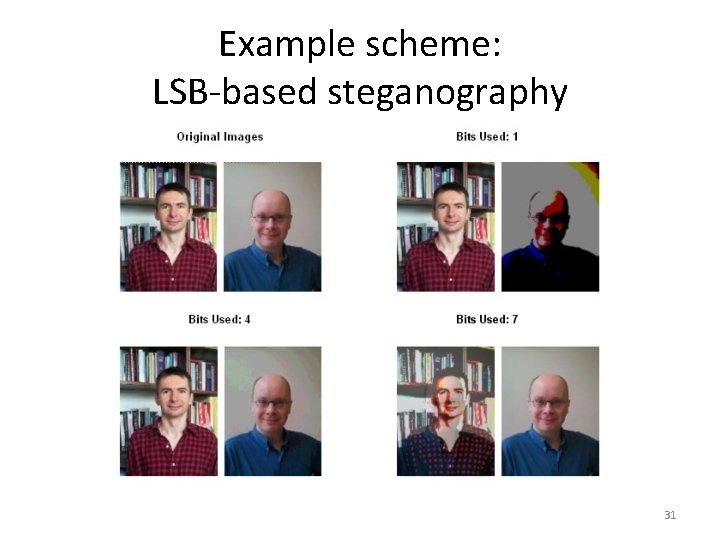
Example Steganography scheme • LSB-based image steganography 26
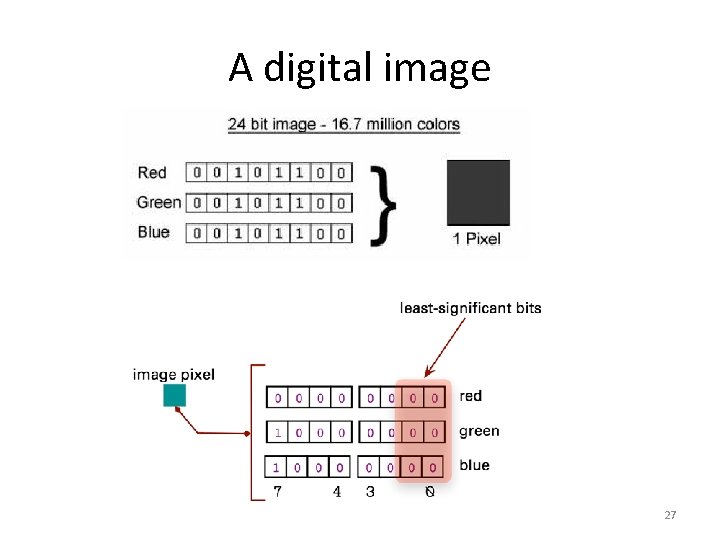
A digital image 27
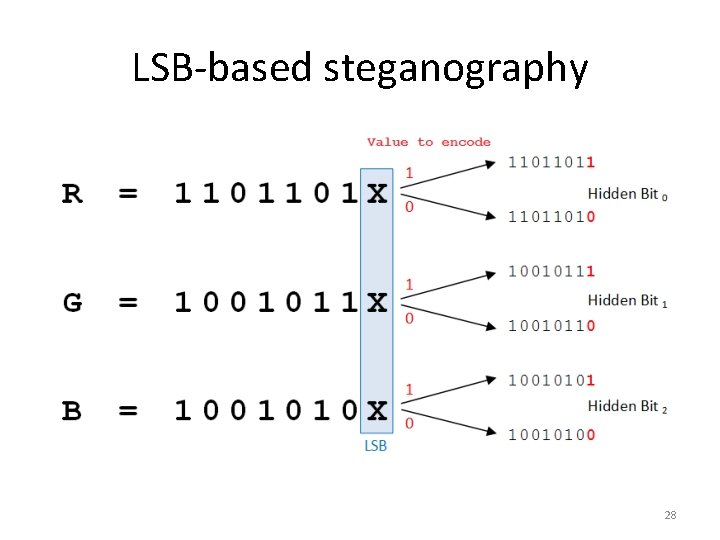
LSB-based steganography 28
29
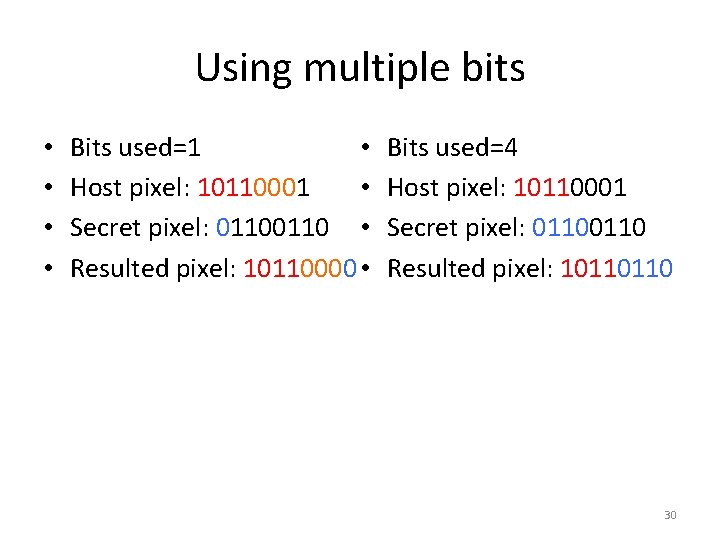
Using multiple bits • • Bits used=1 • Host pixel: 10110001 • Secret pixel: 0110 • Resulted pixel: 10110000 • Bits used=4 Host pixel: 10110001 Secret pixel: 0110 Resulted pixel: 10110110 30
Example scheme: LSB-based steganography 31
Transform-domain schemes • This is fragile! – Sources of noise: compression, resizing, cropping, rotating, AWGN, etc. • For robust watermarking, embed into transform domains – DWT – DCT 32
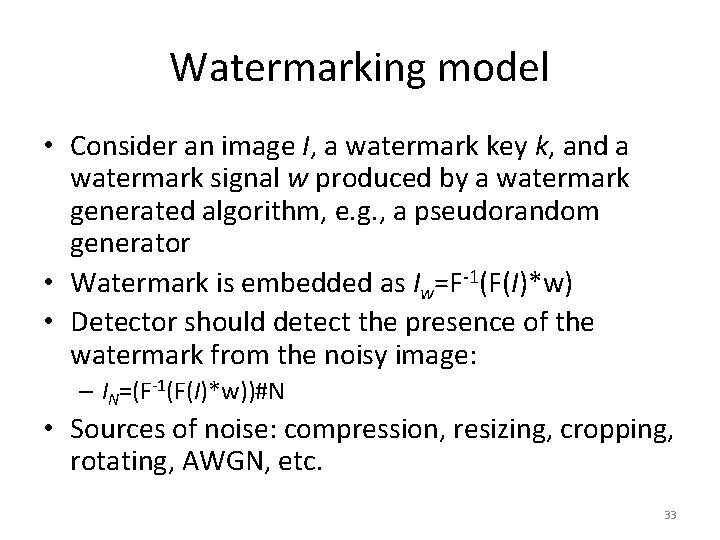
Watermarking model • Consider an image I, a watermark key k, and a watermark signal w produced by a watermark generated algorithm, e. g. , a pseudorandom generator • Watermark is embedded as Iw=F-1(F(I)*w) • Detector should detect the presence of the watermark from the noisy image: – IN=(F-1(F(I)*w))#N • Sources of noise: compression, resizing, cropping, rotating, AWGN, etc. 33
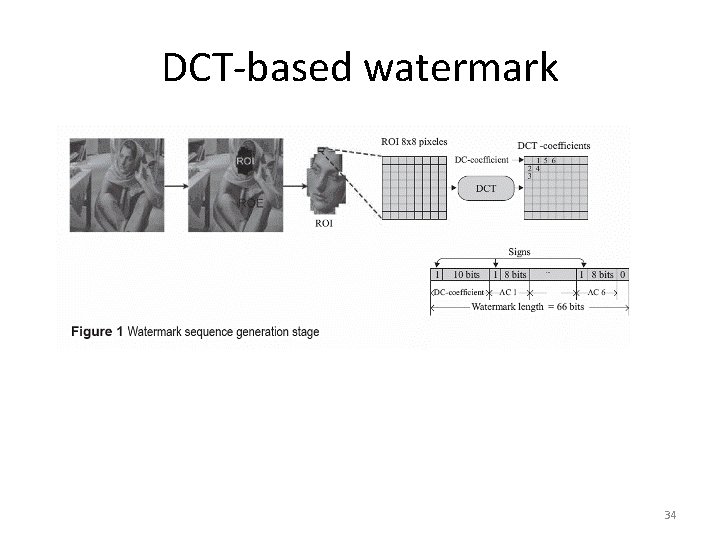
DCT-based watermark 34
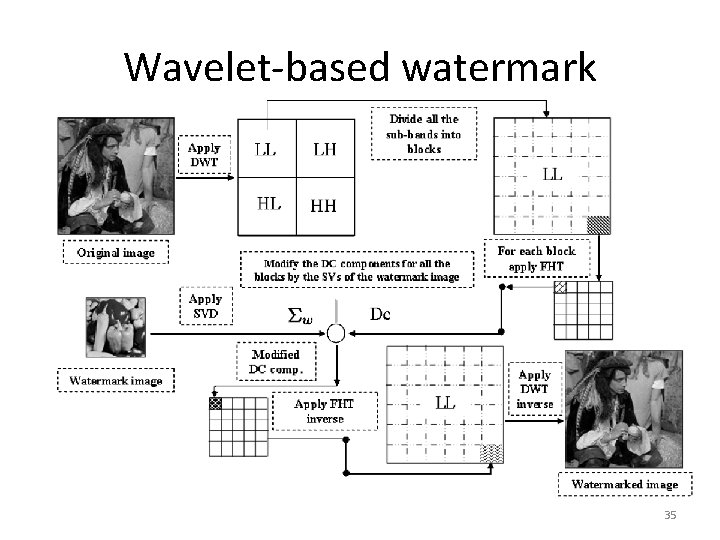
Wavelet-based watermark 35
Why is it more robust? 36
Watermark attacks • Robustness attacks: remove or diminish the presence of watermark • Presentation attacks: modify the content so that detector can not find the hidden watermark • Interpretation attacks: prevent assertion of ownership, e. g. , re-watermarking 37
Practical challenges of watermarks? 38
Classes of Information Hiding • • • Digital watermarking Steganography Covert channels Anonymous communication Protocol obfuscation 39
Acknowledgement • Some of the slides, content, or pictures are borrowed from the following resources, and some pictures are obtained through Google search without being referenced below: • • https: //www. cs. bham. ac. uk/~mdr/teaching/modules 03/security/students/SS 5/Steganograp hy. htm http: //poseidon. csd. auth. gr/LAB_SEMINARS/Dig. Days/Lectures/Information_Hiding. ppt 40
- Slides: 40