
CONTENT LEARNING OBJECTIVES ORIGIN OF INTERNET Define Internet
CONTENT LEARNING OBJECTIVES ORIGIN OF INTERNET Define Internet and its milestones INTERNET TERMINOLOGY Identify the key terms associated with Internet INTERNET SERVICES List the benefits of Internet SECURITY AND PRIVACY List various security threats and privacy issues concerning Internet and how to deal with them
ORIGIN OF INTERNET It is interconnection of computers. The first computer network was jointly designed by The Advanced Research Projects Agency (ARPA) and Department of Defense (Do. D) of United States in 1969 and was called ARPANET. The name Internet was given in 1974.
Internet Milestones 1969 1971 1974 1989 1994 1996 1998 2001 2004 2009 1/8/12 ARPANET was invented which lead to the formation of Internet. First mail or message was sent through ARPANET The term called ‘internet’ was given to ARPANET WWW was founded by Tim Berners Lee. Yahoo was invented by David Fillo and Jerry Yang Hotmail was founded by Sabir Bhatia and Jack Smith Google was founded by Larry Page and Sergey Brin Wikipedia, the free encyclopedia was started Face book was invented by a Harvard university dropout, Mark Zukerberg. Method of cloud computing was developed
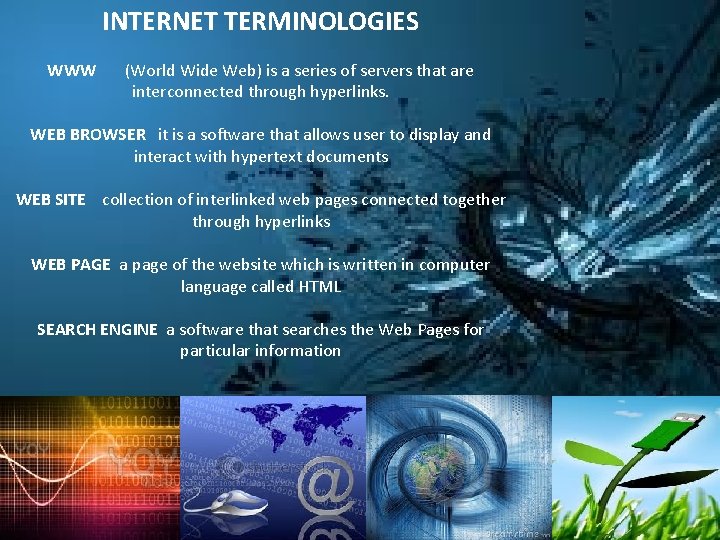
INTERNET TERMINOLOGIES WWW (World Wide Web) is a series of servers that are interconnected through hyperlinks. WEB BROWSER it is a software that allows user to display and interact with hypertext documents WEB SITE collection of interlinked web pages connected together through hyperlinks WEB PAGE a page of the website which is written in computer language called HTML SEARCH ENGINE a software that searches the Web Pages for particular information
Internet Services "The Internet has become a key means by which individuals can exercise their right to freedom and expression. " - The United Nations • CHAT • UPLOADING AND DOWNLOADING FILES • EMAIL • VIDEO CONFERENCING • BLOG • E LEARNING • E COMMERCE • SOCIAL NETWORKING 1/8/12
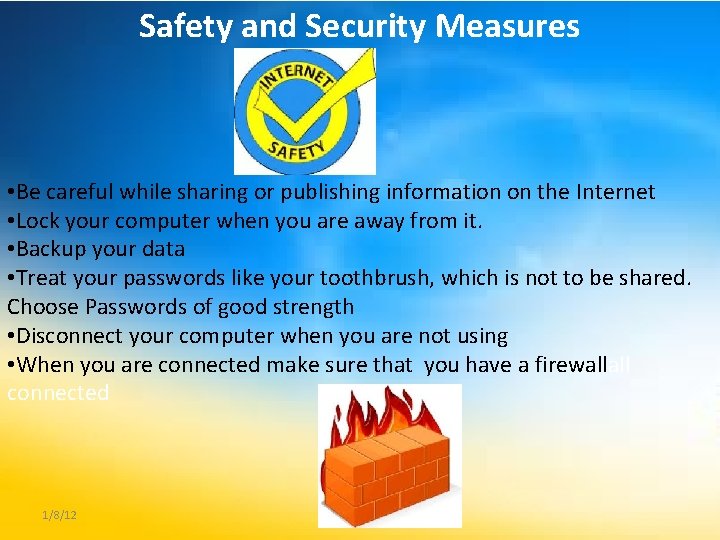
Safety and Security Measures • Be careful while sharing or publishing information on the Internet • Lock your computer when you are away from it. • Backup your data • Treat your passwords like your toothbrush, which is not to be shared. Choose Passwords of good strength • Disconnect your computer when you are not using • When you are connected make sure that you have a firewallall connected 1/8/12
The set of social conventions to be followed while using the Internet are called netiquette (Internet + etiquette). Some tips for effective net communications are: • Never Copy from someone else’s document without his/her permission. It comes under cyber crime. • Respect copyright symbol. Never download or use material, that is copyright of someone without permission. • Avoid CAPITAL letters in communication as it is equivalent to shouting online • Keep your messages short and clear. • Do not send unnecessary forwards or attachments • Never disclose confidential or personal details on the net • Do not open files with unusual name
Quick facts ! 1. VINT CERF, is recognized as one of the FATHER OF INTERNET 2. Ray Tomlinson has been referred to as the father of e-mail 3. Blog is an abbreviation of Web Log coined in 1999 4. The first social networking site Six-Degrees. com was launched in 1997 1/8/12
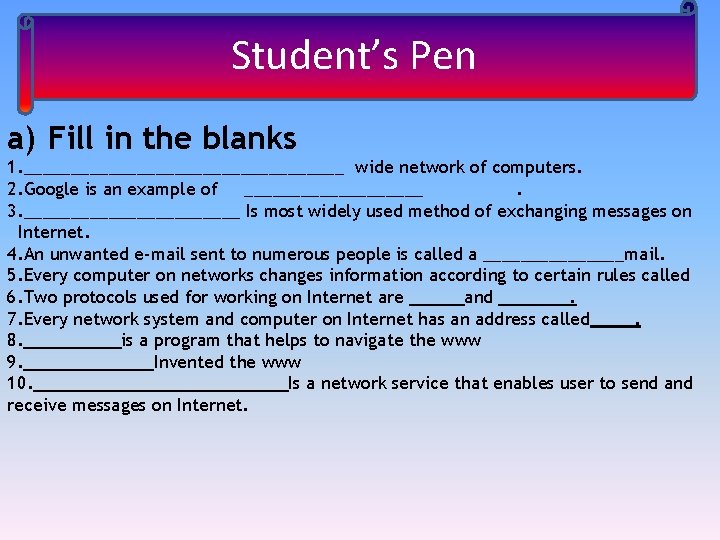
Student’s Pen a) Fill in the blanks 1. _________________ wide network of computers. 2. Google is an example of __________. 3. ____________ Is most widely used method of exchanging messages on Internet. 4. An unwanted e-mail sent to numerous people is called a ________mail. 5. Every computer on networks changes information according to certain rules called 6. Two protocols used for working on Internet are and. 7. Every network system and computer on Internet has an address called. 8. is a program that helps to navigate the www 9. Invented the www 10. Is a network service that enables user to send and receive messages on Internet.
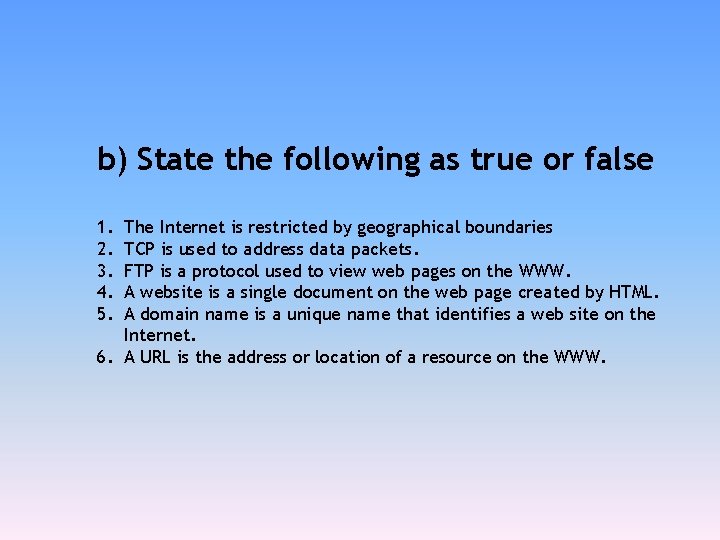
b) State the following as true or false 1. 2. 3. 4. 5. The Internet is restricted by geographical boundaries TCP is used to address data packets. FTP is a protocol used to view web pages on the WWW. A website is a single document on the web page created by HTML. A domain name is a unique name that identifies a web site on the Internet. 6. A URL is the address or location of a resource on the WWW.
c) BRAIN STORMING session 1. Internet a boon or a bane? Give two points each for and against 2. ‘Are social networking sites harming the teenagers? ’ create a blog and post your views d) Higher Order Thinking Skills (Hots) 1. What do these emoticons stand for 1. : -) 2. : -( 3. : -D 4. : -0 2. While working on social networking sites, you must have noticed a term called, “report abuse”. what does it mean? Is it useful in any way? 3. Your brother was in the middle of a financial transaction on the Internet. Suddenly his friend called him and he left the web site open. Do you think this is dangerous. Give 2 reasons.
References • http: //en. wikipedia. org/ • www. internetsociety. org • http: //www. cyberlawsindia. net/ • Informatics Practices, CBSE 1/8/12
- Slides: 14