
CONTENT know facts CONCEPTS understand principals PROBLEM SOLVE
• CONTENT -know facts • CONCEPTS -understand principals • PROBLEM SOLVE -figure things out
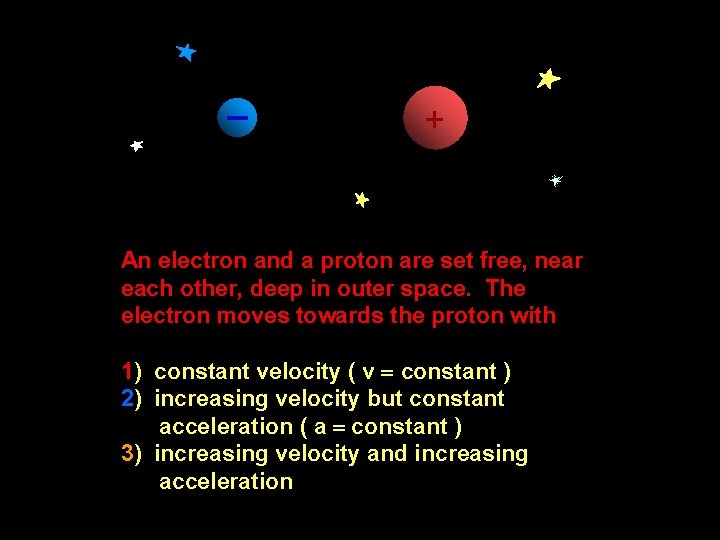
+ An electron and a proton are set free, near each other, deep in outer space. The electron moves towards the proton with 1) constant velocity ( v = constant ) 2) increasing velocity but constant acceleration ( a = constant ) 3) increasing velocity and increasing acceleration
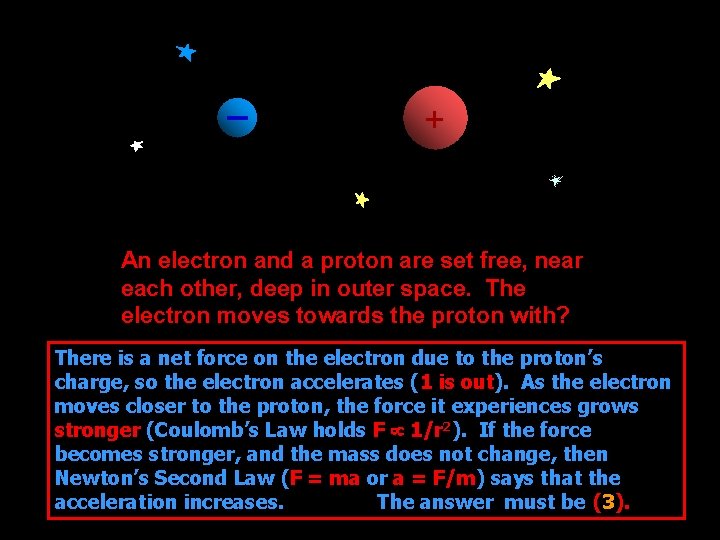
+ An electron and a proton are set free, near each other, deep in outer space. The electron moves towards the proton with? There is a net force on the electron due to the proton’s charge, so the electron accelerates (1 is out). As the electron moves closer to the proton, the force it experiences grows stronger (Coulomb’s Law holds F 1/r 2). If the force becomes stronger, and the mass does not change, then Newton’s Second Law (F = ma or a = F/m) says that the acceleration increases. The answer must be (3).
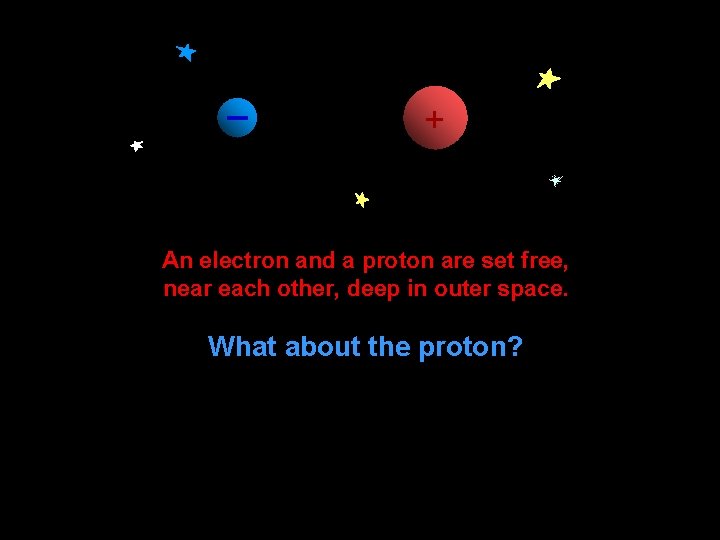
+ An electron and a proton are set free, near each other, deep in outer space. What about the proton?
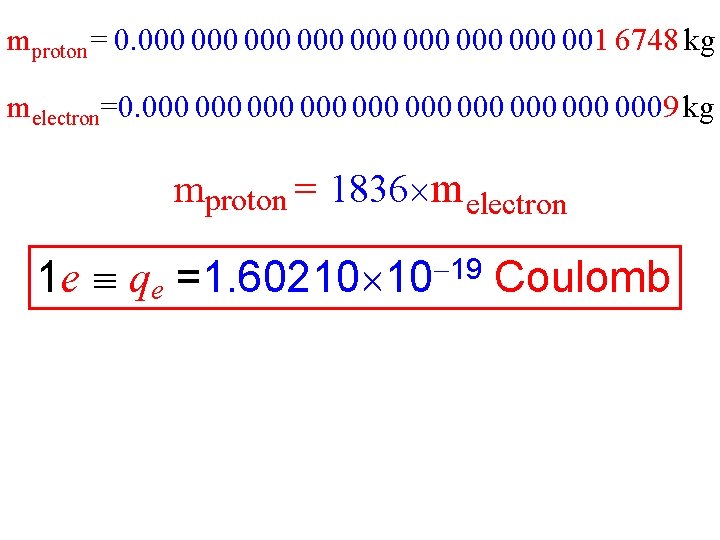
mproton = 0. 000 000 001 6748 kg melectron=0. 000 000 0009 kg mproton = 1836 melectron 1 e qe -19 =1. 60210 10 Coulomb
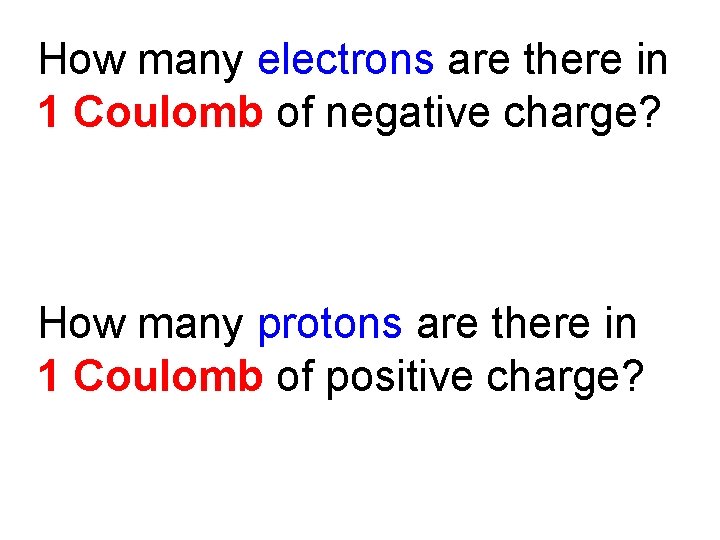
How many electrons are there in 1 Coulomb of negative charge? How many protons are there in 1 Coulomb of positive charge?
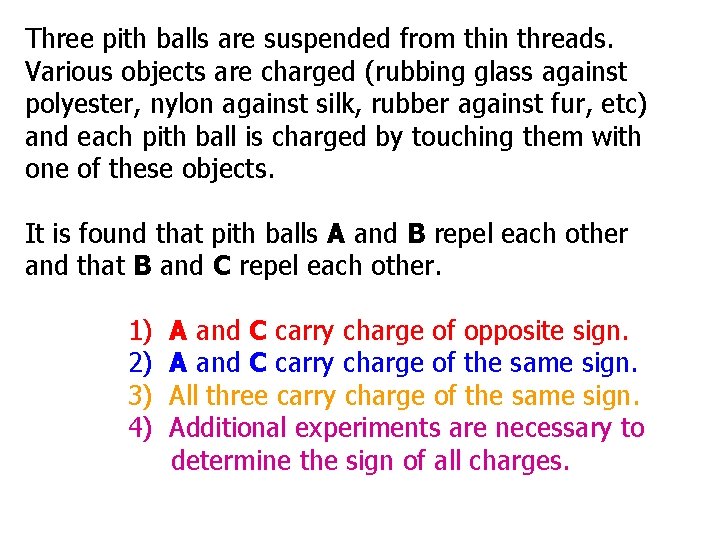
Three pith balls are suspended from thin threads. Various objects are charged (rubbing glass against polyester, nylon against silk, rubber against fur, etc) and each pith ball is charged by touching them with one of these objects. It is found that pith balls A and B repel each other and that B and C repel each other. 1) 2) 3) 4) A and C carry charge of opposite sign. A and C carry charge of the same sign. All three carry charge of the same sign. Additional experiments are necessary to determine the sign of all charges.
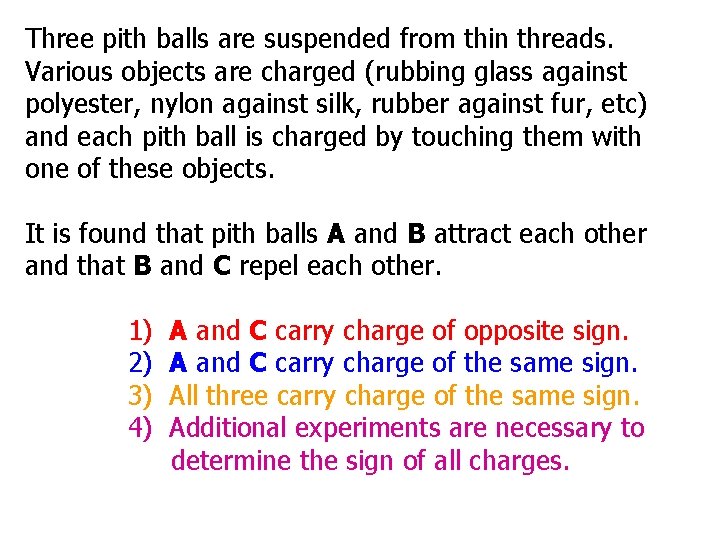
Three pith balls are suspended from thin threads. Various objects are charged (rubbing glass against polyester, nylon against silk, rubber against fur, etc) and each pith ball is charged by touching them with one of these objects. It is found that pith balls A and B attract each other and that B and C repel each other. 1) 2) 3) 4) A and C carry charge of opposite sign. A and C carry charge of the same sign. All three carry charge of the same sign. Additional experiments are necessary to determine the sign of all charges.
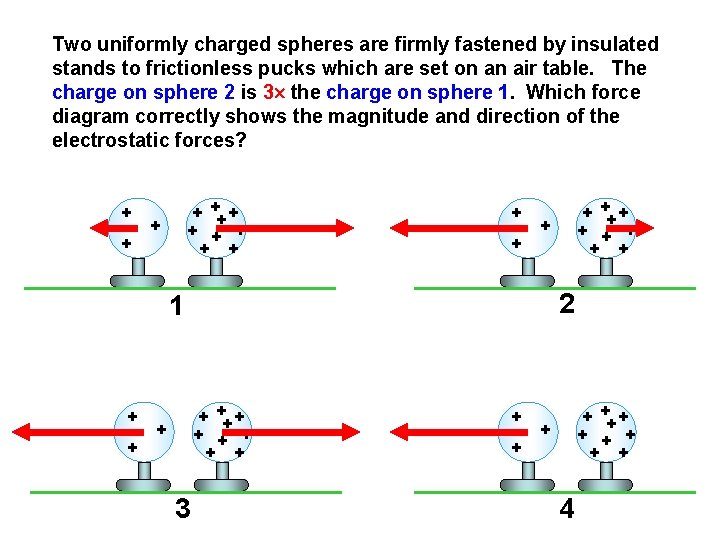
Two uniformly charged spheres are firmly fastened by insulated stands to frictionless pucks which are set on an air table. The charge on sphere 2 is 3 the charge on sphere 1. Which force diagram correctly shows the magnitude and direction of the electrostatic forces? + ++ + + 2 1 + ++ + + + 3 + ++ + + + 4
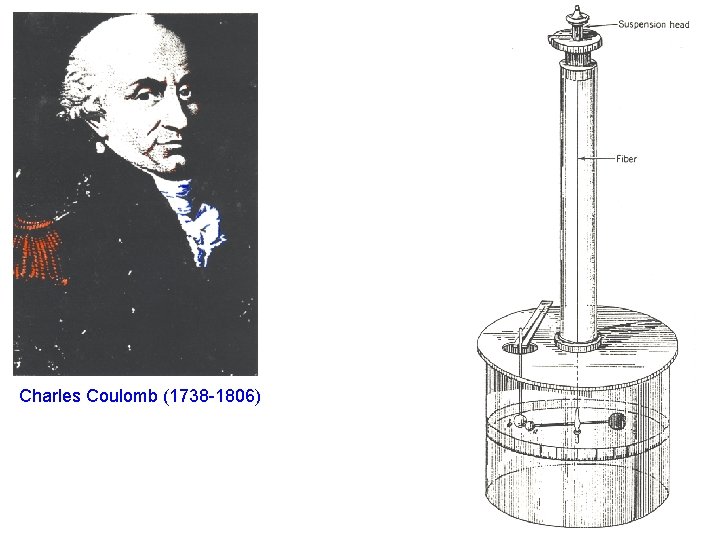
Charles Coulomb (1738 -1806)
What force exists between two concentrations of charge, each 1 coulomb separated center-to-center by 1 meter?
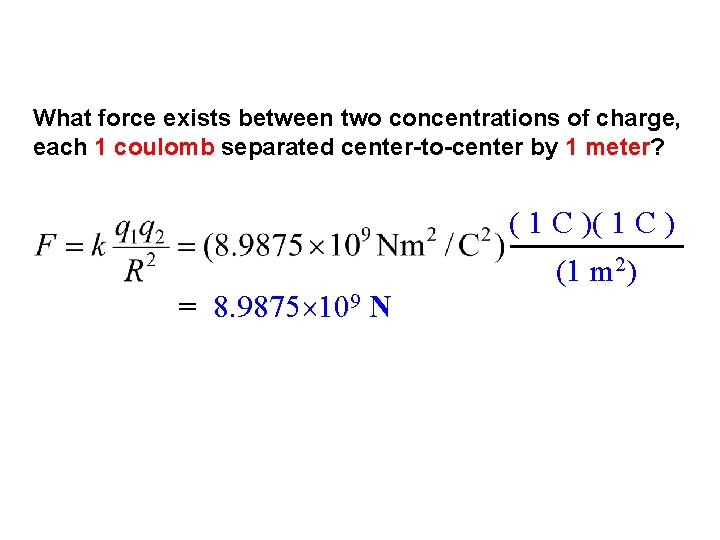
What force exists between two concentrations of charge, each 1 coulomb separated center-to-center by 1 meter? ( 1 C ) (1 m 2) = 8. 9875 109 N
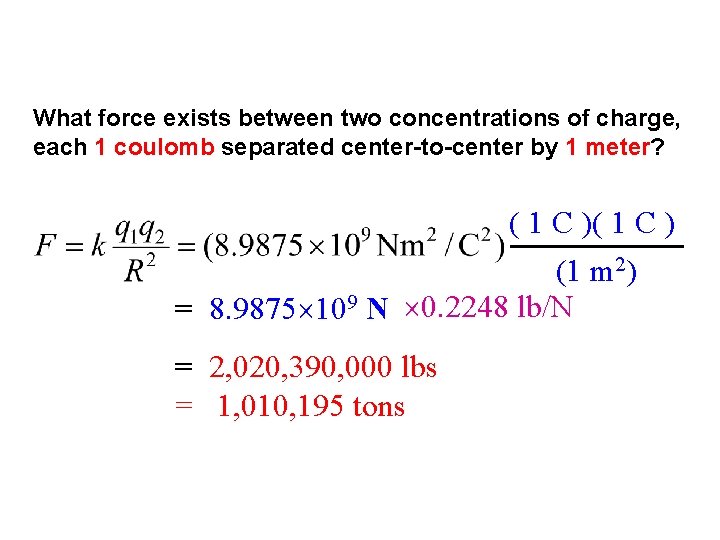
What force exists between two concentrations of charge, each 1 coulomb separated center-to-center by 1 meter? ( 1 C ) (1 m 2) = 8. 9875 109 N 0. 2248 lb/N = 2, 020, 390, 000 lbs = 1, 010, 195 tons
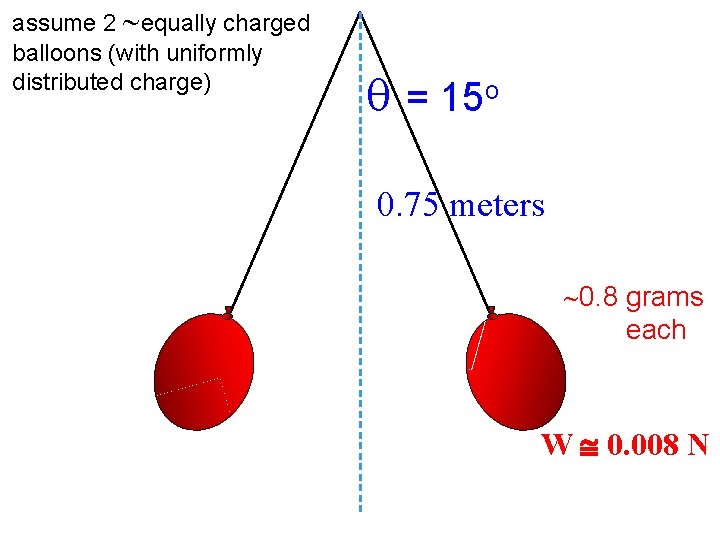
assume 2 equally charged balloons (with uniformly distributed charge) = 15 o 0. 75 meters 0. 8 grams each W 0. 008 N
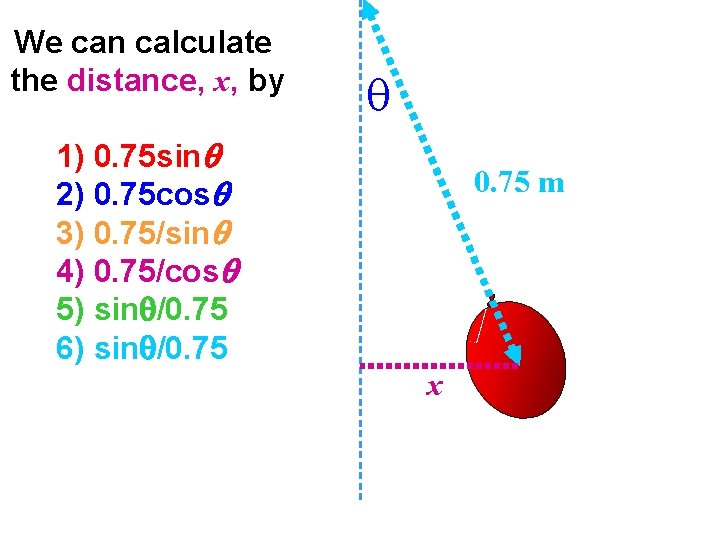
We can calculate the distance, x, by 1) 0. 75 sin 2) 0. 75 cos 3) 0. 75/sin 4) 0. 75/cos 5) sin /0. 75 6) sin /0. 75 m x
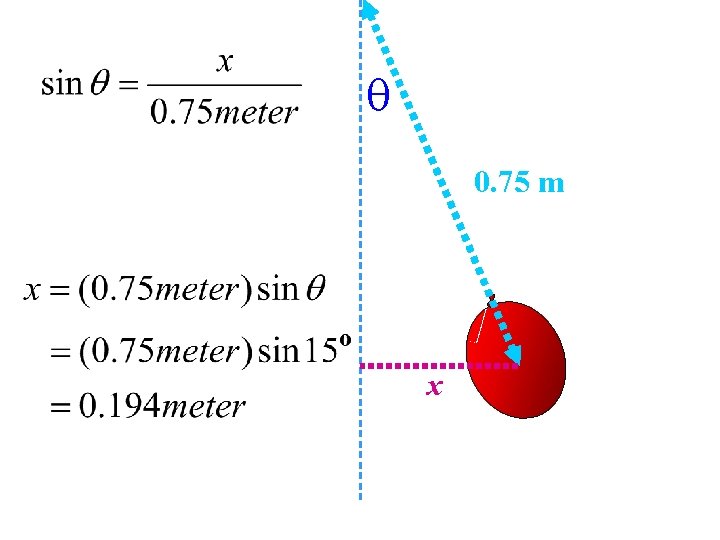
0. 75 m x
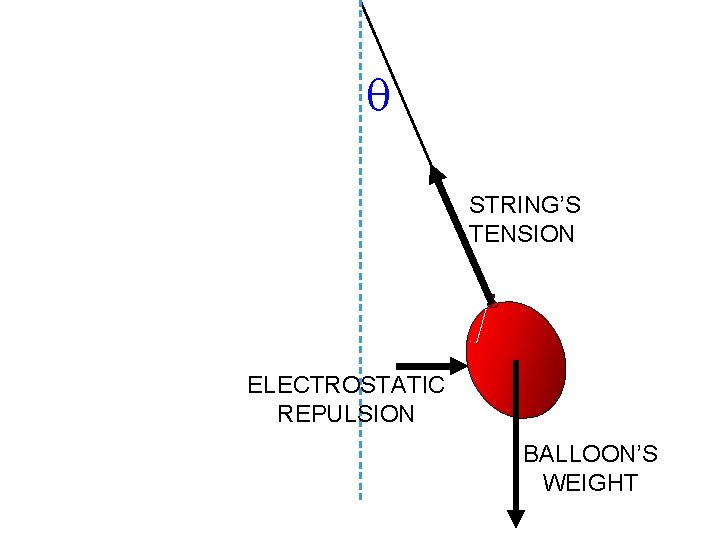
STRING’S TENSION ELECTROSTATIC REPULSION BALLOON’S WEIGHT
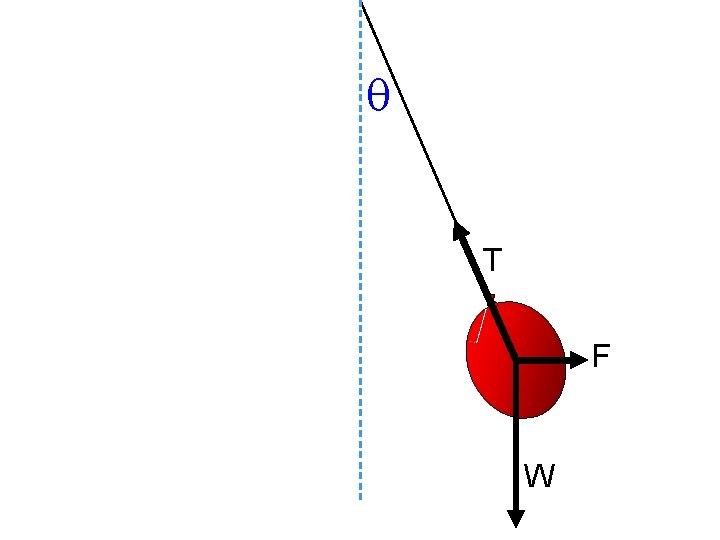
T F W
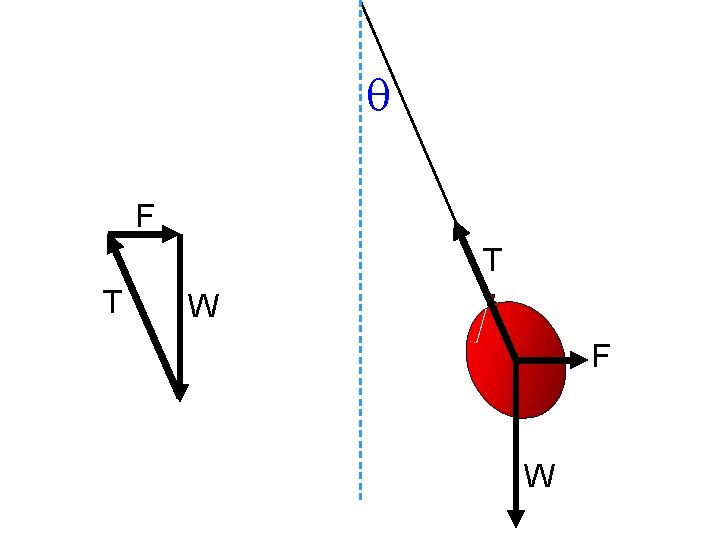
F T T W F W
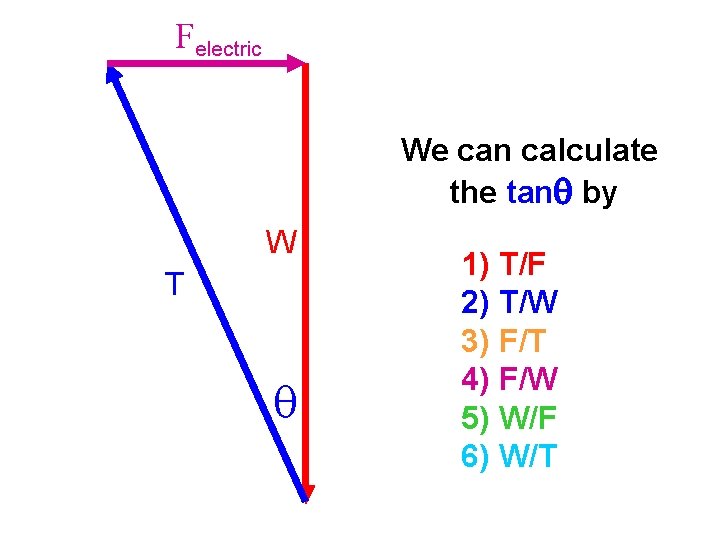
Felectric We can calculate the tan by W T 1) T/F 2) T/W 3) F/T 4) F/W 5) W/F 6) W/T
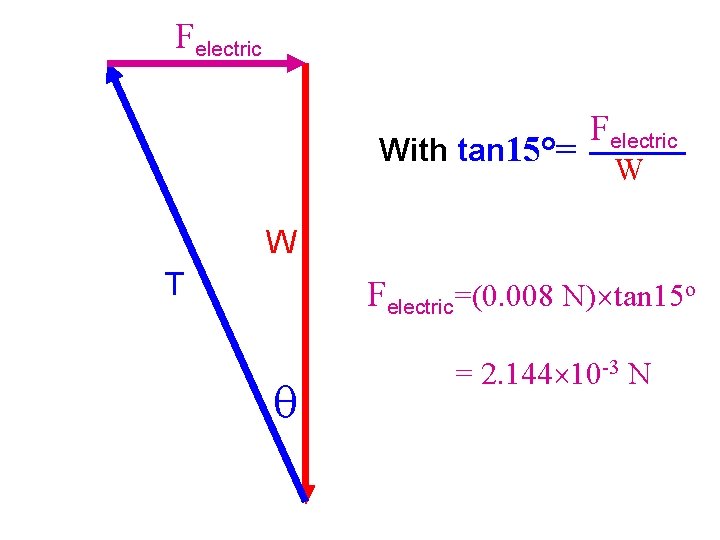
Felectric With tan 15 o= Felectric W W T Felectric=(0. 008 N) tan 15 o = 2. 144 10 -3 N
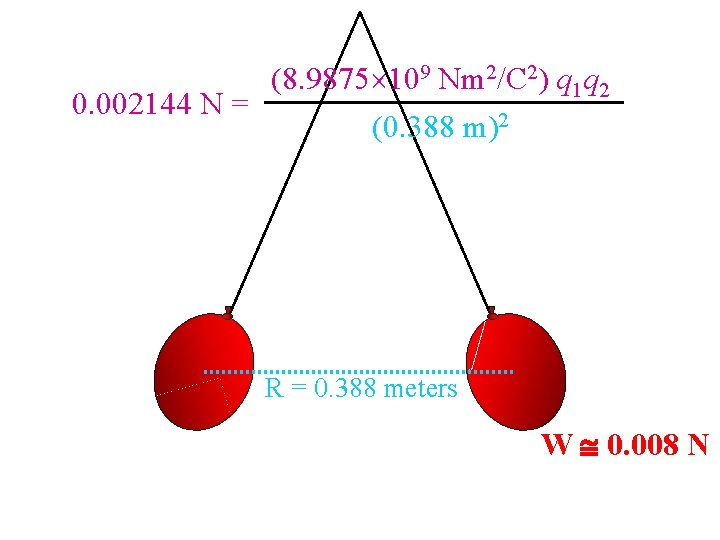
0. 002144 N = (8. 9875 109 Nm 2/C 2) q 1 q 2 (0. 388 m)2 R = 0. 388 meters W 0. 008 N
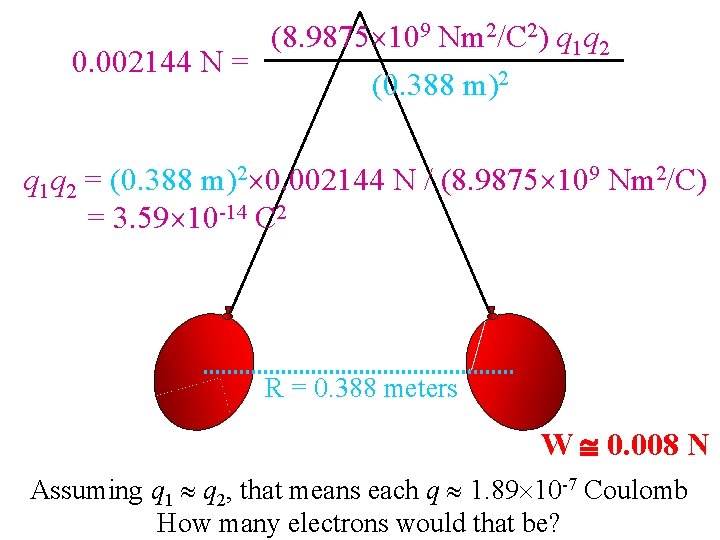
0. 002144 N = (8. 9875 109 Nm 2/C 2) q 1 q 2 (0. 388 m)2 q 1 q 2 = (0. 388 m)2 0. 002144 N / (8. 9875 109 Nm 2/C) = 3. 59 10 -14 C 2 R = 0. 388 meters W 0. 008 N Assuming q 1 q 2, that means each q 1. 89 10 -7 Coulomb How many electrons would that be?
A hydrogen atom is composed of a nucleus containing a single proton, about which a single electron orbits. The electrical force between the two particles is 2. 3 1039 greater than the gravitational force! If we adjust the distance separating the two particles, can we find a separation at which the electrical and gravitational forces are equal? 1) Yes, by moving the particles farther apart. 2) Yes, by moving the particles closer together. 3) No, at any distance.
- Slides: 24