
Content Delivery Networks Ramesh Sitaraman University of Massachusetts







- Slides: 47
Content Delivery Networks Ramesh Sitaraman University of Massachusetts, Amherst
Current Snap Shot of the Internet • World Internet usage: 3 billion users () • 285 million active domains • U. S. household broadband use : 102 million • U. S. Internet retail sales totaled $335 Billion in 2015
Business Drivers and Growth Areas • What is driving business adoption of the Internet? • • • Cost reduction Enhance convenience Broaden reach to a mass market Greater personalization of marketing and services Generate new sources of revenue • Growth areas: • • Online commerce Software downloads (consumer and business) Distributed enterprise applications Voice over IP User-generated content Electronic gaming Media and entertainment
RATIONALE FOR CONTENT DELIVERY NETWORKS (OR, WHAT IS WRONG WITH THE INTERNET)
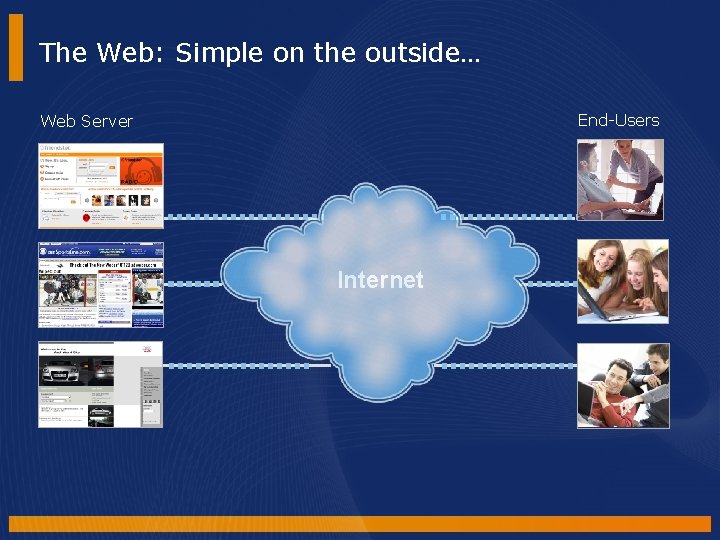
The Web: Simple on the outside… End-Users Web Server Internet
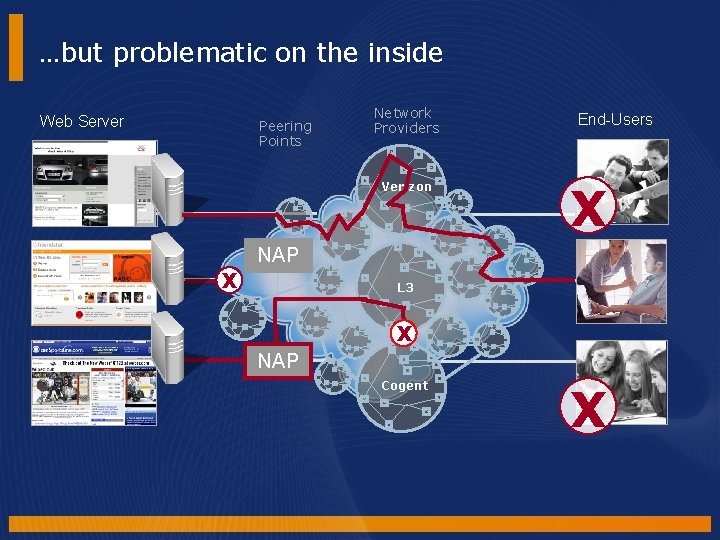
…but problematic on the inside Web Server Peering Points Network Providers Verizon End-Users X NAP X L 3 X NAP Cogent X
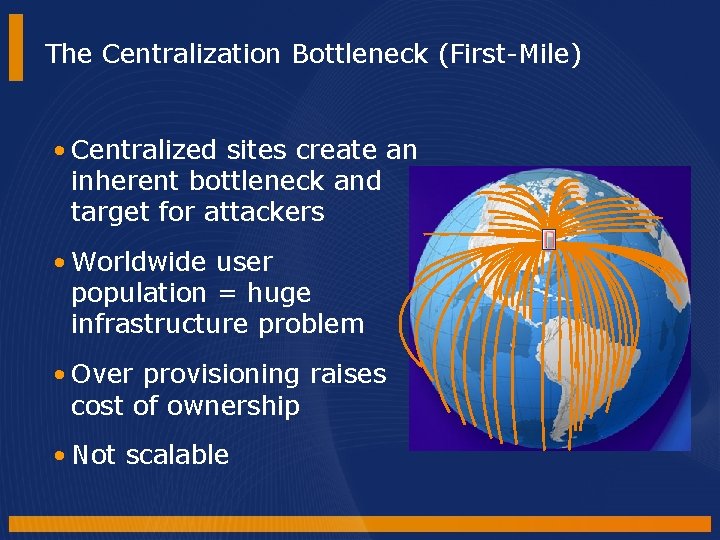
The Centralization Bottleneck (First-Mile) • Centralized sites create an inherent bottleneck and target for attackers • Worldwide user population = huge infrastructure problem • Over provisioning raises cost of ownership • Not scalable
The Problems with Peering (Middle-Mile) • Economic considerations limit peering capacity – results in congestion and poor performance. • Routing algorithms (BGP) ignore congestion! BGP is policy-driven not performance-driven. • Data used to determine routes is subject to intentional inaccuracies and human error. • Routing algorithms are subject to accidental loss of routes, filtering, and intentional theft of routes.
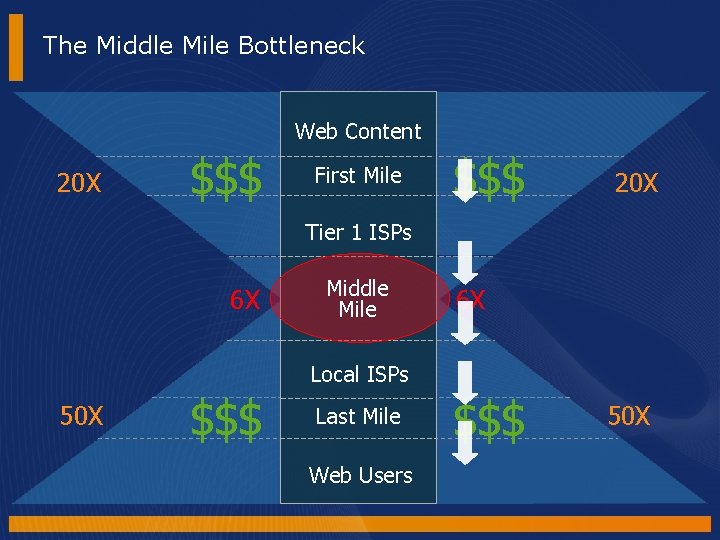
The Middle Mile Bottleneck Web Content 20 X $$$ First Mile $$$ 20 X Tier 1 ISPs 6 X Middle Mile 6 X Local ISPs 50 X $$$ Last Mile Web Users $$$ 50 X
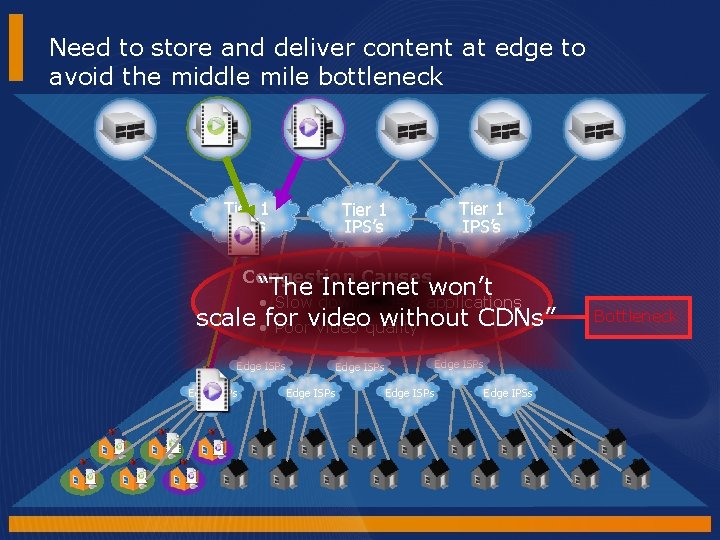
Need to store and deliver content at edge to avoid the middle mile bottleneck Tier 1 IPS’s Congestion Causes “The Internet won’t • Slow downloads & applications scale • for without CDNs” Poorvideo quality Edge ISPs Edge ISPs Edge IPSs Bottleneck
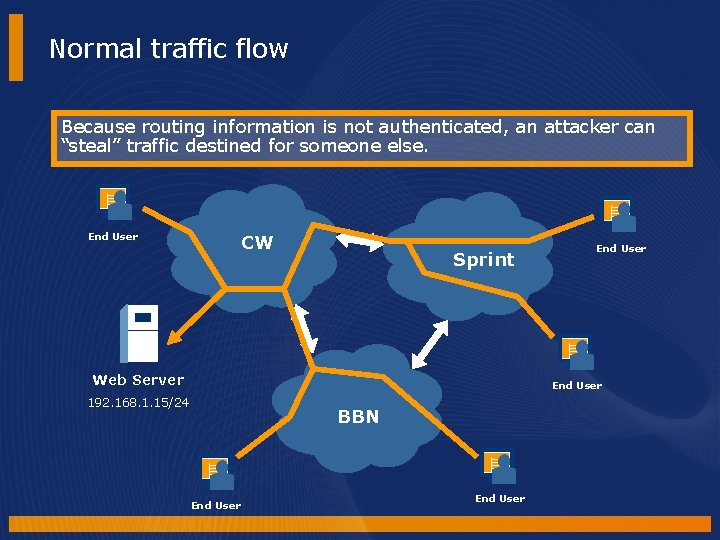
Normal traffic flow Because routing information is not authenticated, an attacker can “steal” traffic destined for someone else. End User CW Sprint Web Server End User 192. 168. 1. 15/24 BBN End User
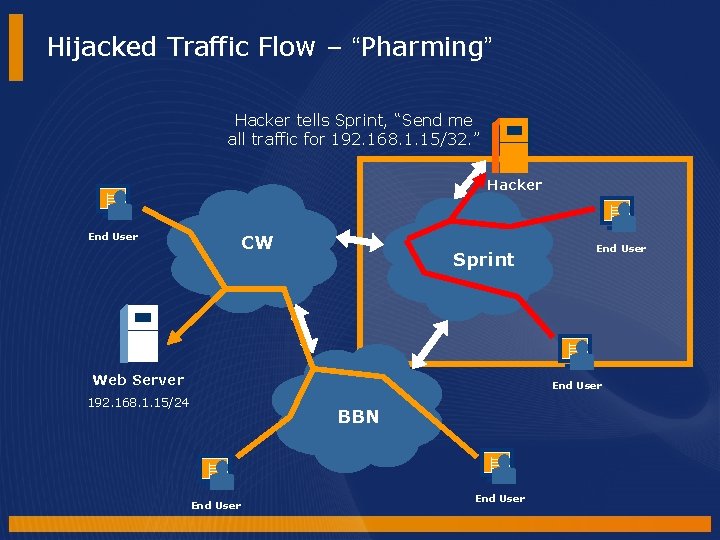
Hijacked Traffic Flow – “Pharming” Hacker tells Sprint, “Send me all traffic for 192. 168. 1. 15/32. ” Hacker End User CW Sprint Web Server End User 192. 168. 1. 15/24 BBN End User
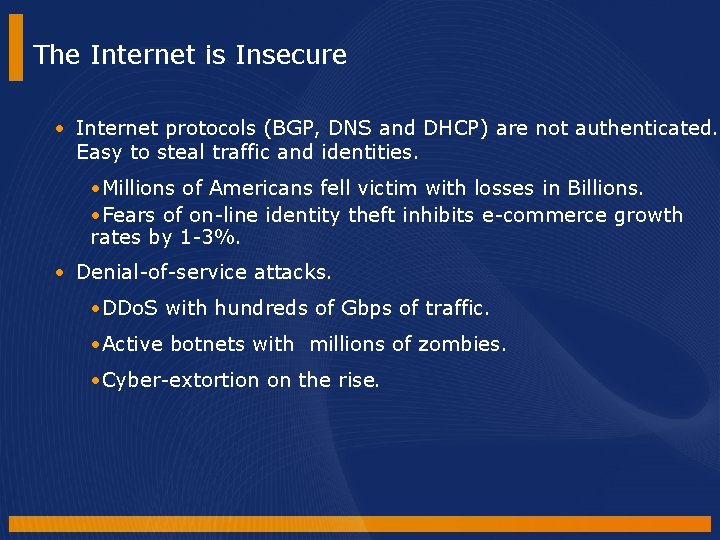
The Internet is Insecure • Internet protocols (BGP, DNS and DHCP) are not authenticated. Easy to steal traffic and identities. • Millions of Americans fell victim with losses in Billions. • Fears of on-line identity theft inhibits e-commerce growth rates by 1 -3%. • Denial-of-service attacks. • DDo. S with hundreds of Gbps of traffic. • Active botnets with millions of zombies. • Cyber-extortion on the rise.
How Did We Get Into this State? The Internet was not designed for the way it is used now! • Internet is a best-effort network with no notion of end-to-end performance guarantees. • Internet protocols and software were designed based on an assumption of trust, which dates back to the days of the ARPANet. This assumption no longer holds.
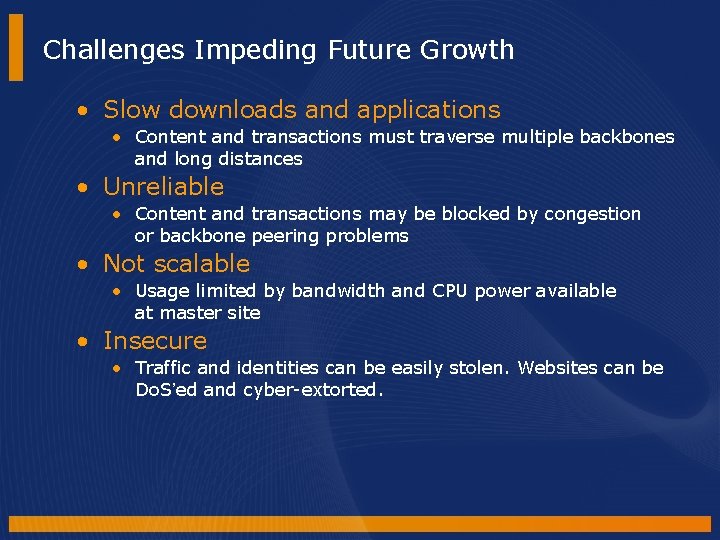
Challenges Impeding Future Growth • Slow downloads and applications • Content and transactions must traverse multiple backbones and long distances • Unreliable • Content and transactions may be blocked by congestion or backbone peering problems • Not scalable • Usage limited by bandwidth and CPU power available at master site • Insecure • Traffic and identities can be easily stolen. Websites can be Do. S’ed and cyber-extorted.
HOW CDNs WORK
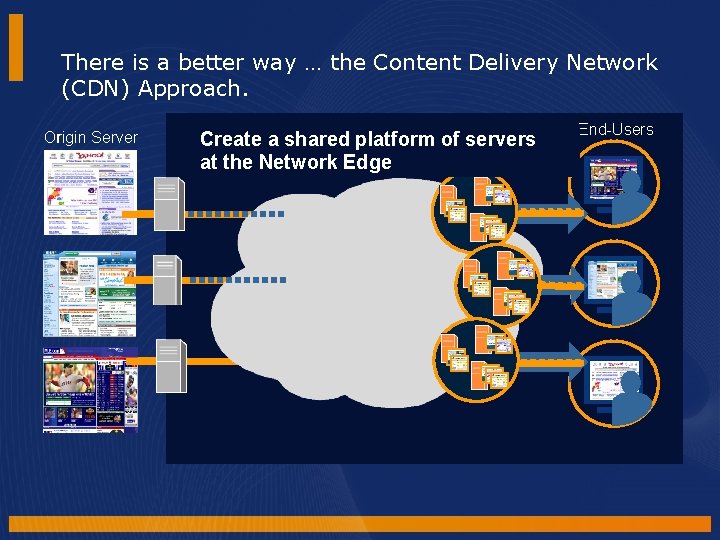
There is a better way … the Content Delivery Network (CDN) Approach. Origin Server Network Providers platform Peering Points Create a shared at the Network Edge of servers End-Users MCI X L 3 X NAP X X NAP AOL
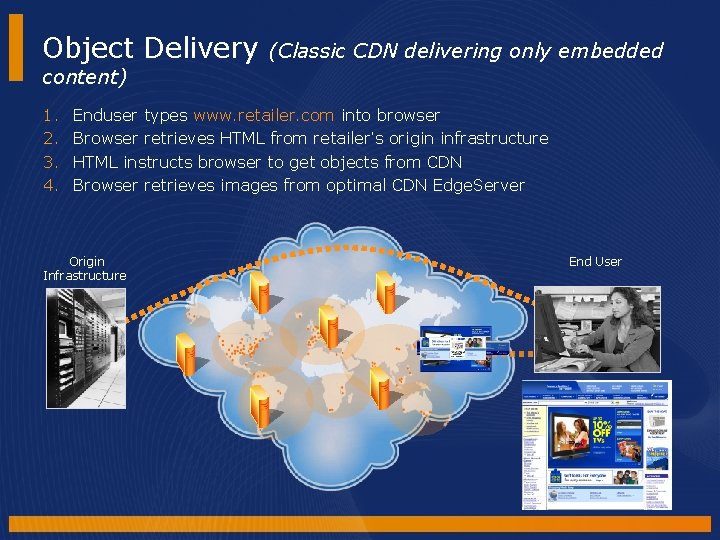
Object Delivery (Classic CDN delivering only embedded content) 1. 2. 3. 4. Enduser types www. retailer. com into browser Browser retrieves HTML from retailer’s origin infrastructure HTML instructs browser to get objects from CDN Browser retrieves images from optimal CDN Edge. Server Origin Infrastructure HTML End User
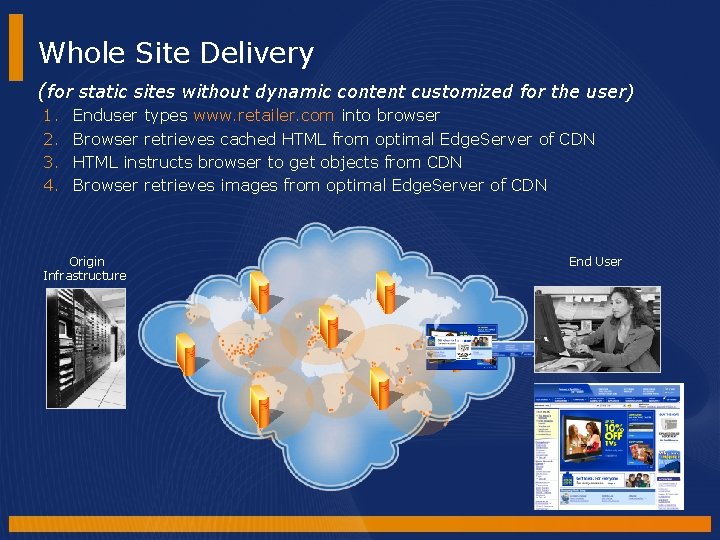
Whole Site Delivery (for static sites without dynamic content customized for the user) 1. 2. 3. 4. Enduser types www. retailer. com into browser Browser retrieves cached HTML from optimal Edge. Server of CDN HTML instructs browser to get objects from CDN Browser retrieves images from optimal Edge. Server of CDN Origin Infrastructure End User HTML
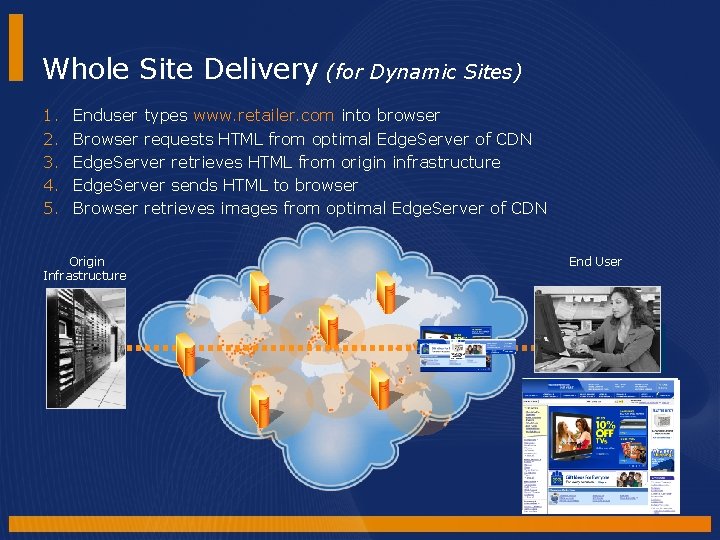
Whole Site Delivery (for Dynamic Sites) 1. 2. 3. 4. 5. Enduser types www. retailer. com into browser Browser requests HTML from optimal Edge. Server of CDN Edge. Server retrieves HTML from origin infrastructure Edge. Server sends HTML to browser Browser retrieves images from optimal Edge. Server of CDN Origin Infrastructure HTML End User HTML
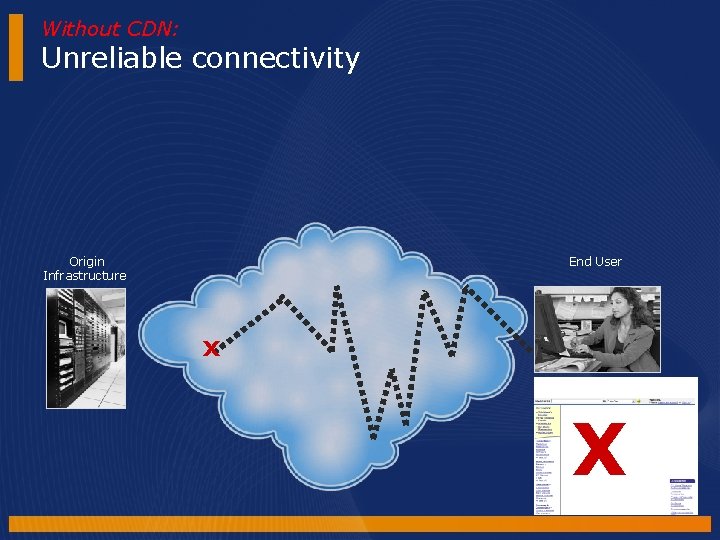
Without CDN: Unreliable connectivity Origin Infrastructure End User x X
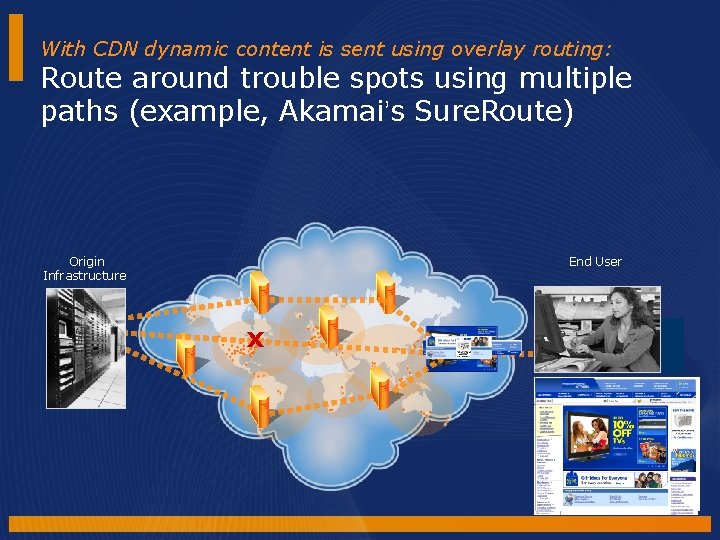
With CDN dynamic content is sent using overlay routing: Route around trouble spots using multiple paths (example, Akamai’s Sure. Route) Origin Infrastructure End User HTML x
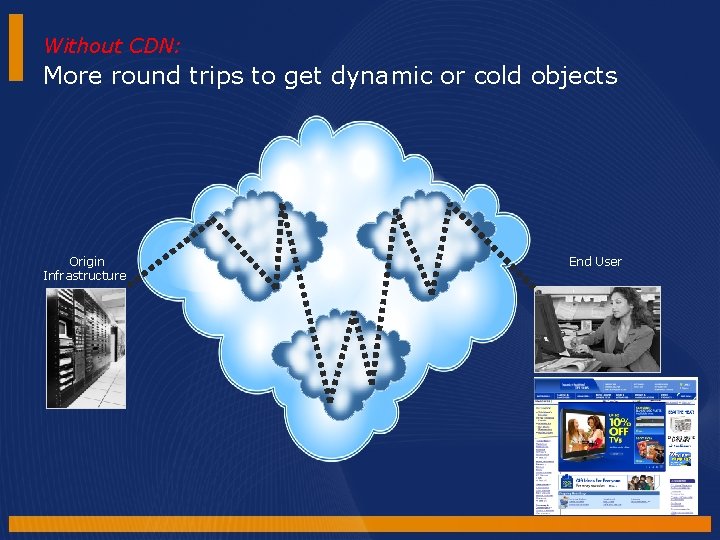
Without CDN: More round trips to get dynamic or cold objects Origin Infrastructure End User
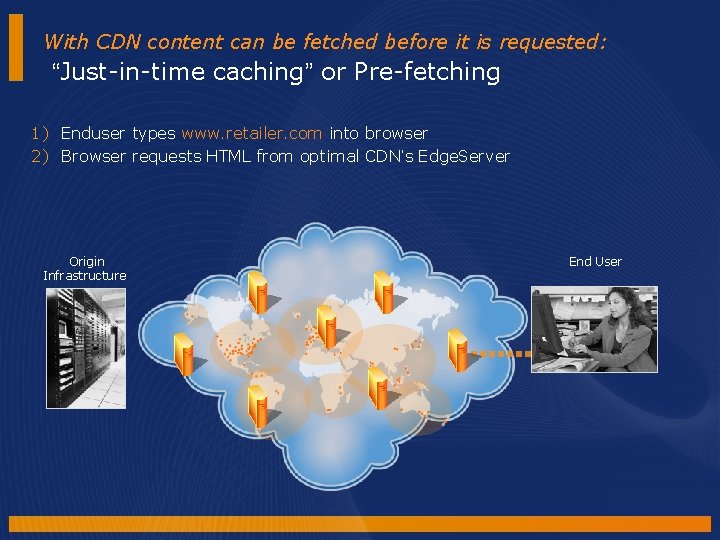
With CDN content can be fetched before it is requested: “Just-in-time caching” or Pre-fetching 1) Enduser types www. retailer. com into browser 2) Browser requests HTML from optimal CDN’s Edge. Server Origin Infrastructure End User
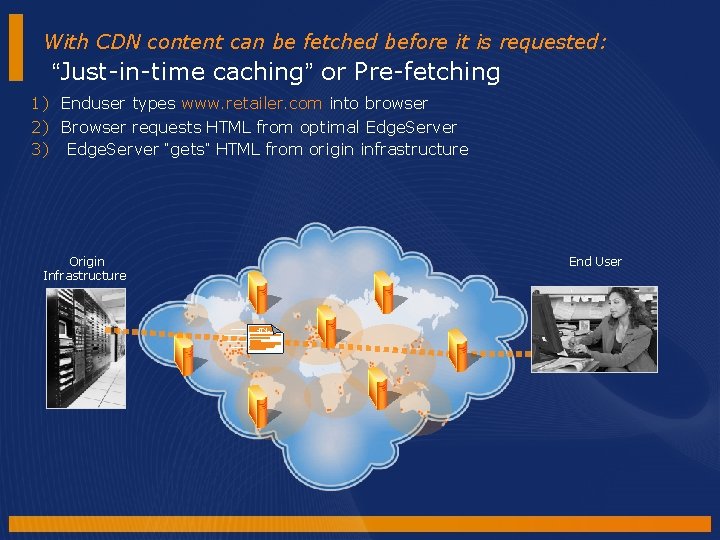
With CDN content can be fetched before it is requested: “Just-in-time caching” or Pre-fetching 1) Enduser types www. retailer. com into browser 2) Browser requests HTML from optimal Edge. Server 3) Edge. Server “gets” HTML from origin infrastructure Origin Infrastructure End User HTML
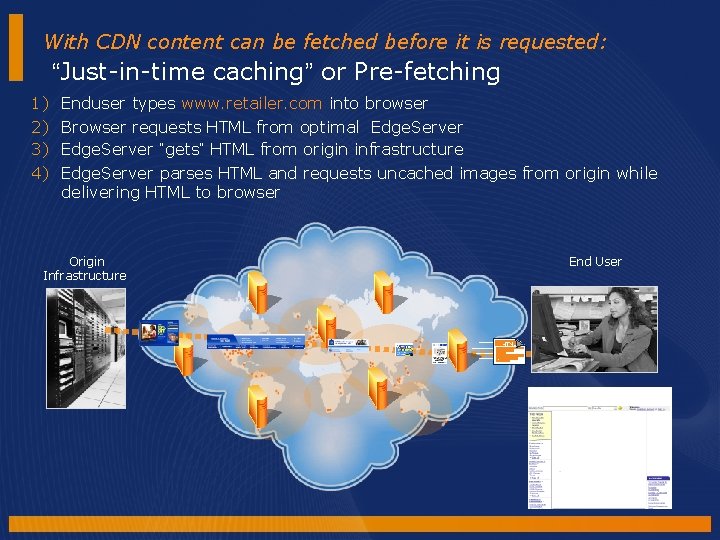
With CDN content can be fetched before it is requested: “Just-in-time caching” or Pre-fetching 1) 2) 3) 4) Enduser types www. retailer. com into browser Browser requests HTML from optimal Edge. Server “gets” HTML from origin infrastructure Edge. Server parses HTML and requests uncached images from origin while delivering HTML to browser Origin Infrastructure End User HTML
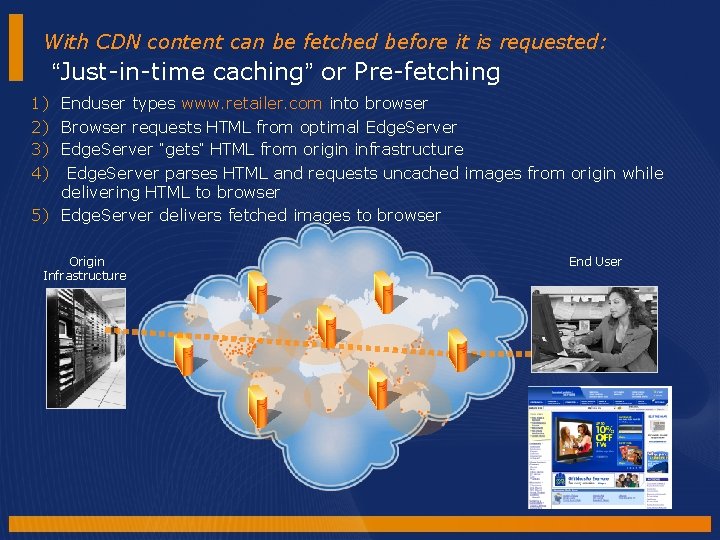
With CDN content can be fetched before it is requested: “Just-in-time caching” or Pre-fetching 1) Enduser types www. retailer. com into browser 2) Browser requests HTML from optimal Edge. Server 3) Edge. Server “gets” HTML from origin infrastructure 4) Edge. Server parses HTML and requests uncached images from origin while delivering HTML to browser 5) Edge. Server delivers fetched images to browser Origin Infrastructure End User
Improving performance further: Constructing dynamic HTML at the edge through Edge. Side Includes (ESI) All of the retailer’s pages are cacheable for a short period of time. Except for one small piece of data, unique for each end user, and for each hit. <% if Application(“use. ESI") = true then %> <esi: include src="/includes/i_top. asp<%=ESI_querystring()%>" no-store="on" /> <% Else %> <!--#include virtual="/includes/i_top. asp"--> <% End If %>
Improving Performance Further: Moving Business logic to the edge (Edge Computing) Other types of Edge Applications: • Configure Product • Register for Entry • Giveaway Contest • Search Site • Locate Dealer/Store • Calculate Financing • Sweepstakes • Complete Survey Contest • User Prioritization • Manage Shopping Cart • Wait for Purchase • Play Game • Plan a trip • Voting Form • Generate a map • Request information • Process Form End User Origin Infrastructure
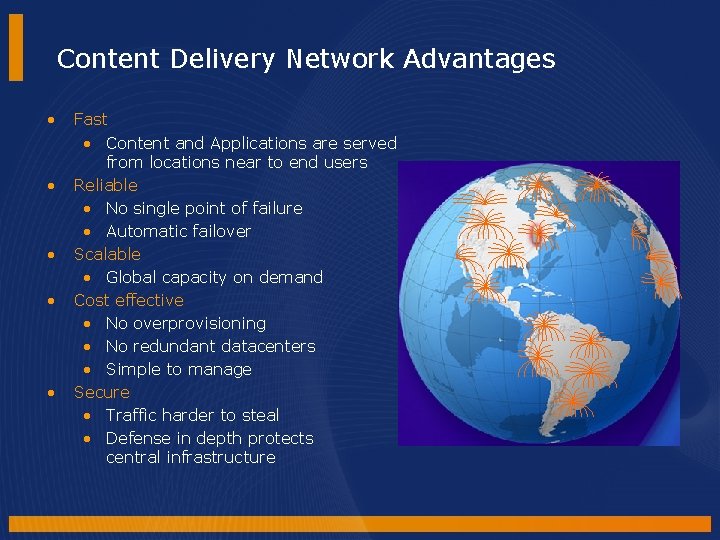
Content Delivery Network Advantages • • • Fast • Content and Applications are served from locations near to end users Reliable • No single point of failure • Automatic failover Scalable • Global capacity on demand Cost effective • No overprovisioning • No redundant datacenters • Simple to manage Secure • Traffic harder to steal • Defense in depth protects central infrastructure
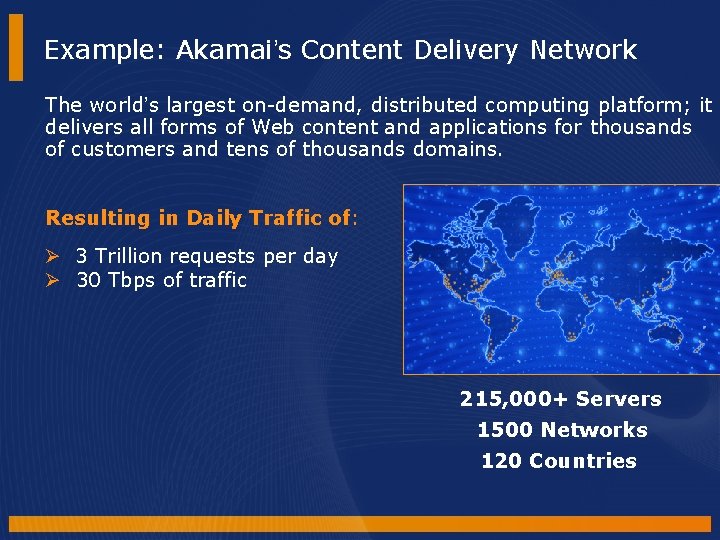
Example: Akamai’s Content Delivery Network The world’s largest on-demand, distributed computing platform; it delivers all forms of Web content and applications for thousands of customers and tens of thousands domains. Resulting in Daily Traffic of: Ø 3 Trillion requests per day Ø 30 Tbps of traffic 215, 000+ Servers 1500 Networks 120 Countries
CDN SYSTEM ARCHITECTURE
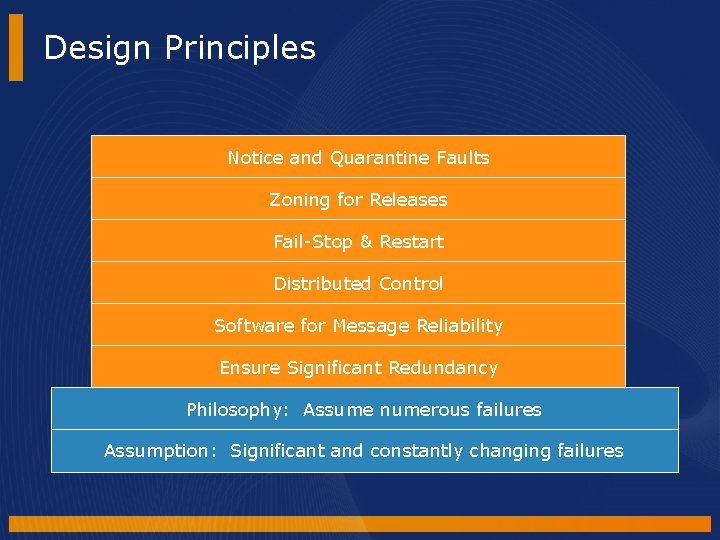
Design Principles Notice and Quarantine Faults Zoning for Releases Fail-Stop & Restart Distributed Control Software for Message Reliability Ensure Significant Redundancy Philosophy: Assume numerous failures Assumption: Significant and constantly changing failures
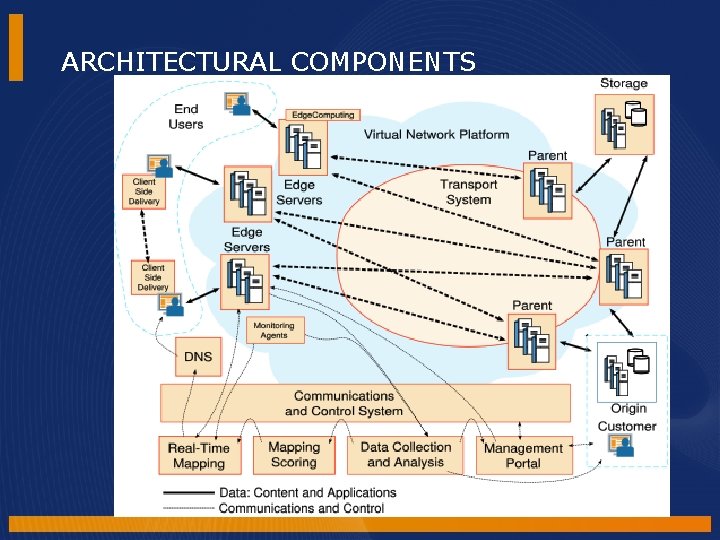
ARCHITECTURAL COMPONENTS
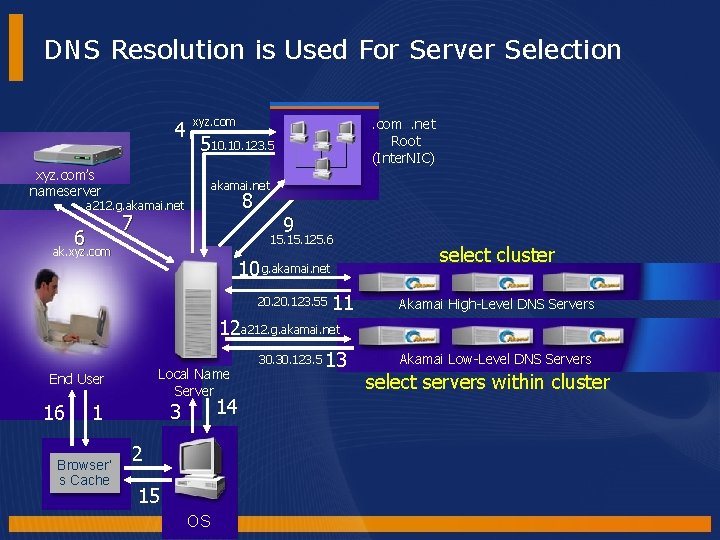
DNS Resolution is Used For Server Selection 4 xyz. com 510. 123. 5 xyz. com’s nameserver akamai. net 8 a 212. g. akamai. net 7 6 . com. net Root (Inter. NIC) 9 15. 125. 6 ak. xyz. com 10 g. akamai. net 20. 123. 55 11 select cluster Akamai High-Level DNS Servers 12 a 212. g. akamai. net Local Name Server End User 16 Browser’ s Cache 14 3 1 2 15 OS 30. 123. 5 13 Akamai Low-Level DNS Servers select servers within cluster
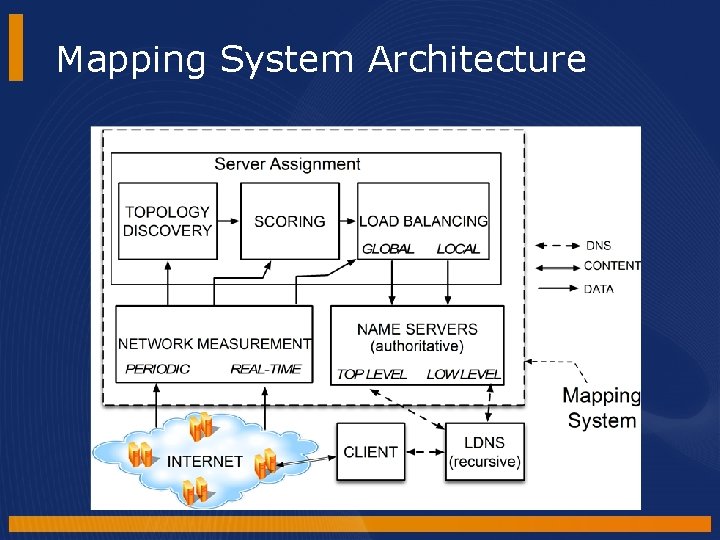
Mapping System Architecture
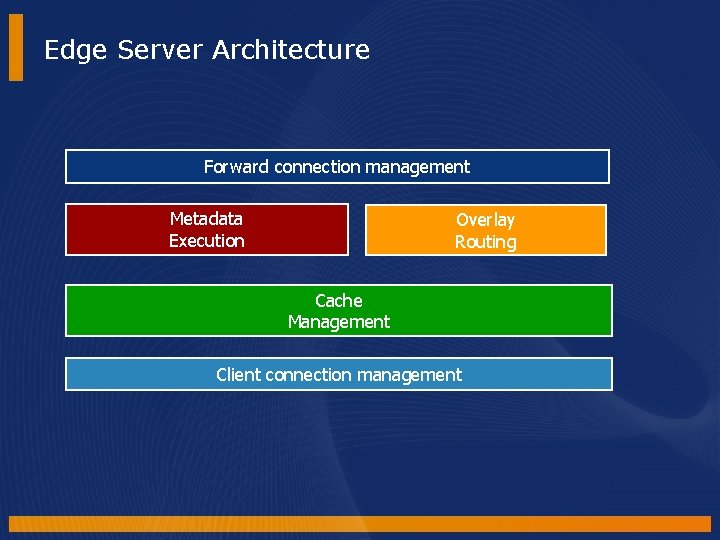
Edge Server Architecture Forward connection management Metadata Execution Overlay Routing Cache Management Client connection management
CDN CHALLENGES
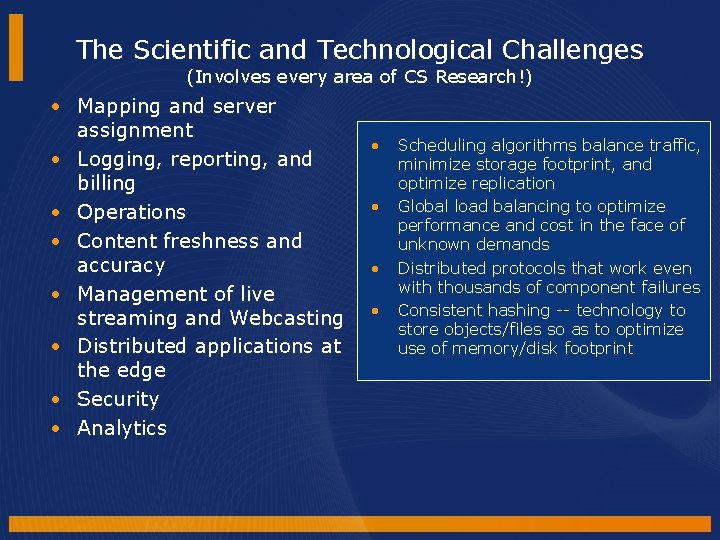
The Scientific and Technological Challenges (Involves every area of CS Research!) • Mapping and server assignment • Logging, reporting, and billing • Operations • Content freshness and accuracy • Management of live streaming and Webcasting • Distributed applications at the edge • Security • Analytics • • Scheduling algorithms balance traffic, minimize storage footprint, and optimize replication Global load balancing to optimize performance and cost in the face of unknown demands Distributed protocols that work even with thousands of component failures Consistent hashing -- technology to store objects/files so as to optimize use of memory/disk footprint
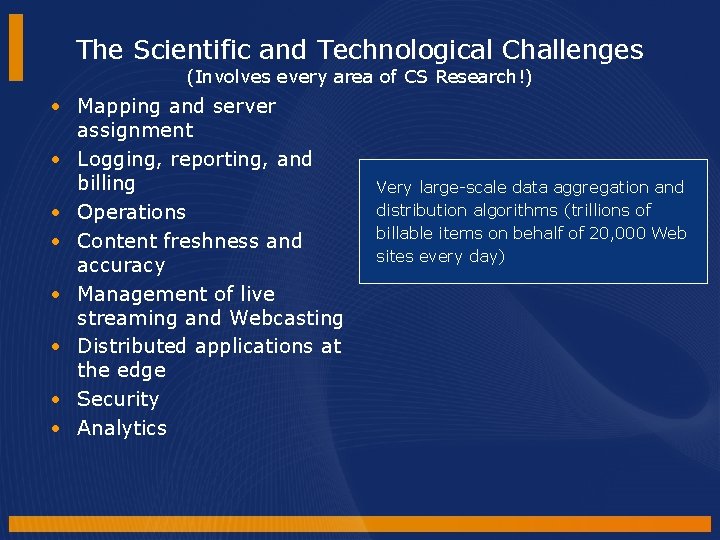
The Scientific and Technological Challenges (Involves every area of CS Research!) • Mapping and server assignment • Logging, reporting, and billing • Operations • Content freshness and accuracy • Management of live streaming and Webcasting • Distributed applications at the edge • Security • Analytics Very large-scale data aggregation and distribution algorithms (trillions of billable items on behalf of 20, 000 Web sites every day)
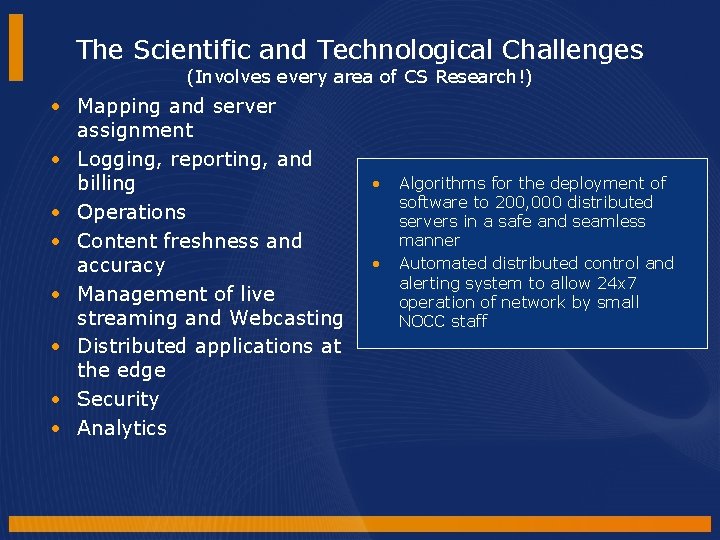
The Scientific and Technological Challenges (Involves every area of CS Research!) • Mapping and server assignment • Logging, reporting, and billing • Operations • Content freshness and accuracy • Management of live streaming and Webcasting • Distributed applications at the edge • Security • Analytics • • Algorithms for the deployment of software to 200, 000 distributed servers in a safe and seamless manner Automated distributed control and alerting system to allow 24 x 7 operation of network by small NOCC staff
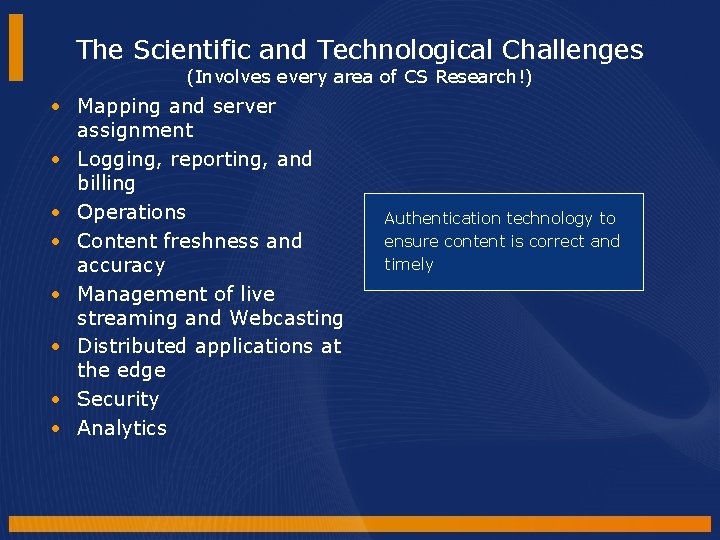
The Scientific and Technological Challenges (Involves every area of CS Research!) • Mapping and server assignment • Logging, reporting, and billing • Operations • Content freshness and accuracy • Management of live streaming and Webcasting • Distributed applications at the edge • Security • Analytics Authentication technology to ensure content is correct and timely
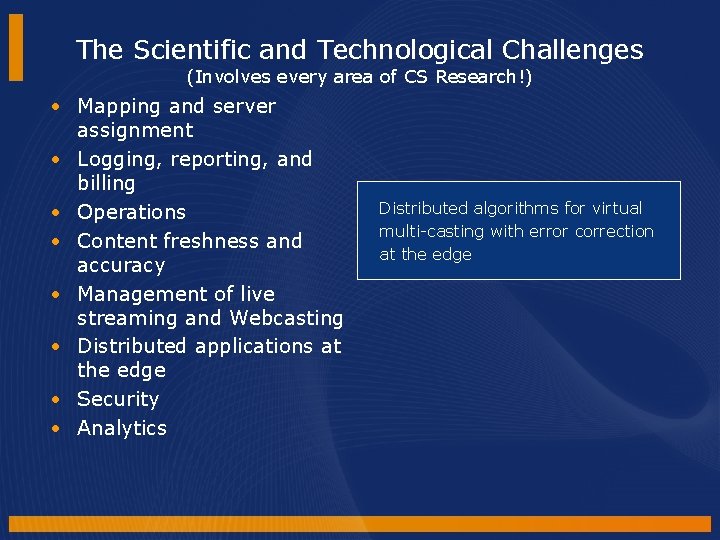
The Scientific and Technological Challenges (Involves every area of CS Research!) • Mapping and server assignment • Logging, reporting, and billing • Operations • Content freshness and accuracy • Management of live streaming and Webcasting • Distributed applications at the edge • Security • Analytics Distributed algorithms for virtual multi-casting with error correction at the edge
The Scientific and Technological Challenges (Involves every area of CS Research!) • Mapping and server assignment • Logging, reporting, and billing • Operations • Content freshness and accuracy • Management of live streaming and Webcasting • Distributed applications at the edge • Security • Analytics Proactive creation of virtual application servers close to end users so as to optimize performance, balance load, and minimize cost
The Scientific and Technological Challenges (Involves every area of CS Research!) • Mapping and server assignment • Logging, reporting, and billing • Operations • Content freshness and accuracy • Management of live streaming and Webcasting • Distributed applications at the edge • Security • Analytics • • True end-to-end authentication and encryption technologies to safeguard sensitive data Digital rights management to monetize assets
The Scientific and Technological Challenges (Involves every area of CS Research!) • Mapping and server assignment • Logging, reporting, and billing • Operations • Content freshness and accuracy • Management of live streaming and Webcasting • Distributed applications at the edge • Security • Analytics • • Measure, analyze, visualize and present business and performance metrics Sophisticated agents, cutting-edge large-scale data mining and analysis, complex visualizations, etc
Questions?