
Content Area Reading Literacy and Learning Across the
- Slides: 16
Content Area Reading Literacy and Learning Across the Curriculum By Richard T. Vacca, Jo Anne L. Vacca, and Maryann Mraz Power. Point™Presentation By Maryann Mraz and Jean Vintinner Copyright © Allyn & Bacon 2011 This multimedia product and its content are protected under copyright law. The following are prohibited by law: Any public performance or display, including transmission of any image over a network; Preparation of any derivative work, including the extraction, in whole or in part, of any images; Any rental, lease, or lending of the program.
Literacy Matters Chapter 1 Copyright © Allyn & Bacon 2011
Frame of Mind n Explain the difference between content and process n n n n knowledge. What are new literacies and how are they changing the way we think about learning and literacy in the 21 st century? What is adolescent literacy and why is it important to 21 st century society? Why do many adolescents have difficulty comprehending academic texts? How are content literacy and disciplinary literacy alike? How are they different? Why is reading to learn a meaning-making, strategic process? What comprehension strategies are critical to reading to learn? What role does prior knowledge play in comprehension? Copyright © Allyn & Bacon 2011
Key Terms n Content literacy n Decoding n Disciplinary literacy n Fluency n Adolescent literacy n Comprehension n New literacies n Vocabulary n Reading to learn n Direct, explicit instruction n Content versus process n Strategic reading n Standards n Prior knowledge n Reading Next n Prediction n Striving Readers Program n Inference n Response to Intervention n Text structure Copyright © Allyn & Bacon 2011
Content and Process Impact on student learning attributed to: n Teachers who achieve major/minor in subject n Students engaged in hands-on activities n Students engaged in higher order thinking n Teachers with professional development in working with special populations Copyright © Allyn & Bacon 2011
Balancing Content and Pedagogical Knowledge n Know the standards for your content area and grade level. n Make instructional decisions based on authentic assessments throughout the school year. n Integrate content literacy practices and strategies into instructional plans and units of study. Copyright © Allyn & Bacon 2011
Defining literacy n “…the term literacy has morphed to characterize someone’s level of knowledge or competence in a particular area or subject in a multimodal society. ” (p. 7) n “Literacy has come to represent a synthesis of language, thinking, and contextual practices through which people make and construct meaning. ” (p. 7) Copyright © Allyn & Bacon 2011
Defining text n “Texts include not only print forms of communication but also nonprint forms that are digital, aural, or visual in nature. ” (p. 7) Copyright © Allyn & Bacon 2011
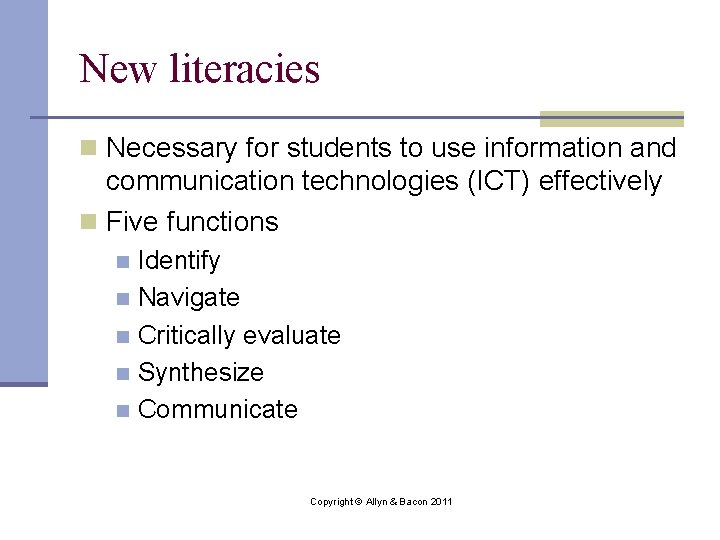
New literacies n Necessary for students to use information and communication technologies (ICT) effectively n Five functions Identify n Navigate n Critically evaluate n Synthesize n Communicate n Copyright © Allyn & Bacon 2011
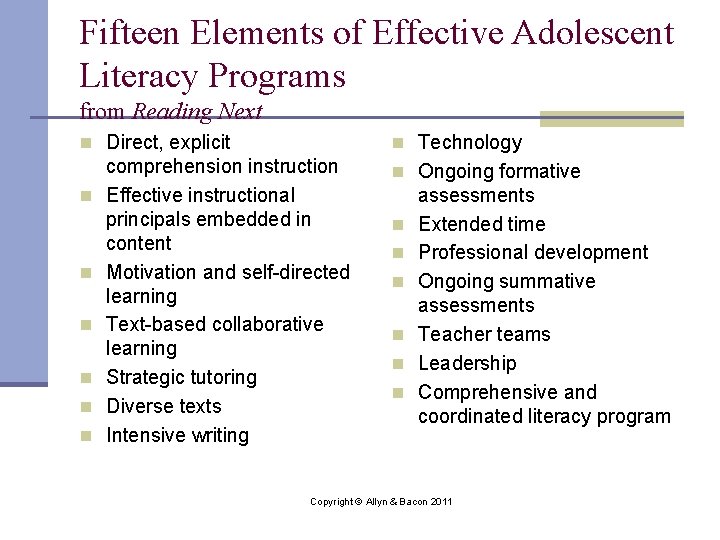
Fifteen Elements of Effective Adolescent Literacy Programs from Reading Next n Direct, explicit n n n n Technology comprehension instruction Effective instructional principals embedded in content Motivation and self-directed learning Text-based collaborative learning Strategic tutoring Diverse texts Intensive writing n Ongoing formative n n n assessments Extended time Professional development Ongoing summative assessments Teacher teams Leadership Comprehensive and coordinated literacy program Copyright © Allyn & Bacon 2011
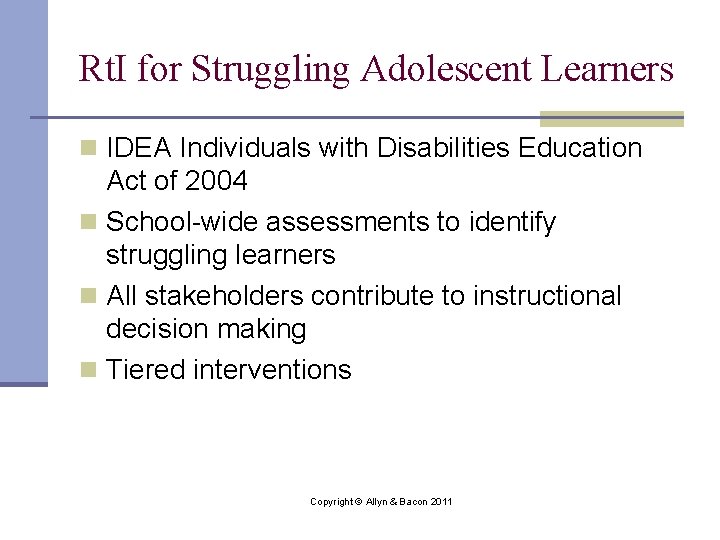
Rt. I for Struggling Adolescent Learners n IDEA Individuals with Disabilities Education Act of 2004 n School-wide assessments to identify struggling learners n All stakeholders contribute to instructional decision making n Tiered interventions Copyright © Allyn & Bacon 2011
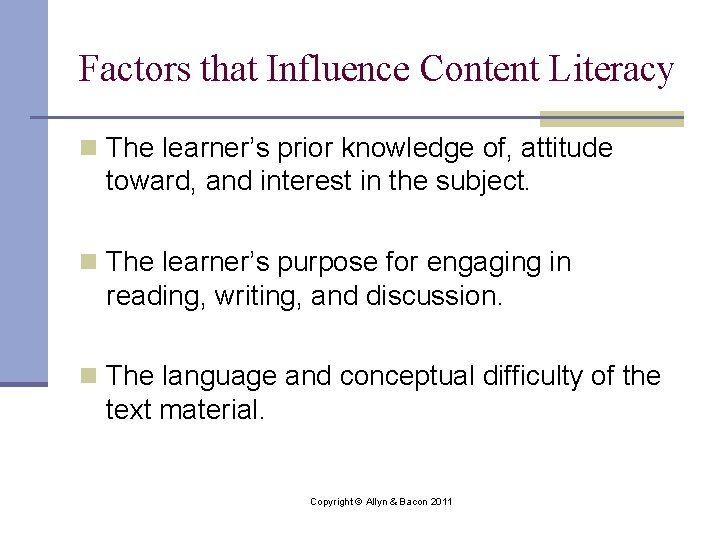
Factors that Influence Content Literacy n The learner’s prior knowledge of, attitude toward, and interest in the subject. n The learner’s purpose for engaging in reading, writing, and discussion. n The language and conceptual difficulty of the text material. Copyright © Allyn & Bacon 2011
Factors that Influence Content Literacy n The assumptions that the text writers make about their audience of readers. n The text structures that writers use to organize ideas and information. n The teacher’s beliefs about and attitude toward the use of texts in learning situations. Copyright © Allyn & Bacon 2011
To comprehend text successfully, readers must n decode or pronounce words quickly and accurately. n read with fluency. n activate vocabulary knowledge. n use text comprehension strategies. Copyright © Allyn & Bacon 2011
Good readers are n active n purposeful n evaluative n thoughtful n strategic n persistent n productive Copyright © Allyn & Bacon 2011
Schema activation n Mechanism by which people access what they know and match it to information in the text Framework to seek and select information relevant to purpose for reading n Organization of information to promote retention n Allows reader to elaborate information n Copyright © Allyn & Bacon 2011