
Content and Language Integrated Learning Ingrida Leimanis 2012
- Slides: 23
Content and Language Integrated Learning Ingrida Leimanis 2012 -05 -15
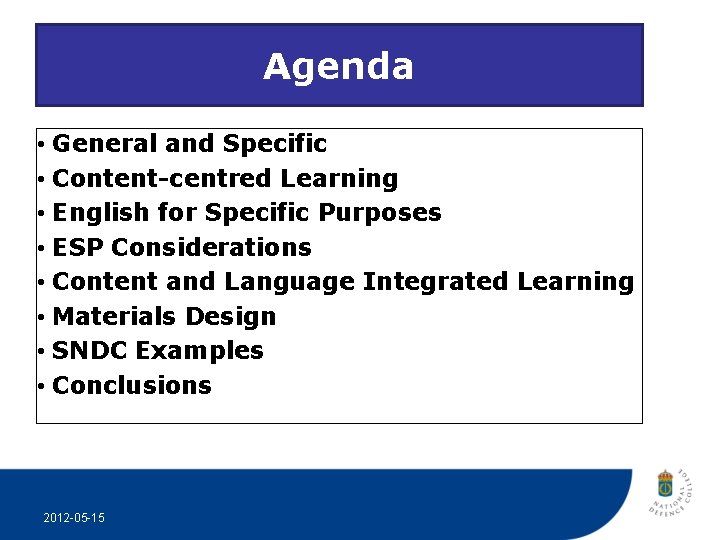
Agenda • General and Specific • Content-centred Learning • English for Specific Purposes • ESP Considerations • Content and Language Integrated Learning • Materials Design • SNDC Examples • Conclusions 2012 -05 -15
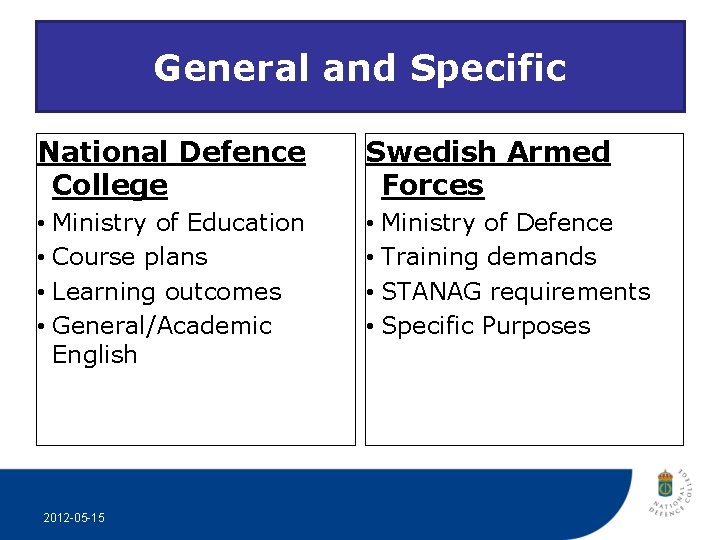
General and Specific National Defence College Swedish Armed Forces • Ministry of Education • Course plans • Learning outcomes • General/Academic English • Ministry of Defence • Training demands • STANAG requirements • Specific Purposes 2012 -05 -15
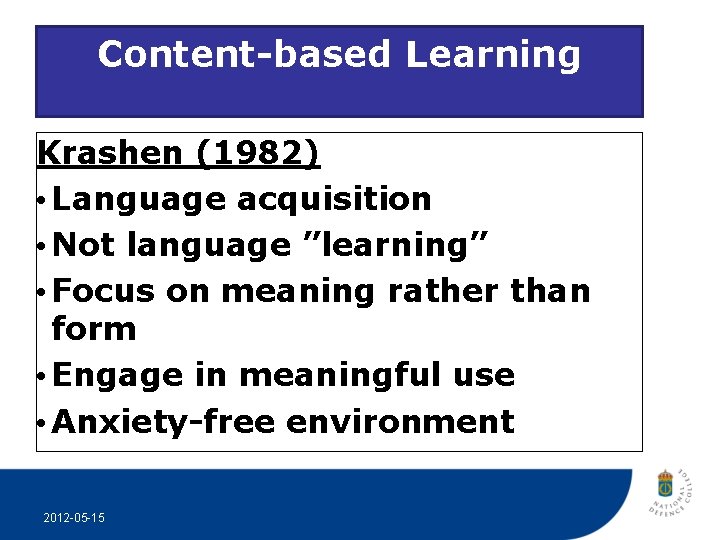
Content-based Learning Krashen (1982) • Language acquisition • Not language ”learning” • Focus on meaning rather than form • Engage in meaningful use • Anxiety-free environment 2012 -05 -15
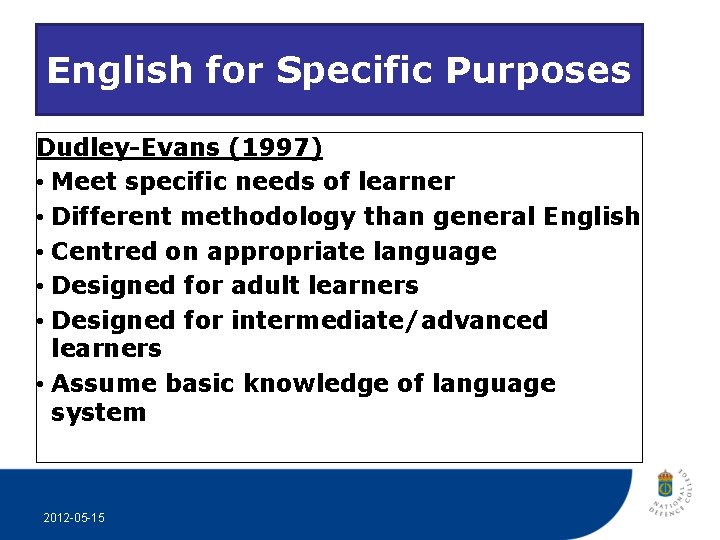
English for Specific Purposes Dudley-Evans (1997) • Meet specific needs of learner • Different methodology than general English • Centred on appropriate language • Designed for adult learners • Designed for intermediate/advanced learners • Assume basic knowledge of language system 2012 -05 -15
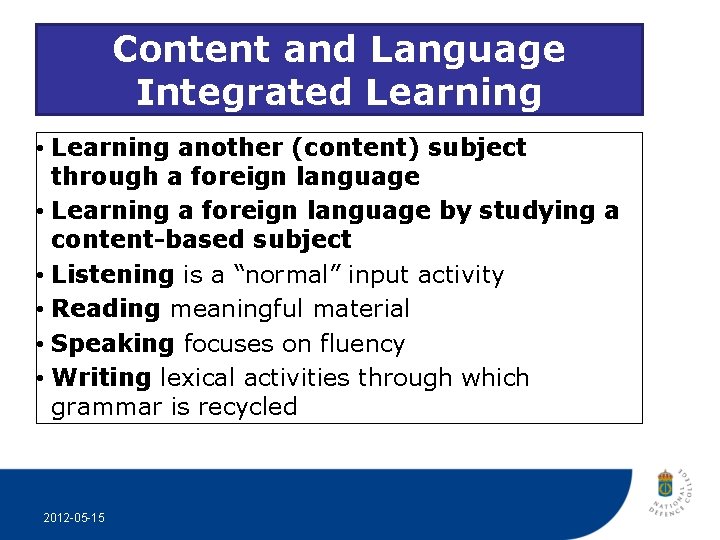
Content and Language Integrated Learning • Learning another (content) subject through a foreign language • Learning a foreign language by studying a content-based subject • Listening is a “normal” input activity • Reading meaningful material • Speaking focuses on fluency • Writing lexical activities through which grammar is recycled 2012 -05 -15
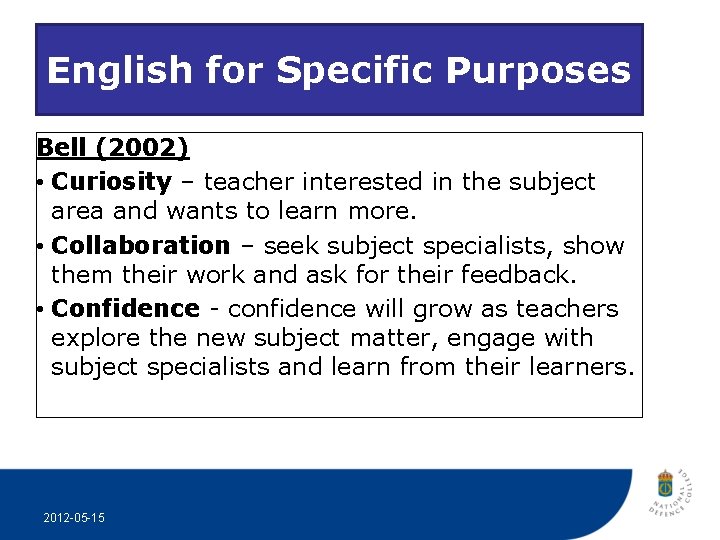
English for Specific Purposes Bell (2002) • Curiosity – teacher interested in the subject area and wants to learn more. • Collaboration – seek subject specialists, show them their work and ask for their feedback. • Confidence - confidence will grow as teachers explore the new subject matter, engage with subject specialists and learn from their learners. 2012 -05 -15
General Characteristics • Learning “subject” content through language • Language is integrated into curriculum • Based on language acquisition • Language used in real-life situations • Fluency is more important than accuracy • Reading is the essential skill. • Increased motivation and natural language in context 2012 -05 -15
Materials - Considerations • College curriculum and subject • Clear language development/outcomes • Balance of specific and general • Learning strategies • Purpose-related orientation • Communication in military settings • Copyright issues using authentic sources • Teacher’s personal confidence and competence 2012 -05 -15
Teacher Produced Materials Advantages • Replaces a course book • For a specific group of students • Takes particular needs and learning environment into account • Teacher decides principle or focus for the material and activities • In response to main subject teachers’ curriculum • Relevant, high-interest topics 2012 -05 -15
Teacher Produced Materials Disadvantages • Can lack coherence and clear language progression • Materials can be fragmentary, lacking clear direction • Poorly constructed, with errors, lacking clarity • Tendency to produce same type of format • Poor instructions • Storage of teacher-produced material 2012 -05 -15
Example – 1 Practical ground appreciation activity Instructions: Each cadet will examine the ground of the Berga coastline from the tactical standpoint of either attack, or defence. The key vocabulary revolves around features (identifiable parts of the ground); topography (the shape of the land); cover (what protection is offered); and going (how easy/hard it is to travel over this ground). 2012 -05 -15
Example – 1 Attack cadet: Look left middle ground, prominent radio mast. Other cadet: Seen (or “not seen”) Attack cadet: From radio mast, go 200 metres right, small copse. Other cadet: Seen (or “not seen”) Attack cadet: That copse is on the edge of a low hill, giving me a reverse slope site for my indirect fire mortars. The leading edge of the copse on the forward slope of the hill gives my Forward Observation Officer good fields of view to direct fire onto likely defensive positions. 2012 -05 -15
Example – 1 I would site a 50 cal heavy machine gun group in the left hand edge of that copse to cover my approach over the open ground. The weapon is accurate to over 2 km, and it is an effective bunker-buster / light vehicle killer. Since there is no cover between the copse and the castle, it could also engage the castle effectively, although does not have line of sight to the castle steps here below us which are in dead ground. 2012 -05 -15
Example – 2 2012 -05 -15
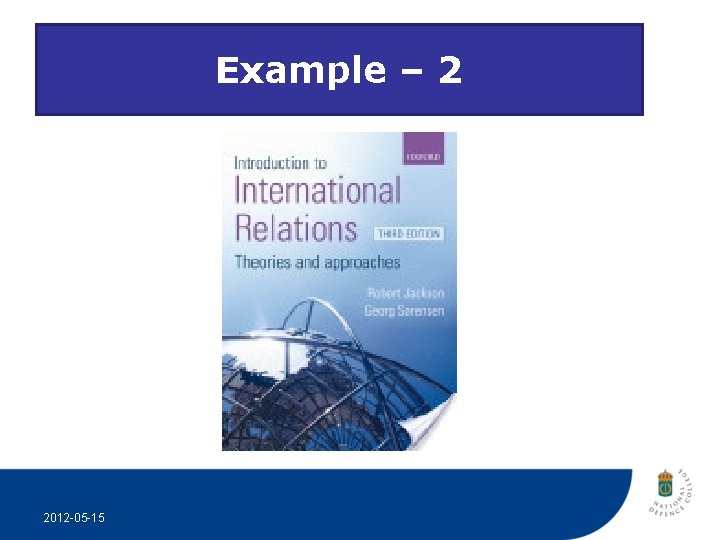
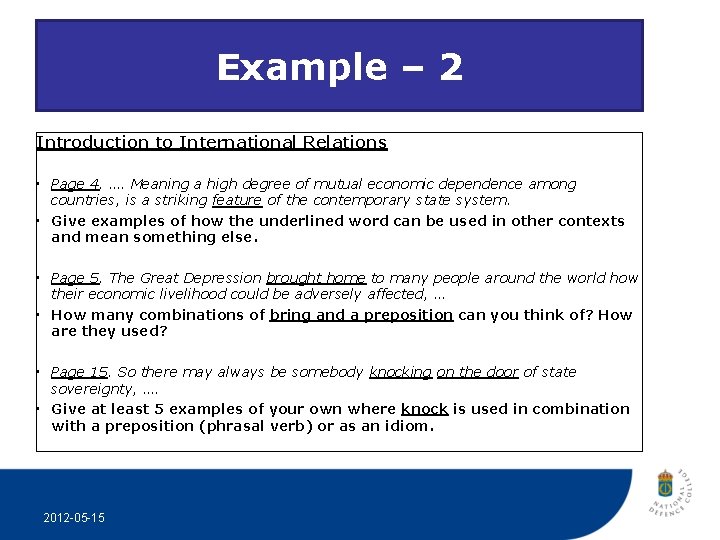
Example – 2 Introduction to International Relations • Page 4. …. Meaning a high degree of mutual economic dependence among countries, is a striking feature of the contemporary state system. • Give examples of how the underlined word can be used in other contexts and mean something else. • Page 5. The Great Depression brought home to many people around the world how their economic livelihood could be adversely affected, … • How many combinations of bring and a preposition can you think of? How are they used? • Page 15. So there may always be somebody knocking on the door of state sovereignty, …. • Give at least 5 examples of your own where knock is used in combination with a preposition (phrasal verb) or as an idiom. 2012 -05 -15
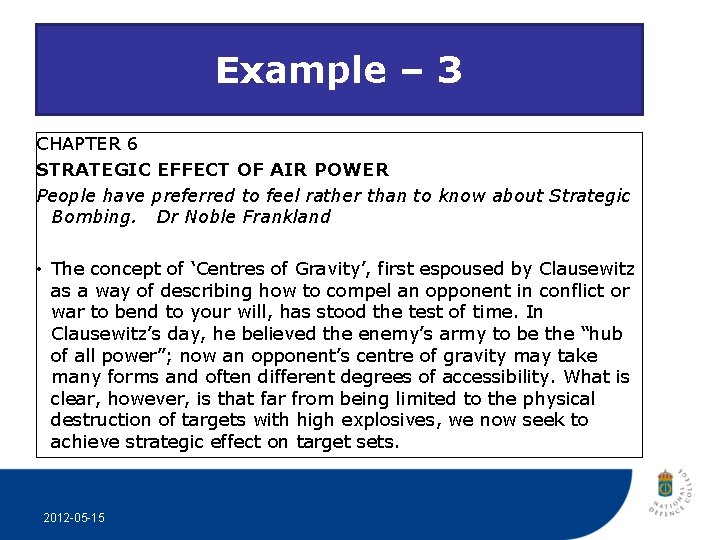
Example – 3 CHAPTER 6 STRATEGIC EFFECT OF AIR POWER People have preferred to feel rather than to know about Strategic Bombing. Dr Noble Frankland • The concept of ‘Centres of Gravity’, first espoused by Clausewitz as a way of describing how to compel an opponent in conflict or war to bend to your will, has stood the test of time. In Clausewitz’s day, he believed the enemy’s army to be the “hub of all power”; now an opponent’s centre of gravity may take many forms and often different degrees of accessibility. What is clear, however, is that far from being limited to the physical destruction of targets with high explosives, we now seek to achieve strategic effect on target sets. 2012 -05 -15
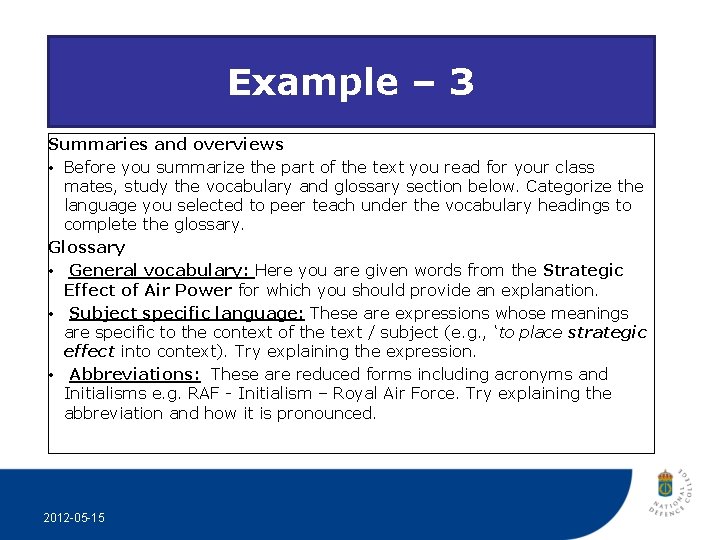
Example – 3 Summaries and overviews • Before you summarize the part of the text you read for your class mates, study the vocabulary and glossary section below. Categorize the language you selected to peer teach under the vocabulary headings to complete the glossary. Glossary • General vocabulary: Here you are given words from the Strategic Effect of Air Power for which you should provide an explanation. • Subject specific language: These are expressions whose meanings are specific to the context of the text / subject (e. g. , ‘to place strategic effect into context). Try explaining the expression. • Abbreviations: These are reduced forms including acronyms and Initialisms e. g. RAF - Initialism – Royal Air Force. Try explaining the abbreviation and how it is pronounced. 2012 -05 -15
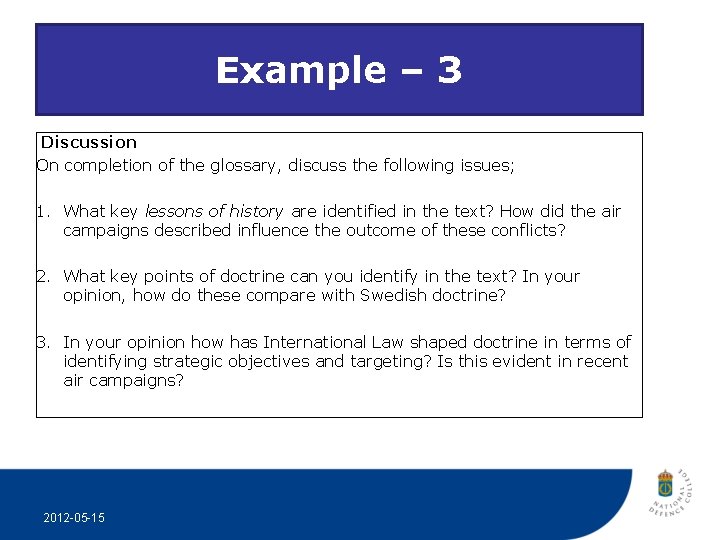
Example – 3 Discussion On completion of the glossary, discuss the following issues; 1. What key lessons of history are identified in the text? How did the air campaigns described influence the outcome of these conflicts? 2. What key points of doctrine can you identify in the text? In your opinion, how do these compare with Swedish doctrine? 3. In your opinion how has International Law shaped doctrine in terms of identifying strategic objectives and targeting? Is this evident in recent air campaigns? 2012 -05 -15
Example – 4 UNDERSTANDING CENTERS OF GRAVITY AND CRITICAL VULNERABILITIES Ambiguity, artificial restrictions and contradictions regarding centers of gravity still exist, despite recent progress. In the past few years the Joint Community has come a long way regarding concepts and definitions of centers of gravity (CGs) and critical vulnerabilities (CVs). Centers of Gravity are now clearly equated to strength, and critical vulnerabilities equated to weakness. It is acknowledged that multiple CGs may exist at a given level of war; that they may change from phase to phase within a campaign; and that they can change unexpectedly when an enemy shifts ''the weight of its attack, thus uncovering or relying on a previously unforeseen center of gravity. " 2012 -05 -15
Benefits – According to EU Commission • builds intercultural knowledge, understanding • improves language competence • develops multilingual interests and attitudes • allows for study of content through different perspectives • more contact with target language • does not require extra teaching hours • complements other subjects • diversifies methods and classroom practice • increases learners' motivation and confidence 2012 -05 -15
Content and Language Integrated Learning Conclusions • Teacher has domain-specific knowledge • Needs analysis should include observations of the language used in context • Students should possess general English proficiency at an appropriate level • Materials should be appropriate and where possible, authentic 2012 -05 -15