
Content Analysis of Text Automated Transformation of raw
- Slides: 17
Content Analysis of Text • Automated Transformation of raw text into a form that represent some aspect(s) of its meaning • Including, but not limited to: – – – Token creation Matrices and Vectorization Phrase Detection Categorization Clustering Summarization
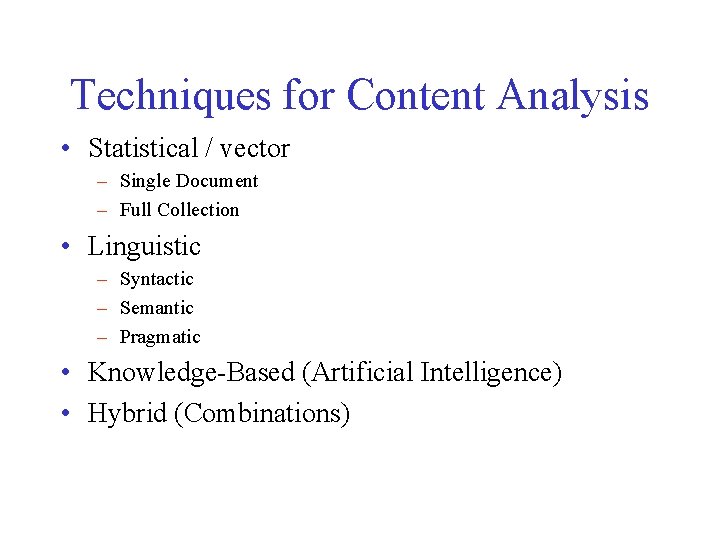
Techniques for Content Analysis • Statistical / vector – Single Document – Full Collection • Linguistic – Syntactic – Semantic – Pragmatic • Knowledge-Based (Artificial Intelligence) • Hybrid (Combinations)
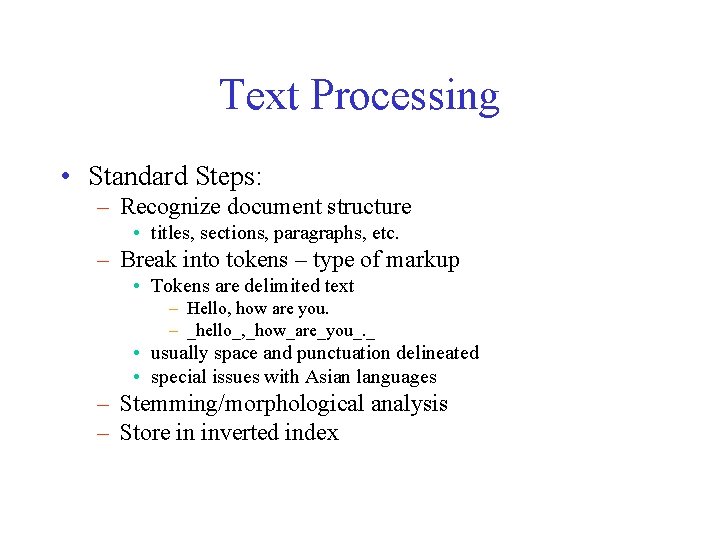
Text Processing • Standard Steps: – Recognize document structure • titles, sections, paragraphs, etc. – Break into tokens – type of markup • Tokens are delimited text – Hello, how are you. – _hello_, _how_are_you_. _ • usually space and punctuation delineated • special issues with Asian languages – Stemming/morphological analysis – Store in inverted index
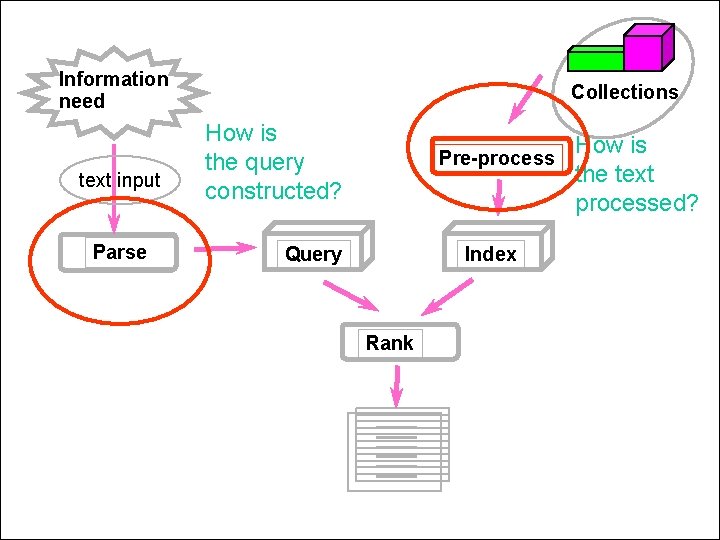
Information need text input Parse Collections How is the query constructed? Pre-process Query Index Rank How is the text processed?
Statistical Properties of Text • Token occurrences in text are not uniformly distributed • They are also not normally distributed • They do exhibit a Zipf distribution
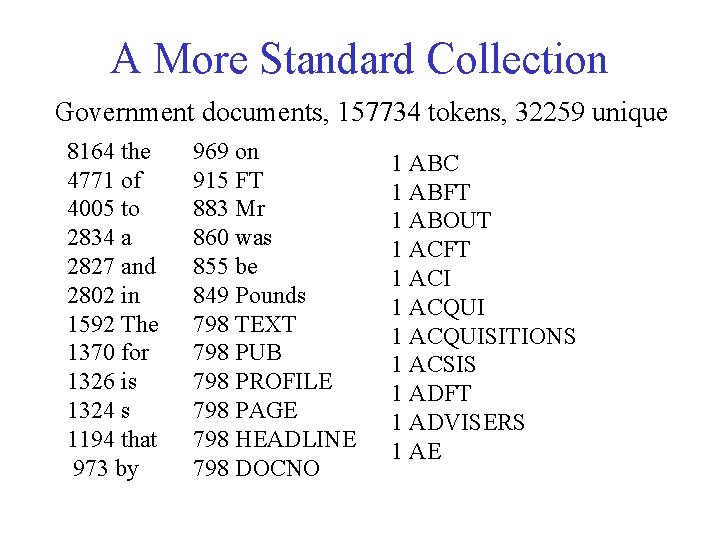
A More Standard Collection Government documents, 157734 tokens, 32259 unique 8164 the 4771 of 4005 to 2834 a 2827 and 2802 in 1592 The 1370 for 1326 is 1324 s 1194 that 973 by 969 on 915 FT 883 Mr 860 was 855 be 849 Pounds 798 TEXT 798 PUB 798 PROFILE 798 PAGE 798 HEADLINE 798 DOCNO 1 ABC 1 ABFT 1 ABOUT 1 ACFT 1 ACI 1 ACQUISITIONS 1 ACSIS 1 ADFT 1 ADVISERS 1 AE
Plotting Word Frequency by Rank • Main idea: count – How many times tokens occur in the text • Over all texts in the collection • Now rank these according to how often they occur. This is called the rank.
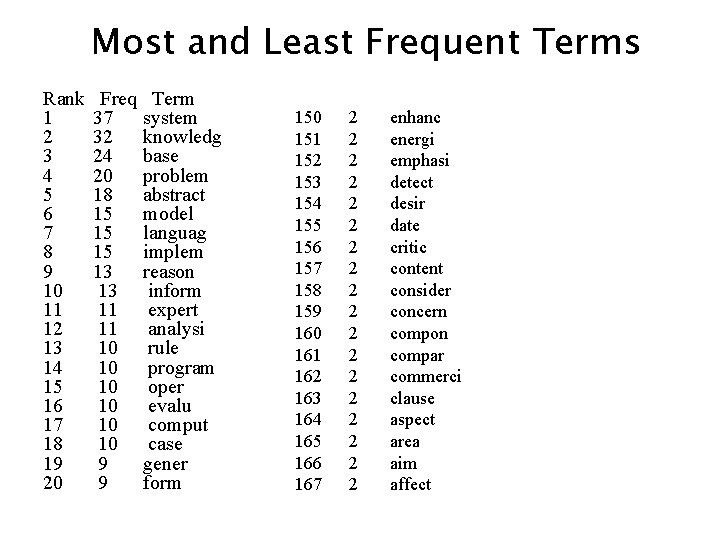
Most and Least Frequent Terms Rank 1 2 3 4 5 6 7 8 9 10 11 12 13 14 15 16 17 18 19 20 Freq 37 32 24 20 18 15 15 15 13 13 11 11 10 10 10 9 9 Term system knowledg base problem abstract model languag implem reason inform expert analysi rule program oper evalu comput case gener form 150 151 152 153 154 155 156 157 158 159 160 161 162 163 164 165 166 167 2 2 2 2 2 enhanc energi emphasi detect desir date critic content consider concern compon compar commerci clause aspect area aim affect
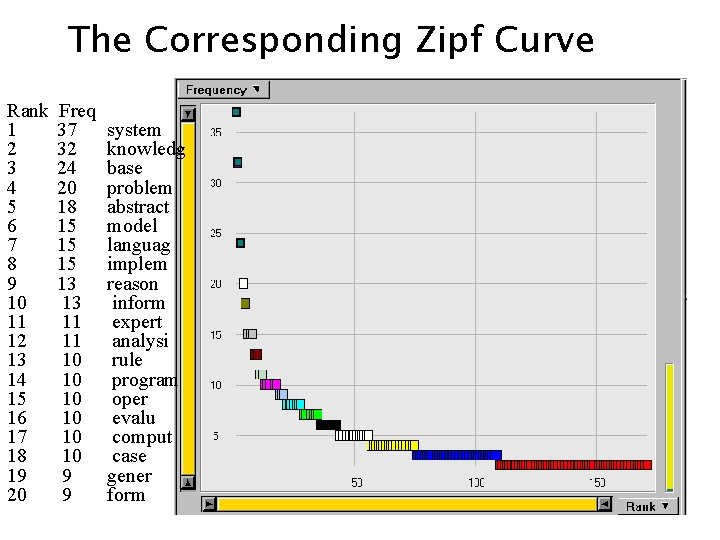
The Corresponding Zipf Curve Rank 1 2 3 4 5 6 7 8 9 10 11 12 13 14 15 16 17 18 19 20 Freq 37 32 24 20 18 15 15 15 13 13 11 11 10 10 10 9 9 system knowledg base problem abstract model languag implem reason inform expert analysi rule program oper evalu comput case gener form
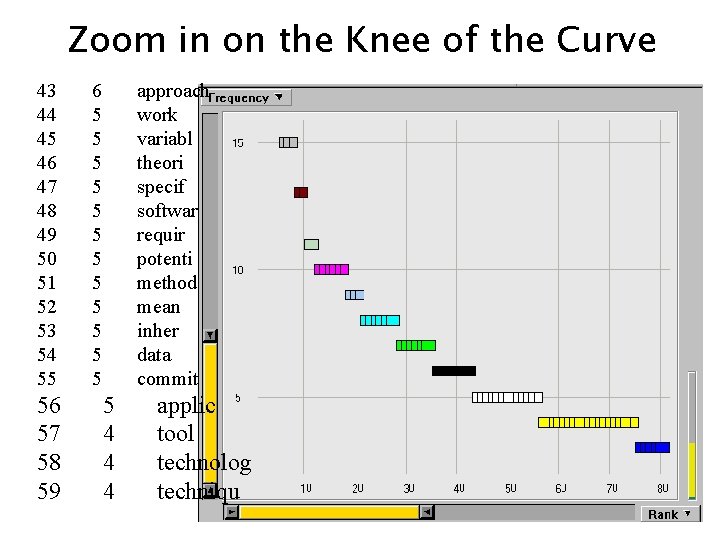
Zoom in on the Knee of the Curve 43 44 45 46 47 48 49 50 51 52 53 54 55 56 57 58 59 6 5 5 5 approach work variabl theori specif softwar requir potenti method mean inher data commit 5 4 4 4 applic tool technolog techniqu
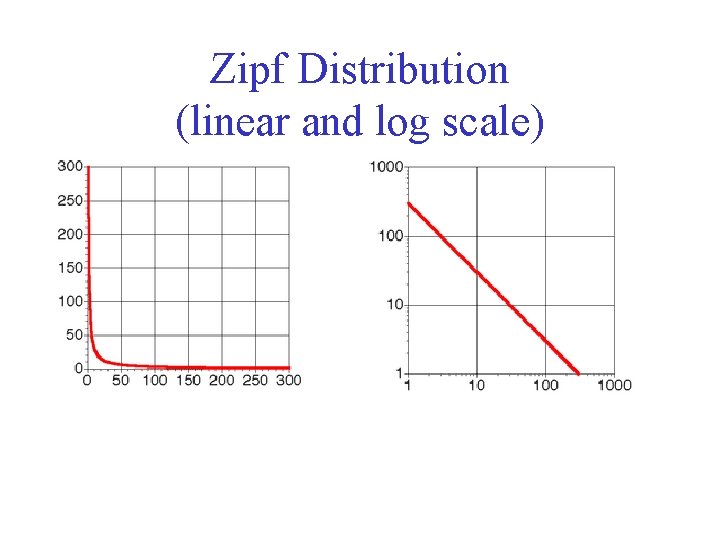
Zipf Distribution • The Important Points: – a few elements occur very frequently – a medium number of elements have medium frequency – many elements occur very infrequently
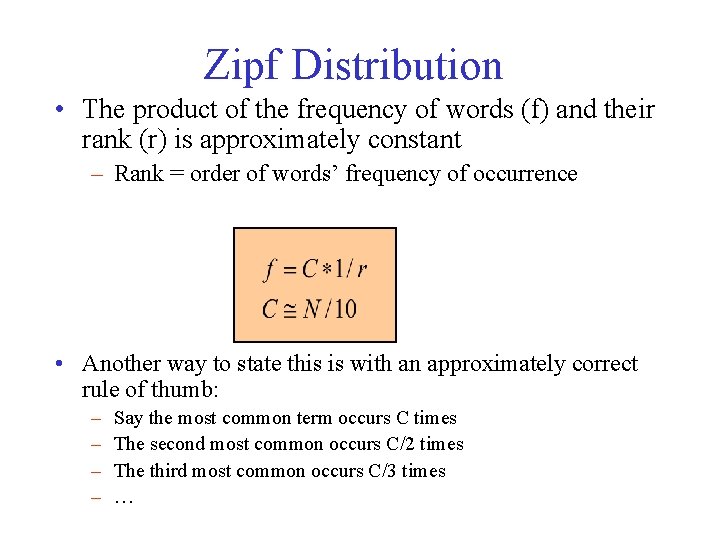
Zipf Distribution • The product of the frequency of words (f) and their rank (r) is approximately constant – Rank = order of words’ frequency of occurrence • Another way to state this is with an approximately correct rule of thumb: – – Say the most common term occurs C times The second most common occurs C/2 times The third most common occurs C/3 times …
Zipf Distribution (linear and log scale)
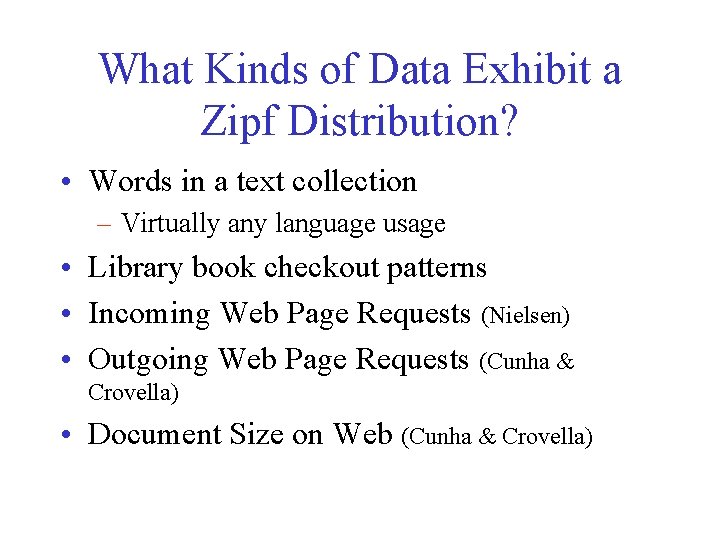
What Kinds of Data Exhibit a Zipf Distribution? • Words in a text collection – Virtually any language usage • Library book checkout patterns • Incoming Web Page Requests (Nielsen) • Outgoing Web Page Requests (Cunha & Crovella) • Document Size on Web (Cunha & Crovella)
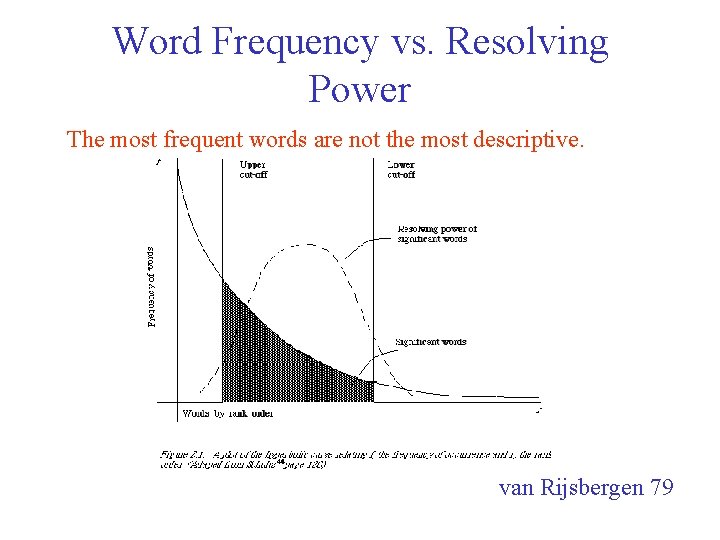
Word Frequency vs. Resolving Power The most frequent words are not the most descriptive. van Rijsbergen 79
Consequences of Zipf • There always a few very frequent tokens that are not good discriminators. – Called “stop words” in IR – Usually correspond to linguistic notion of “closed-class” words • English examples: to, from, on, and, the, . . . • Grammatical classes that don’t take on new members. • There always a large number of tokens that occur once and can mess up algorithms. • Medium frequency words most descriptive