
CONTEMPORY URBAN PLANNING CONTENT The tools of landuse
CONTEMPORY URBAN PLANNING
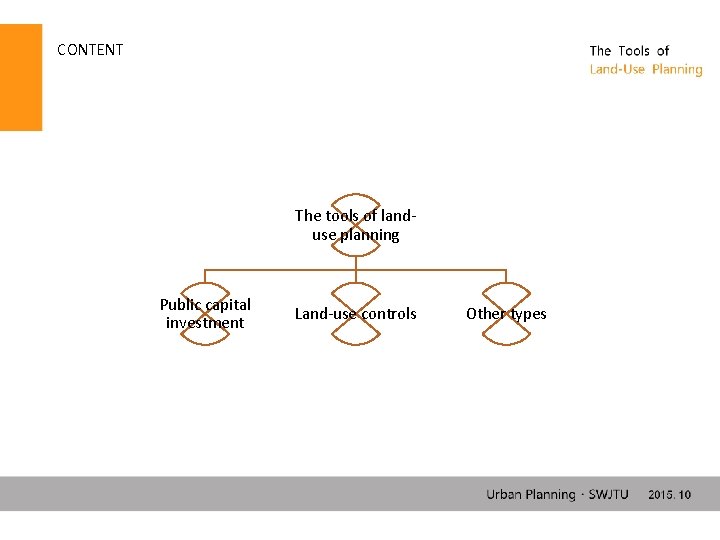
CONTENT The tools of landuse planning Public capital investment Land-use controls Other types
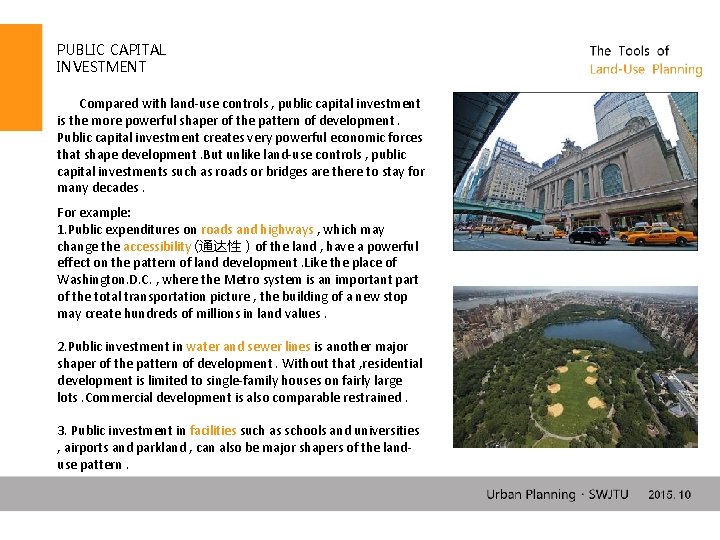
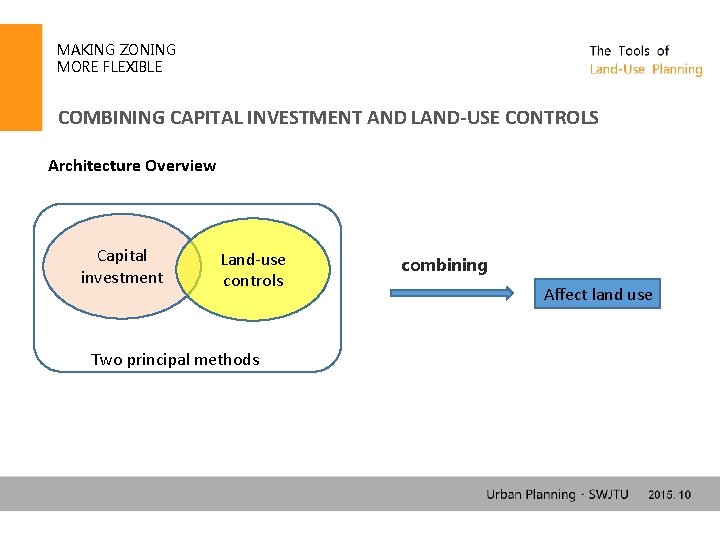
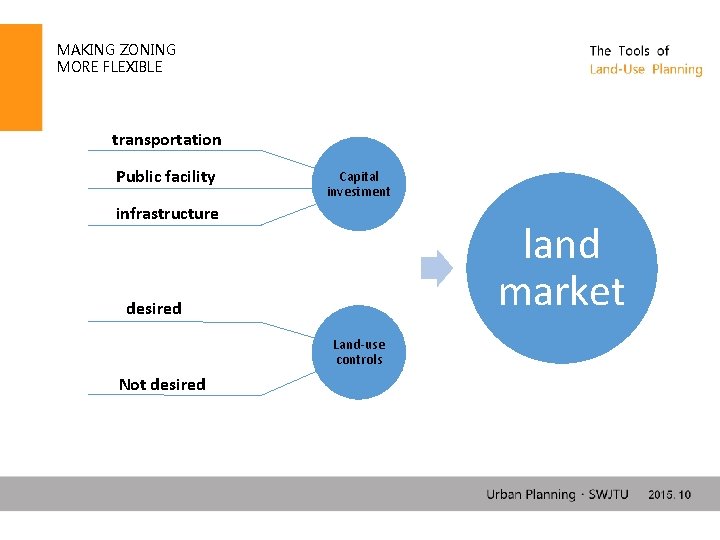
PUBLIC CAPITAL INVESTMENT Compared with land-use controls , public capital investment is the more powerful shaper of the pattern of development. Public capital investment creates very powerful economic forces that shape development. But unlike land-use controls , public capital investments such as roads or bridges are there to stay for many decades. For example: 1. Public expenditures on roads and highways , which may change the accessibility (通达性)of the land , have a powerful effect on the pattern of land development. Like the place of Washington. D. C. , where the Metro system is an important part of the total transportation picture , the building of a new stop may create hundreds of millions in land values. 2. Public investment in water and sewer lines is another major shaper of the pattern of development. Without that , residential development is limited to single-family houses on fairly large lots. Commercial development is also comparable restrained. 3. Public investment in facilities such as schools and universities , airports and parkland , can also be major shapers of the landuse pattern.

LAND-USE CONTROLS Although land-use controls are not quite so powerful a shaper of land use as is public capital investment , they are still extremely important. Their development and implementation constitute a major share of the work effort of most planning agencies. In some citizens’ minds , land-use controls are almost synonymous with planning. Land-use controls Subdivision regulations Zoning ordinances
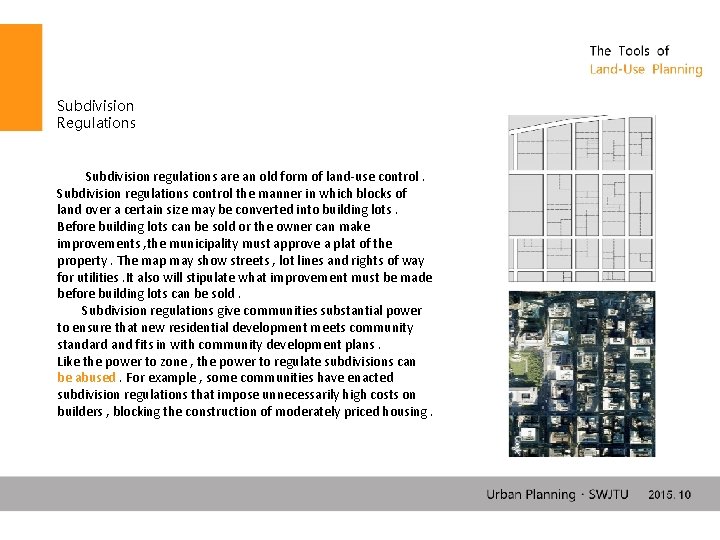
Subdivision Regulations Subdivision regulations are an old form of land-use control. Subdivision regulations control the manner in which blocks of land over a certain size may be converted into building lots. Before building lots can be sold or the owner can make improvements , the municipality must approve a plat of the property. The map may show streets , lot lines and rights of way for utilities. It also will stipulate what improvement must be made before building lots can be sold. Subdivision regulations give communities substantial power to ensure that new residential development meets community standard and fits in with community development plans. Like the power to zone , the power to regulate subdivisions can be abused. For example , some communities have enacted subdivision regulations that impose unnecessarily high costs on builders , blocking the construction of moderately priced housing.
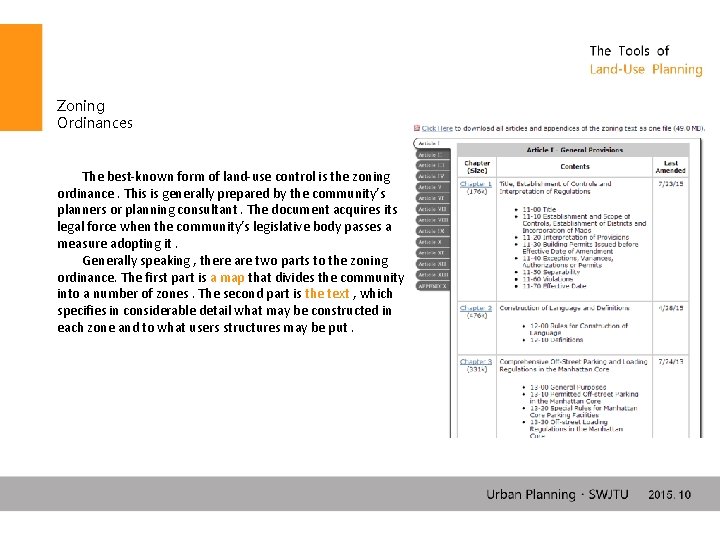
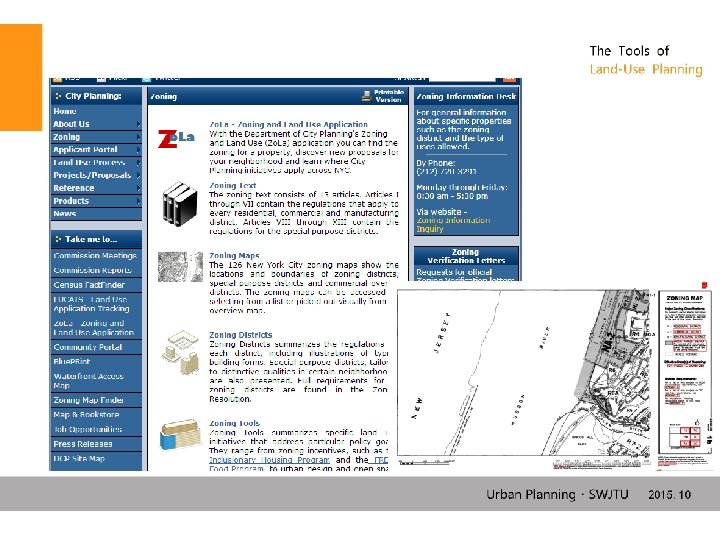
Zoning Ordinances The best-known form of land-use control is the zoning ordinance. This is generally prepared by the community’s planners or planning consultant. The document acquires its legal force when the community’s legislative body passes a measure adopting it. Generally speaking , there are two parts to the zoning ordinance. The first part is a map that divides the community into a number of zones. The second part is the text , which specifies in considerable detail what may be constructed in each zone and to what users structures may be put.
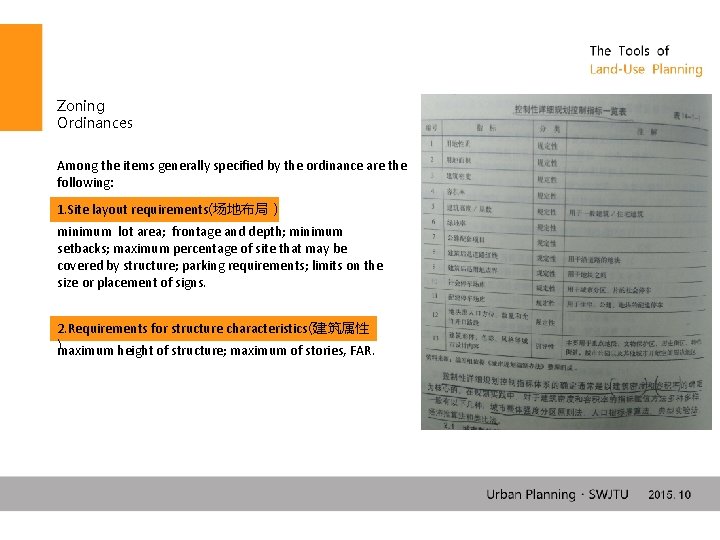
Zoning Ordinances Among the items generally specified by the ordinance are the following: 1. Site layout requirements(场地布局) minimum lot area; frontage and depth; minimum setbacks; maximum percentage of site that may be covered by structure; parking requirements; limits on the size or placement of signs. 2. Requirements for structure characteristics(建筑属性 )maximum height of structure; maximum of stories, FAR.
Zoning Ordinances 3. Uses to which structures may be put(建筑用途 )dwellings be occupied by single families; list which be permitted in the zone like churches, professional offices; which uses are permitted and which are not in the commercial zones. 4. Procedural matters(程序性事物 )specify how it is to be determined whether building plans are in conformity to the zoning ordinance; specify an appeals procedure by which an applicant can apply for relief.
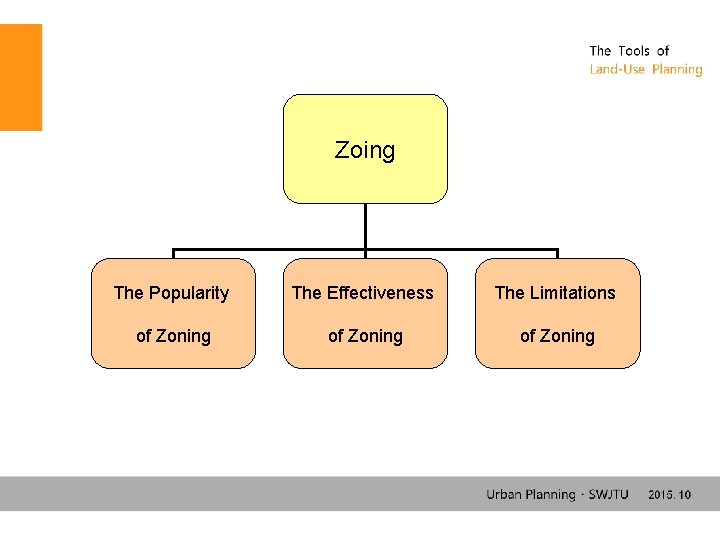
Zoing The Popularity The Effectiveness The Limitations of Zoning
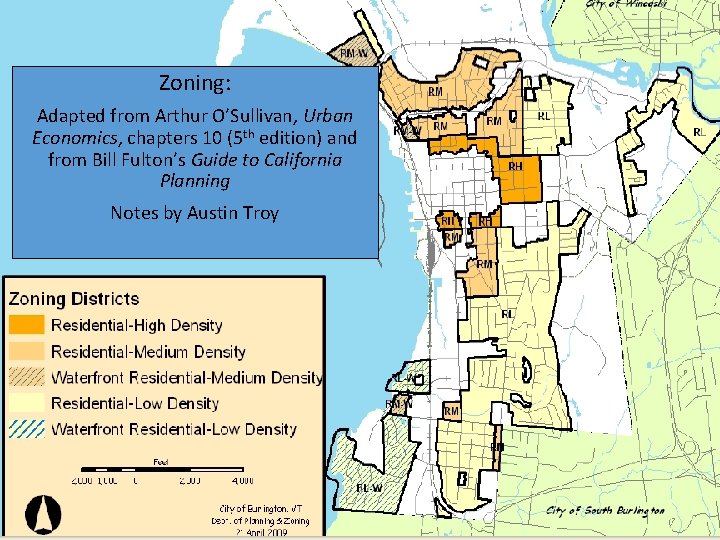
Zoning: Adapted from Arthur O’Sullivan, Urban Economics, chapters 10 (5 th edition) and from Bill Fulton’s Guide to California Planning Land Use Planning Tools Lecture 3: Economics of Zoning Notes by Austin Troy
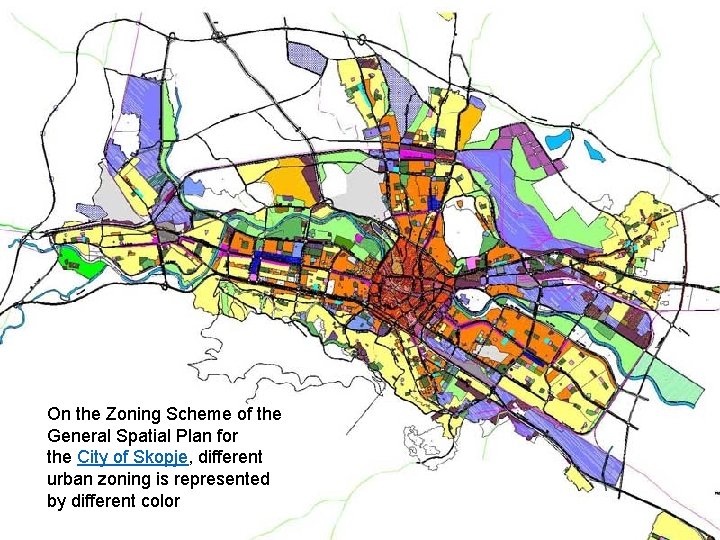
Land Use Planning Tools Lecture 3: Economics of Zoning On the Zoning Scheme of the General Spatial Plan for the City of Skopje, different urban zoning is represented by different color
History of Zoning • Earliest zoning laws were segregationist • New York (1916) zoning law— 5 th avenue retail businesses wanted to limit garment workers; law limited growth of office buildings and garment factories; ostensibly to reduce negative effects of tall buildings • San Francisco- zoned out laundries from certain neighborhoods, which happened mostly to be owned by Chinese • Later zoning became a means for growth management: keep new development in line with available facilities
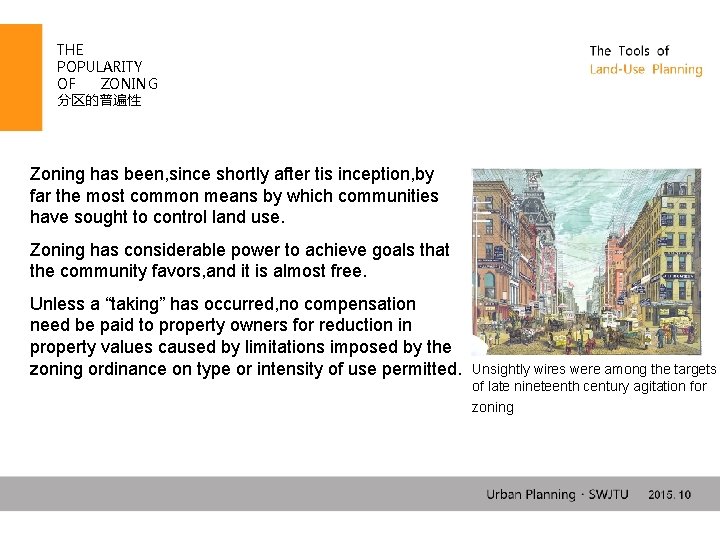
THE POPULARITY OF ZONING 分区的普遍性 Zoning has been, since shortly after tis inception, by far the most common means by which communities have sought to control land use. Zoning has considerable power to achieve goals that the community favors, and it is almost free. Unless a “taking” has occurred, no compensation need be paid to property owners for reduction in property values caused by limitations imposed by the zoning ordinance on type or intensity of use permitted. Unsightly wires were among the targets of late nineteenth century agitation for zoning
THE POPULARITY OF ZONING 分区的普遍性 The same effects could be achieved by exercise of the power of eminent domain or by contract between municipality and property owner. The contract is referred to as an easement. (地役权,在他人土地上通行权和其他某些权利) This is an agreement by the property owner to forgo some rights—for example, that of subdividing the property or developing it in some way—in return for a payment.
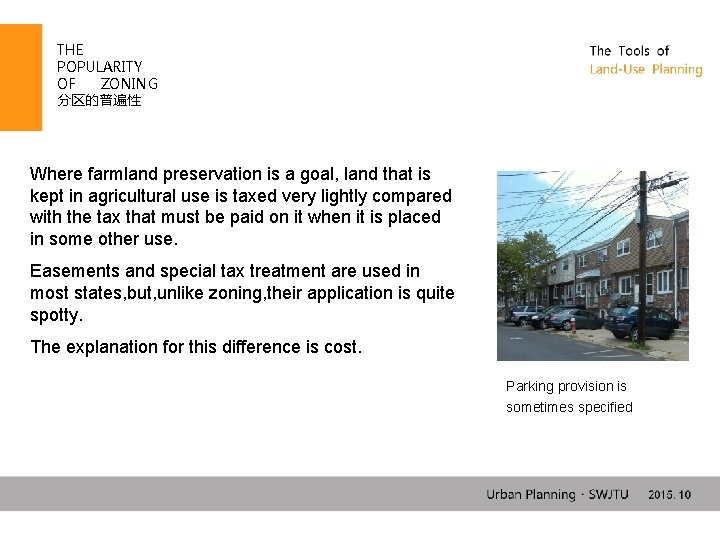
THE POPULARITY OF ZONING 分区的普遍性 Where farmland preservation is a goal, land that is kept in agricultural use is taxed very lightly compared with the tax that must be paid on it when it is placed in some other use. Easements and special tax treatment are used in most states, but, unlike zoning, their application is quite spotty. The explanation for this difference is cost. Parking provision is sometimes specified
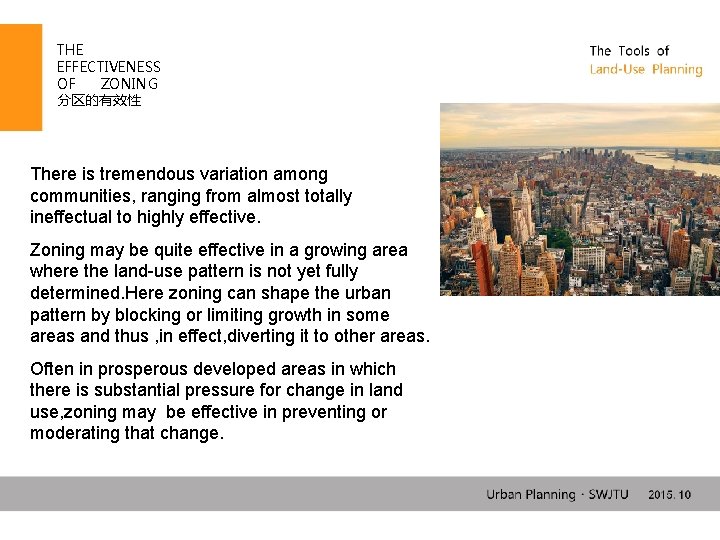
THE EFFECTIVENESS OF ZONING 分区的有效性 There is tremendous variation among communities, ranging from almost totally ineffectual to highly effective. Zoning may be quite effective in a growing area where the land-use pattern is not yet fully determined. Here zoning can shape the urban pattern by blocking or limiting growth in some areas and thus , in effect, diverting it to other areas. Often in prosperous developed areas in which there is substantial pressure for change in land use, zoning may be effective in preventing or moderating that change.
THE EFFECTIVENESS OF ZONING 分区的有效性 One key effective zoning is synchronization between land-use controls and public capital investment. It is possible for a community’s land-use and capital investment policies to be at odds with one anther and for each to undermine and frustrate the intent of the other.
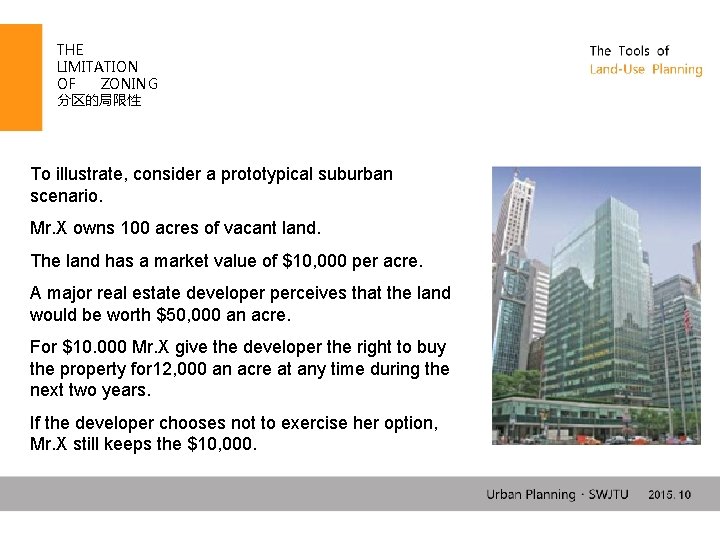
THE LIMITATION OF ZONING 分区的局限性 To illustrate, consider a prototypical suburban scenario. Mr. X owns 100 acres of vacant land. The land has a market value of $10, 000 per acre. A major real estate developer perceives that the land would be worth $50, 000 an acre. For $10. 000 Mr. X give the developer the right to buy the property for 12, 000 an acre at any time during the next two years. If the developer chooses not to exercise her option, Mr. X still keeps the $10, 000.
THE LIMITATION OF ZONING 分区的局限性 The developer will also structure the proposal to give herself room to be reasonable. The developer may or may not obtain a zoning change in this manner. Any planner who has spent some time working in the suburbs has seen such situations go both ways.
THE LIMITATION OF ZONING 分区的局限性 The playing of zoning games is hardly limited to those on the private side of the fence. Municipalities often zone substantial amounts of land in economically unrealistic categories. Similar comments might be made with regard to residential development.
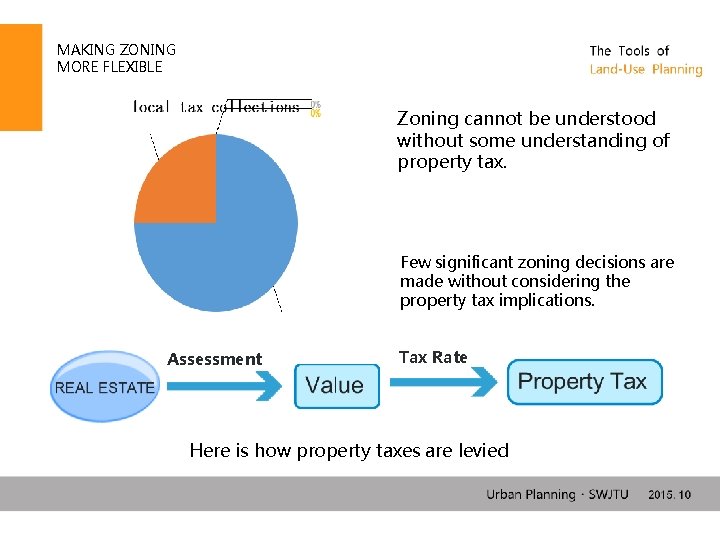
MAKING ZONING MORE FLEXIBLE Zoning cannot be understood without some understanding of property tax. Few significant zoning decisions are made without considering the property tax implications. Assessment Tax Rate Here is how property taxes are levied
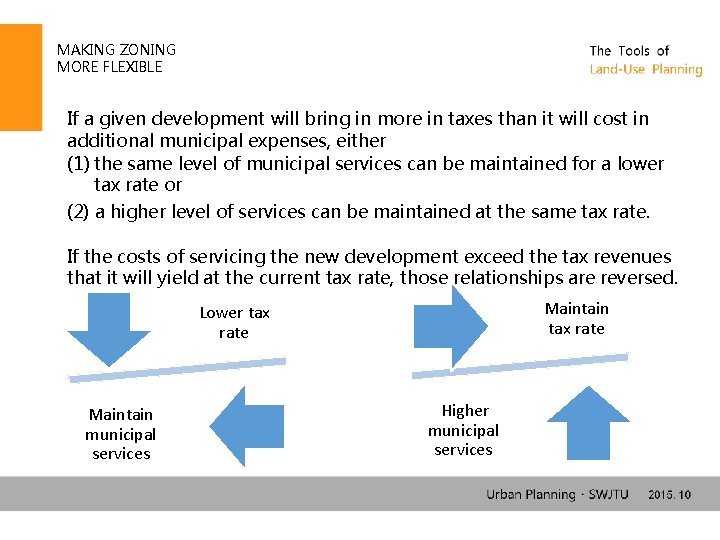
MAKING ZONING MORE FLEXIBLE If a given development will bring in more in taxes than it will cost in additional municipal expenses, either (1) the same level of municipal services can be maintained for a lower tax rate or (2) a higher level of services can be maintained at the same tax rate. If the costs of servicing the new development exceed the tax revenues that it will yield at the current tax rate, those relationships are reversed. Maintain tax rate Lower tax rate Maintain municipal services Higher municipal services
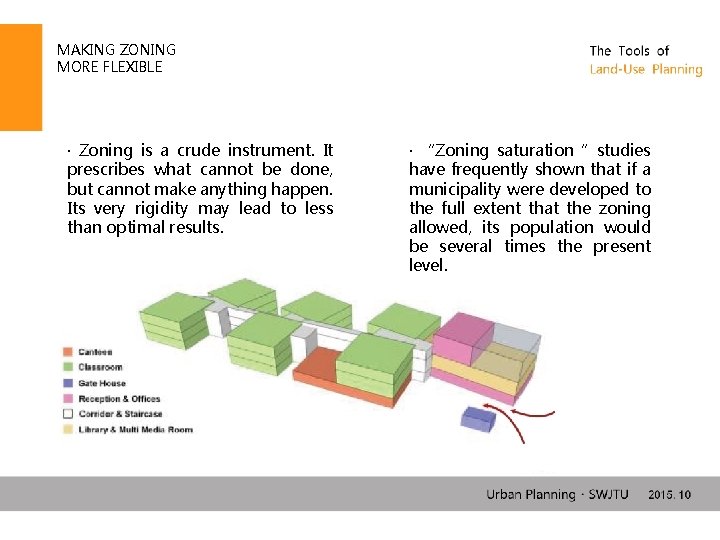
MAKING ZONING MORE FLEXIBLE · Zoning is a crude instrument. It prescribes what cannot be done, but cannot make anything happen. Its very rigidity may lead to less than optimal results. · “Zoning saturation ”studies have frequently shown that if a municipality were developed to the full extent that the zoning allowed, its population would be several times the present level.
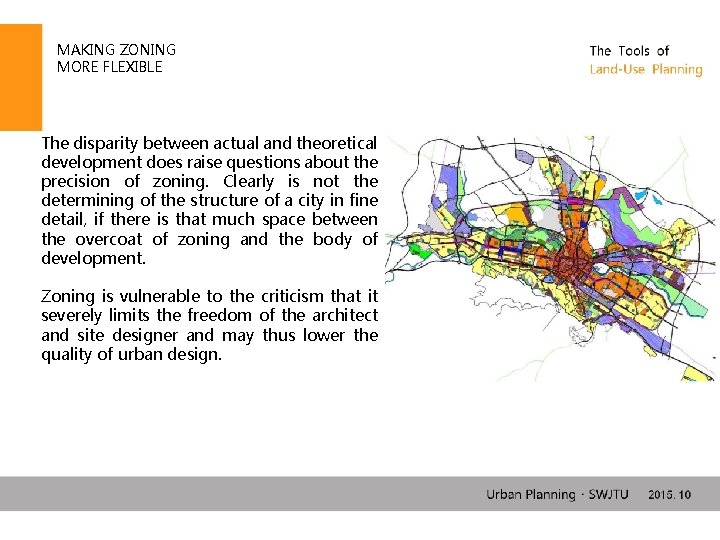
MAKING ZONING MORE FLEXIBLE The disparity between actual and theoretical development does raise questions about the precision of zoning. Clearly is not the determining of the structure of a city in fine detail, if there is that much space between the overcoat of zoning and the body of development. Zoning is vulnerable to the criticism that it severely limits the freedom of the architect and site designer and may thus lower the quality of urban design.
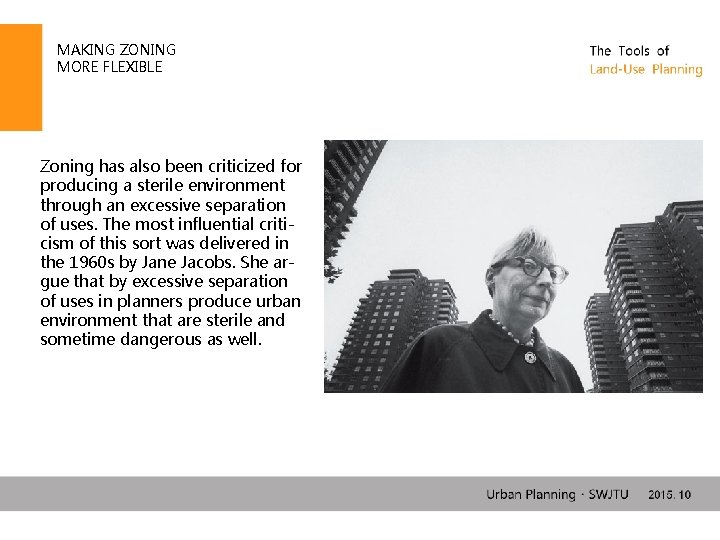
MAKING ZONING MORE FLEXIBLE Zoning has also been criticized for producing a sterile environment through an excessive separation of uses. The most influential criticism of this sort was delivered in the 1960 s by Jane Jacobs. She argue that by excessive separation of uses in planners produce urban environment that are sterile and sometime dangerous as well.
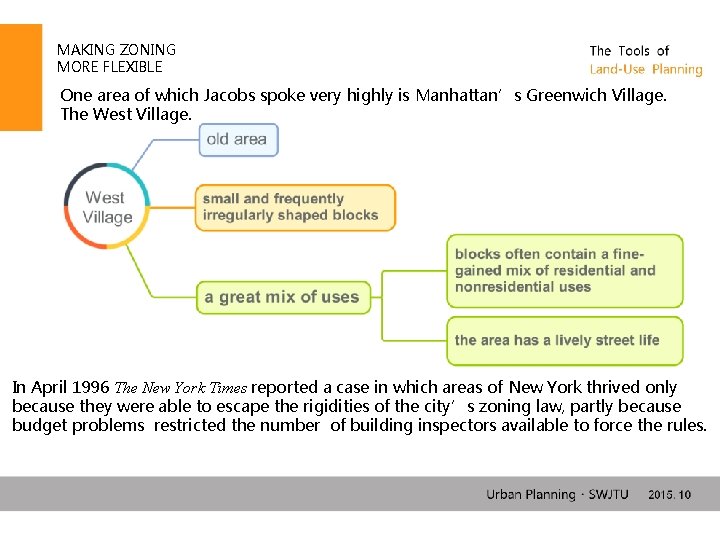
MAKING ZONING MORE FLEXIBLE One area of which Jacobs spoke very highly is Manhattan’s Greenwich Village. The West Village. In April 1996 The New York Times reported a case in which areas of New York thrived only because they were able to escape the rigidities of the city’s zoning law, partly because budget problems restricted the number of building inspectors available to force the rules.
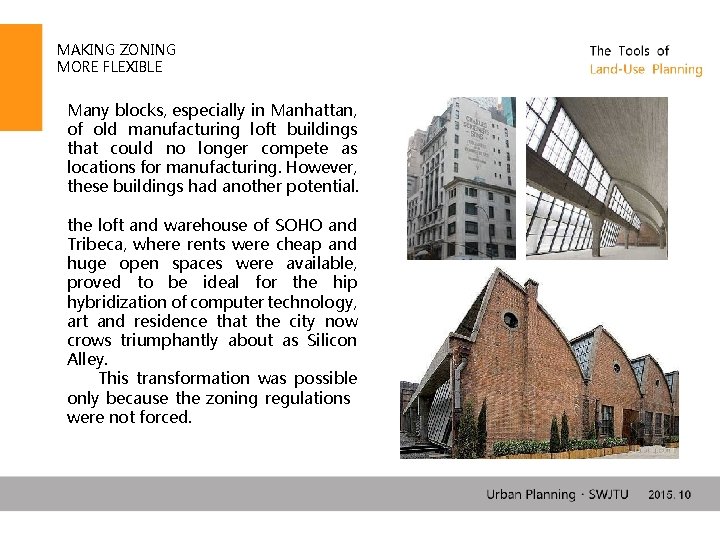
MAKING ZONING MORE FLEXIBLE Many blocks, especially in Manhattan, of old manufacturing loft buildings that could no longer compete as locations for manufacturing. However, these buildings had another potential. the loft and warehouse of SOHO and Tribeca, where rents were cheap and huge open spaces were available, proved to be ideal for the hip hybridization of computer technology, art and residence that the city now crows triumphantly about as Silicon Alley. This transformation was possible only because the zoning regulations were not forced.
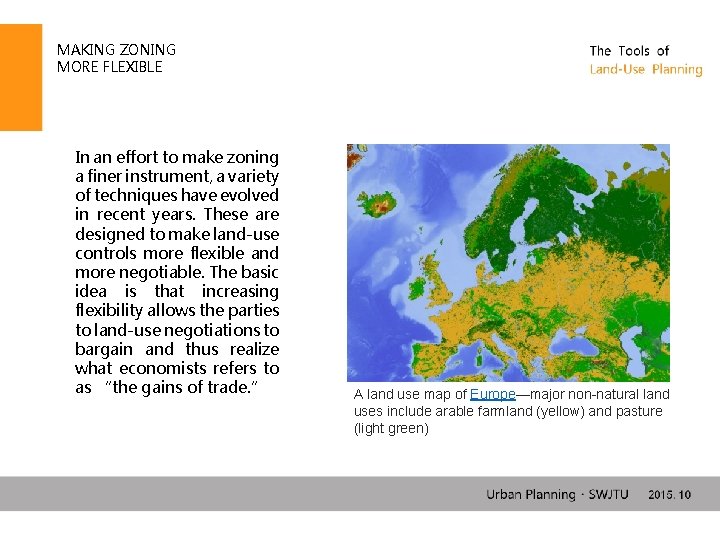
MAKING ZONING MORE FLEXIBLE In an effort to make zoning a finer instrument, a variety of techniques have evolved in recent years. These are designed to make land-use controls more flexible and more negotiable. The basic idea is that increasing flexibility allows the parties to land-use negotiations to bargain and thus realize what economists refers to as “the gains of trade. ” A land use map of Europe—major non-natural land uses include arable farmland (yellow) and pasture (light green)
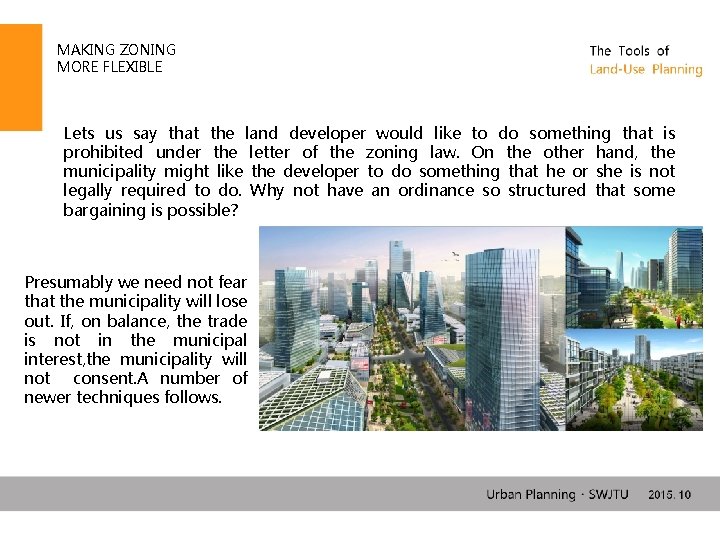
MAKING ZONING MORE FLEXIBLE Lets us say that the land developer would like to do something that is prohibited under the letter of the zoning law. On the other hand, the municipality might like the developer to do something that he or she is not legally required to do. Why not have an ordinance so structured that some bargaining is possible? Presumably we need not fear that the municipality will lose out. If, on balance, the trade is not in the municipal interest, the municipality will not consent. A number of newer techniques follows.
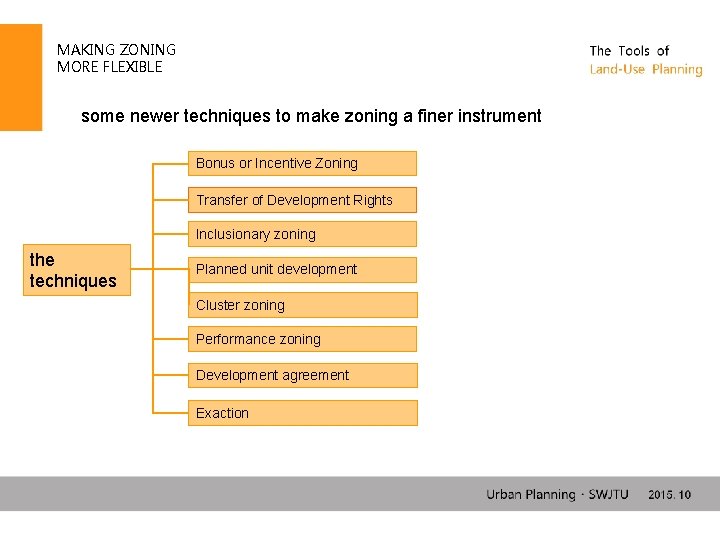
MAKING ZONING MORE FLEXIBLE some newer techniques to make zoning a finer instrument Bonus or Incentive Zoning Transfer of Development Rights Inclusionary zoning the techniques Planned unit development Cluster zoning Performance zoning Development agreement Exaction
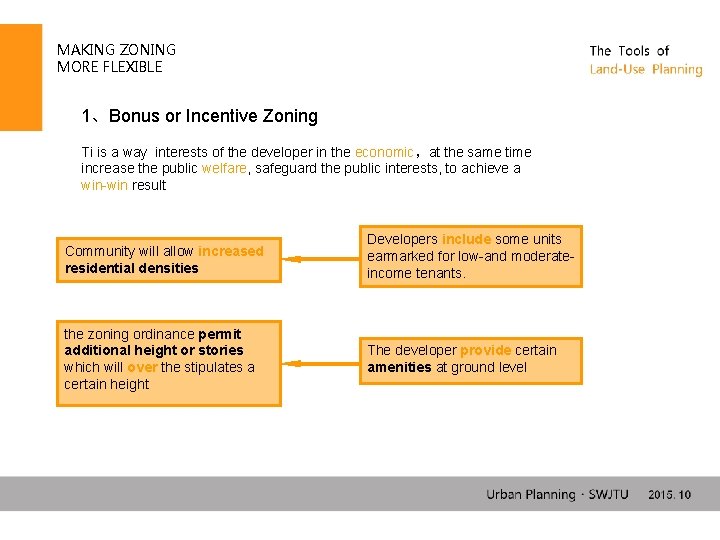
MAKING ZONING MORE FLEXIBLE 1、Bonus or Incentive Zoning Ti is a way interests of the developer in the economic,at the same time increase the public welfare, safeguard the public interests, to achieve a win-win result Community will allow increased residential densities Developers include some units earmarked for low-and moderateincome tenants. the zoning ordinance permit additional height or stories which will over the stipulates a certain height The developer provide certain amenities at ground level
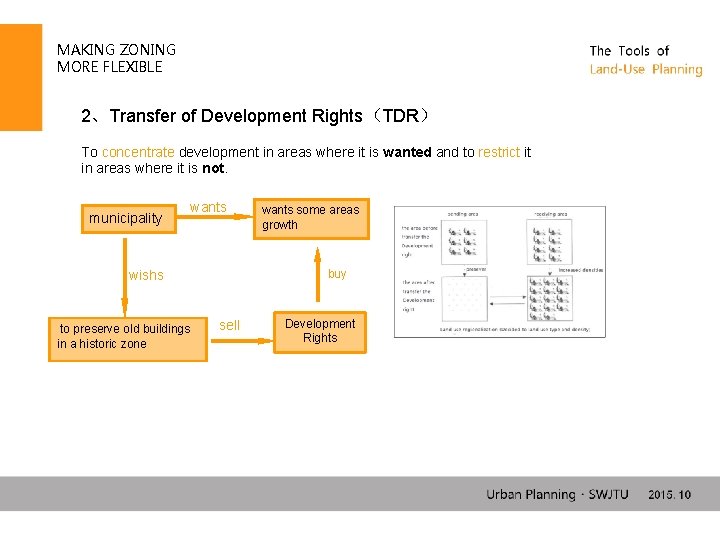
MAKING ZONING MORE FLEXIBLE 2、Transfer of Development Rights(TDR) To concentrate development in areas where it is wanted and to restrict it in areas where it is not. municipality wants buy wishs to preserve old buildings in a historic zone wants some areas growth sell Development Rights
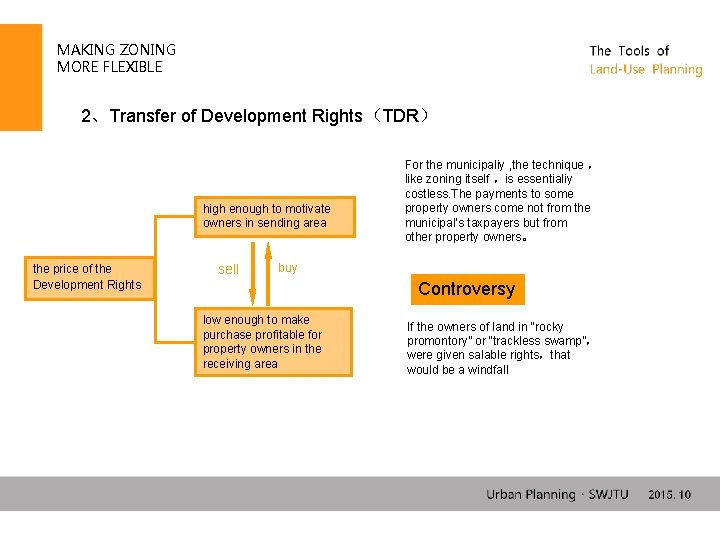
MAKING ZONING MORE FLEXIBLE 2、Transfer of Development Rights(TDR) high enough to motivate owners in sending area the price of the Development Rights sell For the municipaliy , the technique , like zoning itself ,is essentialiy costless. The payments to some property owners come not from the municipal’s taxpayers but from other property owners。 buy Controversy low enough to make purchase profitable for property owners in the receiving area If the owners of land in “rocky promontory” or “trackless swamp”, were given salable rights,that would be a windfall
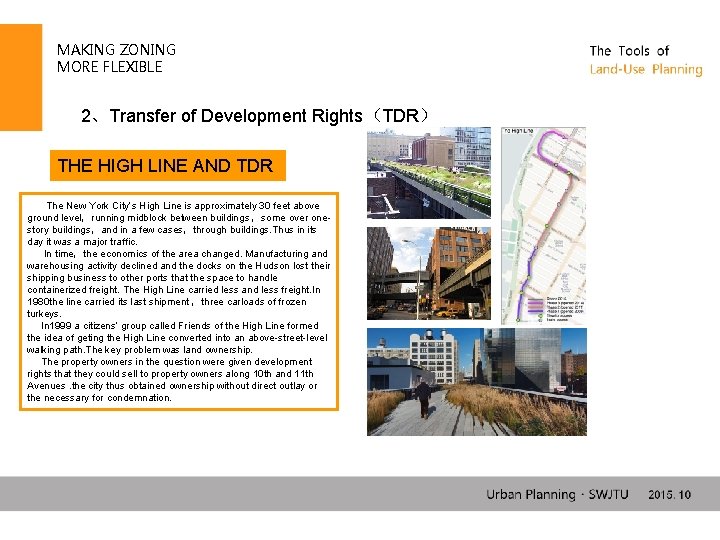
MAKING ZONING MORE FLEXIBLE 2、Transfer of Development Rights(TDR) THE HIGH LINE AND TDR The New York City’s High Line is approximately 30 feet above ground level,running midblock between buildings ,some over onestory buildings,and in a few cases,through buildings. Thus in its day it was a major traffic. In time,the economics of the area changed. Manufacturing and warehousing activity declined and the docks on the Hudson lost their shipping business to other ports that the space to handle containerized freight. The High Line carried less and less freight. In 1980 the line carried its last shipment ,three carloads of frozen turkeys. In 1999 a citizens’ group called Friends of the High Line formed the idea of geting the High Line converted into an above-street-level walking path. The key problem was land ownership. The property owners in the question were given development rights that they could sell to property owners along 10 th and 11 th Avenues. the city thus obtained ownership without direct outlay or the necessary for condemnation.
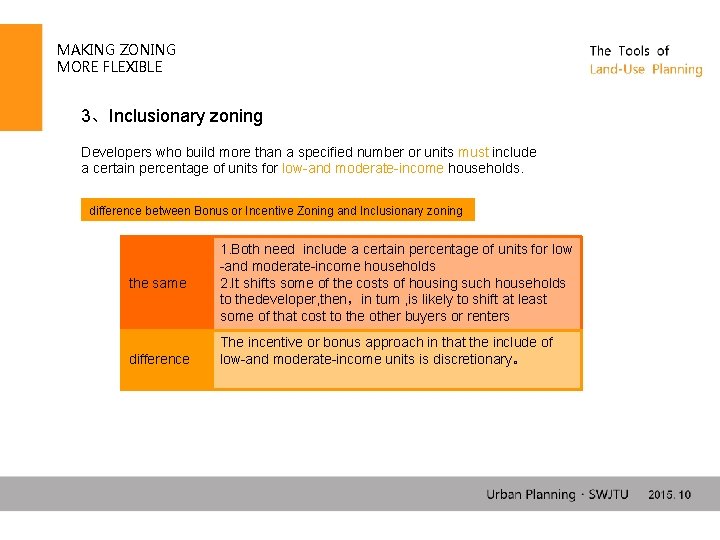
MAKING ZONING MORE FLEXIBLE 3、Inclusionary zoning Developers who build more than a specified number or units must include a certain percentage of units for low-and moderate-income households. difference between Bonus or Incentive Zoning and Inclusionary zoning the same 1. Both need include a certain percentage of units for low -and moderate-income households 2. It shifts some of the costs of housing such households to thedeveloper, then,in turn , is likely to shift at least some of that cost to the other buyers or renters difference The incentive or bonus approach in that the include of low-and moderate-income units is discretionary。
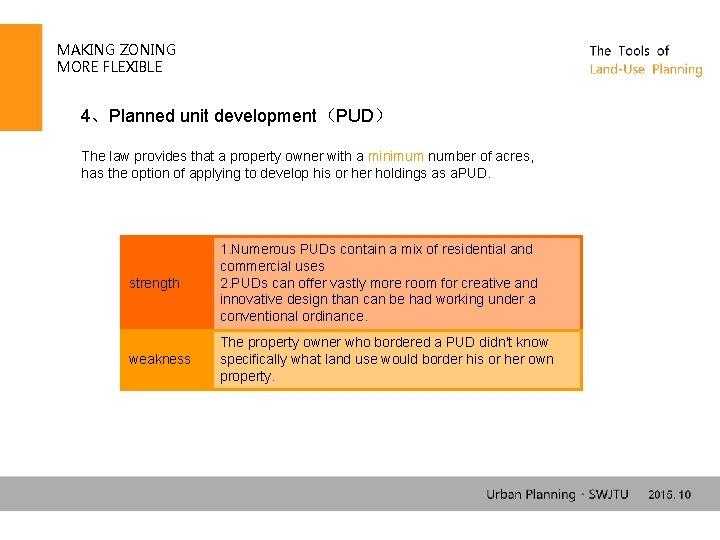
MAKING ZONING MORE FLEXIBLE 4、Planned unit development(PUD) The law provides that a property owner with a minimum number of acres, has the option of applying to develop his or her holdings as a. PUD. strength 1. Numerous PUDs contain a mix of residential and commercial uses 2. PUDs can offer vastly more room for creative and innovative design than can be had working under a conventional ordinance. weakness The property owner who bordered a PUD didn't know specifically what land use would border his or her own property.
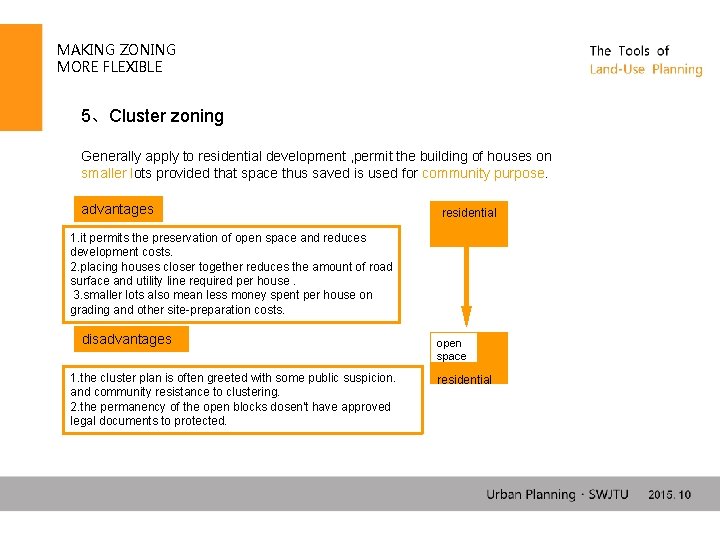
MAKING ZONING MORE FLEXIBLE 5、Cluster zoning Generally apply to residential development , permit the building of houses on smaller lots provided that space thus saved is used for community purpose. advantages residential 1. it permits the preservation of open space and reduces development costs. 2. placing houses closer together reduces the amount of road surface and utility line required per house. 3. smaller lots also mean less money spent per house on grading and other site-preparation costs. disadvantages 1. the cluster plan is often greeted with some public suspicion. and community resistance to clustering. 2. the permanency of the open blocks dosen't have approved legal documents to protected. open space residential
MAKING ZONING MORE FLEXIBLE 6、Performance zoning codes stipulate what may or may not be done in terms of end results instead of giving detailed regulations on the exact form of development. advantages It can achieve the same goals as conventional zoning but in a more flexble manner and avoid that the number of distinctions become harder to distinguish disadvantages Not every municipality that has tried Performance zoning has been equally pleased with it.
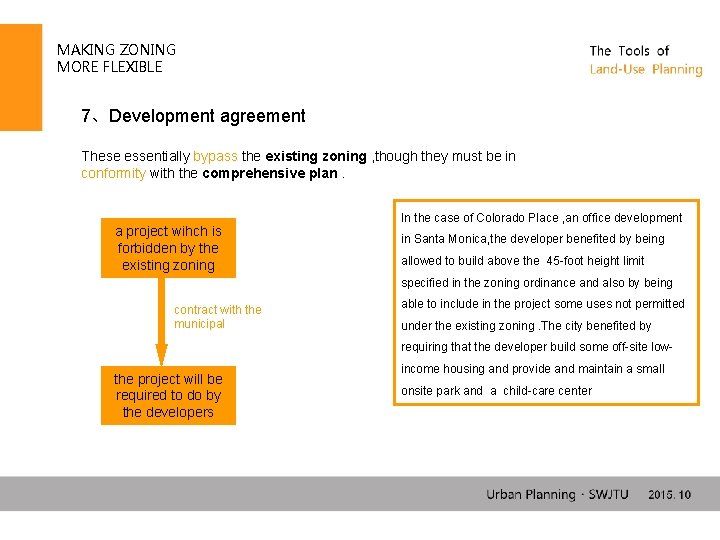
MAKING ZONING MORE FLEXIBLE 7、Development agreement These essentially bypass the existing zoning , though they must be in conformity with the comprehensive plan. a project wihch is forbidden by the existing zoning In the case of Colorado Place , an office development in Santa Monica, the developer benefited by being allowed to build above the 45 -foot height limit specified in the zoning ordinance and also by being contract with the municipal able to include in the project some uses not permitted under the existing zoning. The city benefited by requiring that the developer build some off-site low- the project will be required to do by the developers income housing and provide and maintain a small onsite park and a child-care center
MAKING ZONING MORE FLEXIBLE 8、Exaction is quite substantial, before giving permission to deveolp. Exactions are required only if there is to be a rezoning or San Francisco decided that new office zoning variance. in other case the exactions are changed for development increase the demand for development within the existing zoning law. in general , the housing in the city. since 1981 builders of exaction is charged to pay the costs that the development is office structures of over 50000 square feet presumed to impose on the community. of floor space must earn housing creadits by either building new units themselves or contributing funds to housing rehabilitation or affordable housing projects.
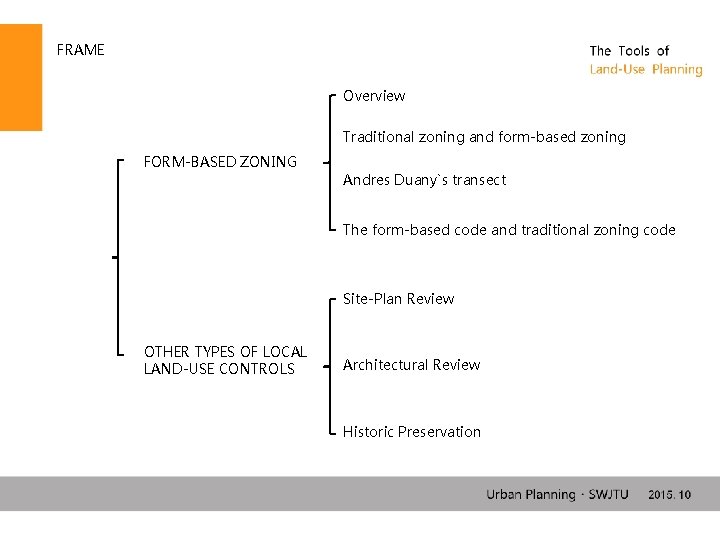
FRAME Overview Traditional zoning and form-based zoning FORM-BASED ZONING Andres Duany`s transect The form-based code and traditional zoning code Site-Plan Review OTHER TYPES OF LOCAL LAND-USE CONTROLS Architectural Review Historic Preservation
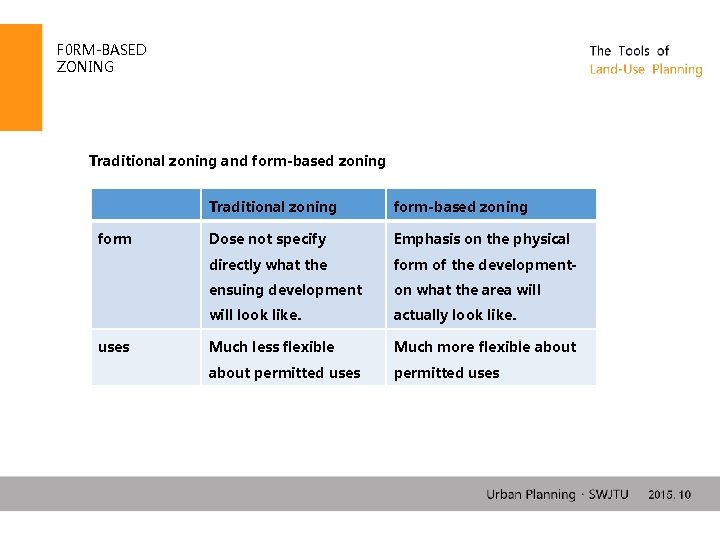
F 0 RM-BASED ZONING Traditional zoning and form-based zoning form uses Traditional zoning form-based zoning Dose not specify Emphasis on the physical directly what the form of the development- ensuing development on what the area will look like. actually look like. Much less flexible Much more flexible about permitted uses
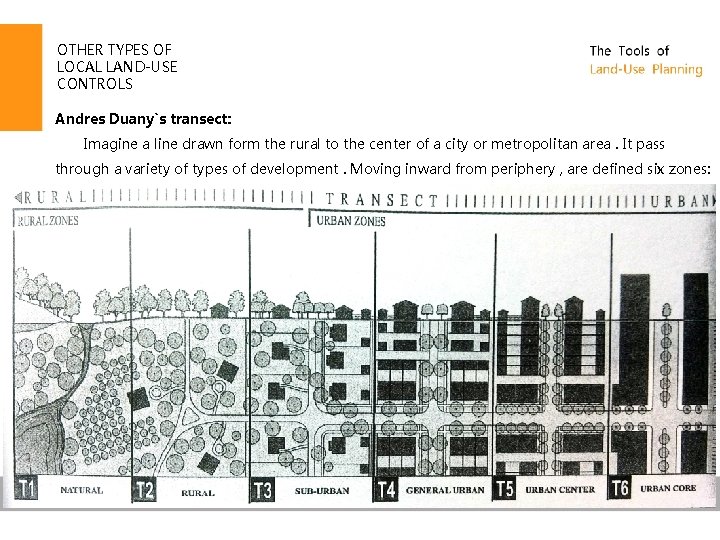
OTHER TYPES OF LOCAL LAND-USE CONTROLS Andres Duany`s transect: Imagine a line drawn form the rural to the center of a city or metropolitan area. It pass through a variety of types of development. Moving inward from periphery , are defined six zones:
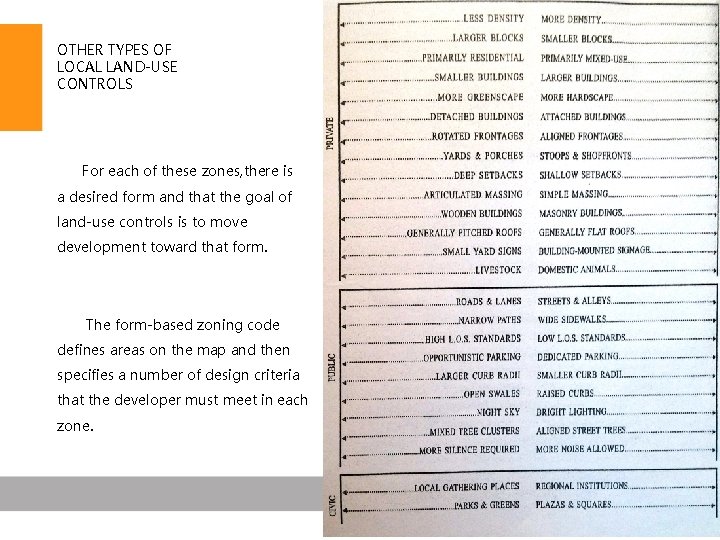
OTHER TYPES OF LOCAL LAND-USE CONTROLS For each of these zones, there is a desired form and that the goal of land-use controls is to move development toward that form. The form-based zoning code defines areas on the map and then specifies a number of design criteria that the developer must meet in each zone.
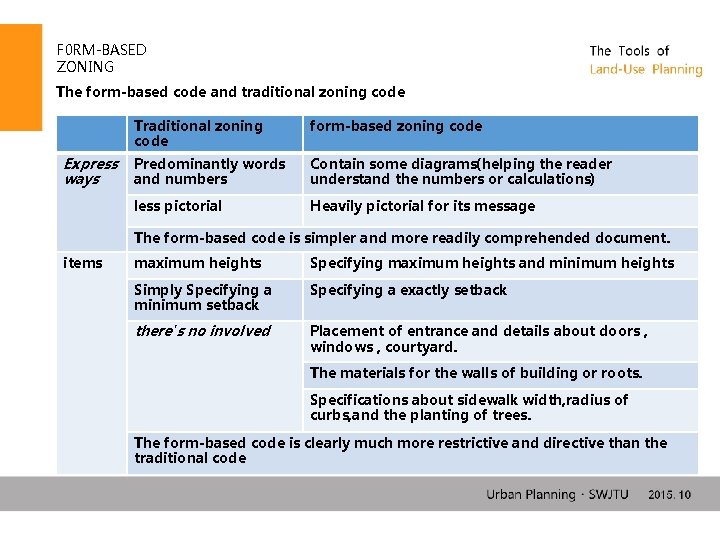
F 0 RM-BASED ZONING The form-based code and traditional zoning code Express ways Traditional zoning code form-based zoning code Predominantly words and numbers Contain some diagrams(helping the reader understand the numbers or calculations) less pictorial Heavily pictorial for its message The form-based code is simpler and more readily comprehended document. items maximum heights Specifying maximum heights and minimum heights Simply Specifying a minimum setback Specifying a exactly setback there's no involved Placement of entrance and details about doors , windows , courtyard. The materials for the walls of building or roots. Specifications about sidewalk width, radius of curbs, and the planting of trees. The form-based code is clearly much more restrictive and directive than the traditional code
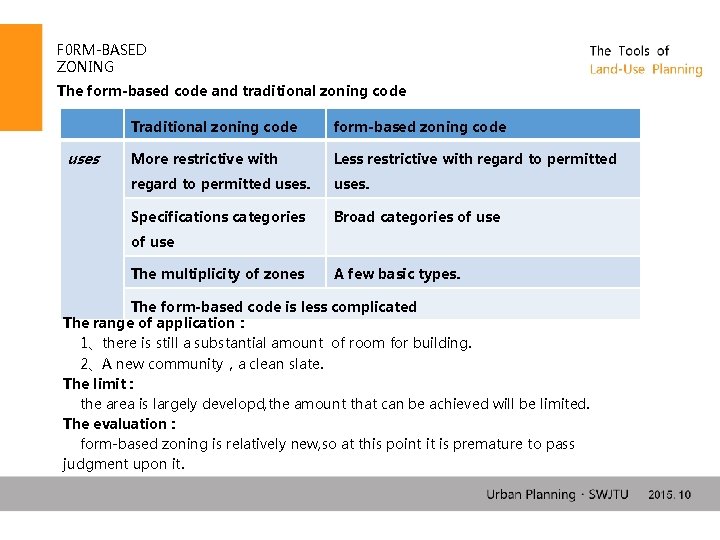
F 0 RM-BASED ZONING The form-based code and traditional zoning code uses Traditional zoning code form-based zoning code More restrictive with Less restrictive with regard to permitted uses. Specifications categories Broad categories of use The multiplicity of zones A few basic types. The form-based code is less complicated The range of application : 1、there is still a substantial amount of room for building. 2、A new community,a clean slate. The limit : the area is largely developd, the amount that can be achieved will be limited. The evaluation : form-based zoning is relatively new, so at this point it is premature to pass judgment upon it.
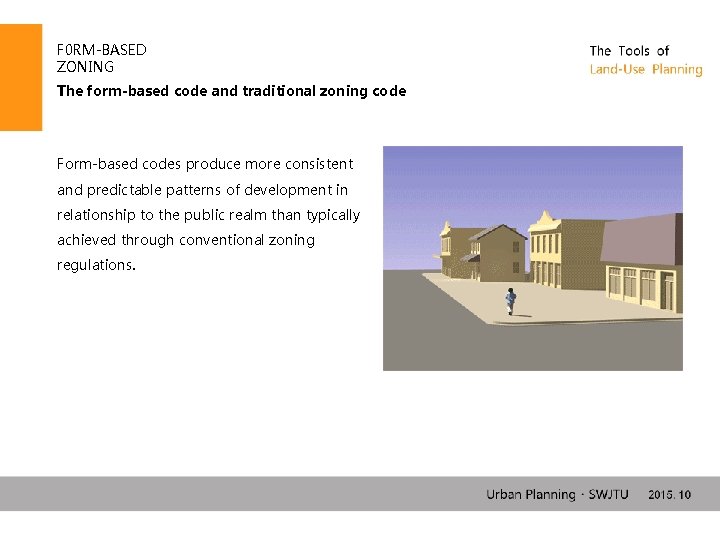
F 0 RM-BASED ZONING The form-based code and traditional zoning code Form-based codes produce more consistent and predictable patterns of development in relationship to the public realm than typically achieved through conventional zoning regulations.
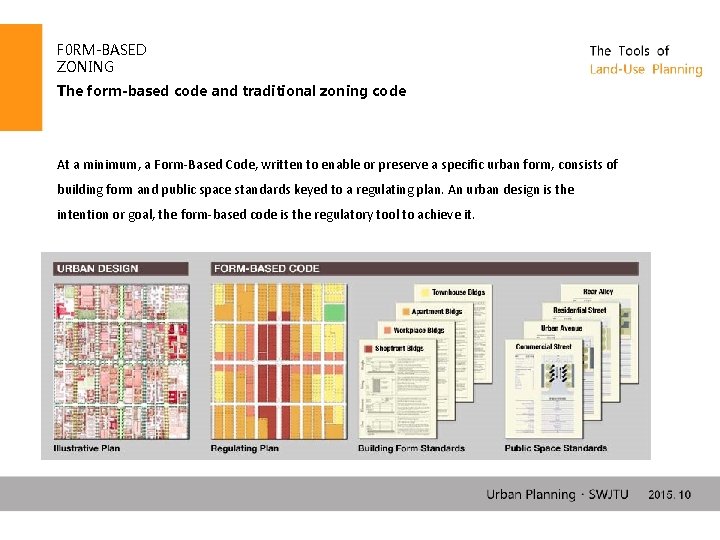
F 0 RM-BASED ZONING The form-based code and traditional zoning code At a minimum, a Form-Based Code, written to enable or preserve a specific urban form, consists of building form and public space standards keyed to a regulating plan. An urban design is the intention or goal, the form-based code is the regulatory tool to achieve it.
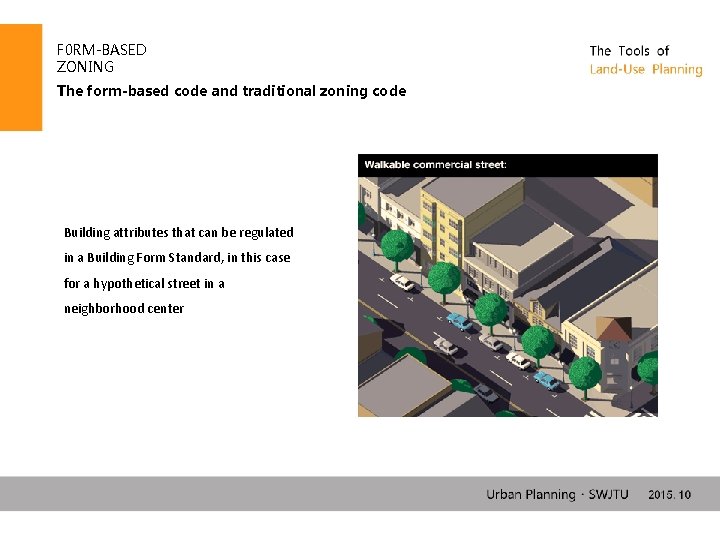
F 0 RM-BASED ZONING The form-based code and traditional zoning code Building attributes that can be regulated in a Building Form Standard, in this case for a hypothetical street in a neighborhood center
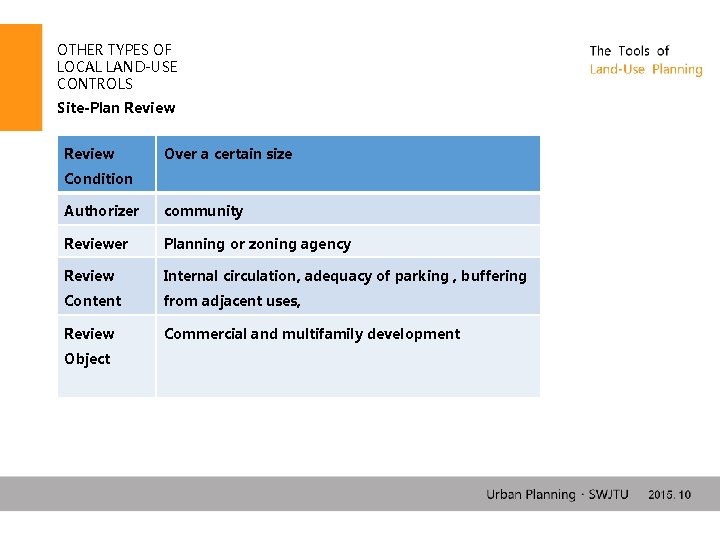
OTHER TYPES OF LOCAL LAND-USE CONTROLS Site-Plan Review Over a certain size Condition Authorizer community Reviewer Planning or zoning agency Review Internal circulation, adequacy of parking , buffering Content from adjacent uses, Review Commercial and multifamily development Object
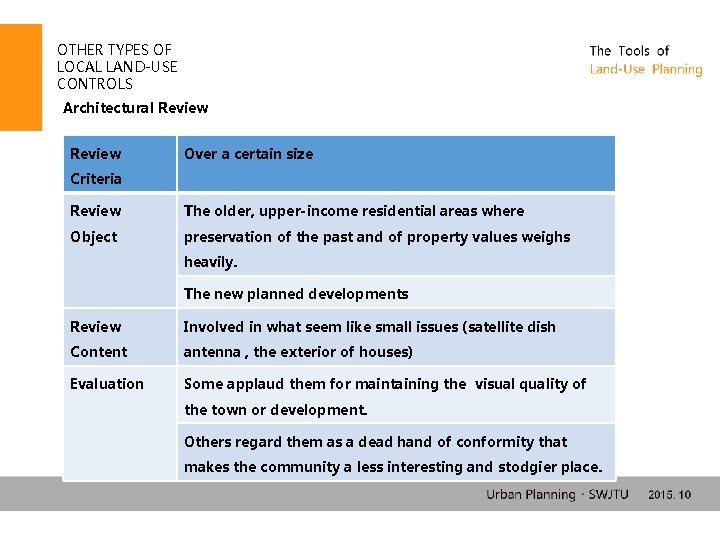
OTHER TYPES OF LOCAL LAND-USE CONTROLS Architectural Review Over a certain size Criteria Review The older, upper-income residential areas where Object preservation of the past and of property values weighs heavily. The new planned developments Review Involved in what seem like small issues (satellite dish Content antenna , the exterior of houses) Evaluation Some applaud them for maintaining the visual quality of the town or development. Others regard them as a dead hand of conformity that makes the community a less interesting and stodgier place.
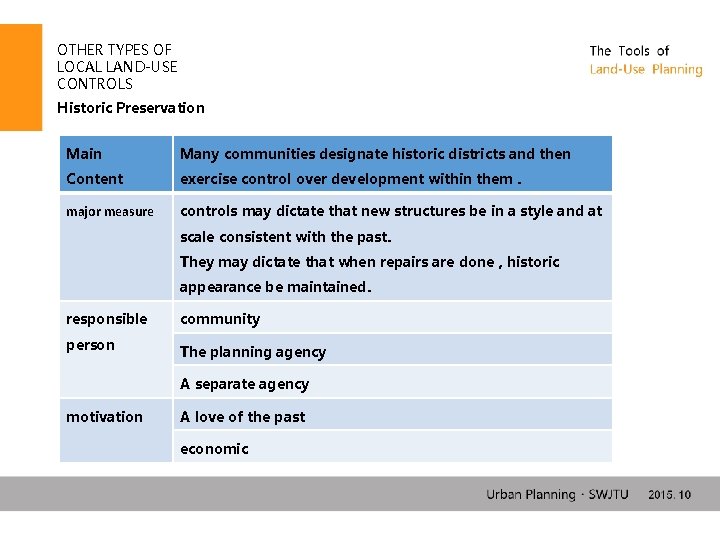
OTHER TYPES OF LOCAL LAND-USE CONTROLS Historic Preservation Main Many communities designate historic districts and then Content exercise control over development within them. major measure controls may dictate that new structures be in a style and at scale consistent with the past. They may dictate that when repairs are done , historic appearance be maintained. responsible person community The planning agency A separate agency motivation A love of the past economic
MAKING ZONING MORE FLEXIBLE COMBINING CAPITAL INVESTMENT AND LAND-USE CONTROLS Architecture Overview Capital investment Land-use controls Two principal methods combining Affect land use
MAKING ZONING MORE FLEXIBLE transportation Public facility Capital investment infrastructure land market desired Land-use controls Not desired
MAKING ZONING MORE FLEXIBLE For example : Westchester Country , New York’s • interstate highway system • Good location • successful case 1/precondition 2/opportunity 4/successful 3/advantages • Accessibility • land value • potential development
MAKING ZONING MORE FLEXIBLE Raise the location value Capital investment Desirable result retailing draw important strategy Permit/prevent Popular Good highway access Land-use controls Rezoning (essential part) destroy road frontage environment measure Prohibiting retailing retained office
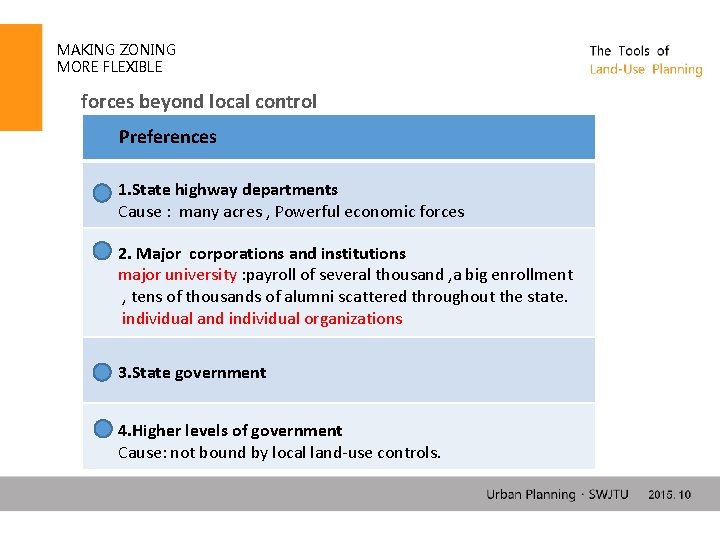
MAKING ZONING MORE FLEXIBLE forces beyond local control Preferences 1. State highway departments Cause : many acres , Powerful economic forces 2. Major corporations and institutions major university : payroll of several thousand , a big enrollment , tens of thousands of alumni scattered throughout the state. individual and individual organizations 3. State government 4. Higher levels of government Cause: not bound by local land-use controls.
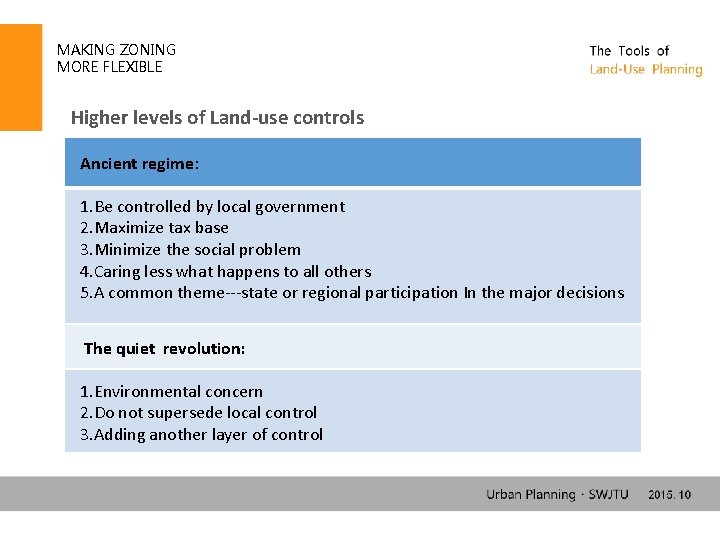
MAKING ZONING MORE FLEXIBLE Higher levels of Land-use controls Ancient regime: 1. Be controlled by local government 2. Maximize tax base 3. Minimize the social problem 4. Caring less what happens to all others 5. A common theme---state or regional participation In the major decisions The quiet revolution: 1. Environmental concern 2. Do not supersede local control 3. Adding another layer of control
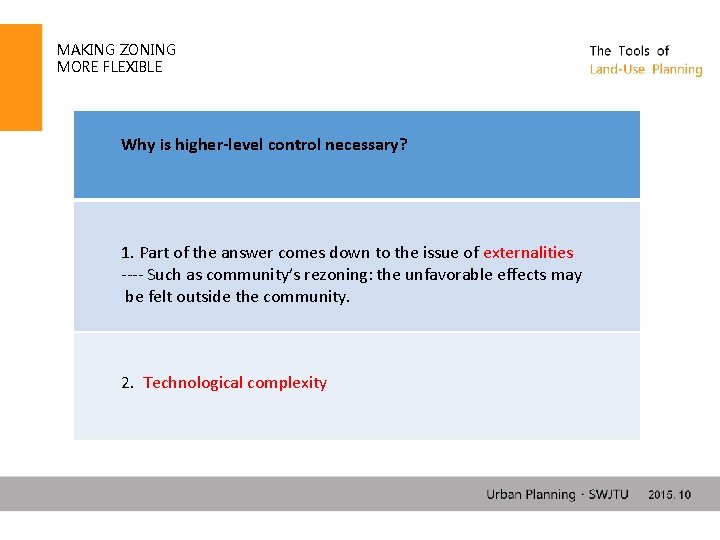
MAKING ZONING MORE FLEXIBLE Why is higher-level control necessary? 1. Part of the answer comes down to the issue of externalities ---- Such as community’s rezoning: the unfavorable effects may be felt outside the community. 2. Technological complexity
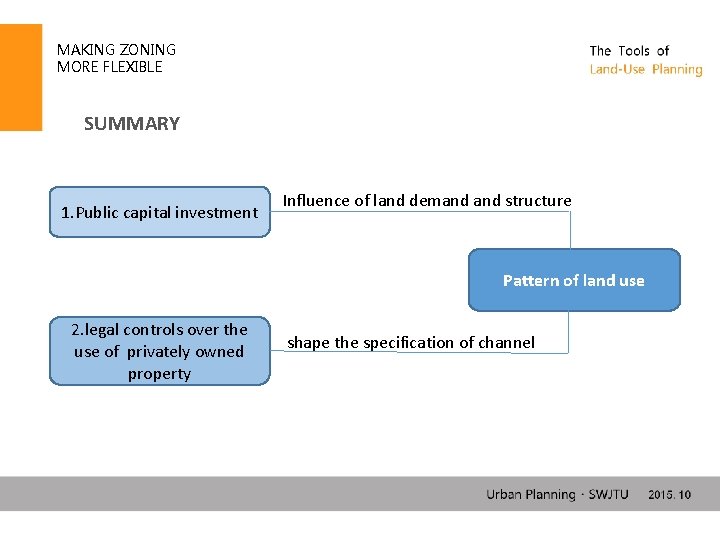
MAKING ZONING MORE FLEXIBLE SUMMARY 1. Public capital investment Influence of land demand structure Pattern of land use 2. legal controls over the use of privately owned property shape the specification of channel
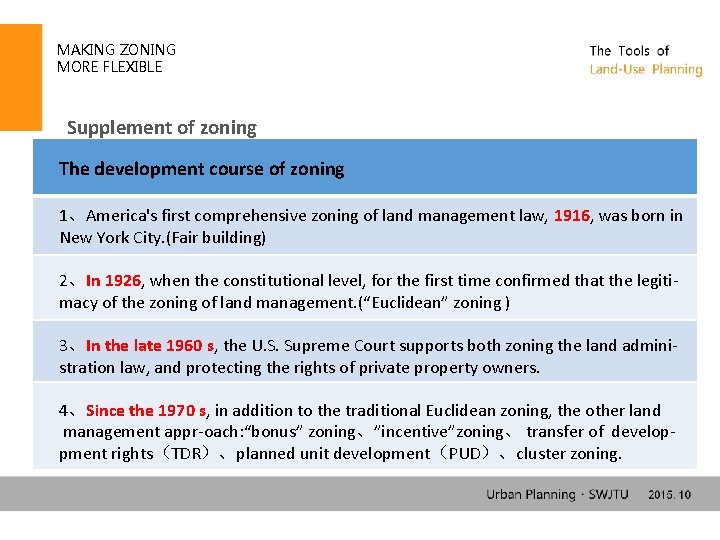
MAKING ZONING MORE FLEXIBLE Supplement of zoning The development course of zoning 1、America's first comprehensive zoning of land management law, 1916, was born in New York City. (Fair building) 2、In 1926, when the constitutional level, for the first time confirmed that the legitimacy of the zoning of land management. (“Euclidean” zoning ) 3、In the late 1960 s, the U. S. Supreme Court supports both zoning the land administration law, and protecting the rights of private property owners. 4、Since the 1970 s, in addition to the traditional Euclidean zoning, the other land management appr-oach: “bonus” zoning、”incentive”zoning、 transfer of developpment rights(TDR)、planned unit development(PUD)、cluster zoning.
- Slides: 62