
Contemporary World Contemporary history describes the period timeframe
Contemporary. World

Contemporary history describes the period timeframe that is without any intervening time closely connected to the present day and is a certain perspective of modern history. The term "contemporary history" has been in use at least by the early 19 th century. In the widest context of this use, contemporary history is that part of history still in living memory. Based on human lifespan, contemporary history would extend for a period of approximately 80 years. Obviously, this concept shifts in absolute terms as the generations pass. In a narrower sense, "contemporary history" may refer to the history remembered by most adults currently living, extending to about a generation. As the median age of people living on Earth is currently 30 years as of the present (2013), approximately half the people living today were born prior to 1983.
From the perspective of the 2010 s, thus, contemporary history may include the period since the mid-tolate 20 th century, including the postwar period and the Cold War and would nearly always include the period from about 1985 to present which is within the memory of the majority of living people. The present age possesses a distinct character of its own.
CONTEMPORARY LITERARURE Contemporary Literature is a highly complex literary movement that is difficult to define. The best defining achievement of Contemporary Literature that distinguishes it from all other literary movements is the joy of life over the destruction that occurs all around the world. Whether trauma is across nations or is personal, Contemporary Literature seeks to connect individuals to provide assurance that all human beings are not along in their traumatic experiences.
Everyone is connected through their trauma and life will continue despite and horrific situation. Life is worth living and being praised in spite of the terrible situations that occur, whether it is the destruction of war, weapons of mass destruction, or the personal traumas of losing family and living through sexual abuse. CONTEMPORARY LITERATURE

The Handsomest Drowned Man in the World By Gabriel García Márquez CONTEMPORARY LITERATURE
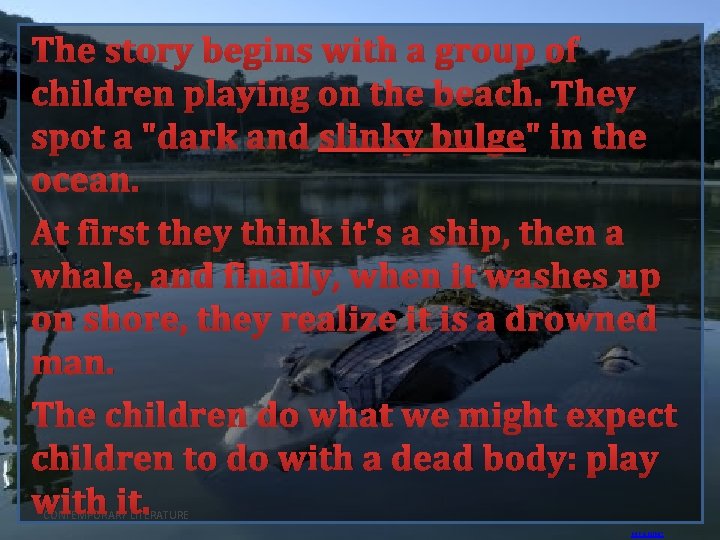
The story begins with a group of children playing on the beach. They spot a "dark and slinky bulge" in the ocean. At first they think it's a ship, then a whale, and finally, when it washes up on shore, they realize it is a drowned man. The children do what we might expect children to do with a dead body: play with it. CONTEMPORARY LITERATURE MEANING
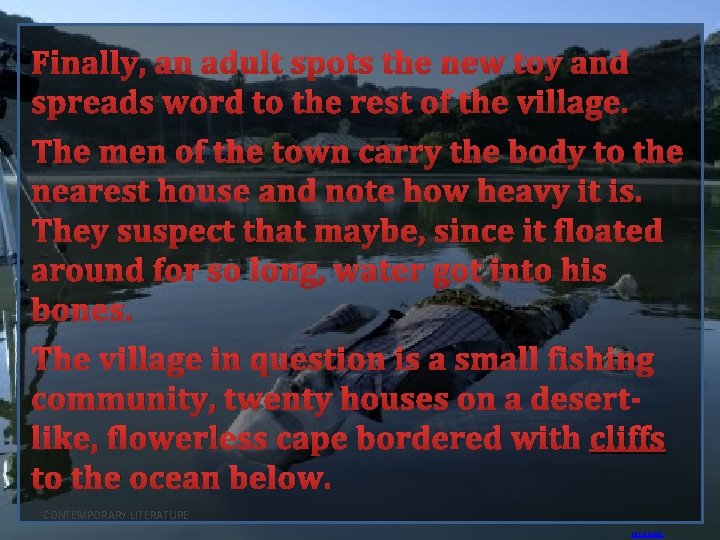
Finally, an adult spots the new toy and spreads word to the rest of the village. The men of the town carry the body to the nearest house and note how heavy it is. They suspect that maybe, since it floated around for so long, water got into his bones. The village in question is a small fishing community, twenty houses on a desertlike, flowerless cape bordered with cliffs to the ocean below. CONTEMPORARY LITERATURE MEANING
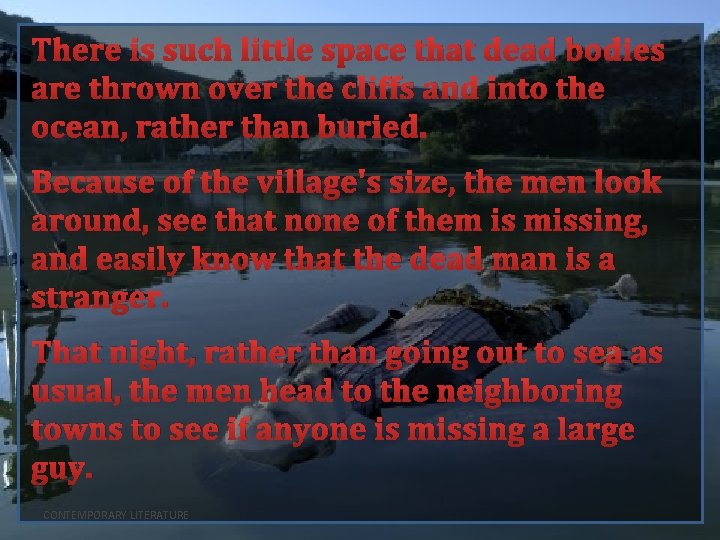
There is such little space that dead bodies are thrown over the cliffs and into the ocean, rather than buried. Because of the village's size, the men look around, see that none of them is missing, and easily know that the dead man is a stranger. That night, rather than going out to sea as usual, the men head to the neighboring towns to see if anyone is missing a large guy. CONTEMPORARY LITERATURE
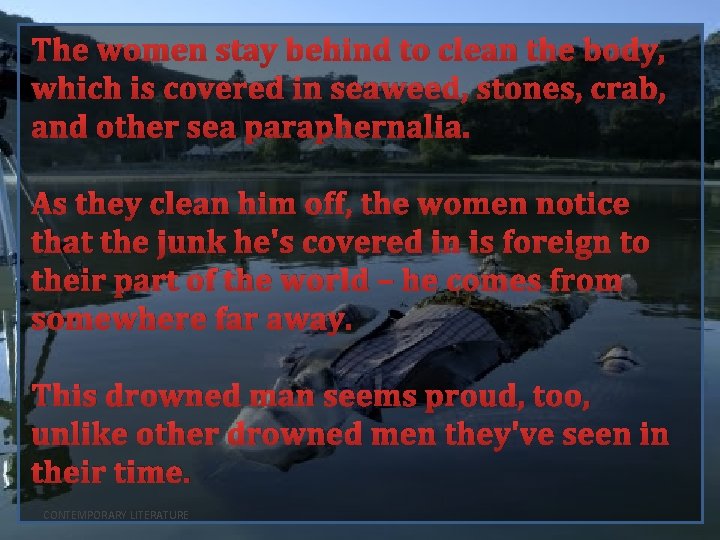
The women stay behind to clean the body, which is covered in seaweed, stones, crab, and other sea paraphernalia. As they clean him off, the women notice that the junk he's covered in is foreign to their part of the world – he comes from somewhere far away. This drowned man seems proud, too, unlike other drowned men they've seen in their time. CONTEMPORARY LITERATURE
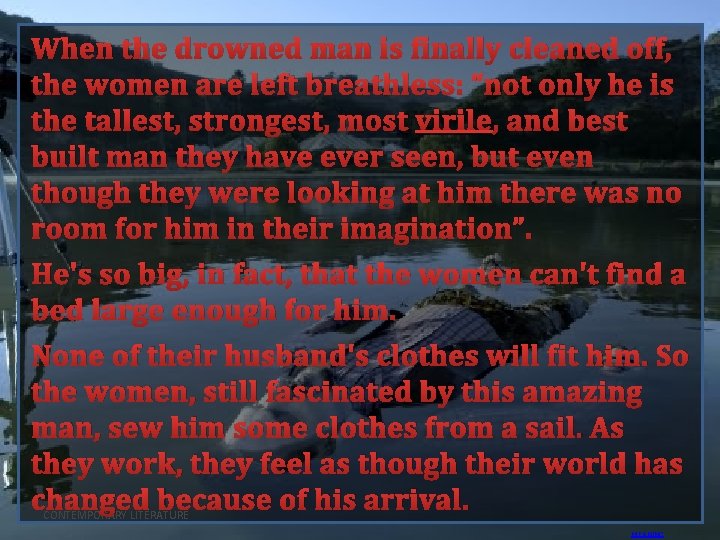
When the drowned man is finally cleaned off, the women are left breathless: “not only he is the tallest, strongest, most virile, and best built man they have ever seen, but even though they were looking at him there was no room for him in their imagination”. He's so big, in fact, that the women can't find a bed large enough for him. None of their husband's clothes will fit him. So the women, still fascinated by this amazing man, sew him some clothes from a sail. As they work, they feel as though their world has changed because of his arrival. CONTEMPORARY LITERATURE MEANING
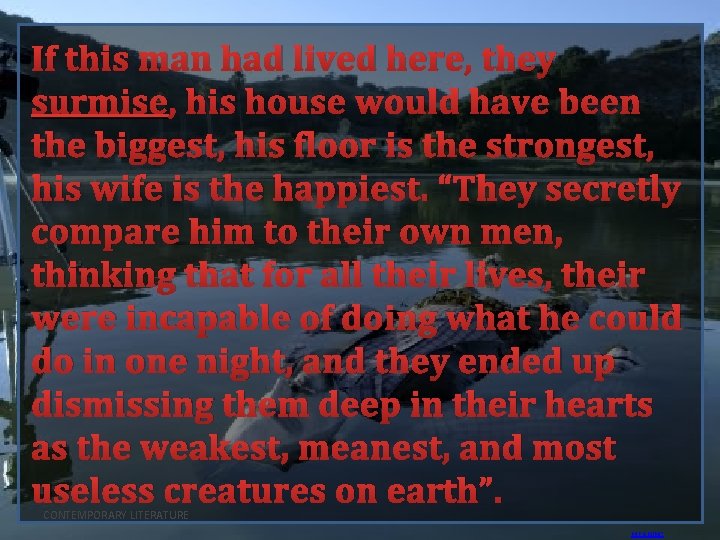
If this man had lived here, they surmise, his house would have been the biggest, his floor is the strongest, his wife is the happiest. “They secretly compare him to their own men, thinking that for all their lives, their were incapable of doing what he could do in one night, and they ended up dismissing them deep in their hearts as the weakest, meanest, and most useless creatures on earth”. CONTEMPORARY LITERATURE MEANING
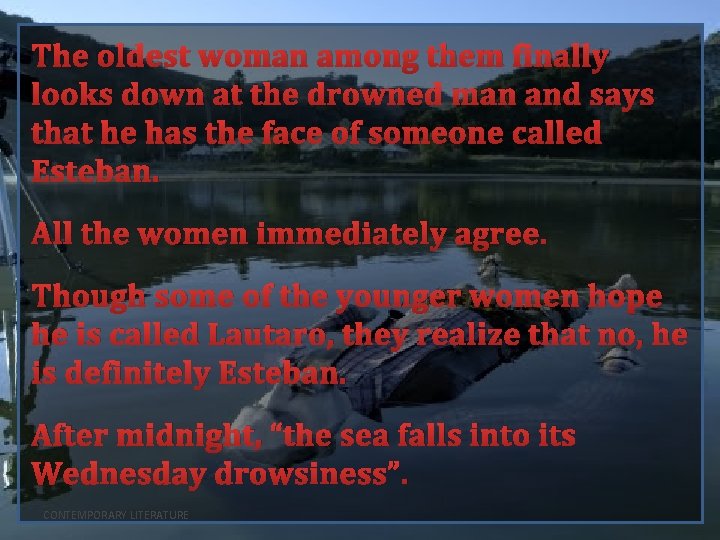
The oldest woman among them finally looks down at the drowned man and says that he has the face of someone called Esteban. All the women immediately agree. Though some of the younger women hope he is called Lautaro, they realize that no, he is definitely Esteban. After midnight, “the sea falls into its Wednesday drowsiness”. CONTEMPORARY LITERATURE
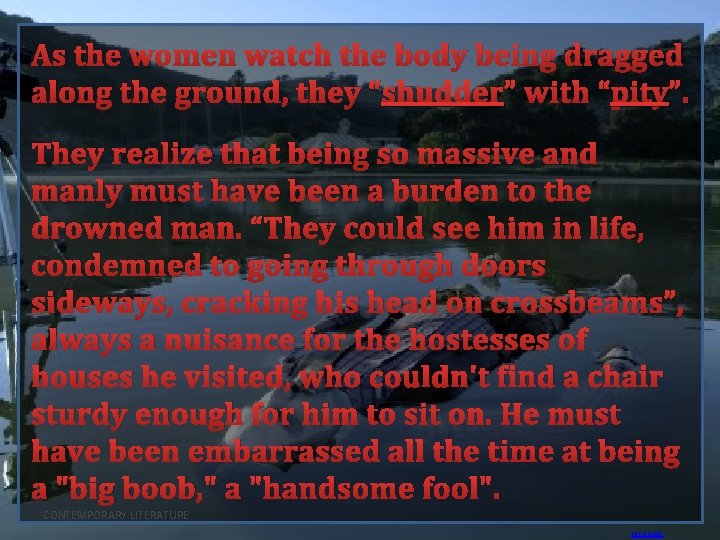
As the women watch the body being dragged along the ground, they “shudder” with “pity”. They realize that being so massive and manly must have been a burden to the drowned man. “They could see him in life, condemned to going through doors sideways, cracking his head on crossbeams”, always a nuisance for the hostesses of houses he visited, who couldn't find a chair sturdy enough for him to sit on. He must have been embarrassed all the time at being a "big boob, " a "handsome fool". CONTEMPORARY LITERATURE MEANING
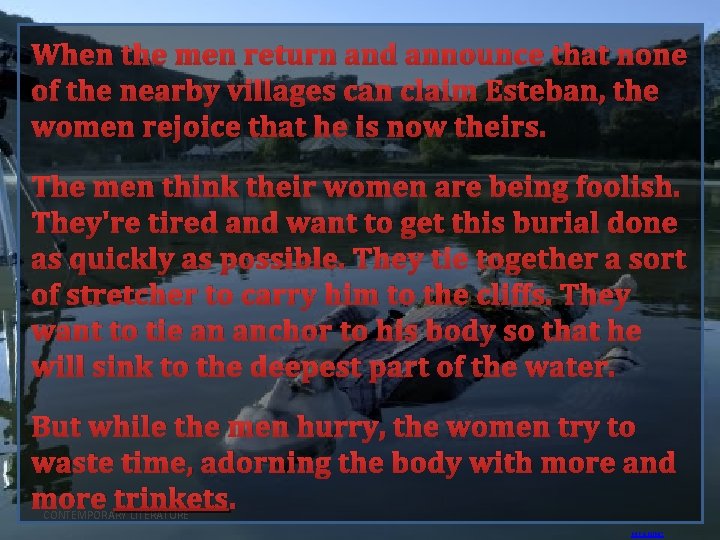
When the men return and announce that none of the nearby villages can claim Esteban, the women rejoice that he is now theirs. The men think their women are being foolish. They're tired and want to get this burial done as quickly as possible. They tie together a sort of stretcher to carry him to the cliffs. They want to tie an anchor to his body so that he will sink to the deepest part of the water. But while the men hurry, the women try to waste time, adorning the body with more and more trinkets. CONTEMPORARY LITERATURE MEANING
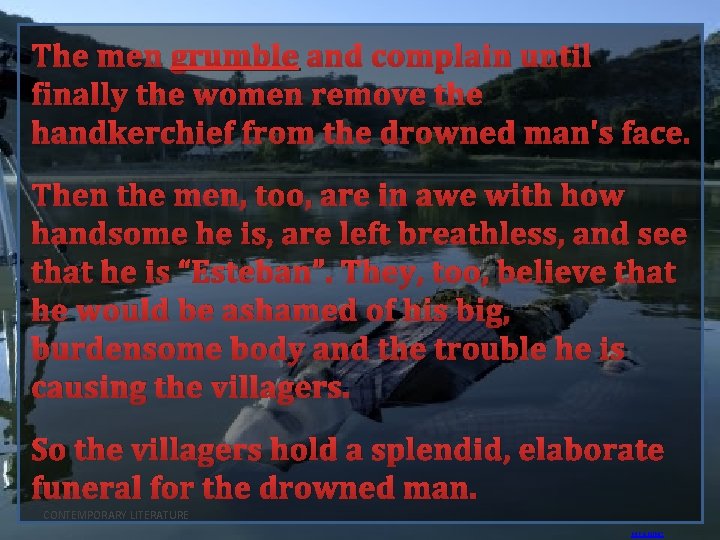
The men grumble and complain until finally the women remove the handkerchief from the drowned man's face. Then the men, too, are in awe with how handsome he is, are left breathless, and see that he is “Esteban”. They, too, believe that he would be ashamed of his big, burdensome body and the trouble he is causing the villagers. So the villagers hold a splendid, elaborate funeral for the drowned man. CONTEMPORARY LITERATURE MEANING
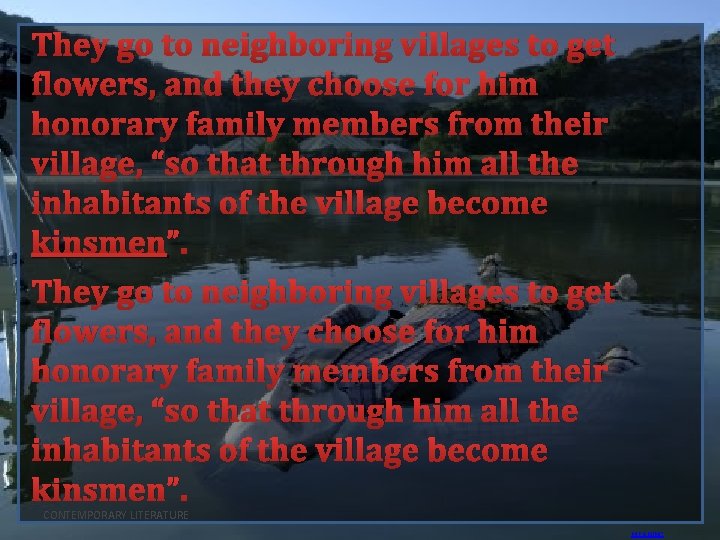
They go to neighboring villages to get flowers, and they choose for him honorary family members from their village, “so that through him all the inhabitants of the village become kinsmen”. CONTEMPORARY LITERATURE MEANING
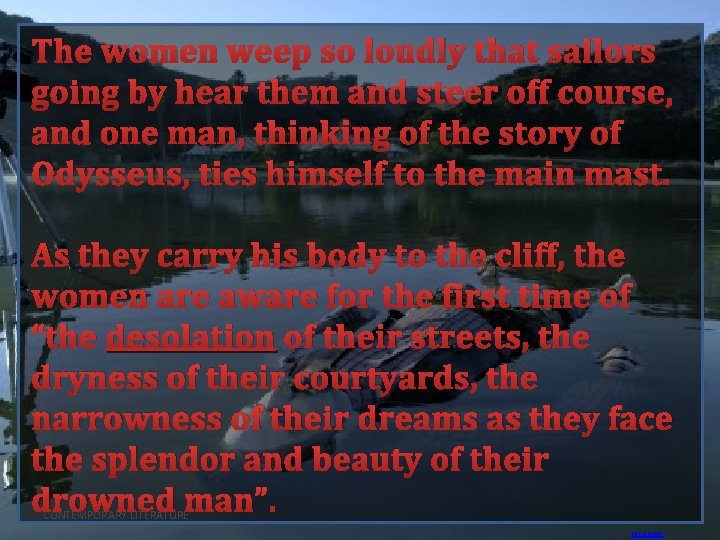
The women weep so loudly that sailors going by hear them and steer off course, and one man, thinking of the story of Odysseus, ties himself to the main mast. As they carry his body to the cliff, the women are aware for the first time of “the desolation of their streets, the dryness of their courtyards, the narrowness of their dreams as they face the splendor and beauty of their drowned man”. CONTEMPORARY LITERATURE MEANING
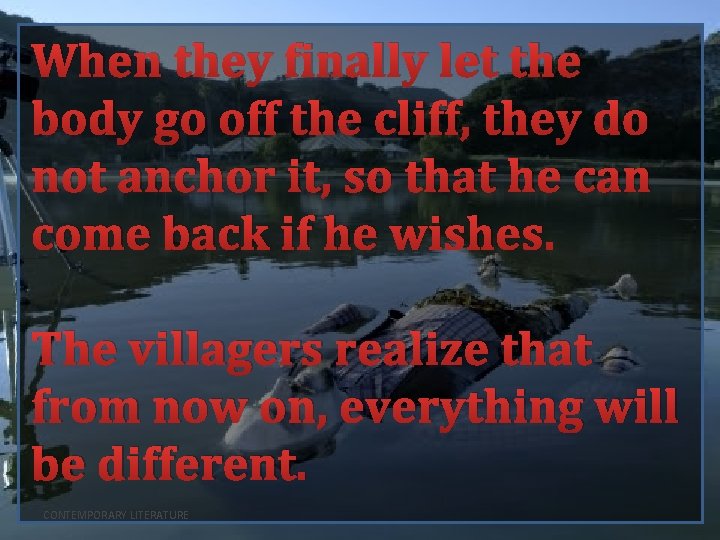
When they finally let the body go off the cliff, they do not anchor it, so that he can come back if he wishes. The villagers realize that from now on, everything will be different. CONTEMPORARY LITERATURE
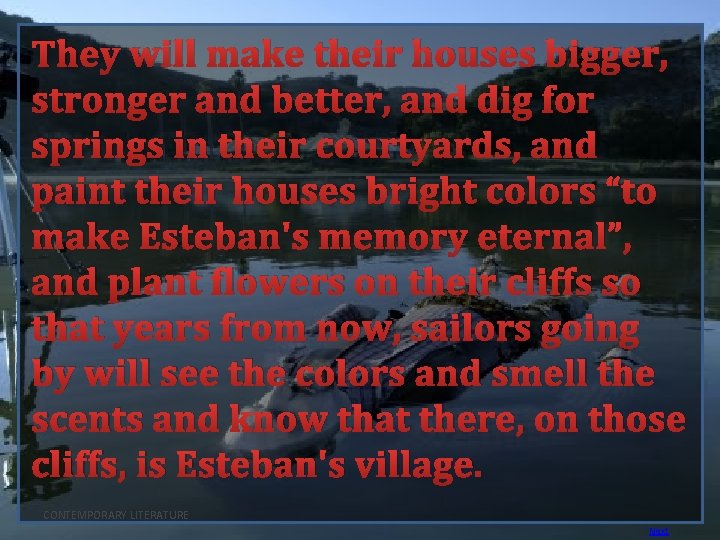
They will make their houses bigger, stronger and better, and dig for springs in their courtyards, and paint their houses bright colors “to make Esteban's memory eternal”, and plant flowers on their cliffs so that years from now, sailors going by will see the colors and smell the scents and know that there, on those cliffs, is Esteban's village. CONTEMPORARY LITERATURE Next
VOCABULARY WORDS CONTEMPORARY LITERATURE
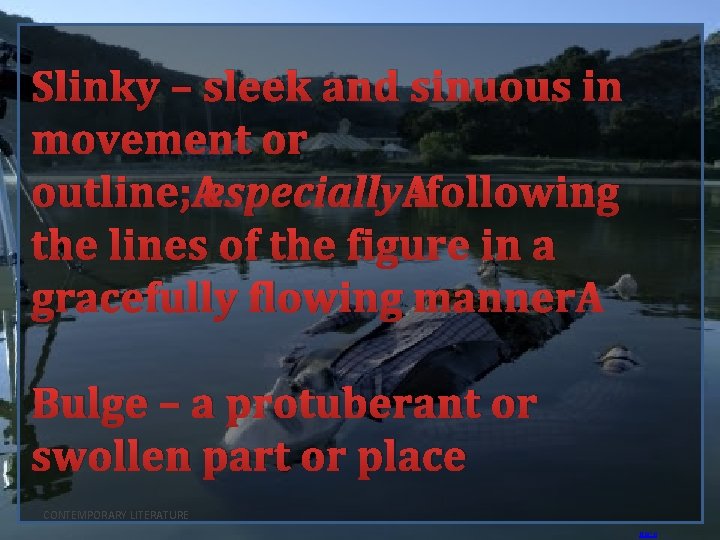
Slinky – sleek and sinuous in movement or outline; especially : following the lines of the figure in a gracefully flowing manner Bulge – a protuberant or swollen part or place CONTEMPORARY LITERATURE BACK
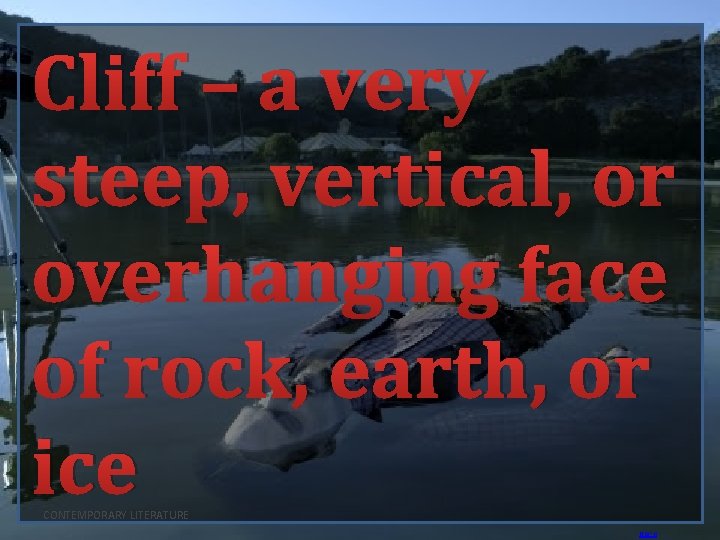
Cliff – a very steep, vertical, or overhanging face of rock, earth, or ice CONTEMPORARY LITERATURE BACK

Virile – having the nature, properties, or qualities of an adult male; specifically : capa ble of functioning as a male in copulation CONTEMPORARY LITERATURE BACK

Surmise – to form a notion of from scanty evidence CONTEMPORARY LITERATURE BACK
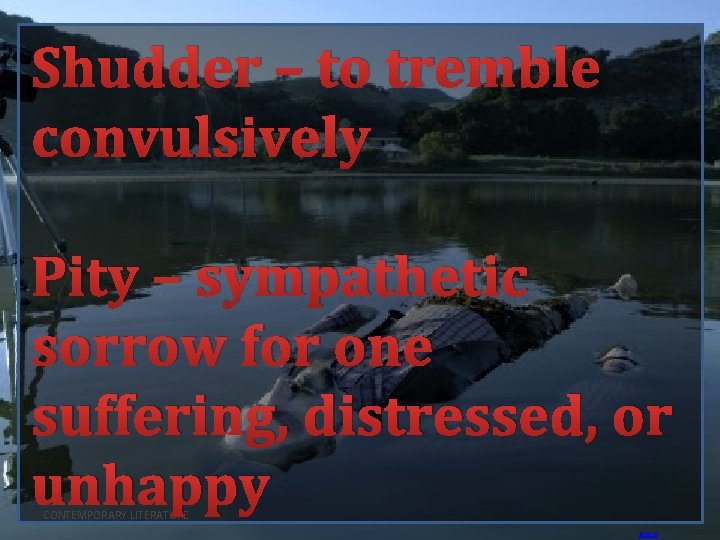
Shudder – to tremble convulsively Pity – sympathetic sorrow for one suffering, distressed, or unhappy CONTEMPORARY LITERATURE BACK

Trinkets – a small ornament (as a jewel or ring) CONTEMPORARY LITERATURE BACK
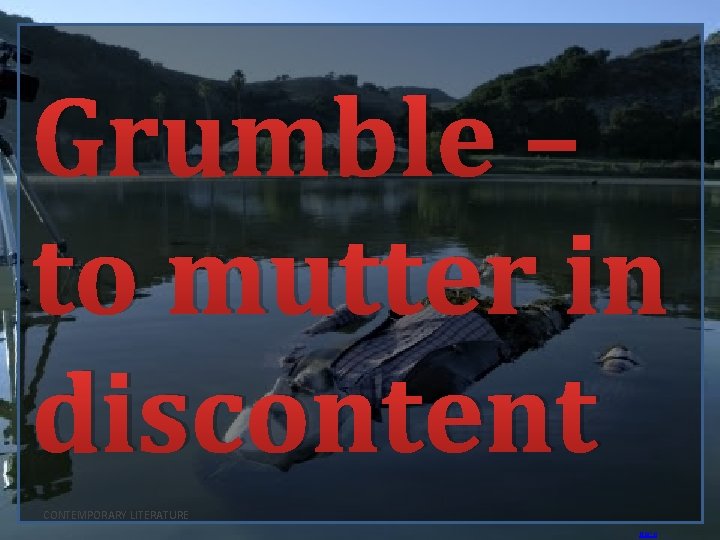
Grumble – to mutter in discontent CONTEMPORARY LITERATURE BACK
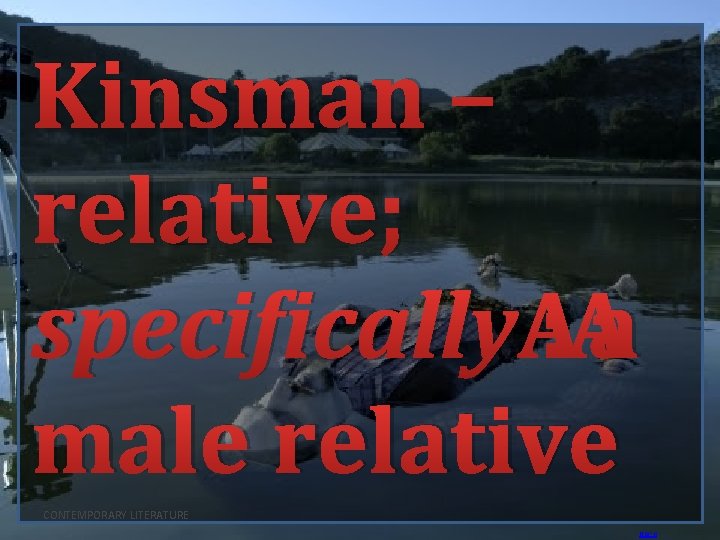
Kinsman – relative; specifically : a male relative CONTEMPORARY LITERATURE BACK
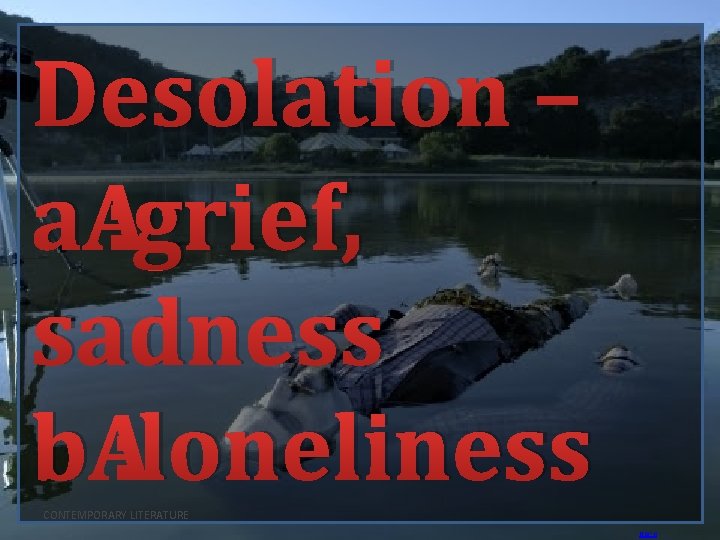
Desolation – a : grief, sadness b : loneliness CONTEMPORARY LITERATURE BACK
- Slides: 30