
Contemporary Perspectives What is a perspective n What

- Slides: 18
Contemporary Perspectives
What is a “perspective”? n What do you think? ? ?
A Perspective: is a conceptual framework to examine a given phenomenon. n has a set of basic assumptions. n Determines which methods (data collection, analysis) will be used to study a given phenomenon. n Can also be referred to as an “approach” in psychology n
Perspectives in Psychology n Biological n Psychodynamic (Psychoanalytical) n Behavioral n Cognitive n Humanistic n Evolutionary n Social-Cultural n Biopsychosocial
1. Biological Perspective n Basic assumptions: n 1. Biology plays a role in behavior. n 2. The physical body affects behavior and thought.
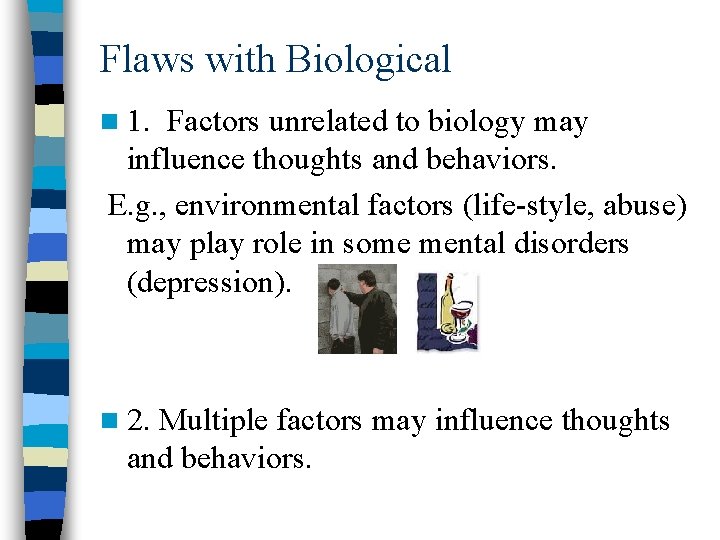
Flaws with Biological n 1. Factors unrelated to biology may influence thoughts and behaviors. E. g. , environmental factors (life-style, abuse) may play role in some mental disorders (depression). n 2. Multiple factors may influence thoughts and behaviors.
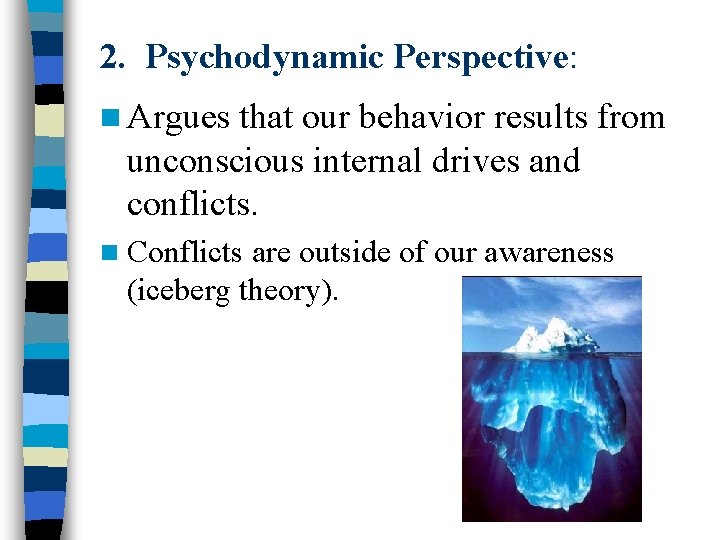
2. Psychodynamic Perspective: n Argues that our behavior results from unconscious internal drives and conflicts. n Conflicts are outside of our awareness (iceberg theory).
Criticism of Psychodynamic: n 1. Freud had no scientific data to support his theories. n 2. Freud’s theories (unconscious, libido, etc. ) cannot be observed. n 3. Theory explains behavior (post-hoc) after the fact. n 4. Observations not representative of population.
3. Behavior Perspective n Focuses on observable behaviors. n Premise—abnormal behavior is learned!! n Learning (classical & operant conditioning, modeling)
Criticisms of Behavior: n 1. Abnormal behavior not connected to particular learning experiences (schizophrenia). n 2. Simplistic circular reasoning (Description as explanation). n 3. Useful for treatment, but not as cause for most mental disorders.
4. Evolutionary Perspective n Focuses on the possible role of evolved psychological mechanisms (inherited tendencies shaped by evolution) in human behavior n Looks at the way the mind works and why it works as it does. n Behavior is seen as having an adaptive or survival value.
Criticism of Evolutionary n Too much attention paid to “adaptations” n It is argued that this isn’t really psychology, just an extension of biology n This is a new theory and still fairly controversial
5. Cognitive Perspective: n Premise- how our minds organize and interpret information n Focuses on memory, intelligence, perception, problem solving, and learning
Criticisms of Cognitive n Depends on “controlled” experiments rather than “real world” n Doesn’t account for genetic factors like heredity
6. Humanistic Perspective: n Theorists argue we are driven to self- actualize, that is, to fulfill our potential for goodness and growth. n How we meet our needs for love and acceptance and achieve self-fulfillment. n More from early roots of psychology in the field of philosophy.
Criticism of Humanistic n Concepts are too vague n Subjective ideas are too hard to objectify (e. g. an experience that is real for one individual may not be real for another person) n Not a “real science” because it’s too much “common sense” and not enough objectivity
7. Social-cultural Perspective n Focuses on the relationship between social behavior and culture. n Social and cultural factors that can influence behavior
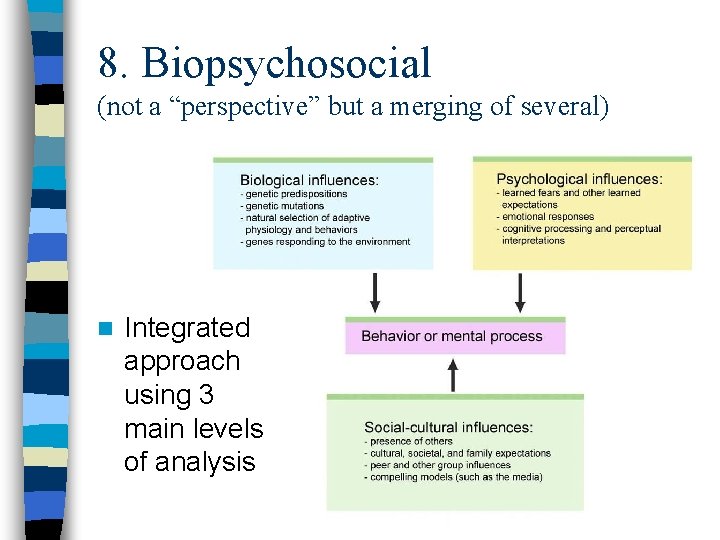
8. Biopsychosocial (not a “perspective” but a merging of several) n Integrated approach using 3 main levels of analysis