
Contemporary Logistics Eleventh Edition Chapter 14 International Logistics





- Slides: 43
Contemporary Logistics Eleventh Edition Chapter 14 International Logistics Copyright©© 2015, 2012, 2009 Pearson. Education, Inc. All. Rights. Reserved Copyright 1
Learning Objectives • To discuss macroenvironmental influences on international logistics • To explain documentation as well as terms of sale and methods of payment for international shipments • To distinguish among the unique activities of international trade specialists • To examine transportation and inventory considerations in international distribution • To introduce you to the Logistics Performance Index Copyright © 2015, 2012, 2009 Pearson Education, Inc. All Rights Reserved 2
3 Overview of Class • Chapter 14 • In-Class Activities (seen on pwpt) – Participation Copyright © 2015, 2012, 2009 Pearson Education, Inc. All Rights Reserved 3
News and Books • Inbound Logistics • Good Read: " • The text is directed at the users of international logistics services: it covers all of the concepts that are important to managers who are actively exporting or importing goods or are otherwise involved in international trade operations. All of the relevant issues are thoroughly explained, including documentation, terms of payment, terms of trade (Incoterms), exchange rate exposure, international insurance, Customs clearance, agency and distributorship sales contracts, packaging, transportation, and security issues. 2015 Cengage Learning Copyright © 2015, 2012, 2009 Pearson©Education, Inc. All Rights Reserved 4
International Logistics Key Terms (1 of 3) • Balance of payments • Gross world product • Cargo preference • Import quota • Certificate of origin • Incoterms • Commercial invoice • International freight forwarders • Embargoes • Export management company • International logistics • Export packers Copyright © 2015, 2012, 2009 Pearson Education, Inc. All Rights Reserved 5
International Logistics Key Terms (2 of 3) • Letter of credit • Nontariff barriers • Load centers • Nonvessel-operating common carrier (NVOCC) • Logistics performance index (LPI) • Macroenvironmental influences • Ocean carrier alliances • Open account • Methods of payment Copyright © 2015, 2012, 2009 Pearson Education, Inc. All Rights Reserved 6
International Logistics Key Terms (3 of 3) • Open skies agreement • Shipper’s export declaration (SED) • Shipper’s letter of instruction (SLI) • Shipping conferences • Short-sea shipping • Tariffs Copyright © 2015, 2012, 2009 Pearson Education, Inc. All Rights Reserved 7
International Logistics (1 of 2) • International logistics • logistics activities associated with goods that are sold across national boundaries. • International logistics occurs when: • A firm exports a portion of a product made or grown • A firm imports raw materials • Goods are partially assembled in one country and then shipped to another, where they are further assembled or processed Copyright © 2015, 2012, 2009 Pearson Education, Inc. All Rights Reserved 8
International Logistics (2 of 2) • International logistics occurs when: • The firm is global in outlook and sees almost all nations as being markets, sources of supply, or sites for markets or for assembly operations • Because of geography, a nation’s domestic commerce crosses foreign borders, often in bond Copyright © 2015, 2012, 2009 Pearson Education, Inc. All Rights Reserved 9
Macroenvironmental Influences on International Logistics (1 of 8) • Macroenvironmental influences • refer to the uncontrollable forces and conditions facing an organization and include cultural, demographic, economic, natural, political, and technological factors. • Factors for macroenvironmental influences • • • Cultural Demographic Economic Natural Political Technological Copyright © 2015, 2012, 2009 Pearson Education, Inc. All Rights Reserved 10
Macroenvironmental Influences on International Logistics (2 of 8) • Political factors • Political restrictions on international trade can take a variety of forms • Tariffs • Nontariff barriers • Import quota • Limits the amount or product (either in units or by value) that may be imported from any one country during a period of time • Embargoes • the prohibition of trade between particular countries Copyright © 2015, 2012, 2009 Pearson Education, Inc. All Rights Reserved 11
Macroenvironmental Influences on International Logistics (3 of 8) • Political factors • Degree of federal government in cross-border trade • Balance of payments • system of accounts that records a country’s international financial transactions 1 • Subsidies • Cargo preference rules Copyright © 2015, 2012, 2009 Pearson Education, Inc. All Rights Reserved 12
Macroenvironmental Influences on International Logistics (4 of 8) • Economic factors • • • Currency fluctuations Market size Income Infrastructure Economic integration Copyright © 2015, 2012, 2009 Pearson Education, Inc. All Rights Reserved 13
Macroenvironmental Influences on International Logistics (5 of 8) • Cultural factors • • • Religion Values Rituals Beliefs Languages Copyright © 2015, 2012, 2009 Pearson Education, Inc. All Rights Reserved 14
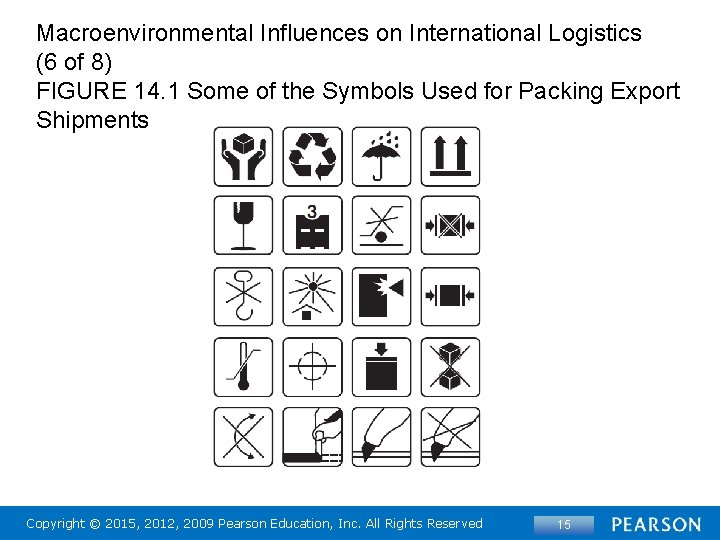
Macroenvironmental Influences on International Logistics (6 of 8) FIGURE 14. 1 Some of the Symbols Used for Packing Export Shipments Copyright © 2015, 2012, 2009 Pearson Education, Inc. All Rights Reserved 15
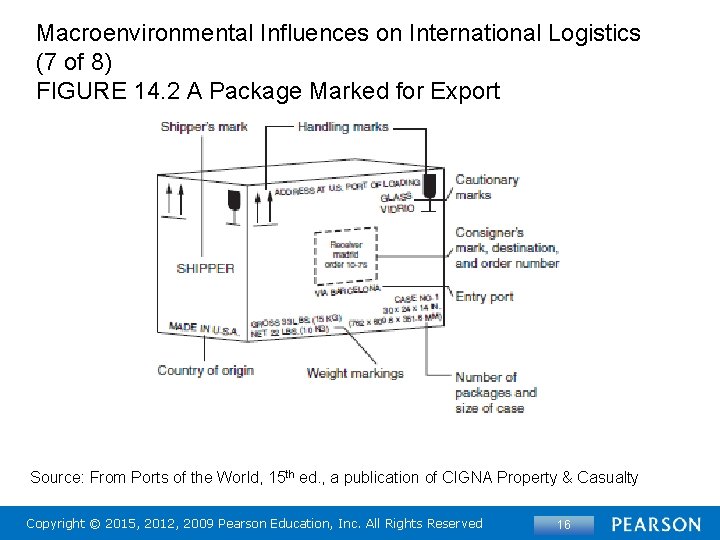
Macroenvironmental Influences on International Logistics (7 of 8) FIGURE 14. 2 A Package Marked for Export Source: From Ports of the World, 15 th ed. , a publication of CIGNA Property & Casualty Copyright © 2015, 2012, 2009 Pearson Education, Inc. All Rights Reserved 16
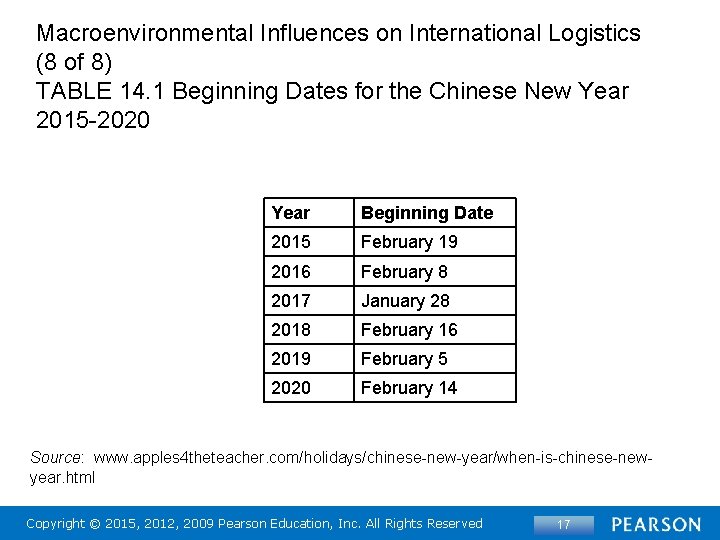
Macroenvironmental Influences on International Logistics (8 of 8) TABLE 14. 1 Beginning Dates for the Chinese New Year 2015 -2020 Year Beginning Date 2015 February 19 2016 February 8 2017 January 28 2018 February 16 2019 February 5 2020 February 14 Source: www. apples 4 theteacher. com/holidays/chinese-new-year/when-is-chinese-newyear. html Copyright © 2015, 2012, 2009 Pearson Education, Inc. All Rights Reserved 17
International Documentation 1 (1 of 8) • Flow of documentation is as much a part of the main logistical flow as the flow of product • Domestic shipments typically only require several pieces of documentation • Export shipments typically require approximately 10 pieces of documentation • Cross-border trades can require more than 100 separate documents 1 This material in this section is drawn from Donald F. Wood, Anthony Barone, Paul R. Murphy, and Daniel L. Wardlow, International Logistics, 2 nd ed. (New York: Amacom, 2002), Chapter 12. Copyright © 2015, 2012, 2009 Pearson Education, Inc. All Rights Reserved 18
International Documentation (2 of 8) • Necessary documents are required at the point of importation • Commonly used documents include: • Certificate of origin • Commercial invoice • Shipper’s export declaration (SED) • Shipper’s letter of instruction (SLI) Copyright © 2015, 2012, 2009 Pearson Education, Inc. All Rights Reserved 19
International Documentation (3 of 8) • Terms of sale involves: • Parties working within the negotiations channel • Looking at the possible logistics channels • Determining when and where to transfer the following between buyer and seller: • Physical goods • Payment for the goods, freight charges, and insurance for the in-transit goods • Legal title to the goods • Required documentation • Responsibility for controlling or caring for the goods in transit, i. e. livestock Copyright © 2015, 2012, 2009 Pearson Education, Inc. All Rights Reserved 20
International Documentation (4 of 8) • Terms of sale involves: • Parties working within the negotiations channel • Looking at the possible logistics channels • Determining when and where to transfer the following between buyer and seller: • Physical goods • Payment for the goods, freight charges, and insurance for the in-transit goods • Legal title to the goods • Required documentation • Responsibility for controlling or caring for the goods in transit, i. e. livestock Copyright © 2015, 2012, 2009 Pearson Education, Inc. All Rights Reserved 21
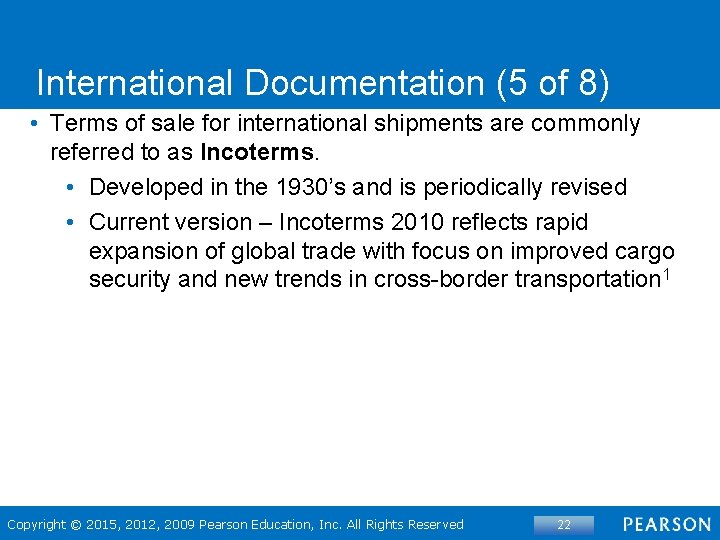
International Documentation (5 of 8) • Terms of sale for international shipments are commonly referred to as Incoterms. • Developed in the 1930’s and is periodically revised • Current version – Incoterms 2010 reflects rapid expansion of global trade with focus on improved cargo security and new trends in cross-border transportation 1 Copyright © 2015, 2012, 2009 Pearson Education, Inc. All Rights Reserved 22
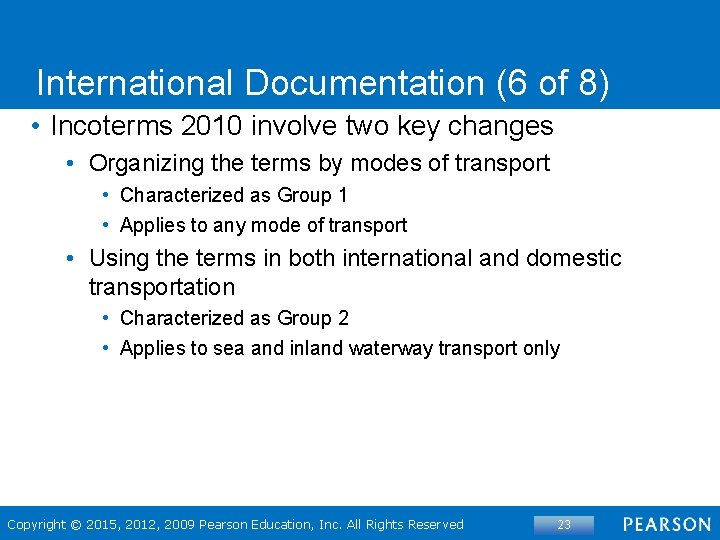
International Documentation (6 of 8) • Incoterms 2010 involve two key changes • Organizing the terms by modes of transport • Characterized as Group 1 • Applies to any mode of transport • Using the terms in both international and domestic transportation • Characterized as Group 2 • Applies to sea and inland waterway transport only Copyright © 2015, 2012, 2009 Pearson Education, Inc. All Rights Reserved 23
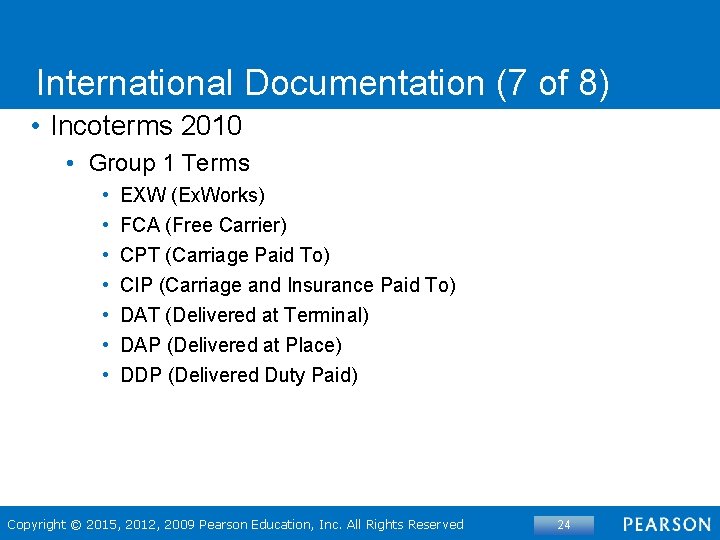
International Documentation (7 of 8) • Incoterms 2010 • Group 1 Terms • • EXW (Ex. Works) FCA (Free Carrier) CPT (Carriage Paid To) CIP (Carriage and Insurance Paid To) DAT (Delivered at Terminal) DAP (Delivered at Place) DDP (Delivered Duty Paid) Copyright © 2015, 2012, 2009 Pearson Education, Inc. All Rights Reserved 24
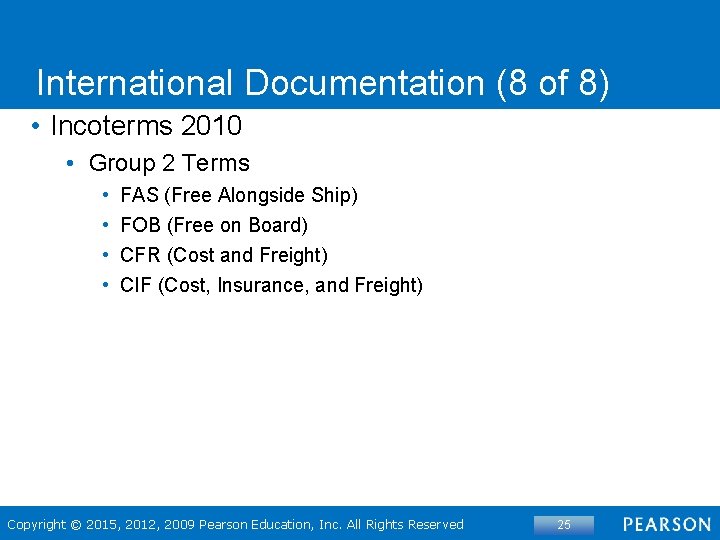
International Documentation (8 of 8) • Incoterms 2010 • Group 2 Terms • • FAS (Free Alongside Ship) FOB (Free on Board) CFR (Cost and Freight) CIF (Cost, Insurance, and Freight) Copyright © 2015, 2012, 2009 Pearson Education, Inc. All Rights Reserved 25
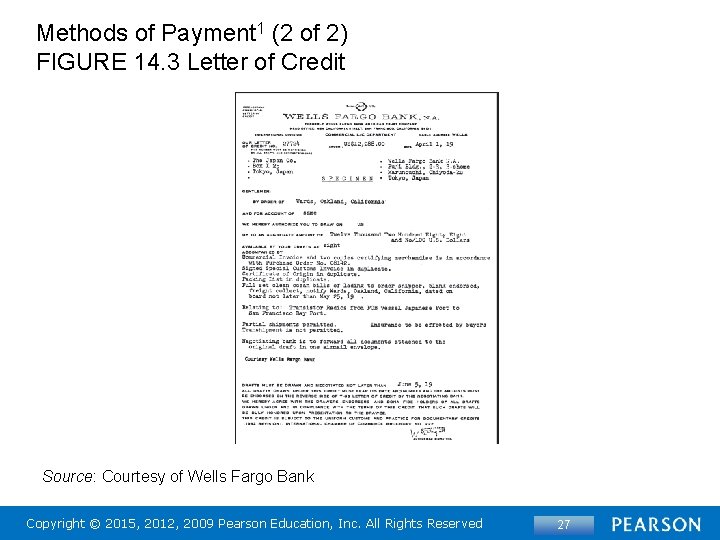
Methods of Payment 1 (1 of 2) • Methods of payment refer to the manner by which a seller will be paid by a buyer. • Much more challenging in international logistics vs. domestic logistics • Four methods of payment include: • • Cash in advance Letters of credit Bills of exchange Open account 1 The material in this section is largely drawn from Jim Sherlock and Jonathan Reuvid, eds. , The Handbook of International Trade (Edinburgh, UK: GMB Publishing, 2005), Part 8. Copyright © 2015, 2012, 2009 Pearson Education, Inc. All Rights Reserved 26
Methods of Payment 1 (2 of 2) FIGURE 14. 3 Letter of Credit Source: Courtesy of Wells Fargo Bank Copyright © 2015, 2012, 2009 Pearson Education, Inc. All Rights Reserved 27
Methods of Payment • Payment method • Should be established at the time that a shipment price is decided upon • Can be influenced by key factors such as • the country the product is to be sold in • the seller’s assessment of buyer risk Copyright © 2015, 2012, 2009 Pearson Education, Inc. All Rights Reserved 28
International Trade Specialists (1 of 4) • International Freight Forwarders • Specialize in handling either vessel shipments or air shipments Copyright © 2015, 2012, 2009 Pearson Education, Inc. All Rights Reserved 29
International Trade Specialists (2 of 5) • Principle functions of International Freight Forwarders include: • Advising on acceptance of letters of credit • Booking space on carriers • Preparing an export declaration • Preparing an air waybill or bill of lading • Obtaining consular documents • Arranging for Insurance • Preparing and sending shipping notices and documents • Serving as general consultant on export matters Copyright © 2015, 2012, 2009 Pearson Education, Inc. All Rights Reserved 30
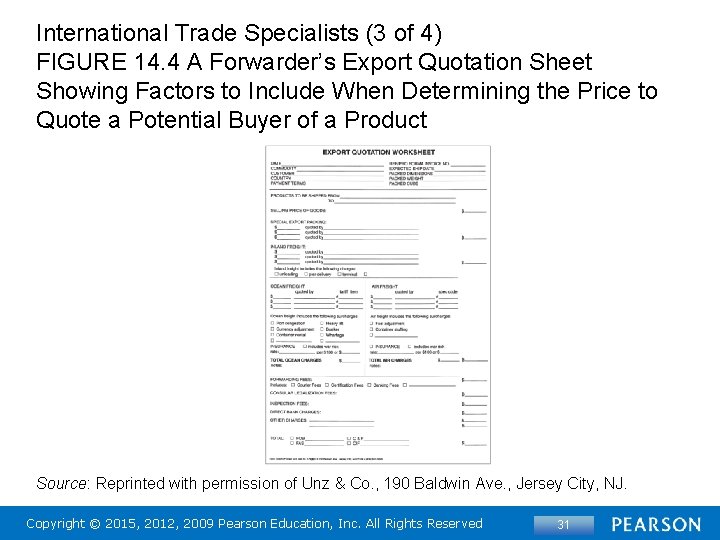
International Trade Specialists (3 of 4) FIGURE 14. 4 A Forwarder’s Export Quotation Sheet Showing Factors to Include When Determining the Price to Quote a Potential Buyer of a Product Source: Reprinted with permission of Unz & Co. , 190 Baldwin Ave. , Jersey City, NJ. Copyright © 2015, 2012, 2009 Pearson Education, Inc. All Rights Reserved 31
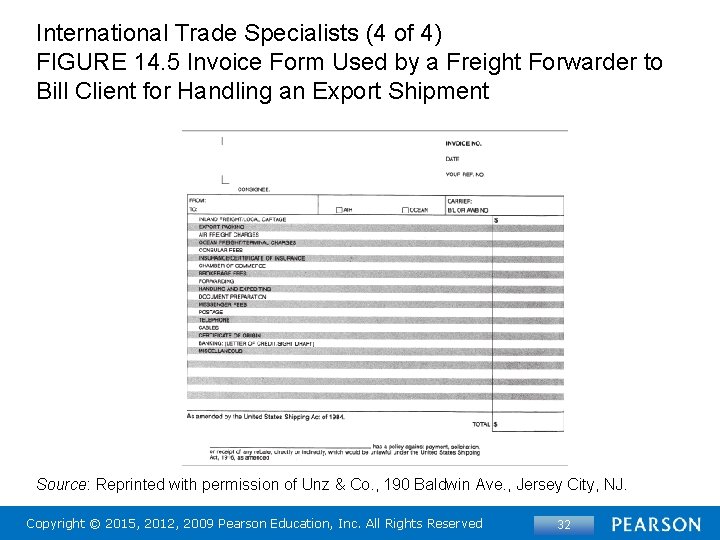
International Trade Specialists (4 of 4) FIGURE 14. 5 Invoice Form Used by a Freight Forwarder to Bill Client for Handling an Export Shipment Source: Reprinted with permission of Unz & Co. , 190 Baldwin Ave. , Jersey City, NJ. Copyright © 2015, 2012, 2009 Pearson Education, Inc. All Rights Reserved 32
International Trade and Supply Chain Specialists • Nonvessel-operating common carrier (NVOCC) • Export management company (EMC) • Export packers Copyright © 2015, 2012, 2009 Pearson Education, Inc. All Rights Reserved 33
Transportation Considerations in International Logistics (1 of 7) • Ocean shipping • International airfreight • Surface transportation Copyright © 2015, 2012, 2009 Pearson Education, Inc. All Rights Reserved 34
Transportation Considerations in International Logistics (2 of 7) • Ocean Shipping • Approximately 60% of cross-border shipments move by water transportation • Variety of ship types include: • • • Dry-bulk Dry cargo Liquid bulk Parcel tanker Containerships • Shipping conferences and alliances pool resources and extend market coverage Copyright © 2015, 2012, 2009 Pearson Education, Inc. All Rights Reserved 35
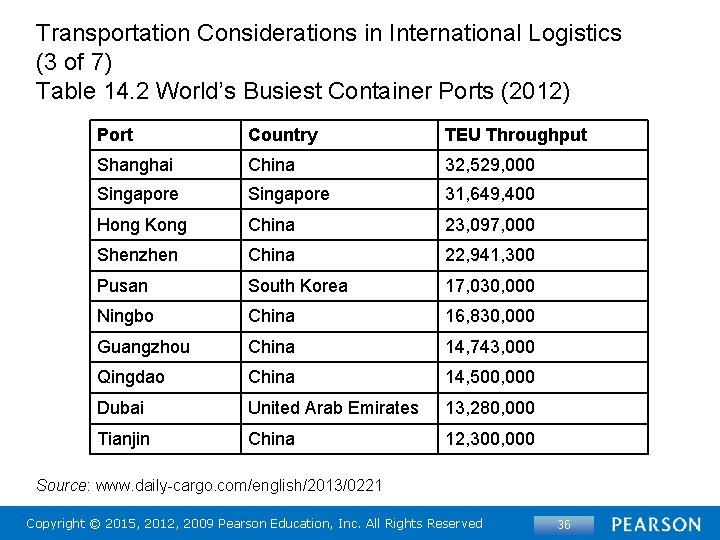
Transportation Considerations in International Logistics (3 of 7) Table 14. 2 World’s Busiest Container Ports (2012) Port Country TEU Throughput Shanghai China 32, 529, 000 Singapore 31, 649, 400 Hong Kong China 23, 097, 000 Shenzhen China 22, 941, 300 Pusan South Korea 17, 030, 000 Ningbo China 16, 830, 000 Guangzhou China 14, 743, 000 Qingdao China 14, 500, 000 Dubai United Arab Emirates 13, 280, 000 Tianjin China 12, 300, 000 Source: www. daily-cargo. com/english/2013/0221 Copyright © 2015, 2012, 2009 Pearson Education, Inc. All Rights Reserved 36
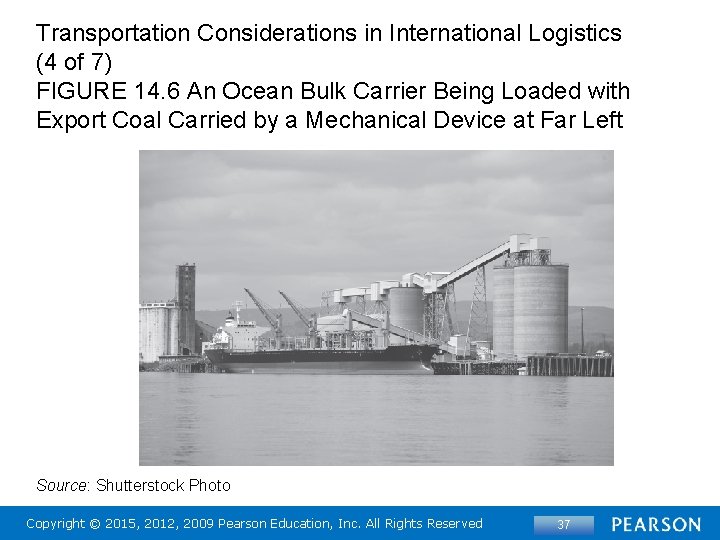
Transportation Considerations in International Logistics (4 of 7) FIGURE 14. 6 An Ocean Bulk Carrier Being Loaded with Export Coal Carried by a Mechanical Device at Far Left Source: Shutterstock Photo Copyright © 2015, 2012, 2009 Pearson Education, Inc. All Rights Reserved 37
Transportation Considerations in International Logistics (5 of 7) • International Airfreight • Three types of international airfreight operations include: • Charted aircraft • Integrated air carriers • Scheduled air carriers Copyright © 2015, 2012, 2009 Pearson Education, Inc. All Rights Reserved 38
Transportation Considerations in International Logistics (6 of 7) • Surface Transport Considerations • Transit times can be significantly impacted by a country’s infrastructure and modal operating characteristics. • Short-sea shipping (SSS) is an alternative to surface transporting Copyright © 2015, 2012, 2009 Pearson Education, Inc. All Rights Reserved 39
Transportation Considerations in International Logistics (7 of 7) FIGURE 14. 7 The European Short Sea Shipping Network Source: Courtesy of Dr. Jean-Paul Rodrigue, The Geography of Transport Systems, 2 nd edition, Routledge, 2013 Copyright © 2015, 2012, 2009 Pearson Education, Inc. All Rights Reserved 40
International Trade Inventories • Safety stocks must be large due to greater uncertainties, misunderstandings and or delays. • Inventory valuation is difficult due to continually changing exchange rates. • Product return (reverse logistics) policies must be understood. • Insufficient warehousing practices can lead to higher inventory carrying costs. Copyright © 2015, 2012, 2009 Pearson Education, Inc. All Rights Reserved 41
Logistics Performance Index (LPI) • Relatively new international logistics concept (2007) • Updated in 2010 • Created in recognition of the importance of logistics in global trade • Incorporates data for approximately 155 countries Copyright © 2015, 2012, 2009 Pearson Education, Inc. All Rights Reserved 42
43 Next Week • Presentations Copyright © 2015, 2012, 2009 Pearson Education, Inc. All Rights Reserved 43