
Contemporary Logic Design TwoLevel Logic Gate Logic Two




- Slides: 29
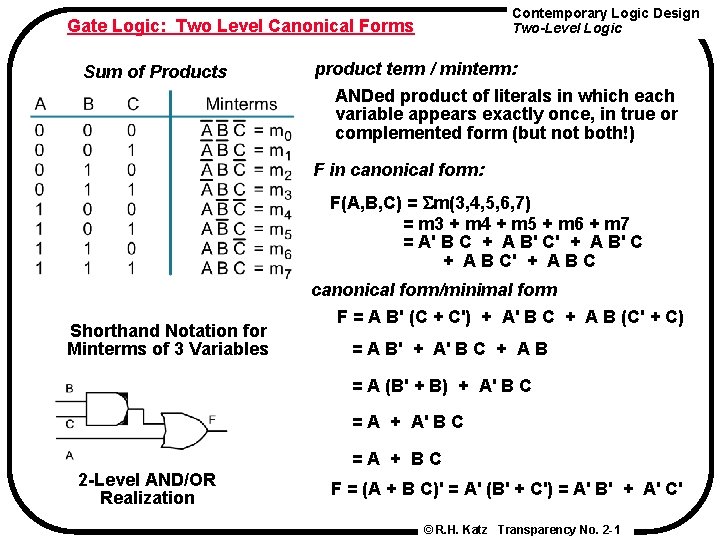
Contemporary Logic Design Two-Level Logic Gate Logic: Two Level Canonical Forms Sum of Products product term / minterm: ANDed product of literals in which each variable appears exactly once, in true or complemented form (but not both!) F in canonical form: F(A, B, C) = m(3, 4, 5, 6, 7) = m 3 + m 4 + m 5 + m 6 + m 7 = A' B C + A B' C' + A B' C + A B C' + A B C Shorthand Notation for Minterms of 3 Variables canonical form/minimal form F = A B' (C + C') + A' B C + A B (C' + C) = A B' + A' B C + A B = A (B' + B) + A' B C = A + A' B C =A + BC 2 -Level AND/OR Realization F = (A + B C)' = A' (B' + C') = A' B' + A' C' © R. H. Katz Transparency No. 2 -1
Contemporary Logic Design Two-Level Logic Gate Logic: 2 Level Canonical Forms Product of Sums / Conjunctive Normal Form / Maxterm Expansion Maxterm: ORed sum of literals in which each variable appears exactly once in either true or complemented form, but not both! Maxterm form: Find truth table rows where F is 0 0 in input column implies true literal 1 in input column implies complemented literal Maxterm Shorthand Notation for a Function of Three Variables F(A, B, C) = M(0, 1, 2) = (A + B + C) (A + B + C') (A + B' + C) F’(A, B, C) = M(3, 4, 5, 6, 7) = (A + B' + C') (A' + B' + C') © R. H. Katz Transparency No. 2 -2
Contemporary Logic Design Gate Logic: Two Level Canonical Forms Two-Level Logic Sum of Products, Products of Sums, and De. Morgan's Law F' = A' B' C' + A' B' C + A' B C' Apply De. Morgan's Law to obtain F: (F')' = (A' B' C' + A' B' C + A' B C')' F = (A + B + C) (A + B + C') (A + B' + C) F' = (A + B' + C') (A' + B' + C') Apply De. Morgan's Law to obtain F: (F')' = {(A + B' + C') (A' + B' + C')}' F = A' B C + A B' C' + A B' C + A B C' + A B C © R. H. Katz Transparency No. 2 -3
Gate Logic: Two-Level Canonical Forms Contemporary Logic Design Two-Level Logic Four Alternative Implementations of F: Canonical Sum of Products Minimized Sum of Products Canonical Products of Sums Minimized Products of Sums © R. H. Katz Transparency No. 2 -4
Contemporary Logic Design Two-Level Logic Gate Logic: Two-Level Canonical Forms Waveform Verification of the Three Alternatives Eight Unique Combinations of Three Inputs Except for timing glitches, output waveforms of the three implementations are essentially identical © R. H. Katz Transparency No. 2 -5
Contemporary Logic Design Two-Level Logic Gate Logic: Two-Level Simplification Algebraic Simplification: not an algorithm/systematic procedure how do you know when the minimum realization has been found? Computer-Aided Tools: precise solutions require very long computation times, especially for functions with many inputs (>10) heuristic methods employed — "educated guesses" to reduce the amount of computation good solutions not best solutions Still Relevant to Learn Hand Methods: insights into how the CAD programs work, and their strengths and weaknesses ability to check the results, at least on small examples don't have computer terminals during exams © R. H. Katz Transparency No. 2 -6
Gate Logic: Two-Level Simplification Boolean Cubes Visual technique for identifying when the Uniting Theorem can be applied Contemporary Logic Design Two-Level Logic Just another way to represent the truth table n input variables = n dimensional "cube" © R. H. Katz Transparency No. 2 -7
Contemporary Logic Design Two-Level Logic Gate Logic: Two-Level Simplification Subcubes of Higher Dimensions than 2 F(A, B, C) = m(4, 5, 6, 7) On-set forms a rectangle, i. e. , a cube of two dimensions represents an expression in one variable i. e. , 3 dimensions - 2 dimensions A is asserted and unchanged B and C vary This subcube represents the literal A © R. H. Katz Transparency No. 2 -8
Gate Logic: Two-Level Simplification Contemporary Logic Design Two-Level Logic In a 3 -cube: a 0 -cube, i. e. , a single node, yields a term in three literals a 1 -cube, i. e. , a line of two nodes, yields a term in two literals a 2 -cube, i. e. , a plane of four nodes, yields a term in one literal a 3 -cube, i. e. , a cube of eight nodes, yields a constant term "1" In general, an m-subcube within an n-cube (m < n) yields a term with n - m literals © R. H. Katz Transparency No. 2 -9
Gate Logic: Two-Level Simplification Karnaugh Map Method hard to draw cubes of more than 4 dimensions Contemporary Logic Design Two-Level Logic K-map is an alternative method of representing the truth table that helps visualize adjacencies in up to 6 dimensions Beyond that, computer-based methods are needed 2 -variable K-map 3 -variable K-map 4 -variable K-map Numbering Scheme: 00, 01, 10 Gray Code — only a single bit changes from code word to next code word © R. H. Katz Transparency No. 2 -10
Gate Logic: Two-Level Simplification Karnaugh Map Method Contemporary Logic Design Two-Level Logic Adjacencies in the K-Map Wrap from first to last column Top row to bottom row © R. H. Katz Transparency No. 2 -11
Gate Logic: Two-Level Simplification Contemporary Logic Design Two-Level Logic K-map Method Examples: 4 variables F(A, B, C, D) = m(0, 2, 3, 5, 6, 7, 8, 10, 11, 14, 15) F= © R. H. Katz Transparency No. 2 -12
Contemporary Logic Design Two-Level Logic Gate Logic: Two-Level Simplification K-map Method Examples: 4 variables F(A, B, C, D) = m(0, 2, 3, 5, 6, 7, 8, 10, 11, 14, 15) F = C + A' B D + B' D' Find the smallest number of the largest possible subcubes that cover the ON-set K-map Corner Adjacency Illustrated in the 4 -Cube © R. H. Katz Transparency No. 2 -13
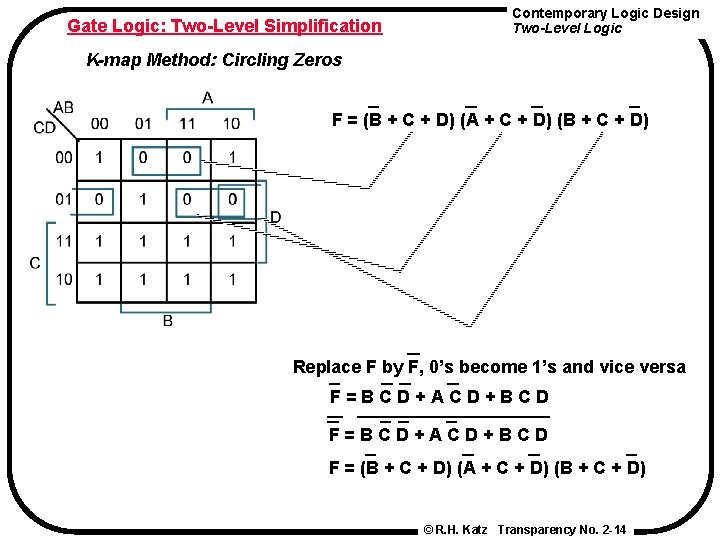
Gate Logic: Two-Level Simplification Contemporary Logic Design Two-Level Logic K-map Method: Circling Zeros F = (B + C + D) (A + C + D) (B + C + D) Replace F by F, 0’s become 1’s and vice versa F=BCD+ACD+BCD F = (B + C + D) (A + C + D) (B + C + D) © R. H. Katz Transparency No. 2 -14
Gate Logic: Two-Level Simplification Contemporary Logic Design Two-Level Logic K-map Example: Don't Cares can be treated as 1's or 0's if it is advantageous to do so F(A, B, C, D) = m(1, 3, 5, 7, 9) + d(6, 12, 13) F= F= w/o don't cares w/ don't cares © R. H. Katz Transparency No. 2 -15
Gate Logic: Two-Level Simplification Contemporary Logic Design Two-Level Logic K-map Example: Don't Cares can be treated as 1's or 0's if it is advantageous to do so F(A, B, C, D) = m(1, 3, 5, 7, 9) + d(6, 12, 13) F = A'D + B' C' D w/o don't cares F = C' D + A' D w/ don't cares By treating this DC as a "1", a 2 -cube can be formed rather than one 0 -cube In Po. S form: F = D (A' + C') Same answer as above, but fewer literals © R. H. Katz Transparency No. 2 -16
Contemporary Logic Design Two-Level Logic Gate Logic: Two Level Simplification Definition of Terms implicant: single element of the ON-set or any group of elements that can be combined together in a K-map prime implicant: implicant that cannot be combined with another implicant to eliminate a term essential prime implicant: if an element of the ON-set is covered by a single prime implicant, it is an essential prime Objective: grow implicants into prime implicants cover the ON-set with as few prime implicants as possible essential primes participate in ALL possible covers © R. H. Katz Transparency No. 2 -17
Contemporary Logic Design Two-Level Logic Gate Logic: Two Level Simplication Examples to Illustrate Terms 6 Prime Implicants: A' B' D, B C', A C, A' C' D, A B, B' C D essential Minimum cover = B C' + A C + A' B' D 5 Prime Implicants: B D, A B C', A C D, A' B C, A' C' D essential Essential implicants form minimum cover © R. H. Katz Transparency No. 2 -18
Contemporary Logic Design Two-Level Logic Gate Logic: Two Level Simplification More Examples Prime Implicants: B D, C D, A C, B' C essential Essential primes form the minimum cover © R. H. Katz Transparency No. 2 -19
Contemporary Logic Design Gate Logic: Two-Level Simplification Two-Level Logic Algorithm: Minimum Sum of Products Expression from a K-Map Step 1: Choose an element of ON-set not already covered by an implicant Step 2: Find "maximal" groupings of 1's and X's adjacent to that element. Remember to consider top/bottom row, left/right column, and corner adjacencies. This forms prime implicants (always a power of 2 number of elements). Repeat Steps 1 and 2 to find all prime implicants Step 3: Revisit the 1's elements in the K-map. If covered by single prime implicant, it is essential, and participates in final cover. The 1's it covers do not need to be revisited Step 4: If there remain 1's not covered by essential prime implicants, then select the smallest number of prime implicants that cover the remaining 1's © R. H. Katz Transparency No. 2 -20
Gate Logic: Two-Level Simplification Contemporary Logic Design Two-Level Logic 5 -Variable K-maps ƒ(A, B, C, D, E) = m(2, 5, 7, 8, 10, 13, 15, 17, 19, 21, 23, 24, 29 31) = © R. H. Katz Transparency No. 2 -21
Gate Logic: Two-Level Simplification Contemporary Logic Design Two-Level Logic 5 -Variable K-maps ƒ(A, B, C, D, E) = m(2, 5, 7, 8, 10, 13, 15, 17, 19, 21, 23, 24, 29 31) = C E + A B' E + B C' D' E' + A' C' D E' © R. H. Katz Transparency No. 2 -22
Contemporary Logic Design Two-Level Logic Gate Logic: Two Level Simplification 6 - Variable K-Maps ƒ(A, B, C, D, E, F) = m(2, 8, 10, 18, 24, 26, 34, 37, 42, 45, 50, 53, 58, 61) = © R. H. Katz Transparency No. 2 -23
Contemporary Logic Design Two-Level Logic Gate Logic: Two Level Simplification 6 - Variable K-Maps ƒ(A, B, C, D, E, F) = m(2, 8, 10, 18, 24, 26, 34, 37, 42, 45, 50, 53, 58, 61) = D' E F' + A D E' F + A' C D' F' © R. H. Katz Transparency No. 2 -24
Gate Logic: CAD Tools for Simplification Contemporary Logic Design Two-Level Logic Espresso Method: Overview 1. Expands implicants to their maximum size Implicants covered by an expanded implicant are removed from further consideration Quality of result depends on order of implicant expansion Heuristic methods used to determine order Step is called EXPAND 2. Irredundant cover (i. e. , no proper subset is also a cover) is extracted from the expanded primes Just like the Quine-Mc. Cluskey Prime Implicant Chart Step is called IRREDUNDANT COVER 3. Solution usually pretty good, but sometimes can be improved Might exist another cover with fewer terms or fewer literals Shrink prime implicants to smallest size that still covers ON-set Step is called REDUCE 4. Repeat sequence REDUCE/EXPAND/IRREDUNDANT COVER to find alternative prime implicants Keep doing this as long as new covers improve on last solution 5. A number of optimizations are tried, e. g. , identify and remove essential primes early in the process © R. H. Katz Transparency No. 2 -25
Contemporary Logic Design Two-Level Logic Gate Logic: CAD Tools for Simplification Espresso Inputs and Outputs ƒ(A, B, C, D) = � m(4, 5, 6, 8, 9, 10, 13) + d(0, 7, 15) Espresso Input. i 4. o 1. ilb a b c d. ob f. p 10 0100 1 0101 1 0110 1 1001 1 1010 1 1101 1 0000 0111 1111. e Espresso Output -- # inputs -- # outputs -- input names -- output name -- number of product terms -- A'BC'D' -- A'BC'D -- A'BCD' -- AB'C'D -- AB'CD' -- ABC'D -- A'B'C'D' don't care -- A'BCD don't care -- ABCD don't care -- end of list . i 4. o 1. ilb a b c d. ob f. p 3 1 -01 1 10 -0 1 01 -- 1. e ƒ = A C' D + A B' D' + A' B © R. H. Katz Transparency No. 2 -26
Gate Logic: CAD Tools for Simplification Contemporary Logic Design Two-Level Logic Espresso: Why Iterate on Reduce, Irredundant Cover, Expand? Initial Set of Primes found by Steps 1 and 2 of the Espresso Method 4 primes, irredundant cover, but not a minimal cover! Result of REDUCE: Shrink primes while still covering the ON-set Choice of order in which to perform shrink is important © R. H. Katz Transparency No. 2 -27
Gate Logic: CAD Tools for Simplification Espresso Iteration (Continued) Second EXPAND generates a different set of prime implicants Contemporary Logic Design Two-Level Logic IRREDUNDANT COVER found by final step of espresso Only three prime implicants! © R. H. Katz Transparency No. 2 -28
Contemporary Logic Design Two-Level Logic: Summary Primitive logic building blocks INVERTER, AND, OR, NAND, NOR, XNOR Canonical Forms Sum of Products, Products of Sums Incompletely specified functions/don't cares Logic Minimization Goal: two-level logic realizations with fewest gates and fewest number of gate inputs Obtained via Laws and Theorems of Boolean Algebra or Boolean Cubes and the Uniting Theorem or K-map Methods up to 6 variables or Quine-Mc. Cluskey Algorithm or Espresso CAD Tool © R. H. Katz Transparency No. 2 -29