
Contemporary Issues Research Paper Self Edit ENG 102
- Slides: 17
Contemporary Issues Research Paper Self Edit ENG 102
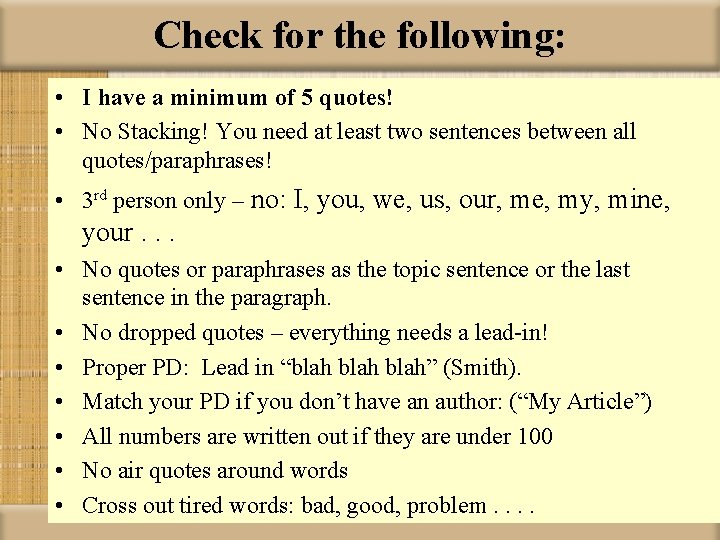
Check for the following: • I have a minimum of 5 quotes! • No Stacking! You need at least two sentences between all quotes/paraphrases! • 3 rd person only – no: I, you, we, us, our, me, my, mine, your. . . • No quotes or paraphrases as the topic sentence or the last sentence in the paragraph. • No dropped quotes – everything needs a lead-in! • Proper PD: Lead in “blah” (Smith). • Match your PD if you don’t have an author: (“My Article”) • All numbers are written out if they are under 100 • No air quotes around words • Cross out tired words: bad, good, problem. .
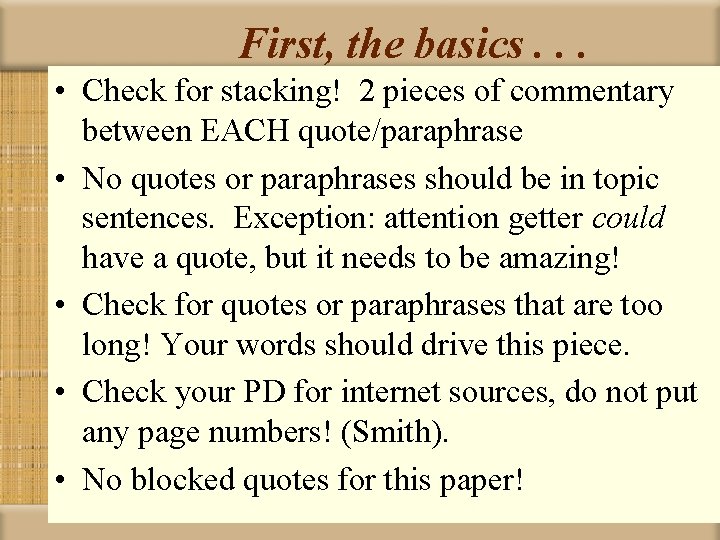
First, the basics. . . • Check for stacking! 2 pieces of commentary between EACH quote/paraphrase • No quotes or paraphrases should be in topic sentences. Exception: attention getter could have a quote, but it needs to be amazing! • Check for quotes or paraphrases that are too long! Your words should drive this piece. • Check your PD for internet sources, do not put any page numbers! (Smith). • No blocked quotes for this paper!
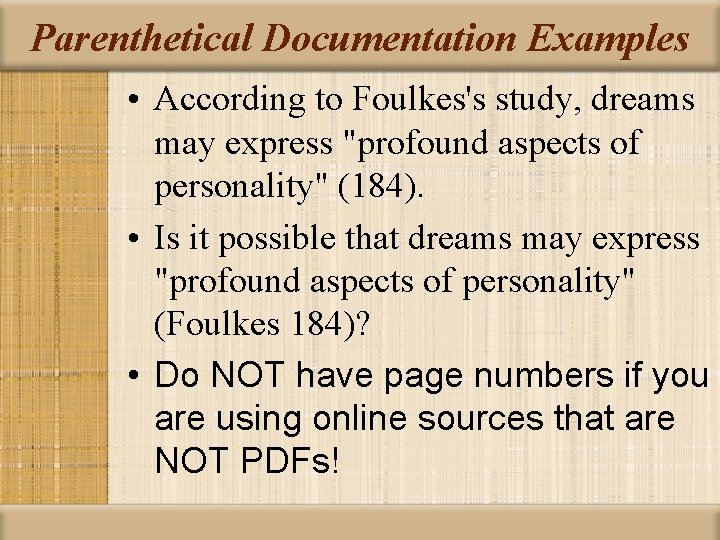
Parenthetical Documentation Examples • According to Foulkes's study, dreams may express "profound aspects of personality" (184). • Is it possible that dreams may express "profound aspects of personality" (Foulkes 184)? • Do NOT have page numbers if you are using online sources that are NOT PDFs!
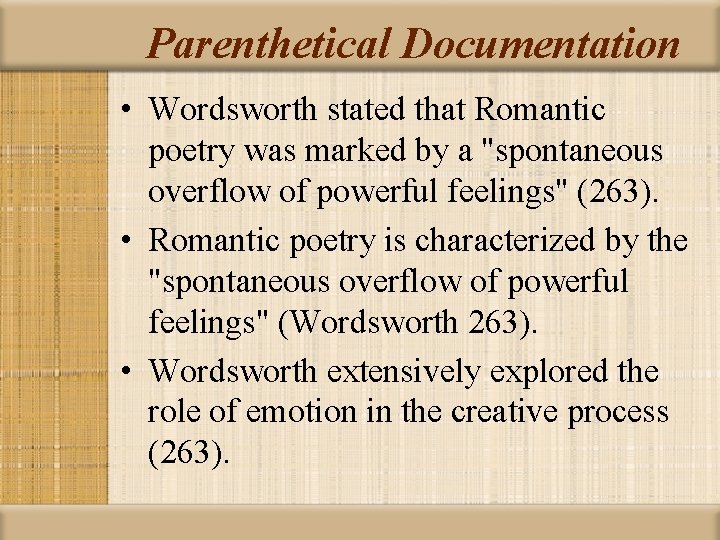
Parenthetical Documentation • Wordsworth stated that Romantic poetry was marked by a "spontaneous overflow of powerful feelings" (263). • Romantic poetry is characterized by the "spontaneous overflow of powerful feelings" (Wordsworth 263). • Wordsworth extensively explored the role of emotion in the creative process (263).
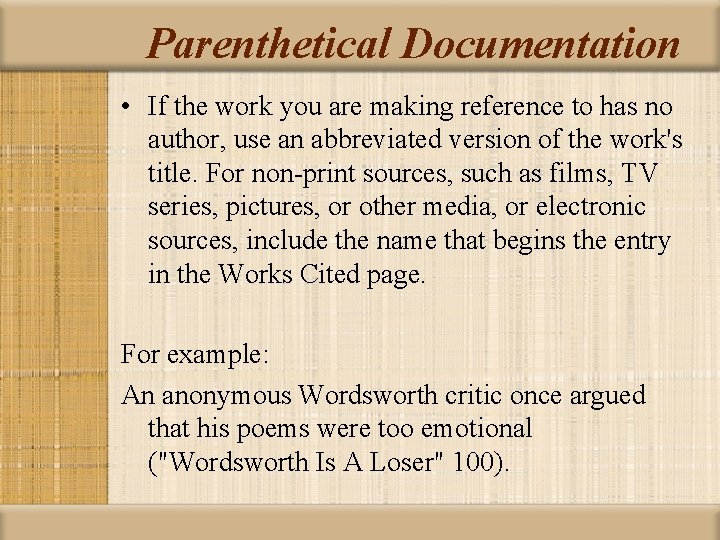
Parenthetical Documentation • If the work you are making reference to has no author, use an abbreviated version of the work's title. For non-print sources, such as films, TV series, pictures, or other media, or electronic sources, include the name that begins the entry in the Works Cited page. For example: An anonymous Wordsworth critic once argued that his poems were too emotional ("Wordsworth Is A Loser" 100).
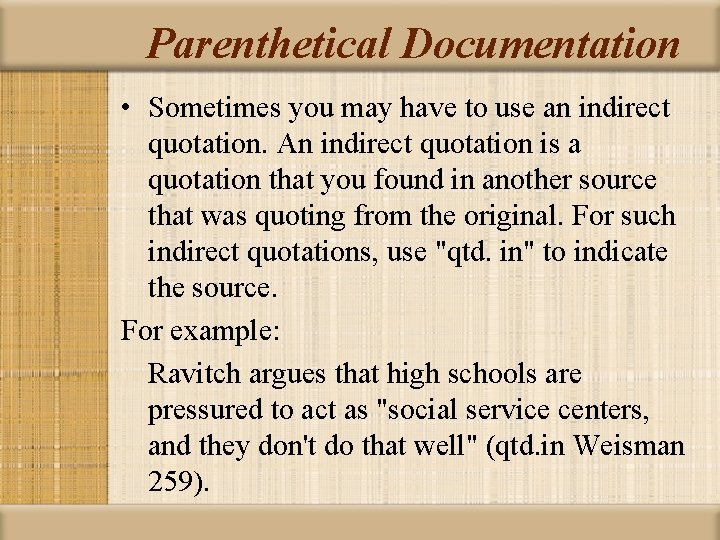
Parenthetical Documentation • Sometimes you may have to use an indirect quotation. An indirect quotation is a quotation that you found in another source that was quoting from the original. For such indirect quotations, use "qtd. in" to indicate the source. For example: Ravitch argues that high schools are pressured to act as "social service centers, and they don't do that well" (qtd. in Weisman 259).
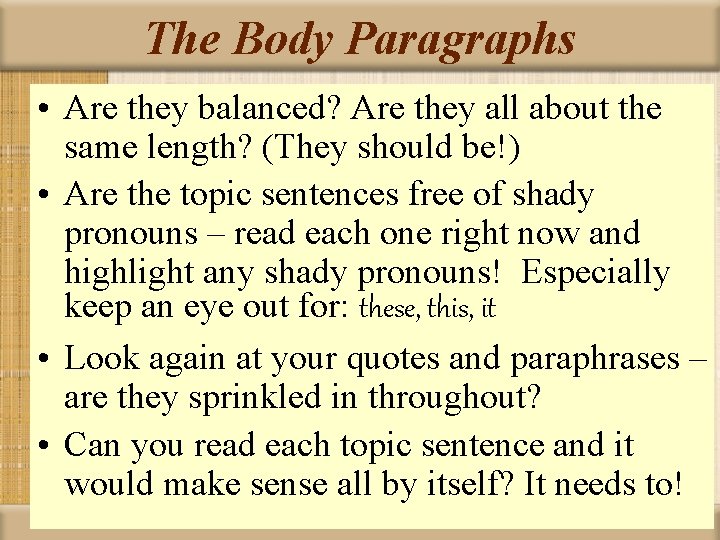
The Body Paragraphs • Are they balanced? Are they all about the same length? (They should be!) • Are the topic sentences free of shady pronouns – read each one right now and highlight any shady pronouns! Especially keep an eye out for: these, this, it • Look again at your quotes and paraphrases – are they sprinkled in throughout? • Can you read each topic sentence and it would make sense all by itself? It needs to!
The Introduction • Is your attention getter vibrant? Will it truly draw in the reader. • Do you a provide a statement of the problem? • Check your thesis – be sure it is the last sentence (or two) of your intro paragraph. • Capture your audience’s attention? • Give a BRIEF background on your topic? • Develop interest in your topic? • Guide the reader to thesis? • Are you (as the reader) feeling a level of concern that you do need to know more about this so that you can help to solve this problem?
The Body Paragraphs History of the Problem - • Do you know all that you need to know about the problem? • Is the focus on the problem at hand? Read thesis just to be sure! • Is the history contained within just one paragraph? • Do you feel you need to know anything else? If so, make a note of that!
The Body Paragraphs Extent of the Problem – • Do you address who is directly affected? How bad it really is? • Is the extent “bad” enough to create concern? • Is there a connection to why other teens would care about this problem?
The Body Paragraphs Repercussions (impact/effect) – • Do you clearly break down what the future will hold if YOUR problem is not solved? • Are the repercussions clearly addressing a snow ball effect? • Is a dire need for this “problem” to be solved set forward?
The Body Paragraphs Future Solutions – • Are there two paragraphs delineated for the solutions? • Is the first paragraph a smaller, immediate “band aid” to the solution? • Is the second solution paragraph clearly a bigger, stronger solution that could potentially make a great change? • Are there any holes or faulty logic within the solutions? Do you need to know more? Less? • Could you (as the reader) take part in the band aid solution?
The Conclusion – do you: • Stress the importance of thesis statement? • Give the essay a sense of completeness? • Leave a final impression on the reader? • End with a strong final sentence without being too dramatic?
The Works Cited • • Must be double-spaced Have its own header Alphabetical order If you don’t have an author and you have to put the article title in your parentheses for your PD be sure you have the title in quotation marks in your PD! You have to match it to your works cited page! • Journals, magazines, newspapers, and web page titles are all in italics. Article titles are in quotation marks. NOTHING is underlined.
Some picky MLA works cited elements: • • No URL should be listed. No library information. List Web or Print. Your access date is the last item. Your access date is written weird: 4 Feb. 2014 NOT Feb. 4, 2014. Place a period at the end of each entry. Be sure that article titles are in quotation marks and journal titles in italics! All your entries should be in alphabetical order! Be sure if you used the cite now feature that you selected MLA and not APA!
I'm not a very good writer, but I'm an excellent rewriter. ~James Michener