
Contemporary Issues in Childhood and YouthtoAdult Transitions in
- Slides: 26
Contemporary Issues in Childhood and Youth-to-Adult Transitions in the Risk Society Dave Merryweather - 2010 -11
Lecture Aims l l l To consider traditional understandings of the move from youth-to-adulthood; To explore recent social and cultural change and the impact on youth-to-adult transitions; To consider the increasingly complex and problematic character of youth-to-adult transitions in the risk society.
Back in the day … Many aspects of people’s identities were effectively ‘given‘ – q i. e. in becoming adult, the BIG ‘decisions’ adhered to traditional social norms: q For example … Ø Gender roles, Ø Educational ‘opportunities’, Ø Occupational status. q
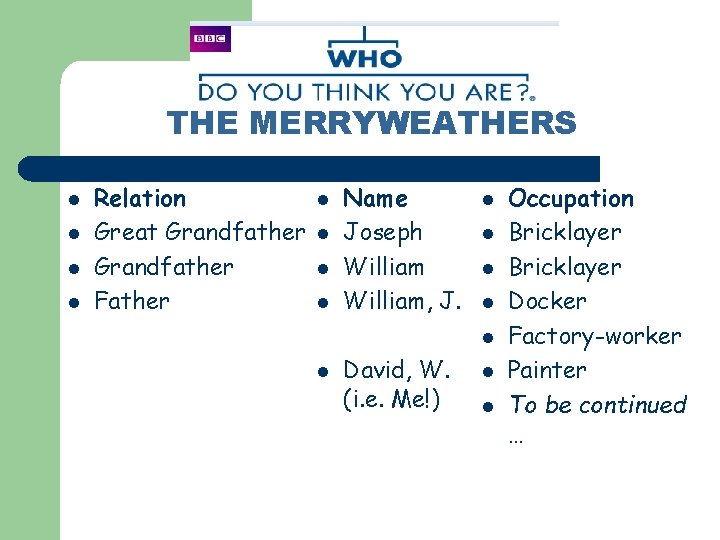
THE MERRYWEATHERS l l Relation Great Grandfather Father l l Name Joseph William, J. l l l David, W. (i. e. Me!) l l Occupation Bricklayer Docker Factory-worker Painter To be continued …
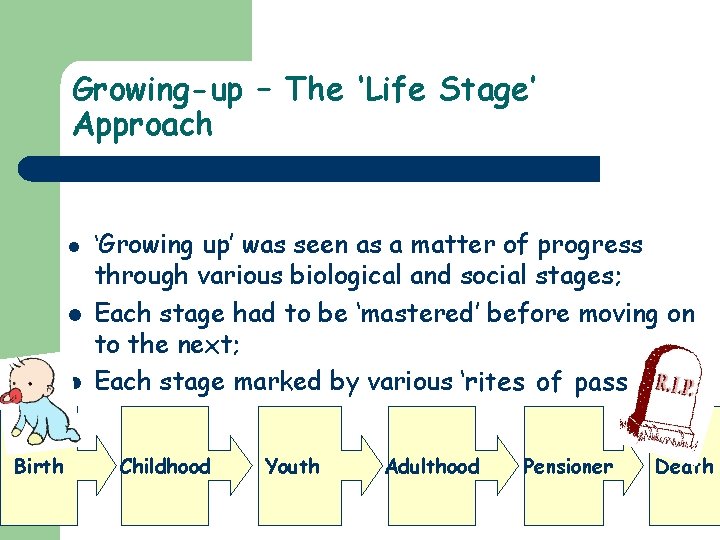
Growing-up – The ‘Life Stage’ Approach l l l Birth ‘Growing up’ was seen as a matter of progress through various biological and social stages; Each stage had to be ‘mastered’ before moving on to the next; Each stage marked by various ‘rites of passage’. Childhood Youth Adulthood Pensioner Death
Growing-up – The ‘Life Course’ Approach l Ø Ø l l Focused on social trends in key ‘life events’ on the path to adulthood – i. e. Age at leaving school; Entry into employment; Age at first marriage; Age at birth of first child; Becoming adult is a matter of society’s norms and values, as well as codified legal markers of transition. BUT …
Changing Society, Changing Transitions q Cultural & social changes have altered nature of transition; – i. e. Ø What we mean by ‘youth’ and ‘adulthood’; Ø Economic restructuring; Ø Educational expectations; Ø Welfare Benefits system; Ø Extended dependency on parents.
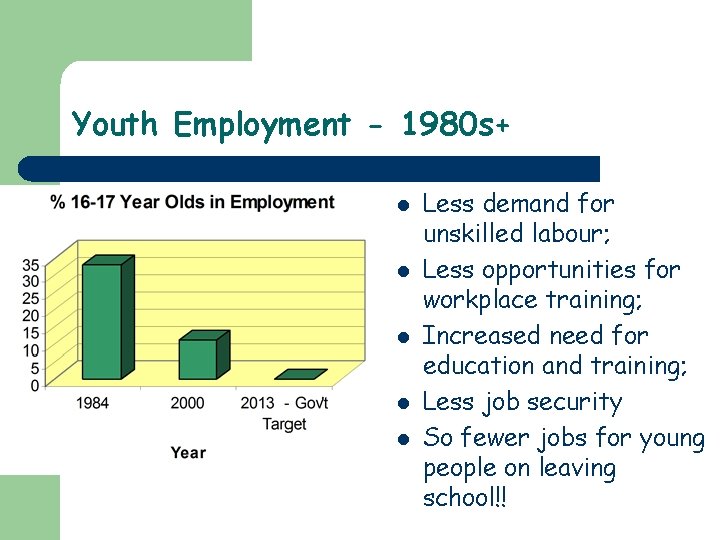
Youth Employment - 1980 s+ l l l Less demand for unskilled labour; Less opportunities for workplace training; Increased need for education and training; Less job security So fewer jobs for young people on leaving school!!
Education and Training q Youth employment replaced by: Training schemes; Ø Apprenticeships; Ø Post-16 Education – e. g. Widening Participation q Result? ? ? Ø Early economic independence becomes less viable for many young people; Ø Transition into fully independent adulthood is ‘extended’. Ø
Changes in Benefits System - 1980 s+ Gradual withdrawal of welfare benefits for school leavers – i. e. Ø Unemployment benefits; Ø Housing benefits; Ø Other benefits targeted at the most ‘needy’; q Result? ? ? Ø Young People increasingly reliant on family for financial support with the result that … q
Domestic Transitions l l Young People stay in parental home much longer than previously; Marriage deferred with higher levels of cohabitation and/or independent living; Birth of first child deferred till late 20 s/early 30 s; Return to parental home increasingly common – i. e. move to full independence may involve several ‘leavings’
Result? Transition has become more complex, varied and uncertain. Significance of ‘life events’ has changed; q No longer a straight forward, linear path from youth to adulthood; q Transitions characterised by: Ø ‘False starts’; Ø Shifts from dependency to independency and back to dependency; Ø Semi-independency. q
Becoming Adult: “Are We There Yet? ” v. Are you an adult? v What for you are the key indicators of reaching adulthood? v Do you ever feel that you’re an adult in some aspects of your life but not others? Explain.
Transition as ‘Interconnected Strands’ (See Jones, 2009) Transition to adulthood is increasingly multifaceted – i. e. Ø From education to labour market; Ø From child to partner/parent; Ø From living with parents to living independently q Possible to be an ‘adult’ on one strand though not on others!!! q Transition increasingly complex, potentially risky and uncertain… q
Late Modernity: Risk Society and the Reflexive Self Key Theorists – Giddens, Beck q We are now living in a period known as ‘Late Modernity’ in which self-identity is no longer ‘given’ by class, gender, tradition etc. ; q Rather, identity has been ‘individualised’ –i. e. we engage in an on-going reflexive biography, endlessly making and re-making our identities out of a range of available options. Ø
For Beck and Giddens … “… the question, ‘How shall I live? ’ has to be answered in day-to-day decisions about how to behave, what to wear and what to eat – and many other things …” (Giddens, 1991: 14). “Decisions on education, profession, job, place of residence, spouse, number of children and so forth, with all the secondary decisions implied, no longer can be, they must be made (Beck. 1992: 135).
Implications for Youth-to-Adult Transitions? q Ø Ø Ø At crucial (fateful) moments in our lives we have to make ‘decisions’ about who we want to be – e. g. What course to take? What college to go to? Should I get a job? Should I leave home or remain with my family? BUT – we are always faced with the possibility of making the wrong choice!!!
Individualised Biographies? l l l Traditional class and gender based pathways into adulthood may not be as strong as they once were; BUT - this does not mean we are ‘free’ to choose who we want to be; Rather, we choose from a limited range of options depending on where we live, social class, gender etc;
Think about your ‘choice’ to come to Hope … v How much freedom of choice did you have? v Could you have gone to another Liverpool university? v Could you have gone to another town/city? v Where there alternatives to university? If so, how viable were these?
Successful Transitions For those with ready access to education, training and employment opportunities … q As well as all the cultural, social and economic resources that these require …. q Transition into adulthood is likely to be prolonged, but ultimately, successful … q
BUT for others, ‘Successful’ transition may be constrained: q Ø Ø Ø Class and Socio-economic factors – i. e. Not all families can provide financial support; Some areas have poor quality labour market; poor education, training, transport etc. Result? ? ? Many forced to leave school earlier and enter low paid, casual, unstable employment; Leads to marginalisation or exclusion from society i. e. Risky Futures and Poor Transitions!!!
Key Point … l l l Transition to adulthood is ‘individualised’; BUT – not every young person has the same ‘choices’ available and some face more barriers than others; However, in an ‘individualised’ society young people are often blamed if they ‘fail’ to make a successful transition.
Journey’s End? l l l For some, decisions made at 16 may affect the rest of their lives; BUT – transition to adulthood is increasingly dynamic, reflexive and on-going – i. e. Often we make decisions when young that we were not ready to make; Experience may lead us to revise our plans and rethink ‘where we are going’; Need to consider that young people may want 2 nd, 3 rd 4 th chances to get where they want to go’
Don’t feel guilty if you don’t know what you want to do with your life… The most interesting people I know didn’t know at 22 what they wanted to do with their lives, Some of the most interesting 40 year olds I know still don’t. Get plenty of calcium. Be kind to your knees, you’ll miss them when they’re gone. (Baz Luhrman, Everybody’s Free (To Wear Sunscreen)
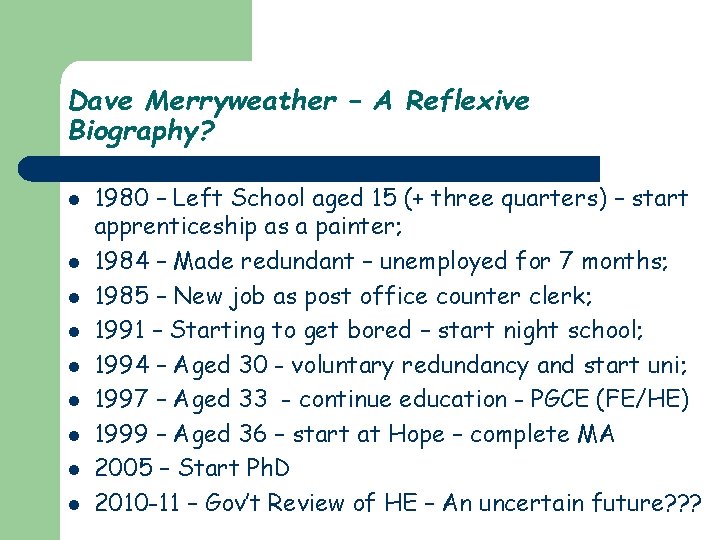
Dave Merryweather – A Reflexive Biography? l l l l l 1980 – Left School aged 15 (+ three quarters) – start apprenticeship as a painter; 1984 – Made redundant – unemployed for 7 months; 1985 – New job as post office counter clerk; 1991 – Starting to get bored – start night school; 1994 – Aged 30 - voluntary redundancy and start uni; 1997 – Aged 33 - continue education - PGCE (FE/HE) 1999 – Aged 36 – start at Hope – complete MA 2005 – Start Ph. D 2010 -11 – Gov’t Review of HE – An uncertain future? ? ?
Conclusions l l For today’s youth Becoming Adult is a very different experience compared to earlier generations; Societal changes mean that the transition into adulthood is often extended into mid-20 s; BUT – not all young people experience successful transitions; And the question of ‘where’ this transition ends is very much an open one.