
Contemporary Era 1914 Now Contemporary Era n n
- Slides: 33
Contemporary Era 1914 - Now
Contemporary Era n n Divides into 3: World War/ Depression – 1914 to 1945 Cold War/ Decolonization – 1945 – 1991 →
Contemporary Era n n n Does a new period in history begin after WWI? Beginning of the end of European dominance – a massive “civil war” in the West. Emergence of nationalism in Africa and Asia.
Contemporary Era n n n Chinese revolution Collapse of Ottoman Empire Balance of power shifts to U. S. advantage, but relative power of West declines. n n Relative decline vs. absolute decline. Is the U. S. a Western power? Or is it another animal? As it becomes a new voice is it saying new things or is it just reinforcing the traditional West?
How do the dominant themes of the 19 th Century begin to change? n n A steady retreat of Western political, military, and economic power. Political n Decolonization begins between WW’s – increases after WWII. Europe no longer controls large areas of the world.
How do the dominant themes of the 19 th Century begin to change? n Military n n Non-Western powers develop technology to challenge the West. New nations develop arsenals to prevent the West from entering their territory (i. e. Suez, 1956). n n (Contrast with 19 th C. when small number of Brits could overcome thousands of “natives”) Alternative military strategies: guerilla warfare, terrorism (Vietnam, Algeria, Iraq).
How do the dominant themes of the 19 th Century begin to change? n n Economics Whole batch of countries learn to get out of the periphery. Stalin’s Soviet Union, Mao’s China, Hitler’s Germany all become external (the reemergence of external). n Modern China aiming to become core. n
Who will replace the West? n n n U. S. dominates military power – complicates things. Since 1991 US the only superpower (recent and temporary). Will East Asia become the dominant civilization? Or could it be more than one civilization?
World Economy n Continuity and Change in trade. Change occurs in specifics of what is being made in the core. n Core includes West and Pacific Rim. n n Geographic periphery shifts to sub. Saharan Africa – colonial exploitation in 20 th Century not yet reversed there.
World Economy n What strategies to nations use to get out of peripheral status? Substitution: We can produce our own products protected by tariffs (Iran, Turkey in 1920 s and Latin America in 1930 s). n Cheap Products: Let’s find a range of products that we can produce more cheaply than other nations. n
World Economy n n n Chile – truck gardening (1970 s), Canada and Australia – raw materials. Most efficient with high technology. Oil becomes a key factor. Oil gets countries economically independent – doesn’t make them core though.
World Economy n n Industrial Exporter: Brazil after WWII becomes major steel producer and computer manufacturer (4 th largest), India and China computer chips. International economic dependence increases, Western dominance curtailed.
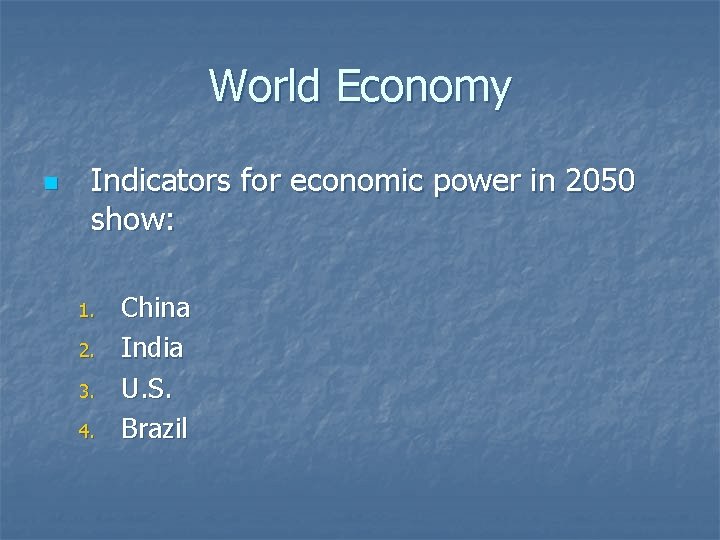
World Economy n Indicators for economic power in 2050 show: 1. 2. 3. 4. China India U. S. Brazil
New Themes 1. 2. 3. 4. Power rebalancing Communications & transportation technologies: air travel, radio, cable, internet, satellites, space travel etc. Redefinition of war – potential for total annihilation. Global population explosion
New Themes n Population effects: Migration patterns n Strain of resources n Massive urbanization n 2006 the first year that ½ world’s population is urban. n 20 th C. bloodiest century in human history – pop. Growth. n
New Themes n Nation-State still dominant, but problems come to the fore – inadequacies economically, multinational (multi ethnic? ) states.
Political Change n n How many countries have the same political structures today as they did in late 19 th C. ? U. S. , Western Europe. Classical regimes of agricultural Era no longer adequate – that is a major change n n Monarchy gone Decolonization in 20 th C.
Political Change n n n What are the structures that take over from monarchy? New forms of authoritarianism (fascism) Communism (declined by end of 20 th C. ) Democracy (multiparty) (gains ground after 1970 s) Is there global agreement on a system?
Social Change n n n Largest social class in 1914 – peasants Largest social class in 2008 - low wage urban working-class. Industrialization/urban replacing agricultural systems – remember the cool map! Most important social class in 1914 – landed aristocracy. Most important social class in 2008 – upper middle-class, urban, owners of capital and formally educated.
Social Change n n Gender In virtually every society in 20 th century women get the vote (Turkey 1927). New legal rights (UN support after 1945) Educational gains & reduction of education gap (varies by society) – Iran & UAE over 55% of university grads are women.
Social Change n n Birth-rate reduction by late 20 th century. France and Italy below reproduction levels (Sub-Saharan Africa? ) Patriarchy begins to end, although inequality does not.
Social Change n Problems: n n n Increase of women into service industry – in U. S. by 1950 s. But, in Sub-Saharan Africa women falling behind. Increased exploitation in sex trade. Increased domestic violence (India, Pakistan – dowry murders) Deliberate use of rape as a war tactic. Increased abortion of females and female infanticide. Male resistance to changes?
Culture n n Period of massive cultural change and resistance. Pace of cultural change depends on region. n n Urban – quicker/ rural – slower Only 30% of the world has access to the internet.
Culture n n n Before 1914 most believed in one of the traditional belief systems from the classical and post-classical period. Since 1914 these belief systems have been increasingly challenged. Global revival of religion since 1970 s.
Culture n Communism: Own symbols n Own cultural apparatus n Gained ground in and out of communist nations. n n Nationalism: n Always challenged religion to some extent – religion might get in the way of the nation (i. e. fascism).
Culture n Secularism: Consumerism – personal acquisition n Science n Toleration n n These beliefs can overlap - all secular.
Culture n n Communism no longer a serious cultural idea. Nationalism questionable. Secularism still up and running. What do you believe in when your system collapses?
Culture n n n Since 1970 s a rise of fundamentalist movements (Islamic fundamentalists against nationalism). Increasing effort to have the state support religion. New missionary efforts in Latin America – Evangelical Protestantism.
Culture n n Increase in Islam and Christianity in Africa. Japan and Western Europe – secular – we have no idea where this is going – we have no pattern.
A New Framework? n Notion of interconnectedness not new. n How (or does it? ) differ from previous eras? n Globalization theorists argue that this is a new framework that goes beyond past connections. n I. e. When the prosperity of U. S. depends on decisions made in Korea, Japan, and China – that is global.
A New Framework? n n n U. S. exports culture. Globalization of costume (over 150 years). Globalization of sports since 1950 s – Chess is internationalized earlier (soccer, baseball to lesser extent). Standards of beauty globalized – Britney Spears). Global effort to combat climate change - new
A New Framework? n n n SARS epidemic (spread by plane) – old, but response was new – 20 th century first time international coordination so complete. Contemporary globalization probably began in late 19 th century – ships etc. A few decades where it retreats (Bolsheviks etc. )
A New Framework? n n n After 1970 s globalization increases. We don’t know if it will continue – as there anti-globalization forces. Cold War – Anti-globalization (division), but both have global aspirations.