
Contamination in TripTransfer Blanks Trip blank Water sample
Contamination in Trip/Transfer Blanks • Trip blank – Water sample produced by the laboratory, taken into the field and stored with the analytical samples – Collected in association with river samples • Transfer blanks – Obtained by pouring deionized water into the sample container while in the field – Collected in association with wastewater samples
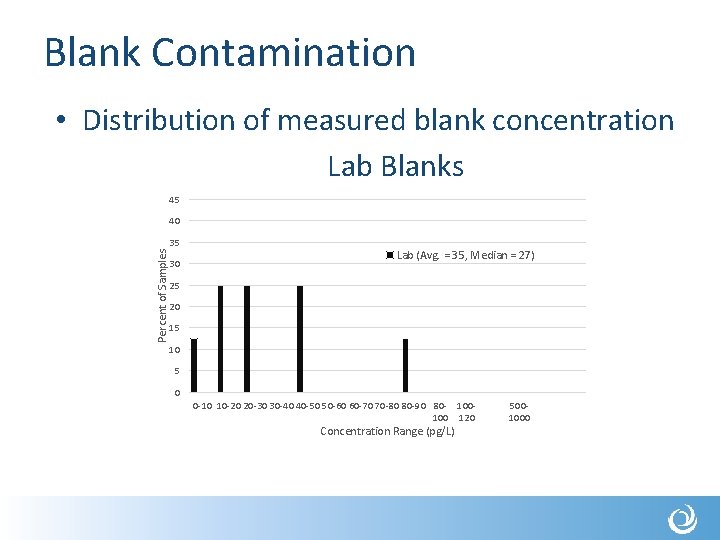
Blank Contamination • Distribution of measured blank concentration Lab Blanks 45 40 Percent of Samples 35 30 Lab (Avg. = 35, Median = 27) 25 20 15 10 5 0 0 -10 10 -20 20 -30 30 -40 40 -50 50 -60 60 -70 70 -80 80 -90 80 - 100100 120 Concentration Range (pg/L) 5001000
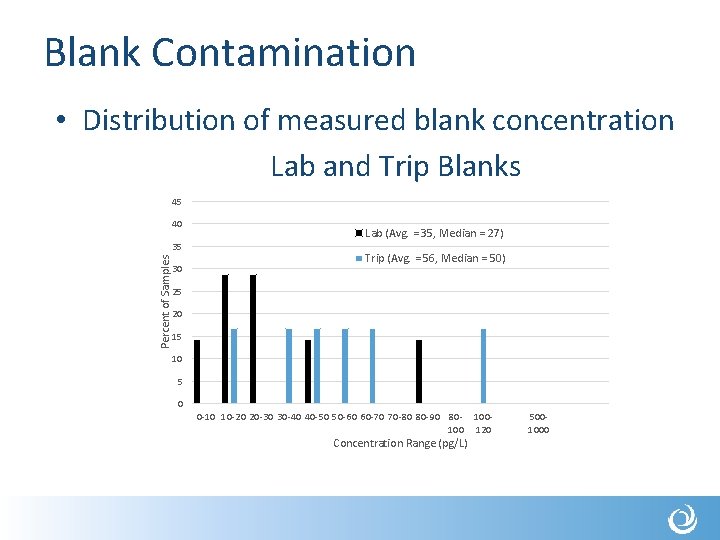
Blank Contamination • Distribution of measured blank concentration Lab and Trip Blanks 45 40 Percent of Samples 35 30 Lab (Avg. = 35, Median = 27) Trip (Avg. = 56, Median = 50) 25 20 15 10 5 0 0 -10 10 -20 20 -30 30 -40 40 -50 50 -60 60 -70 70 -80 80 -90 80 - 100100 120 Concentration Range (pg/L) 5001000
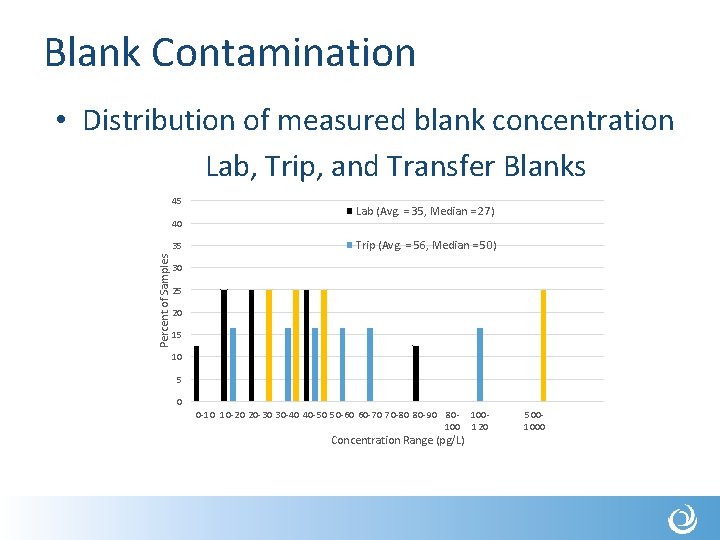
Blank Contamination • Distribution of measured blank concentration Lab, Trip, and Transfer Blanks 45 40 Percent of Samples 35 Lab (Avg. = 35, Median = 27) Trip (Avg. = 56, Median = 50) 30 25 20 15 10 5 0 0 -10 10 -20 20 -30 30 -40 40 -50 50 -60 60 -70 70 -80 80 -90 80 - 100100 120 Concentration Range (pg/L) 5001000
Observations • Unopened sample bottles taken into the field appear to add some contamination – Trip blanks ~20 pg/L higher than lab blanks • Exposure of sample bottles to atmosphere generally doesn’t add contamination – Most transfer blanks showed similar contamination as trip blanks – But the potential for contamination is significant – Need to be mindful of environmental conditions
- Slides: 5